Startup B2B Marketing Setup — What Founders Need to Know Before Hiring Their First Marketer
 임재복
임재복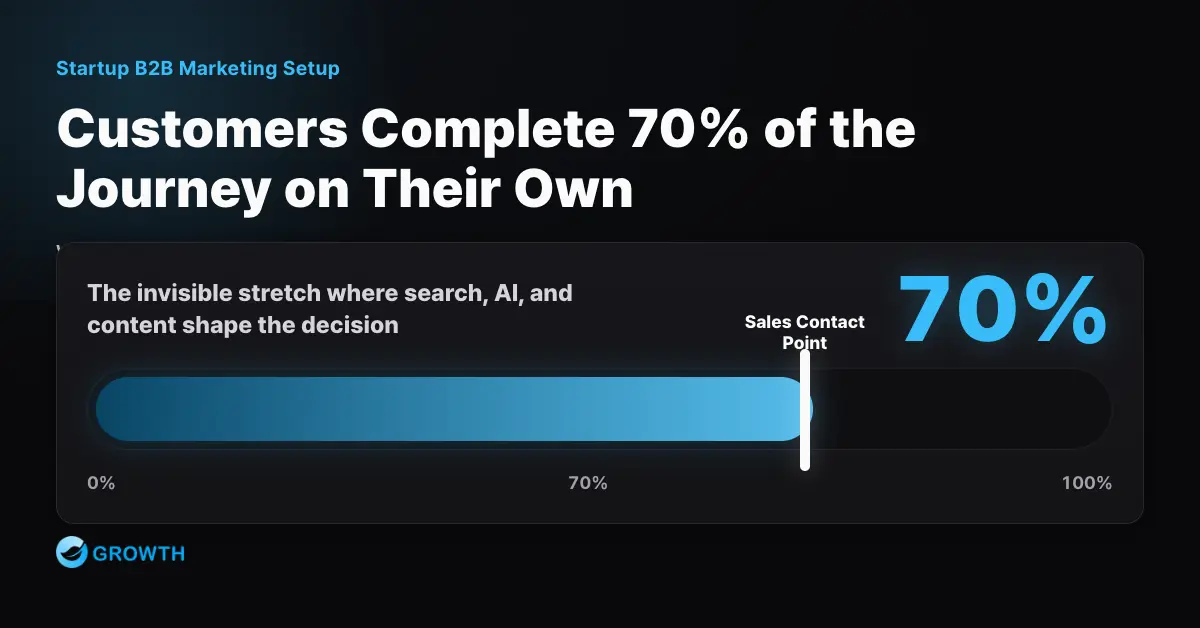
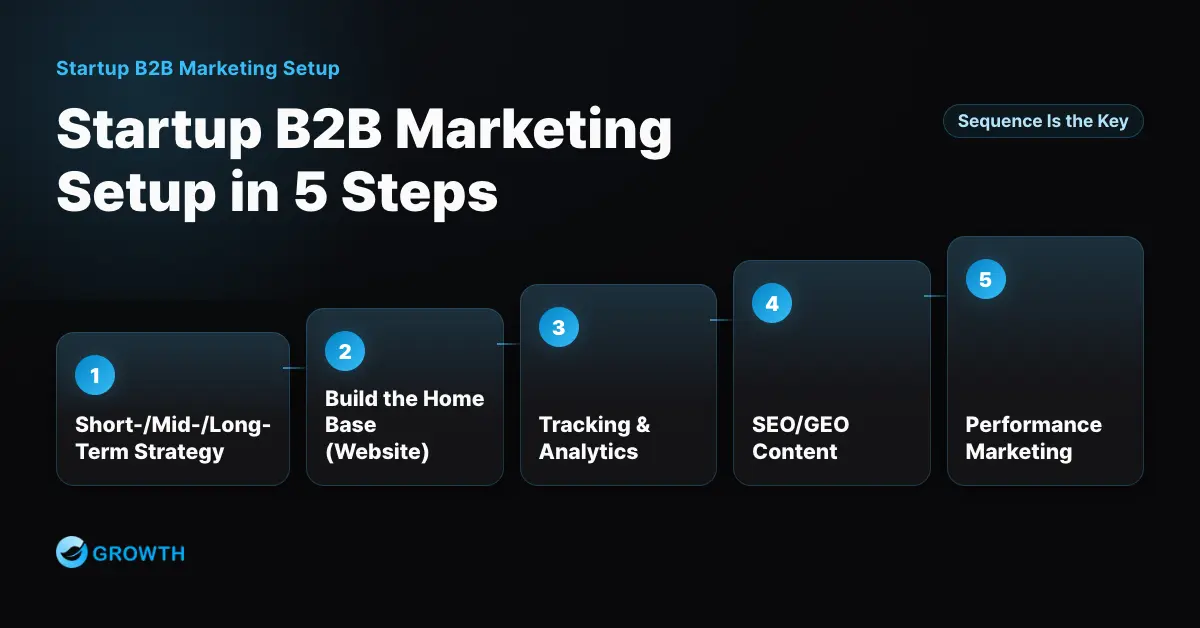
Setting up B2B marketing at a startup doesn’t start with running channels — it starts with building structure. There are five steps, in order: setting a short-, mid-, and long-term strategy; building the home base (website) that will collect your traffic; building tracking and analytics infrastructure; SEO/GEO content; and performance marketing. This guide comes from Growth, Inc., which has handled B2B marketing for both large enterprises and startups since 2009, written for C-level founders at technical startups without a dedicated marketer.
Why marketing gets neglected at technical startups
At pre- and post-Series A technical startups, we often find marketing sitting neglected. It’s not laziness — it’s three structural factors compounding each other.
First, hiring feels like too much. A proven senior marketer’s salary is a heavy fixed cost for an early-stage startup, but hiring an unproven junior leaves no one to set direction. Second, existing staff can’t go deep enough. Engineers and salespeople squeeze in time to write content or run ads, but execution without strategy doesn’t compound. Third, there’s no confidence about what outside help is right. So the decision gets deferred — and in the meantime, the startup burns through one-off marketing funded by government support grants, then stops once the money runs out. This pattern repeats.
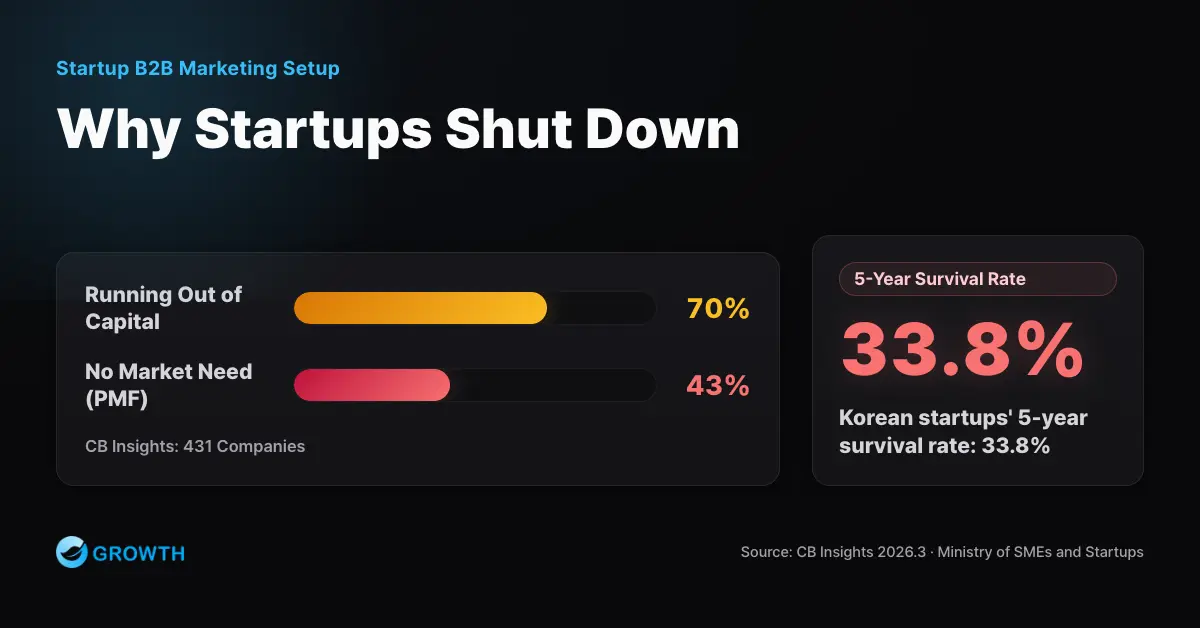
The data confirms just how risky this is. CB Insights’ analysis of 431 VC-backed startups that shut down since 2023 (updated in 2026) found that 70% cited running out of capital as a cause of failure, and 43% cited failure to validate market need (lack of product-market fit). When a team that knows how to build a product keeps delaying the work of getting into the market and validating demand, it edges closer to both causes of failure. The domestic environment is even less forgiving: according to Korea’s Ministry of SMEs and Startups, the five-year survival rate for Korean startups is 33.8% — below the OECD average for major economies.
Buyers have already finished 70% of the journey on their own
There’s data behind why “sales is running, marketing can wait” is a risky call.
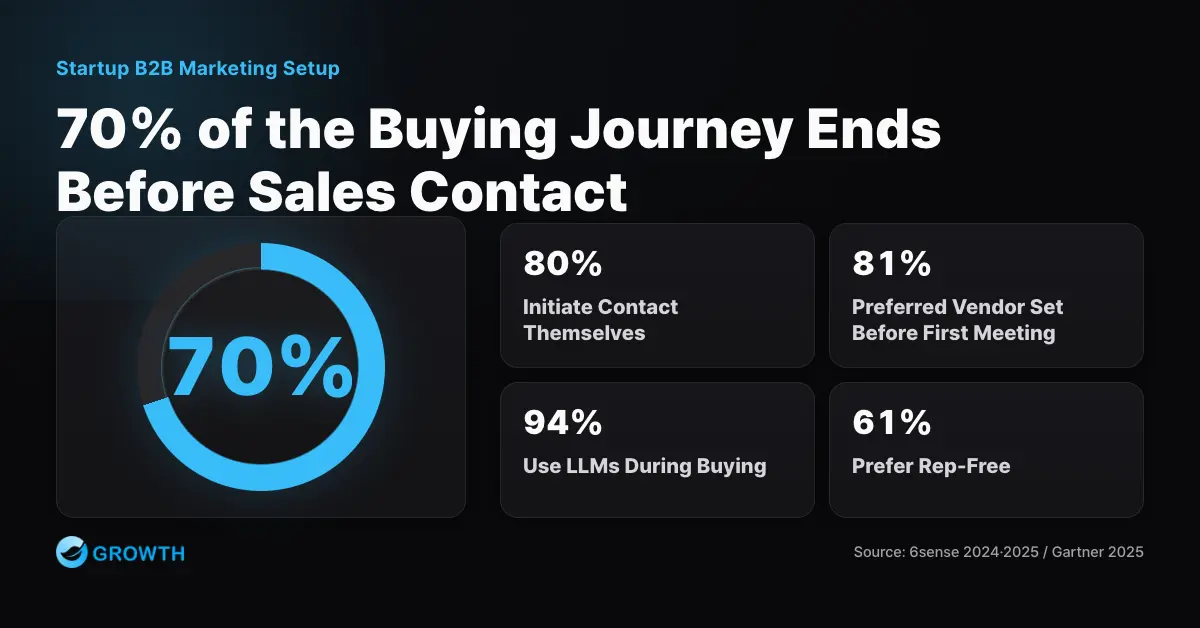
According to 6sense’s 2024 B2B Buyer Experience Report, 80% of B2B buyers initiate first contact themselves rather than the supplier — and by that point, they’ve already completed roughly 70% of the buying journey. By the time of the first meeting, 81% had already decided on a preferred vendor. In the same organization’s 2025 survey, 94% of B2B buyers said they use an LLM like ChatGPT during the purchase process. Gartner’s 2025 survey similarly found that 61% of B2B buyers prefer a rep-free buying experience.
Put simply: your prospects narrow down their shortlist and make up their minds through search, AI, and content — long before your sales team ever makes contact. Relying on outbound alone means handing that entire invisible 70% over to your competitors. So the goal of setup is clear: build the inbound structure that lets customers find you on their own.
The five-step roadmap for startup B2B marketing setup
This is Growth’s “growth-style B2B workflow” — the same process we use on real client projects — compressed to fit startup conditions. Following the order is what matters.
- Set short-, mid-, and long-term strategy — Use discovery interviews and competitive research to diagnose your market position, then design separately for what you’ll prove within a quarter (short-term), what structure you’ll build within a year (mid-term), and what assets you’ll accumulate (long-term). The reason support-grant-funded one-off campaigns keep repeating is the absence of this distinction.
- Build the home base (website) — No amount of ad spend converts if the destination is weak. Rewrite messaging around the customer’s problem rather than the product, and design the path all the way through to an inquiry or demo request. See our B2B Website Development Guide for the specifics.
- Build tracking and analytics infrastructure — Set up GA4, Search Console, and conversion events on Google Tag Manager. The earlier the stage, the more a single lead’s source can reshape your entire strategy — so measurement isn’t a luxury, it’s a survival tool.
- SEO/GEO content marketing — Build a library of content that answers the questions your prospects search for and ask AI. In an environment where 94% of buyers use an LLM, it’s more efficient to design for search visibility (SEO) and AI-answer citation (GEO) together from the start. See our GEO 90-Day Roadmap for where to begin.
- Performance marketing — Once steps 1–4 are in place, run paid campaigns with targeting tight enough to filter in only “real” prospects. In B2B, the addressable pool is small, so targeting precision is what determines budget efficiency. See our B2B Marketing KPI Guide for how to judge performance.
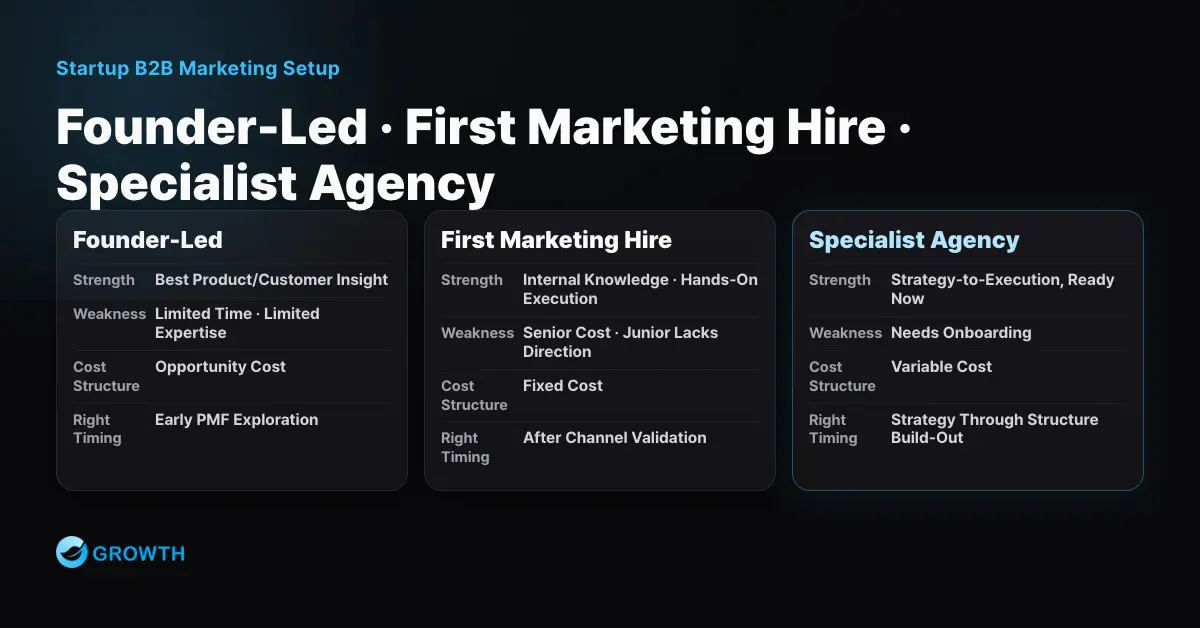
Founder-led vs. first marketing hire vs. agency: what’s right?
This is the question we hear most from C-level founders. The right answer depends on your stage.
| Founder-led | First marketing hire | Specialist agency | |
|---|---|---|---|
| Strength | Best product/customer understanding | Internal knowledge builds up, hands-on execution | Full range from strategy to execution, ready immediately |
| Weakness | Limited time, limited expertise | Senior hires are costly; junior hires lack direction | Needs onboarding to understand your business |
| Cost structure | Opportunity cost | Fixed cost (salary + hiring risk) | Variable cost (scope is adjustable) |
| Right timing | Early PMF exploration | After channels are validated | Strategy-setting through structure build-out |
The sequence matters. If you hire before you’ve validated which channels actually work, your first marketer ends up single-handedly responsible for strategy, website, data, content, and ads all at once — and the odds of success are low. It’s lower risk to build the structure with an outside specialist during the pre-validation phase, then hire an operator for a specific channel once it’s proven.
Case study: A Series A startup that hit its revenue target on inbound leads alone in six months
This is a Series A technical startup Growth worked with. When we joined, the situation matched the pattern described above exactly: with no marketing expert on staff, the company had no clear strategy and was burning through various government support grants on one-off efforts, while revenue depended entirely on the sales team’s outbound activity.
Growth first set a short-, mid-, and long-term marketing strategy, then built out the website and tracking infrastructure, and finally built an inbound lead structure through SEO/GEO content and precisely targeted advertising. The result: within six months, the company hit its revenue target on inbound leads alone, with no outbound — and growth has continued since. The key wasn’t any single channel’s success — it was that the source of leads shifted from “people” (sales) to “structure” (assets). You can find a similar analysis in our B2B Startup Marketing Case Study.
Frequently Asked Questions
Q. Isn’t this too early if we’re not at Series A yet?
The earlier you build strategy, home base, and a measurement structure, the better. That said, scaling up paid ads is safer once PMF and your sales process have been reasonably validated.
Q. Our budget is genuinely tiny. If we could only do one thing?
Your home base (website) and tracking infrastructure. Once those are in place, every dollar you spend afterward turns into “learning.”
Q. When can we expect results?
Ads generate signal within a few weeks, but content and SEO assets typically compound over months. That’s exactly why separating short-, mid-, and long-term goals matters — it prevents you from abandoning a sound strategy out of impatience.
Q. Is it the same approach for midsize companies or Korean subsidiaries of global companies?
The framework is the same, but the challenge differs. For midsize companies, it’s “rebuilding the measurement structure.” For Korean subsidiaries of global companies, it’s “getting headquarters on board and localizing.” We cover each in Midsize Company B2B Marketing Strategy and B2B Marketing for Korean Subsidiaries of Global Companies.
Setup completeness checklist for your company
If you answer “no” to 3 or more of the following 8 items, setup comes before running ads.
- We’ve documented our ideal customer profile (ICP) and their buying decision process.
- Our marketing goals for the quarter (short-term), the year (mid-term), and beyond (long-term) are separated.
- Our website is written around solving the customer’s problem, not showcasing the product.
- Inquiry and demo-request conversions are tracked as GA4 events.
- We have a list of questions our prospects search for, and content that answers them.
- We’ve checked whether we get mentioned when someone asks ChatGPT about solutions in our space.
- We can connect a lead’s source (channel/keyword) to its sales outcome.
- Our grant funding and budget spend builds up assets rather than funding one-off campaigns.
If you’re not sure where to start with setup, Growth can work with you from a current-state diagnosis through to a prioritized plan. Request a consultation
References
- CB Insights, “Top Reasons Startups Fail,” updated March 2026
- Ministry of SMEs and Startups, data submitted to the National Assembly on the five-year survival rate of startups, 2023
- 6sense, “2024 B2B Buyer Experience Report,” 2024 / “2025 Buyer Experience Report,” 2025
- Gartner Sales Survey, “61% of B2B Buyers Prefer a Rep-Free Buying Experience,” June 2025