
Midsize Company B2B Marketing Strategy — How to Get Stalled Growth Moving Again
 임재복
임재복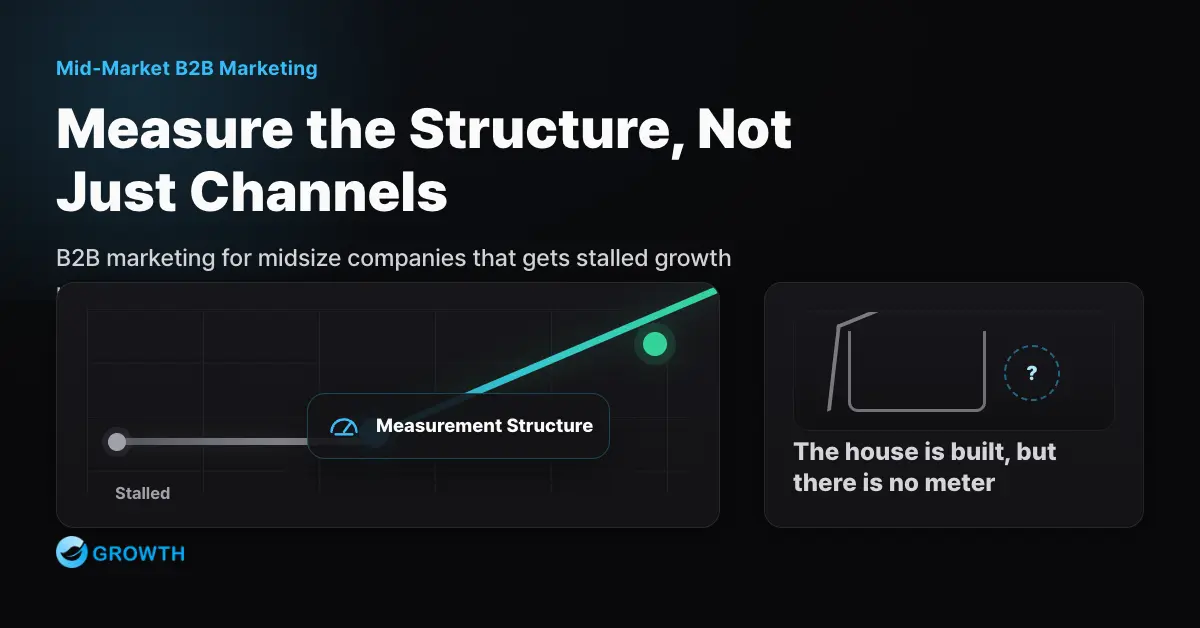
What determines success in midsize-company B2B marketing isn’t the number of channels — it’s whether you have a structure you can actually measure. If you’re running both advertising and content but growth has stalled, the cause is rarely a lack of effort. More often, it’s a data structure that can’t tell you which activities are actually driving inquiries and revenue. This guide comes from Growth, Inc., which has handled B2B marketing for companies of every size — from Samsung Electronics and LG CNS to Hyosung Group — since 2009, written for decision-makers at midsize companies.
You’re running ads and content. So why has growth stopped?
Most midsize companies who come to us for a consultation tell a similar story: “We spend a meaningful amount on advertising, and we keep up a blog and a newsletter — but inquiries have been flat for years. What’s even more frustrating is that we don’t even know what’s wrong.”
That last sentence is the real issue. Weak performance isn’t the core problem — not being able to pinpoint why performance is weak is. If you can’t tell which keywords are bringing in visitors who actually submit inquiries, or whether ads or content are contributing more to your pipeline, then every decision to raise budget or add a channel is ultimately just a bet made on gut feeling.
When we run diagnostics on companies like this, we tend to find the same pattern: GA4 is installed, but conversion events aren’t defined; Naver and Google traffic aren’t tracked separately; and ad performance data isn’t connected to on-site behavioral data. It’s a house that’s been built — but with no utility meter installed.
The midsize company condition — neither a conglomerate nor a startup
According to the “Basic Statistics on Midsize Companies” published by South Korea’s Ministry of Trade, Industry and Energy and the Korea Federation of Middle Market Enterprises, there were 6,474 midsize companies in Korea as of 2024 — up 10.3% year-over-year — with combined revenue of KRW 1,030.5 trillion. That’s a scale that earns midsize companies the label “backbone of the economy.” But from a marketing standpoint, midsize companies sit in an unusual position, squeezed between two very different worlds.
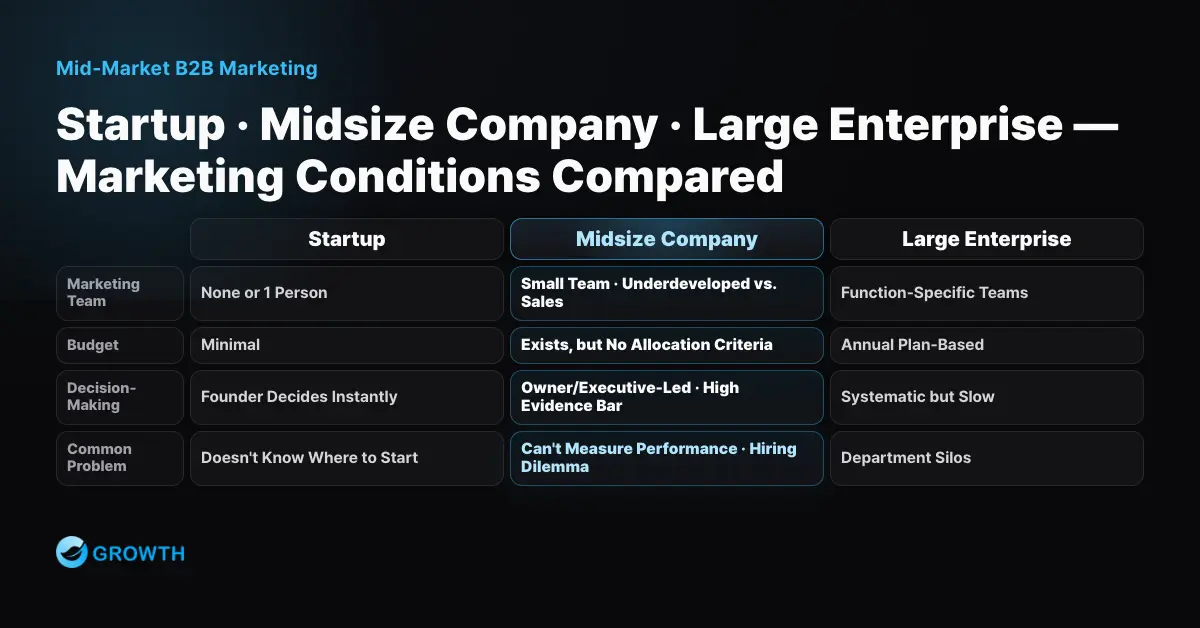
| Startup | Midsize Company | Large Enterprise | |
|---|---|---|---|
| Marketing organization | None or one person | Small team, underdeveloped relative to sales | Dedicated function-specific teams |
| Budget | Minimal | Exists, but no clear allocation criteria | Based on annual planning |
| Decision-making | Founder decides instantly | Owner/executive-driven, high bar for evidence | Systematic but slow |
| Common problem | Doesn’t know where to start | Can’t measure performance, hiring dilemma | Silos between departments |
This is where decision-makers ask us the same question most often: “Do we need to hire a specialist every time we want to add a new marketing channel?”
The short answer is no — you shouldn’t. Paid search, content, SEO, and now AI search optimization (GEO): channels keep multiplying, and hiring a dedicated specialist for each one is unsustainable in both cost and speed. What you actually need isn’t a headcount per channel — it’s a data structure that lets you judge performance by the same standard regardless of channel, and a strategy for setting priorities on top of that structure. For the areas where you do need more hands, combining internal hires with an external specialist partner is a far more efficient approach.
In the meantime, the B2B buyer has changed completely
Before setting a strategy, you have to look at how the buyer has changed. The numbers are unambiguous about the direction.
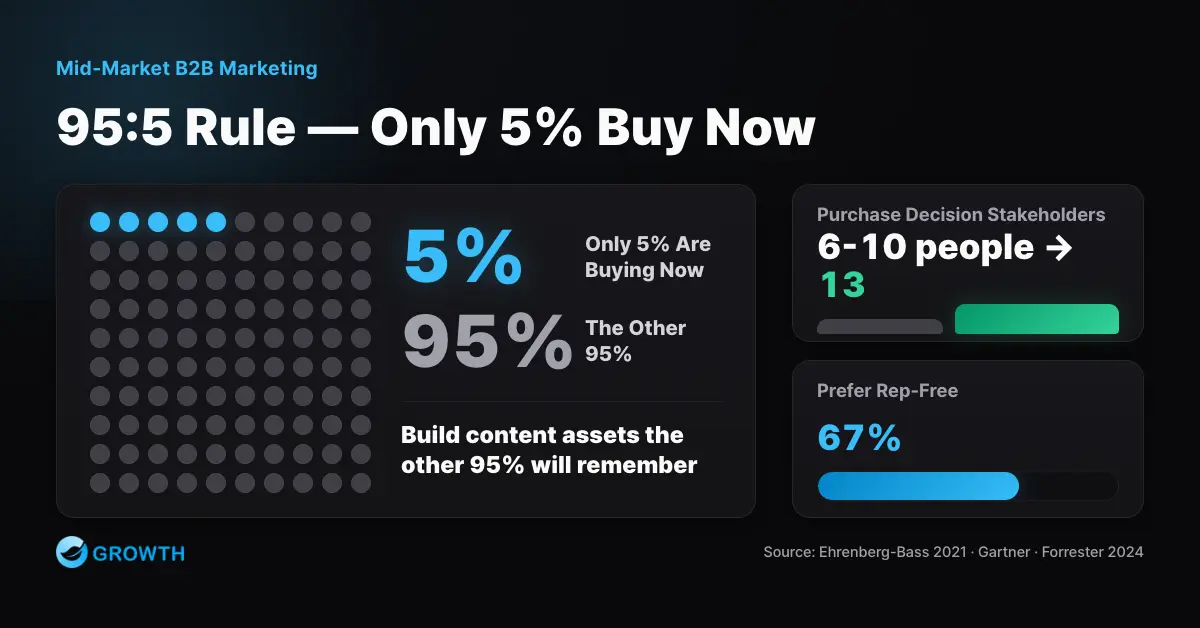
- According to a 2021 study from Australia’s Ehrenberg-Bass Institute (the “95:5 rule”), as much as 95% of B2B buyers are not in-market to buy at any given moment. Only 5% convert the instant an ad reaches them — which means you need content assets that stay memorable for the other 95%.
- Gartner’s 2019 study of the B2B buying journey found that time spent meeting with a given supplier’s sales rep accounts for only 5–6% of the entire buying journey, and that buying groups typically involve 6–10 decision-makers. Forrester’s 2024 survey put the average number of people involved in a purchase decision as high as 13.
- In a March 2026 survey, Gartner found that 67% of B2B buyers now prefer a rep-free buying experience altogether.
In short, customers have already made most of their decisions through your website, search, and content — long before they ever meet a salesperson. This shift hits hardest at midsize companies with strong sales organizations, because the opportunity for sales to even make contact is now decided digitally. On top of that, Gartner projects that traditional search engine query volume will drop 25% by 2026 as AI chatbots spread. In an era where customers ask ChatGPT — not just Naver or Google — “who’s good in this space,” you also need to prepare to be cited in AI answers (GEO). We covered how to prioritize AI search readiness in our GEO 90-Day Roadmap.
The Growth B2B workflow — eight steps from diagnosis to execution
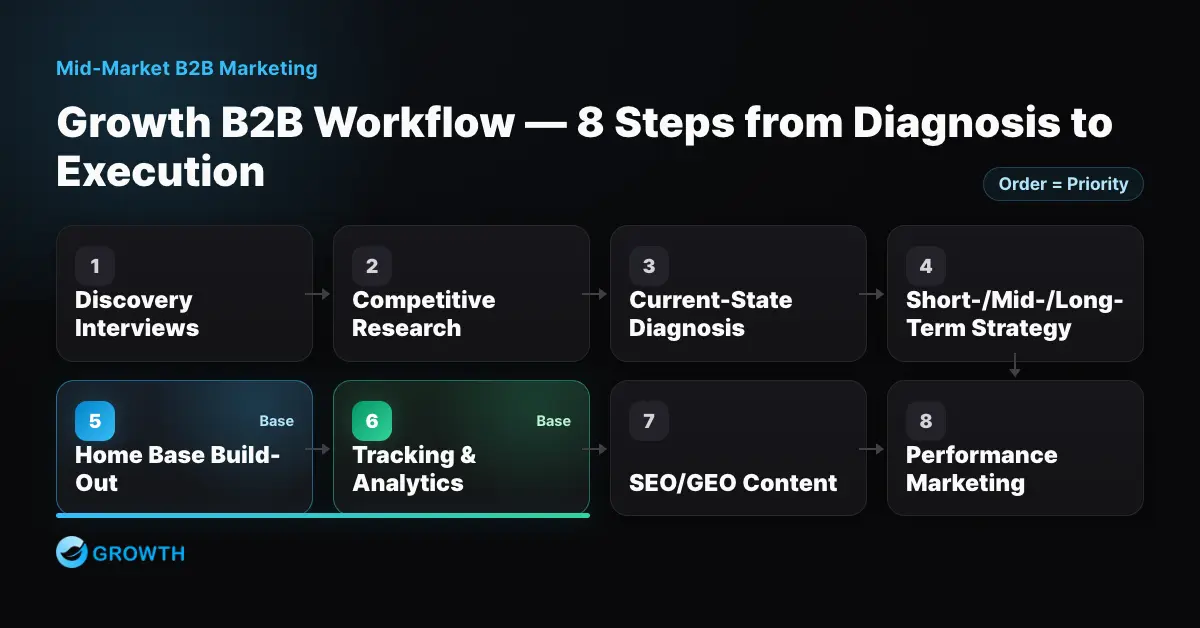
Growth runs midsize-company B2B marketing through the following eight steps. The order is the priority.
- Discovery interviews — Interviews with frontline staff and decision-makers to understand the real sales structure, customer acquisition paths, and bottlenecks.
- Competitive research — Analyzing competitors’ search presence, content assets, and ad operations to establish your relative position.
- Current-state diagnosis — Assessing your website, data collection setup, and channel performance to separate what’s measurable from what isn’t.
- Short-, mid-, and long-term strategy — Designing quarterly performance targets separately from a plan for building assets over a year or more.
- Home base build-out — Rebuilding the website that traffic will land on, with conversion as the design principle. See our B2B Website Development Guide for the approach.
- Tracking and analytics infrastructure — Precisely connecting GA4, Clarity, Search Console, Naver Premium Log Analysis, and channel-level conversion tracking, built on Google Tag Manager.
- SEO/GEO content marketing — Building a library of content assets that get found both in search and in AI answers.
- Performance marketing — Running paid campaigns with tightened targeting so only “real” prospects come through, continuously improved using the data from step 6.
Many companies start at steps 7–8 and fail. Ads and content run without steps 5–6 in place leave you unable to explain success when it happens — or failure when it doesn’t. We cover how to design the metrics for judging performance in our B2B Marketing KPI Guide.
Case study: A Korean midsize company that grew inbound inquiries 350% in one year
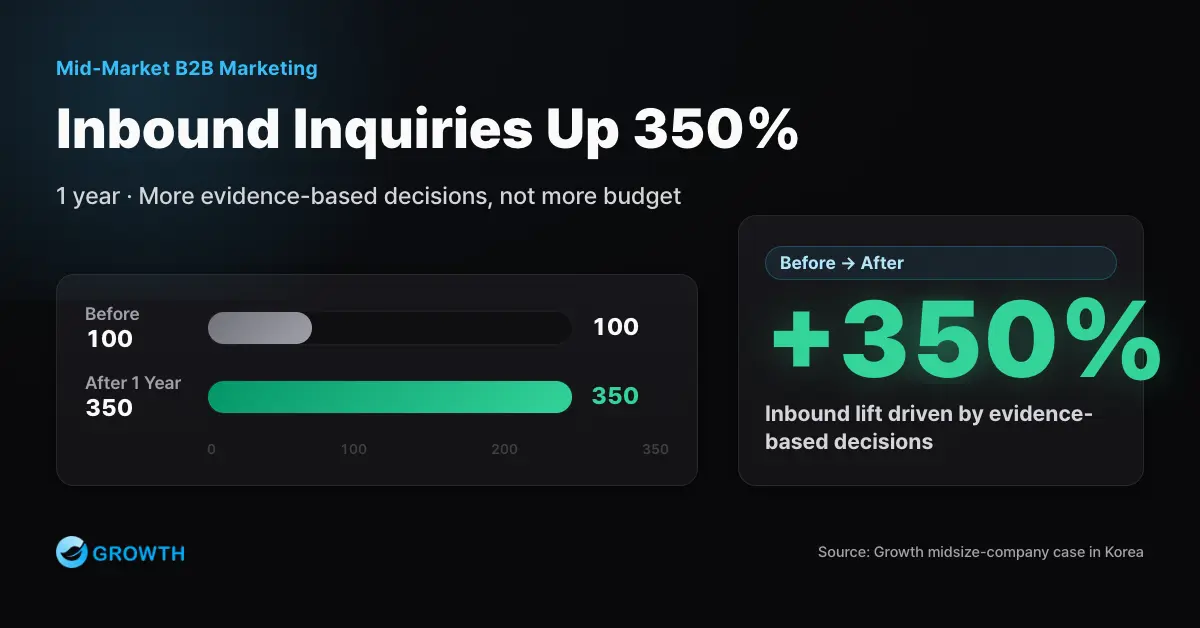
This is a Korean midsize-company case Growth handled directly. The company was running both advertising and content diligently, but growth had stalled — the exact pattern described above: performance was weak, and no one could say why.
Instead of adding more channels, Growth rebuilt the measurement structure first. Built on Google Tag Manager, we precisely upgraded GA4, Microsoft Clarity, Google Search Console, Naver Premium Log Analysis, and channel-level conversion tracking, making every source of traffic, on-site behavior, and conversion across the website and blog fully trackable. Using that data, we comprehensively improved ad targeting and creative, along with content topics and structure. The result: total inbound inquiries rose 350% within a year of engagement. What increased wasn’t the budget — it was the number of decisions made on evidence rather than instinct.
Frequently Asked Questions
Q. What’s an appropriate B2B marketing budget for a midsize company?
There’s no one-size-fits-all answer, but the right sequence is to first build the structure to measure the performance of your existing budget before experimenting with new channels. Once you can measure results, performance often improves through better allocation alone — with no increase in budget.
Q. Our marketing team is small. Where should we start?
Your website (home base) and your tracking/analytics infrastructure. Once those two are in place, every activity after that becomes a “measurable experiment.”
Q. What should we look for in a B2B marketing agency?
We’d recommend checking whether the agency has B2B references that go beyond running ads — real experience in strategy design and data infrastructure — and what metrics they use to report performance. Breadth of experience across different industries and company sizes matters too.
Q. How is this different from B2B marketing at a startup or a Korean subsidiary of a global company?
The core challenge differs. For startups, it’s “setting things up for the first time.” For Korean subsidiaries of global companies, it’s “getting headquarters on board and localizing.” We cover each in Startup B2B Marketing Setup and B2B Marketing for Korean Subsidiaries of Global Companies.
Self-diagnostic checklist for your company’s B2B marketing
If you answer “no” to 4 or more of the following 10 items, you need a structural review before adding more channels.
- I can immediately answer which channels and keywords drove last month’s inquiries.
- GA4 has conversion events defined that match our business.
- We can view Naver and Google traffic and conversion performance separately.
- We receive quarterly reports on pipeline contribution relative to ad spend.
- Our website is designed around inquiry conversion, not just company introduction.
- We know whether our company appears in search results for our core keywords.
- We’ve checked whether our company gets mentioned when someone asks ChatGPT or another AI about our industry.
- Sales regularly gives feedback on the quality of leads marketing generates.
- Content is published on a defined schedule, with performance tracked by topic.
- When considering a new channel, we compare options beyond hiring (e.g., using a partner).
How many did you check? If your growth has stalled and you can’t pinpoint why, Growth can diagnose your website, data structure, and channel performance together. Request a consultation
References
- Ministry of Trade, Industry and Energy / Korea Federation of Middle Market Enterprises, “2024 Basic Statistics on Midsize Companies,” December 2025
- Ehrenberg-Bass Institute, “95-5 Rule,” LinkedIn B2B Institute, 2021
- Gartner, “The New B2B Buying Journey,” 2019 (based on a 2017 survey of 750 buyers)
- Gartner Sales Survey, “67% of B2B Buyers Prefer a Rep-Free Experience,” March 2026
- Forrester, “The State of Business Buying, 2024,” December 2024
- Gartner, “Search Engine Volume Will Drop 25% by 2026,” February 2024