
B2B Marketing for Korean Subsidiaries of Global Companies — How to Win Over Headquarters and Deliver Results in Korea
 임재복
임재복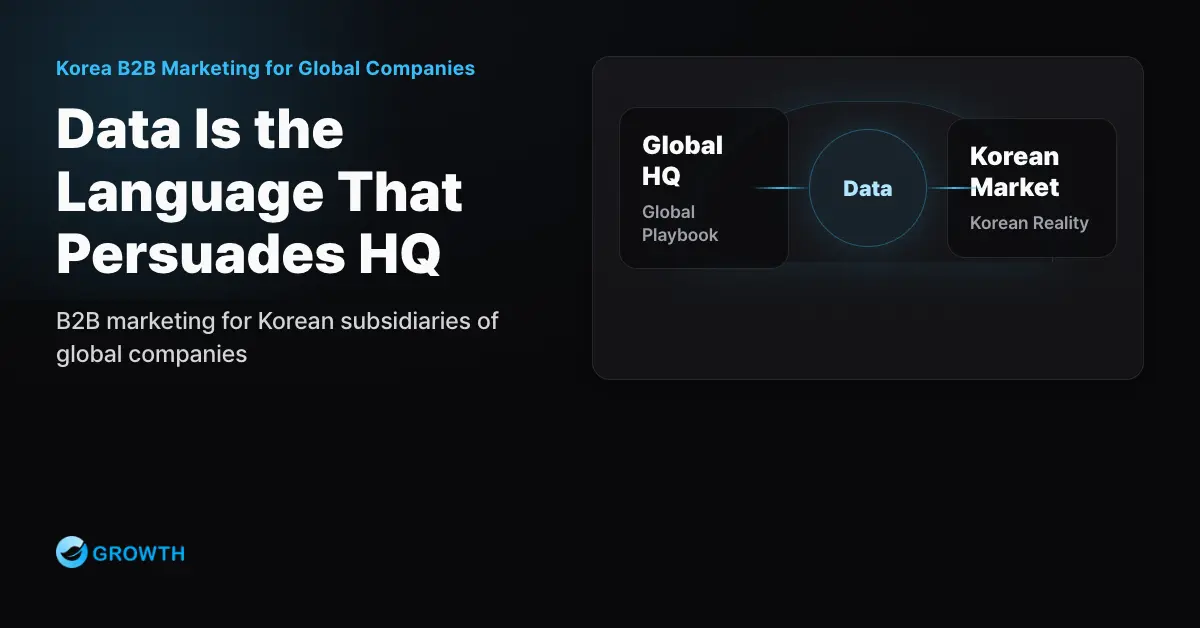
The biggest reason B2B marketing fails at Korean subsidiaries of global companies isn’t poor execution — it’s an inability to translate Korean market data into a language headquarters understands. Playbooks that are proven globally — LinkedIn-centric campaigns, translated English content — simply don’t work the same way in a Korean B2B environment dominated by Naver and Kakao. This guide comes from Growth, Inc., which has run Korean B2B marketing for global companies, written for Korea country managers and general managers.
The structural dilemma facing Korea country managers
Korea remains an attractive market for global companies. According to Korea’s Ministry of Trade, Industry and Energy, foreign direct investment into Korea hit a record USD 36.05 billion (on a notification basis) in 2025. But separate from the market’s appeal, marketing at the Korea subsidiary is uniquely hard. In our consultations, we hear the same four problems on repeat.
First, there’s no one to do it. Korea offices tend to run lean, and even where a marketing person exists, more of their time goes to communicating with headquarters than to actual marketing work. Because hiring tends to prioritize “marketers who can communicate in English,” depth of marketing expertise is often lacking. Second, HQ policy clashes with Korean reality. In the name of a “global standard,” subsidiaries are pushed toward LinkedIn-centric campaigns and English-language channels — but as we’ll show below, Korea’s channel landscape looks completely different. Third, decisions move slowly. Even a single campaign needs approval from the region (APAC) and headquarters, causing the subsidiary to miss market timing. Fourth — and the most painful problem — when things go well, it’s credited to headquarters’ strategy; when they don’t, it’s blamed on the Korea office’s execution. Under this dynamic, it’s hard to make a bold move or defend one with confidence.
All four problems share a common fix: building a case with Korean market data that can actually persuade headquarters.
The Korean market starts out different — at the data level
Here are the numbers you can use as a starting point to persuade HQ.
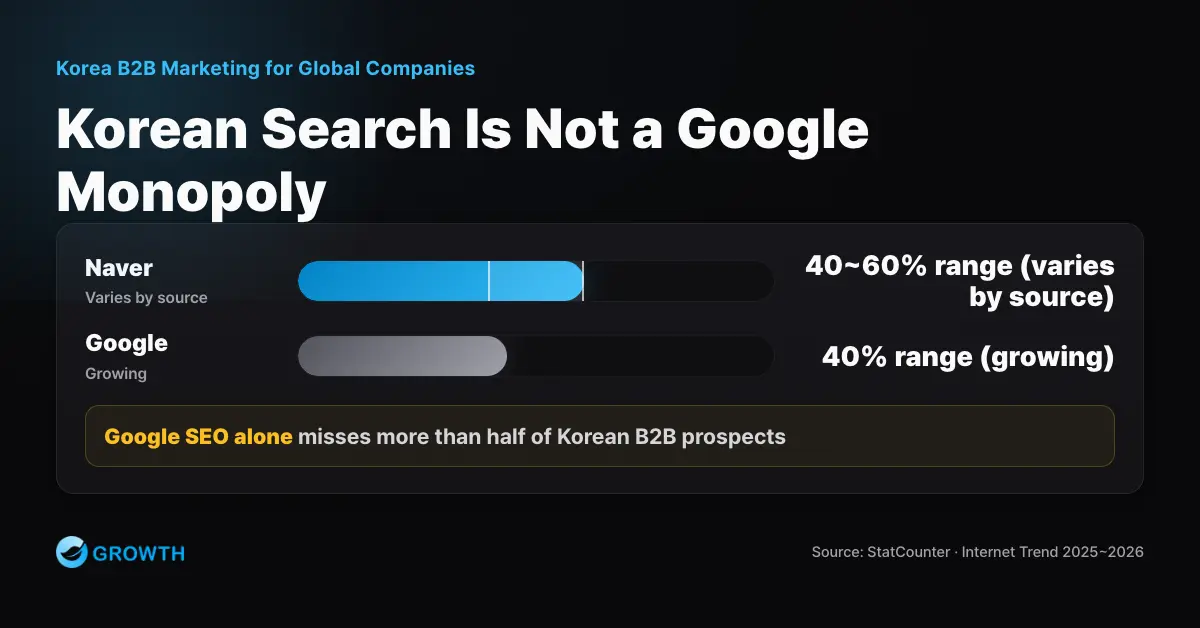
Search market — Korea is one of the rare markets globally where Google hasn’t captured the search market outright. Per StatCounter, Google and Naver were competing in the 40%-range as of early 2026, while domestic log-based statistics (Internet Trend) put Naver’s share at around 60%. The gap between the two comes down to methodology (global tracking-code data vs. domestic panel data), but either way the conclusion is the same: Google SEO alone leaves out more than half of Korean B2B prospects. Naver search and content need to be targeted separately.
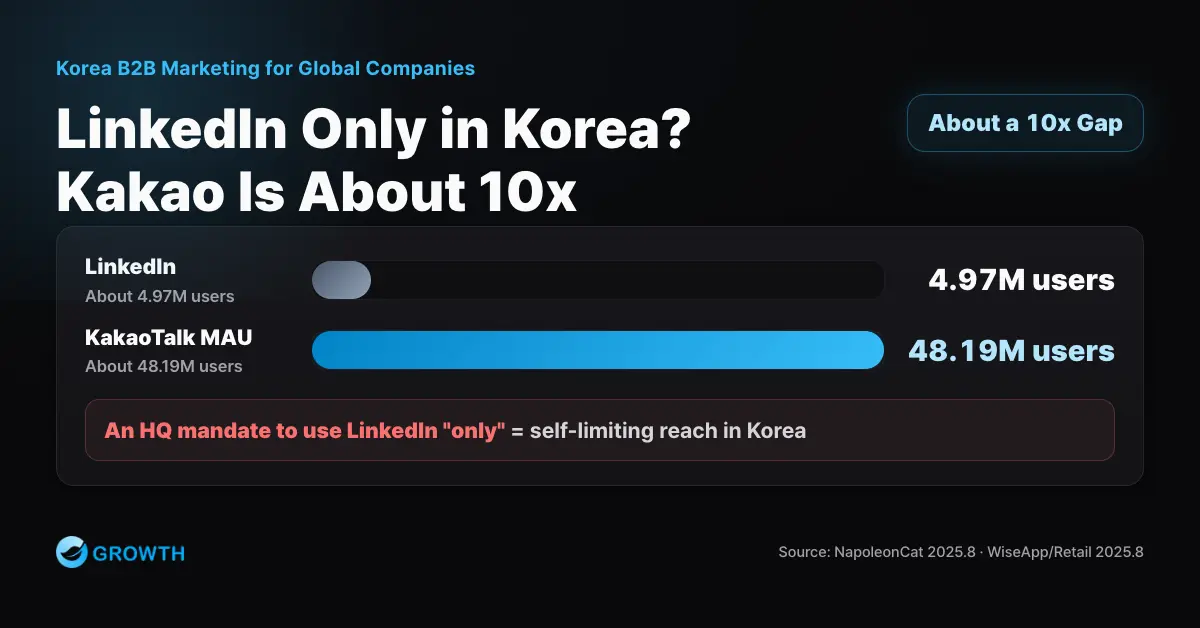
Social and messaging channels — Per NapoleonCat, Korea had roughly 4.97 million LinkedIn users as of August 2025 — about 9.4% of the population. By comparison, WiseApp/Retail data put KakaoTalk’s MAU at roughly 48.19 million in the same period — a roughly tenfold gap. This doesn’t mean LinkedIn is useless (it’s still effective for targeting specific professional roles or expat-facing audiences) — it means an HQ mandate to use LinkedIn “only” is a decision that voluntarily caps your reach in Korea.
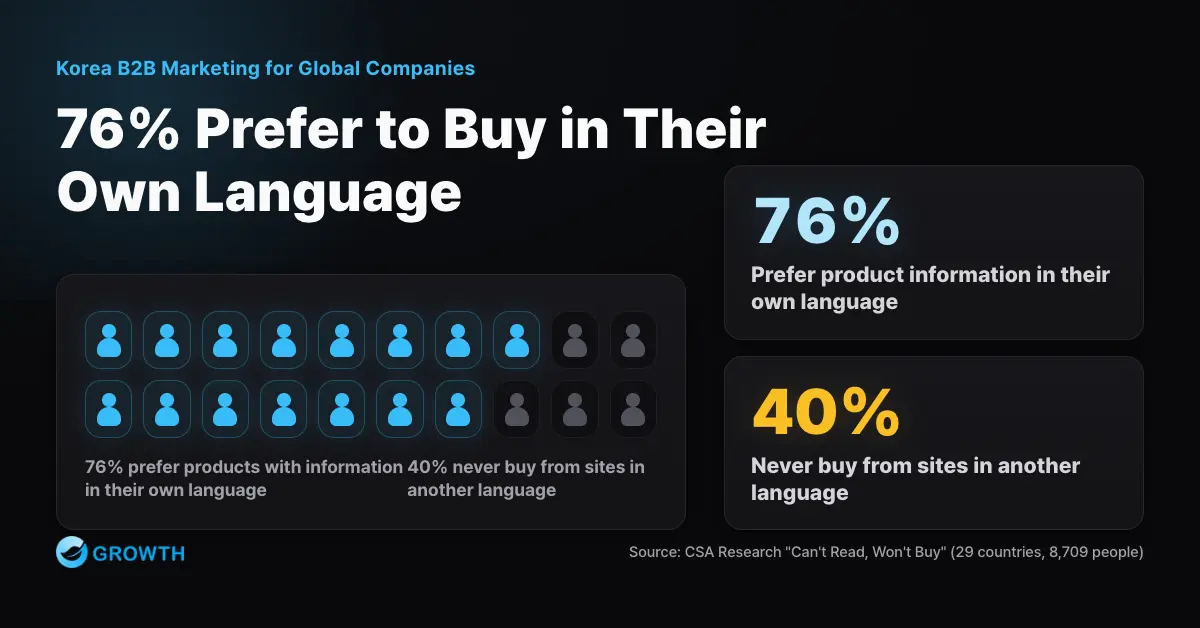
Language — CSA Research’s 29-country consumer survey, “Can’t Read, Won’t Buy,” found that 76% of respondents prefer to buy products with information provided in their own language, and 40% never buy from sites in another language. B2B buyers are no different: technical evaluation may happen in English, but internal approval and circulation within the organization happen in Korean.
| Channel | Domestic usage | B2B use case |
|---|---|---|
| Naver | ~40–60% search share (varies by source) | Search ads, blog, brand search — core of building trust in Korean |
| ~40% search share (growing) | Technical/global comparison queries, essential for SEO | |
| ~4.97M users (Aug 2025) | Targeted ABM for specific roles, but reach is limited | |
| Kakao | ~48.19M MAU (Aug 2025) | Business channel and ads to supplement reach with working-level professionals |
The language that persuades headquarters is data
Convincing “up” is often the hardest part of a Korea country manager’s job. Based on our experience working directly with global headquarters, we’ve identified three principles.
- Frame localization requests as opportunity cost, not exceptions. The argument “Korea is different” gets rejected. The quantified argument — “not addressing Naver means we’re missing half of annual search demand” — gets reviewed. We cover this reporting framework in depth in The GEO Business Case — The Language of Opportunity Cost That Persuades Executives.
- Report using HQ’s own metrics. Speaking the same language as headquarters’ dashboards — pipeline contribution, SQL conversion rate, CAC — changes how quickly approvals move. See our B2B Marketing KPI Guide for how to design these metrics.
- Build the communication capability to lead the conversation. The moment something has to go through translation, persuasive power drops by half. Growth works alongside a communications manager with native-level English to directly lead meetings with global headquarters, making and defending the case for the localization actions that are needed. The turning point comes when the subsidiary’s team shifts from being “the recipient of HQ instructions” to being “the proposer of Korea strategy.”
Executing Korean localization: transcreation, not translation
Once you’ve secured HQ buy-in, execution runs on three tracks.
Content localization — A literal translation of headquarters’ whitepapers and case studies reads to Korean buyers like someone else’s story. It needs transcreation — rewriting to reflect Korean regulations, business customs, and the competitive landscape — combined with at least one or two Korean customer case studies to make it credible.
SEO/GEO localization — Design keyword and content structures separately for Korea’s split Naver-and-Google search environment, while also preparing GEO so you get cited when AI search engines like ChatGPT and Claude answer Korean-language questions. AI answers to Korean-language queries favor companies that have Korean-language content assets. We cover platform-specific approaches in Multi-Platform GEO Strategy.
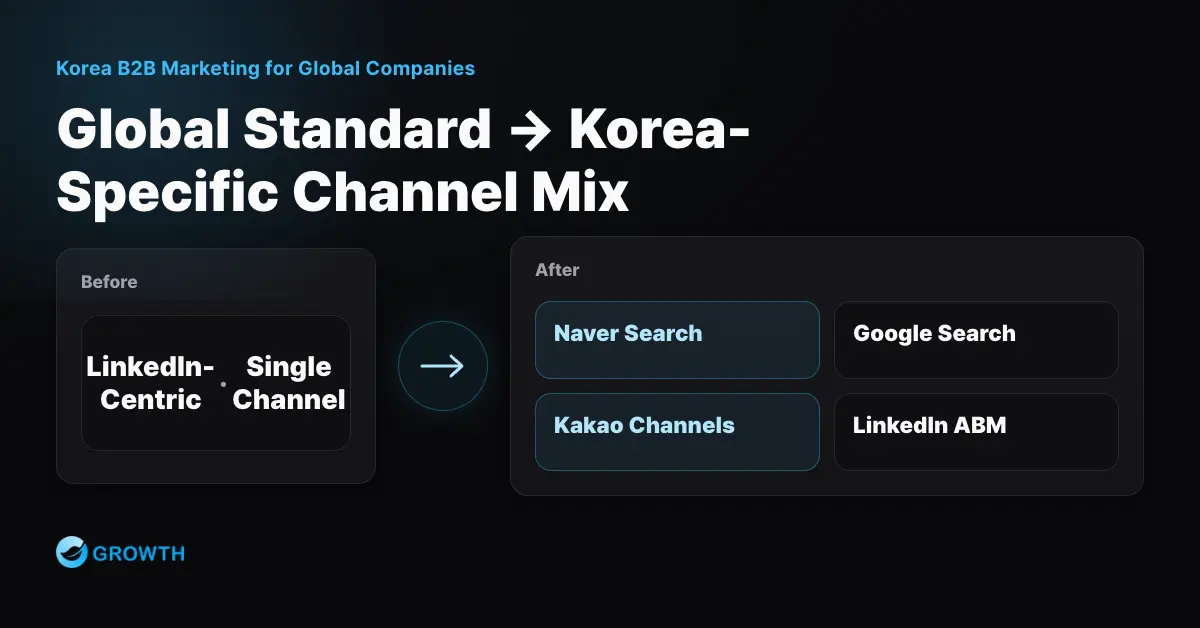
Ad strategy redesign — Reallocate the global-standard media mix to fit Korea’s landscape. Keep LinkedIn for precision-targeted ABM, but combine Naver Search Ads, Google Search Ads, and Kakao channels to put budget where the actual buying journey happens.
Case study: Localization that grew Korean revenue sixfold in two years
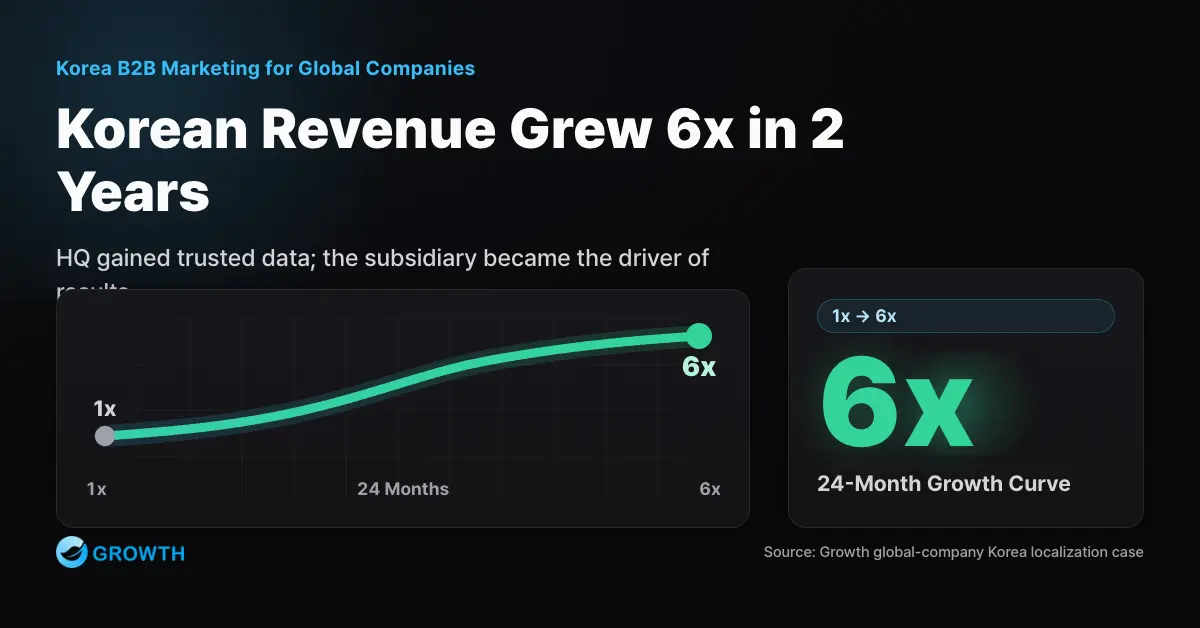
This is a case Growth handled directly. The client was a global company headquartered in Western Europe — well known worldwide, but with surprisingly low awareness and market share in Korea specifically. The cause matched the pattern described above exactly: a thin Korea team, HQ policy centered on LinkedIn and English-language channels, and global marketing guidelines that didn’t account for realities on the ground in Korea.
After joining the engagement, Growth set a short-, mid-, and long-term marketing strategy, and worked alongside a communications manager with native-level English to directly lead meetings with global headquarters — requesting and winning approval, one by one, for the actions needed to localize for Korea. With the latitude that unlocked, we executed Korea-specific SEO/GEO, content localization, and an ad strategy redesigned for the Korean market. Korean revenue grew sixfold within two years. Neither headquarters nor the subsidiary had to sacrifice anything: headquarters got data it could trust, and the subsidiary became the driver of the results.
Frequently Asked Questions
Q. Should we invest in Naver or Google first?
It depends on your target customers’ search behavior, but for most B2B categories, running both in parallel is closer to the right answer, since search intent differs between the two. Technical comparisons and global information skew toward Google; vendor reputation and Korean-language research skew toward Naver.
Q. Why don’t translated HQ content pieces perform well?
Because the language changes, but the context doesn’t. You need transcreation tailored to Korean buyers’ internal approval structures, competitive environment, and search habits, along with Korean customer case studies.
Q. We have zero to one marketing person. Where do we start?
Start by securing Korean market diagnostic data. Persuading headquarters, securing budget, and choosing a partner all start from there. In the stage where you’re short on execution headcount, it’s faster to fill the gap with a local partner who can handle strategy through execution than to hire.
Q. How is this different from B2B marketing at a domestic Korean company?
The execution methodology is the same, but there’s an added gate: winning over headquarters. We cover the domestic-company perspective in Midsize Company B2B Marketing Strategy and Startup B2B Marketing Setup.
Self-diagnostic checklist for your Korea subsidiary’s marketing
If you answer “no” to 3 or more of the following 8 items, structural work comes before running campaigns.
- We track how our brand and core keywords show up in Naver and Google search results.
- We’re building up a library of Korean-language content assets (case studies, guides, blog posts).
- We run a channel mix that includes Naver, Kakao, and Google — not just LinkedIn.
- When reporting to headquarters, we present Korean market data (search demand, channel landscape) as evidence.
- In HQ meetings, we’re proposing Korea strategy — not just executing instructions.
- We have Korean customer case studies captured as Korean-language content.
- Our company gets mentioned when someone asks an AI like ChatGPT about our industry in Korean.
- We can report marketing performance using headquarters’ own metrics (e.g., pipeline contribution).
We understand the weight of having to prove results caught between headquarters and the Korean market — which is why Growth prepares both the data and the communication to back it up. Start with a diagnosis of the Korean market. Request a consultation
References
- Ministry of Trade, Industry and Energy, “2025 Foreign Direct Investment Trends,” January 2026
- StatCounter Global Stats / Internet Trend, Korean search engine market share, 2025–2026
- NapoleonCat, “LinkedIn users in Republic of Korea,” August 2025
- WiseApp/Retail, KakaoTalk MAU, August 2025
- CSA Research, “Can’t Read, Won’t Buy” (survey of 8,709 consumers across 29 countries), 2020