
Why SEO Matters More in the GEO Era — Anthropic’s SEO Lead
 임재복
임재복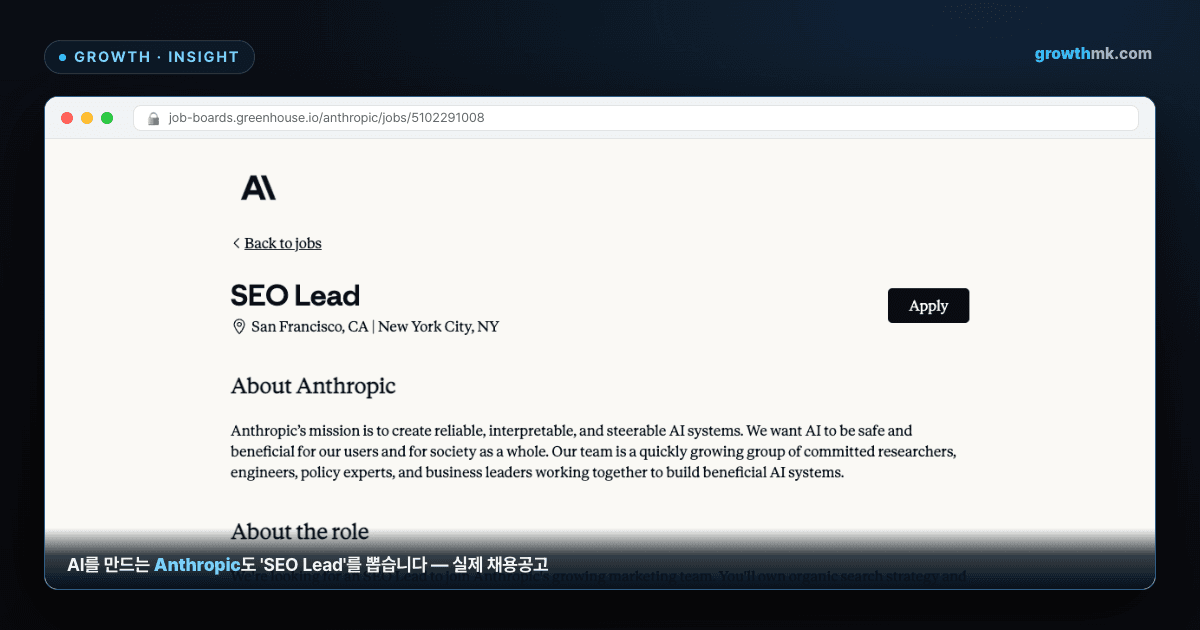
Anthropic — the company behind Claude, the LLM that stands shoulder to shoulder with ChatGPT — recently posted an opening for an “SEO Lead.” Sit with that for a second: the very company reshaping what search looks like is hiring a search engine optimization expert for $255,000–$320,000 a year. That single job post sends marketers a clear message. SEO didn’t die in the GEO era — it matters more than ever. And GEO isn’t something separate from SEO; it’s one more layer stacked on top of it.
The actual Anthropic “SEO Lead” job posting — view the original (greenhouse.io)
Junior marketers just starting out ask me one question more than any other these days: “Everyone asks ChatGPT instead of searching now — do we still need to do SEO?” It’s a good question. And the most convincing answer to it came, fittingly, straight from a company that builds the very kind of AI behind ChatGPT. Today I want to walk slowly through this one job posting the way a senior marketer would read it, and sort out together what really matters in GEO and SEO.
The company set to “replace” search is hiring a search-optimization expert
A little ironic, isn’t it? The company making AI answers stand in for search is hiring a Technical SEO expert with 8+ years of experience — for its own websites (claude.ai, docs.anthropic.com, anthropic.com). If “AI is killing search” were really true, this hire wouldn’t add up.
The answer is simple. AI answers are still built by reading, weighing, and citing somebody’s content. To be the “somebody” that gets picked, you have to make sure AI can find your content (crawling), understand it (rendering and structure), and judge it trustworthy (trust). That’s essentially the same job SEO has done for the past 20 years. Only the stage has changed — from “ten blue links” to “a single paragraph the AI summarizes.”
The first principle Growth drills into every client is exactly this: start from the customer’s point of view. If the stage of search has changed, what we should watch isn’t the tool — it’s “where is the customer asking, and what are they asking, right now?” Follow that question to its answer, and SEO and GEO naturally merge into a single picture.
Start with the numbers — search is on the move
Not building strategy on gut feel — that’s Growth’s second principle. So let’s start the GEO conversation with data, too. Pull together the recent industry analyses and one thing is clear: the center of gravity in search behavior is shifting fast.
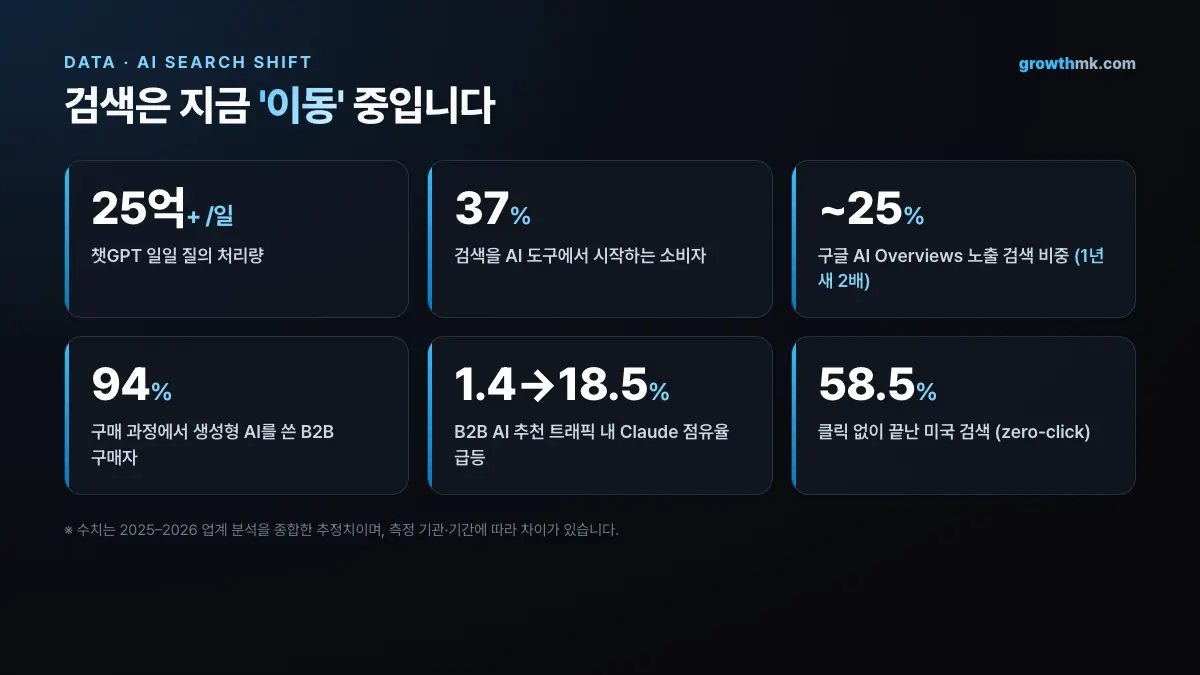
▲ AI search adoption, 2025–2026. Figures are estimates compiled from industry analyses and vary by source and measurement period.
- ChatGPT handles roughly 2.5 billion queries a day, and its weekly active users passed 900 million in early 2026.
- About 4 in 10 consumers (37%) say they start their search in an AI tool rather than a traditional search engine.
- Google’s AI Overviews (AI-summarized answers) now appear on about 25% of all searches — nearly double the figure from a year ago (~13%).
- 94% of B2B buyers used a generative AI tool somewhere in their purchase process. The longer the evaluation cycle — think SaaS, fintech, professional services — the higher that share climbs.
Here’s the part marketers easily miss. As AI search grows, so does “zero-click” search. The AI answers the question outright, so users never click a link. That’s why “how much traffic did I send to my site” is no longer enough on its own. The new battleground is this: was my brand cited as a trusted source inside the AI’s answer?
One detail is worth flagging. By one analysis, Claude’s share of AI referral traffic in B2B jumped from 1.4% to 18.5%. In other words, Anthropic knows better than anyone that the “referral traffic” its own AI generates has a real business impact. So hiring an SEO expert to make sure its own site shows up well in both search and AI answers is, frankly, the most rational decision it could make.
If you’re wondering where this shift hits the customer decision journey (CDJ), we go deeper in our Growth Strategy and Performance Marketing topics.
Dissecting the job post — what Anthropic expects from its SEO Lead
Now to the heart of it. Go through the role’s responsibilities and qualifications line by line, and you’ll find the answer to “what matters in the GEO era” sitting there almost fully formed. I’ve grouped what the post asks for into four buckets.
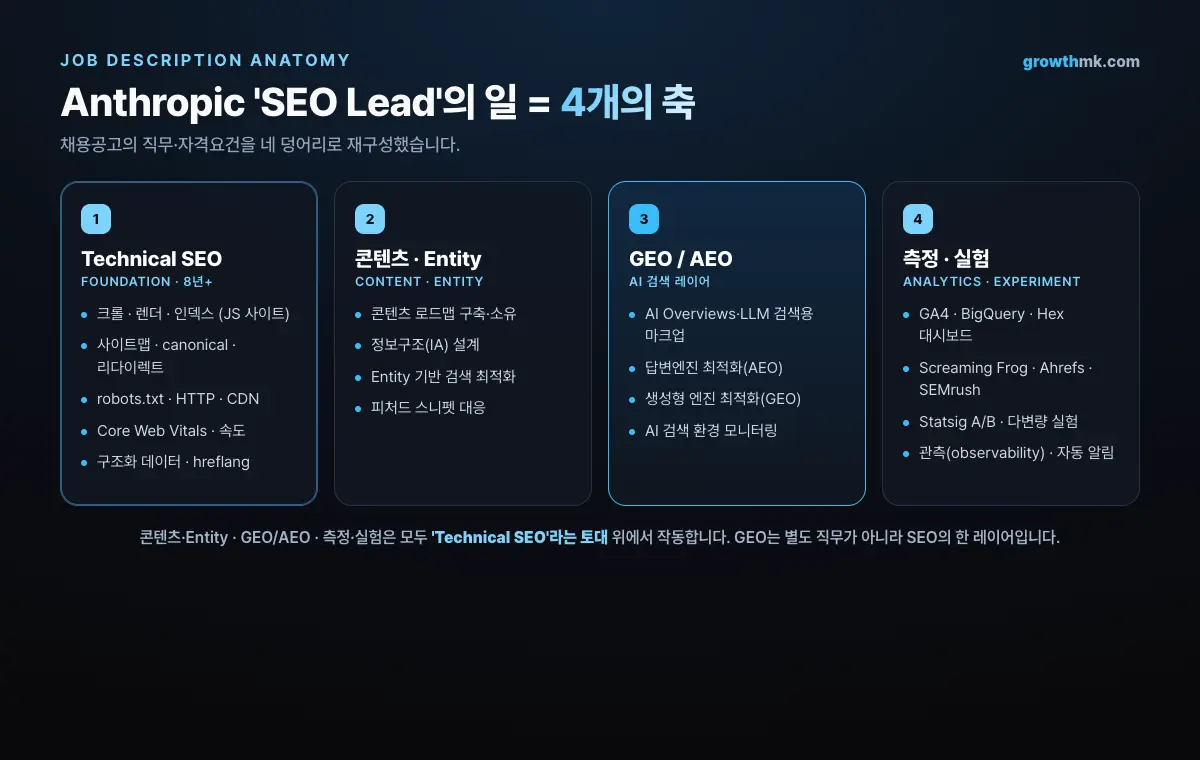
▲ The Anthropic SEO Lead job post, reorganized into four axes
Eight-tenths of the role is still Technical SEO
The job’s very first qualification is “8+ years of Technical SEO experience.” And the items listed underneath read almost exactly like the fundamentals from an SEO textbook a decade ago.
Crawl, render, index — the same rules apply to AI crawlers
The post asks candidates for “a deep understanding of how search engines crawl, render, and index JavaScript-heavy sites.” Sitemaps, canonical tags, redirect strategy, robots.txt, HTTP status codes, even CDN configuration — this is textbook Technical SEO territory. Here’s the key: the crawlers behind AI answer engines (GPTBot, ClaudeBot, PerplexityBot, and the rest) travel the same road in the end. A page that doesn’t get crawled can’t be cited — not by Google, not by AI. Once the technical foundation crumbles, nothing you stack on top of it matters.
Speed, structured data, internationalization — and “checking the logs”
The post spells out Core Web Vitals (speed and stability metrics) optimization, structured data (JSON-LD) implementation, and an hreflang-based international SEO playbook. One more item is worth a close look — it says to “monitor crawl efficiency and indexing with Google Search Console and log analysis.” What an AI crawler actually took from your site isn’t a guess; it’s recorded in your server logs. On a multilingual site, hreflang is how you make clear that “the canonical answer page for this question is the Korean edition,” so AI cites the right page for each language. (It’s exactly why we publish this piece in Korean, English, and French together.)
GEO/AEO is written in as a layer of SEO, not a separate job
This is the part I most want to drive home today. Look closely.
The post clearly names GEO (Generative Engine Optimization) and AEO (Answer Engine Optimization). But they appear inside a single role — “SEO Lead” — listed as preferred qualifications. Anthropic didn’t open a separate “GEO Lead” req. It hired an SEO Lead and added GEO skills on top.
From the posting (paraphrased): “Optimize content structure and markup for AI Overviews and LLM-based search.” / Preferred: “an understanding of Answer Engine Optimization (AEO) and Generative Engine Optimization (GEO),” and “experience optimizing content for AI Overviews, featured snippets, and entity-based search.”
The message in that structure is unmistakable. GEO isn’t a new technology that replaces SEO; it’s the newest layer riding on top of solid SEO. The foundation of 8-years-deep Technical SEO comes first, and the skill of “getting cited by AI” goes on top of it — in that order. Trying to do GEO before the foundation is like building the rooftop before you pour the footing.
Pay attention to the phrase “entity-based search”
The post lists “experience optimizing content for entity-based search” as a plus. Don’t skim past that phrase.
Search engines and AI now recognize and connect not just “keywords” but entities — distinct, real things like people, companies, and concepts. For a specific brand to surface when someone asks an AI to “recommend a B2B marketing agency,” that brand has to be learned as one consistent entity. When the company’s About page, homepage, JSON-LD, and external profiles (LinkedIn, Naver, and the like) all say the same thing with the same definition, AI trusts that brand.
The starting point of the GEO/AIEO work we applied to our own homepage was exactly this entity definition. I’ll unpack the full method shortly, under “Principle 2.”
Half the job is measurement and experimentation
The last bucket is analytics and experimentation. The post asks the candidate to build dashboards with GA4, BigQuery, and Hex; run regular technical audits with Screaming Frog, Ahrefs, and SEMrush; design, run, and analyze A/B and multivariate experiments with Statsig; and stand up an “SEO observability infrastructure with automated alerting.” It even includes the phrase “a strong grasp of statistical significance.”
This is the part that made me nod hard. It’s the exact same language as the data-science-driven marketing Growth talks about. SEO or GEO, what doesn’t get measured doesn’t get improved. Not cranking out content on instinct, but forming hypotheses, running experiments, and validating with statistics — this is half of what the world’s leading AI company expects from an SEO role.
GEO doesn’t replace SEO — it adds a layer
Distill what we got from dissecting one job post into a single picture, and it looks like this.
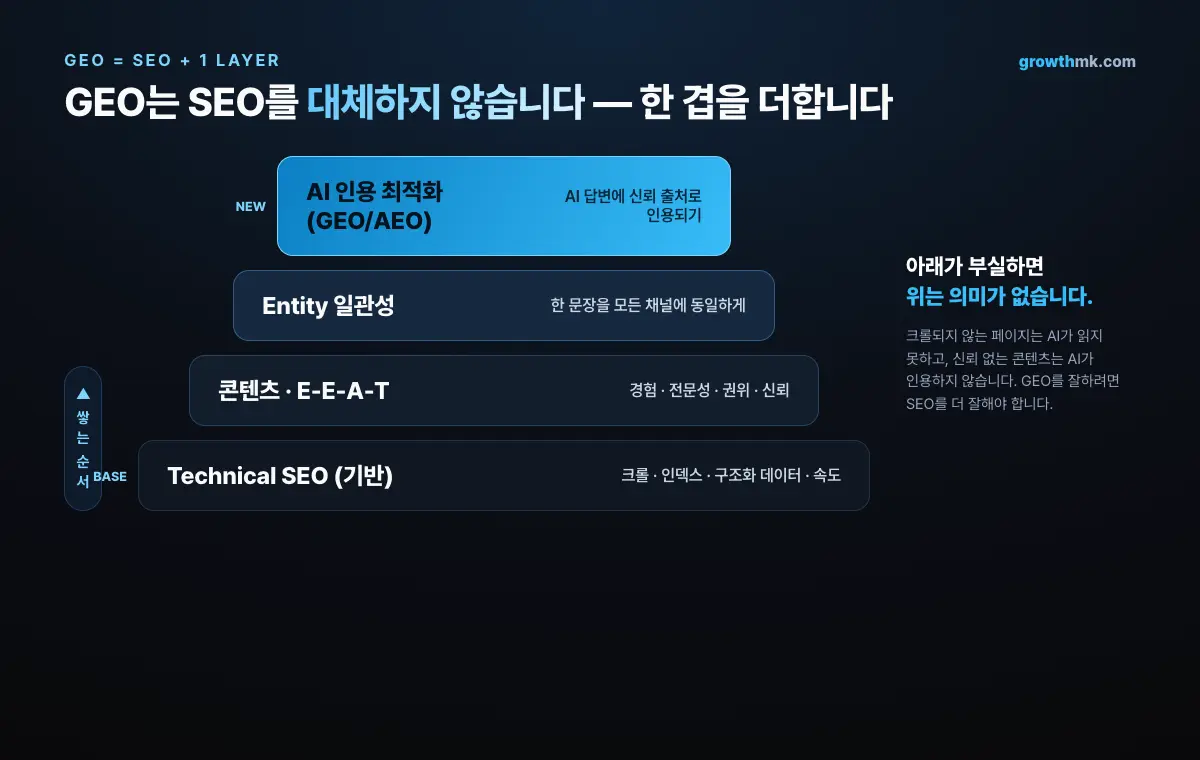
▲ A layered structure: GEO/AEO stacking on top of an SEO foundation
At the very bottom sits the foundation: Technical SEO (crawl, index, structured data, speed). On top of it go high-quality content and E-E-A-T (Experience, Expertise, Authoritativeness, Trust). Entity consistency stacks above that, and at the very top rides the newest layer — AI-citation optimization (GEO/AEO).
What matters is that if the lower floors are shaky, the upper floors are meaningless. AI can’t read a page that doesn’t get crawled, and it won’t cite content it doesn’t trust. So the call to “drop SEO now that we have to do GEO” is exactly backwards. To do GEO well, you have to do SEO even better. Google says as much in its own documentation: there are no special requirements to appear in AI features (like AI Overviews); the same good SEO best practices simply apply (Google Search Central, AI Features and Your Website).
Five things for practitioners — what really matters in GEO and SEO
From here, I’ll lay out five principles in a form that marketing practitioners, leads, and executives at mid-size and large companies can check and act on right away. Each principle rests on the job-post requirements above, plus official guidance from academia and Google.
Principle 1. The technical foundation is non-negotiable
What: crawl, index, structured data, speed
If AI crawlers can’t get in, the game never starts. Begin by checking whether robots.txt is accidentally blocking AI crawlers, whether your core content is still visible after JavaScript renders, and whether your sitemap, canonical tags, and redirects are clean. It’s the same reason the post specifically calls for experience with “site migrations, canonicalization, and duplicate-content handling.” When the same content is scattered across multiple URLs, AI gets confused about which page to cite as the “answer.”
Putting it to work
- Run a technical audit at least once a quarter with a tool like Screaming Frog or Ahrefs.
- Implement structured data (JSON-LD) thoroughly — Article, Organization, Author, FAQ, Breadcrumb.
- We’ve laid out the checklist items and priorities in the Technical SEO topic.
Principle 2. Define your entity and plant it consistently
What: “your company in one sentence”
This is the most practical response to the “entity-based search” we saw earlier. First, define your brand in one sentence: what you do, who you do it for, what sets you apart. Then plant that one sentence — word for word, unchanged — in four places: (1) the homepage hero / first paragraph of your About page, (2) the description field in your Organization JSON-LD, (3) your meta description, and (4) external profiles like LinkedIn and Naver.
The post’s call to “build content roadmaps for developers, decision-makers, and practitioners each” comes from the same place. Even within one company, different readers want different things — so keep the entity single and consistent, but design the content per reader.
Putting it to work
This is the core of the work that “makes us show up when someone asks ChatGPT to recommend a B2B marketing agency.” Growth applied this method to its own site first, and wrote up the whole process in the GEO Whitepaper. It covers a three-axis strategy — entity, technical, off-page — along with 85+ pieces of global research, which makes it a solid starting point for an in-house GEO project. For execution at the service level, see GEO/AIEO.
Principle 3. E-E-A-T: in the end, trust matters most
What: Experience, Expertise, Authoritativeness, Trust
Google describes the bar for good content as E-E-A-T (Experience, Expertise, Authoritativeness, Trustworthiness), and states plainly that Trust matters most of the four (Creating Helpful, Reliable, People-First Content). And, intriguingly, the conditions for getting cited by AI are nearly identical.
The evidence in data: what increases AI citations
A GEO paper from a Princeton research team (KDD 2024) tested nine content strategies across 10,000 queries. The top strategies — the ones that lifted citation visibility in AI answers by 30–40% — were these:
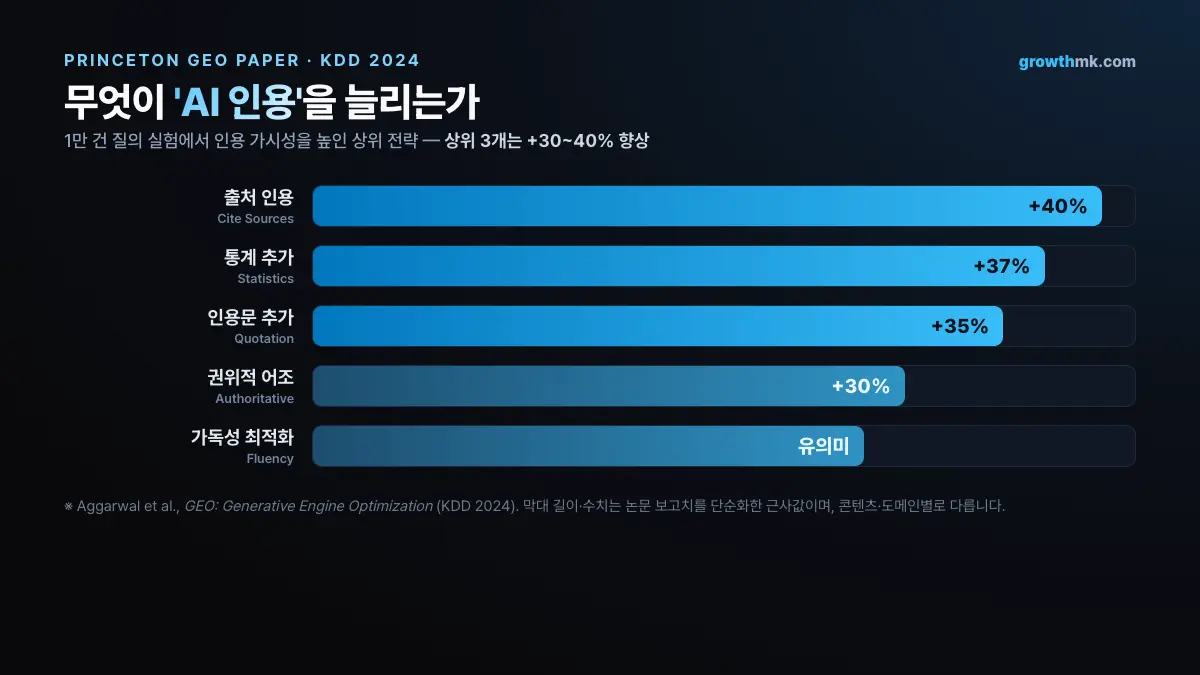
▲ Key results from the Princeton GEO paper (Aggarwal et al., KDD 2024). Source: arXiv:2311.09735
- Cite Sources — content that cites credible sources gets cited more.
- Statistics Addition — content with concrete numbers gets picked.
- Quotation Addition — expert quotes raise trust.
- An authoritative tone and fluency (readability) also worked to a meaningful degree.
Notice anything? That list is, point for point, the profile of “a well-written piece by a credible expert.” Naming your author clearly (Author schema), bringing firsthand experience and data, citing your evidence — E-E-A-T and GEO point at the same place. That’s why Growth attaches an author profile and sources to every piece, and treats E-E-A-T separately in our SEO Fundamentals hub.
Principle 4. Structure content so AI finds it easy to cite
What: a structure that answers the question head-on
AI pulls “one clean slice of an answer” out of a long article and cites it. So pose the question as a heading (H2/H3), and give the core answer right beneath it in two or three sentences. Tables, lists, and definition sentences are formats AI especially likes.
Putting it to work
- Make an “inverted pyramid + Q&A” structure your default — core question as the heading, answer in the first paragraph.
- Mark up FAQs with FAQPage structured data (it helps with both featured snippets and AI citations).
- For designing topic clusters that group content assets by theme, see the SEO Content and Content Marketing topics.
Principle 5. Measure, experiment, compound
What: not luck, but compounding
The last principle, and the belief Growth holds dearest. There’s no luck in search. There’s no magic that rockets you to #1 overnight, no cheat code that suddenly makes AI cite you. What exists is the loop of measure → experiment → improve, and the assets that compound from it like interest. That’s why Anthropic fills half of its SEO role with measurement and experimentation, and why Google says there are no shortcuts to AI visibility.
Putting it to work
- Build a dashboard that views AI citations, search visibility, and conversions together (e.g., GA4 + Search Console + AI-citation monitoring).
- Every time you change a title, a structure, or your structured data, validate it with an A/B test, and standardize only the patterns you’ve confirmed work.
- We cover the framework for experimentation and compounding in detail in the Growth Strategy and Performance Marketing topics.
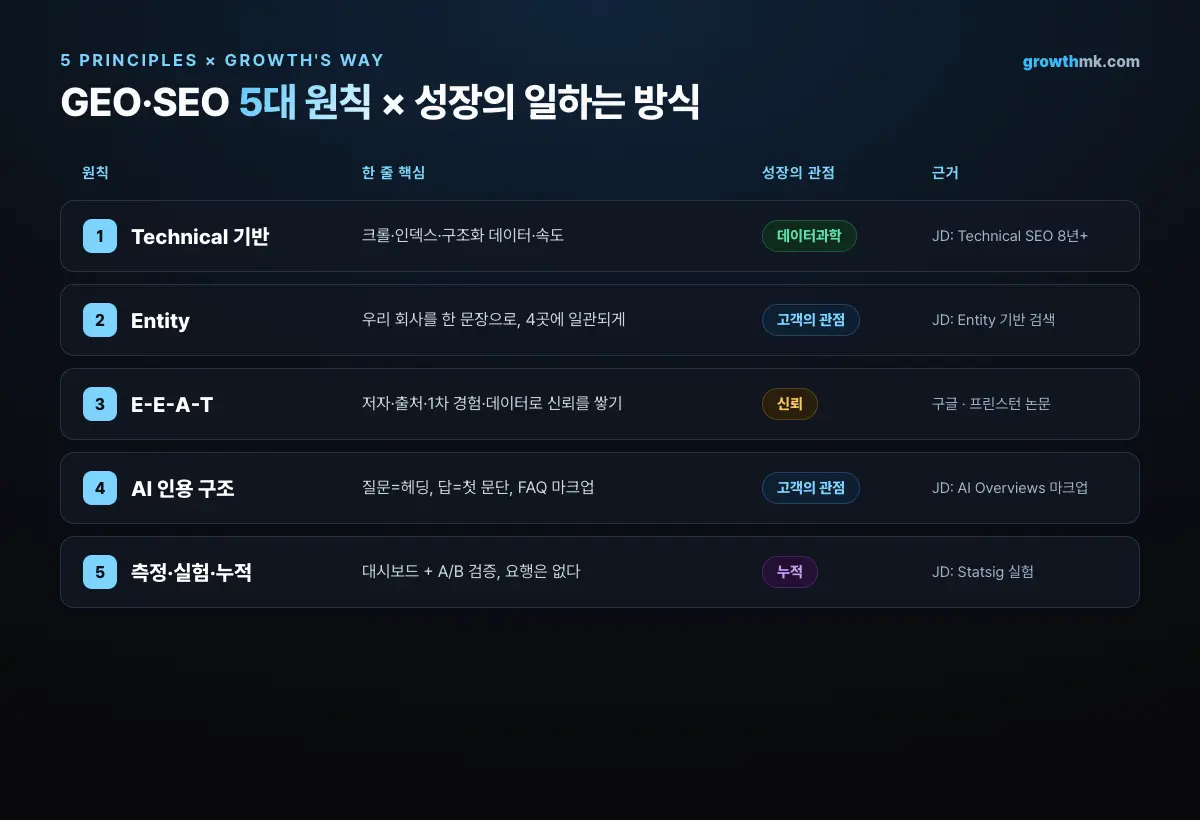
▲ A map linking the five principles to Growth’s three ways of working
How Growth sees search — the essence, not the tool
Let me restate all of this in Growth’s own language. The tool — search engine or AI — keeps changing. But three things at the core don’t.
First, we look from the customer’s point of view
We start not from “which tool is hot” but from “where is the customer asking, and what are they asking, right now?” If customers have started asking AI, then we simply become the trusted source inside the AI’s answer. The tool changes, but the question stays the same — how do we help this customer make a decision?
Second, we validate with data science
SEO, GEO, content, and performance move as one team looking at the same data. We form a hypothesis, run the experiment, validate with statistics, and circle back to the hypothesis. We don’t win arguments on gut feel.
Third, we compound — no luck involved
Growth (Seongjang Inc.) is a Seoul-based growth marketing agency founded in 2009, built on customer-centric marketing and data-driven growth hacking, operating SEO, GEO (AI search optimization), content, and performance marketing as one integrated team — decomposing the customer decision journey (CDJ) into stages to experiment and improve each one — to generate revenue-qualified leads for B2B and B2G businesses that need persuasion and explanation.
It’s the same reason Growth talks about the one buyer worth more than 10,000 visitors. Rather than detonating a traffic spike from search, we make “that one person” seek us out first as a trusted source — in AI answers and in search alike. That’s growth that compounds. If you’re curious about real results, see our case studies.
A checklist to run right now
Compressed into one page, the way I’d hand it to a junior marketer. Fill in this table with your team this week.
| Check area | Core question | Growth’s lens |
|---|---|---|
| Technical foundation | Can AI crawlers read our core pages? Have we implemented structured data? | Data science |
| Entity | Have we defined our company in one sentence? Is that sentence consistent across all four places? | Customer’s point of view |
| E-E-A-T | Does every piece have an author, sources, firsthand experience, and data? | Trust |
| AI citation | Did we pose the question as a heading and put the answer in the first paragraph? Did we mark up the FAQ? | Customer’s point of view |
| Measurement & experimentation | Do we have a dashboard that views search, AI citations, and conversions together? Do we validate changes with A/B tests? | Compounding |
The GEO era isn’t the end of SEO — it’s the era that demands you do SEO deeper and better. The fact that even the companies building AI are hiring SEO experts is the surest proof of that.
If you’d like a diagnosis of your company’s search and AI visibility, or you need a partner to run SEO, GEO, content, and performance as one team — take a look at Growth’s SEO service and GEO/AIEO service, and reach out anytime through our contact page.
Related reading
- GEO / Generative Engine Optimization topic hub — how to get cited in ChatGPT, Perplexity, and AI Overviews
- GEO Whitepaper: A Brand Visibility Strategy for the AI Search Era — a 14-chapter execution guide
- SEO Fundamentals topic hub — the basics of E-E-A-T and search optimization
- Technical SEO topic hub — crawling, indexing, Core Web Vitals
- B2B Marketing topic hub — lead strategy for long-evaluation businesses
Sources
- Anthropic, SEO Lead job posting — job-boards.greenhouse.io/anthropic/jobs/5102291008
- Aggarwal et al., GEO: Generative Engine Optimization, KDD 2024 — arxiv.org/abs/2311.09735
- Google Search Central, AI Features and Your Website — developers.google.com/search/docs/appearance/ai-features
- Google Search Central, Creating Helpful, Reliable, People-First Content — developers.google.com/search/docs/fundamentals/creating-helpful-content
About the author. Jaebok, Lim — CEO of Growth (Seongjang Inc.). Since 2009, he has designed growth marketing for B2B and B2G businesses that need persuasion and explanation. He runs SEO, GEO, content, and performance as one integrated team, guided by a single belief: the one buyer worth more than 10,000 visitors.