Generative Engine Optimization (GEO): The Complete Guide for AI Search Visibility
 임재복
임재복
Generative Engine Optimization (GEO) is the systematic practice of getting your brand and content selected, cited, and recommended as a trusted source when generative AI engines such as ChatGPT, Perplexity, and Google AI Overviews compose an answer to a user’s question. The term was first defined academically in a late-2023 paper by researchers from Princeton, Georgia Tech, and IIT Delhi, GEO: Generative Engine Optimization (arXiv:2311.09735), which showed experimentally that simply adding citations, statistics, and source attributions can lift a page’s visibility inside AI-generated answers by up to 40%. GEO does not replace SEO; it is an additional layer built on top of an SEO foundation, and it aims at the same target as the overlapping industry terms you may have seen, including AEO, AIEO, and LLMO.
This guide covers GEO end to end: its definition and academic origin, how generative engines actually choose their sources, the tangle of related terminology, the relationship between GEO and SEO, six field-tested execution tactics, a measurement framework, and the practical realities of operating across multiple languages. Every figure cited below is drawn directly from the original paper or the official documentation of each AI company. If you are a marketer or decision-maker who needs a confident answer to “What is GEO?” and “How is it different from SEO?”, this article is designed to be the one you can stop at.
What is GEO (Generative Engine Optimization)? Definition and Origin
To understand GEO precisely, start with what a “generative engine” is. A generative engine is a system that, instead of returning a list of ten blue links like a traditional search engine, retrieves and synthesizes information from multiple sources into a single finished answer and cites a subset of those sources as its evidence. ChatGPT with web search, Perplexity, Google’s AI Overviews and AI Mode, and Naver’s AI Briefing all fall into this category.
In classic search, the user clicked one of ten links and verified the information themselves. In a generative engine, the AI performs that verification step on the user’s behalf. That shifts where marketing is won or lost. The question is no longer “What position do we rank in?” but rather “Are we cited inside the answer the AI produced?” GEO is the strategy for answering that question deliberately rather than by accident.
Academic Origin: The KDD 2024 Paper That Defined GEO
GEO did not begin as a marketing buzzword; it was defined in an academic paper first. Aggarwal and colleagues, affiliated with Princeton University, Georgia Tech, and IIT Delhi, published the work in November 2023 and presented it at ACM KDD 2024. They defined GEO as “an optimization framework for improving the visibility of content in generative engine responses” and released a benchmark to test it, GEO-bench, comprising roughly 10,000 queries spanning multiple domains (Aggarwal et al., KDD 2024).
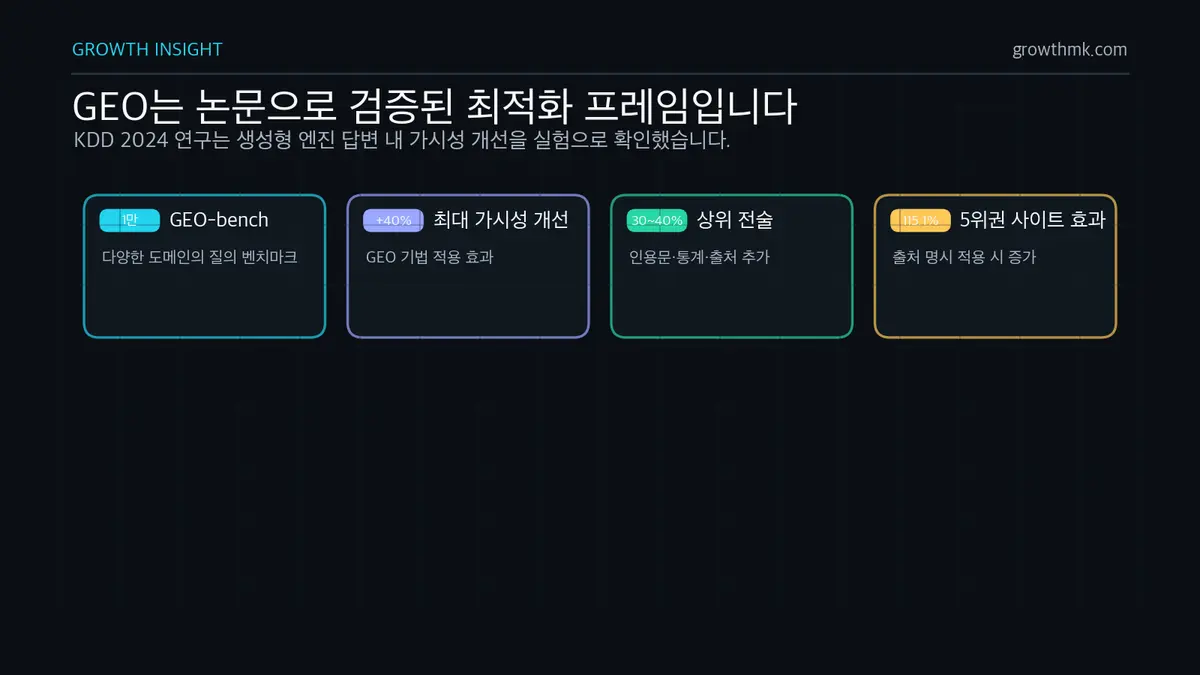
The paper’s experimental results are the starting point for any serious GEO practice, so they are worth citing precisely.
- Visibility up to +40% — Content optimized with GEO methods saw its visibility inside generative engine answers improve by as much as 40%.
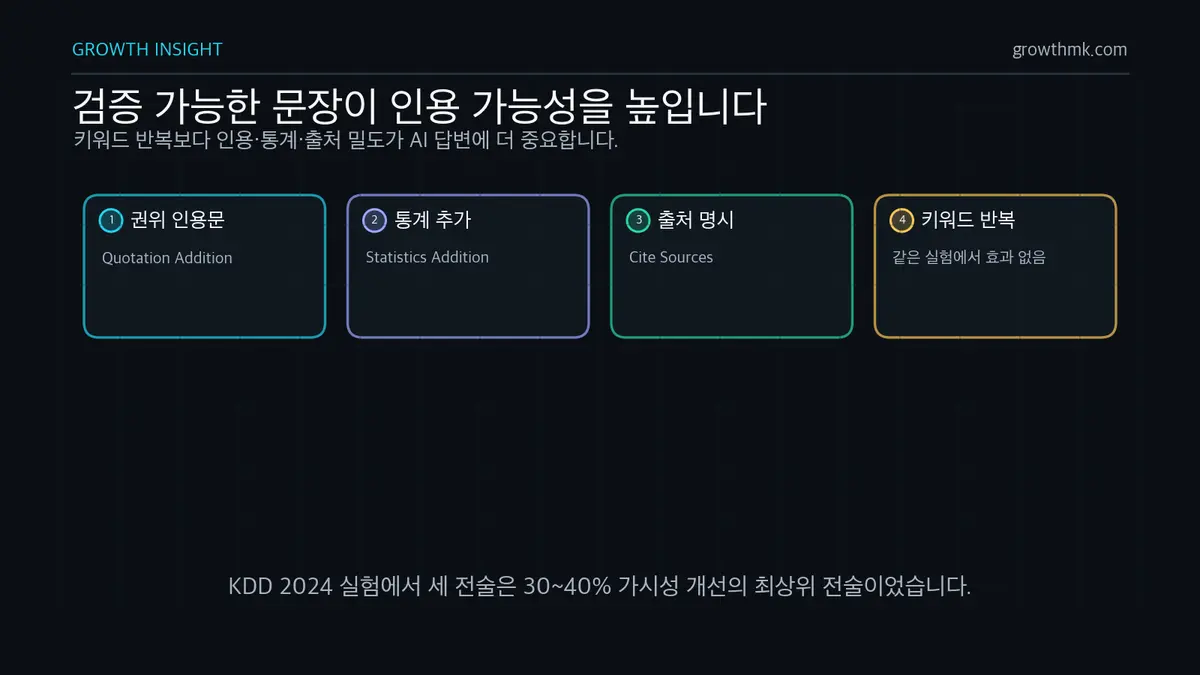
- The top tactics were adding quotations, statistics, and citations — Adding authoritative quotations (Quotation Addition), adding statistics (Statistics Addition), and citing sources (Cite Sources) were the most effective methods, delivering relative improvements in the 30–40% range on position-adjusted visibility metrics.
- Keyword stuffing did nothing — The repetitive keyword insertion that once worked in traditional SEO produced almost no improvement in generative engines. This is direct evidence that tactics carried over from search do not automatically transfer to generative answers.
- Lower-ranked sites gained the most — When a site ranked around fifth in search applied the citation tactic, its visibility rose by 115.1%, while the top-ranked site actually lost visibility. The authors described this as a possible “democratization of digital space.” In other words, GEO can be a tool for challengers who trail on domain authority.
- Effects vary by domain — The impact of each tactic differed by subject area. There is no single “magic move” that works for every site; you need to test combinations that fit the nature of your own content.
Why GEO Now: Three Measured Numbers
The case for GEO rests not on a forecast but on data that has already been measured. The following three figures point in the same direction.
| Signal | Measured figure | Source |
|---|---|---|
| Zero-click search | 58.5% of US Google searches end without a click to the open web (only ~360 of every 1,000 searches reach a non-Google property) | SparkToro / Datos, 2024 |
| AI Overview impact on CTR | When an AI Overview is shown, the position-1 clickthrough rate falls by 34.5% (analysis of 300,000 keywords) | Ahrefs, 2025 |
| Conversion quality of AI traffic | In Ahrefs’ own data, AI search drove just 0.5% of visitors but produced 12.1% of sign-ups — roughly a 23× higher conversion rate than regular search | Ahrefs, 2025 |
Connect the three figures and the conclusion is singular. The total volume of clicks (traffic) is structurally shrinking, yet within that shrinking traffic, the purchase intent of an AI-recommended visitor is far stronger. At Growth, we frame this as prioritizing “the one lead that becomes revenue over sheer traffic volume.” Being cited accurately once in an AI answer is closer to revenue than ten thousand impressions that have nothing to do with a purchase. GEO is the work of designing for that one buyer as they pass through a new gateway: the AI-generated answer.
How Do Generative Engines Choose Their Sources? The Mechanics of GEO
Before executing GEO, you need to understand how a generative engine builds an answer, because without the mechanics the tactics become superstition. A generative engine’s knowledge comes from two broad paths.
| Dimension | Pretrained knowledge (Parametric) | Real-time retrieval (RAG, retrieval-augmented generation) |
|---|---|---|
| Source of information | Web documents and literature learned at model training time | Fresh documents pulled from a search index at query time |
| Refresh cadence | Fixed until the next model update | Real-time, on every query |
| Marketing implication | “Does the AI know our brand?” — governed by brand mentions and consistency across the wider web | “Is the AI citing us right now?” — governed by crawl access, content structure, and source attribution |
| Response strategy | Entity consistency, third-party signals (off-page) | Crawler access, answer-shaped structure, citations and statistics (technical and content) |
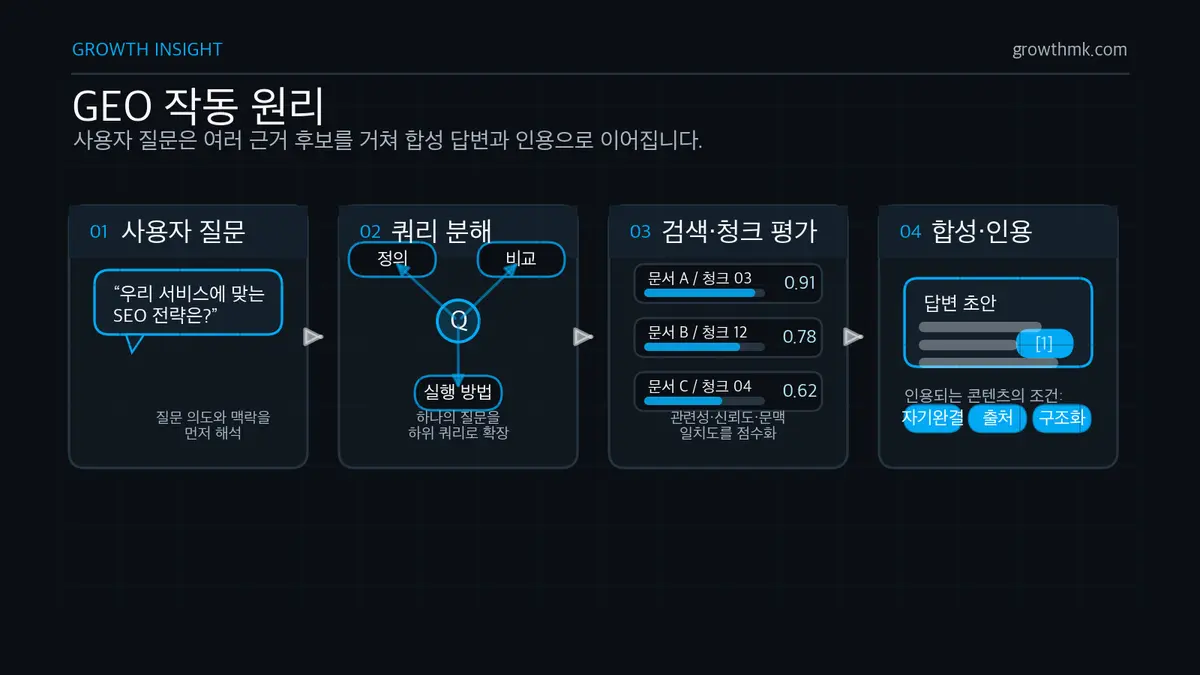
Even if your brand is absent from pretraining, it can still be selected through RAG retrieval. That is exactly why GEO matters so much for lesser-known companies. RAG-based answer generation generally runs through the following four-stage pipeline.
- Query analysis and expansion — The engine interprets the user’s question by intent and splits it into sub-questions. Google states in its official AI features documentation that its AI features may use a “query fan-out” technique that expands one question into multiple related searches across subtopics. In short, follow-up questions the user never typed are searched alongside the original.
- Retrieval — Using the search index and live crawling, the engine gathers tens to hundreds of candidate documents. The price of admission at this stage is technical accessibility. A page that blocks AI crawlers or is not indexed is already eliminated here.
- Chunk evaluation and selection — The engine evaluates candidates not as whole pages but as extractable passages (chunks). The criteria are: does it directly answer the question (relevance), can it be verified with figures and sources (credibility), and is it understandable without surrounding context (self-containment)? The KDD 2024 finding that quotations, statistics, and citations are effective operates precisely at this stage.
- Synthesis and citation — The engine combines the selected handful of chunks into an answer and attaches citation links to the sources it relied on. Which sentence your brand appears next to here is what shapes the user’s perception.
The practical lesson of this pipeline is unmistakable. “Being read” and “being cited” are not the same thing. Even if the AI collected your page (passing stage 2), it will not cite you if there is no verifiable chunk worth lifting into the answer (failing stage 3). Most GEO execution concentrates on stage 3 — manufacturing chunks the engine has little choice but to cite.
Seen through the lens of the customer journey, the shift is even larger. The exploring, comparing, and evaluating that a buyer once did across dozens of websites is being compressed into a few conversations with an AI. We call this stretch the “AI dark funnel.” Candidates are shortlisted in a place your analytics tools cannot see, and by the time a customer reaches your website they have already largely made up their mind. A brand missing from the AI’s answer is quietly excluded during this invisible review.
AEO, LLMO, AIEO: Different Names, One Target
Search for GEO and you will quickly run into AEO, AIEO, LLMO, LLM SEO, and AI SEO, all jumbled together. The bottom line first: these terms all describe the same phenomenon — optimizing to be chosen in a generative AI’s answer — from slightly different angles. The very fact that the vocabulary is unsettled is itself evidence that the field is in an early, pre-standardization phase. Distinguish the emphasis of each term and the confusion disappears.
| Term | Full name | Emphasis | Notes |
|---|---|---|---|
| GEO | Generative Engine Optimization | Citation and overall visibility inside generative engine answers | Carries an academic definition from the KDD 2024 paper. Global usage is converging on this term. |
| AEO | Answer Engine Optimization | Winning the “single answer” to a question | In use since the featured-snippet and voice-assistant era. Predates GEO and overlaps with the “answer-shaped structure” subset of GEO. |
| AIEO | AI Engine Optimization | Optimization for AI engines broadly | Used as a de facto synonym for GEO in practice. We ourselves used this term early on for its intuitive clarity. |
| LLMO | Large Language Model Optimization | Brand recognition by the model (LLM) itself rather than its search feature | Focuses on how a brand is imprinted in pretraining data. |
| LLM SEO / AI SEO | — | Colloquial SEO-industry variants | Closer to nicknames for GEO than to standalone methodologies. |
Our recommended framing is this. Standardize on GEO as the umbrella term, treat AEO as the “build answer-shaped structure” execution area within GEO, and read AIEO and LLMO as synonyms of, or adjacent concepts to, GEO. Whatever you call it, the execution is the same: make your content readable by AI, make it impossible not to cite, and prove your trustworthiness across the wider web.
One caution. The AEO used on the TikTok ads platform means App Event Optimization, an entirely different concept. If you see “AEO” in advertising operations documentation, check the context first.
Does GEO Replace SEO? No — It Is an Extension on the Same Foundation
This is the first question almost everyone asks when they encounter GEO. The answer is clear. GEO does not replace SEO. It adds a new layer on top of the SEO foundation. There are three reasons.
First, the source candidates for generative engines still come from search infrastructure. In its official AI features documentation, Google states plainly that “there are no additional requirements to appear in AI Overviews or AI Mode, nor other special optimizations necessary,” and recommends the same fundamentals as ordinary search: meeting standard technical requirements, allowing crawling, and creating people-first, helpful content. If the SEO foundation of crawling, indexing, and rendering is broken, GEO never even starts. For that foundation, see our SEO Marketing: 5-Step Comprehensive Guide.
Second, ranking and citation are not the same thing. As the KDD 2024 case of a fifth-ranked site lifting its visibility by 115.1% with source attribution shows, a low search rank can still be cited if the chunk quality is high, and a number-one page can be omitted if it has no sentence worth extracting. Because the unit of evaluation (page vs. chunk), the success metric (clicks vs. citations), and the user behavior (visiting vs. being recognized inside the answer) all differ, GEO performance is invisible if you only watch the SEO rank tracker. For how AI Overviews are reshaping this in practice, see Google AI Overviews: SEO Tactics for AI Search Results.
Third, the two efforts reinforce each other. The answer-shaped structure you build for GEO helps you win featured snippets; expanding structured data increases rich-result exposure in search; and stronger sourcing and statistics improve content-quality assessment. Conversely, the domain trust and backlinks you accumulate through SEO are reused as trust signals when the AI chooses which source to cite.
| Dimension | SEO (Search Engine Optimization) | GEO (Generative Engine Optimization) |
|---|---|---|
| Goal | Higher rankings in search results and capturing clicks | Securing citations, mentions, and recommendations inside AI answers |
| Unit of evaluation | Page and domain | Extractable chunk (paragraph or sentence) |
| Core metrics | Ranking, impressions, CTR, sessions | Share of answer, citation frequency, AI-referred conversion rate |
| Core tactics | Keywords, internal links, backlinks, technical optimization | Adding citations, statistics, and sources; answer-shaped structure; entity consistency |
| Surface | Google and Naver search results pages | ChatGPT, Perplexity, AI Overviews, Naver AI Briefing |
| Relationship | Not replacement but mutual reinforcement — SEO is the ticket in, GEO is the recognition | |
The budget conclusion follows. You do not stop SEO and switch to GEO; you maintain the SEO foundation and add a GEO layer on top, which is the rational allocation right now. The more SEO assets a company already has, the lower its cost of adopting GEO.
The GEO Execution Framework: Six Field-Tested Tactics
At Growth we structure GEO execution along three axes: technical (make it readable by AI), content (make it impossible not to cite), and off-page (make the wider web vouch for you). The six tactics below break those axes into practical units, ordered from highest priority down.
| # | Tactic | Axis | Rationale |
|---|---|---|---|
| 1 | Add citations, statistics, and primary sources | Content | The top tactic in the KDD 2024 experiment (30–40% visibility gain) |
| 2 | Answer-shaped structure and self-contained chunks | Content | Directly tied to the selection criteria at the chunk-evaluation stage |
| 3 | FAQ and structured data (schema) | Technical | Machine-readable meaning plus rich-result benefit in search |
| 4 | Entity consistency | Technical / Off-page | Determines brand-identification accuracy in pretraining and cross-checks |
| 5 | Third-party signals (earned media) | Off-page | AI trusts external verification over self-assertion |
| 6 | Allow AI crawlers + llms.txt | Technical | The ticket in at the retrieval stage — if blocked, everything else is void |
1. Embed Citations, Statistics, and Primary Sources in the Body
Start with the most validated tactic. Link a source inline for every key claim, use figures wherever you can, and quote experts or primary literature directly. In the KDD 2024 paper, quotation addition, statistics addition, and source citation were the top tactics, each producing 30–40% visibility gains. A generative engine must minimize its own hallucination risk, so it preferentially cites verifiable sentences. By contrast, dated tactics like keyword repetition showed no effect in the same experiment. First-party data found nowhere else — your own customer data, benchmarks gathered in operation, original research you ran — is the highest-value citable asset you can own.
2. Write So the Answer Comes First: Answer-First and Chunk Design
The AI lifts the paragraph that “answers the question immediately” out of your page, so you must optimize the very structure of your writing for extraction. There are four operating principles.
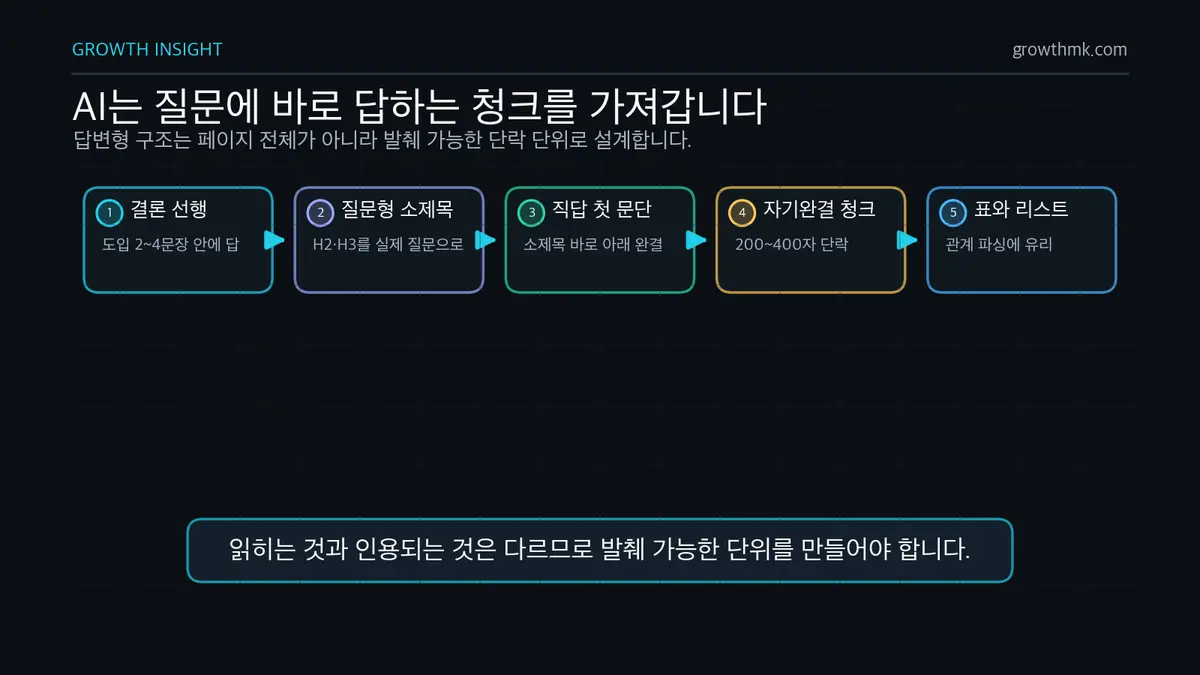
- Front-load the conclusion — Within the first two to four sentences, give a self-contained answer to the question, then develop the evidence and detail afterward. The opening paragraph of this article is the example.
- Question-style subheads + direct first paragraph — Write H2s and H3s as the sentences users actually ask, and complete the answer in the very first paragraph beneath them.
- Self-contained chunks — Write each paragraph (roughly 200–400 characters) so it is understandable on its own, without surrounding context. Dependent phrases like “as mentioned above” hinder extraction.
- Tables and lists — Structure comparison and summary information as tables. It is the format a machine parses most easily.
3. Convey Meaning to Machines with FAQ and Structured Data
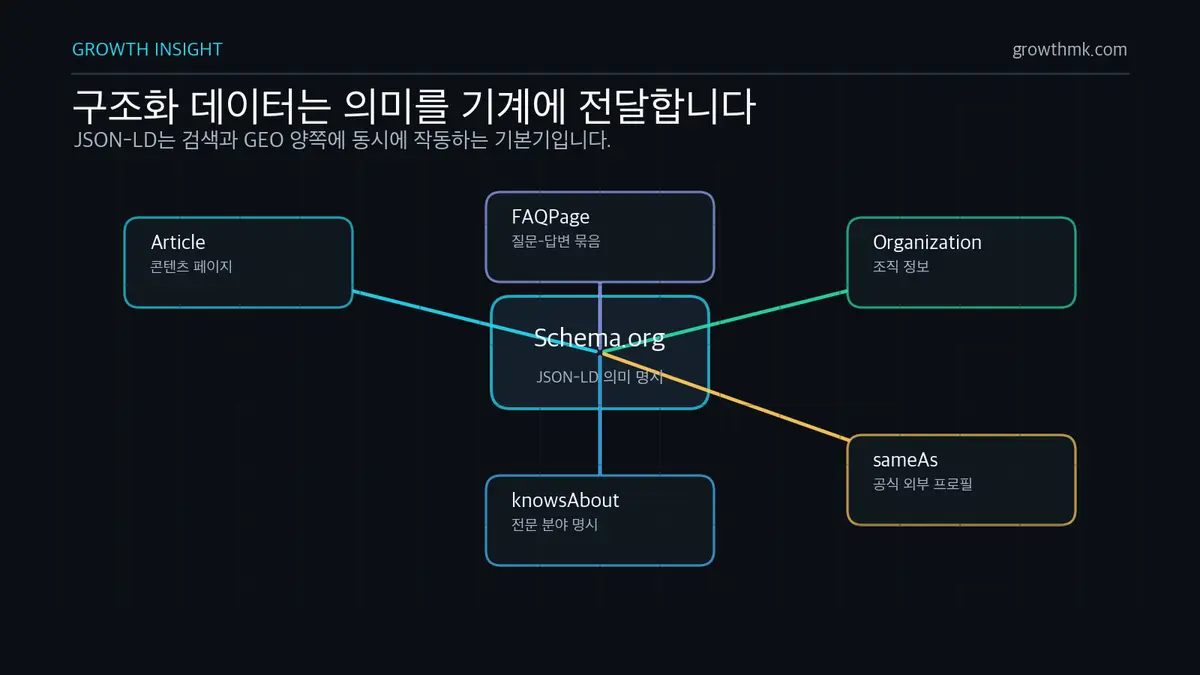
Structured data (Schema.org JSON-LD) is the standard for spelling out the meaning of your content in a machine-readable form. Apply Article schema to content pages, FAQPage to question-and-answer blocks, and Organization to company information. The sameAs property of Organization schema (linking your official external profiles) and knowsAbout (declaring your areas of expertise) contribute directly to how the AI identifies your brand entity. Structured data also powers rich results in traditional search, making it a rare investment that pays off for both SEO and GEO at once.
4. Unify Your Entity into a Single Sentence
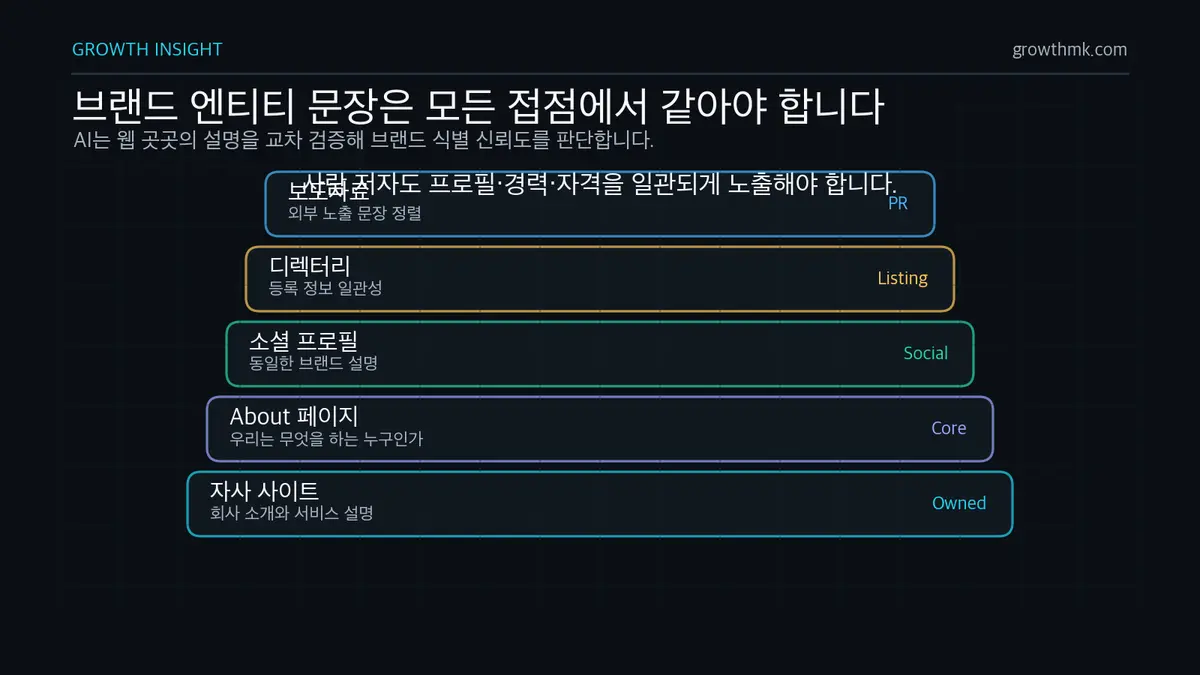
AI recognizes your brand as a single entity and cross-checks information about it from across the web. If the sentence describing your company differs across your own site, your About page, your social profiles, directory listings, and press releases, the AI’s confidence in identifying your brand drops. Settle “who we are and what we do” into one sentence and use it identically at every touchpoint. The same goes for human authors: presenting author profiles, experience, and credentials consistently maps directly onto Google’s E-E-A-T quality criteria (Experience, Expertise, Authoritativeness, Trustworthiness). As an agency that operates its own KO/EN/FR site on headless WordPress, we treat that first-hand multilingual operating experience as a legitimate Experience signal in its own right.
5. Let Third Parties Speak for You
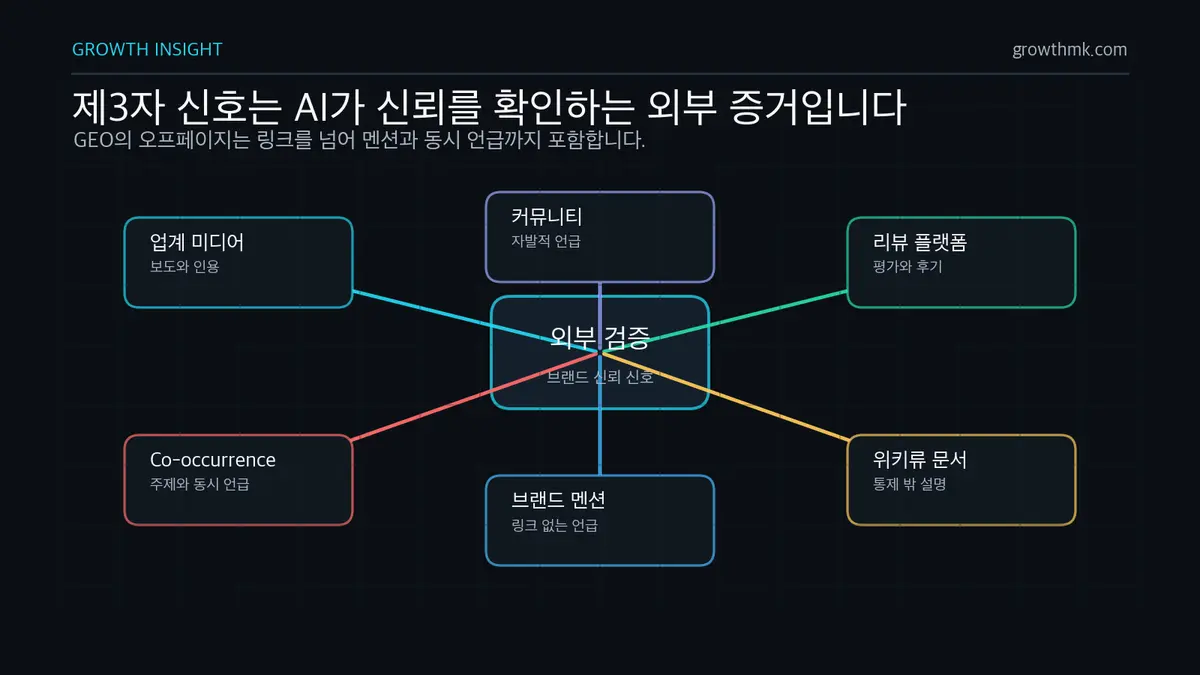
A generative engine does not judge trust from a single site’s self-assertion alone. Coverage in industry media, mentions in communities, ratings on review platforms, and wiki-style entries — verification in places you do not control — carry significant weight in the citation decision. Where traditional SEO’s backlinks were bound to the “link” format, GEO’s off-page is a broader concept that includes brand mentions and co-occurrence regardless of whether a link exists. The starting point is the same, though: first create something worth citing (data, cases, a point of view), then let it be mentioned naturally. For B2B teams specifically, whether the AI brings you into its vendor shortlist quickly becomes a pipeline question, which is why B2B lead generation fundamentals still anchor the work.
6. Open the Door to AI Crawlers: robots.txt and llms.txt
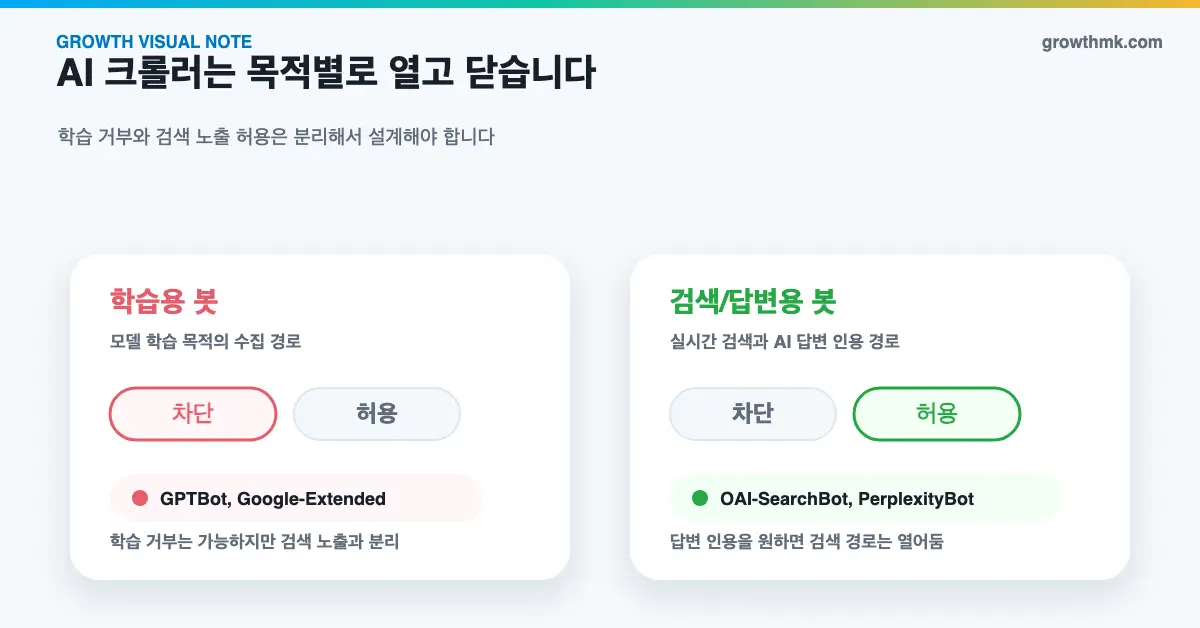
No matter how good the content, it cannot be cited if the AI cannot fetch it. Surprisingly, many companies block AI crawlers wholesale out of security or bandwidth concerns and then ask, “Why don’t we show up in AI answers?” The key fact is that training bots and search/answer bots are separate. Summarized from each provider’s official documentation:
| Crawler | Operator | Purpose | Effect if blocked |
|---|---|---|---|
| GPTBot | OpenAI | Collection for foundation-model training | Excluded from training data (separate from search visibility) |
| OAI-SearchBot | OpenAI | Surfacing sites in ChatGPT search results | Disappears from ChatGPT search answers |
| ChatGPT-User | OpenAI | Fetching a page a user explicitly requested | User-initiated, so robots.txt may not apply |
| ClaudeBot / Claude-SearchBot / Claude-User | Anthropic | Training / search quality / user requests, respectively | Controllable individually by purpose |
| PerplexityBot / Perplexity-User | Perplexity | Search surfacing / user requests (not for model training) | Excluded from Perplexity search results |
| Google-Extended | Controls use for Gemini training and grounding | Blocking does not affect Google Search or AI Overview exposure |
(Sources: OpenAI bots documentation, Anthropic crawler documentation, Perplexity bots documentation, Google common crawlers documentation.)
The decision rule is simple. If you want to stay out of training but appear in AI search, block GPTBot but allow the search bots such as OAI-SearchBot and PerplexityBot. Block the search bots too and your brand vanishes from those engines’ answers. The frequently mentioned llms.txt is a file that summarizes a site’s core content in Markdown to guide LLMs; it was proposed by Jeremy Howard in September 2024 (llmstxt.org). No major AI engine has yet announced official adoption, so treat it as a low-cost “insurance” policy while prioritizing the proven fundamentals of robots.txt and schema.
How Do You Measure GEO Performance? Share of Answer and Conversion Quality
You cannot improve what you cannot measure. GEO measurement cannot reuse SEO’s ranking-and-traffic dashboard as-is, so you need to design a new metric set. The five core metrics we use when operating GEO as a data-driven growth practice are below.
| Metric | Definition | How to measure |
|---|---|---|
| Share of Answer | The share of AI answers to target questions in which your brand is cited or mentioned | Query 50–100 target questions across 3–5 engines on a regular schedule and log the results |
| Engine coverage | How many of the monitored engines cite your brand | Cross-check ChatGPT, Perplexity, Gemini, AI Overviews, and Naver AI Briefing |
| AI referral conversion rate | Inquiry or sign-up conversion rate of visitors arriving via AI search | In GA4, separate referrers such as chatgpt.com and perplexity.ai into their own channel and compare |
| Brand accuracy and sentiment | Factual accuracy of how the AI describes you and the positive/negative context | Collect answer text and assess qualitatively (fix source content when errors appear) |
| Branded demand lift | Growth in branded search and inquiries that say “I saw you in an AI answer” | Search Console branded-query trend plus an inquiry-form source survey |
We recommend starting operations simply. The first step is a spreadsheet. Build a list of questions your customers would plausibly ask, query the same questions to the major engines each week, and log whether you were cited, the context of the citation, and any competitor mentions. Because generative engines have a non-determinism that makes answers vary slightly each time, do not conclude from a single measurement; judge by the trend across repeated measurements.
The second step is referral separation in GA4. AI-driven traffic is small in absolute volume and easily buried in the overall average, but if it is a channel where, as the Ahrefs data showed, 0.5% of visitors produce 12.1% of conversions, you have to view it separately to see its value. Finally, to correct for the “dark funnel” of visitors who came because of an AI answer but register as direct traffic, add a single question right after an inquiry or sign-up — “How did you hear about us?” — with an “AI search (ChatGPT, etc.)” option. Running the loop of measure, diagnose the bottleneck, run a content experiment, and re-measure is what turns GEO from a buzzword into a genuine growth channel.
GEO in Multilingual and Local Markets: Triple-Search Structures and the Content Gap
A global GEO playbook leaves gaps when applied directly to a local market, because the search environment in markets like South Korea is reorganizing into a triple structure: Naver (AI Briefing), Google (AI Overviews), and global AI (ChatGPT, Perplexity). The same dynamic appears wherever a dominant local engine coexists with Google and the global assistants.
| Front | Characteristic | Response focus |
|---|---|---|
| Naver AI Briefing | Composes answers mainly from Naver-ecosystem content (blogs, cafes, Knowledge-iN) | Keep Naver-channel operations and smart-block response as a separate track |
| Google AI Overviews | Expanding to local-language queries; the standard search index is the basis for citation candidates | Respond with technical SEO on your own domain plus answer-shaped content |
| ChatGPT / Perplexity | Search the open web in real time; frequently cite English sources even for local-language queries | Allow AI crawlers and pre-empt the gap with clearly sourced local-language authority content |
Here a structural disconnect deserves attention. Naver Blog’s robots.txt (blog.naver.com/robots.txt) explicitly blocks GPTBot, OAI-SearchBot, and PerplexityBot, with a comment that it “strictly prohibits bot access for AI training and retrieval-augmented generation (RAG) purposes.” In plain terms, content accumulated only on Naver Blog and cafes is excluded from the citation pool of ChatGPT and Perplexity. The more a company’s marketing is locked into a walled-garden platform, the closer to zero its presence can be in global AI search. The conclusion is clear: building content assets on your own domain, where you directly control crawl policy, is a precondition for GEO.
Another opportunity is the gap in authoritative local-language content. For queries like “GEO” or “generative engine optimization” in many languages, the arXiv paper, English Wikipedia, and English guides still occupy the top spots. That means accurate local-language content that cites the primary sources is scarce — and conversely, a company entering now can claim the “local-language reference source” position for the topic. The KDD 2024 finding of a “115.1% visibility increase for a lower-ranked site” is the academic basis for this land-grab strategy. This matters most in B2B, where the review journey is long and information-seeking is deep, so whether the AI admits you into its vendor-shortlisting stage becomes a pipeline issue directly.
To summarize the launch sequence: (1) audit your own domain’s crawl, index, and robots.txt policy (technical); (2) produce answer-shaped content rich in sources and statistics, built from your customers’ real questions (content); (3) accumulate consistent brand mentions across industry media, communities, and directories (off-page); and (4) run the share-of-answer measurement loop (measurement). The order matters — if the door is shut (step 1), every other investment is wasted.
This is exactly the work Growth’s GEO / AIEO service delivers, from diagnosing AI answer share to technical groundwork, citable content design, and a measurement dashboard. See our GEO / AIEO service for details, and explore the full topic in the GEO topic hub.
Want to know whether AI search is citing your brand — and whether it gets you right?
We can review your current AI answer visibility and map the highest-priority moves for your situation. Tell us about your goals and we’ll respond with a concrete starting point. Talk to us about your AI search visibility →
Frequently Asked Questions (FAQ)
Should I start with GEO or SEO?
If the SEO fundamentals — crawling, indexing, site structure — are broken, start there. The citation candidates for generative engines come from search infrastructure, so a site that is not indexed cannot begin GEO. If the fundamentals are in place, do not separate the two: the most efficient approach is to layer GEO onto your existing SEO content by adding sources, statistics, and answer-shaped structure.
When does GEO start to show results?
There is no industry-standard timeframe yet, but the speed differs by path. RAG-based (real-time retrieval) engines can show changes in citation relatively quickly, as soon as content improvements and crawler access are reflected, whereas the path of imprinting a brand into a model’s pretraining follows model-update cycles and is a months-long effort. We recommend logging share of answer for your target question list on a weekly basis and judging by the 8–12 week trend.
If I allow AI crawlers, won’t my content be stolen?
You have controls. OpenAI, Anthropic, and Google all separate training bots from search/answer bots, so “refuse training but allow search exposure” is achievable in a single robots.txt file. For example, you can block GPTBot (training) while allowing OAI-SearchBot (ChatGPT search). Bear in mind, though, that if you block the search/answer bots too, your brand disappears from those engines’ answers.
Our company already appears in ChatGPT answers — do we still need GEO?
Yes. Being cited is only the beginning; three things still need managing. First, accuracy — whether the AI describes your service, pricing, and strengths correctly. Second, context — whether it is a positive recommendation or a flat listing. Third, share — how often and how favorably you are mentioned versus competitors on the same question. Because generative engines waver on the same question, the most common mistake is to relax after seeing yourself cited once, without repeated measurement.
What is the single most validated GEO tactic?
The academically validated top tactic is adding authoritative quotations, statistics, and sources to your content. In the 10,000-query experiment of the KDD 2024 paper (arXiv:2311.09735), these three methods produced the largest visibility gains of 30–40%, while dated tactics like keyword repetition had no effect. That said, effect size varies by domain (subject area), so find your combination through repeated experiments in your own topic.