
SaaS Marketing: The Complete Guide to PLG, SLG, CAC, and LTV
 임재복
임재복
SaaS marketing is not the work of “selling something once.” It is the work of designing something customers keep paying for. It comes down to three things. First, you build a unit-economics scoreboard around metrics like CAC, LTV, and NRR before anything else. Second, depending on your product’s ACV (annual contract value) and onboarding complexity, you choose the right growth model between PLG (product-led growth) and SLG (sales-led growth). Third, you invest early in compounding channels like content and SEO, where the cost of acquiring a customer falls as time passes. Follow this order and you can build a growth curve without endlessly raising ad spend. Get the order wrong and you end up trapped in a structure where every dollar you spend deepens the loss.
This guide walks through everything in the order you’ll actually apply it in practice: why SaaS marketing differs from general marketing, how the core metrics are calculated, the PLG vs SLG decision matrix, stage-by-stage strategy, channel design, and the specifics of entering the Korean market along with the failure patterns we see most often. Every benchmark cited here is drawn only from sources with verifiable data, such as David Skok’s SaaS Metrics 2.0 and a16z’s 16 Startup Metrics. The lens stays consistent throughout: the goal is not the volume of traffic, but bringing in the one customer who becomes revenue, and making them stay.
Why does SaaS marketing need a different approach from regular marketing?
SaaS (Software as a Service) is a model that sells software as a subscription rather than a one-time license. That single difference changes the goals, the metrics, and the budget structure of marketing entirely. Import the playbook of ordinary product marketing and, in SaaS, it fails almost without exception. There are three reasons why.
Revenue accrues over the usage period, not at the moment of signing
In a one-time sale, marketing cost is recovered on the first transaction. In SaaS, the first month’s subscription fee recovers only a tiny fraction of the customer acquisition cost (CAC). The customer has to stay for a certain period before they turn cash-flow positive. According to David Skok’s analysis, even strong SaaS businesses take 5 to 7 months to recover CAC, and profitability deteriorates sharply once the recovery period stretches beyond 12 months. SaaS marketing, in other words, is not about “the moment a deal is won” but about “the moment recovery begins,” and the real contest is decided by what happens afterward: retention.
| Dimension | One-time sale model | SaaS subscription model |
|---|---|---|
| Revenue recognition | Full amount at point of sale | Spread across usage period (MRR/ARR) |
| Marketing cost recovery | Immediate, on first transaction | Several months to a year or more (CAC payback) |
| Goal of marketing | Purchase conversion | Conversion + activation + retention + expansion |
| Core metrics | Units sold, ROAS | CAC, LTV, NRR, payback period |
| Customer relationship | Ends at purchase | Begins at purchase (renewal, expansion, referral) |
| Cost of failure | Loss of that one campaign | Full CAC lost on churn + lost future revenue |
Retention is growth
SaaS is often compared to a leaky bucket. No matter how much you pour in new customers, if the hole of churn is large, the water never fills. The frightening thing about churn is that it compounds. A 2% monthly churn rate works out to losing about 21.5% of customers over a year; at 5% monthly, roughly 46% disappear within a year. Spend the same marketing budget, and a difference in churn alone produces a completely different revenue curve twelve months later.
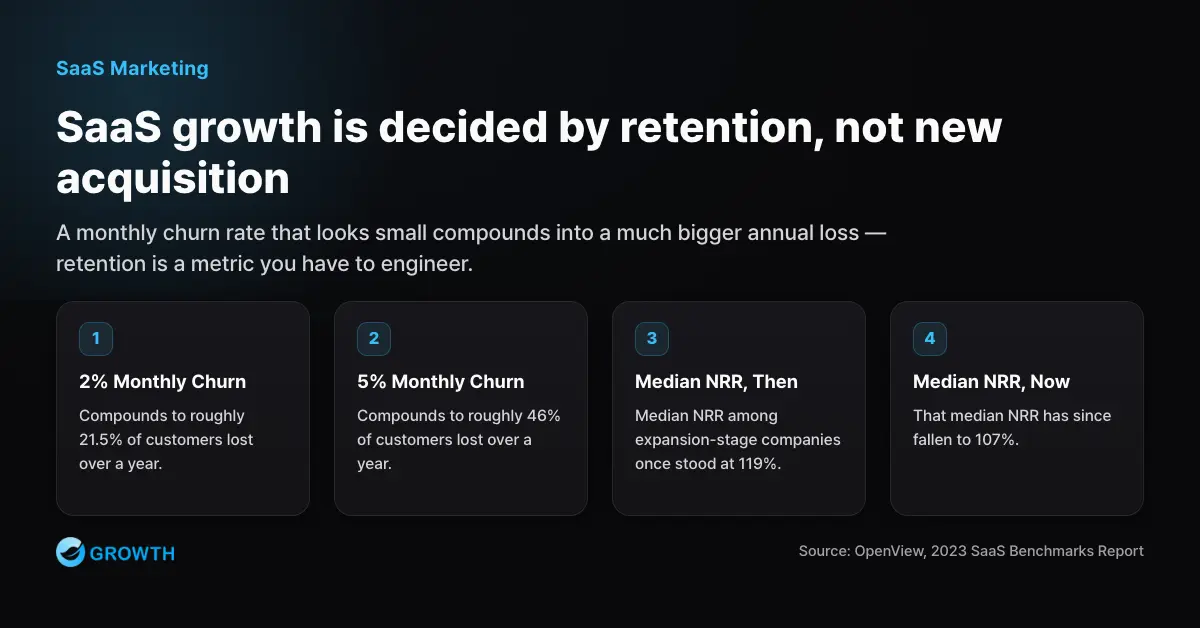
So in SaaS, the very way you measure churn has to be precise. In its 16 Startup Metrics, a16z insists on always separating gross churn (the revenue actually lost each month) from net revenue churn (churn offset by upsell). Look only at net churn and expansion revenue from existing customers can mask the churn loss, so leadership discovers a leaking bucket far too late. The market makes retention harder too. According to OpenView’s 2023 SaaS Benchmarks Report (a survey of 710 SaaS operators), median NRR among expansion-stage companies fell from 119% to 107%. Retention is no longer something handed to you for free; it is a metric you have to engineer.
The customer journey continues after the contract
The traditional marketing funnel ends at purchase, but a SaaS customer journey runs through awareness, evaluation, purchase, onboarding, activation, expansion, renewal, and referral, with the larger share of revenue arising in the post-purchase stages. The basic framework for how customers explore and decide is covered in our guide to growth-led B2B strategy, but SaaS adds one thing: an entire “post-contract journey” layered on top.
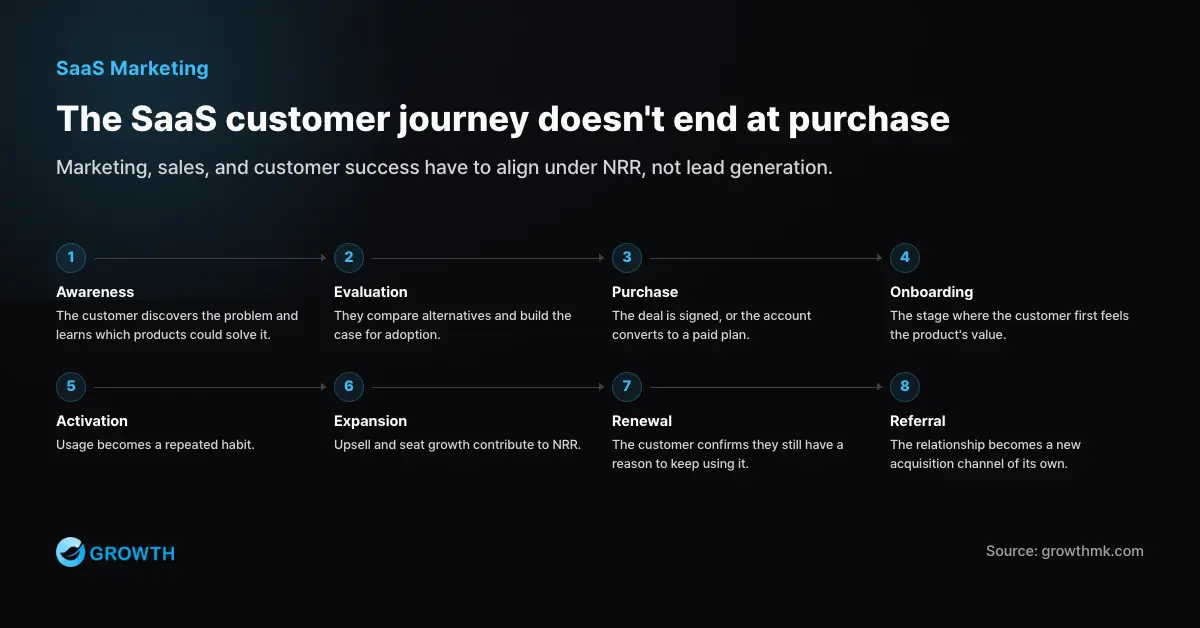
In this structure, marketing, sales, and customer success cannot operate in separate silos. If a customer marketing brought in fails to feel value during onboarding and churns, the entire marketing investment turns into a loss. That is why mature SaaS organizations align all three teams under a journey-spanning metric like NRR rather than departmental metrics. A SaaS marketer’s scope of responsibility does not end at lead generation; it continues until that lead becomes revenue that stays.
The SaaS core metrics system: CAC, LTV, payback, and NRR
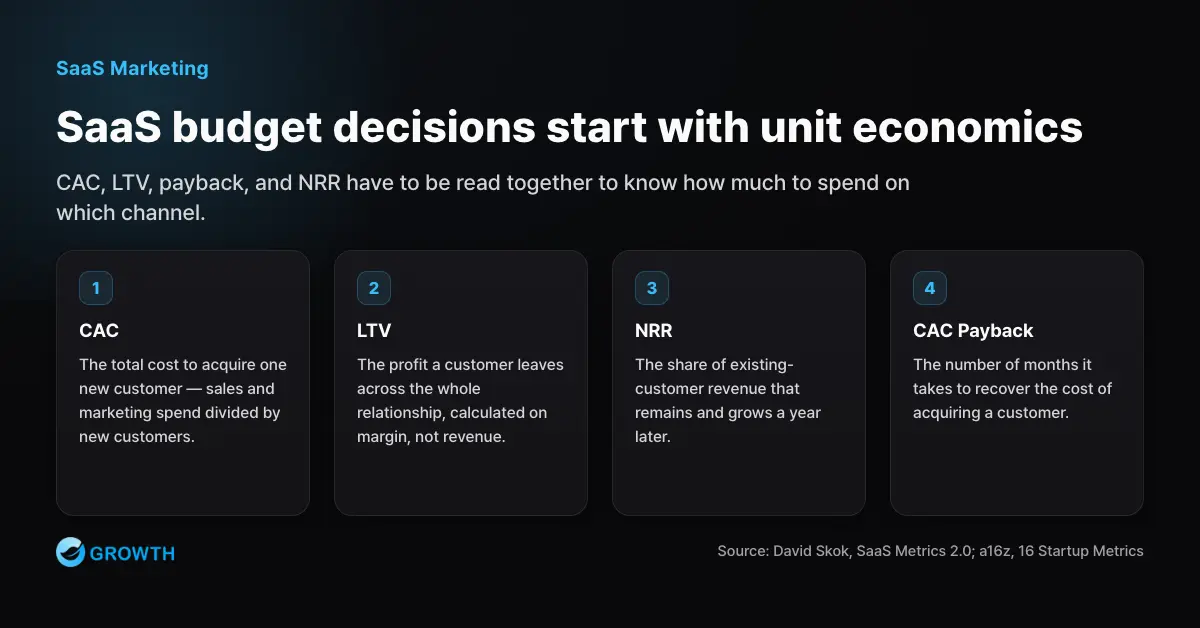
SaaS marketing decisions should start from unit economics, not gut feel. Once you know how much it costs to acquire one customer (CAC), how much that customer is worth over their lifetime (LTV), how many months until your investment returns (payback), and whether revenue from existing customers grows on its own (NRR), the question of how much to spend on which channel becomes a calculation rather than an argument. Getting just five metrics right changes the entire quality of your marketing budget meetings.
The five metrics: definitions and benchmarks
| Metric | Definition | Formula | Reference benchmark |
|---|---|---|---|
| CAC (customer acquisition cost) |
Total cost to win one new customer (one account) | (Sales + marketing spend) ÷ number of new customers | No absolute target — judge alongside LTV and payback (HubSpot) |
| LTV (lifetime value) |
The profit one customer leaves across the whole relationship | (Monthly revenue per customer × gross margin) ÷ monthly churn rate | Calculate on margin, not revenue (a16z) |
| LTV:CAC | Lifetime value as a multiple of acquisition cost | LTV ÷ CAC | 3 or higher; the best companies reach 7–8 (David Skok) |
| CAC payback | Time to recover acquisition cost | CAC ÷ (monthly revenue per customer × gross margin) | 5–7 months for strong companies; past 12 months is a warning sign (David Skok) |
| NRR (net revenue retention) |
How much revenue from an existing customer cohort remains and grows a year later | (Cohort’s current MRR ÷ MRR 12 months ago) × 100 | For SMB/mid-market, 90% is acceptable and 110% strong; for enterprise, 110% acceptable and 130% best-in-class (Lenny Rachitsky) |
Three cautions. First, the numerator of CAC must include not just ad spend but sales and marketing salaries, fees, content production costs, and tooling. HubSpot’s definition explicitly lists salaries, commissions, and software costs within the scope of CAC. A CAC calculated from ad spend alone comes out smaller than reality and distorts your channel-scaling decisions. Second, do not calculate LTV on revenue. a16z defines LTV as “the net profit a customer leaves over the entire relationship,” and names confusing it with revenue as the single most common error it sees in investment reviews. Third, look at gross revenue retention (GRR, retention excluding upsell) alongside NRR. If NRR is above 100% but GRR is low, a handful of customers’ expansion is hiding the churn of many.
A worked example: a hypothetical B2B SaaS, “Company A”
The numbers make it concrete. Assume a hypothetical B2B SaaS, Company A, selling a collaboration tool.
| Input | Value | Derived metric | Result |
|---|---|---|---|
| Monthly sales + marketing spend | $50,000 | CAC | $50,000 ÷ 20 = $2,500 |
| New customers per month | 20 accounts | ||
| Average monthly revenue per account (ARPA) | $300 | CAC payback | $2,500 ÷ ($300 × 0.75) = 11.1 months |
| Gross margin | 75% | LTV | ($300 × 0.75) ÷ 0.02 = $11,250 |
| Monthly customer churn | 2% | LTV:CAC | $11,250 ÷ $2,500 = 4.5 |
Here is the diagnosis. The LTV:CAC of 4.5 clears the benchmark of 3, but the payback of 11.1 months is right up against the 12-month danger line. That means cash to reinvest in growth is tied up for nearly a year, so Company A’s next-quarter priority is not “more ad spend” but shortening payback. There are two paths. Improve onboarding to drop monthly churn from 2% to 1.5%, and LTV jumps to $15,000 and LTV:CAC to 6.0; or lift ARPA through expansion revenue, and payback shrinks directly. When the metrics system is in place, “what to fix first” stops being a debate and becomes the output of a calculation.
An NRR example: if a customer cohort with combined MRR of $10,000 twelve months ago has since lost $1,500 to churn and $500 to downgrades while adding $3,000 in upsell, current MRR is $11,000 and NRR is 110%. That same cohort’s GRR is 80%, so you can see this company has the profile of “good at expansion but weak on churn defense.”
The trap of averages: slice by cohort and segment
Company-wide average CAC and average churn are nearly useless for decision-making. a16z advises that to judge the efficiency of paid channels you should look at paid CAC isolated by channel, not a blended CAC that lumps in all costs, and that you should confirm future retention with actual cohort data rather than assumptions. When organic inflows are mixed in, a blended CAC creates the illusion that ad efficiency is better than it really is.
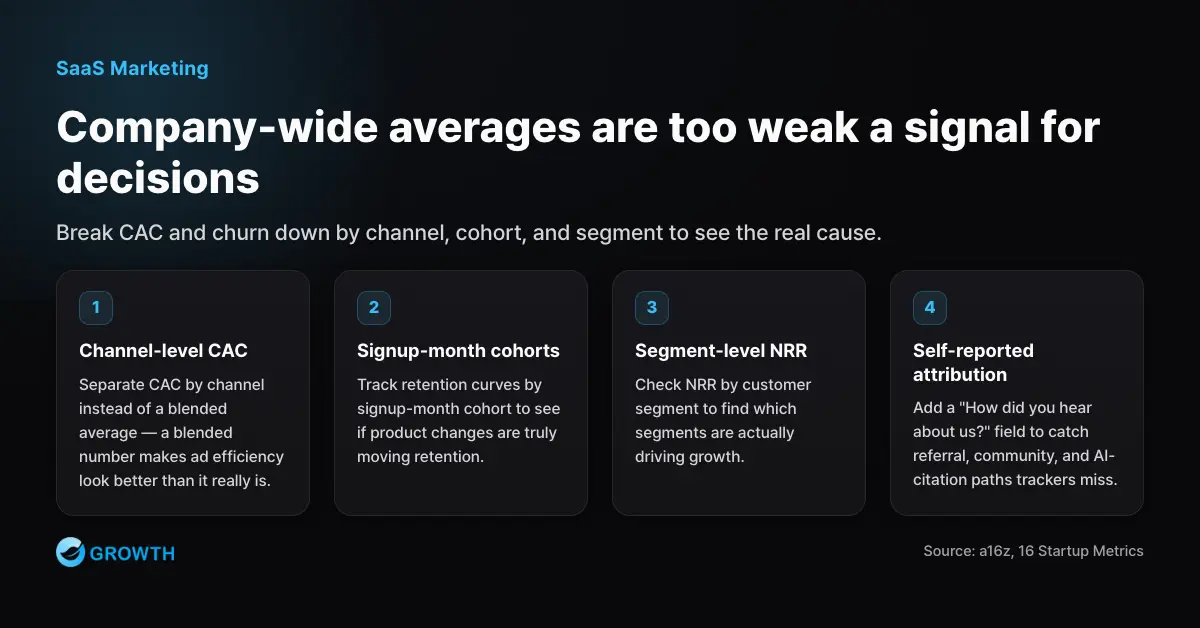
In practice we recommend decomposing along at least three axes: CAC by channel (which channel brings in customers who actually pay back), retention curves by signup-month cohort (whether product improvements are genuinely moving retention), and NRR by customer segment (which customer groups are the ones that grow). This decomposition requires a tracking system that connects signup, billing, and usage data, and that is the point at which SaaS marketing becomes a data-science discipline.
Attribution demands the same caution. B2B SaaS purchase journeys are long with many touchpoints, so allocating performance on last-click alone systematically undervalues asset-type channels like content and SEO that built trust early in the evaluation. Read first-touch and mid-touch data together, and add a self-reported “How did you hear about us?” field to the signup form, and you can correct for paths the measurement tools miss (referrals, community, citations in AI answers).
PLG vs SLG: which growth model should you choose?
With the metrics system in place, the next question is the growth model. SaaS customer acquisition breaks down broadly into product-led growth (PLG) and sales-led growth (SLG), and this choice cascades into organizational structure, pricing, and marketing channels.
Defining the two models
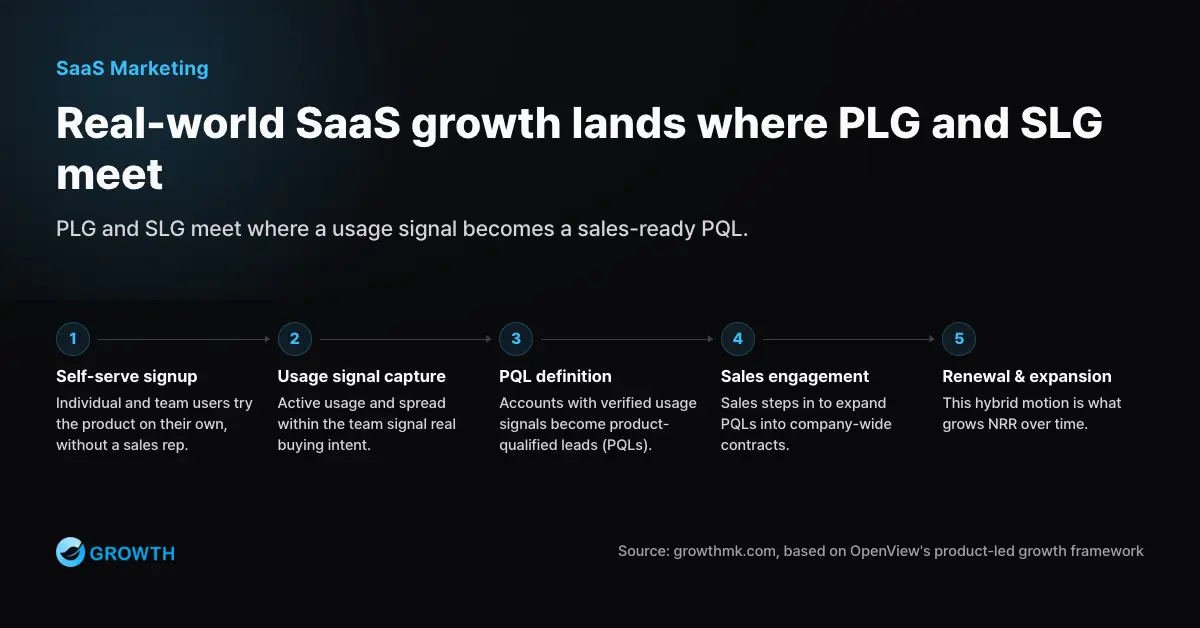
According to OpenView’s definition, PLG is “an end-user-focused growth model that relies on the product itself as the primary driver of customer acquisition, conversion, and expansion.” Users sign up directly without going through a sales rep, try the product, feel its value, then pay, and usage spreads within the team. Slack, Zoom, and Atlassian are the canonical examples, with a free trial (time-limited) or freemium (a plan that opens core features at no cost) as the entry mechanism. OpenView lists the preconditions for PLG as removing friction from signup and onboarding, delivering value before asking for payment, and hiring the sales team last.
SLG is the reverse: the sales organization drives growth. Marketing generates leads, sales runs meetings, demos, proposals, and negotiation to close, and a dedicated team owns onboarding after the deal. It is the standard model for enterprise SaaS, where contract values are large and several departments are involved in the buying decision.
| Dimension | PLG (product-led) | SLG (sales-led) |
|---|---|---|
| First customer touchpoint | Self-serve signup (trial / freemium) | Sales meeting / demo request |
| Buying decision-maker | End user → team → company (bottom-up) | Decision-maker / buying committee (top-down) |
| Conversion mechanism | In-product onboarding, usage limits, upgrade prompts | Proposals, PoC, contract negotiation |
| CAC structure | Product and content investment, low marginal cost | Sales headcount, high cost per deal |
| Suitable ACV | Low to mid (a price point self-serve can recover) | High (a price point that supports sales cost) |
| Onboarding | Solved inside the product so users feel value themselves | Dedicated staff support setup and training |
| Key leading indicators | Activation rate, PQL (product-qualified leads) | SQL, pipeline value, win rate |
| Examples | Slack, Zoom, Atlassian | Traditional enterprise software sales |
The decision matrix: judge on ACV and onboarding complexity
Which side fits is not a matter of taste but a function of two variables. Is the annual contract value per account (ACV) large enough to support a sales cost, and is onboarding simple enough that a customer can feel value without help?
| Dimension | Simple onboarding (self-serve possible) | Complex onboarding (deployment support needed) |
|---|---|---|
| Low ACV | PLG fits. Self-serve minimizes acquisition cost so the unit economics hold | Danger zone. A low price can’t recover onboarding cost — raising price or simplifying onboarding must come first |
| High ACV | Hybrid fits. Use PLG to gather users and let sales expand into company-wide contracts (product-led sales) | SLG fits. Enterprise sales and dedicated onboarding are the standard |
The cell to watch is the bottom-left danger zone. A product with a low price but complex deployment will not make the unit economics work under any growth model. Here, adding marketing is not the answer; the product-level decision comes first: raise price and move to SLG, or simplify onboarding and move to PLG. This is the classic moment where a marketing diagnosis leads into a product-strategy diagnosis.
Free trial vs freemium: how to choose your entry mechanism
If you’ve chosen PLG, you have to design the entry mechanism. Even within self-serve, free trials and freemium work on different principles.
| Dimension | Free trial (time-limited) | Freemium (permanent base plan) |
|---|---|---|
| Suitable product | Short time-to-value, where value is complete even when used solo | Collaboration or network products where value grows with more users |
| Strength | A deadline speeds the decision and makes the conversion point clear | Minimal entry barrier; team spread builds a latent pipeline |
| Risk | If the core value isn’t experienced within the window, the lead is lost | Infrastructure and support cost; weak upgrade drivers leave users on the free plan forever |
| Key metric to manage | Trial-to-paid conversion, activation rate | Free-to-paid conversion, seat expansion per account |
Either way the precondition is the same: OpenView’s PLG principle of “deliver value before asking for it” has to actually work. If the product is one where the trial gets spent on setup alone, the answer isn’t to extend the window but to shorten the path to first value; and if it’s freemium with a weak upgrade driver, you have to redraw the plan boundaries (usage, features, seats) using data.
Reality converges on hybrid
PLG and SLG are not an either/or. Many mature PLG companies attach a sales team to deals above a certain size, defining accounts that show buying signals in usage data as PQLs (product-qualified leads) and passing them to sales. Conversely, SLG companies adopt trial environments and self-serve demos to make the product do work before sales engages. And PLG is no silver bullet, which the data confirms: in OpenView’s 2023 benchmarks, the median growth rate of PLG companies fell from 45% to 29%. A model only determines the structure; it does not guarantee the result. Performance comes from the value the product delivers and the quality of execution in delivering it.
Stage-by-stage SaaS marketing strategy: pre-PMF, early traction, expansion
Even within the same SaaS, the right marketing differs by stage. The most common waste is activity that doesn’t match the stage: burning ad budget before product-market fit (PMF) is even confirmed, or still relying on the founder’s network for sales after entering the expansion phase.
| Stage | Core question | Core metrics | Marketing priority | What to avoid |
|---|---|---|---|---|
| Pre-PMF | Does anyone genuinely struggle without this product? | Flattening of the retention curve, qualitative feedback | Customer interviews, early-user acquisition, problem-focused content | Scaling paid ads, scaling headcount |
| Early traction | Is there a repeatable acquisition formula? | CAC by channel, activation rate, payback | Focused validation on 1–2 channels, experiment design, securing case studies | Spreading across many channels at once, relying on average metrics |
| Expansion | Do retention and expansion revenue carry the growth? | NRR, LTV:CAC, retention by segment | Building content hubs and SEO assets, channel diversification, designing expansion revenue | Chasing new acquisition while neglecting retention, zero brand investment |
Pre-PMF: this is not the stage to scale marketing
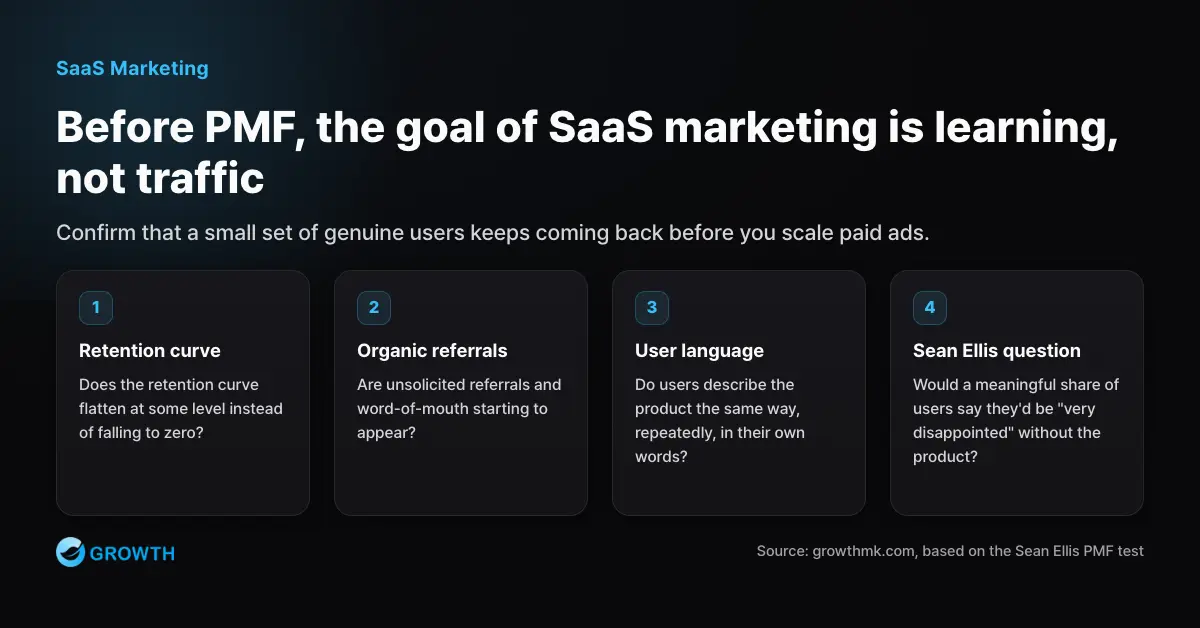
The goal at this stage is learning, not traffic. The whole task is confirming whether a small set of genuine users keeps using the product (at what point the cohort retention curve flattens) and how they describe the product in their own words. The signal of PMF usually appears when three things overlap: the retention curve flattens at some level instead of falling to zero, unsolicited referrals and word-of-mouth start appearing, and a meaningful share of users answer “very disappointed” to the survey question “How would you feel if you could no longer use this product?” (the Sean Ellis test). Marketing here amounts to going directly where target customers gather, plus a few pieces of content addressing the problems they search for. Scale paid ads in this period and you simply pour traffic onto a product without PMF, stacking up nothing but churn data.
Early traction: find a repeatable formula in one or two channels
Once the PMF signal appears, it’s time to validate “which channel, at what cost, brings which customers.” The key is not to spread across many channels at once but to spin the cycle of hypothesis, experiment, measurement, and learning quickly in one or two channels. This experiment-design methodology is covered in detail, alongside the AARRR framework, in our guide to what growth hacking is. The output of this stage is less the revenue itself than a validated acquisition formula with proven CAC and payback by channel, plus the early customer case studies that will become ammunition for sales and content in the next stage.
Expansion: shift to a balance of new acquisition and retention/expansion
The growth formula in the expansion phase is “new MRR + expansion MRR − churned MRR.” A company that grows on new acquisition alone and a company backed by 110% NRR draw completely different curves on the same marketing budget. At this stage you scale the budget of validated channels while also investing marketing capability into the post-contract journey: onboarding improvements, usage spread, and upsell scenarios. Content, too, should move beyond individual articles into topic hubs (topic clusters) structured to compound as search assets.
Expansion revenue does not happen by accident. Set data-defined upsell triggers in advance, such as accounts approaching a plan’s usage limit, accounts whose seat count is climbing fast, or accounts that repeatedly view features exclusive to a higher tier, and design in-product guidance and rep outreach to fire automatically when those signals occur. Just as you might propose a value review 90 days before a renewal date, churn defense in the expansion phase should run on signals rather than the calendar.
Why are content and SEO the core channels for SaaS?
The starting point for channel strategy is alignment with unit economics. SaaS is a business where LTV forms over a long horizon, so channels that look expensive now but get cheaper over time are structurally advantageous. That is exactly why content and SEO became the standard channels of SaaS.
Ads are rent; content is an asset
Paid advertising is a rental channel: stop spending and the inflow stops. Every customer you bring in incurs cost again, and as competition increases, bid prices rise and CAC tends to climb over time rather than fall. Content and SEO, by contrast, are paid for upfront only; an article that earns a top search position keeps generating inflow for years at no additional cost. As articles accumulate, the topical authority of the whole site rises and new articles rank faster too, a textbook compounding structure. As a result, the more a SaaS leans on asset-type channels, the more its blended CAC falls over time, buying longer growth on the same budget.
| Channel | Nature | CAC trajectory | Suitable stage | Note |
|---|---|---|---|---|
| Content / SEO | Asset | Falls over time | Early traction to expansion (start early) | Takes months to pay off — recoverable because SaaS LTV is long |
| GEO (AI search optimization) | Asset | Strong early-mover advantage | All stages | Structuring content to be cited in AI answers is key |
| Paid search / social ads | Rental | Rises as competition intensifies | Channel validation, demand capture, retargeting | Strength is speed of message and segment validation |
| Outbound / sales development | Rental (headcount) | High cost per deal, justified at high ACV | SLG / enterprise | Quality of target-account selection decides success |
| Community / referral / word-of-mouth | Asset | Very low | PLG, all stages | Requires product satisfaction — limited ability to engineer artificially |
| Review platforms / directories | Semi-asset | Low | Capturing the comparison/evaluation stage | A trust-verification channel for customers right before purchase |
This does not mean rental channels are unnecessary. Paid ads are still effective for quickly validating message and segment and for capturing demand right before purchase, and they fill the gap while asset-type channels grow. But once ad dependence sets in, the cost structure starts eating into growth. We cover that mechanism, and how to overcome it, separately in our guide to performance marketing pitfalls.
In B2B SaaS, lead quality beats lead quantity
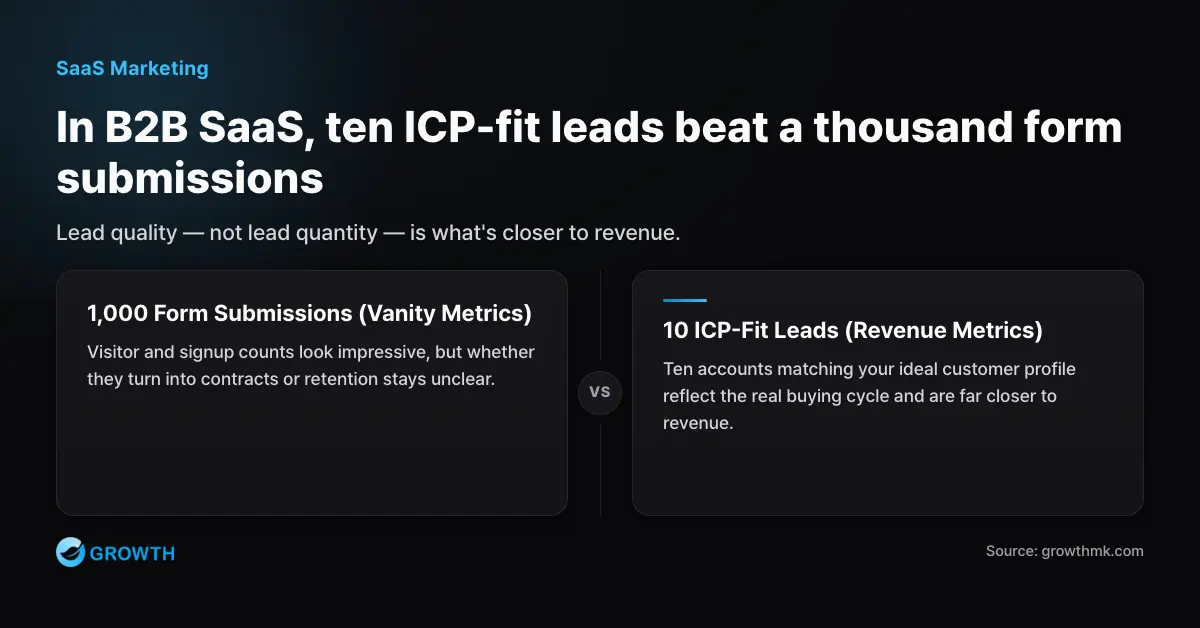
B2B SaaS purchases have long evaluation cycles and involve multiple stakeholders, so marketing performance must be measured not by visitor count but by “how many leads that lead to contracts and retention you brought in.” Ten leads that match your ICP (ideal customer profile) are closer to revenue than 1,000 form submissions. Aligning content topics and conversion design around the one person who becomes revenue, rather than the volume of traffic, is the essence of B2B SaaS content strategy. The concrete methods for raising lead quality are laid out in our piece on B2B lead generation, and the higher-level strategy spanning channels, ABM, and measurement is handled through our B2B marketing service.
Fill content topics from purchase-near keywords first
The most common mistake when starting content and SEO is attacking high-volume generic keywords first. An early-stage SaaS has limited content resources, so you should fill in order of fastest payback. The recommended sequence runs from the bottom of the funnel upward.
- Bottom-of-funnel (BOFU) keywords: “comparison, alternative, pricing, implementation.” Searches like “[product] alternative,” “[product] vs [product],” and “[product] pricing” are low in volume but come from people already evaluating a purchase. A keyword with a search volume of 10 that converts even one person into a contract is closer to revenue than an informational keyword with a volume of 10,000.
- Middle-of-funnel (MOFU) keywords. The stage where people search the problem your product solves; design the content so the product naturally becomes part of the answer within the solution.
- Top-of-funnel (TOFU) keywords. High-volume topics like category and concept definitions should be attacked after domain authority has accumulated, so that both ranking probability and payback improve.
This sequence applies the “one customer who becomes revenue over the volume of traffic” principle directly to the content roadmap. For the same reason, content performance reporting should be designed around content-attributed signups and pipeline contribution, not pageviews.
The AI search era: content cited in comparison and recommendation answers
“Alternative discovery,” the entry point of the SaaS purchase journey, is steadily migrating to generative AI. In an environment where AI directly composes answers to questions like “recommend a collaboration tool” or “which is better, A or B,” the new competitive edge is not only search ranking but whether your product and content are cited in the AI’s answer. Structured content with comparison tables, definitions, and evidence data is favored for citation, and this optimization methodology is covered systematically in our guide to how Google’s AI Overviews affect SEO. Because companies that have built up SEO assets face a lower cost of converting to AI-search optimization, content investment compounds twice over.
Expanding SaaS into the Korean market
Korea is one of the highest-value SaaS expansion markets in Asia Pacific, and also one of the most frequently misread. Generic global playbooks tend to stumble here. As a Seoul-based growth team, this is the home-market context we work in every day, and there are three structural conditions worth knowing before you allocate budget to entering Korea.
A fast-growing but still small market — size the gap before you size the spend
Korea’s domestic SaaS market is roughly 0.5% of the global SaaS market in scale, according to Digital Daily’s reporting. Yet the growth rate is the headline: domestic SaaS revenue grew about 24% year over year, outpacing the roughly 18–20% global average. In other words, Korea is a “growing fast but still small” market, and that very gap is what makes it an opportunity rather than a saturated battleground. For a foreign SaaS company, the implication is to size the addressable segment realistically before committing spend: a market that is small in absolute terms but expanding quickly rewards early positioning more than aggressive volume.

Enterprise buying culture leans sales-led
This is the condition foreign SaaS companies most often underestimate. Analysis from the Software Policy & Research Institute (SPRi) characterizes Korea’s traditional software market by a customer base centered on large enterprises and government bodies, direct face-to-face sales and consulting-led selling, long-term relationship building, and a near-default expectation of contract negotiation and customization. That buying culture carries substantially into how Korean enterprises evaluate SaaS: domestic enterprise customers frequently require proposals, demonstrations, security reviews, and reference checks before adoption. In regulated industries such as public sector and finance, security certifications and data-residency requirements can be a precondition of purchase.
So a foreign SaaS targeting Korean enterprises will frequently find that pure PLG cannot close the deal. The realistic combination is to win trust early in the evaluation through content and search, and let sales close, in a hybrid motion. Because multiple departments are involved in the decision, it is effective to prepare deep practitioner-level material and a separate business case for decision-makers. A multi-touch, ABM-oriented approach tends to outperform single-channel advertising here, which is the higher-level strategy our B2B marketing service is built around.
Three practical implications for market entry
- Localize beyond translation. SPRi names multilingual and multinational support, data-protection compliance (such as GDPR), flexible pricing, and effective local marketing as the core elements of successful expansion. Korean-language content earns domestic trust; it is not a literal copy of your English assets but a parallel build that reflects local search intent.
- Split the growth model by market. Korean enterprises skew SLG while a global self-serve base skews PLG, so even the same product may need a different model mix depending on the market it is entering.
- Treat the local SERP’s translation gap as an opening. Korean-language search results for SaaS marketing topics are heavily translated and summarized from overseas material, which leaves room for original content grounded in genuine Korean-market context to claim authority early.
Seven common SaaS marketing failure patterns
Finally, here are the failure patterns we observe repeatedly in the field, with their symptoms and the corrective direction. Most are not problems of channel or creative but of structure and sequence.
| Failure pattern | Symptom | Corrective direction |
|---|---|---|
| 1. Pouring water into a leaky bucket | New signups rise but MRR stays flat | Diagnose churn causes and improve onboarding before scaling acquisition (retention first) |
| 2. The blended-CAC illusion | Ad reports look good but cash is drying up | Isolate paid CAC; measure payback by channel |
| 3. Overstated LTV | LTV:CAC looks good but losses persist | Recalculate LTV on margin, not revenue |
| 4. Over-marketing before PMF | Plenty of traffic but the retention curve falls to the floor | Pause ads; return to customer interviews and product improvement |
| 5. Growth-model mismatch | High-cost sales on a low-priced product, or self-serve only on a complex product | Realign the model with the ACV × onboarding matrix |
| 6. Lead-quantity-centric reporting | MQL targets hit, but revenue contribution is unclear | Swap metrics for ICP-fit leads, pipeline value, and win contribution |
| 7. Abandoning asset channels too early | Declaring content “ineffective” after three months | Evaluate asset channels on an annual, not quarterly, basis; track leading indicators (ranking, citations, conversions) |
The common denominator across all seven is the absence of a measurement system. Without tracking you get fooled by averages, and when you’re fooled by averages budget goes to the wrong place. Conversely, when measurement stands at the cohort, segment, and channel level, most of the patterns above are caught early in a quarterly review. SaaS marketing’s edge comes not from flashy campaigns but from a data system that sees the truth faster than everyone else.
Frequently Asked Questions (FAQ)
What percentage of revenue should a SaaS marketing budget be?
We don’t recommend a flat percentage rule. The same percentage means different things depending on stage (pre-PMF vs expansion) and growth model (PLG vs SLG). Instead, work backward from guardrail metrics: scale budget only on validated channels, within the range where CAC payback stays under 12 months and LTV:CAC holds at 3 or higher. If payback is short and retention is solid, you can spend aggressively; if the reverse, the problem is the unit economics, not the budget size.
What is a good LTV:CAC ratio?
The widely used benchmark is the 3:1 or higher that David Skok proposed, with the best SaaS companies reaching 7–8. Two caveats apply, though. Early-stage companies often fall short of the benchmark, so the trend of improvement matters more than the absolute figure; and a ratio that is too high (say, above 10) can actually signal underinvestment in growth. LTV:CAC should also always be read together with CAC payback — a great ratio still drains cash if recovery is slow.
Do I have to choose only one of PLG or SLG?
No. The two models are not mutually exclusive, and many mature SaaS companies run a hybrid. A common approach is to gather individual and team users via self-serve, then have sales engage accounts that show buying signals in usage data (PQLs) and grow them into company-wide contracts. The deciding factors are ACV and onboarding complexity: low price and simple onboarding favor a higher PLG share, while high price and complex deployment favor a higher SLG share, which is what the unit economics support.
What does it mean when NRR exceeds 100%?
It means that even without adding a single new customer, upgrade and expansion revenue from existing customers outweighs churn loss, so company revenue grows on its own. As a benchmark, 110% is strong for SMB and mid-market SaaS, while for enterprise SaaS 110% is acceptable and 130% is best-in-class. But even a healthy NRR can hide trouble: if gross revenue retention (GRR) is low, a few customers’ expansion is masking the churn of many, so the two metrics should always be checked together.
What should a foreign SaaS company do first when entering the Korean market?
Build the measurement system first. Connect signup, billing, and usage data so you can see CAC, payback, and cohort retention by channel, then define your ICP for the Korean market and decide the growth model (PLG, SLG, or hybrid). On channels, start with asset-type channels like content and SEO that take time to pay off — and because Korean enterprises lean sales-led, plan Korean-language content as a parallel build (not a translation of your English pages) so it reflects local search intent and buying culture from the start.
Why is retention more important than acquisition in SaaS?
Because SaaS revenue accrues over the usage period, not at signing. The first month’s fee recovers only a fraction of CAC, so a customer has to stay 5–7 months just to repay acquisition cost, and the profit comes only afterward. Churn also compounds: 5% monthly churn erases roughly 46% of customers in a year, so on the same acquisition budget, a company with strong retention and one with weak retention draw entirely different revenue curves twelve months later. That is why retention, expansion, and NRR sit at the center of SaaS marketing.
For a fuller picture of where this fits, browse the SaaS marketing topic hub, which collects the related guides in this cluster.
Diagnose your growth model
Growth, Inc. designs and runs the methodology in this guide end to end — from building the metrics system for B2B and SaaS companies, to constructing content and SEO assets, to running lead-quality-centric campaigns — through our B2B marketing service. If you’d like a diagnosis of the growth model that fits your stage and market, including expansion into Korea, get in touch with our team.