How to Choose a SaaS Marketing Agency: 5 Evaluation Criteria and Questions to Ask
 임재복
임재복
When choosing a marketing agency for a B2B SaaS startup, the real question isn’t “are they good at ads or content?” — it’s “do they understand our subscription economics and unit economics, and can they define success by paid conversion and pipeline contribution rather than free-trial signup counts?” SaaS isn’t a sell-once business; it’s a subscription business with monthly renewals, expansion, and churn, so whether an agency can talk fluently in CAC (customer acquisition cost), NRR (net revenue retention), and CAC payback period is what separates the good ones from the rest. A strong SaaS marketing agency is defined by five things: ① understanding SaaS metrics (can they talk CAC and NRR?), ② defining success around pipeline contribution (not raw trial or MQL counts), ③ content and SEO capability (a compounding asset for subscription businesses), ④ product understanding and onboarding process, and ⑤ a connected measurement stack. This article is a decision guide built around those five criteria, with a table of questions you can ask verbatim in a meeting.
What sets SaaS marketing apart from general marketing
Even though it’s called “marketing” either way, SaaS plays by different rules than general product or service marketing. Before we get into the evaluation criteria, here are three reasons why you shouldn’t judge a SaaS agency by general-agency standards. The bigger picture of B2B buying structure is covered in our complete guide to B2B marketing; here we’ll focus only on what directly matters for choosing a SaaS agency.
First, the metrics system is different — it’s not one sale, it’s the whole subscription lifetime
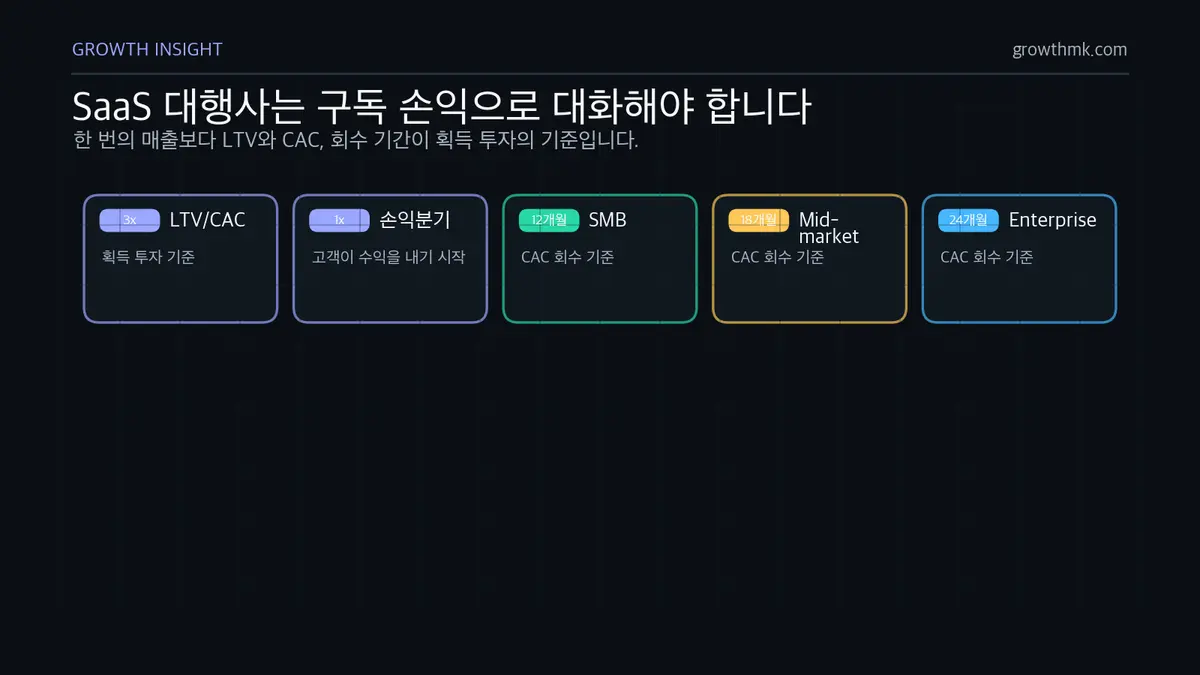
For a regular product, the story ends at “sold.” For SaaS, it begins the moment a customer signs up. They renew every month, expand through upsells, and some churn. So SaaS health isn’t measured by a one-time sale — it’s measured by how much, and how fast, the revenue earned over a subscriber’s entire lifetime (LTV) exceeds the cost of acquiring them (CAC). Industry benchmarks suggest an LTV/CAC ratio of 3x or higher is worth investing in for acquisition, and 1x is merely the point where a customer starts becoming profitable (Source: Bessemer Venture Partners, SaaS Benchmarks). The same source considers a healthy CAC payback period to be under 12 months for SMB, under 18 months for mid-market, and under 24 months for enterprise. An agency that can’t hold a conversation around these numbers doesn’t understand SaaS unit economics.
Second, the funnel is different — there’s a free-trial or freemium conversion stage in the middle
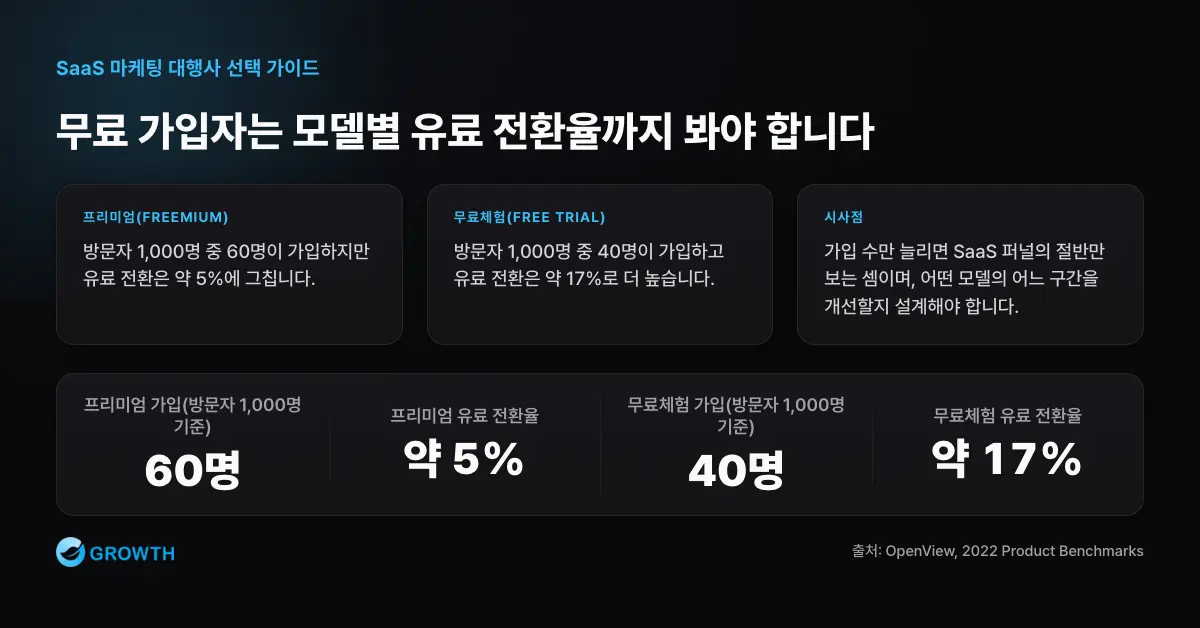
A typical B2B lead funnel runs “awareness → lead → consultation → contract,” but SaaS has a distinct stage wedged in the middle: free trial or freemium → paid conversion — and the conversion rate at this stage varies dramatically by model. According to OpenView’s product benchmark research, out of 1,000 visitors, freemium models see about 60 signups but only around 5% convert to paid, while free-trial models see about 40 signups with roughly 17% converting to paid (Source: OpenView, 2022 Product Benchmarks). In other words, “let’s get more signups” is only half the story in SaaS. An agency that can’t design which stage of which model to improve is leaving the core of the SaaS funnel untouched.
Third, content becomes an asset — not traffic that vanishes the moment you turn off the ads
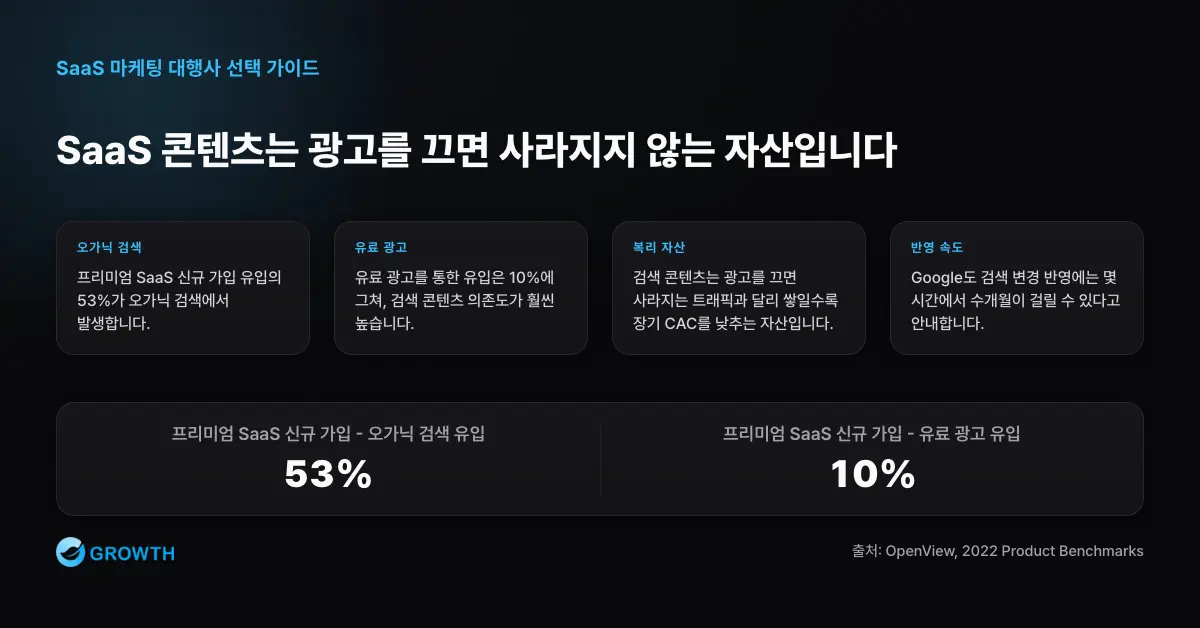
SaaS buyers do their own research and shortlist candidates long before ever talking to sales, and they keep searching for how-tos and use cases even after adopting a product. So search and content aren’t “traffic that disappears when you turn off the ads” — they’re “an asset that compounds the more it accumulates.” In fact, that same OpenView study found that 53% of new signups for freemium-based SaaS came from organic search, while paid ads accounted for only 10% (Source: OpenView, 2022 Product Benchmarks). Unlike a general agency that leans heavily on paid ads, for SaaS it’s the ability to build up a search asset that determines long-term CAC. That asset does take time, though — even Google notes that search changes can take “anywhere from a few hours to several months” to show up (Source: Google Search Central).
In short, a SaaS agency should be evaluated not by “how fast can they drive reach” but by “can they understand subscription P&L, turn free signups into paid revenue, and compound a search asset over time.” Now let’s look at the five criteria that verify those capabilities.
Five criteria for evaluating a SaaS marketing agency
The five criteria below are the things that determine SaaS success or failure — the ones a typical “nice portfolio, fair pricing” checklist misses. For each one, we’ve laid out questions you can ask verbatim in a meeting, in table form. If an agency dodges the question or just says “it depends on the case,” that’s a signal their capability in that area is weak. (For B2B-wide criteria like industry understanding and sales alignment, see our complete guide to B2B marketing alongside this one — here we focus on SaaS-specific items.)
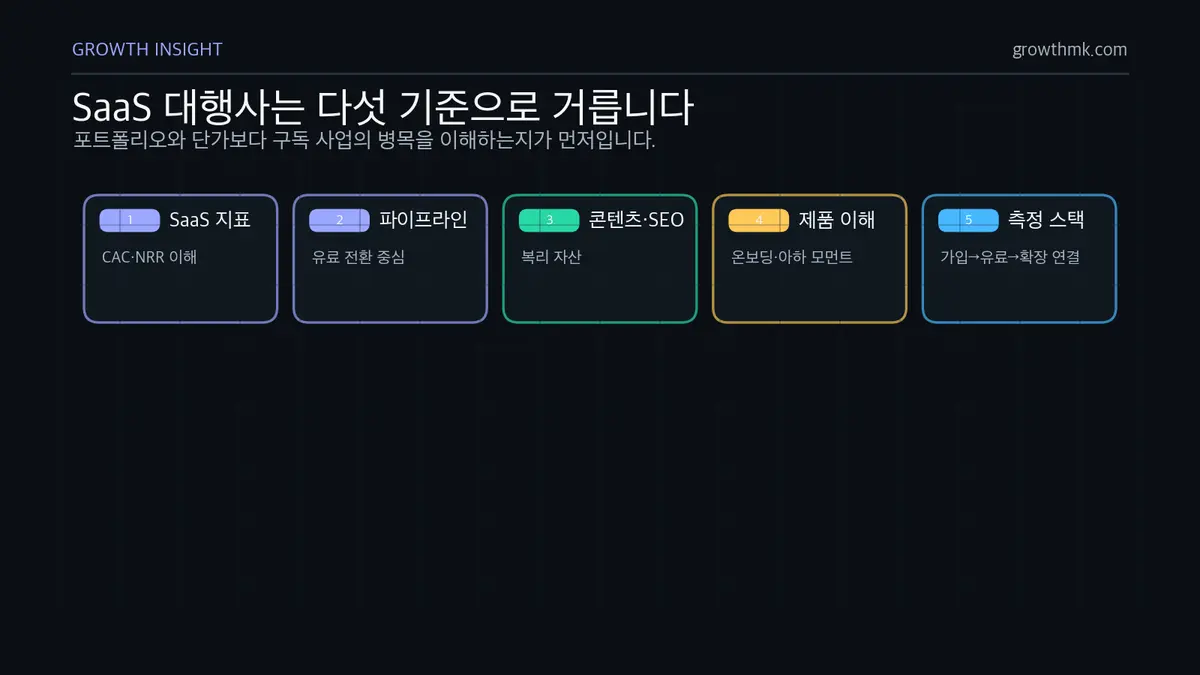
Criterion 1. Understanding SaaS metrics — can they talk CAC and NRR?
The fastest litmus test for filtering SaaS agencies is whether they naturally ask, in the first meeting, “what’s your NRR right now?” or “how do you view your CAC payback period?” NRR (net revenue retention) is the share of revenue a company’s existing customer base retains a year later, after renewals, expansion, and churn — a key metric showing whether your growth engine is leaking or filling up. Benchmarks show that companies with under $10M ARR average around 140% NRR, with gross retention around 85–90% (Source: Bessemer Venture Partners, SaaS Benchmarks). A good agency doesn’t just understand these metrics — they can tell you whether a given activity is contributing to new acquisition (CAC) or to retention and expansion (NRR). The definitions of SaaS metrics and the underlying experimental mindset are also covered alongside the AARRR framework in our growth hacking guide.
| Question to ask | Signal of a good answer |
|---|---|
| Could you ask us about our NRR and CAC payback period first? | They ask for the metrics first, then propose a strategic direction (acquisition vs. retention) that fits the numbers |
| Does what you do contribute to CAC or to NRR? | They clearly distinguish contributions to new acquisition vs. retention/expansion (not a vague blend) |
| At what LTV/CAC ratio would you suggest scaling up a channel? | They decide based on a specific benchmark like 3x or higher, plus payback period |
| How does strategy change across billing models (monthly/annual, seat-based, usage-based)? | They understand that messaging and conversion design shift depending on the billing structure |
Criterion 2. Defining success around pipeline contribution — not free-trial signup counts
This is the single most important criterion in evaluating a SaaS agency. Many agencies tout “500 free-trial signups a month” or “200 MQLs a month” as results. But free-trial signups or whitepaper downloaders are far removed from actual revenue. As we saw above, even a good free-trial conversion rate is only about 17%, and freemium is around 5% (Source: OpenView, 2022 Product Benchmarks). So bragging about 5,000 signups is meaningless if you can’t see how much of that fed into paid revenue pipeline. This is exactly why Growth talks about “one customer who will actually buy” over “a pile of traffic,” starting right on the homepage. What we need isn’t a free signup count — it’s one customer who will convert to paid.
A good agency agrees with your sales and CS teams, before a campaign even launches, on “what actually counts as success.” For SaaS, that means going beyond free-trial signups to metrics like PQL (Product Qualified Lead — a lead who’s actively used the product and shows high conversion likelihood), paid conversion, and expansion revenue. The broader mindset of running leads by quality rather than volume is laid out in our B2B lead generation guide — worth reading alongside the SaaS-specific free-to-paid stage.
| Question to ask | Signal of a good answer |
|---|---|
| How do you report results? Free signups/MQLs, or paid conversion/pipeline contribution? | They lead with paid conversion, PQL, or pipeline value as the primary metric (signup count is secondary) |
| What signals, among free-trial signups, tell you someone’s likely to convert to paid? | They filter by product-usage signals like active use or reaching a core feature (PQL) |
| Would you focus first on growing signups or on lifting the conversion rate? | They diagnose the funnel bottleneck with data first, then set priorities |
| Which is the better result — 5,000 signups or 50 paid conversions? | They don’t say “more is better” without context — they’re clear about revenue contribution |
Criterion 3. Content and SEO capability — a compounding asset for a subscription business
In SaaS, search and content are a compounding asset that works on both new acquisition and retention. Before purchase, it earns you a spot on the shortlist through problem-aware searches; after adoption, usage and onboarding content helps users reach product stickiness (the “aha moment”) and reduces churn. The fact that 53% of freemium SaaS signups came from organic search, as noted above (Source: OpenView, 2022 Product Benchmarks), shows exactly how much weight this capability carries. So a SaaS agency should be judged less on “can they negotiate good ad rates” and more on “can they build content assets that get discovered and trusted in search.”
SaaS content also needs to be filled with real practitioner depth, not just keyword stuffing, to earn trust. Google’s self-assessment guidance for people-first content asks, “does it clearly demonstrate first-hand expertise and depth of knowledge, such as expertise that comes from having actually used a product or service?” (Source: Google Search Central, Helpful Content). A good SaaS agency draws out your product’s domain expertise into content with this E-E-A-T lens in mind, and keeps an eye on how search is expanding into AI-generated answers.
| Question to ask | Signal of a good answer |
|---|---|
| How long do you expect SaaS search and content to take before it shows results? | They’re honest that it’s a weeks-to-months compounding process (they don’t promise instant results) |
| Do you design pre-purchase content and post-adoption (onboarding/usage) content separately? | They have a process for planning acquisition content and retention content separately |
| How do you draw out our product’s expertise into content? | They ground depth in first-hand sources like product-team interviews and real usage data |
| How do you handle exposure in AI search and generative answers? | They offer concrete methods like structured data and answer-formatted content (not a vague nod to a trend) |
Criterion 4. Product understanding and onboarding process
SaaS marketing can’t be separated from the product. How persuasive the messaging is depends entirely on how precisely the agency understands “what problem the product solves, and how,” and free-trial conversion hinges on how quickly users are guided to core value (the aha moment). So what you need to verify is: “does the agency actually sign up and use our product themselves, hitting the same friction points a real user would?” Just as Google emphasizes “expertise that comes from having actually used it” as a content evaluation criterion (Source: Google Search Central, Helpful Content), an agency that hasn’t used the product can’t communicate its value in the user’s own language. A good agency goes through onboarding themselves at kickoff, and reviews the free-trial flow, activation metrics, and drop-off points together with you.
| Question to ask | Signal of a good answer |
|---|---|
| Do you sign up and actually use our product before we sign the contract? | They go through the free trial themselves and point out friction and strengths from a user’s perspective |
| What do you think our product’s “aha moment” is? | They form a concrete hypothesis about the moment a user first feels the product’s value |
| Where do you think users drop off most during onboarding? | They break the activation funnel into stages and propose bottleneck hypotheses |
| How do you work with our product and CS teams? | They have a structure for working closely with product — interviews, shared usage data, etc. |
Criterion 5. Measurement stack — does the data connect from signup all the way through paid and expansion?
Measuring SaaS success shouldn’t be about “ad clicks” — it should be about “how much did this activity contribute at each stage: free-trial signup → activation → paid conversion → expansion.” That requires web analytics, product analytics, CRM, and billing data to be connected without gaps. This is exactly why Growth emphasizes a data-science, growth-hacking mindset. Without measurement infrastructure, you can’t tell which campaign actually drove paid revenue, and improvement becomes guesswork. A good agency checks tracking design — events, UTMs, in-product activation events, CRM integration — before a campaign even launches. Why tracking setup matters especially for B2B and SaaS is covered in why your tracking setup matters for B2B marketing.
| Question to ask | Signal of a good answer |
|---|---|
| How do you connect the data from free-trial signup through paid conversion and expansion? | They give a concrete explanation of web analytics–product analytics–CRM–billing integration |
| Do you track in-product activation (reaching the aha moment) as an event? | They have a process for defining and instrumenting core activation events |
| Do you review tracking design before launching a campaign? | They set up events, UTMs, and conversion definitions before the campaign begins |
| Do we get direct access to the dashboards? | They provide real-time, transparent reporting (not just a one-page PDF at month’s end) |
Which type of agency fits your stage? — pre-PMF, seed-to-Series A, and scale-up
Even within SaaS, the right agency depends on your stage. A company that hasn’t yet found product-market fit (PMF) and pours budget into large-scale performance marketing ends up “just dumping traffic on a product that doesn’t fit,” while a scale-stage company that only outsources one-off content pieces fails to build a real growth engine. Below is a table of what to prioritize and what type of agency fits at each stage.

| Stage | What actually matters right now | Right type of agency / priority | What to avoid |
|---|---|---|---|
| Pre-PMF (searching for product-market fit) | Finding who buys and why. Validating messaging/positioning, early user interviews | A strategic partner strong in positioning, messaging, and customer interviews. Focused on small experiments | Large-scale paid ad spend (just burning traffic on a product that isn’t a fit yet) |
| Seed to Series A (early growth) | Finding 1–2 repeatable acquisition channels. Establishing the free-to-paid funnel, building the measurement stack | A growth-oriented agency that handles channel experiments, conversion optimization, and content foundations together | Running 5 channels at once (learning doesn’t compound) |
| Scale-up (post–Series B) | Scaling what’s already working, strengthening retention and expansion (NRR), compounding search assets | A full-funnel agency with per-channel expertise, content-as-asset thinking, and sales alignment | Outsourcing one-off content or one-off campaigns (fails to build a growth engine) |
The key is to first define “what’s our bottleneck right now” and then pick the type of agency that fits it. Ask the agency, “given our stage and metrics, where do you think we should focus first?” — their answer will quickly reveal whether they understand SaaS’s stage-based priorities. The customer-centric, experimental thinking that underlies stage assessment is also laid out alongside the AARRR stages in our growth hacking guide.
Agencies to avoid — red flags that are especially dangerous for SaaS
Finally, let’s cover the red flags that show up most often in real-world hiring decisions. These signals tend to repeat whenever a SaaS agency is chosen using general marketing standards.
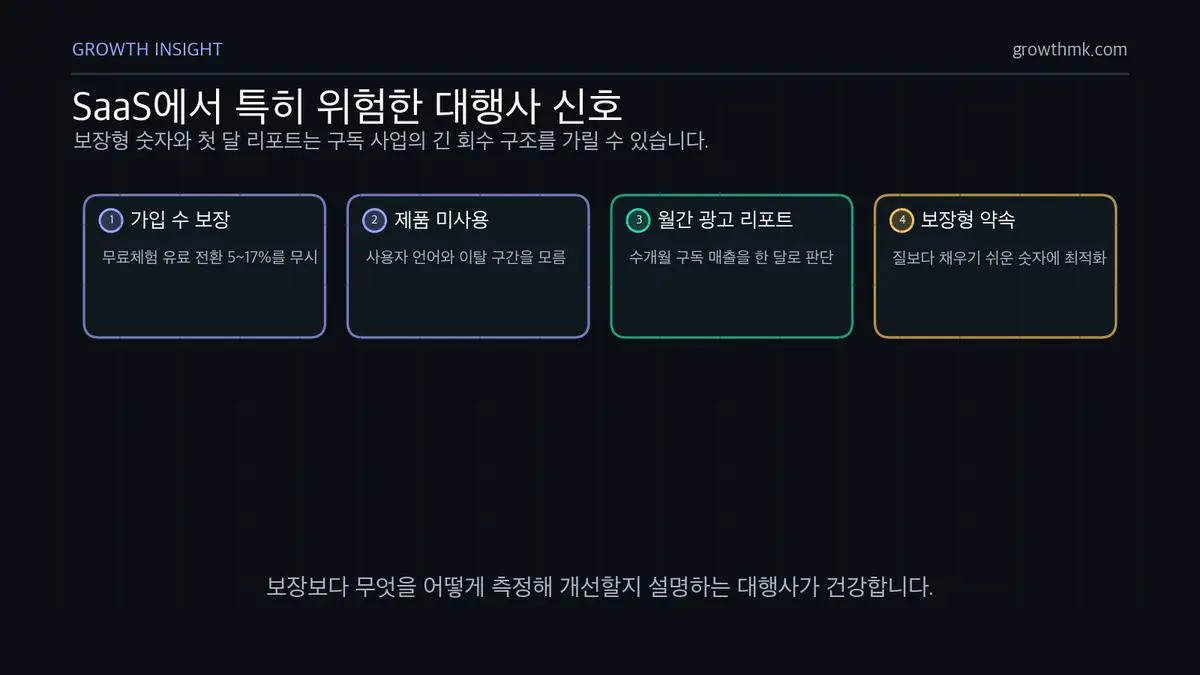
Red flag 1 — They promise results in free-trial “signup count.” “Guaranteed X free-trial signups a month” sounds clear, but it’s a red flag in SaaS. Hitting a signup target means pulling in people who have no real intent to convert, and given a 5–17% paid conversion rate (Source: OpenView, 2022 Product Benchmarks), a signup spike can actually make CAC worse. Choose an agency that agrees to define and verify paid conversion and pipeline contribution — not one that just guarantees a signup number.
Red flag 2 — They propose a campaign without ever having used the product. An agency that hasn’t used the product can’t communicate value in the user’s own language, and can’t identify where free-trial users drop off. An impressive general-marketing portfolio doesn’t guarantee SaaS conversion. Price comparison should be the last step — first confirm whether they actually understand your product and users.
Red flag 3 — They judge long-term performance from monthly ad reports alone. SaaS revenue unfolds over months, through renewals and expansion, and search assets build up even more slowly. Google itself notes that search changes can take “anywhere from a few hours to several months” to show up (Source: Google Search Central). If you judge an agency — or shake up the contract — based only on first-month clicks and signups, you risk pulling the plug right before conversion and retention data actually matures.
Red flag 4 — They reassure you with guaranteed-results promises. A “guaranteed X” sounds like accountability, but a number an agency can guarantee is usually a number achievable only by sacrificing quality. The same trap shows up in SEO, and the mechanism is covered in detail in why SEO agencies push guaranteed-results contracts. An agency that’s transparent about “what we’ll measure and how we’ll improve together,” rather than offering a guarantee, is the healthier choice.
How Growth is different
Growth is a B2B and SaaS marketing partner that works by the principle of “one customer who will actually buy” over “a pile of traffic.” We focus on the one customer who will convert to paid, not the free-trial signup count. We use the product ourselves before a campaign starts and find the same friction points a real user would. We speak in CAC and NRR. And we keep the data connected without gaps, from free-trial signup all the way through paid conversion and expansion. The five criteria above are, in essence, how Growth itself works. If you’re looking for a SaaS marketing partner, check out Growth’s B2B marketing service to see our approach, or reach out for a consultation to talk through whether it fits your stage and metrics.
You can see the full picture of this topic in “The Complete Guide to SaaS Marketing — PLG vs. SLG, CAC and LTV, and the Korean Market.”
Frequently asked questions (FAQ)
What’s the very first thing to check when choosing a SaaS marketing agency?
How they define success. SaaS should be evaluated by paid conversion and pipeline contribution — not free-trial signup counts. Even a good free-trial conversion rate is only about 17%, and freemium is around 5% (OpenView, 2022 Product Benchmarks), so simply chasing signup volume can actually make CAC worse. In your first meeting, ask whether they measure success by signup count or by paid conversion and pipeline contribution.
What’s the difference between a general full-service agency and a SaaS specialist?
The biggest difference is understanding of subscription-economy metrics and funnels. SaaS isn’t a sell-once business — it’s a subscription business with monthly renewals, expansion, and churn — so you need to view profit and loss through CAC, NRR, and CAC payback period (Bessemer, SaaS Benchmarks). It also requires understanding the unique free-trial/freemium conversion stage and product activation (the aha moment). General agencies are often strong on reach and awareness campaigns, but for SaaS’s subscription P&L and product-led conversion, a specialist is often the better fit.
We haven’t found product-market fit yet — should we even hire an agency right now?
If you’re pre-PMF, a strategic partner strong in positioning, messaging validation, and early customer interviews is a better fit than large-scale performance marketing execution. Pouring ad traffic onto a product that isn’t a fit yet just worsens CAC without generating any real learning. At this stage, it’s safer to spend budget on small experiments to find “who buys and why,” and expand into a growth-oriented agency once you reach seed-to-Series A and start seeing repeatable acquisition channels emerge.
How soon can we expect results after hiring an agency?
SaaS revenue unfolds over months through renewals and expansion, and search and content assets build up even more slowly. Google itself notes that search changes can take “anywhere from a few hours to several months” to show up (Google Search Central). So treat the first quarter as a period to watch leading indicators improve, in this order: paid conversion rate → activation metrics → pipeline and retention contribution. Give compounding activities like search assets enough time and evaluate them on cumulative impact.