Choosing a B2B Marketing Agency: A Decision Guide
 임재복
임재복
When choosing a B2B marketing agency, the real question isn’t “can they run ads well?” — it’s “do they understand our industry’s buying committee, and can they define and validate leads that actually turn into revenue?” In B2B, an average of 6 to 10 people sit on a buying committee that takes months to reach a decision (source: Gartner), and because each contract is large, success should be judged by lead quality (SQL, pipeline contribution) rather than lead count (MQL). A good B2B agency stands out on five dimensions: ① understanding of the industry and DMU (decision-making unit), ② the ability to define lead quality, ③ search-compounding content and SEO capability, ④ experience with sales alignment, and ⑤ a pipeline-level measurement framework. This article is a decision guide built around those five criteria, along with a table of questions you can ask directly.
Why B2B Agency Work Is Fundamentally Different From B2C
Even under the same label of “marketing agency,” B2B and B2C are different games. Before we get into the evaluation criteria, let’s cover three reasons you shouldn’t judge a B2B agency by B2C standards. The full structural picture is covered in The Complete Guide to B2B Marketing; here we’ll focus only on what directly affects agency selection.
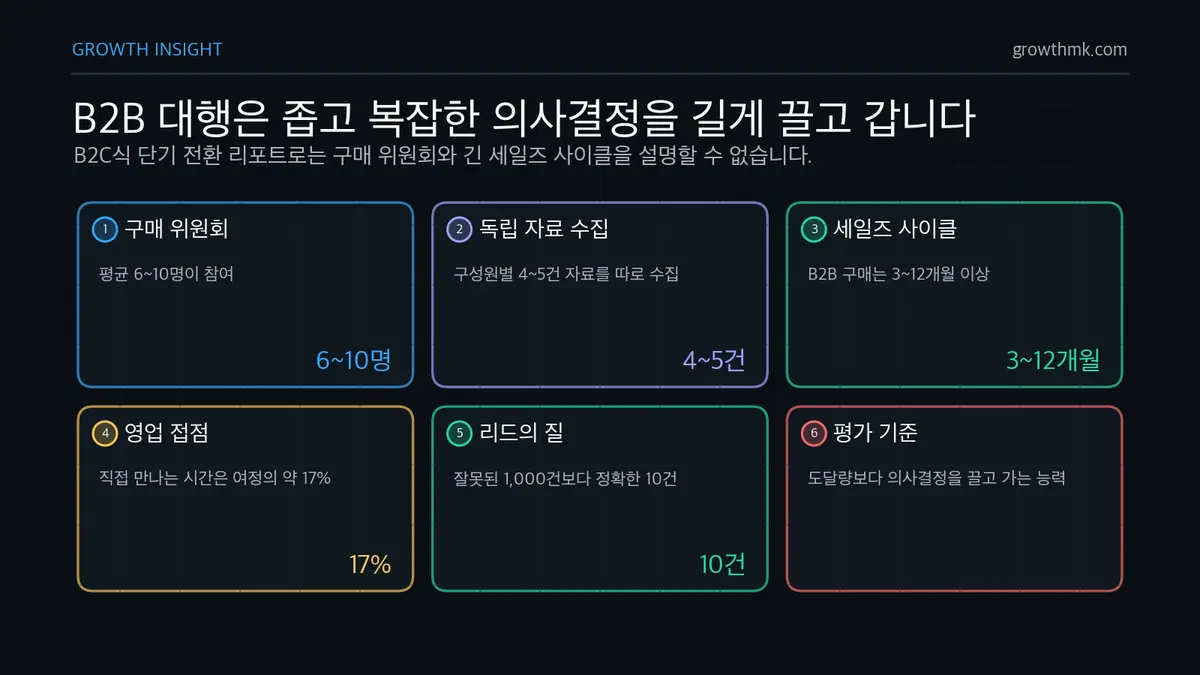
First, the buying committee. In B2C, a single consumer decides to buy within minutes or days. In B2B, an average of 6 to 10 people make up a buying committee, and each member independently gathers 4 to 5 pieces of information before sharing internally (source: Gartner). Finance looks at ROI, IT and security look at integration and risk, and end users look at usability. If an agency is only mapping “one target persona,” it’s missing at least half of the B2B decision. How to address each committee role is covered in more depth in our B2B decision-maker marketing strategy article.
Second, the sales cycle. A B2B purchase takes 3 to 12 months — longer still at the enterprise level. What’s more, buyers spend only about 17% of the entire buying journey in direct contact with a sales rep; the rest is spent researching, comparing, and building internal consensus on their own (source: Gartner). In other words, revenue shows up not as “this month’s clicks” but as “a contract months from now.” An agency that only reports monthly ad performance is out of sync with B2B’s time structure.
Third, lead quality. In B2C, conversion volume itself is often roughly proportional to revenue, but in B2B, 10 well-qualified leads beat 1,000 poorly-qualified ones. Contract sizes are large and sales resources are limited. That’s why the center of any B2B agency evaluation should always be “what kind of leads are they bringing in.” Lead types (IQL, MQL, SQL) and how to define them are covered in our B2B Lead Generation Guide.
In short, a B2B agency should be evaluated not on “the ability to reach a lot of people fast,” but on “the ability to carry a narrow, complex decision through to the end.” Now let’s look at the five criteria that verify that ability concretely.
5 B2B-Specific Evaluation Criteria
The five criteria below are the ones that decide B2B success or failure — the ones a generic “good portfolio, fair pricing” checklist misses. For each one, we’ve put together a table of verification questions you can ask directly in a meeting. If an agency dodges the question or only answers “it depends on the case,” that’s a signal their capability in that area is weak.
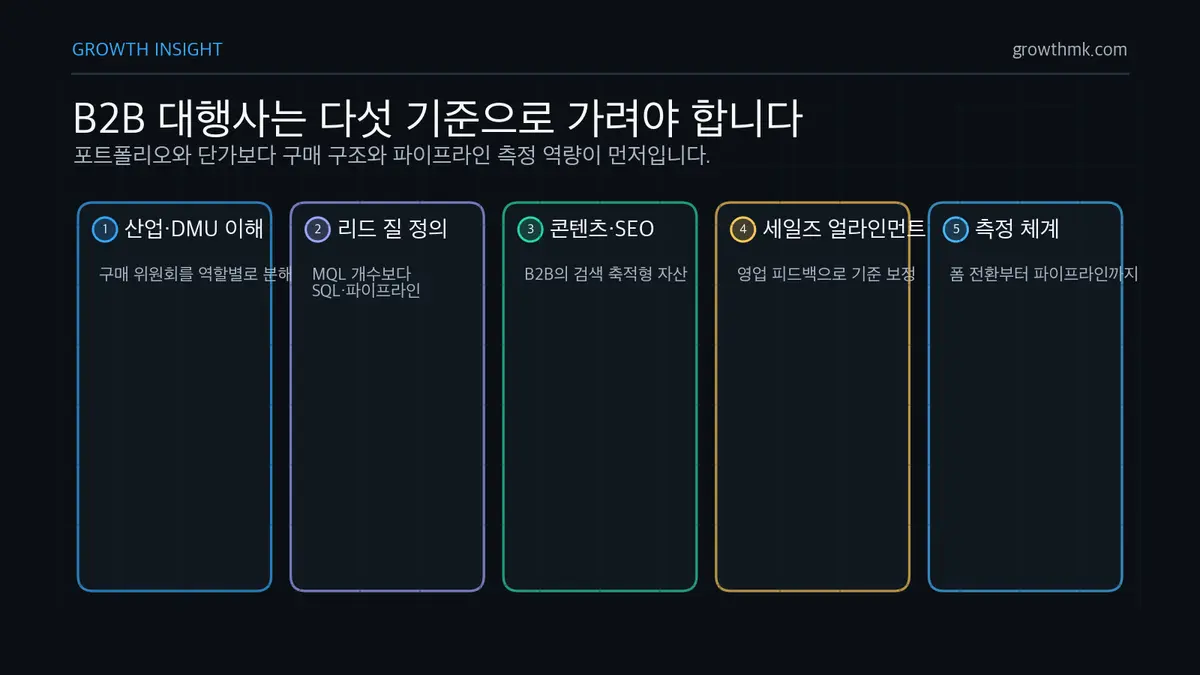
Criterion 1. Industry Understanding and Grasp of the DMU (Decision-Making Unit)
In B2B, the message doesn’t start from “what does the product do” — it starts from “which person, under what pressure in this industry, fears what.” Even for the same solution, the message aimed at a manufacturing procurement team should differ from the one aimed at a SaaS startup’s CTO. A good agency doesn’t stop at hearing your product pitch during kickoff — it breaks the buying committee down by role and maps out each member’s motivations, objections, and information sources. This connects directly to the customer-journey perspective Growth Marketing emphasizes: content and channels need to be designed for each stage as a buyer becomes aware of a problem, then explores and evaluates solutions.
| Question to ask | Signal of a good answer |
|---|---|
| Have you run projects in our industry? Who made up the buying committee at the time? | Breaks roles down concretely (economic buyer, technical evaluator, user, gatekeeper) |
| Hearing about our product for the first time, which stakeholder would push back, and why? | Names real-world objections (budget, integration, switching costs, internal politics) |
| Do you conduct customer interviews or sit in on sales calls during kickoff? | Has a process for shaping messaging from primary sources (customer and sales input) |
| Do you know the key messaging our competitors use in the market? | Researches competitive positioning up front and proposes differentiation |
Criterion 2. Ability to Define Lead Quality — SQL and Pipeline Contribution, Not MQL Counts
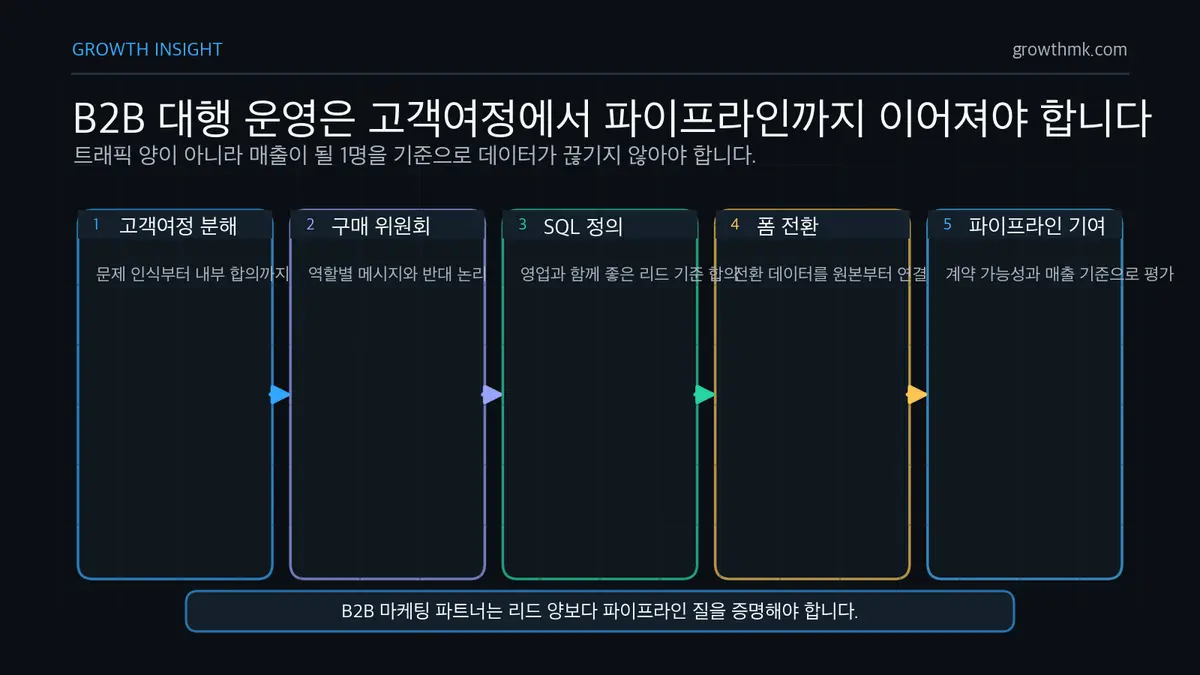
This is the single most important criterion in evaluating a B2B agency. Many agencies tout “200 MQLs a month” as a result. But MQL is a loose metric — loose enough to include someone who downloaded a whitepaper once — and only a small share of MQLs convert into real sales opportunities. What’s actually tied to revenue is the SQL that sales confirms is “genuinely worth a conversation,” and the pipeline value that SQL creates. This is exactly why Growth Marketing talks, even on its homepage, about “one person who will become revenue, not traffic volume.” A good agency agrees with your sales team on “what counts as an SQL” before a campaign even launches.
Concretely, this means codifying the criteria for handing an MQL off as an SQL (company size, title, confirmed budget, timing, etc.), prioritizing with lead scoring, and sometimes deliberately making a form harder to fill out to favor quality over quantity. For the basics of defining lead stages and designing scoring, see our Lead Generation Guide.
| Question to ask | Signal of a good answer |
|---|---|
| What do you report as results — MQLs, or SQLs and pipeline contribution? | Presents SQLs, sales-call requests, and pipeline value as primary metrics (MQL as secondary) |
| How do you agree with our sales team on the criteria for passing an MQL to SQL? | Has codified criteria (title, company size, budget, timing) and an agreement process |
| What mechanisms filter out low-quality leads? | Controls quality via form design, lead scoring, and disqualification rules |
| Between 100 leads and 10 sales calls, which do you consider the better result? | Doesn’t answer “more is always better” without context — clearly prioritizes quality |
Criterion 3. Content and SEO Capability (B2B Search Compounds Over Time)
B2B buyers do a lot of their own research and shortlisting long before they ever meet a sales rep. That’s why search in B2B isn’t “traffic that disappears the moment you turn off ads” — it’s “an asset that compounds the more it accumulates.” In Content Marketing Institute’s 2025 survey, 74% of B2B marketers said content marketing helped generate demand and leads, and 87% said it helped build brand awareness (source: CMI, B2B Content Marketing 2025). That said, search and content take time. Even Google notes that changes to search can take anywhere from a few hours to several months to show up (source: Google Search Central).
B2B content also needs real hands-on depth, not just keyword-stuffing, to earn trust. Google’s own self-assessment guidance for people-first content asks “does the content clearly demonstrate first-hand expertise and depth of knowledge from having actually used a product or service?” (source: Google Search Central, Helpful Content). A good B2B agency draws out your domain expertise into content through this E-E-A-T lens, and keeps in mind how search is expanding into AI-generated answers.
| Question to ask | Signal of a good answer |
|---|---|
| How long do you expect B2B search to take before it shows results? | Honestly frames it as compounding over 3–12 months (doesn’t promise instant results) |
| How do you draw our domain expertise out into content? | Has a process for gathering depth from primary sources — expert interviews, hands-on data |
| What criteria do you use to select keywords? | Selects based on purchase intent, conversion potential, and buying stage — not just search volume |
| How do you handle exposure in AI search and generative answers? | Offers concrete methods — structured data, answer-formatted content — not vague trend talk |
Criterion 4. Experience With Sales Alignment
When marketing and sales operate in silos in B2B, leads leak through the cracks. It’s common for sales to sit on leads marketing passed over, dismissing them as “low quality,” while the real objections sales hears in the field never make it back to marketing. When a B2B agency comes in from the outside, this disconnect can get even worse. So what you need to verify is whether the agency has experience working as one team with your sales organization. It should be able to walk you through concrete mechanisms — agreeing on lead definitions (criterion 2), a lead handoff process, a feedback loop that folds sales input back into content and campaigns, and regular sync meetings.
| Question to ask | Signal of a good answer |
|---|---|
| How often, and on what, do you sync with our sales team? | Presents concrete collaboration structures — regular meetings, shared dashboards, lead handoff SLAs |
| How do you respond when sales says “this lead isn’t good”? | Has an improvement loop that folds feedback into targeting, messaging, and forms |
| How do you collect the objections and questions sales hears in the field? | Gathers primary input through sales interviews, call listening, and feeds it into content |
| Do you track what happens to handed-off leads afterward? | Has a system tracking whether leads progress through SQL, sales calls, and contracts |
Criterion 5. Measurement Framework — Does It Operate at the Pipeline Level?
B2B performance measurement shouldn’t be about “ad click counts” — it should be about “how much did this activity contribute, and at what stage of the pipeline.” That requires data flowing without breaks from form conversion, to CRM lead, to sales stage, to closed contract. This is exactly why Growth Marketing emphasizes a data-science and growth-hacking mindset. Without measurement infrastructure, you can’t tell which campaign actually generated revenue, and improvement becomes guesswork. A good agency checks tracking design — events, UTMs, CRM integration — before a campaign ever launches. For why tracking setup matters so much specifically in B2B, see why tracking-tool setup matters for B2B marketing.
| Question to ask | Signal of a good answer |
|---|---|
| How do you connect data from form conversion through to contract? | Concretely explains analytics tool–CRM–sales stage integration |
| How do you handle attribution for a long sales cycle? | Presents an approach suited to B2B reality — multi-touch, contribution-based models |
| Do you check tracking design before a campaign launches? | Has a process for setting up events, UTMs, and conversion definitions before the campaign starts |
| Can we access the dashboard ourselves? | Offers real-time, transparent reporting — not just a single PDF at month-end |
What Does a Good Collaboration Structure Look Like? — From Kickoff to Day 90
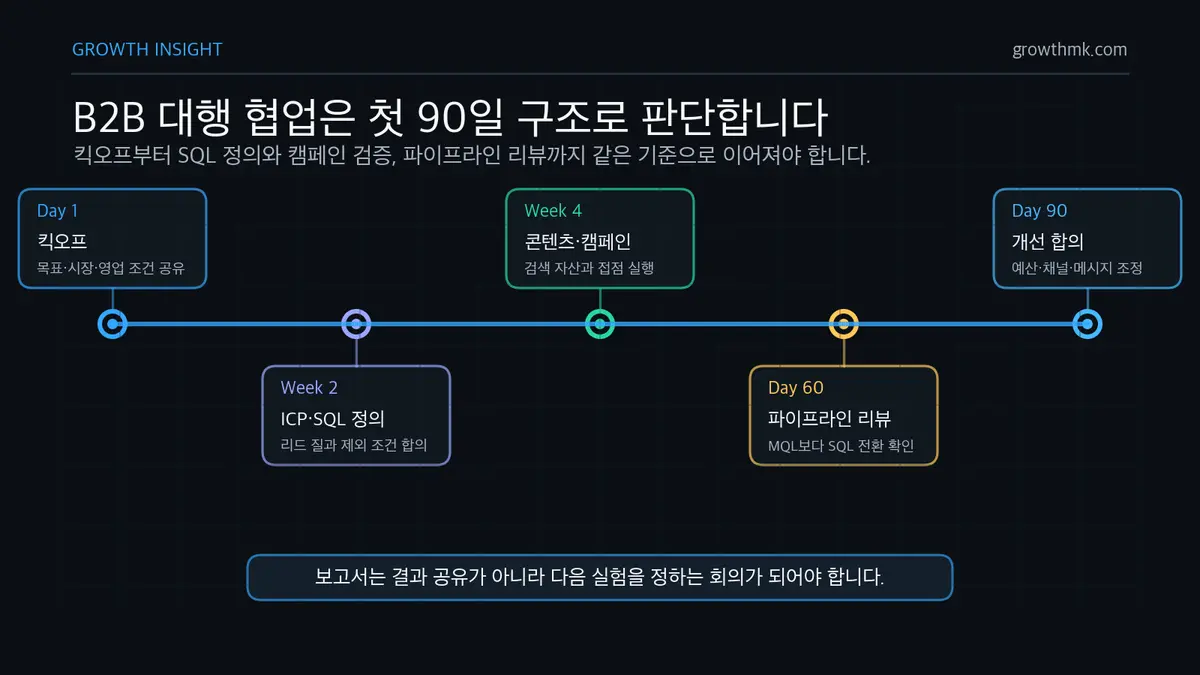
Even an agency that passes every evaluation criterion won’t deliver results if the collaboration structure is weak. B2B has a long sales cycle, so contract revenue won’t fully show up within the first 90 days. The first 90 days should be seen not as “the period when all the revenue comes in” but as “the period when you lay the structure for revenue and confirm the leading indicators.” Below is the standard flow of a healthy B2B agency collaboration.
| Phase | Core activities | Signal of success at this point |
|---|---|---|
| Kickoff (~2 weeks) | Break down the buying committee/DMU, customer and sales interviews, agree on the SQL definition, review tracking design, finalize KPIs and reporting cadence | Both sides have a written agreement on what counts as a good lead and how it’s measured |
| Initial execution (~30 days) | First-round production of core messaging, landing pages, and content; channel setup; lead scoring and handoff process go live | Leads start coming in and are handed to sales according to the agreed criteria |
| Optimization (~60 days) | Incorporate sales feedback, refine messaging/targeting/forms, build up content, compare quality across channels | Lead quality (SQL conversion rate) shows a trend of improvement |
| Validation and scaling (~90 days) | Review pipeline contribution, scale up what’s working and trim what isn’t, agree on next quarter’s plan | Data confirms that leading indicators (SQL, pipeline) are on track to become revenue |
What matters most is that the “definition of a good lead” and the measurement approach agreed at kickoff stay consistent throughout all 90 days. If the success criteria shift every quarter, improvements never compound. Ask the agency upfront what they’ll look at over the 90 days to judge success or failure — the answer will quickly tell you whether they understand B2B’s time structure.
3 Bad Selection Patterns to Avoid
Finally, let’s cover three of the most common bad decisions we see in actual agency selection. These patterns show up repeatedly when companies judge a B2B agency by B2C standards.
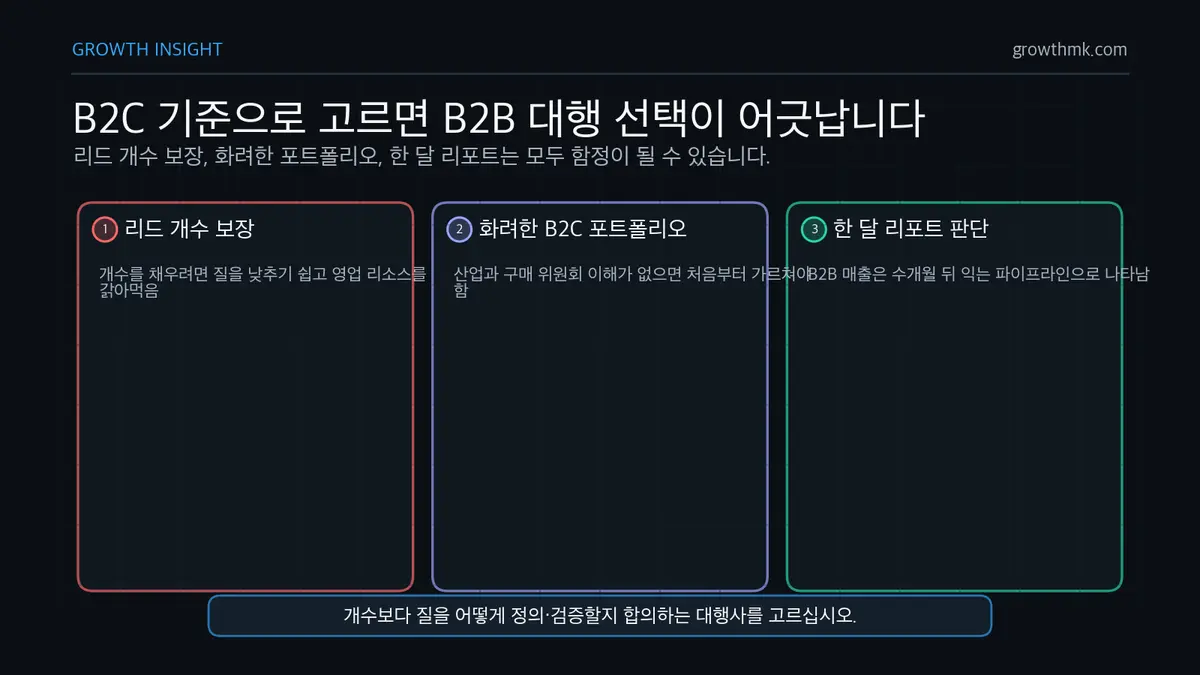
Pattern 1 — Choosing an agency that promises results in lead “counts.” “Guaranteed X MQLs a month” sounds clear-cut, but in B2B it can be a red flag. Hitting a fixed count usually means sacrificing quality. Leads unrelated to actual revenue drain sales resources, and sales stops trusting marketing-sourced leads. This same trap shows up in SEO as well, and the mechanism is covered in detail in why SEO agencies push guarantee-based contracts. Choose an agency that agrees on “how to define and verify quality,” not one that guarantees a count.
Pattern 2 — Looking only at “price and a flashy portfolio,” regardless of industry. An impressive B2C campaign portfolio doesn’t guarantee B2B results. In B2B, understanding the industry and buying committee decides half the message. An agency unfamiliar with your industry context ends up needing you to teach them everything from scratch, wasting precious time in an already-long sales cycle. Price comparison should be the last step — first confirm whether the agency actually understands how your customers make decisions.
Pattern 3 — Judging long-term results by monthly ad reports. B2B revenue shows up months later. If you evaluate an agency, or shake up a contract early, based only on first-month clicks and impressions, you risk pulling the plug right before the pipeline was about to ripen. Look together at the leading indicators marketing and sales agreed on (SQL, pipeline contribution), and give compounding assets like search and content the time to show their cumulative effect. You can find more on the time it takes for content to translate into revenue in Do B2B newsletters really drive revenue?
How Growth Marketing Is Different
Growth Marketing is a B2B marketing partner that works by the standard of “one person who will become revenue, not traffic volume.” Before a campaign launches, we break down the customer journey and buying committee, define SQL together with your sales team, and connect data seamlessly from form conversion all the way to pipeline contribution. The five evaluation criteria above are, in essence, how we work. If you’re looking for a B2B marketing partner, see our approach on the B2B Marketing service page, and reach out for a consultation to talk through whether it fits your situation.
You can find the full picture of this topic in [The Complete Guide to Selecting and Costing a Marketing Agency: From 7 Selection Criteria to Fee Structures and the 90-Day Checkpoint].
Frequently Asked Questions (FAQ)
What’s the first thing to check when choosing a B2B marketing agency?
How they define and verify lead “quality.” In B2B, contract sizes are large and sales resources are limited, so SQL and pipeline contribution matter far more to results than MQL counts. In your first meeting, ask whether they report results as MQLs or as SQLs and pipeline contribution, and prioritize an agency willing to agree on SQL criteria together with your sales team.
What’s the difference between a full-service ad agency and a B2B-specialist agency?
The biggest difference is understanding of the buying committee and the long sales cycle. Because B2B decisions typically involve 6 to 10 people over several months (source: Gartner), you need role-specific messaging, stage-based content, and sales alignment. Full-service agencies are strong at reach and awareness campaigns, but a specialist agency is often better suited to B2B’s pipeline-level measurement and lead-quality management.
How soon can I expect results after hiring an agency?
B2B sales cycles run 3 to 12 months, so contract revenue won’t fully materialize within the first 90 days. Instead, the 90 days are a period to watch leading indicators improve in sequence: agreeing on the definition of a good lead → leads coming in → quality improving (SQL conversion rate) → confirmed pipeline contribution. Search and content in particular compound over time, and even Google notes that changes can take anywhere from a few hours to several months to show up (Google Search Central).
Can I trust a contract that “guarantees” a number of leads?
Be cautious. Hitting a fixed count often means sacrificing quality, and leads unrelated to revenue drain sales resources and erode trust between marketing and sales. An agency that clearly explains how it defines and verifies lead quality — and how it filters out low-quality leads — is a healthier choice than one that guarantees a count. Make sure to confirm, before signing, whether the structure genuinely prioritizes quality over quantity.