
What B2B Decision-Maker Marketing Really Requires
 임재복
임재복
In a fast-shifting B2B landscape, marketing aimed at decision-makers has become a core driver of sustainable growth. Traditional sales tactics alone no longer cut it in today’s crowded, competitive market. As [Which marketing channels actually work? A 2025 analysis] shows, the limits of old-school selling are becoming impossible to ignore. This article offers a deep dive into B2B decision-maker marketing and points to where your company’s strategy should head next.
Why B2B Decision-Maker Marketing Matters
The complexity and dynamics of the B2B market demand a distinct approach to marketing. Reaching decision-makers in particular calls for strategic considerations that differ substantially from B2C marketing.
A Shifting Market and the Rise of the Decision-Maker
As global competition intensifies, B2B companies can no longer simply offer a superior product or service — they now face an environment where survival depends on delivering differentiated value. Traditional selling built on long-standing customer trust is quickly hitting its limits amid today’s fierce competition. Building brand awareness among prospects through an effective marketing strategy, and securing an edge over rivals, has become an essential piece of the puzzle.
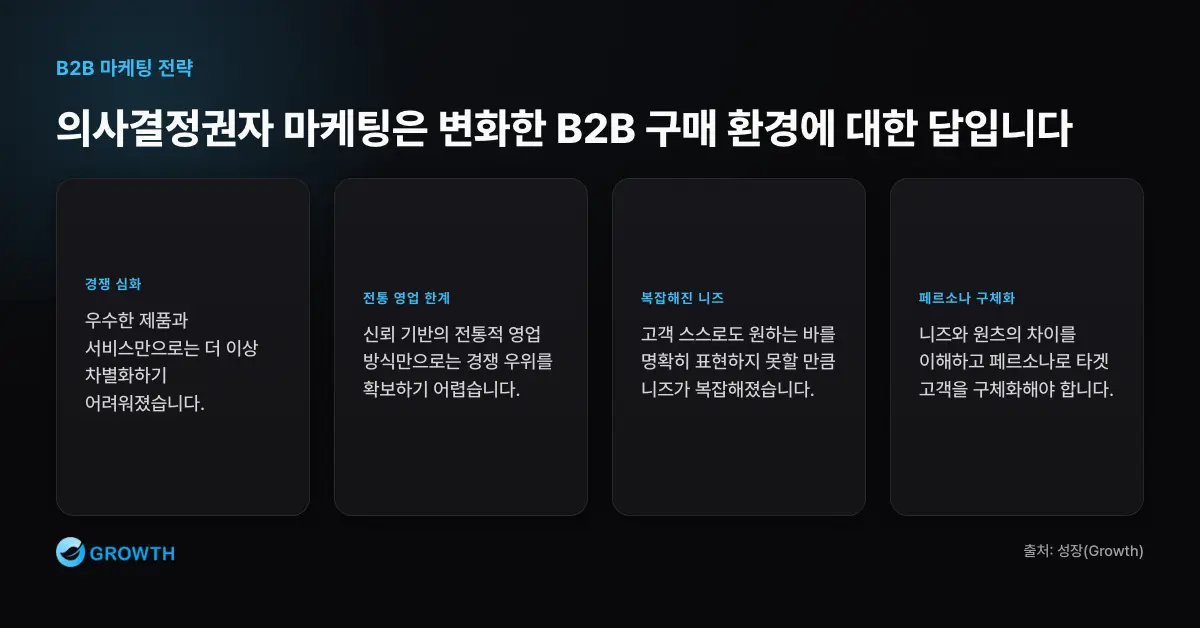
Customer needs have also grown far more complex and varied than before. As the pace of technological change accelerates, customers themselves sometimes struggle to clearly articulate what they truly want. In this environment, effective marketing goes beyond simply selling a product — it starts with a clear grasp of [the difference between customer Needs and Wants] and moves on to defining target customers concretely through [Persona] building. Marketing plays a decisive role in understanding customer needs at a deeper level and strategically shaping the customer relationship.
Digital Transformation and Customer-Led Buying Journeys

B2B sales once relied heavily on reps directly visiting customers to introduce and sell products — the classic cold call or the foot-in-the-door technique (FIDT). But with the rise of the internet and mobile technology, customers increasingly gather information and make purchase decisions through online channels. As buying teams are increasingly staffed by younger generations, they show a marked preference for online channels over legacy face-to-face selling or unsolicited phone calls. Traits like phone phobia are now a genuine drag on the success rate of traditional sales approaches.
This shift signals that in B2B as well, marketing strategies that move from offline to online engagement are no longer optional. As explored in [B2B Marketing Trends 2024: An A-to-Z Analysis], digital marketing has gone from a nice-to-have to a necessity. Online marketing reaches prospective customers effectively and helps manage an increasingly complex purchase process efficiently. Marketing activity can dramatically improve a sales rep’s productivity by discovering and nurturing prospects on their behalf. A model that still relies solely on individual sales reps’ skills clearly limits how far a company can grow revenue and generate leads. Marketing now needs to own lead generation from a strategic, long-term view, while sales focuses on managing the resulting pipeline.
Core Strategies for B2B Decision-Maker Marketing
Growth Marketing proposes the following core strategies for succeeding at B2B decision-maker marketing.
Value-Driven Content Marketing: Delivering Tailored Information at Each Stage of the Journey
A B2B customer’s buying journey is long and complex, and what a customer is thinking about differs at every stage. It’s therefore critical to break the journey into Awareness, Consideration, and Decision stages, identify which stage a given customer is currently in, and design tailored content and outreach for that stage. This staged approach can draw on frameworks such as [the Customer Decision Journey] and the [AISVAS consumer purchase-decision model]. For example, in the early stage, content addressing industry trends or problem-solving case studies can build awareness, while later stages can lean on product comparison materials or demos to support the final decision.
B2B content needs to effectively convey specialized services and speak the customer’s language — using industry- or role-specific terminology to build a logical, persuasive case. It’s important to apply the fundamentals covered in [Content Marketing: From Definition to Strategy] to the B2B context specifically. B2B buyers gravitate toward dynamic content that goes beyond bare information to offer actionable guidance — content that must be easy to read, valuable, and clear about its key takeaway. Content like this builds brand trust, increases loyalty among target customers, and ultimately generates interest and leads that contribute to revenue growth.
In particular, a “content grows” strategy — one that moves beyond simple traffic acquisition to drive real conversion — matters a great deal. To build a successful content strategy, take a systematic approach by referencing [How to Write a Content Marketing Plan], and accurately measure performance using the [Content Marketing KPI Measurement Guide].
Marketing teams should also develop specific indices for measuring the qualitative value and conversion contribution of content, and analyze them continuously. For example, you can track how many times, on average, a customer who submitted a quote request read a given piece of content, how many percent of it they read, and whether they clicked a call-to-action (CTA) link before submitting the form. Data-driven decisions like these let you scale content with high conversion rates while continuously optimizing content that underperforms.
Account-Based Marketing (ABM): A Personalized Strategy Focused on High-Value Accounts
As detailed in [What Is Account-Based Marketing (ABM)?], ABM is a strategy that runs marketing campaigns targeting specific “companies” — high-value accounts. The first step in an effective ABM strategy is clearly defining target accounts that match your business’s ideal customer profile (ICP). It’s also essential to understand the various individuals involved in the actual decision-making process within that company — the buyer personas — to gain insight into their specific requirements, challenges, and motivations, and then craft tailored messaging and content accordingly.
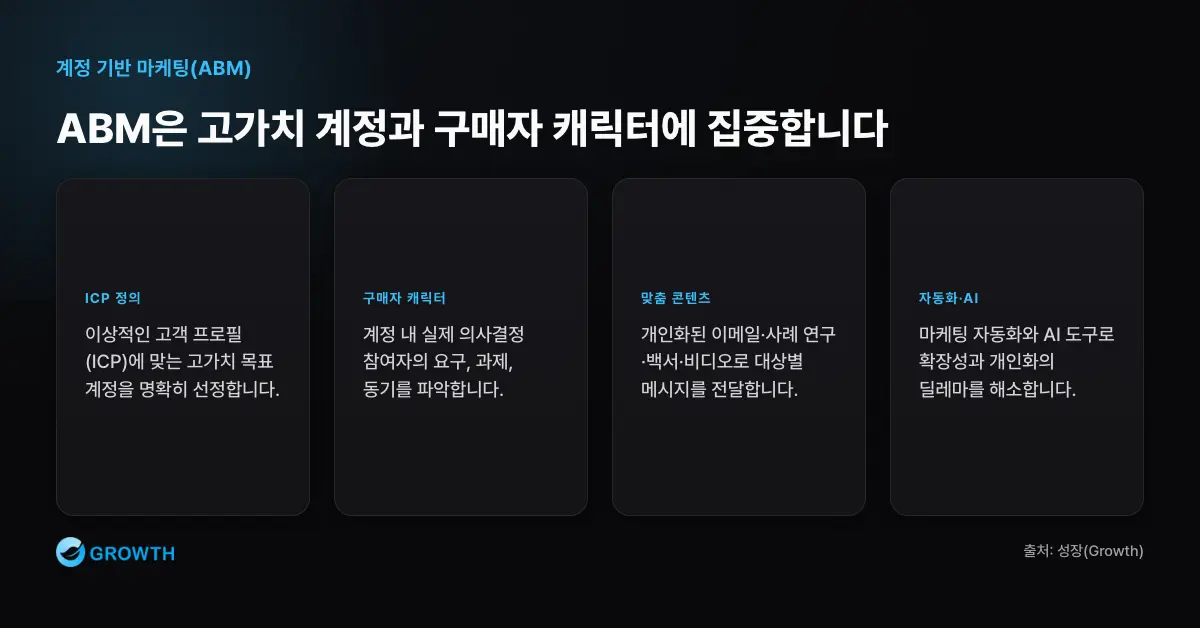
The core of ABM is personalization. Using insight gained through research and profiling, you need to create tailored content that directly addresses the challenges and goals of each target company and buyer. This can take many forms — personalized emails, case studies, whitepapers, videos — and messaging should be positioned to speak the customer’s industry language, reference their use cases, and align with their business goals, forming a strong connection and positioning your company as a valuable partner.
One major challenge in implementing ABM is the dilemma of building a scalable strategy across multiple accounts while still producing tailored content for each. Solving this requires using marketing automation platforms and AI-based tools to automate and streamline content generation, personalized messaging delivery, and customer behavior data analysis.
Integrated Channel Strategy: Reaching Decision-Makers Through an Omnichannel Approach
A B2B decision-maker marketing strategy needs to integrate multiple channels to reach decision-makers effectively. Email marketing remains one of the most powerful methods in B2B marketing, still actively used today. It’s effective for reaching target audiences in a personalized way, generating leads, and driving interest in your product or service. That said, as [7 Strategic Mistakes Companies Make That Sink Their Email Marketing] shows, you can’t expect results without a strategic approach.
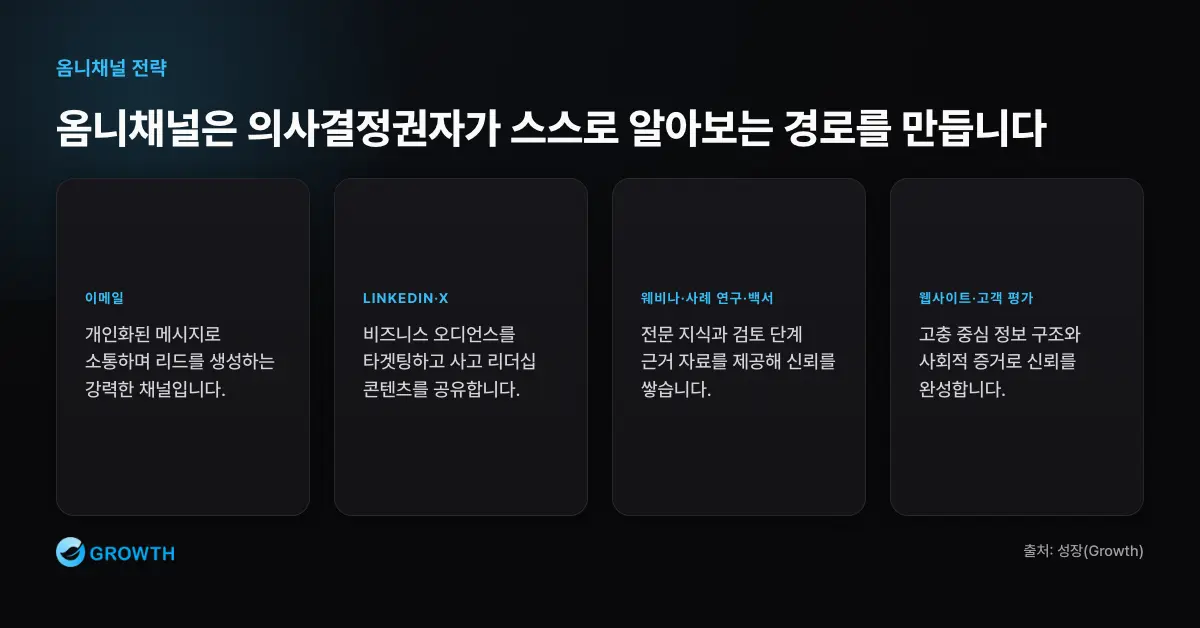
Social media platforms — especially LinkedIn and Twitter (now X) — give B2B companies a way to target specific business audiences, promote products or services, share thought-leadership content, and build brand awareness. Rather than direct sales pitches, it’s more effective to focus on sharing useful information and providing insight.
Distributing specialized content such as webinars, case studies, and whitepapers is central to delivering real value. Leveraging positive customer reviews and referral programs, and designing a website focused on customer intent and pain points, matter as well. Ultimately, reaching buyers effectively requires understanding the character of each channel and combining them deliberately through a [Marketing Channel Mix] strategy.
This means an omnichannel strategy actively engaging social media and search engines so that every buyer can easily learn about your company and products.
Grow With Us — Succeed at B2B Decision-Maker Marketing
Growth Marketing deeply understands the complexity and importance of B2B decision-maker marketing. Built on strategic customer-centric thinking, tighter alignment between marketing and sales, and continuous data analysis and optimization, we deliver the marketing solution best suited to your company’s growth.
A B2B decision-maker marketing strategy isn’t just a cost center — it needs to prove itself as a core engine of revenue for your company. We’re committed to using clear, data-driven performance measurement and optimization to maximize marketing ROI while avoiding the [trap of ad-spend-only thinking, and the difference between ROI and ROAS], applying the methodology outlined in [How to Set B2B Marketing KPIs], and contributing to long-term brand value. Put our expertise to work building and executing a strategy that reaches decision-makers effectively across a complex, lengthy B2B buying journey, builds trust, and ultimately drives revenue growth.
Worth Reading Next
- The Complete Guide to B2B Marketing — Strategy, Channels, ABM, Lead Generation, and Measurement
- Where Should B2B Marketing Position Itself in the AI Era?
- B2B Marketing Channels: How Do They Differ From B2C?
- B2B Marketing Formats: Video vs. Text Content Marketing
- B2B Newsletters: Do They Really Drive Revenue?
If you’d like to apply this to your own business — visit our B2B Marketing service to see how we approach growth, or reach out for a consultation if you need a diagnosis tailored to your specific situation. We’re paid based on results, not on traffic.