Startup Marketing Agencies: A Decision Framework Built on Stage and Budget
 임재복
임재복
The best marketing agency for an early-stage startup isn’t “the one who can generate the most visibility” — it’s “the one who asks first what needs to be validated at your current stage.” If you’re at seed or pre-Series A, what you need isn’t a performance agency running channels broadly — it’s a partner who’ll help design experiments to quickly confirm product-market fit (PMF). Only once you’re past Series A, scaling channels that are already validated, does an operations-and-scale agency start to make sense. There’s just one real criterion: not traffic volume, but whether they’re building a validation structure that more precisely brings in the one customer who will become revenue.
This article is written by a marketing agency — which is exactly why we’re being more honest about it. There are clear combinations where an early-stage startup shouldn’t be advised to hire an agency at all. Below, we walk through, in order: 3 classic patterns of startups misusing agencies, a stage-by-purpose decision matrix, realistic expectations by budget size, and 5 questions to identify a startup-friendly agency.
Why is an “impressions report” meaningless for an early-stage startup?
An early-stage startup’s biggest risk isn’t failing to run ads — it’s pouring money into a product nobody wants yet. According to CB Insights’ post-mortem analysis of 431 VC-backed startups that shut down since 2023, the second-biggest cause of failure after running out of money (70%) was a lack of product-market fit (43%). That same report is explicit: “running out of money is almost always the proximate cause, not the root cause.” In other words, the real reason the money dried up is often that marketing spend got poured into a product that wasn’t selling, first.
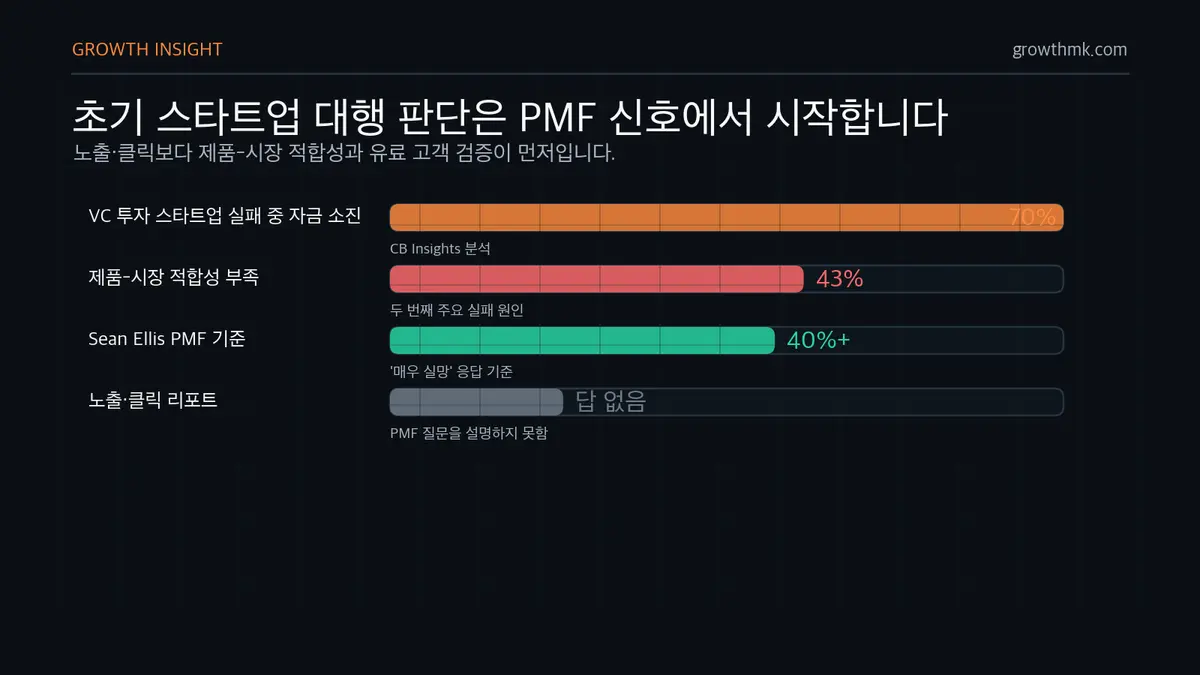
That’s why the success metric at an early stage shouldn’t be “300K impressions and 5,000 clicks this month” — it should be “are there enough people who’d genuinely miss our product if it disappeared?” The PMF measurement method growth expert Sean Ellis developed asks users, “How would you feel if you could no longer use this product?” — and if 40% or more say ‘very disappointed,’ you’re considered close to PMF. Companies that fall short of that 40% threshold have run into growth trouble almost without exception. An impressions-and-clicks report gives you zero answer to this question.
In short, what an early-stage startup should expect from an agency isn’t an impressions report — it’s validation and revenue. You need a partner who answers, with data, which message works for which customer, how much it cost to acquire one paying customer (CAC), and whether that customer sticks around (retention). This is exactly the same root as the growth hacking methodology, which measures and experiments on customer behavior stage by stage.
3 patterns of startups misusing agencies
It’s rarely the agency itself that’s the problem — the problem is using an agency “in a way that doesn’t fit your current stage.” Here are three patterns that repeat over and over at early-stage startups.

Pattern 1: hiring a performance agency before PMF
This is the most expensive mistake. It’s hiring a performance agency to “just run ads and make sales happen” while you still don’t know who’s buying, why they’re buying, or what price they’d pay. Pour ad spend into unvalidated messaging and a landing page, and all the data will tell you is “this channel is expensive” — it won’t tell you what actually needs fixing. Running ads is like pouring water into a funnel — and if the funnel has a hole in it, the more you pour, the more you lose. As with the case of a social marketing platform that collapsed after failing to clearly define its customer while shifting its target from SMBs to large enterprises (see a B2B startup marketing case study), if who you’re selling to isn’t settled, no agency can patch that hole.
Pattern 2: outsourcing operations with no strategy at all
The second pattern is handing over your entire strategic decision-making with a “we don’t really know marketing, just handle it” attitude. An agency is an expert in running channels — not the owner of your company’s product, customer, or financial context. Outsource decisions like what to prioritize, which hypothesis to test first, and which customers to walk away from, and the agency ends up repeating the same “safe, generically effective” playbook. The result is a campaign that looks similar to what any other company would run, and whatever’s actually distinctive about your startup never shows up in the data. The principle should be: hold strategy inside, borrow execution from outside.
Pattern 3: signing a contract with no reporting structure, or one that only reports impressions
The third pattern is signing a contract with no measurement structure at all. If all you get at the end of each month is a table showing “X impressions, Y reach,” you’ll never actually know whether that money turned into revenue. It gets worse when the data accumulates inside the agency’s own accounts — the moment the contract ends, everything you learned disappears along with it. The earlier the stage, the more every campaign needs to function as an “experiment,” and an experiment needs a recorded trail of hypothesis → execution → result → next hypothesis. The importance of setting up this kind of measurement environment as a company asset from day one is covered separately in why tracking setup matters for marketing.
A stage × purpose decision matrix
So the real answer to “should we use an agency” only emerges once you cross-reference your company’s stage against the purpose you’re actually trying to solve right now. The table below puts investment stage (seed/pre-A/A/B) in rows and marketing’s four purposes (validation, brand, acquisition, scale) in columns, showing which combinations fit an agency and which fit in-house or the founder directly. It’s a starting point, not an ironclad rule.

| Stage | Validation (PMF/messaging) | Brand (positioning) | Acquisition (paid channels) | Scale (scaling up) |
|---|---|---|---|---|
| Seed (idea to early product) |
Founder directly — customer interviews and message testing can’t be delegated | Founder directly — the founder sets tone and story | Hold off — too early for paid acquisition | Not applicable |
| Pre-Series A (early traction) |
Founder + expert advisory — outside help limited to experiment design | Founder + freelancer/small agency | Small-agency experiments — small scale, just 1–2 channels | Still too early |
| Series A (growth after PMF confirmed) |
One in-house lead | Agency collaboration — compounding areas like content, SEO | Agency runs it fully — scale up validated channels | In-house core + agency execution |
| Series B+ (scaling a validated model) |
In-house data team | In-house + specialist agency | In-house + multiple agencies | In-house core + agency volume |
Two key things to read out of this table. First, the closer you get to the top-left (seed, validation), the harder it is to delegate; the closer to the bottom-right (Series B+, scale), the more an agency pays off. Validation and messaging are the company’s identity itself, so handing them off means the learning never accumulates internally — while scaling means repeating what’s already proven, at greater volume, which is exactly where an agency’s scale and tooling shine. Second, paid acquisition (the acquisition column) means the exact opposite thing depending on stage. At seed, holding off is correct; at pre-Series A, “small-scale experiments” are correct; from Series A onward, running it in earnest is correct. The exact same “performance ads” is a loss at seed and leverage at Series A.
Compounding areas in particular — brand, SEO, content — that build up value over time see especially strong returns when agency collaboration starts around Series A. That said, these areas take time to pay off, so managing expectations matters. Even Google’s own documentation states that SEO typically takes 4 months to a year from a change to a result. How to judge the stage of scaling up validated paid channels is covered in greater depth in our complete guide to performance marketing, and the structure for generating leads that connect directly to revenue is covered in our B2B lead generation guide.
Realistic expectations by budget size
The most common source of startup conflict is a mismatch between expectations and “what does this budget actually get us?” Separate agency fees from ad spend, and what you can realistically expect changes meaningfully by monthly budget size. Below is a rough guide, paired with stage.

| Monthly marketing budget | What’s realistically achievable | What you shouldn’t expect | Fitting stage |
|---|---|---|---|
| ~KRW 1 million range | Founder-led execution + one-off advisory, basic content/SEO setup, a single small-channel experiment | Running multiple channels simultaneously, fast revenue growth | Seed, pre-Series A |
| KRW several million range | Managed execution on 1–2 channels, starting to build content/SEO, repeated A/B testing | Immediate large-scale conversion, covering every channel | Pre-Series A, Series A |
| KRW 10 million+ | Scaling validated channels in earnest, running multiple channels, advanced measurement and attribution | Guaranteed success even on unvalidated channels | Post–Series A |
The key is to view budget as “the cost of validation,” not “ad spend.” At an early stage, a few million KRW a month isn’t money that generates revenue — it’s closer to tuition you’re paying to learn which channel and message actually work. And once that learning accumulates, it pays compounding returns. According to Forrester Research, companies that excel at lead nurturing generate 50% more sales-ready leads at 33% lower cost. In other words, for the same budget, whichever side has a “measure and improve” structure in place sees its unit cost fall over time. Buy impressions without measurement, on the other hand, and increasing the budget won’t move the unit cost at all. Misunderstanding unit cost is exactly how budget leaks away — a trap we cover in the ROI and ROAS trap.
5 questions to identify a startup-friendly agency
So the question an early-stage startup should be asking in an agency meeting isn’t “how much visibility can you generate?” How an agency answers the five questions below reveals whether it’s a partner that actually understands the startup’s stage, or just a shop selling a standard package.

| Question | What it checks | Good signal / bad signal |
|---|---|---|
| 1. “What do you think we should validate first, at our current stage?” | Stage awareness | Good: the answer changes based on stage / Bad: “start with ads” regardless of stage |
| 2. “What experiment will you run to confirm this channel actually works?” | Experiment design capability | Good: a specific hypothesis, metric, and timeframe / Bad: “we’ll know once we run it” |
| 3. “Whose name do the data and ad accounts accumulate under?” | Data ownership | Good: company-owned, agency granted delegated access / Bad: locked inside the agency’s own accounts |
| 4. “What’s the smallest possible scope we could start with?” | Ability to start small | Good: one channel, a small budget to start / Bad: only a full-package, long-term contract |
| 5. “What can we realistically expect 3 months from now, on this budget?” | Honest expectations | Good: states a range along with the uncertainty / Bad: guarantees rankings or revenue |
Be especially wary if question 5 gets an absolute promise like “guaranteed top rankings” or “Nx revenue within N months.” As noted above, even Google itself says SEO results take 4 months to a year, and its own documentation warns against providers claiming to guarantee rankings. The real story behind contract structures that sell what looks like a guarantee is broken down in detail in why SEO agencies push guaranteed-results contracts, and general criteria for vetting an agency are laid out in our SEO agency selection checklist.
Question 3 (data ownership) is also especially critical for early-stage startups. Analytics accounts (GA4, etc.), ad conversion data, and customer/lead data all need to accumulate in accounts owned by your company — that’s the only way whatever you learned survives when you switch agencies or bring things in-house. A good agency actually welcomes this requirement, because they know transparent data sharing is the foundation of long-term trust.
So how should our startup decide?
To sum up, here’s the decision order. First, be honest about whether you’re in a validation phase (seed, pre-Series A) or a growth phase (post–Series A). Second, identify which purpose you’re actually trying to solve: validation, brand, acquisition, or scale. Third, check whether that intersection on the matrix points to “founder directly/in-house” or “agency.” Fourth, treat your budget as tuition, not revenue, and calibrate your expectations accordingly. Fifth, if you do hire an agency, use the five questions above to verify their stage awareness, experiment design, data ownership terms, ability to start small, and honest expectations.

And the final standard behind every one of these decisions is the same: not more impressions or bigger reach, but whether it’s a validation structure that more precisely brings in the one customer who will become revenue. An impressions report is meaningless for an early-stage startup. What you need is validation and revenue — and a good partner asks about both, first.
Deciding this together with Growth
Growth Inc. doesn’t claim “an agency is always the answer.” Grounded in data science and growth-hacking methodology, we diagnose a startup’s stage and purpose first — and if right now is a time the founder needs to validate things directly, we’ll tell you exactly that. At stages where an agency is genuinely meaningful — especially compounding assets like SEO and content around Series A — we keep the data and accounts owned by the client, start small, validate through experiments, and only then scale up. Designing a structure focused on the one customer who becomes revenue, not traffic volume, is how we work.
If you’re wondering what combination fits your startup’s stage and purpose, take a look at Growth Inc.’s SEO solutions, or tell us about your current stage and the challenge you’re trying to solve via consultation. We’ll give you an honest diagnosis of whether hiring an agency is even right for you yet.
You can see the full picture of this topic in “Startup Marketing Strategy — It’s a Validation Sequence, Not a Budget: A Stage-by-Stage Guide from Seed to Series B.”
Frequently asked questions (FAQ)
We’re an early-stage startup — is it okay to use a marketing agency?
It depends on your stage and purpose. If you’re still validating product-market fit (PMF), like at seed or pre-Series A, the founder needs to personally handle customer interviews and message testing, and paid ad agencies are often premature. That said, you can start small with things like basic content/SEO setup or a small-scale experiment on 1–2 channels. An agency’s impact really starts to grow once PMF is confirmed, around Series A. Either way, judge based on validation and revenue — not impression volume.
Is it a bad idea to hire a performance ad agency before we’ve reached PMF?
We don’t recommend it. Pour ad spend in before validating who’s buying and why, and it’s like pouring water into a funnel with a hole in it — the data will only tell you “this channel is expensive.” CB Insights’ analysis found that 43% of failed startups cited lack of product-market fit as a cause of failure. An ad agency is a tool for scaling up validated messaging and a validated landing page — not a substitute for doing the validation itself.
How can I tell if an agency is startup-friendly?
Ask five things: ① what they think needs validating first at your current stage (stage awareness), ② what experiment they’ll run to confirm a channel works (experiment design), ③ whose name the data and accounts accumulate under (data ownership), ④ what the smallest possible starting scope looks like (ability to start small), and ⑤ what you can realistically expect 3 months from now on this budget (honest expectations). Be wary if the answers are “start with ads” regardless of stage, only a full-package long-term contract, or a guarantee of rankings or revenue.
Who should own the data when working with an agency?
The company must own it, without exception. Keep top-level access to analytics accounts (like GA4), ad accounts, Search Console, and your domain under the company’s name, and grant the agency delegated access only. If data accumulates in the agency’s own accounts, everything you learned disappears the moment the contract ends, forcing you to start over from scratch if you switch agencies or bring things in-house. A good agency welcomes this requirement as the foundation of trust.