Startup Marketing Strategy: It’s About Validation Order, Not Budget (A Seed-to-Series-B Guide)
 임재복
임재복
The core of startup marketing strategy isn’t “which channel should we use” — it’s “which hypothesis do we need to validate at this stage.” Seed stage needs to validate “who buys, and why” (PMF signal); pre-A through Series A needs to validate “one reproducible acquisition channel and unit economics”; post-Series B needs to validate “channel portfolio and organization.” Skip this order and no matter how large the budget gets, only the odds of failure grow. In fact, in a CB Insights report analyzing 431 VC-backed startups that shut down since 2023, 43% cited lack of product-market fit and 19% cited unsustainable unit economics — no company on that list failed “because it picked the wrong channel.” This guide tables out the validation questions, budget character, and things-not-to-do at each stage from seed to Series B, and covers the full arc of startup marketing decisions — a channel-selection matrix, a minimum measurement stack, and when to bring in an agency.
Why does startup marketing keep failing even when you switch channels?
Search “startup marketing” and you’ll get a flood of similar answers: seven low-cost channels, social media tips, collections of viral case studies. The shared premise of this content is “pick a good channel and you’ll grow.” But the data on failed startups points somewhere else entirely.
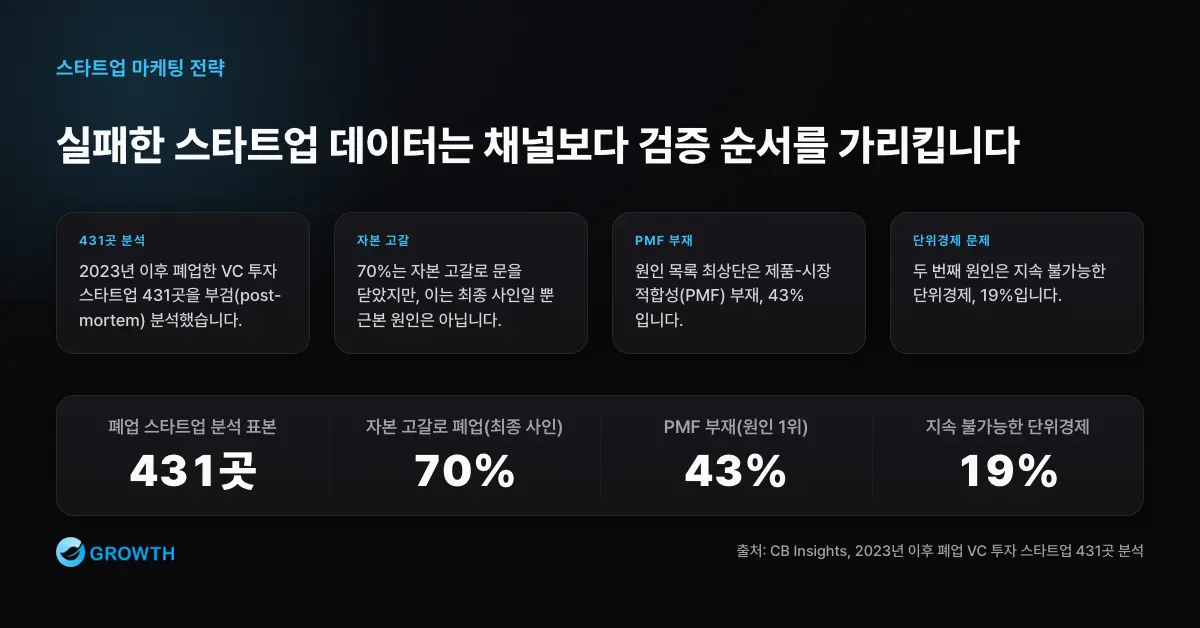
CB Insights’ post-mortem analysis of 431 VC-backed startups that shut down since 2023 found that 70% closed due to running out of cash — but the report itself is explicit that this is “the final cause of death, not the root cause.” At the top of the actual cause list are lack of product-market fit (PMF) at 43% and unsustainable unit economics at 19% (multiple responses allowed). Nowhere on that list is “picked the wrong channel” or “the ad creative was bad.”
Translated into marketing terms: most startup marketing failures come down to spending money to promote something whose reason for selling was never validated in the first place. A product that doesn’t sell won’t sell on any channel. Switching channels changes your cost-per-click and traffic volume, but it leaves the question “who buys, and why” exactly as unanswered as before. Conversely, a company that has that answer corrects quickly even when it picks the wrong channel — once you know what you’re looking for, you notice fast when it isn’t there.
In the field, this failure tends to follow a fixed sequence.
- Months 1–2 — Open Instagram, a blog, and YouTube all at once and start stacking content. No response.
- Months 3–4 — “Content is naturally slow,” so you turn on performance ads. Clicks come in, but no signups or purchases.
- Month 5 — Blame the creative, then the targeting, then the channel, and switch channels. Same result repeats.
- Month 6 — Budget runs out. What’s left is operational experience across a handful of channels, and the fact that “we still don’t know who our customer is.”
Nowhere in this scenario is there a “wrong channel.” What’s wrong is the order. On top of an unvalidated hypothesis, no channel gives you an answer; on top of a validated one, even an ordinary channel becomes the answer.
So this guide redefines startup marketing strategy not as a list of channels, but as the order of hypotheses that must be validated. The theoretical root isn’t new. In The Lean Startup principles, Eric Ries argued that under extreme uncertainty, a startup’s only real unit of progress isn’t revenue or downloads — it’s “validated learning,” and the speed at which you cycle through Build-Measure-Learn is your actual competitive edge. Marketing runs on the same loop. Ad spend isn’t “money you deploy” — it’s “money you use to buy learning,” and a campaign isn’t “operations,” it’s “an experiment.” There are three hypotheses to validate, in order.
- Hypothesis 1 — Who buys, and why. Find evidence that a specific customer chooses your product for a specific reason. (Seed)
- Hypothesis 2 — Can you bring in that customer at a reproducible cost. Prove that putting money and time into one channel produces a predictable number of customers. (Pre-A through Series A)
- Hypothesis 3 — Does that structure scale across channels and an organization. Break single-channel dependence and move the growth formula that lived in the founder’s head into a system. (Post-Series B)
Channel-centric thinking and validation-centric thinking move in entirely different directions even with the same budget.
| Comparison | Channel-centric thinking | Validation-centric thinking |
|---|---|---|
| Starting question | “Which channel is cheap and effective?” | “What hypothesis needs to be proven at this stage?” |
| What budget means | An amount to be spent | The cost of buying learning |
| Definition of success | Growth in traffic, followers, impressions | A hypothesis is confirmed or rejected (both count as success) |
| Handling failure | “This channel doesn’t work” → switch channels | Revise the hypothesis and re-test the same question |
| Basis for scaling | Add channels when budget allows | Increase spend on a channel once reproducibility is proven |
| What’s left after a year | Operational experience across channels, and a depleted budget | An asset: “who our customers are and at what cost we can acquire them” |
The reason we emphasize this view is simple. What a startup needs isn’t traffic volume — it’s the one person who becomes revenue — and validation, not channel choice, is what tells you who that person is.
The validation-order framework — seed through Series B at a glance
The stage names borrow investment-round terminology, but what they really measure isn’t money — it’s the level of what’s been proven. Even a company that’s raised a Series A but still can’t answer “who buys, and why” needs to solve seed-stage problems from a marketing standpoint. Conversely, a bootstrapped, revenue-funded company that has proven a reproducible acquisition channel can move straight to the next stage’s tasks.
| Stage | Core hypothesis to validate | Main validation method | Character of the budget | Condition for moving to the next stage |
|---|---|---|---|---|
| Seed | “A specific someone buys for a specific reason” | 20–50 customer interviews, manual sales/onboarding, landing-page smoke tests | Learning cost — interviews, building experiments, small amounts of test traffic (not “running” ads) | A signal that the same type of customer repeat-purchases/reuses for the same reason and misses it if it’s gone |
| Pre-A through Series A | “Putting money into one channel produces that customer at a predictable cost” | Single-channel focused experiments, cohort analysis, CAC/LTV unit-economics calculation | Experiment budget + performance-linked increases only as much as validated | LTV:CAC ≥ 3, CAC payback within 12 months, reproduced at similar efficiency for 3 straight months |
| Post-Series B | “Multiple channels and an organization drive growth without the founder” | Channel-portfolio operation, incrementality testing, building a growth organization | Portfolio budget — allocated by ratio across core, growth, and experimental channels | Falling reliance on a single channel; an always-on pipeline for validating new channels |
Three principles govern how you run this framework.
- Don’t skip a stage. Scaling acquisition without a PMF signal is like turning on the tap over a bucket with a hole in it. The bigger the budget, the more leaks out.
- Set budget by character, not amount. “Is 5 million won a month reasonable?” has no answer. That same 5 million won buys 50 interviews and 10 experiments at seed, but buys channel reproducibility at Series A.
- Go back if an earlier-stage hypothesis breaks. When a channel that was running well suddenly loses efficiency, the most common cause isn’t channel fatigue — it’s that your early-adopter base has been exhausted and the “why they buy” that worked before doesn’t hold for the next customer segment. The fix here isn’t more budget; it’s going back to seed-stage methodology (interviews, re-validation).
How does this connect to the AARRR funnel?
This stage framework runs orthogonal to the AARRR (Acquisition-Activation-Retention-Referral-Revenue) funnel. Seed stage is effectively validating Activation and Retention — it all comes down to whether the small number of people you bring in feel value and stick around — pre-A through Series A is validating the reproducibility of Acquisition, and post-Series B is optimizing the entire funnel, including Referral and Revenue. Contrary to a common misconception, AARRR isn’t a funnel you solve starting from A (Acquisition) — it’s one you validate from the inside out (Activation, Retention) before moving outward (Acquisition, scale). Metric design for each AARRR stage, supporting frameworks like NSM and RICE, and experiment-design methodology are covered in depth in our growth hacking guide; here we’re only borrowing the mapping of “which part of the funnel gets validated at which funding stage.”

Seed stage — validating “who buys, and why”
The goal of seed-stage marketing isn’t to promote — it’s to learn. There’s exactly one sentence you need to prove at this stage: “A [specific] person in a [specific] situation chooses our product because of [specific reason], and keeps using it.” Any ad spend deployed while these blanks remain unfilled just buys statistically uninterpretable noise.
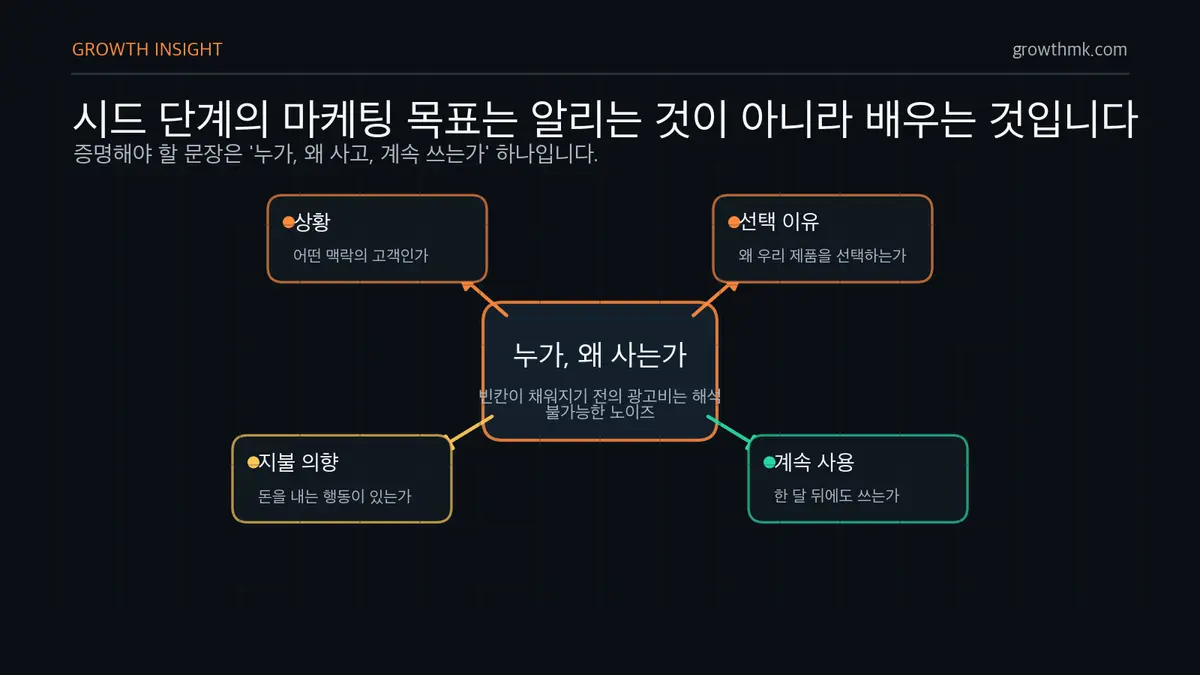
a16z co-founder Marc Andreessen wrote in his 2007 essay The Only Thing That Matters that “the only thing that matters for a startup is getting to product-market fit.” Customers buying the moment you can build it, usage climbing fast, word of mouth spreading — marketing before that state and marketing after it have different goals and different methods entirely. Two tools are enough at seed stage: qualitative interviews and small experiments.
Tool 1 — Qualitative interviews: data when you have no data
An early-stage startup doesn’t have a population large enough for statistics. The densest data available comes straight from customers’ mouths. This should be an interview that reconstructs the decision journey before and after a purchase — not a vague satisfaction survey. We recommend at least 20 interviews, ideally 50. There are four things to ask.

- Situation and trigger — “What was the specific event that made you decide you had to solve this problem?” Ask about the context of the problem, not the product.
- Alternatives and comparison — “What did you use to solve this before us? What did you compare us to?” The competitor is often not a similar product — it’s Excel, manual work, or “just putting up with it.”
- Reason for choosing — “What was the one deciding factor that made you choose us?” The customer’s own phrasing here becomes the raw material for every future ad copy and landing-page line.
- Churn assumption — “How would you feel if you couldn’t use this product starting tomorrow?” Devised by Sean Ellis, this question is read as a leading indicator of PMF when 40%+ of users answer “very disappointed.” In a case study published on First Round Review, the email app Superhuman found this metric stuck at just 22%, so it segmented out only the “very disappointed” respondents and rebuilt its roadmap around what that group loved — pushing the score to 58% within about three quarters. It’s a textbook example of marketing driving the measure → segment → improve → re-measure loop.
Avoid two common traps in interviews. First, hypothetical future-tense questions (“would you use it if it had this feature?”) only return polite agreement — ask about real past behavior instead (“when was the last time you spent money or time on this problem?”). Second, don’t tally compliments as data. The bar for validated learning is behavior — payment, return visits, referrals, waitlist signups — not sentiment.
Tool 2 — Small experiments: marketing done by hand
If interviews generate the hypothesis for “why they buy,” small experiments validate that hypothesis through action. In his essay Do Things that Don’t Scale, Paul Graham points out that nearly every successful startup brought in its first users by hand, one at a time. Airbnb’s founders went door to door visiting hosts in New York; Stripe’s founders took the laptops of developers who showed interest and installed the product on the spot. He counters founders’ reluctance — because the numbers “look too small” — with a compounding calculation: 100 users growing 10% a week becomes 14,000 within a year. At seed stage, these experiments are worth running.
- Landing-page smoke test — Send a small amount of traffic (on the order of a few hundred dollars) to a page with a single core value proposition and a pre-signup button, and compare conversion rates by message and segment. It’s the cheapest way to validate a message before the product exists.
- Manual sales and manual onboarding — The founder personally sells to 10–30 people and onboards them personally. The output that matters more than conversion rate is a list of reasons people said no, and the number of conversations it took to close a deal.
- Concierge test — Deliver by hand what will eventually be an automated feature, and confirm willingness to pay. Selling before building is the right order.
If you want a feel for what this stage looks like in practice, our B2B startup marketing case study shows how early-stage validation actually plays out.
| Seed stage | Details |
|---|---|
| Core validation questions | ① Who’s in the most pain (segment)? ② What triggers a purchase (trigger)? ③ What did they compare to and give up (alternative)? ④ Are they still using it a month later (retention)? ⑤ Do they pay (willingness to pay)? |
| Right character for budget | Learning cost: interview incentives, landing-page production, small amounts of traffic for message tests, prototype running costs. Budget per experiment, not a fixed monthly ad spend — “what does it cost to reject or accept this hypothesis?” |
| Success signal | Sean Ellis test at 40%+, unsolicited referrals/word of mouth, manual sales conversion consistently high in a specific segment, the same “reason for choosing” showing up repeatedly in interviews |
| Don’t | Brand-awareness campaigns, always-on performance ads, opening multiple channels at once (launching blog, Instagram, YouTube, and newsletter together), outsourcing all of marketing, hiring a full-time marketer |
Pre-A through Series A — prove one reproducible acquisition channel
Once you’ve answered “who buys, and why,” the next hypothesis is “can we bring in that customer, repeatedly, at a predictable cost.” There are two common, opposite mistakes at this stage. One is still relying entirely on the founder’s network and legwork, so growth scales with the founder’s stamina. The other is spreading budget across 5–6 unvalidated channels, so nowhere gets enough signal for statistical confidence.
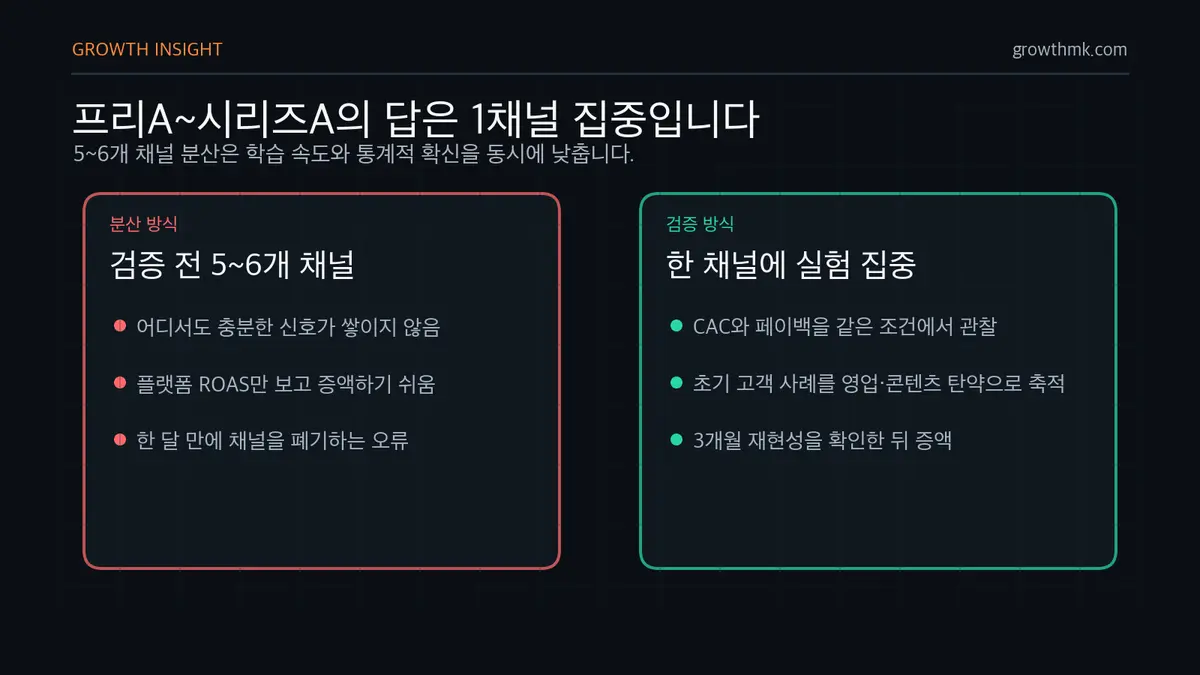
The answer is focus on one channel. Narrowing channels looks conservative, but it’s the opposite. Concentrating experiments on one channel speeds up learning, and only accumulated learning lets you find out where that channel’s marginal efficiency tops out. According to research by Lenny Rachitsky tracking the early days of Slack, Stripe, Figma, and others, the first 10 customers of fast-growing B2B companies came almost entirely from three sources — ① the founder’s personal network, ② communities where prospects already gather, and ③ press coverage — and most companies used the first two in parallel. This stage’s job is to find the first systematic channel that can replace that “founder-driven” path.
Unit economics — the passing grade at this stage
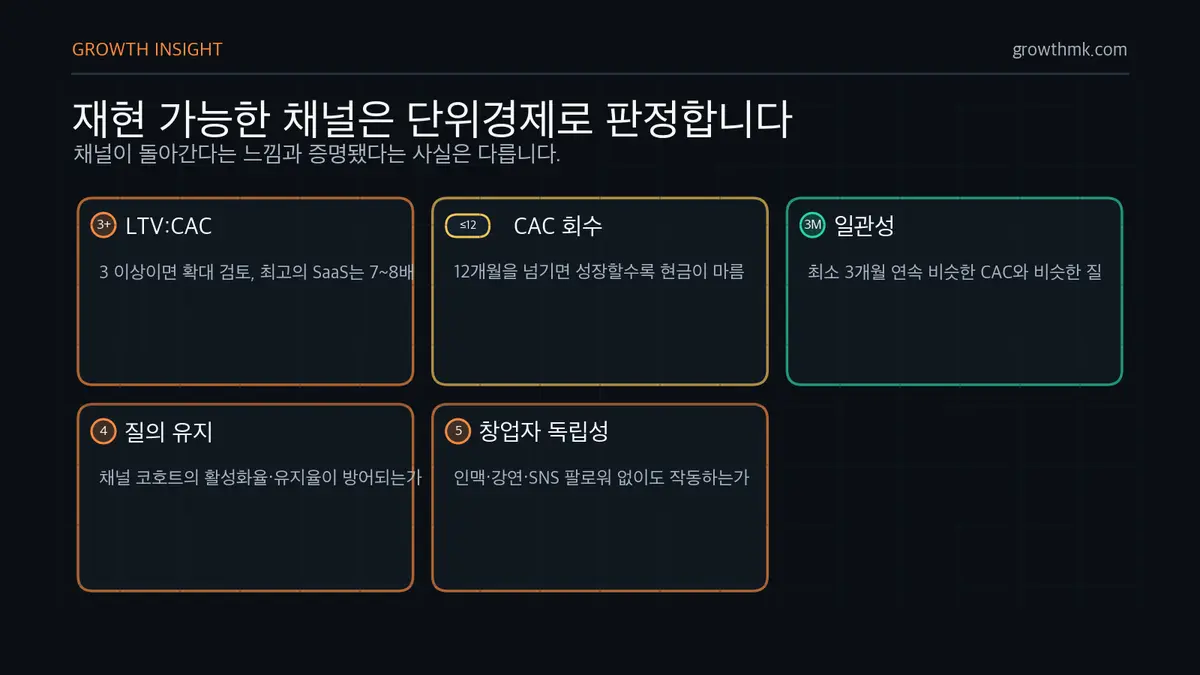
A channel feeling like it’s working and a channel being proven are two different things. Proof speaks the language of unit economics. David Skok, a SaaS investor and former general partner at Matrix Partners, lays out two benchmarks in SaaS Metrics 2.0: LTV (customer lifetime value) at least 3x CAC (customer acquisition cost) — the best SaaS companies reach 7–8x — and CAC payback within 12 months. Exceed 12 months, and growth becomes a structure that drains cash the more it succeeds. The principle holds even outside SaaS: if you can’t answer “by when does this customer pay back what we spent to acquire them,” that channel isn’t proven yet.
Watch out for ROAS as a trap here. The ROAS your ad platform shows doesn’t account for margin, repeat purchases, or duplicated attribution, so it’s common to see healthy-looking ROAS while the company’s bank balance quietly drains. We break this down in detail in the trap of ROI and ROAS. If you’re planning to validate paid ads as your core channel, read the complete performance-marketing guide first for platform-specific characteristics and the limits of attribution.
“Reproducible” holds only when all three of the following are true simultaneously.
- Consistency — for at least 3 straight months, similar CAC brings in similarly qualified customers (month-to-month variance stays within an explainable range)
- Quality retention — the activation and retention rates of the cohort from this channel look like your early customer cohort. If volume rises but retention collapses, that’s dilution, not acquisition
- Founder independence — the channel works without the founder’s involvement. Results that lean on the founder’s network, talks, or social following are being spent, not reproduced
| Pre-A through Series A | Details |
|---|---|
| Core validation questions | ① Which channel matches our customers’ discovery path? ② What’s the CAC, and what fraction of LTV is it? ③ How many months to pay back CAC? ④ Does this efficiency reproduce for 3+ months? ⑤ Does the retention of channel-acquired customers match early customers? |
| Right character for budget | Experiment budget + performance-linked increases. Don’t lock in an annual budget upfront — increase quarterly “by exactly as much reproducibility has been proven.” Start at a size that can sustain the minimum 3-month validation window per channel |
| Success signal | LTV:CAC ≥ 3, CAC payback within 12 months, efficiency held for 3 straight months, channel cohort retention holds up, sales/CS says “lead quality has changed” |
| Don’t | Run 5 channels at once (spreading makes validation impossible), scale spend based on platform ROAS alone, kill a channel after just 1 month of testing (ignoring the learning curve), buy cheap traffic with no purchase intent just because it’s cheap, hand your agency the definition of “success” itself |
Post-Series B — channel portfolio and organization
Once one channel is proven, two new risks appear: dependency risk (a spike in cost, a policy change, or saturation in your primary channel instantly becomes a company-level crisis) and bottleneck risk (the growth formula lives only in the heads of the founder or one or two early team members). Post-Series B marketing’s hypothesis is therefore: “do multiple channels and an organization produce growth without depending on any one person?”
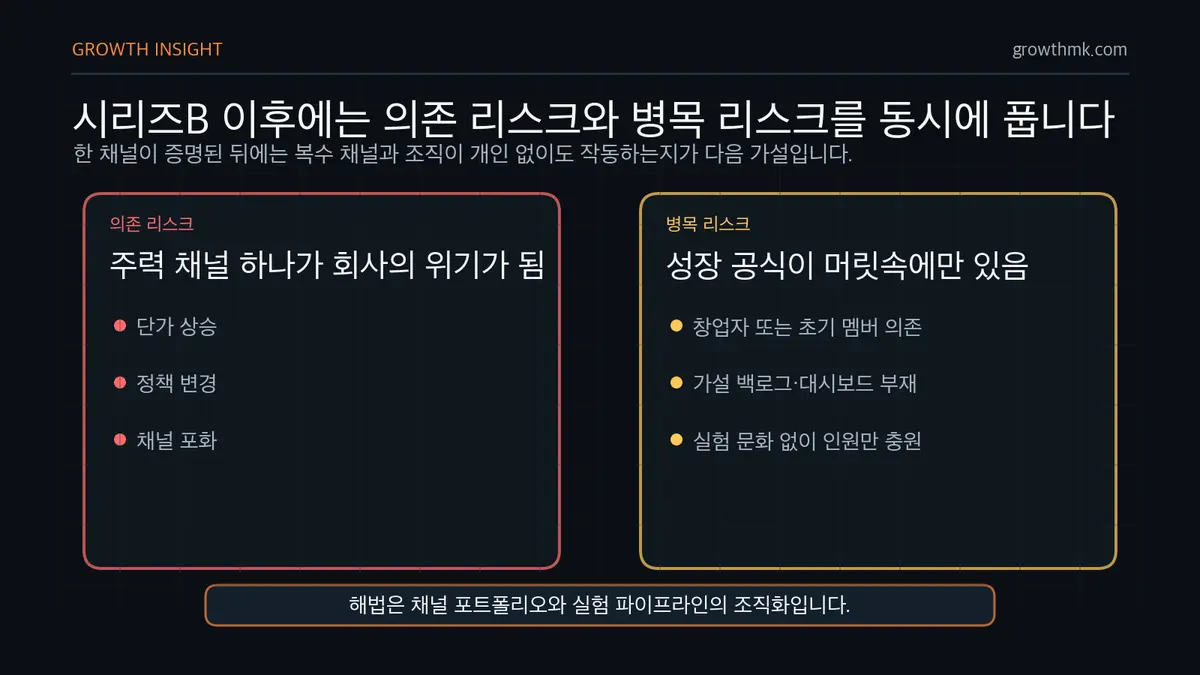
Channel portfolio — running three tiers
At this stage, budgeting stops being about optimizing a single channel and becomes a portfolio-allocation problem. We recommend splitting channels into three tiers by validation level and applying different expectations and metrics to each.
| Tier | Definition | Budget share (example) | Judging metric | Operating principle |
|---|---|---|---|---|
| Core channel | 1–2 channels with proven unit economics that are being scaled steadily | 60–70% | CAC/LTV, marginal CAC (efficiency of incremental spend) | Continuously watch for where marginal efficiency starts to decline — don’t scale infinitely just because efficiency looks good |
| Growth channel | 1–2 channels with an early signal confirmed, currently being tested for reproducibility | 20–30% | Cohort quality, 3-month reproducibility | Apply the same methodology used at pre-A through Series A, unchanged |
| Experimental channel | New channels or segments still at the hypothesis stage | 5–10% | Learning speed (number of hypotheses rejected/accepted) | Apply the same seed-stage methodology, unchanged — small, fast, by hand |
The key idea is the recursiveness of the framework. Even after a company passes Series B, any newly opened channel or newly entered segment always starts back at the seed-stage question — “who buys, and why.” The moment your core channel’s efficiency turns down is usually the moment your early-adopter base is exhausted and the mainstream customer’s reason for buying has shifted — and what’s needed then isn’t a bid adjustment, it’s re-validation.
Organization — turning a formula into a system
From an organizational standpoint, this is when founder-led marketing hands off to an experiment pipeline. The operating system and team structure for this — hypothesis backlogs, experiment prioritization, weekly growth meetings — are covered in the team-structure section of our growth hacking guide. If you’re in B2B, this is also when structural work like marketing-sales alignment, ABM, and lead scoring kicks into gear in earnest — you can see the full picture in the complete B2B marketing guide. It’s also reasonable to start brand investment (content assets, category messaging, PR) at this stage — not because brand doesn’t matter earlier, but because brand investment has a long payback cycle and only compounds once “what to say to whom” has already been validated.
| Post-Series B stage | Details |
|---|---|
| Core validation questions | ① Where does the core channel’s marginal CAC start turning down? ② Do the second and third channels bring in the same quality of customer? ③ Is the incremental effect between channels real (after removing duplicate attribution)? ④ Does the growth formula exist as documentation, process, and dashboards? |
| Right character for budget | Portfolio budget. Allocate roughly 60–70 core / 20–30 growth / 5–10 experimental, and rebalance quarterly. This is the first stage to budget for long-payback investments like brand and content assets |
| Success signal | Reliance on the #1 channel drops below 50% of revenue, new-channel validation runs every quarter, metrics hold up even when the founder steps back from marketing execution |
| Don’t | Pour the entire budget into one proven channel (accelerating saturation), roll out unvalidated channels all at once (“we have money now, so let’s do everything”), misread numbers from an attribution tool as true incrementality, add headcount without an experimentation culture in place |
How do you pick a channel? — a product type × customer-discovery matrix
There’s no such thing as “a good channel for startups.” What exists is only “a channel that matches the path our customers actually use to discover a solution to this problem.” So the starting point for channel selection isn’t a channel comparison chart — it’s the customer-journey data you gathered in your seed-stage interviews. Customers discover solutions in one of three ways.
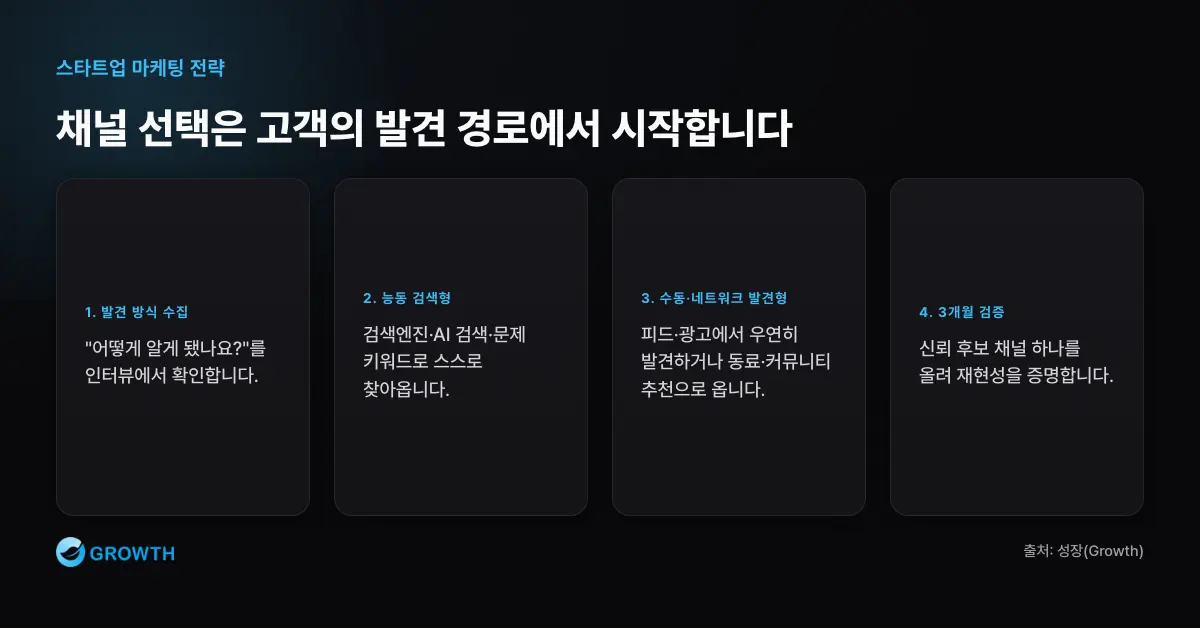
- Active search — Customers recognize the problem and search for a solution. Search engines and AI search (ChatGPT, Perplexity, etc.) are the main stage.
- Passive discovery — Problem awareness is weak or latent; customers stumble across it in a feed, video, or ad, and a want forms afterward.
- Network / referral — Spreads through the trust of peers, communities, or existing users. Stronger the higher the purchase risk or the more expertise the product requires.
| Product type \ Discovery mode | Active search | Passive discovery | Network / referral |
|---|---|---|---|
| B2B SaaS / professional services | ◎ Problem-keyword SEO, search ads, AI-search visibility — long review cycles mean content assets compound the most | △ LinkedIn and similar job-role targeting — only as an awareness-stage supplement | ◎ Communities, webinars, customer-referral programs, partnerships |
| B2C app / subscription | ○ App-store search (ASO), category keywords | ◎ Short-form/social ad creative experiments — the creative itself is the targeting | ○ Referral incentives, viral loops (only work when built into the product) |
| Commerce / consumer goods | ○ Shopping search, review keywords | ◎ Social commerce, creator collaborations — discovery converts directly to purchase | ○ Accumulated reviews and UGC drive repeat purchase and trust |
| Developer / technical products | ◎ Technical-docs and tutorial SEO, visibility in AI coding assistants | △ Ad efficiency is generally low | ◎ Open source, technical communities, conferences — trust is the only currency |
Using the matrix is simple. ① In your seed interviews, collect answers to “how did you first hear about us?” and “where do you usually look when you need something like this?” to map the distribution of your customers’ discovery modes. ② Shortlist the top channel at the relevant intersection of the matrix. ③ Prove it over 3 months using the single-channel validation methodology laid out above. Choosing a channel from the matrix alone, without interview data, is just a step back into channel-centric thinking.
Two additional notes. First, active search now includes AI search. As more customers ask ChatGPT things like “recommend a good ___,” generative engine optimization has joined search engine optimization as a channel that now needs validating. The mechanics and execution are covered in our complete GEO (generative engine optimization) guide. Second, the same channel is operated differently at different stages. SEO at seed is “keyword research to learn the customer’s language”; SEO at Series A is “focused pursuit of conversion keywords”; SEO at Series B is “building a content asset that covers an entire topic.” Sharing a channel’s name doesn’t mean sharing its job.
A minimum measurement stack — not ahead of your stage, not behind it
A measurement setup costs you either way if it’s too little or too much. Adopting a multi-touch attribution tool at seed stage is buying a microscope for a sample size of 30; scaling ad spend at Series A with no conversion tracking is merging onto a highway with no dashboard. There’s one principle: don’t collect a number you won’t use in this quarter’s decisions.
| Stage | Must measure | Minimum tooling | Not yet needed |
|---|---|---|---|
| Seed | Interview notes (recurring reasons for buying), activation rate, early retention, Sean Ellis score | Spreadsheet, tracking 1–2 core product events, a survey tool | Attribution tools, BI dashboards, a CDP, marketing automation |
| Pre-A through Series A | CAC by channel, cohort retention, conversion path, LTV estimate, CAC payback period | GA4 + server-side conversion tracking, a lightweight CRM, cohort analysis (product analytics or SQL) | Multi-touch attribution modeling, MMM, a full-scale data warehouse build |
| Post-Series B | Marginal channel efficiency, incrementality test results, channel dependence, experiment-pipeline throughput, measured LTV | Data warehouse + BI, attribution (as a reference), incrementality design (geo splits, holdouts) | — |
The accuracy of your tracking setup directly decides whether validation succeeds or fails, especially in the pre-A through Series A window. If conversion tracking is set up wrong, your CAC calculation is wrong from the ground up, and a “this channel works / doesn’t work” conclusion built on a wrong CAC drags the company’s next year in the wrong direction. What to set up and how is laid out in why tracking-tool setup matters.
Discipline matters more than tooling. Write down in advance, for every metric, “what will we change if this number comes out this way” — and periodically strip your measurement stack down by removing any metric that hasn’t informed a single decision in a full quarter. The point of measurement isn’t filling out a report; it’s picking the next experiment.
When and what should you hand to an agency?
The question “which agency should an early-stage startup work with” hides an assumption. What’s safe to hand off and what isn’t changes by stage. The principle is clear: ownership of the hypothesis can never be outsourced, at any stage. Learning who buys and why is the founding team’s job. An agency’s role is to increase the speed and precision of that validation.
| Stage | Good to outsource | Don’t outsource | Right collaboration model |
|---|---|---|---|
| Seed | Landing-page/experiment creative production, initial tracking setup, advisory on interview and experiment design | All of marketing, a “X pieces of content per month” volume contract, a branding package | Spot projects/hourly advisory — a fixed retainer is premature |
| Pre-A through Series A | Specialized operation of one channel nearing validation (performance, SEO, content), building the unit-economics measurement system | Handing off channel selection itself (“you decide what’s best”), handing off the definition of success, transferring data ownership | A single-channel specialist agency + monthly hypothesis review — ad accounts and data must stay owned by your company |
| Post-Series B | Splitting specialized operation across channels, outsourcing new-channel validation, creative volume production, incrementality-test design | Overall growth strategy (that’s the in-house core team’s job), authority over experiment prioritization | An in-house core team + a portfolio of channel-specialist agencies |
Regardless of stage, three questions distill how to spot a good agency.
- “Do they ask about the hypothesis before the channel?” There’s a world of difference between an agency that jumps straight from “what’s your budget? then this channel package works” in the first meeting, and one that opens with “let’s first look at who’s buying right now, and why.”
- “Do they report performance as learning?” Check whether reports say “this month we validated this hypothesis and rejected that one” rather than just impressions and clicks. An agency that talks about what it learned from a failed experiment is a more trustworthy partner than one that hides failures.
- “Is the contract easy to leave?” Check that your company owns the ad accounts, data, and content, and that termination terms are clean. See our agency-selection checklist for the detailed criteria.
The right agency for an early-stage startup isn’t one that promises traffic volume — it’s one that helps you validate who “the one person who becomes revenue” is, and proves the cost of bringing them in with data. That’s exactly how Growth Inc. works — we build hypotheses from customer-journey analysis, validate them through experiments, and report in unit economics. If you need validation design suited to your current stage, take a look at Growth Inc.’s services, and if you’d like to start with a diagnosis of your company’s stage, reach out for a consultation.
Related guides in this cluster
- Startup Marketing Agencies — A Decision Framework Based on Stage and Budget
- Early-Stage Startup Marketing Budgets: Allocate by Validation Stage, Not “% of Revenue”
- B2B Startup Marketing Case Study — Argyle Social vs. BuzzGuRu, Read Through Stage-by-Stage Validation
Frequently Asked Questions (FAQ)
What’s a reasonable marketing budget for an early-stage startup?
The character of the budget matters more than a dollar figure (“X% of revenue”). At seed stage, budget isn’t ad spend — it’s learning cost: interviews, landing-page tests, small message experiments — usually enough at a few hundred to a few thousand dollars a month. It’s safest to increase real spend only once a “reproducible channel” is proven, and to raise it quarterly within the range where unit economics hold — LTV:CAC ≥ 3, CAC payback within 12 months.
Is there such a thing as too early to start marketing?
“Promotional” marketing (ads, brand campaigns) is too early before a PMF signal exists. But “learning” marketing (customer interviews, smoke tests, manual sales) should start before the product is even finished — effectively, on day one of the company. If you define marketing as “promoting something after you finish building it,” it’s easy to start too late; if you define it as “validating why something sells,” there’s no such thing as too early.
When should you hire your first marketer?
Typically once one reproducible acquisition channel starts to emerge — the pre-A through Series A window. Marketing before that stage is about meeting customers directly and forming hypotheses, work the founder is usually best positioned to do — and a marketer hired without a validated channel struggles to deliver under a vague “try anything” mandate. Your first hire should be an execution-focused specialist who can dig deep into a proven channel, rather than a brand generalist.
Is it okay to run paid ads before PMF is validated?
No if the goal is “growth,” yes if the goal is “learning.” Sending small amounts of traffic to a landing page to compare which message and segment respond is an efficient experiment that speeds up PMF validation. But the moment you start increasing that same ad spend to grow traffic volume as a goal in itself, you’re pouring traffic into an unvalidated product — exactly the failure formula CB Insights’ data shows. It’s the purpose, not the budget, that decides whether it’s okay.
What kind of marketing agency is a good fit for an early-stage startup?
One that proposes validation design, not a channel package. Specifically: ① in the first meeting, it asks “who buys, and why” before channels or quotes; ② it reports performance in terms of hypothesis validation and unit economics (CAC, LTV), not impressions and clicks; ③ it leaves ad-account and data ownership with your company. Flexibility that understands your stage — spot advisory at seed, single-channel specialist operation around Series A — is also an important signal. Avoid any agency that recommends the same full package regardless of stage.