2024 Marketing Calendar and Key Dates at a Glance
 임재복
임재복
In a marketing world where every moment counts, checking the marketing calendar is a surprisingly high-leverage habit. It looks simple on the surface, but it holds one of the real keys to marketing success and efficiency.
A marketer who checks the marketing calendar regularly, by definition, already has a roadmap for strategic planning. That one habit alone streamlines the whole marketing process and gives you a clear read on upcoming key dates and moments — which in turn makes faster, better-timed decisions possible. Planning your content calendar ahead of time also cuts down on last-minute scrambling for ideas and keeps a steady publishing rhythm — and a consistent publishing cadence lines up nicely with search engines’ preference for frequently updated sites.
A well-organized marketing calendar keeps your messaging consistent. By giving decision-makers a bird’s-eye view of upcoming campaigns, it lets everyone align messaging across the board.
In a market where staying on top of trends matters, it also means you can jump on new trends and stay ahead of the competition.
It helps you allocate budget and headcount efficiently too, matching resources to what each planned campaign actually needs.
Growth Marketing builds out its marketing calendar every year before the year-end rush. As we review the schedule, we measure the impact of past campaigns and map out the strategy for campaigns we’ll run during peak seasons — all in service of maximizing reach to the right prospects and capturing new trends early.
For more on seasonal keywords — search terms that spike around peak seasons or specific events — see our piece on what a seasonal keyword (SK) actually is.
You can find the full details on downloading Growth Marketing’s 2024 marketing calendar in the section below.
Q1 Marketing Calendar
January
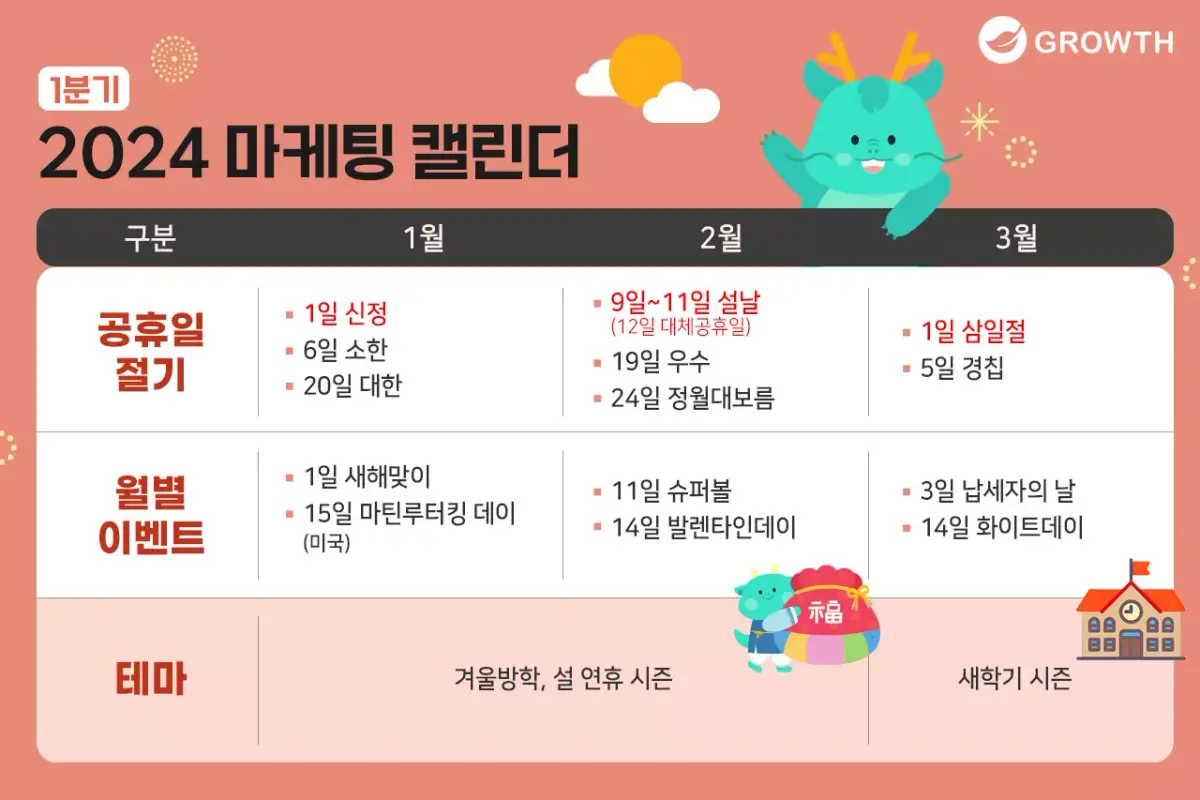
- Jan 1 — New Year’s Day
- Jan 15 — Martin Luther King Jr. Day (US)
January, the start of a new year, is all about fresh beginnings. Seasoned marketers know how to tap into that new-year energy.
Try aligning your product or service with common New Year’s resolutions. Health and wellness, financial goals, personal growth — whatever the angle, it’s a chance to position your brand as a partner in your customers’ journey.
February
- Feb 9–12 — Seollal, the Lunar New Year (12th is a substitute holiday)
- Feb 11 — Super Bowl
- Feb 14 — Valentine’s Day
- Feb 24 — Jeongwol Daeboreum (Korea’s first full moon festival)
February still has some winter left to work with, so run promotions tailored to the season. Think cozy, comforting themes that pull in customers during the cold months, or New Year discounts and bundle deals.
Early in the year is also the best window for clearing out old inventory. Evaluate last year’s stock, clear the shelves, and make room for new products.
March
- Mar 1 — Independence Movement Day (Samiljeol)
- Mar 3 — Taxpayers’ Day
- Mar 8 — International Women’s Day
- Mar 14 — White Day
- Mar 31 — Easter
Taxpayers’ Day is a national observance created to raise tax awareness and encourage tax revenue. It’s a natural fit for educational content that builds your audience’s financial literacy — think blog posts with tips or insights on tax-related topics.
Or use it as an opportunity to highlight your company’s commitment to transparency and ethical financial practices. Tying Taxpayers’ Day to a charitable initiative is another way to demonstrate corporate social responsibility.
Q2 Marketing Calendar
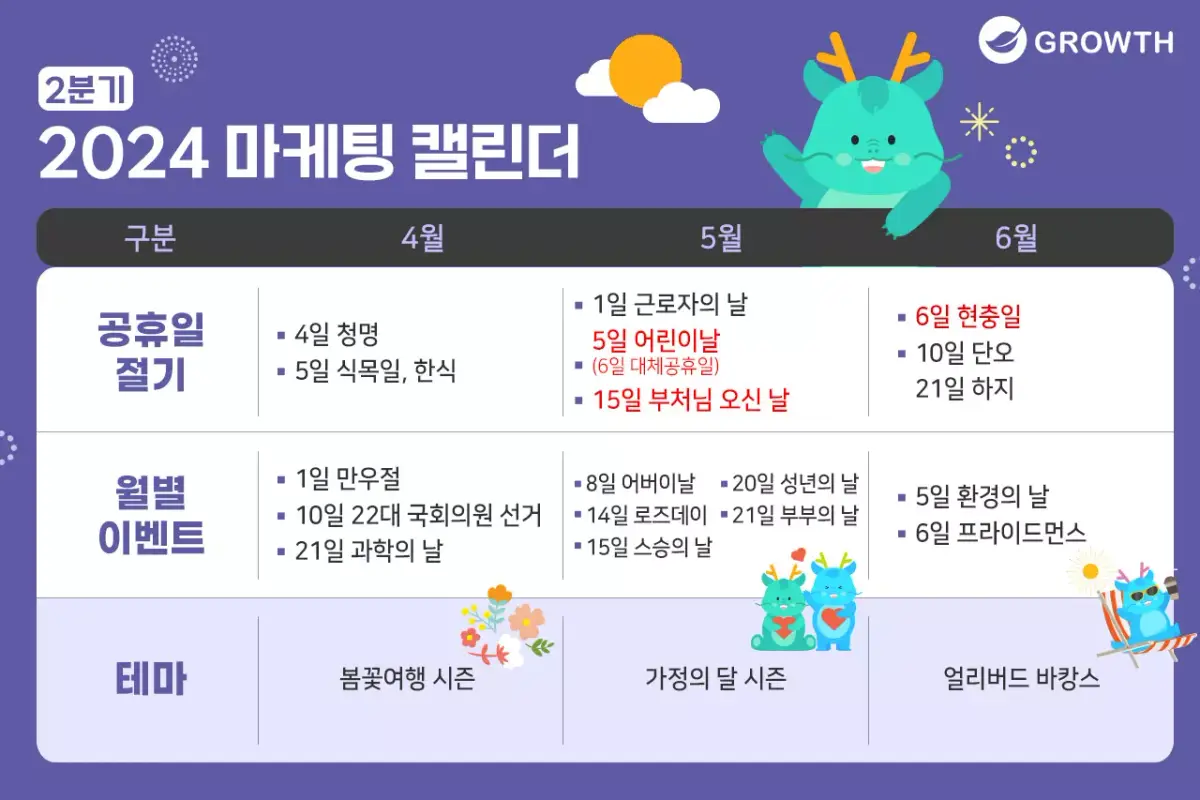
April
- Apr 1 — April Fools’ Day
- Apr 10 — 22nd National Assembly election
- Apr 21 — Science Day
- Apr 22 — Information and Communication Day
- Apr 25 — Law Day
April is a great month to bring some spring energy into your campaigns — bright, fresh, and full of life. Themes around growth and positivity tend to resonate well with audiences.
April 10 is the 22nd National Assembly election. Aligning your marketing around a political event, done thoughtfully, can raise brand visibility and drive community engagement.
Try creating content that surfaces key election issues and sparks an informed conversation. Or lean into the heightened civic awareness around election day with a special promotion or discount. Encouraging customers to share their “I voted” sticker or their voting-day experience for an exclusive deal is a simple way to build a positive connection with your brand.
May
- May 1 — Labor Day
- May 5 — Children’s Day
- May 6 — Substitute holiday for Children’s Day
- May 8 — Parents’ Day
- May 14 — Rose Day
- May 15 — Buddha’s Birthday, Teachers’ Day
- May 21 — Married Couples’ Day
May is packed with holidays and events. Spring getaways and celebrations give you plenty of room to tailor your marketing to the seasonal mood.
Known as “Family Month” in Korea, May puts a spotlight on family bonds and the importance of relationships. Brands can lean into themes of family togetherness and love, encouraging consumers to celebrate and show appreciation for the people closest to them.
From Children’s Day, honoring the youngest members of society, to Teachers’ Day, recognizing educators’ contributions, to Rose Day and Parents’ Day, which express love and affection — there’s no shortage of occasions to help people express what they feel for the people close to them.
Buddha’s Birthday is one of May’s major religious and cultural observances. Brands can build campaigns around the themes of peace, harmony, and mindfulness associated with the day.
June
- Pride Month
- Jun 6 — Memorial Day
In a marketing context, Pride means celebrating diversity, inclusion, and LGBTQ+ identity. So why does Pride matter for marketing?
Pride Month commemorates the Stonewall riots — the uprising that began on June 28, 1969, when LGBTQ+ patrons at the Stonewall Inn in Greenwich Village, New York, resisted a police raid. Every June, major cities around the world, from New York to San Francisco, hold Pride festivals in its honor.
Showing support for Pride, from a marketing standpoint, can strengthen a brand’s reputation as inclusive and socially responsible.
LGBTQ+ consumers, in turn, are more likely to support brands whose values align with their own and that show genuine support for the community.
Q3 Marketing Calendar
July
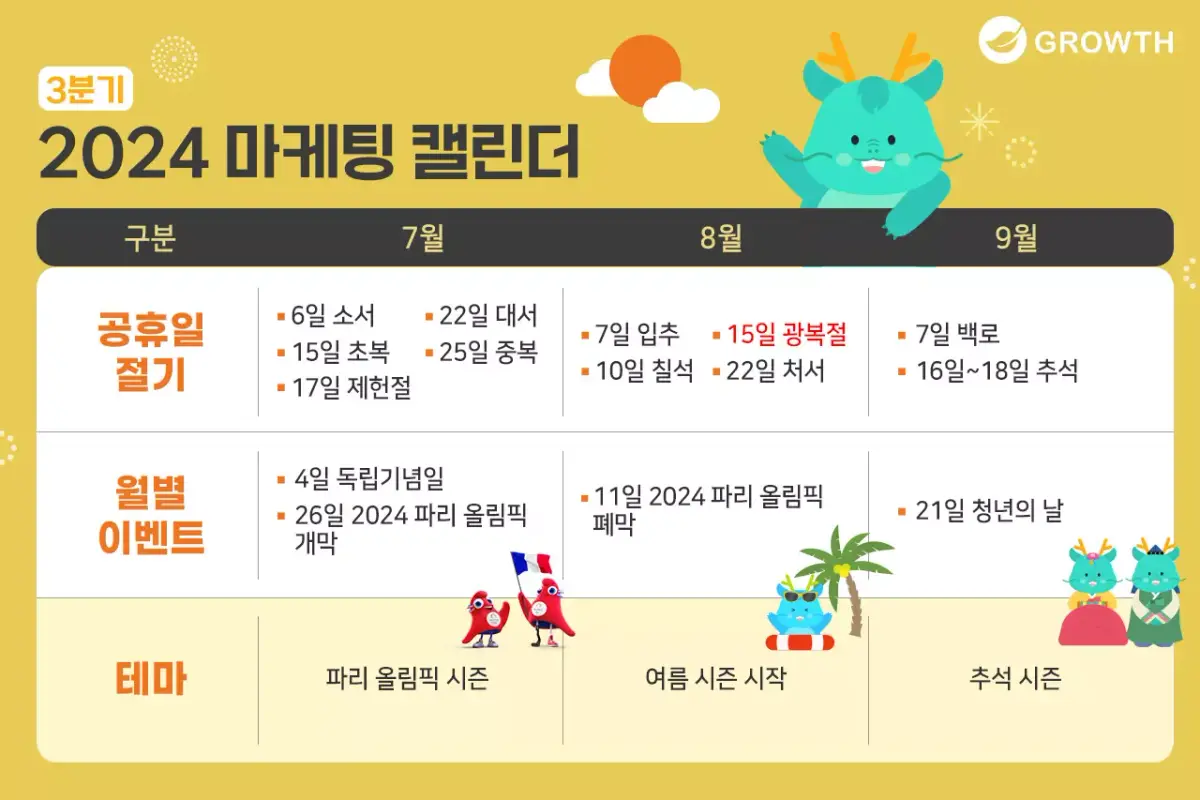
- Start of summer peak season
- Jul 4 — Independence Day (US)
- Jul 17 — Constitution Day
- Jul 26 — 2024 Paris Olympics opening ceremony
July is synonymous with sunshine and the outdoors.
Lean into the summer mood with eye-catching sales and promotions. Whether it’s a summer sale or a season-only exclusive offer, this is a high-spend, high-energy window worth capturing your audience’s attention in.
July 26 marks the opening ceremony of the 2024 Paris Olympics. Paris 2024 officially opened on July 26 and closed on August 11 — a major global event, and a great hook for campaigns that celebrate the Games alongside your brand.
August
- Back-to-school season
- Aug 11 — 2024 Paris Olympics closing ceremony
- Aug 15 — Liberation Day
August is a good time to look at partnerships with other brands to power your summer campaigns. Collaborations extend your reach and give your product a fresh angle in front of a new audience.
September
- Sep 2 — Labor Day (US, Canada)
- Sep 16–18 — Chuseok
Chuseok falls on the 15th day of the 8th lunar month and is Korea’s major harvest festival, celebrated by Koreans at home and by Korean communities around the world. Families gather to share a bountiful meal, hold ancestral rites, and enjoy traditional games and festivities.
You can build Chuseok-themed imagery and messaging into your marketing materials to mark the occasion. Consider partnering with Korean restaurants, cultural centers, or community organizations on joint promotions or events.
Chuseok is also a chance to build authenticity and cultural connection. Keep investing in a long-term relationship with the Korean community, rather than treating it as a one-off moment.
Put these strategies to work, and Chuseok becomes a genuinely effective part of your marketing calendar for reaching more of the audience that matters to you.
Q4 Marketing Calendar
October
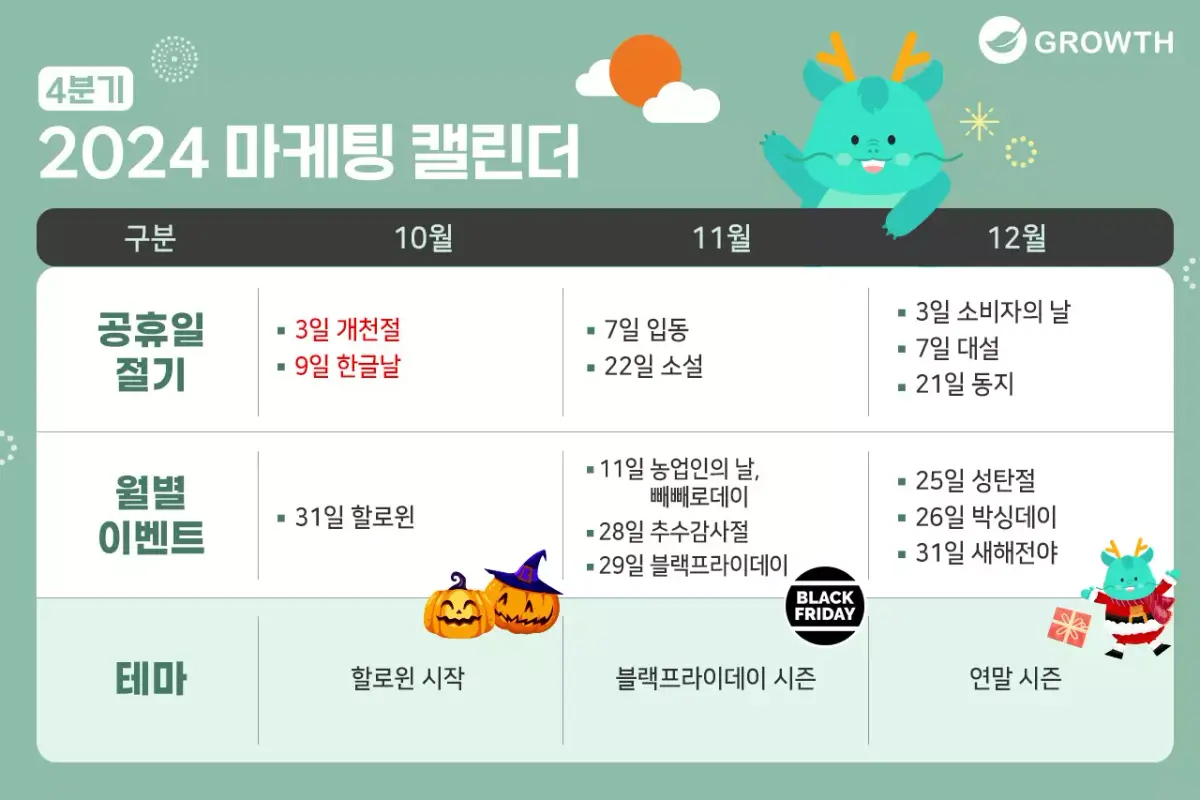
- Oct 3 — National Foundation Day
- Oct 9 — Hangeul Day
- Oct 31 — Halloween
Q4 is the momentum that carries you toward closing out the year strong.
Run your most compelling campaigns of the holiday season. Promotional events, gift guides, and limited-time discounts all let you tailor your messaging to the festive mood.
November
- Nov 11 — Pepero Day, Farmers’ Day
- Nov 28 — Thanksgiving
- Nov 29 — Black Friday
Black Friday and Cyber Monday have become well-known shopping events in Korea too by now. Plan standout promotions to get ready for the shopping frenzy — this is your window to significantly boost sales and win over eager shoppers.
December
- Dec 25 — Christmas
- Dec 26 — Boxing Day
- Dec 31 — New Year’s Eve
December is a natural moment to look back on the year with your audience. Share your wins, express gratitude, and give a sneak peek at what’s coming next year — it’s a great way to build a sense of community and loyalty.
Download the 2024 Marketing Calendar
A marketing calendar built with care for each season’s mood can genuinely shift the trajectory of a business. It lets you run campaigns strategically, matched to the unique opportunity each quarter offers.
Put together your marketing calendar now, and set the stage for a year of growth, engagement, and success!
📅 Download Growth Marketing’s 2024 marketing calendar
Related reading
- What Is Growth Hacking? Definition, AARRR, Experiment Design, and Real Cases — the Complete Growth Strategy Pillar
- What Is Marketing Channel Mix?
- CDJ (Customer Decision Journey)
- What Is a Persona?
- Needs vs. Wants: What’s the Difference?
If you want to apply this to your own business — if you need a concrete assessment of your situation, reach out through our consultation contact form. We answer in terms of the one customer who becomes revenue, not raw traffic volume.
FAQ
Why is it worth building a marketing calendar ahead of time?
Preparing a calendar in advance lets you see upcoming seasons, holidays, and events at a glance, so you can allocate budget and staffing by time period. As covered above, the simple habit of checking your schedule regularly speeds up decision-making and keeps your messaging consistent. It also cuts down on last-minute, rushed content, helping you keep a steady publishing rhythm.
How should I plan campaigns quarter by quarter?
It works well to build a theme around each quarter’s distinct mood and events: Q1 around New Year’s resolutions and inventory clearance, Q2 around spring and Family Month, Q3 around the summer peak season and Chuseok, and Q4 around year-end and shopping events like Black Friday. Use the month-by-month breakdown above as a starting point, then design campaigns around the moments that genuinely connect to your own product or service.
How do seasonal keywords work alongside the calendar?
Seasonal keywords — search terms that spike around a specific season or event — often line up with the peak seasons and holidays on your calendar. Preparing related content ahead of the event itself gives you a shot at ranking well right when search demand peaks. See our linked piece above for a deeper look at the concept.
What should I watch out for when marketing around a holiday?
For dates with real social or cultural weight, like Pride Month or Chuseok, authenticity matters. Rather than treating the day as an excuse for a discount, respecting the context and values behind it is what builds real brand trust. As covered above, going beyond a one-off campaign to build a genuine, long-term relationship with the community is what actually works.