
CDJ (Customer Decision Journey) — Definition, Stages, and Applications
 임재복
임재복
What is the CDJ (Customer Decision Journey)?
The CDJ (Customer Decision Journey) is a model that systematically maps out the entire process and experience a consumer goes through — from becoming aware of a product or service, to considering it, evaluating it, purchasing and using it, and ultimately forming loyalty to the brand. It evolved from the older, simpler, linear purchase funnel model into a non-linear, cyclical framework that reflects today’s complex, diversified consumer behavior and the many digital touchpoints involved.
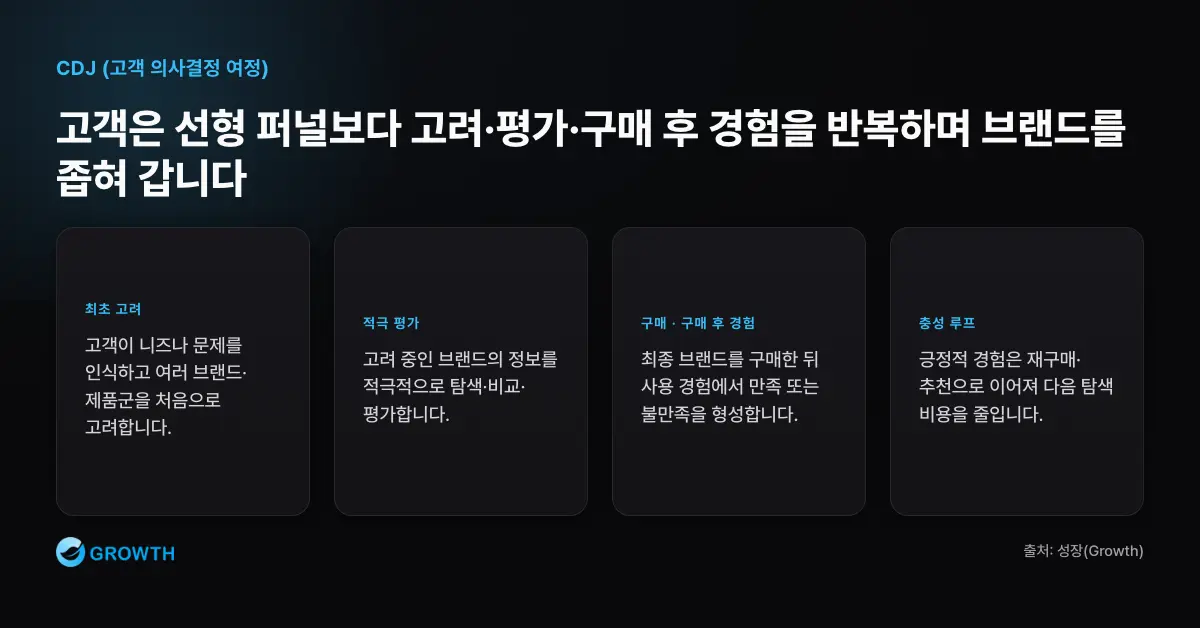
Grounded in real data and research, the CDJ is used to understand a customer’s needs, emotions, and behavior at each stage, optimize key touchpoints, deliver a positive customer experience, and ultimately raise both purchase conversion and customer loyalty. It’s recognized as a core tool for putting a customer-centric approach into practice in modern marketing and customer experience management.
The history and evolution of the CDJ
The limits of the traditional purchase funnel model
In the past, marketing mostly explained the consumer purchase process using a linear sales funnel model, like the AIDA model (Awareness–Interest–Desire–Action). This model assumed that prospective customers entered at the funnel’s wide top (awareness) and moved through progressively narrower stages until they reached the final purchase (action).
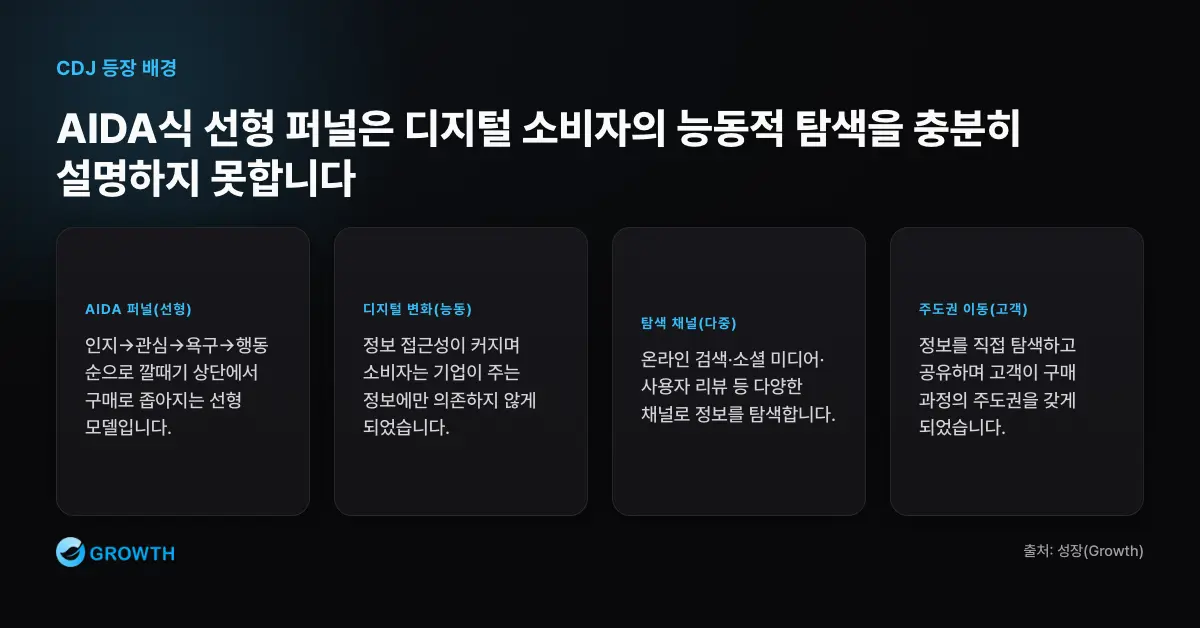
But advances in digital technology and greater access to information made consumer behavior more complex and active. Consumers no longer rely solely on information provided by companies — as shown in [SEO Marketing: Starting from the Customer’s Perspective] and [SEO Marketing Case Studies — A Keyword-Analysis-Based Content Strategy], they actively research and share information across channels like online search, social media, and user reviews — and have taken the lead in their own purchase process.
The emergence of the modern CDJ model
The Customer Decision Journey model emerged to reflect this shift. In particular, the CDJ model McKinsey & Company presented in 2009 pointed out the limitations of the traditional funnel model, and emphasized the importance of a cyclical “Loyalty Loop” — where the post-purchase experience and the resulting loyalty, repurchase, and advocacy feed back into influencing the initial consideration stage.
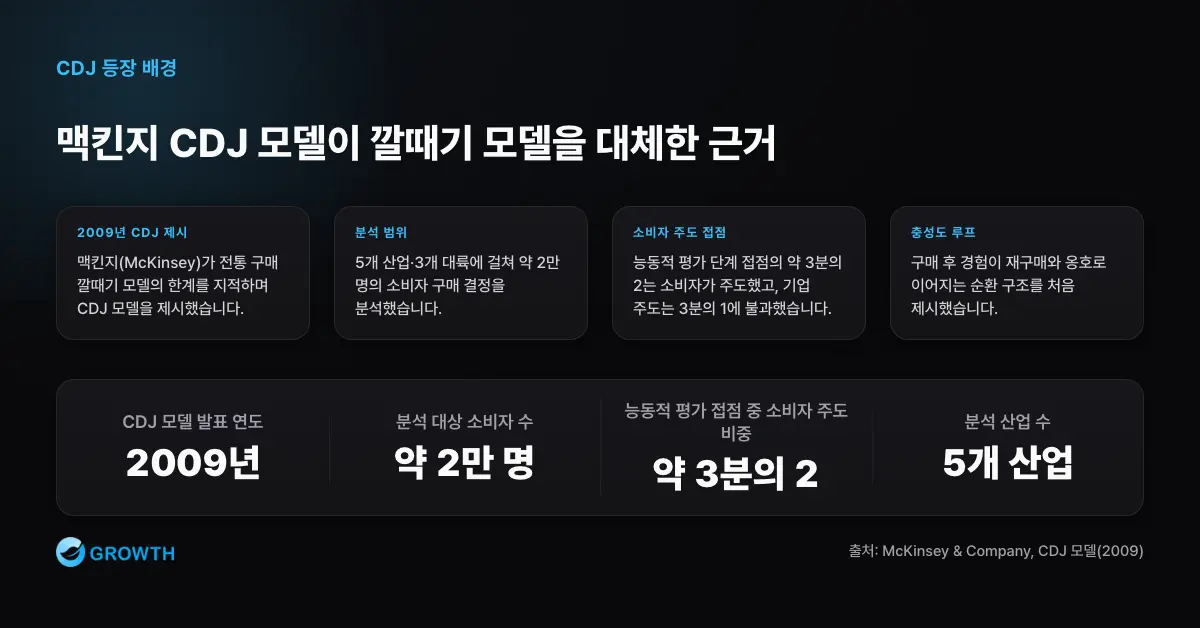
This model wasn’t just theory — it was a data-driven discovery. When McKinsey analyzed roughly 20,000 consumer purchase decisions across 5 industries and 3 continents, researchers led by David Court found that about two-thirds of touchpoints in the active evaluation stage were “consumer-driven” activities like internet reviews and word-of-mouth recommendations, while company-driven touchpoints made up just a third. In other words, the fact that purchase control shifted from companies to consumers is the core evidence behind the CDJ replacing the funnel model.
Along with the AISVAS consumer purchase decision model, this model has had a major influence on modern marketing strategy, providing the theoretical foundation for a customer-centric approach.
Key features and components of the CDJ
The core characteristics of the CDJ
The CDJ gives you a specific, relatable answer to the question of who your target customer or user actually is. From a customer-centric perspective, it centers thinking on the customer’s buying experience and process, rather than the company’s sales process.
The CDJ’s core characteristics consist of four elements: multiple touchpoints, non-linearity and repetition, holistic experience, and a dynamic, evolving process. Combined with a persona, these characteristics enable a more specific and personalized understanding of the customer, and help clarify the difference between customer needs and wants.
The CDJ’s stage-by-stage components
A modern CDJ model generally includes the following core stages. In the initial consideration stage, the customer recognizes a specific need or problem and first considers several brands or product categories. In the active evaluation stage, the customer actively researches, compares, and evaluates information about the brands or products they’re considering.
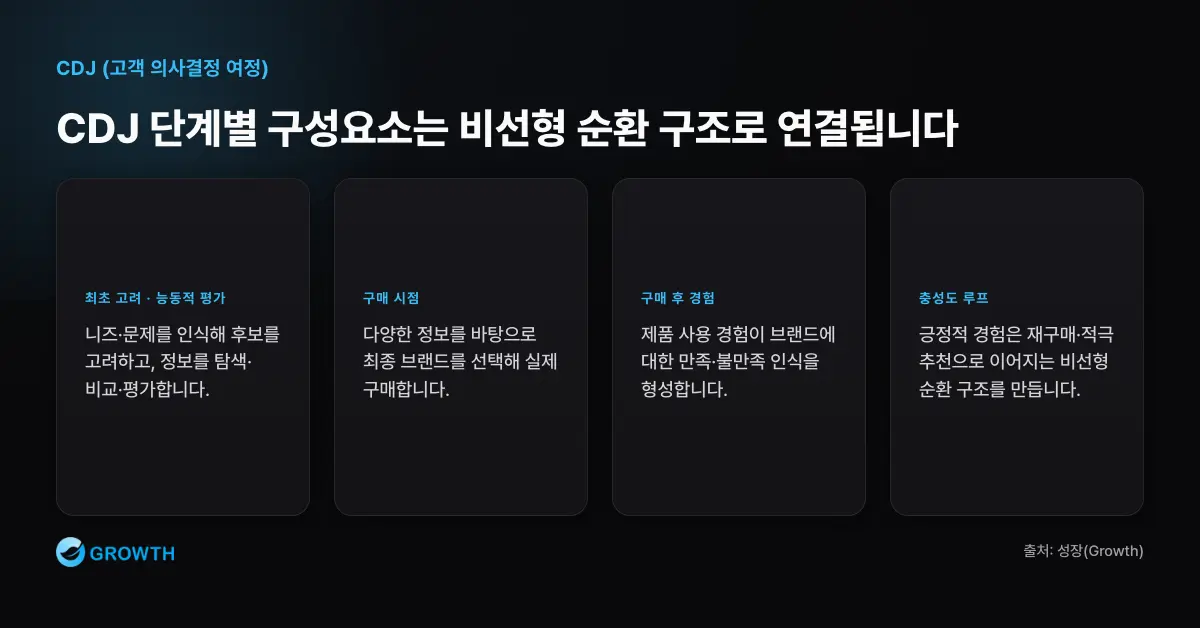
At the moment of purchase, the customer decides, based on all the information gathered, to buy a specific brand’s product or service, and follows through with that purchase. In the post-purchase experience stage, the customer experiences satisfaction or dissatisfaction while using the product or service and forms an impression of the brand — and a positive experience enters the loyalty loop, leading to repurchase or active recommendation.
Factors that influence the CDJ

The modern CDJ is shaped by a complex mix of internal and external factors. Advances in digital technology increase access to information, foster interaction between customers, and create new touchpoints. As shown in our content marketing case study analysis, the flood of information and questions of credibility make a customer’s ability to filter trustworthy information more important, and demand greater transparency and authenticity from companies.
Rising expectations for personalization, the influence of social proof, brand trust and reputation, the omnichannel experience, the complexity and price of the product or service, and individual psychological factors all combine to shape the CDJ.
Applications and use cases for the CDJ
Using the CDJ in marketing strategy
In marketing, the CDJ plays a key role in clarifying the target customer and developing effective messaging. In the marketing keyword research process, the CDJ helps you understand what information a customer needs and which channels they use to find it, enabling tailored content planning.
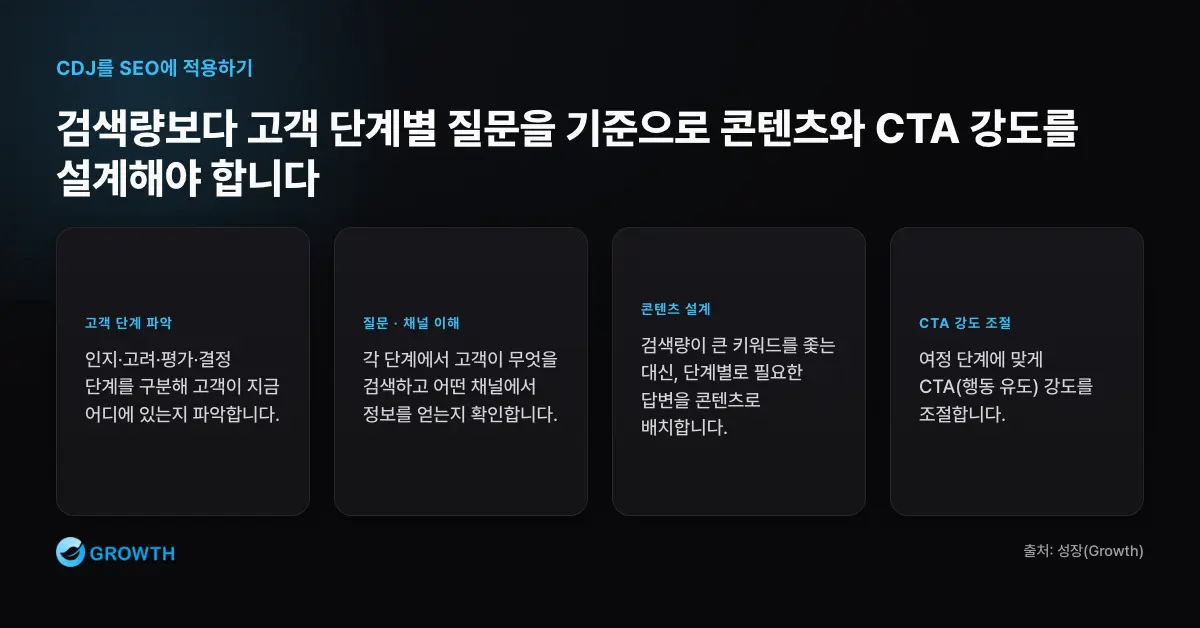
Carrying this “customer journey lens” directly into search marketing changes where SEO starts. Instead of chasing high-volume keywords, you design the intensity of your content and CTAs based on what customers search for at each stage — awareness, consideration, evaluation, decision. We cover the specific method for applying the CDJ to SEO step by step in Designing SEO Around the Customer Journey — Starting from People, Not Keywords. Reading this article (the CDJ concept) alongside that one (applying the CDJ to SEO in practice) gives you a fuller picture of how a single lens — the customer journey — connects strategy all the way through to execution.
As shown in [Performance Marketing References — Need Reliable Results?], CDJ-based targeting directly contributes to improved marketing performance. In growth hacking too, understanding users through the CDJ forms the foundation for building an effective growth strategy.
Using the CDJ in customer experience management
In customer experience management, the CDJ is a core tool for implementing user-centered design. As shown in The Importance and Practice of User-Oriented UX Writing, the CDJ helps you understand a customer’s language and mindset to design a better interface and experience.
In data-driven optimization processes like A/B testing as well, you can use the CDJ as a lens for interpreting test results and setting a direction for improvement. It gives you a basis for judging which features or messages matter most for helping a customer reach their goal at each stage of the journey.
Using the CDJ across different business domains
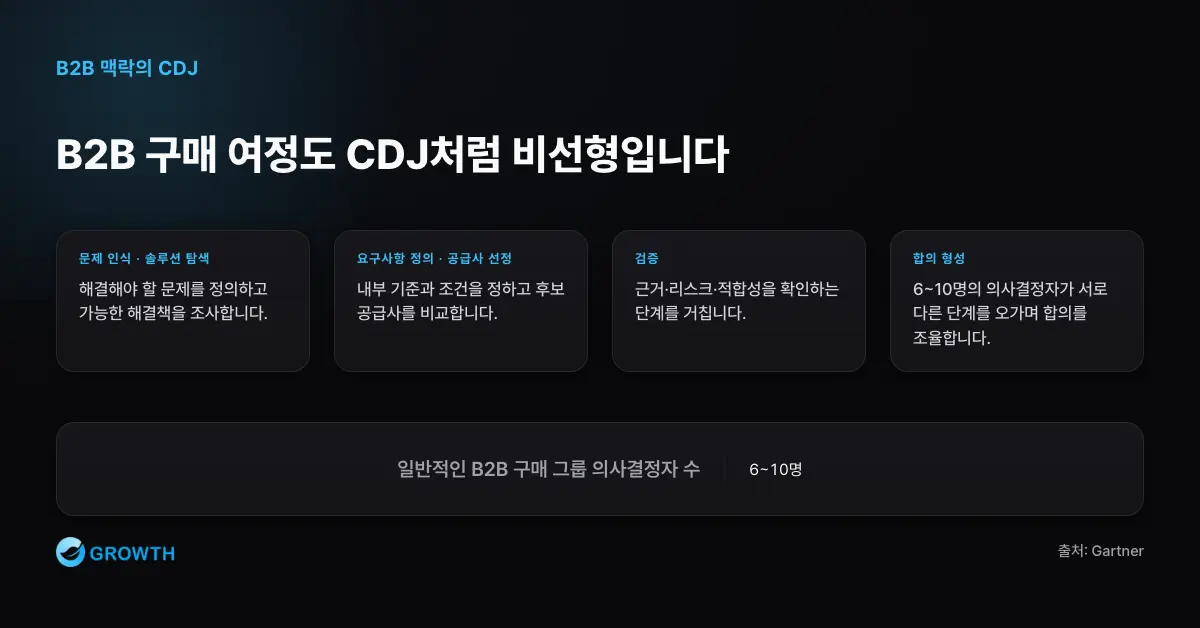
Beyond marketing, the CDJ is used across a range of domains. As shown in our B2B marketing trend analysis, the CDJ plays an important role in understanding decision-makers’ complex purchase process in B2B environments too. In fact, Gartner’s analysis finds that a typical B2B buying group involves 6 to 10 decision-makers, who move through a non-linear buying journey of “problem identification → solution exploration → requirements building → supplier selection → validation → consensus creation.” This process — where multiple people move back and forth across different stages at once — is a clear illustration of the CDJ’s non-linear, multi-touchpoint nature in a B2B context. In content marketing case studies too, this framework is used to identify what information customers need at each stage and build a strategy for delivering the right content.
In educational content development, it’s used to design tailored materials and curricula suited to learners’ characteristics and learning goals; in policy-making, it’s used to analyze the diverse profiles of citizens affected by a given policy in order to predict and improve its impact.
Related concepts and methodologies
The CDJ mapping process
CDJ mapping is the process of visually charting the customer decision journey to record and analyze a customer’s behavior, thoughts, emotions, experience, touchpoints, and pain points in concrete detail. It moves through the stages of defining goals and scope, defining personas, collecting and researching customer data, identifying journey stages and touchpoints, describing behavior, thoughts, and emotions at each stage, surfacing pain points and opportunities, visualizing and sharing, and continuous updating.
During mapping, real customer data is gathered through methods like customer interviews, surveys, web analytics, voice-of-customer (VOC) data, and usability testing, supplemented with quantitative data from analytics tools like Google Analytics 4.
How the CDJ differs from related concepts
The CDJ is a conceptual model or framework that describes the overall process by which a consumer makes purchase-related decisions. A Customer Journey Map is a concrete artifact — a visual representation of the CDJ that a specific persona follows to achieve a specific goal.
The Sales Funnel is a linear model, mainly viewed from the company’s perspective, that shows how a prospect converts at each stage from awareness to purchase. It’s typically used, alongside performance metrics like CPC (Cost Per Click) or ROAS (Return on Ad Spend), to measure sales and marketing performance, and places relatively less emphasis on a customer’s complex experience or the post-purchase stage.
Marketing methodologies connected to the CDJ
The CDJ is closely tied to a range of marketing methodologies. As mentioned in [Viral Marketing Starts and Ends with “Planning”], the sharing behavior patterns and interests you uncover through the CDJ provide important insight for planning viral content.
In building a remarketing strategy too, you can set the right message and timing by considering a customer’s status at each stage of the CDJ. Improving [engagement rate] is also more effective when you identify which stage of the journey a customer is in and deliver tailored content accordingly.
Limitations and cautions with the CDJ
Challenges in managing and optimizing the CDJ
Effectively managing and optimizing the CDJ comes with several challenges. It’s difficult to collect and integrate the massive volume of customer data generated across various online and offline channels into one consistent view. Because customer behavior is non-linear and unpredictable, not every customer follows the same path — behavior can shift unpredictably based on individual circumstances and external factors.
Broken experiences across channels, the difficulty of accurately measuring attribution, organizational silos between departments, keeping pace with constant change, and resource constraints in trying to satisfy every customer are all cited as major challenges.
Cautions when using the CDJ
There are common pitfalls in using the CDJ. Building an overly complex CDJ model reduces its practical usability and makes it hard to maintain. It’s more effective to limit stages to a reasonable 3–5 and focus on key touchpoints.
Building the model purely on imagination, without research, or letting it reflect stereotypes or bias, is also a problem. As emphasized in [How to Set B2B Marketing KPIs the Right Way], it’s essential to build the CDJ on real customer data and research findings, and to continuously validate and refine it.
Limitations
It’s important to recognize that the CDJ is a model that reflects representative customer behavior patterns — it can’t capture every individual customer’s unique traits. It’s important to keep listening to diverse customer feedback and avoid mistaking the CDJ for an absolute standard that covers every customer.
To avoid becoming a decorative artifact that’s built once and never used, the CDJ needs to be integrated into real work processes, and a culture needs to be built where it’s actively referenced in meetings and decision-making. Because markets and customers change, it’s necessary to review the CDJ regularly and keep it updated with current information.
The future outlook for the CDJ
How the CDJ will evolve with advancing technology
Advances in AI, big data, and personalization technology are expected to change how the CDJ is used and the role it plays. As shown in [Should You Use Generative AI in Content Marketing?], AI could analyze the massive volume of user data collected in real time to produce a dynamic CDJ that shifts with context and grows even more finely personalized.
AI could improve production efficiency by automating the creation of CDJ drafts through data analysis and pattern recognition. Building on the CDJ, it could also be combined with individual customers’ real-time behavioral data to deliver even more finely hyper-personalized experiences.
The CDJ’s role in a new technology landscape
The spread of voice search and conversational interfaces, predictive and proactive customer support, and the growing importance of community and peer-to-peer interaction are set to emerge as new characteristics of the CDJ. As shown in [Which Marketing Channels Actually Work? The Latest 2025 Analysis], the CDJ’s complexity will keep increasing as new channels and touchpoints continue to emerge.
As mentioned in [ESG Content Case Studies and a Practical Strategy], the spread of sustainability and values-based consumption means a company’s environmental, social, and governance (ESG) values and social responsibility will have an increasingly large influence on customers’ brand choice and journey.
Ethical considerations and sustainability
Stronger data privacy and ethical considerations will become increasingly important. Transparency and ethical responsibility in the use of customer data will be emphasized more heavily, and earning customer trust will become a core factor in the CDJ’s success.
Despite technological advances, the CDJ’s essential value — deeply understanding and empathizing with the customer — won’t change, and it will continue to play an important role as a core tool for a customer-centric approach. The CDJ of the future is expected to become more personalized and data-driven, evolving in a direction where technology and human sensibility work in harmony.
Related reading
- What Is Growth Hacking? Definition, AARRR, Experiment Design, and Real Cases — the Complete Growth-Strategy Pillar
- Marketing channel mix
- Persona
- The difference between customer needs and wants
- The 2024 marketing calendar and must-know events at a glance
If you want to apply this to your own business — if you need a concrete diagnosis of your situation, reach out via Contact us. We answer based on the one customer who becomes revenue, not on traffic volume.
Frequently Asked Questions (FAQ)
How is the CDJ different from a sales funnel?
They differ in perspective and shape. A sales funnel is a linear model, viewed from the company’s side, that tracks conversion rates at each stage from awareness to purchase, and places relatively little emphasis on the post-purchase experience. The CDJ, by contrast, is a non-linear model viewed from the customer’s side, cycling through awareness, consideration, evaluation, purchase, and the post-purchase experience into a loyalty loop. Like McKinsey’s finding that roughly two-thirds of touchpoints in the active evaluation stage were consumer-driven, the CDJ assumes that the customer, not the company, holds the initiative in the purchase process.
What does the CDJ’s “loyalty loop” mean?
It refers to a cyclical structure where a positive post-purchase experience leads to repurchase and recommendation, which in turn influences other customers’ initial consideration stage. Loyal customers sometimes skip the extensive evaluation process altogether and go straight to repurchase. That’s why the CDJ treats purchase not as an endpoint but as the start of the next journey, emphasizing post-purchase experience management as a key lever for growth.
How do you get started with CDJ mapping?
The process moves through defining goals and scope → defining personas → collecting and researching customer data → identifying journey stages and touchpoints → describing behavior, thoughts, and emotions at each stage → surfacing pain points and opportunities → visualizing and sharing → continuous updating. It’s important to combine qualitative data — customer interviews, surveys, VOC, usability testing — with quantitative data like Google Analytics 4. Grounding the map in real data, rather than imagination, is what makes it a living CDJ instead of a decorative one.
How do you apply the CDJ to SEO and content marketing?
Instead of chasing high-volume keywords, you design content and CTAs based on what customers actually search for and what information they need at each stage of the journey — informational content at the awareness stage, and comparison, case-study, and conversion-driving content at the evaluation and decision stages. You can find the step-by-step application in “Designing SEO Around the Customer Journey.”
Marketing Insights
Marketing insights, delivered weekly
Practical growth and GEO/B2B marketing insights, summarized in your inbox every week.
Subscribe for insights