Marketing Channel Mix
 임재복
임재복
What Is Marketing Channel Mix?
Marketing channel mix refers to the strategic combination of marketing channels a company uses to reach its target customers and hit its marketing goals. It’s an integrated approach to allocating limited marketing resources effectively and maximizing impact through the synergy between channels.
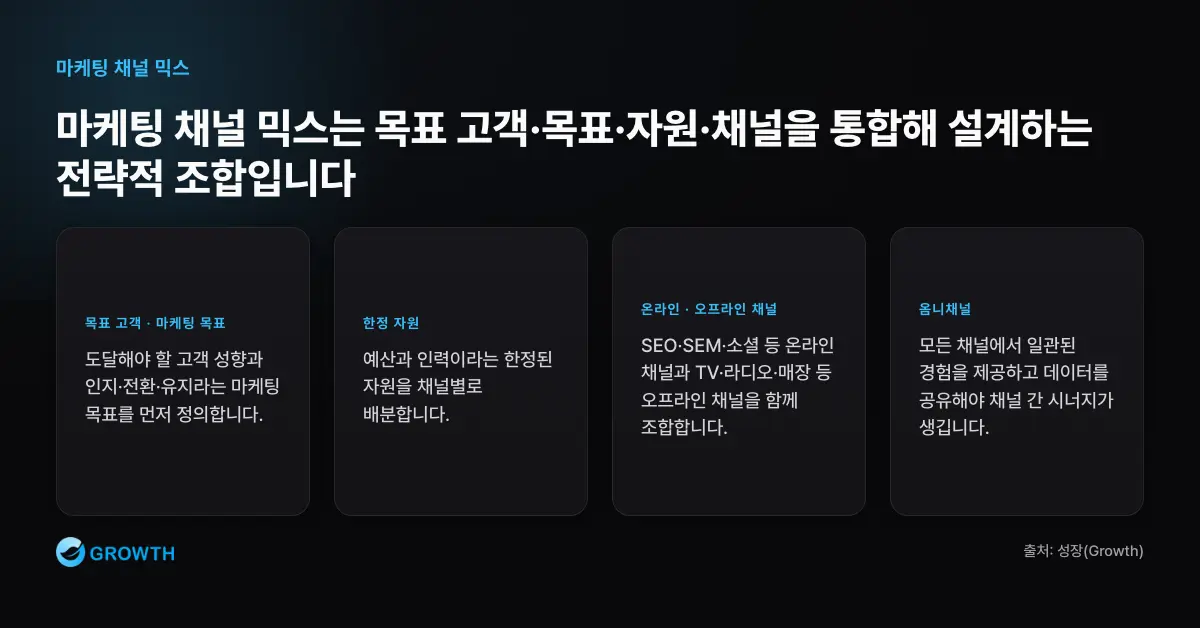
An effective marketing channel mix isn’t just about using several channels at once. It involves weighing each channel’s unique characteristics, the target customer’s tendencies, and the company’s marketing goals together to design and run the optimal combination. In modern marketing, as omnichannel strategies bridging online and offline channels have become increasingly important, the strategic value of channel mix has grown right along with them.
The History and Evolution of Marketing Channel Mix
The concept of marketing channel mix emerged in the 1960s as marketing mix theory took hold. When E. Jerome McCarthy introduced the 4P framework — Product, Price, Place, Promotion — in 1960, thinking about how to strategically combine channels and media took off in earnest. The starting point was a media mix centered on traditional advertising media like newspapers, radio, and television. Channel mix at this stage focused on one-way communication through mass media.
As the internet became commercialized in the 1990s and digital marketing channels emerged, channel mix grew far more complex. Email marketing, websites, and early forms of online advertising began to be used alongside existing offline channels. In the 2000s, as search engine optimization and search engine marketing rose to become core channels, companies started building more sophisticated channel strategies.
The 2010s brought major shifts to marketing channel mix as social media exploded and mobile devices became ubiquitous. Platforms like Facebook, Instagram, and YouTube established themselves as major marketing channels, and content marketing and influencer marketing emerged as new channels. These days, personalized channel-mix strategies powered by AI and big data are drawing significant attention.
Key Characteristics and Components
Online Channels
Digital marketing channels are the core of any modern channel mix. Search engine optimization is a long-term strategy for ranking a website higher in search results, and it’s effective for driving organic traffic. Google’s own Search Central SEO starter guide describes search optimization as the process of helping users find your content more easily. Search engine marketing, by contrast, uses paid ads on platforms like Google or Naver to secure immediate visibility.
Social media marketing is a channel for communicating directly with your target audience on platforms like Facebook, Instagram, YouTube, and LinkedIn. Content marketing involves creating and distributing genuinely useful content — blog posts, videos, infographics — to attract prospects and build brand expertise. Email marketing is considered a particularly effective channel for sustaining relationships with existing customers and driving repeat purchases.
Offline Channels
Traditional offline channels still play an important role. TV and radio ads are effective at building broad brand awareness, while print media and out-of-home advertising deliver a message with focus, concentrated on a specific region or audience. Event marketing and trade shows offer the chance to let people experience a product directly and meet people face to face, which is valuable for building trust.
In-store marketing is a channel that directly influences a customer’s decision at the point of purchase. Point-of-purchase displays and product sampling have the advantage of driving purchases on the spot.
An Integrated Approach
Today’s channel mix breaks down the boundary between online and offline channels through omnichannel strategy. It delivers a consistent experience no matter which channel a customer encounters the brand through, and shares data across channels to power personalized marketing. A/B testing continuously refines each channel’s performance, and metrics like ROAS measure return on investment. Tools that measure each channel’s contribution — like Google Analytics attribution analysis — let you fine-tune budget allocation with precision.
Use Cases and How to Apply Them
A B2C E-Commerce Example
A small B2C e-commerce business has to build an effective channel mix within a limited budget. An online shop selling handmade accessories might build its mix around showcasing products visually on Instagram and collaborating with influencers, using Facebook ads for precise targeting of its audience. It builds long-term organic traffic through SEO marketing on Naver Smart Store and a blog, and uses email marketing to encourage repeat purchases from existing customers.
Supporting channels might include selling and building awareness offline at flea markets, or using YouTube to show the product-making process or how to use the product. Pairing this kind of channel mix with experience-group marketing (offering products to reviewers for honest feedback) can significantly amplify the effect of customer reviews and word of mouth.
A B2B Example
In B2B marketing, expertise and credibility are what matter most. A SaaS company building collaboration software might make LinkedIn — targeting professionals and distributing content there — its primary channel. It captures solution-related keywords through Google Search ads, and focuses on lead generation through blog posts, whitepapers, and webinars in its content marketing.
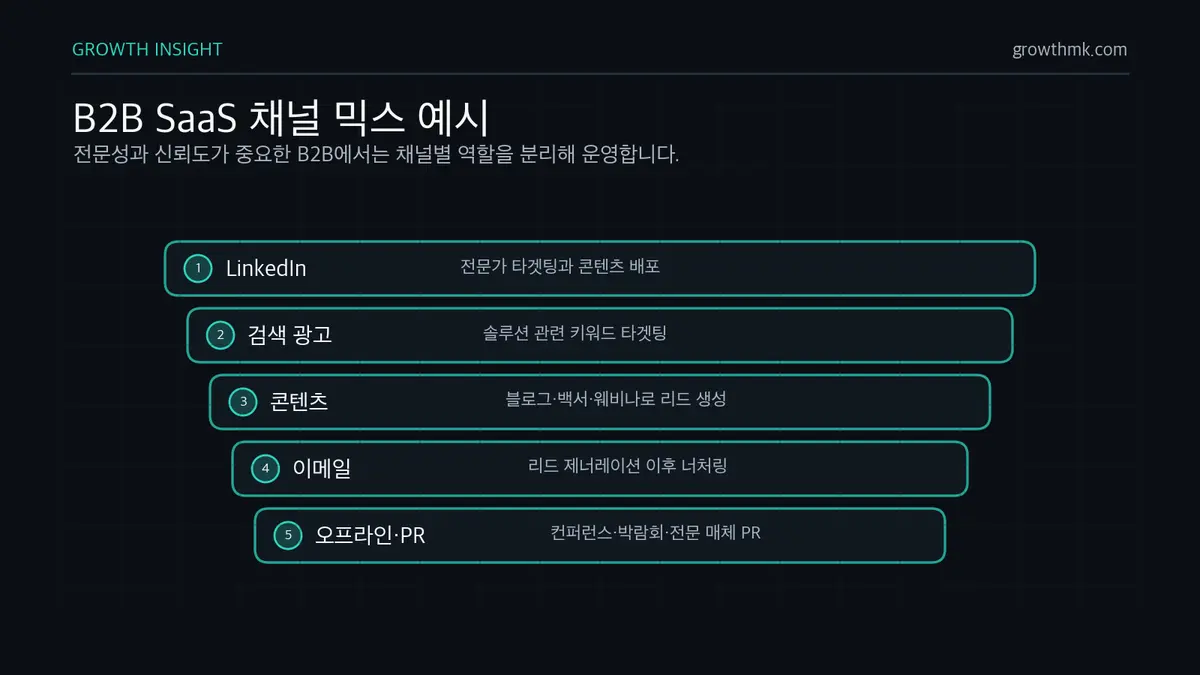
Email marketing plays a key role in the step after lead generation — the nurturing process that turns prospects into actual customers. Attending industry conferences and trade shows to meet people and demo the product, and PR through trade media, round out the important supporting channels.
A Local Service Business Example
A locally-scoped channel mix suits location-based service businesses well — think a neighborhood fitness studio. Local SEO through platforms like Naver Place and maps is the core, and outreach targeted at local community apps and online cafés is essential too. Instagram gets used to post photos of activity inside the studio and member testimonials, alongside traditional offline promotion like flyers and banners.
Related Concepts
Marketing channel mix connects to several other marketing concepts. Performance marketing is an indispensable approach for measuring and optimizing the performance of each channel. Growth hacking is a methodology for continuously improving a channel mix through data-driven experimentation.
The AISVAS consumer decision model helps identify which channels work well at each stage of the customer journey. The AARRR model is a framework for systematically breaking down channel performance in app marketing.
Cost metrics like CPC matter for evaluating the efficiency of paid channels, and remarketing is a strategy for bringing back customers who left across various channels. Engagement rate is a core metric for measuring performance, particularly on social media channels.
Evergreen content is the foundation of a content-channel strategy that keeps traffic flowing steadily, and ABM is a methodology B2B companies use to build a channel mix targeted at specific accounts only. In modern marketing, SEO-friendly content and keyword research strategy are key to boosting how effective a channel mix is.
Related Reading
- What Is Growth Hacking? Definition, AARRR, Experiment Design, and Real Case Studies — the complete growth-strategy pillar guide
- CDJ (Customer Decision Journey)
- Persona
- The Difference Between Customer Needs and Wants
- 2024 Marketing Calendar and Key Events at a Glance
Want to apply this to your own business? — Visit our performance marketing service page to see our approach to growth, or get in touch for a specific diagnosis of your situation. We measure success by the one customer who becomes revenue, not by traffic volume.
Frequently Asked Questions (FAQ)
Are marketing channel mix and media mix the same thing?
They’re related but not identical. Media mix is a narrower term that mainly refers to the combination of advertising media — TV, newspapers, digital ads, and so on. Marketing channel mix is a broader concept that covers not just advertising media but the strategic combination of every channel that reaches customers, including SEO, content, email, physical stores, and events.
Is more channels always better?
No. Spreading limited resources too thin makes it hard for any single channel to perform well enough. It’s better to weigh where your target customers actually spend their time against your marketing goals and budget, focus on the core channels, and use supporting channels to reinforce the synergy.
How does channel mix differ between B2B and B2C?
B2C leans heavily on channels that create visible exposure and lead directly to a purchase — Instagram, Facebook ads, Naver Smart Store. B2B centers on channels that build expertise and trust to support a longer decision-making process — LinkedIn, whitepapers, webinars, email nurturing.
How do you measure performance across different channels?
Paid channels are evaluated with cost/revenue metrics like CPC and ROAS, social channels with engagement rate, and content/SEO channels with organic traffic and conversions. Tools that measure each channel’s contribution — like Google Analytics attribution analysis — let you make data-driven decisions about where to put more budget.
Marketing Insights
Marketing insights, delivered weekly
Practical growth and GEO/B2B marketing insights, summarized in your inbox every week.
Subscribe for insights