
B2B Marketing vs. B2C Marketing: The Complete Difference in Strategy, Channels, and Execution
 임재복
임재복
The biggest difference between B2B and B2C marketing comes down to this: are you dealing with one person’s impulse, or a group’s consensus? B2C appeals to individual emotion and need, driving purchases on a relatively short cycle. B2B, by contrast, is a non-linear journey where an average of 6 to 10 stakeholders weigh ROI and risk over several months. That means your target audience, buying process, messaging, channels, and success metrics all need to be different — and porting a B2C playbook directly into B2B is a recipe for failure.
Working on the ground in B2B marketing — analyzing the customer decision journey (CDJ) and driving results through SEO content that digs into search context and customer pain points — we’ve repeatedly watched companies struggle in B2B. This is especially true when a marketer who built a track record in B2C joins the team: that very experience often becomes a liability. This article breaks down how B2B and B2C differ across three layers — strategy, channels, and execution — with tables and examples, and lays out a path to B2B marketing that actually drives revenue, free of B2C habits.
We’ll first compare the two models across eight fundamental dimensions, then dig deeper into the most commonly confused area — channels. From there we’ll cover the mistakes that keep recurring when teams default to B2C thinking, what actually makes B2B marketing succeed, and finish with an execution checklist.
Understanding the fundamental difference between B2B and B2C marketing
The difference between B2B (business-to-business) and B2C (business-to-consumer) marketing goes far beyond “is the buyer a company or a person.” Nearly every variable in your marketing strategy changes — target audience, purchase motivation, decision-making structure, sales cycle, messaging, channels, customer relationships, even customer lifetime value. A successful B2B strategy starts with understanding these differences precisely.
1. Target audience
- B2B: You’re dealing with an approval process made up of multiple stakeholders — decision-makers, practitioners, and finance staff within a specific department. They evaluate purchases against clear business objectives: hitting organizational goals, boosting efficiency, cutting costs, improving ROI.
- B2C: The buyer is an individual consumer, so purchase decisions tend to be relatively impulsive, driven by personal need, desire, emotion, enjoyment, and brand image.
2. Decision-making process
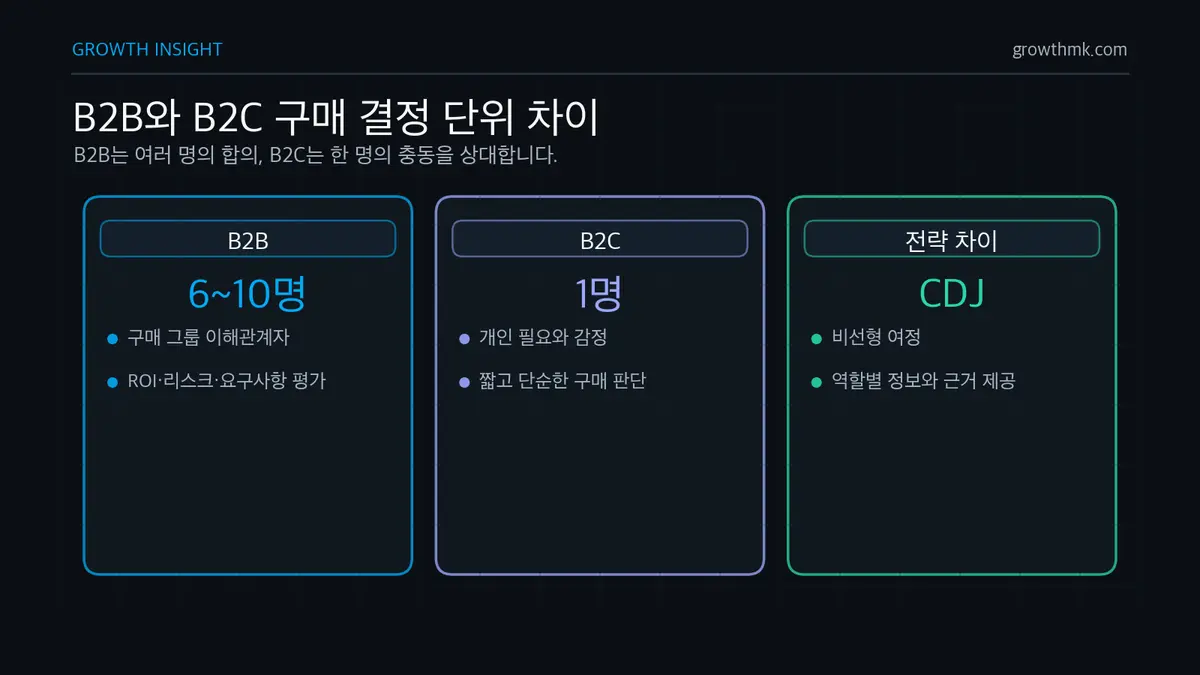
- B2B: People across multiple departments and roles participate in a logical, complex evaluation process. Problem recognition, solution exploration, requirements definition, vendor evaluation, and internal alignment don’t happen sequentially — they run in parallel or loop back to earlier stages, making the journey fundamentally non-linear. Gartner’s research on B2B buying journeys found that a typical buying group involves an average of 6 to 10 stakeholders, and that number grows for complex solutions. This is a structure that simply can’t be solved by marketing aimed at persuading a single person.
- B2C: Relatively short and simple, with purchases driven by personal emotion or immediate need. Compared to B2B, it’s fair to call this impulsive.
This non-linearity connects directly to what Google calls the “messy middle”. Before making a decision, people cycle repeatedly between two modes — “exploration” and “evaluation” — as many times as they need to, and that cycling intensifies the higher the involvement and price of the purchase. B2B buying is, by nature, the domain where this messy middle is longest and most complex. For a deeper look at mapping a non-linear journey to your own industry, see our Customer Decision Journey (CDJ) guide.
3. Sales cycle
- B2B: Product/service complexity, high price points, and multiple decision-makers often stretch the sales cycle from months to years. You always need to account for how long the decision itself takes.
- B2C: The purchase cycle is short, and strategies that drive immediate or frequent repeat purchases are effective.
4. Messaging & content
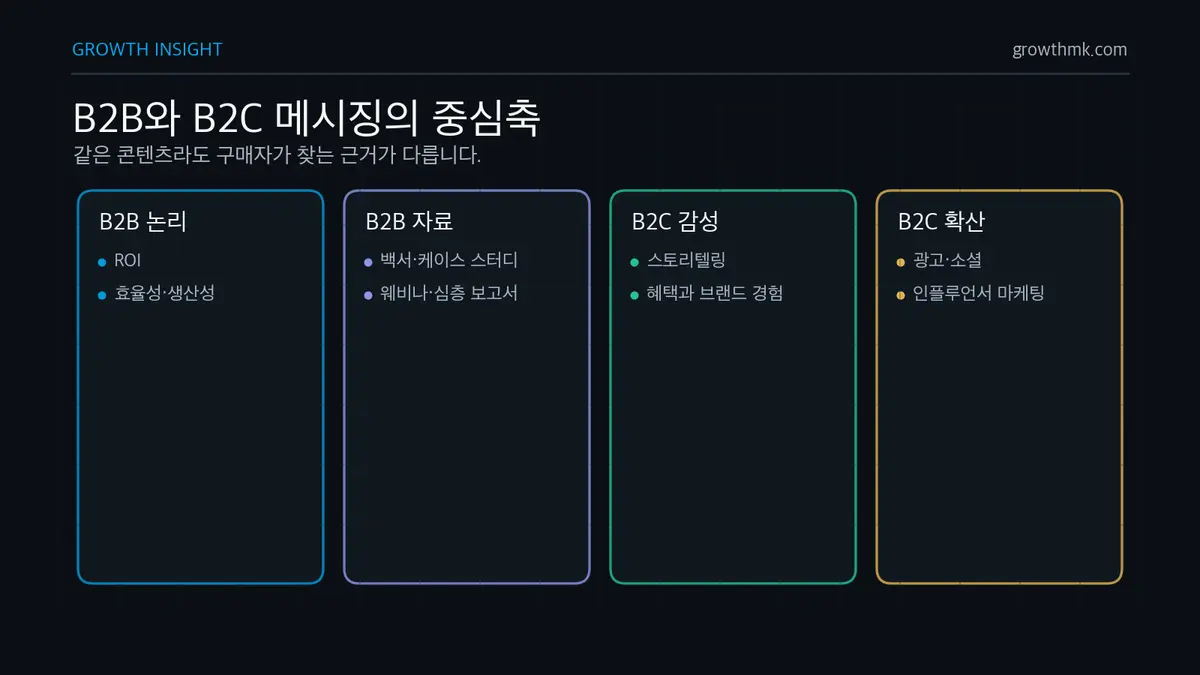
- B2B: Logical and data-driven, focused on concrete business value — ROI, efficiency, productivity gains. Highly credible content — whitepapers, case studies, webinars, in-depth analysis reports — matters a great deal.
- B2C: Emotional and storytelling-driven, emphasizing product/service benefits and brand experience. Advertising, social media, and influencer marketing dominate, and results can scale explosively when something catches on broadly.
5. Customer relationships
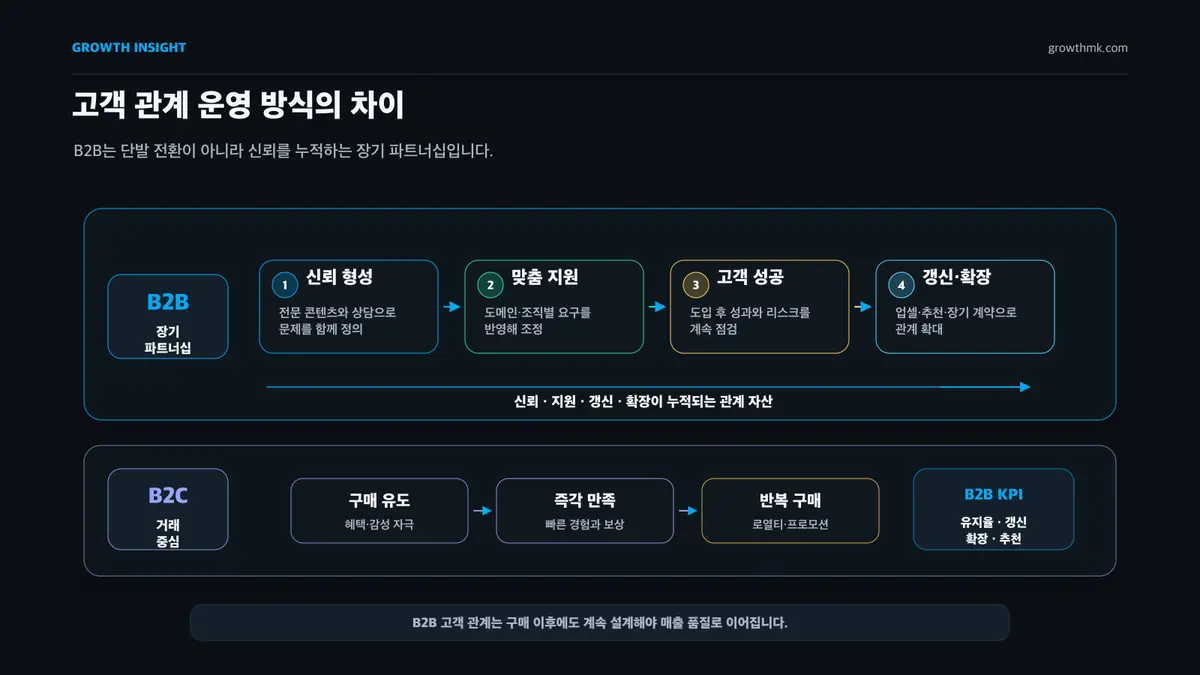
- B2B: Long-term, strategic partnership built on trust is the core. Ongoing communication and tailored support are essential, and for narrow-domain products, account management often matters more than new business development.
- B2C: Centered on individual transactions, with a focus on loyalty programs and immediate customer satisfaction to build brand loyalty.
6. Customer lifetime value (CLV)
- B2B: Deal sizes are large, with frequent long-term contracts and repeat purchases, so CLV tends to be very high. Companies often adopt a solution because a competitor did, and it’s common for a practitioner to switch companies and become the point of contact at yet another client organization.
- B2C: Deal sizes are small and purchase cycles short, which makes it easy to skew toward short-term revenue without factoring in CLV.
A table summarizing the key differences between B2B and B2C marketing at a glance.
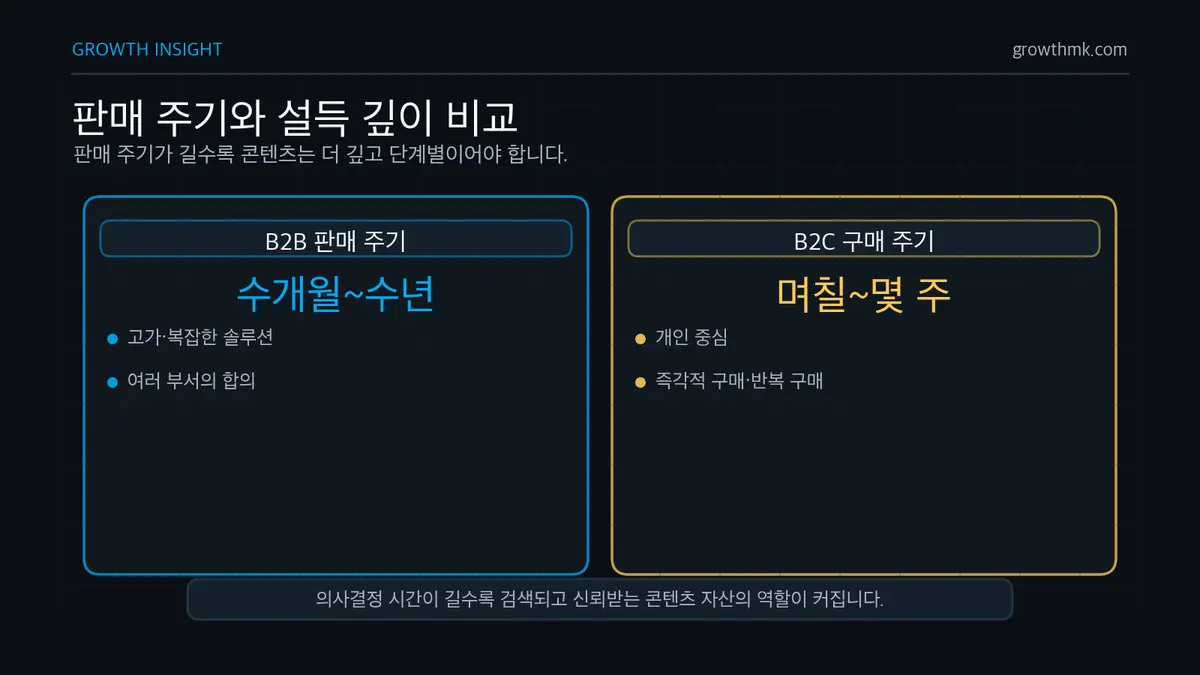
| Dimension | B2B (Business-to-Business) | B2C (Business-to-Consumer) |
| Target audience | An internal approval process/decision chain within a company | Individual consumers |
| Purchase motivation | Logic, ROI, efficiency, productivity | Emotion, need, desire, enjoyment, brand image |
| Decision process | Complex, multiple participants (avg. 6–10), non-linear | Simple, individual-centered, relatively impulsive |
| Sales cycle | Long (months to years) | Short (days to weeks) |
| Messaging/content | Logical, data-driven, educational, expertise-focused | Emotional, storytelling, benefit/value-focused |
| Customer relationship | Long-term, trust-based, partnership | Transaction-focused, brand loyalty, immediate satisfaction |
| Key channels | LinkedIn, email, SEO/content, webinars, trade media | Social media (Instagram, YouTube, TikTok), search/display ads, TV/radio |
| Core KPIs | Lead quality, pipeline, conversion rate, CLV, sales contribution | Reach, revenue, average order value, repeat purchase rate |
| Customer lifetime value (CLV) | High | Relatively low |
Ignoring these fundamental differences and applying whatever worked in B2C directly to B2B causes problems. If a B2C insight has real depth, there’s room for it to work in B2B too — but most failures come from carrying over B2C-centric media mix, strategy, and KPI habits wholesale. And the area where this confusion shows up most often is channels.
B2B vs. B2C marketing channels: what’s actually different?
“Should we be marketing on YouTube or TikTok too?” As younger generations start participating in purchase decisions and content grows more important, interest in B2C-centric platforms keeps rising. But the starting point for choosing a channel shouldn’t be “what’s hot” — it should be “where do our decision-makers actually trust information?” The same piece of content can perform completely differently depending on a channel’s purpose and the user’s context.
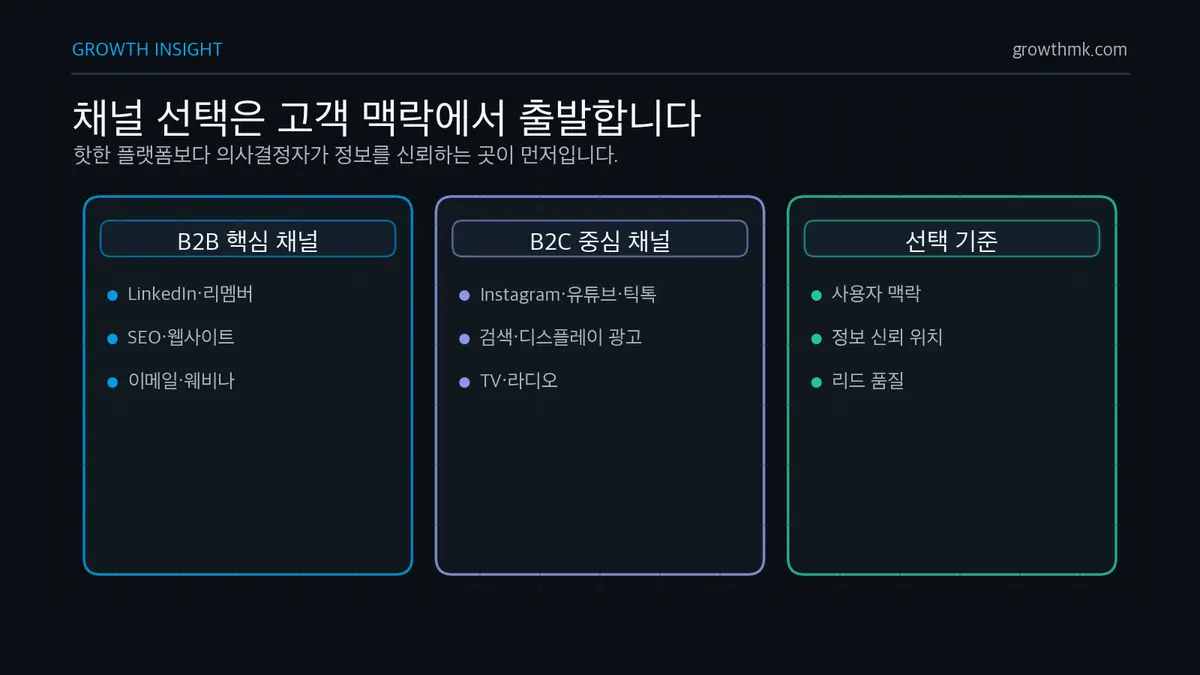
B2B’s proven core channels: LinkedIn, SEO, email, and webinars
The channels with the strongest proven track record in B2B are professional networks and search-driven channels — places users show up specifically for “business purposes” from the start.
- LinkedIn: Users log in to explore new opportunities, track industry trends, and develop their expertise, which means B2B content is well received — and precise targeting by title, company size, and industry is possible.
- SEO/website: B2B buyers reliably search at every stage from problem recognition to solution exploration. Early on they search things like “how to solve [problem],” and at the solution-evaluation stage they search “[tool] comparison” — which means staying visible with stage-appropriate content matters. Above all, your website is a channel your company fully controls, immune to shifting platform algorithms.
- Email: One of the highest-efficiency channels in B2B for lead nurturing and retention. Because it’s a “permission-based” channel — recipients have actively opted in to receive information — receptivity is high, and it supports deep personalization and segmentation by interest, buying stage, and behavior.
- Webinars and trade media: Because attendees actively invest roughly an hour of their time, webinars are excellent for capturing leads with high interest and purchase intent. Contributing to or being featured in trade media is an effective way to demonstrate authority and expertise.
Why are these channels so strong? Because most B2B buyers have already done substantial independent research before they ever contact a salesperson. Gartner’s analysis of the B2B buying journey found that buying groups spend the majority of their time on independent online research, while time spent with any single sales rep amounts to only a single-digit percentage. In other words, if your marketing doesn’t have content assets that get found and trusted, most of the buyer’s decision-making happens somewhere you can’t see. To dig deeper into channel effectiveness from a lead-quality perspective, see our guide on defining and executing B2B lead generation; for search channel execution, see our complete A-to-Z guide to SEO marketing.
Are B2C channels (YouTube, TikTok, Threads) effective for B2B?
The short answer: yes, but with a limited role. The biggest strength of B2C platforms is their sheer user base and reach — but the key question is how many of those users actually hold B2B decision-making power. The key people involved in B2B purchase decisions are still far more exposed to LinkedIn, email, and trade media, and entertainment-first platforms tend to dilute expertise and purchase context.
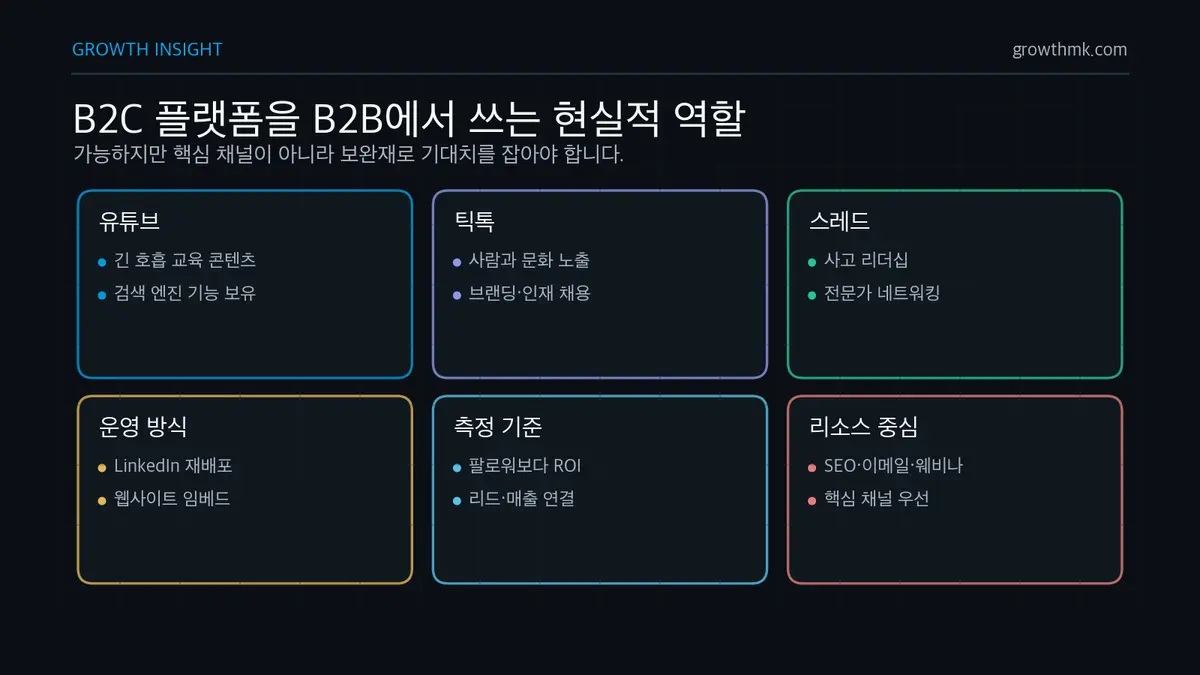
- YouTube: Strong for long-form educational content and delivering depth, and its built-in search functionality can generate real SEO value. That said, focus on education and value — how-tos, trend analysis, expert interviews — rather than direct product promotion.
- TikTok: Better suited to showing “people” and “culture” than the product itself. It’s more realistic to expect impact on brand awareness and recruiting than on direct revenue.
- Threads: A text-based, conversational platform well suited to building thought leadership and networking with peers. That said, personal branding gains don’t translate directly into company revenue very easily.
In practice, HubSpot built a large subscriber base on YouTube by focusing on marketing education rather than product promotion, growing brand trust in the process, while SAP saw a positive lift in awareness and recruiting from TikTok content aimed at younger developers. On the flip side, plenty of global companies have grown views and followers on TikTok and YouTube without translating that into actual lead or revenue conversion. That’s not a channel problem — it’s an expectation-setting problem, and we’ve broken down the patterns that recur most often from a performance perspective in our complete guide to performance marketing.
So the most realistic approach is to treat B2C channels as a complement to your core channels. Keep your budget and resources centered on proven channels like LinkedIn, email, SEO, and webinars, while running an integrated operation — for instance, redistributing YouTube educational content on LinkedIn and embedding it on your website to reinforce SEO. Keep TikTok and Threads clearly scoped to branding, recruiting, and thought leadership, and when you do experiment with B2C channels, measure ROI against real business KPIs rather than followers or views before deciding whether to keep investing. Rather than pouring resources into Instagram — often consumed in Korea as a “show off and browse” platform — it’s more efficient to focus on content-driven targeting and newsletter-based lock-in. For an analysis of whether newsletters actually convert into revenue, see Do B2B newsletters really drive revenue?
Common mistakes that come from thinking like B2C
Applying B2C success experience directly, without understanding the unique conditions of B2B, is a leading cause of failure — it’s like trying to drive a large bus with the reflexes you built driving a sedan. Here are three mistakes rooted in B2C thinking that we’ve watched play out repeatedly in the field.
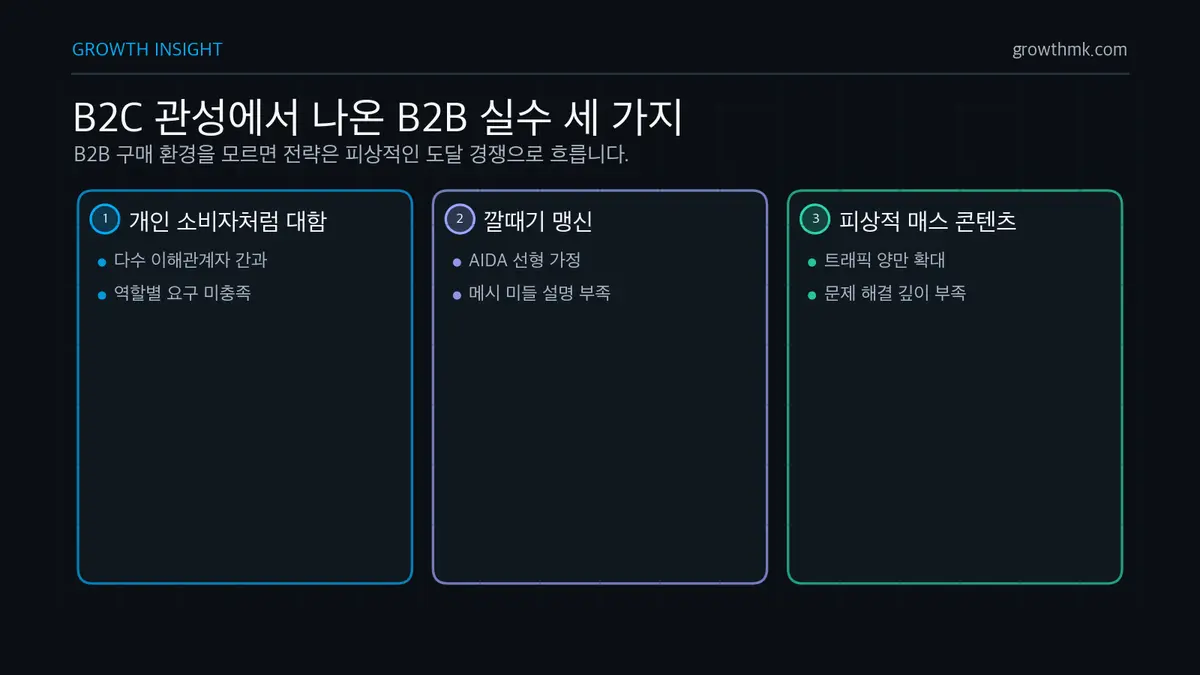
Mistake 1: Treating B2B buyers like B2C consumers
The most common mistake is treating B2B buyers like individual consumers — overlooking the complex organizational structure and multiple stakeholders involved in the decision, and defaulting to emotional appeals or broad targeting instead. A B2B purchase isn’t one person’s decision — it’s a process where finance, technical teams, business units, and executives reach consensus, and a generic message that fails to address each role’s needs (functionality for the technical expert, cost-efficiency for finance) struggles to persuade anyone. As noted above, an average of 6 to 10 stakeholders — and more for complex solutions — are involved, each requiring different information and a different line of reasoning. We dig deeper into strategy by decision-making unit in our B2B decision-maker marketing strategy guide.
Here’s the core question: can your B2B message actually persuade everyone involved in the purchase — finance, technical teams, and the final approver — or does it only appeal to the emotions of an individual end user? You need to generously arm the practitioner you’ve engaged with the evidence and materials they need to become your advocate and push the deal through the approval chain.
Mistake 2: Blindly relying on outdated funnel theory
This is applying the classic funnel model (Awareness → Interest → Desire → Action, AIDA) directly to B2B. It assumes customers move through predictable, linear stages in order — but that’s far from the reality of modern B2B buying. The actual journey is non-linear and buyer-driven; buyers loop across multiple stages and complete extensive independent research online before ever contacting sales. The traditional funnel simply doesn’t capture this complex “messy middle.”
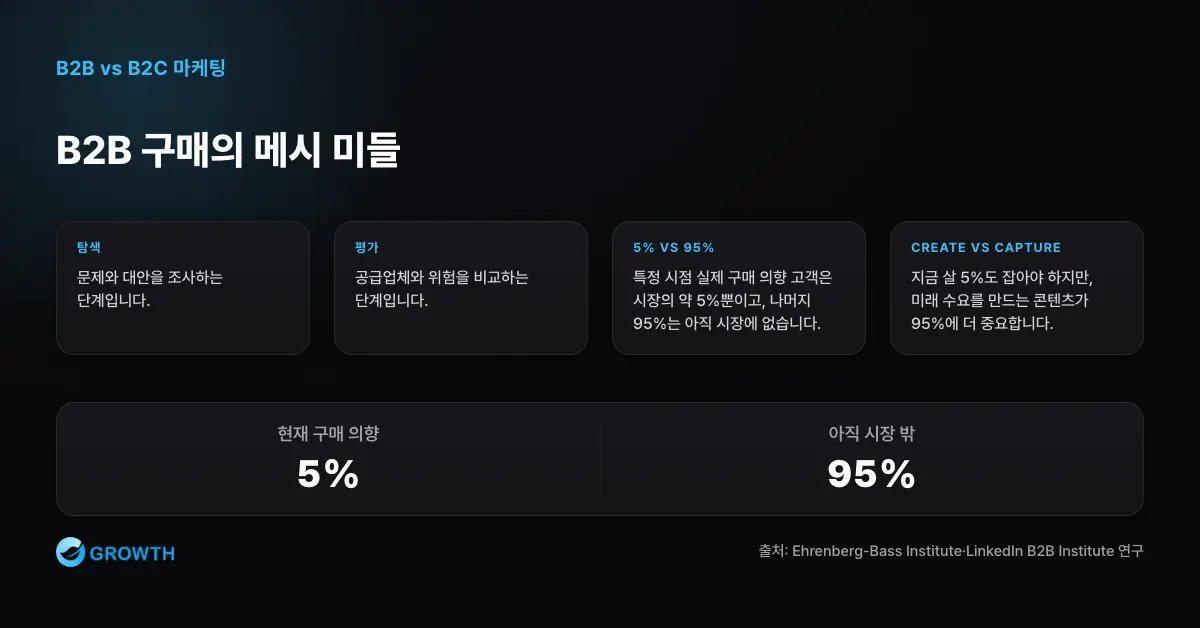
Especially worth noting is the 95:5 rule. Research from the Ehrenberg-Bass Institute, conducted with the LinkedIn B2B Institute, found that because companies switch vendors roughly once every five years on average, only about 5% of the market has genuine purchase intent at any given moment — the remaining 95% simply aren’t in market right now. LinkedIn’s B2B Institute reaches the same conclusion. Pushing an aggressive bottom-of-funnel tactic on that remaining 95% isn’t just inefficient — it can actively create resistance. What the 95% who aren’t buying today need isn’t “capture” marketing — it’s marketing that “creates” trust and awareness for a future purchase moment.
Mistake 3: Focusing on mass marketing and shallow content
This means applying tactics common in B2C — broad advertising, strategies that simply chase traffic volume, and content built for surface-level interest rather than depth — to B2B. B2B only works when you precisely target a specific role at a specific company. Mass marketing aimed at an undifferentiated audience is wasted budget; B2B buyers aren’t looking for a catchy slogan, they’re looking for deep expertise, data, evidence, and clear solutions to complex problems.
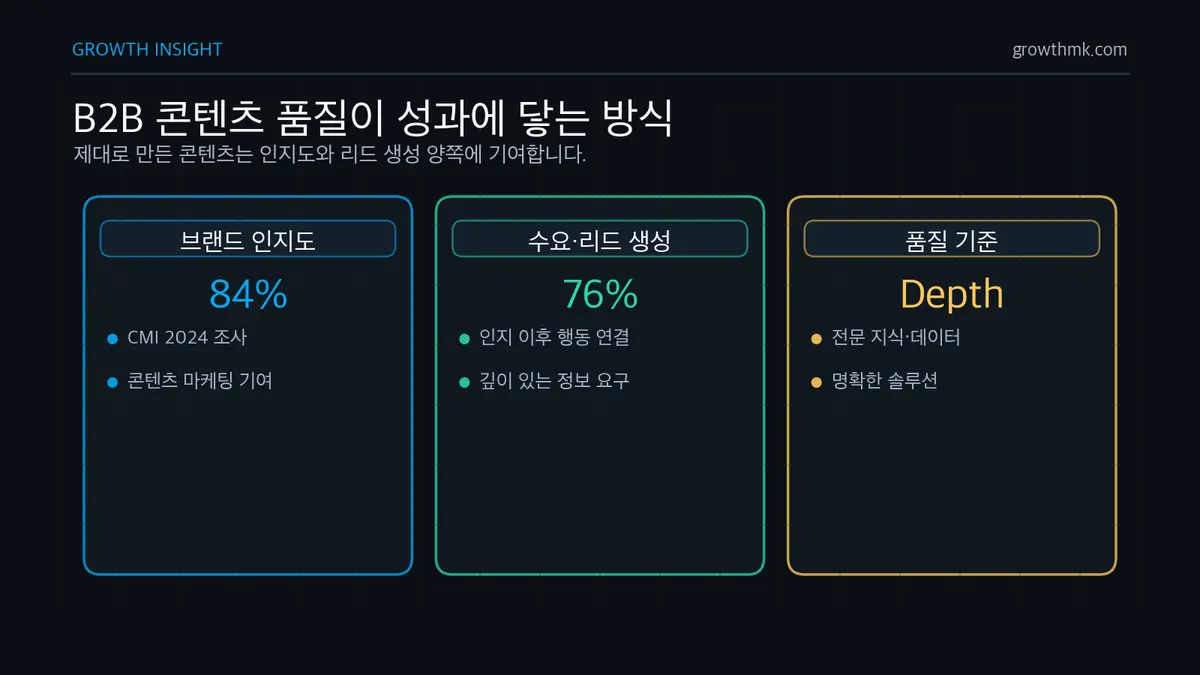
In practice, content quality and relevance have a direct effect on B2B performance. According to a 2024 survey from the Content Marketing Institute, 84% of B2B marketers said content marketing contributed to brand awareness, and 76% said it contributed to demand/lead generation. In other words, content built well delivers results on both awareness and leads — while shallow content builds neither trust nor solves any real business problem. The core question is this: is your content built simply to be “seen” by as many people as possible, or does it add real value to a specific buyer’s “research” and “problem-solving”? If you’re building a content strategy from scratch, our guide from content marketing definitions to strategy is a good starting point.
What successful B2B marketing is actually built on: precision, expertise, and relationships
Breaking free of B2C’s shadow and building B2B marketing that actually succeeds requires more than avoiding mistakes — it requires focusing on the elements that fit the true nature of B2B. That takes a strategic approach centered on long-term value creation rather than short-term results, and success comes down to four things.
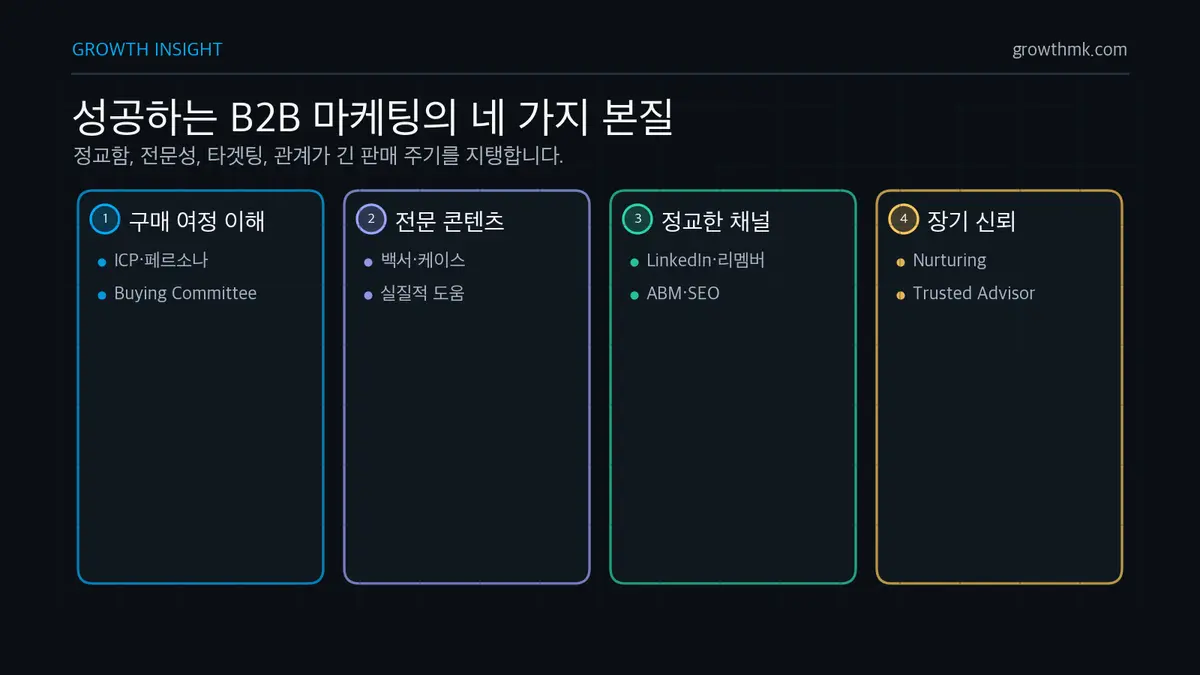
1. A deep understanding of your target customer and their buying journey
Go beyond surface-level information like company size and industry, and define a detailed Ideal Customer Profile (ICP) and buyer personas. In particular, you need to understand the role, responsibilities, goals, pain points, and research habits of every stakeholder in the buying committee. Mapping a non-linear journey (CDJ) specific to your industry — through customer interviews, collaboration with your sales team, market research, and campaign data analysis — is the foundation for precise targeting and messaging.
2. A value-based content strategy backed by real expertise
B2B buyers actively search out information to solve their problems. Go beyond product promotion and consistently provide high-quality content that genuinely helps define and solve the customer’s problem, positioning your brand as a trusted thought leader. In-depth analysis, industry reports, whitepapers, case studies, detailed guides, webinars, and data-driven insights are all effective, and even when you use storytelling, it needs to be grounded in logical evidence and real customer experience. For accessibility, keep most content ungated, while high-value content can be gated to capture leads.
Samsung Medison, which makes medical ultrasound equipment, is a good example — through a dedicated site (Samsung The Suite), it offers equipment usage guides, lectures from respected medical key opinion leaders (KOLs), and ultrasound images for training, building global trust over time. Highly credible content meets the informational needs of a rational buyer, supports a long sales cycle, surfaces quality leads, and effectively backs up your sales team.
3. Precise targeting and channel strategy
Rather than relying on broad, mass channels, focus on the specific channels where B2B decision-makers actually source information. LinkedIn, highly segmented email, and industry forums and trade media are the standouts, and account-based marketing (ABM) is effective for high-value accounts. You can find ABM’s concept and execution in our What is ABM guide. It also matters to drive relevant, organic traffic through SEO focused on buyer search intent, and to use performance ads targeted with data from industry contacts gathered at trade shows and exhibitions to secure precisely targeted reach. Concentrating limited resources on your highest-performing channels, based on data, is the path to maximizing ROI.
4. Building and sustaining long-term trust
B2B marketing isn’t a one-off transaction — it’s a process of building trust across a long sales cycle, sustaining the relationship after purchase, and growing into a genuine partnership. You need to nurture prospects by delivering value throughout the buying journey, and after purchase, boost satisfaction with excellent support. Consistent communication, a personalized approach, transparent disclosure, and following through on commitments are the essentials, and tight collaboration between marketing and sales is non-negotiable. B2B success depends heavily on high retention, up-sell/cross-sell, and referrals from satisfied customers — all of which flow directly from strong trust. The ultimate goal of B2B marketing is to be recognized not as a mere vendor, but as a trusted advisor who helps the customer succeed.
So, how should you actually execute B2B marketing?
Boiling everything above down into execution terms: the starting point is breaking decisively free of habitual B2C tactics and speaking the language of your B2B customer.
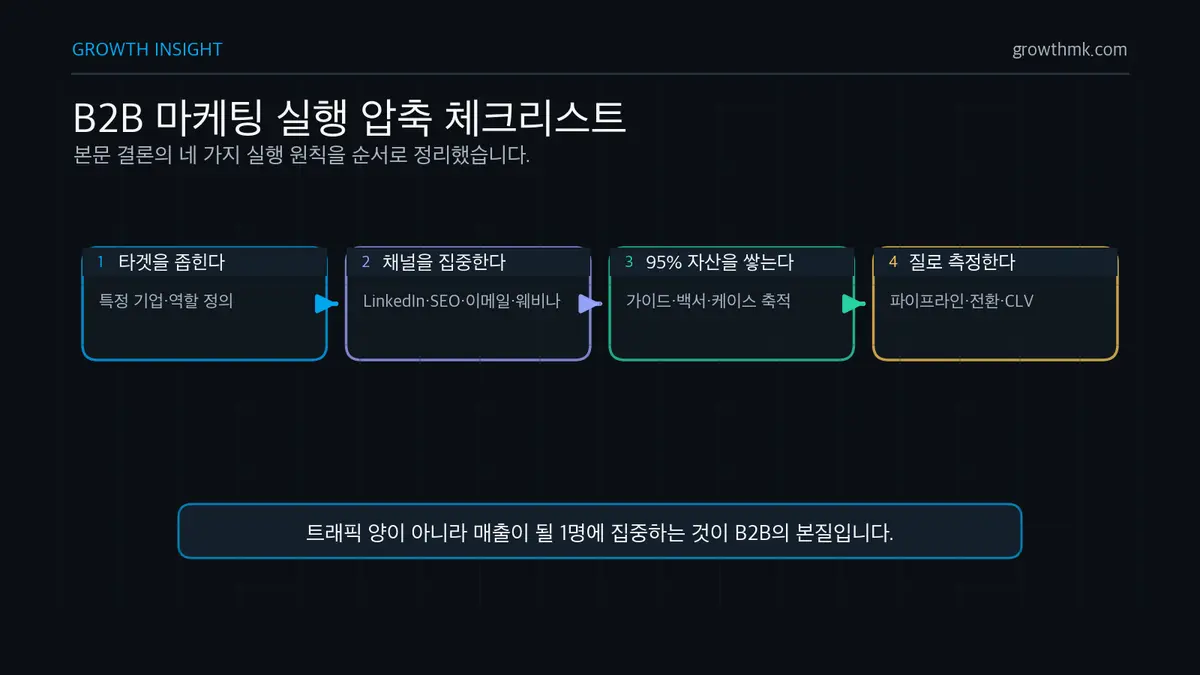
- Narrow your target. Rather than “everyone,” define specific companies and specific roles on the buying committee, and split your messaging to address each role’s pain points.
- Choose and focus your channels. Keep LinkedIn, SEO, email, and webinars at the core, and scope YouTube, TikTok, and Threads to a supporting role (branding, thought leadership, recruiting).
- Build assets for the 95%. For the 95% who aren’t buying right now, build content assets that get found and trusted — guides, whitepapers, case studies — so you’re top of mind when their future purchase moment arrives.
- Measure lead quality, not volume. Set your KPIs around pipeline, conversion, CLV, and sales contribution — not followers or views — and review ROI regularly. Focusing on “the one person who becomes revenue” rather than traffic volume is the essence of B2B.
Our Complete Guide to B2B Marketing ties all of this together — strategy, channels, ABM, lead generation, and measurement — in one place, and we’d recommend reading it alongside this article. B2B marketing isn’t a cost you incur — it’s a long-term strategic investment that drives sustainable growth for your company and brand.
Knowing the difference between B2B and B2C is one thing. Executing on it is another. Growth builds content, SEO, and channel strategy grounded in customer decision journey (CDJ) analysis and data science / growth hacking methodology, designed to persuade the entire B2B buying group. If you need a B2B marketing partner who focuses on “the one person who becomes revenue” rather than traffic volume, take a look at Growth’s B2B marketing services, and reach out via consultation inquiry to discuss a strategy suited to your business.
Frequently asked questions
What’s the biggest difference between B2B and B2C marketing?
The biggest difference is decision-making structure. In B2C, an individual decides relatively quickly based on emotion and need. In B2B, an average of 6 to 10 stakeholders weigh ROI and risk in a non-linear process that reaches consensus over several months. Because of this, your target audience, messaging (emotional vs. logical/data-driven), sales cycle, channels, and KPIs all differ — and porting a B2C playbook directly into B2B tends to fail.
What are the most effective channels for B2B marketing?
The channels users visit for business purposes are the most effective. Specifically, that means professional networks like LinkedIn, SEO and a website that captures search intent, email — which excels at lead nurturing — and webinars that deliver in-depth information. These channels are strong because most B2B buyers finish independent online research before ever contacting sales.
Should B2B companies also use B2C channels like YouTube and TikTok?
You can, but it’s realistic to keep them scoped to a supporting role. Decision-maker engagement is low and these platforms skew entertainment-first, which limits their ability to drive direct lead or revenue conversion. YouTube can build trust and SEO value through educational content, while TikTok and Threads work well for branding, thought leadership, and recruiting — with your core budget staying on proven B2B channels as part of an integrated strategy. When experimenting, measure ROI against real business KPIs, not followers or views.
What is the “95:5 rule” in B2B buying?
It’s the principle that only about 5% of the B2B market has genuine purchase intent at any given moment, while the remaining 95% simply isn’t in market right now. It’s grounded in research from the Ehrenberg-Bass Institute and the LinkedIn B2B Institute, and stems from the fact that companies switch vendors on a long cycle — roughly once every five years on average. That means the 95% who aren’t buying today need a long-term strategy that steadily builds trust and awareness for a future purchase moment, rather than being pushed toward an immediate conversion.