
What Is ABM (Account-Based Marketing)?
 임재복
임재복
What Is ABM?
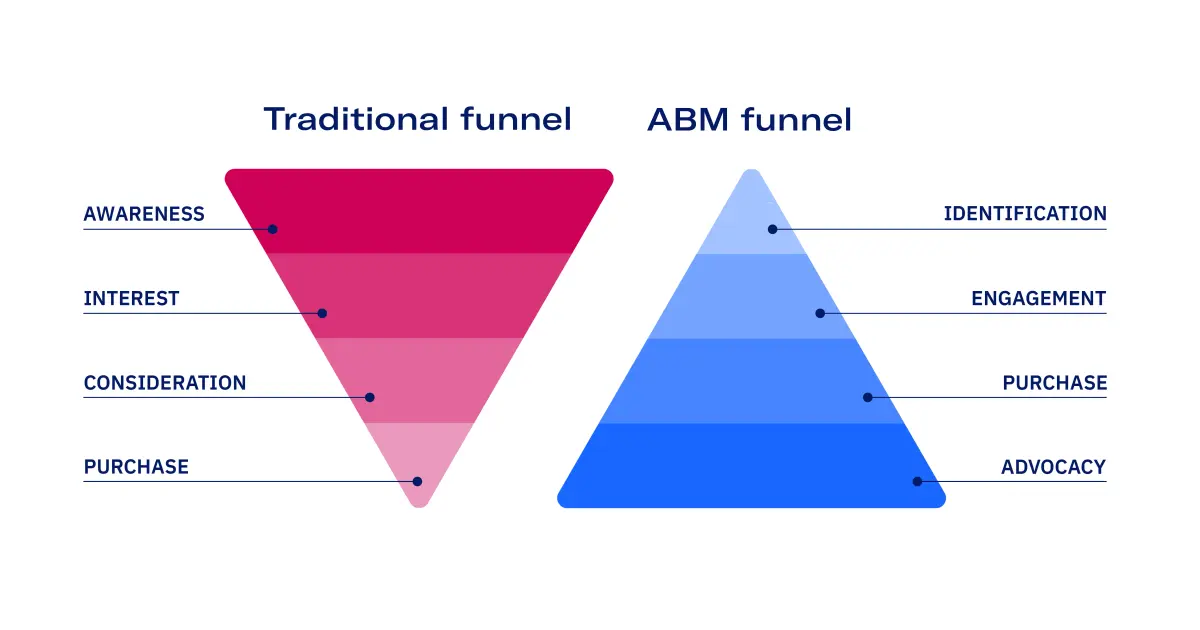
Account-Based Marketing (ABM) is an innovative approach within B2B marketing strategy. At its core, ABM treats each individual client company as its own market and builds marketing activity tailored specifically to that company. When it comes to B2B marketing, Growth believes the most important standard to hold onto is this: one qualified inquiry (SQL) from a single prospect who is genuinely likely to convert into revenue is worth more than 10,000 clicks or 10,000 visitors.
Unlike traditional marketing, which aims at a broad audience, ABM concentrates on a specific company or group of companies. It delivers personalized content and campaigns that match each account’s particular needs, challenges, and business goals. This raises marketing efficiency and strengthens the relationship with the customer. And, naturally, the ultimate goal of ABM is a higher return on investment (ROI).
ABM is especially powerful in B2B precisely because B2B purchasing itself is a matter of ‘consensus among many people.’ According to Gartner’s research on the B2B buying journey, a typical B2B buying group involves 6 to 10 decision-makers, each bringing different information and priorities to the negotiating table. Mass marketing aimed at a broad public struggles to persuade this complex buying committee. ABM fits the structural reality of B2B precisely because it targets ‘the multiple decision-makers inside a single account’ as one unit. Since ABM is essentially a branch of the broader B2B marketing strategy, we recommend first getting the big picture — channels, lead generation, and measurement included — from The Complete Guide to B2B Marketing — Strategy, Channels, ABM, Lead Generation, and Measurement, then returning to this piece as the ABM deep dive.
The Principles of ABM
Customer-Centric Approach
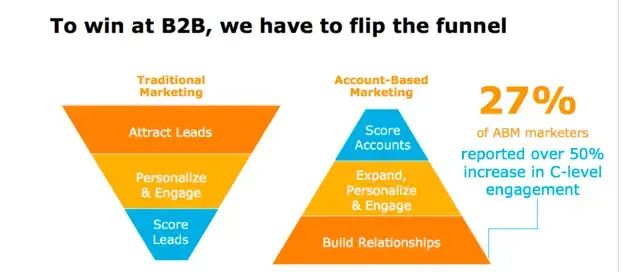
The most fundamental principle of ABM is the customer-centric approach.
This goes beyond simply selling a product or service. The core of it is understanding the client company’s business deeply and contributing to its success.
Companies executing an ABM strategy thoroughly analyze the target account’s industry trends, competitive landscape, internal organizational structure, and decision-making process. Building on that deep understanding, they propose tailored solutions that solve the account’s specific problems or create new opportunities.
This approach focuses on building long-term partnerships rather than short-term sales, and on landing bigger deals rather than a single transaction. The result is greater business value created over time.
Personalization
One of the core elements of an ABM strategy is personalization — and it goes well beyond simply inserting a customer’s name into a message.
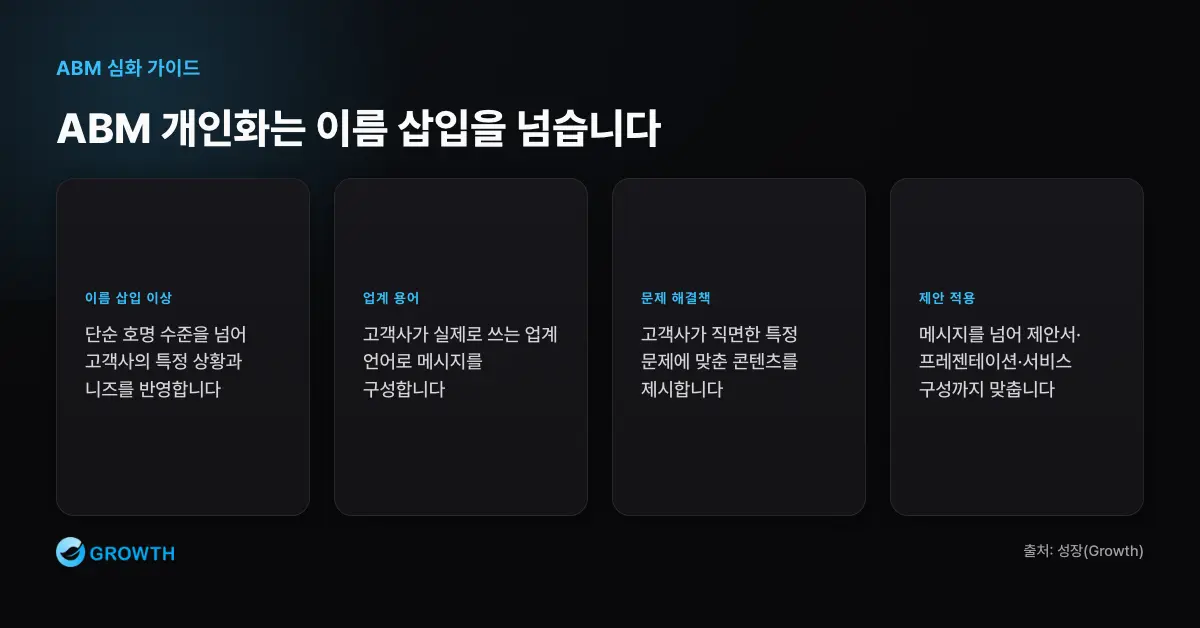
This means deep personalization matched to the account’s specific situation and needs — using the account’s own industry-specific terminology, for example, or structuring content around solutions to the exact problems the account is facing.
This personalization extends to marketing messages, proposals, presentations, and even the product or service itself. A highly personalized approach captures attention and drives engagement.
Ultimately, this can have a positive influence on the purchase decision.
Integrated Sales and Marketing
Close collaboration between sales and marketing is essential in ABM. The two teams no longer operate as separate departments — they move as one integrated team. They share information about target accounts, build strategy together, and deliver a consistent message. For example, when marketing uncovers an insight about a specific account, it’s shared with sales immediately so it can be applied on the ground.
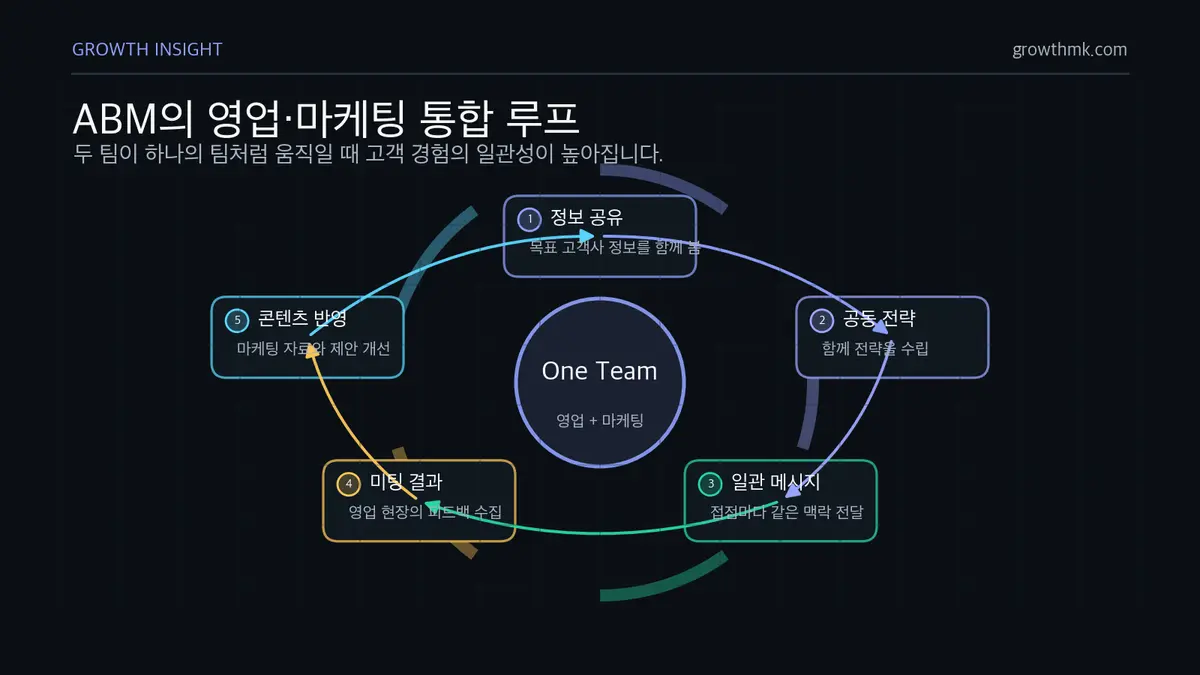
Conversely, the outcomes of sales meetings feed back into marketing’s content strategy. This tight collaboration greatly improves consistency in the customer experience and helps shorten the sales cycle.
Measurable ROI
ABM places heavy emphasis on clearly measuring and analyzing return on investment. Because activity is tailored to each individual account, its impact can be tracked and measured on an account-by-account basis.
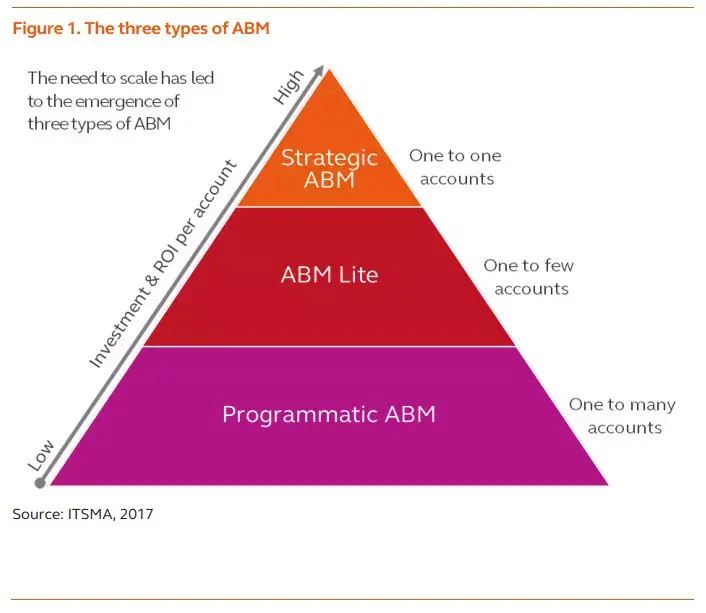
Companies running ABM measure ROI using a range of metrics — engagement level, opportunities created, deal close rate, retention, and customer lifetime value, among others. This precise measurement demonstrates the effectiveness of marketing activity and delivers the insight needed for continuous strategy improvement. It also lets teams clearly show leadership the value ABM creates, helping justify further investment.
ABM Strategy
Selecting Target Accounts
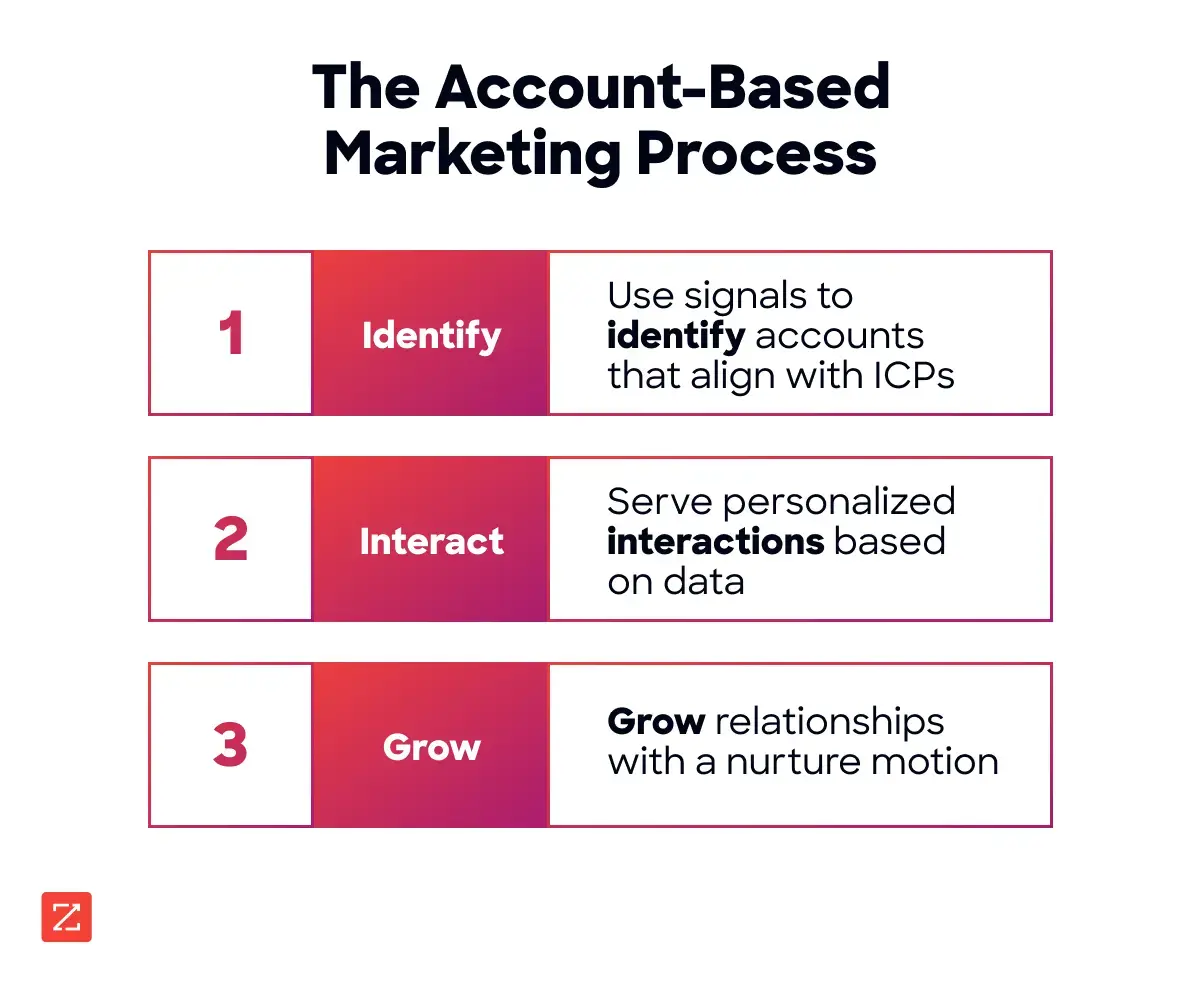
Selecting target accounts is the first and most important step in any ABM strategy. This is where you identify the prospective accounts that best fit your product or service and are likely to bring the highest return.
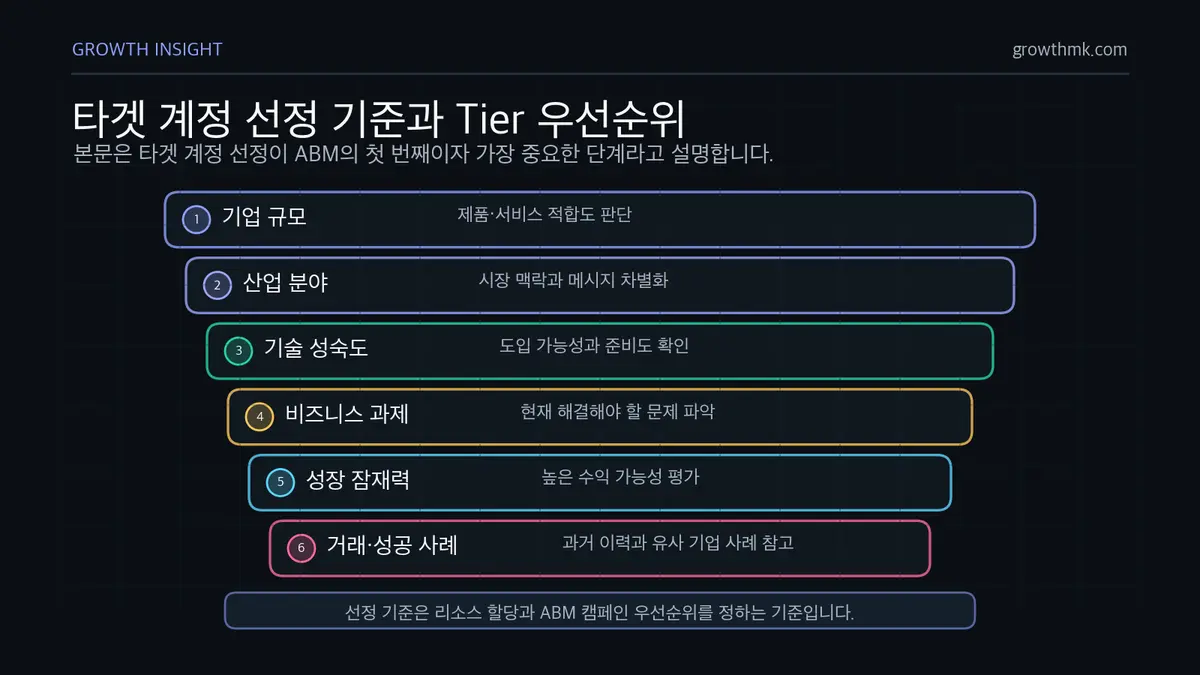
Selection criteria vary by company, but they generally include company size, industry, technology maturity, current business challenges, and growth potential. Past deal history and success stories from comparable companies also serve as important reference points.
Selected target accounts are usually sorted into tiers to set priority. These tiers then become the basis for future resource allocation and strategy development.
Gathering Insight
Gathering deep insight about selected target accounts is essential to ABM’s success. At this stage, you collect detailed information about the target company’s business model, market position, key decision-makers, corporate culture, and recent strategic initiatives.
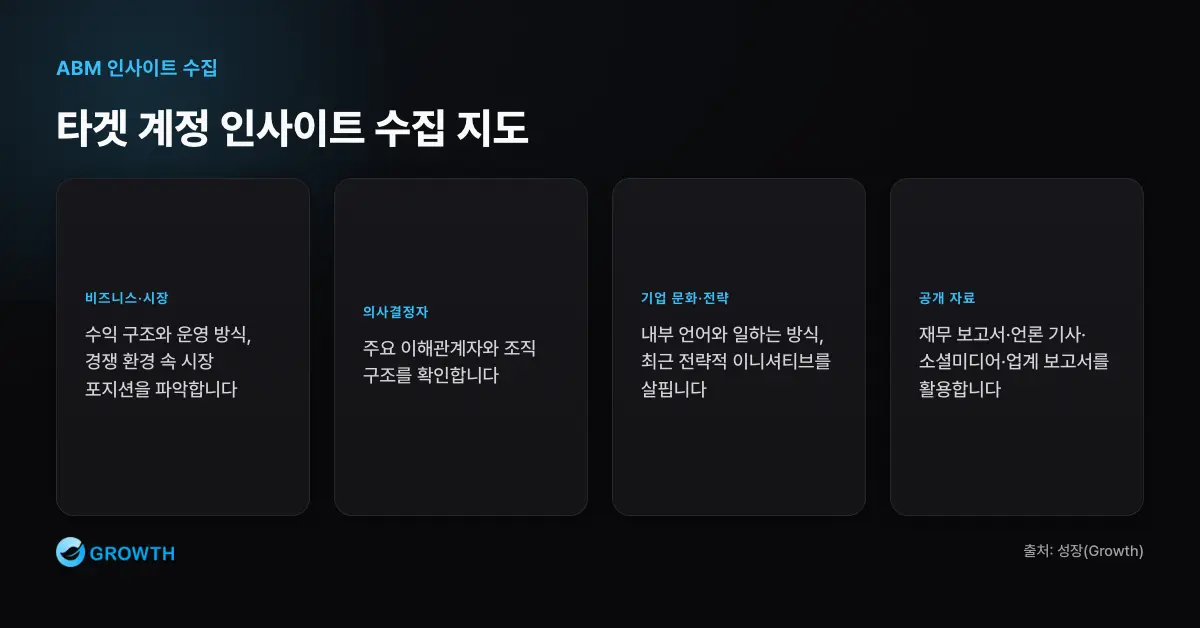
Teams draw on a range of sources for this — public financial reports, press coverage, social media, and industry reports. And when a direct conversation with the target company’s employees or partners is possible, it can yield even richer insight.
Information gathered this way plays a central role in shaping personalized marketing messages and proposals later on.
Developing Tailored Content
Based on the insight gathered, teams develop high-quality content tailored to each target account. This content needs to go beyond a simple product pitch — it should offer real, deep insight into the account’s specific problem or opportunity.
Examples include case studies specific to the account’s industry, custom ROI calculators, and solution proposals for a particular business challenge. The format of the content is also chosen with the account’s preferences and consumption habits in mind.
Whitepapers, infographics, video, and webinars are all used to capture the customer’s attention and drive engagement. Tailored content like this delivers real value to the account while also effectively communicating your own expertise.
A Multi-Channel Approach
Taking a multi-channel approach in ABM means delivering a consistent message to selected target accounts through multiple touchpoints. This spans both digital channels (email, social media, website personalization, and so on) and traditional channels (in-person visits, phone calls, direct mail).
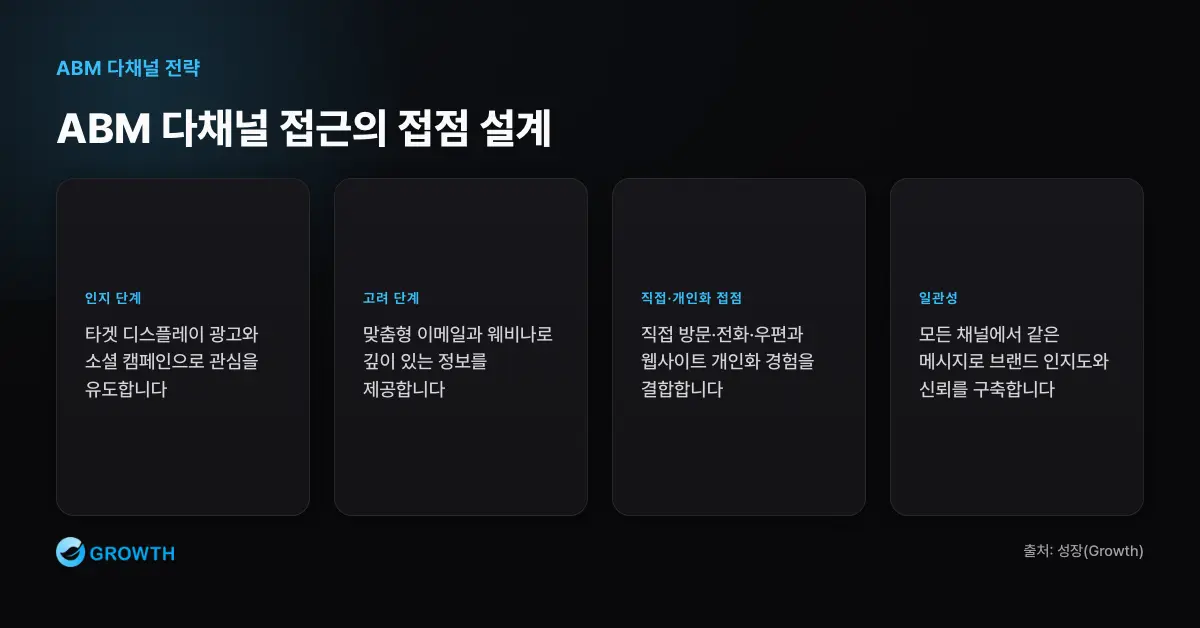
Each channel is used strategically based on where the account is in its buying journey and its preferences. In the early awareness stage, for instance, targeted display ads or social media campaigns can build interest; at the consideration stage, personalized email and webinars can go deeper.
What matters most is delivering a consistent message and experience across every channel, building brand awareness and trust along the way.
Driving Ongoing Engagement
Driving ongoing engagement in ABM means aiming for a long-term relationship, not just a short-term sale. This means the relationship with the account keeps developing even after the deal closes.
This can look like regular performance review meetings, sharing industry trend insights, or inviting the account to exclusive events — all ways of delivering continuous value. Teams also periodically check in on the account’s changing needs and propose new solutions accordingly.
This ongoing engagement raises customer satisfaction and opens up opportunities for upselling and cross-selling. Ultimately, it maximizes customer lifetime value.
Extending ABM
ABM vs. Inbound Marketing
ABM is generally thought of as an outbound strategy, but combining it with inbound marketing can create even bigger synergy. Inbound marketing is the strategy of getting prospects to come find you on their own.
Combining the two brings several benefits. You can build inbound content tailored to target accounts. You can also optimize SEO and social strategy around the interests of those target accounts. And you can use behavioral data from target accounts to run more accurate lead scoring.
Ultimately, this lets you prioritize inbound leads that happen to belong to a target account. This integrated approach maximizes the impact of ABM and creates more opportunities to connect with target accounts across more touchpoints.
How Small and Mid-Sized Businesses Can Use ABM
ABM isn’t just for large enterprises — it can be applied effectively at small and mid-sized businesses too. There are a few things worth keeping in mind when a smaller company adopts ABM.
- Focus your limited resources on a small number of the most valuable accounts.
- Lean on technology. Low-cost marketing automation tools can increase personalization and efficiency.
- Go after a niche. It helps to build your ABM strategy around expertise specific to a particular industry or region.
- Use your flexibility and speed. Smaller companies can make decisions faster than large enterprises, and that lets you adjust strategy quickly.
With this kind of approach, small and mid-sized businesses can capture the benefits of ABM even with limited resources.
Connecting ABM with Customer Experience (CX)
ABM contributes to more than just marketing outcomes — it improves the overall customer experience. This connection between ABM and CX shows up in a few ways.
- Consistent messaging: delivering a message tailored to the account at every touchpoint
- Personalized interaction: providing a customized experience based on the account’s needs and preferences
- Proactive problem-solving: anticipating the account’s potential problems and offering solutions before they’re asked for
- Continuous value: providing ongoing support and insight for the account’s success even after the sale
This approach raises customer satisfaction and helps build long-term relationships.
The Benefits of ABM
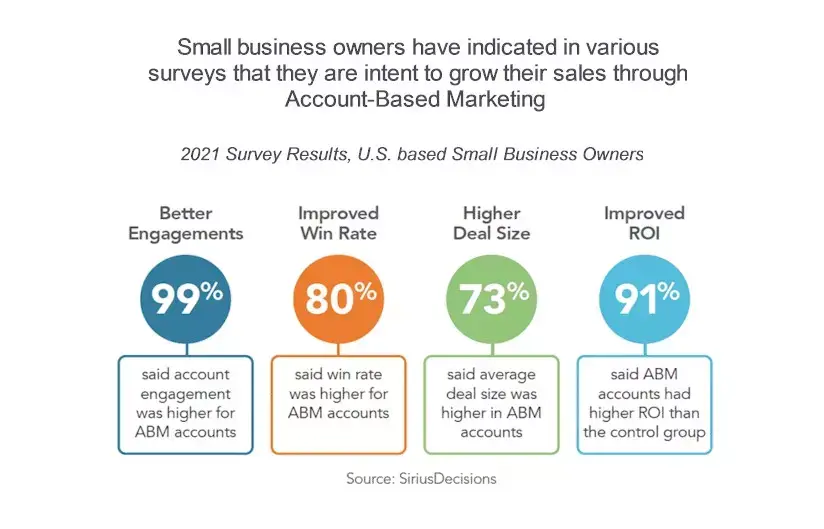
That said, since the figures above come from a single survey in one particular year (2021), it’s more accurate to treat them as a reference point showing ‘how practitioners feel about ABM’ rather than an absolute generalization. A more structural case for ABM can be found in the Gartner analysis referenced earlier: according to Gartner, the 6 to 10 decision-makers in a B2B buying group each gather information independently before sharing it, and the final stage of the buying journey is ‘consensus creation.’ In other words, the more a B2B deal depends on multiple stakeholders reaching agreement, the more an account-level, consistent message from ABM works in your favor for conversion.
- Higher ROI: by concentrating resources on the most valuable accounts, ABM can achieve a stronger return on investment. The tailored approach lifts conversion rates and increases the odds of closing large deals.
- Shorter sales cycles: deep understanding of the target account and a tailored approach speed up decision-making and cut out unnecessary steps. This has the effect of shortening the overall sales cycle.
- Stronger customer loyalty: ABM drives high customer satisfaction by accurately identifying and solving each account’s specific needs, which leads to long-term relationships and strong loyalty.
- More efficient use of resources: focusing on the most valuable accounts lets you use marketing and sales resources more efficiently. This cuts spending on unnecessary lead generation and lets you concentrate investment on accounts with the highest chance of success.
The tailored approach also means resources can be allocated to each account in the way that fits it best, significantly improving overall marketing efficiency. That, in turn, drives better overall company performance.
- Precise performance measurement: because ABM operates at the level of the individual account, the performance of each activity can be measured and analyzed precisely — something that’s difficult with traditional mass marketing.
Precise measurement is a huge help for ongoing strategy improvement and resource optimization. It also makes it easier to clearly demonstrate marketing’s value to leadership.
The Limits of ABM — and How to Overcome Them
High Upfront Investment
Getting ABM off the ground requires substantial upfront investment — mostly in building technical infrastructure such as data analytics tools, marketing automation platforms, and CRM systems.
There’s also a cost to hiring or training the specialized people needed to build and execute an ABM strategy. This high initial cost can be a significant burden, especially for small businesses and startups.
On top of that, the results of ABM may not show up right away. For companies focused on short-term ROI, that can make this investment hard to justify.
A Heavy Investment of Time and Effort
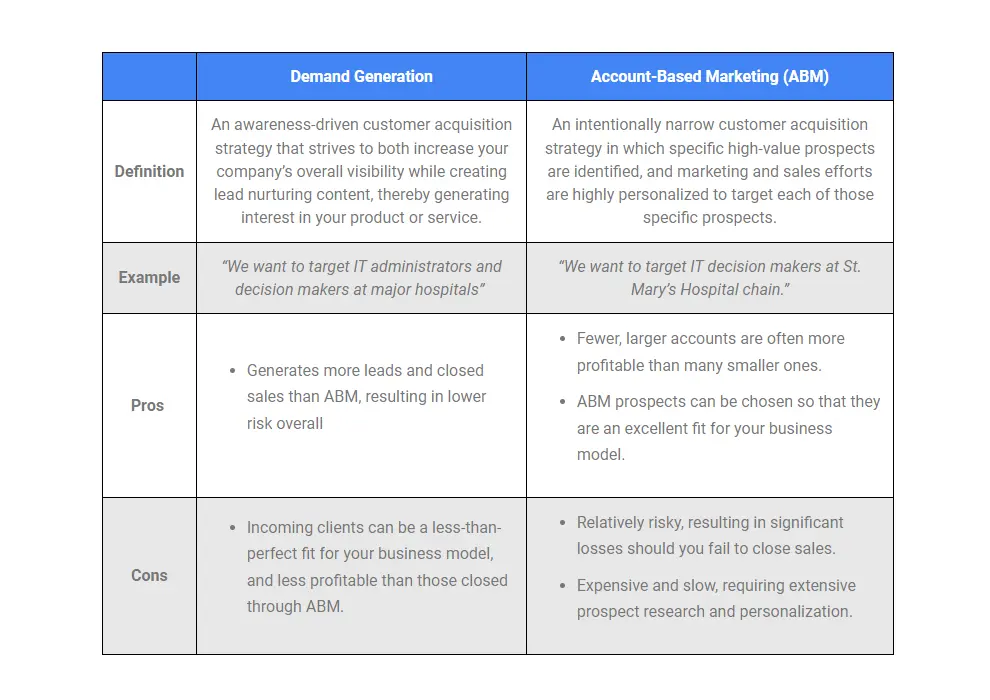
ABM demands deep understanding of each account and a tailored strategy, which requires a considerable amount of time and effort. Selecting target accounts, gathering detailed insight on each one, and developing custom content are all time-intensive processes.
These activities also have to be ongoing, and need to keep adjusting as the account changes. That can be a major challenge for companies that want fast results, or that have limited resources.
On top of that, it can take time before ABM’s results show up. It requires patience and a long-term perspective.
Difficulty Getting the Right Data
The success of ABM depends heavily on accurate, rich data — but getting that data isn’t easy.
In a B2B environment especially, privacy regulations and corporate security policies can make it hard to access the data you need. Integrating and cleaning data collected from multiple sources while maintaining consistency and accuracy is also a major challenge.
Incomplete or inaccurate data can lead to the wrong insights, which can significantly undermine the effectiveness of an ABM strategy.
How to Overcome These Challenges
You can overcome ABM’s upfront cost and complexity by taking a phased approach. Start with a pilot program targeting a small number of core accounts. This lets you learn the basic principles and process of ABM and see early results. Based on a successful pilot, you can gradually expand the target account list and refine your strategy.
This kind of approach reduces initial risk and helps justify the investment. It also lets the organization build up the capabilities ABM requires gradually, which sets you up for more effective ABM execution in the long run. To overcome ABM’s demanding time and effort requirements, actively using AI and automation tools is also a good idea. AI-powered data analysis tools, for example, can speed up target account selection and insight gathering.
Marketing automation platforms let you manage personalized content distribution and campaign execution efficiently. Customer behavior tracking tools help you analyze responses in real time and adjust strategy accordingly. Using this kind of technology automates and optimizes a large part of the ABM process, reducing reliance on manual work and enabling faster execution and scale.
To overcome the difficulty of securing the right data, you can consider partnering with a trusted marketing agency. Growth, for example, provides high-quality B2B data gathered from multiple sources, along with the analysis and insight services to go with it. A partnership like this gives companies access to data that would be hard to collect on their own, with guaranteed accuracy and freshness. It also lets you combine internal and external data to build a richer customer profile.
ABM Case Studies
Case 1: IBM
IBM is a global technology company and one of the best-known examples of success with ABM. IBM recognized the need for ABM in the process of selling complex enterprise solutions.
IBM’s ABM strategy has the following characteristics.
- For targeting, IBM selected around 500 core accounts worldwide — the companies that needed IBM’s solutions most and had the greatest growth potential.
- It produced detailed case studies and whitepapers tailored to each account’s specific industry and business model — for instance, in-depth content on blockchain solutions for financial institutions and AI-driven customer analytics for retailers.
- It took an integrated approach. Marketing and sales worked closely together to build and execute an integrated strategy for each account, enabling consistent messaging and efficient use of resources.
- It ran multi-channel campaigns, combining digital ads, email marketing, personalized landing pages, and in-person visits to maximize touchpoints with customers. And finally, it drove ongoing engagement.
Even after the sale, IBM kept providing value and strengthening relationships through regular strategy meetings, technical workshops, and executive networking events — continuously adjusting and optimizing its approach for each account.
As a result, IBM significantly grew revenue from its target accounts through this ABM strategy. It saw particularly strong results in cloud services, and customer retention and satisfaction both improved substantially.
Case 2: Salesforce
Salesforce, a global CRM (customer relationship management) solution provider, is a case study of using ABM effectively to strengthen its position in the enterprise market. Salesforce’s ABM strategy has the following characteristics. Salesforce managed target accounts across several tiers. The top tier included the large enterprises with the highest potential value, and these got the most concentrated resources.
Salesforce also focused heavily on gathering deep insight, following up with detailed analysis of each target company’s organizational structure, decision-making process, and key business challenges. To do this, it drew on internal data, external market research, and social listening. It delivered tailored messages to specific departments and decision-makers at each account.
For example, it emphasized strategic value to the CEO, technical advantage to the CIO, and cost efficiency to the CFO.
To do this, Salesforce made heavy use of digital marketing, running highly personalized digital marketing campaigns through its own Marketing Cloud platform. It also hosted tailored events, delivering value and building relationships through custom events for key target accounts — for example, bringing together leaders from a specific industry for a roundtable discussion on future technology trends.
Finally, it pursued ongoing optimization, monitoring and analyzing campaign performance in real time and continuously refining strategy. Salesforce’s ABM strategy proved highly successful, significantly expanding its enterprise customer base and driving major growth in enterprise solution sales in particular. Its relationships with accounts also deepened, with many evolving into long-term partnerships.
Building on this ABM success, Salesforce has added ABM capabilities to its own marketing automation tools, helping other companies adopt ABM more easily.
The Future of ABM
AI and Machine Learning Integration: Sharper Customer Insight
Advances in AI and machine learning are expected to significantly increase the effectiveness of ABM. Here’s how these technologies are likely to integrate into ABM.
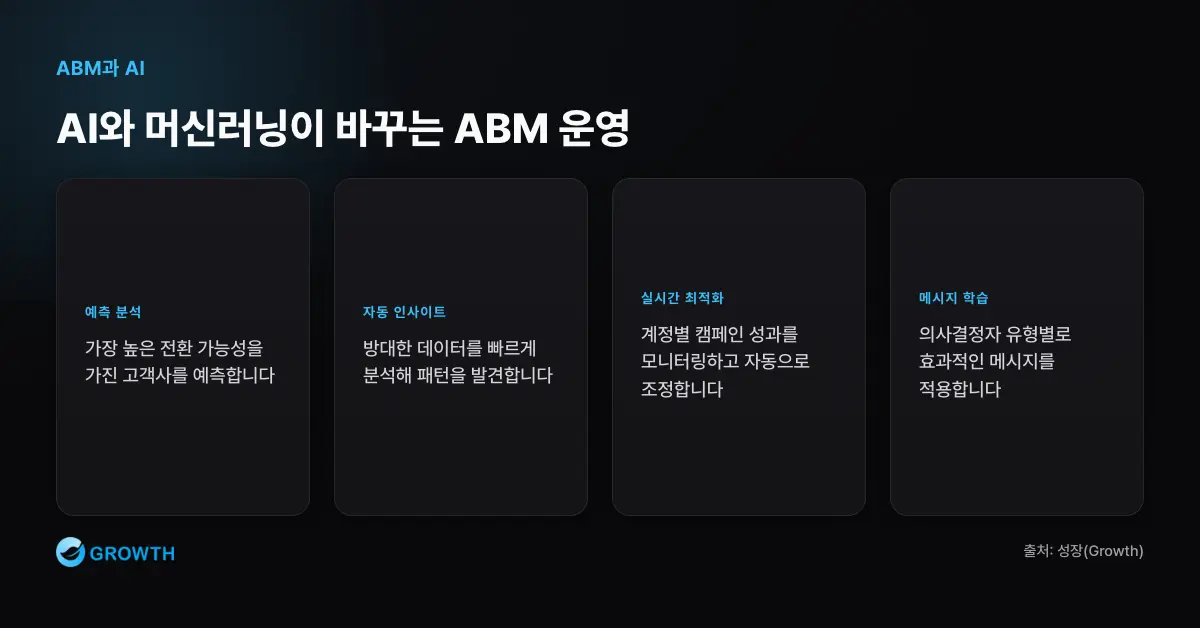
First, predictive analytics will get more sophisticated. AI algorithms can analyze historical data to predict which accounts have the highest likelihood of converting.
This can significantly improve the accuracy of target account selection.
Second, automated insight generation will become possible. Machine learning models can rapidly analyze massive amounts of data to automatically generate deep insight on each account — helping surface patterns or opportunities that a human marketer might miss.
Third, real-time optimization will become far more advanced. AI can monitor campaign performance in real time and automatically make adjustments to optimize results.
For instance, once a system learns that a particular message works better with a particular type of decision-maker, it can apply that automatically. This integration of AI and machine learning will substantially increase ABM’s accuracy and efficiency, enabling far more sophisticated customer insight.
Hyper-Personalization: Extremely Tailored Experiences Powered by Real-Time Data
Hyper-personalization will be a defining trend in the future of ABM — using real-time data and advanced analytics to deliver an extremely tailored experience to each account and individual decision-maker.
First, real-time context awareness will become possible. Systems can consider a customer’s current situation, recent activity, and even mood in the moment to deliver the most appropriate message and offer in real time.
Second, dynamic content generation will become standard. AI-powered content generation tools can automatically produce content tailored to each account’s characteristics and interests.
This can extend to blog posts, emails, and even proposals.
Third, personalized customer journeys will get far more sophisticated. Teams will be able to design and execute a fully personalized journey that accounts for each account and decision-maker’s preferences, past interactions, and current stage. This hyper-personalization is expected to significantly improve customer experience and boost marketing effectiveness.
Omnichannel Integration: A Seamless Experience Across Online and Offline
Future ABM will integrate online and offline channels more tightly, delivering a consistent, seamless experience across the customer journey.
First, data integration across channels will strengthen further. Data collected at every touchpoint will be integrated in real time, giving teams a full 360-degree view of the customer journey.
This will make it possible to understand and predict customer behavior and preferences with much greater accuracy.
Cross-channel consistency will also be maximized. Digital ads, email, the website, sales meetings, events — every channel will deliver a consistent message and experience. For instance, content a customer saw online could naturally continue into an offline meeting.
Finally, real-time channel optimization will become possible, dynamically selecting the most appropriate channel based on the customer’s current situation and preferences.
This kind of omnichannel integration will significantly improve customer experience and maximize the impact of ABM. Customers will get a consistent, personalized experience across every interaction with the company, building greater trust and loyalty toward the brand.
More Advanced Predictive Analytics: Better Prediction of Customer Behavior and Needs
Advances in predictive analytics will take ABM’s strategic approach to another level.
- Predicting purchase intent: analyzing an account’s various behavioral signals to predict what products or services it’s interested in and when it’s likely to buy.
- Detecting churn risk: spotting changes in an account’s behavior patterns to identify churn risk early and respond proactively.
- Predicting the optimal moment to reach out: predicting the best time to approach each account and decision-maker, maximizing the impact of marketing and sales activity.
Experts believe this kind of advanced predictive analytics will significantly increase the accuracy and effectiveness of ABM strategy.
In short, ABM will keep evolving into a more sophisticated and effective strategy as technology advances. As AI and machine learning, big data analytics, and real-time personalization technology get woven into ABM, companies will be able to build deeper relationships with customers and achieve long-term business growth.
But alongside this technological progress, consideration for privacy and ethical use will also become increasingly important. The successful future of ABM will be realized through a balance of advanced technology, human insight, and ethical judgment.
Companies will need to keep learning and innovating to adapt to these changes and seize new opportunities. ABM will come to represent more than just a marketing strategy — it will become a company’s overall customer-centric business philosophy. Through this, companies can achieve a higher ROI, and customers can get a better experience. Ultimately, the evolution of ABM is expected to completely reshape the paradigm of B2B marketing and sales.
Not every company can run ABM exactly like the IBM or Salesforce examples in this piece. But the most important point in building a ‘customer-centric’ marketing strategy that fits your own company and brand — while still capturing the benefits of ABM — is consistently staying focused on the good accounts that can bring you real value.
Growth combines the strengths of ABM with clients’ B2B marketing this way, and it delivers strong results. Has your marketing goal always just been maximum traffic and attention from as many people as possible? Right now is the moment to shift that perspective — and find your turning point.
Related Reading
- The Complete Guide to B2B Marketing — Strategy, Channels, ABM, Lead Generation, and Measurement
- What Should Be Different About Marketing to B2B Decision-Makers
- Where Should B2B Marketing Position Itself in the Age of AI
- How Do B2B Marketing Channels Differ from B2C?
- B2B Marketing Formats: Video vs. Text Content Marketing
If you’d like to apply this to your own business — you can see Growth’s approach on our B2B marketing service page, and if you need a specific situational diagnosis, reach out through Contact Us. We’ll answer based on the one customer who becomes revenue — not the volume of traffic.
Frequently Asked Questions (FAQ)
What’s the biggest difference between ABM and traditional marketing?
It’s the scope of the audience and the approach. Traditional marketing targets a broad public, pursuing reach and traffic. ABM treats a single client company as its own independent market and concentrates content and campaigns tailored to that account. This matters especially in B2B deals involving 6 to 10 decision-makers, where a consistent, account-level message from ABM is effective at persuading a complex buying committee.
Is ABM only for large enterprises? Can small and mid-sized businesses do it too?
Small and mid-sized businesses can absolutely apply ABM. The key is focusing limited resources on a small number of the most valuable accounts. Use low-cost marketing automation tools to boost personalization and efficiency, go after a niche with expertise specific to a particular industry or region, and use your ability to make decisions faster to adjust strategy nimbly. You don’t need to handle hundreds of accounts like IBM or Salesforce — ABM’s principles can be applied at whatever scale fits your business.
What are ABM’s biggest limitations and risks?
High upfront investment, a heavy demand on time and effort, and difficulty securing the right data. There’s also significant risk if you invest heavily in an account and fail to convert it. To overcome this, a phased approach works well — start with a pilot targeting a small number of core accounts and expand gradually, use AI and automation tools to speed up target selection and insight gathering, and work with a trusted partner to ensure data accuracy and freshness.
Can ABM and inbound marketing be used together?
Yes, and combining them creates real synergy. You can build inbound content tailored to target accounts, optimize SEO and social strategy around those accounts’ interests, and use their behavioral data to run more accurate lead scoring. If you prioritize inbound leads that happen to belong to a target account, you can capture both ABM’s precision and inbound’s scalability at the same time.
Marketing Insights
Marketing insights, delivered weekly
Practical growth and GEO/B2B marketing insights, summarized in your inbox every week.
Subscribe for insights