
Can Content Made with AI Get Cited by AI? Quality Standards for Generative AI Content
 임재복
임재복
Content made with AI can absolutely be cited by search engines and AI answers. Google has officially stated that it evaluates content by “quality and usefulness, not by who or what made it,” and it doesn’t ban generative AI outright. But there’s a catch. Content that gets cited by AI needs to contain first-party data, a unique point of view, verified sources, and real experience — and these are exactly the elements AI can’t generate on its own. In other words, there’s a gap between “made with AI” and “cited by AI” that only a human can fill.
This article covers the quality standards Growth developed from actually using generative AI in our own content production. It connects two things into a single workflow: not just how you use AI (production), but how the content you make with it gets selected by generative engines (GEO) and search engines (citability). The goal is content that reaches the one customer who will become revenue, not traffic volume.
Why the frame needs to shift: from making to being cited
Since 2023, the marketing industry’s question has been “should we use generative AI for content?” That question is effectively settled now — using it has simply become a given. Growth also uses generative AI routinely for keyword research, drafting, and copy optimization. Just as the generation that rejected computers when they first appeared got left behind, rejecting AI tools is no longer really an option.
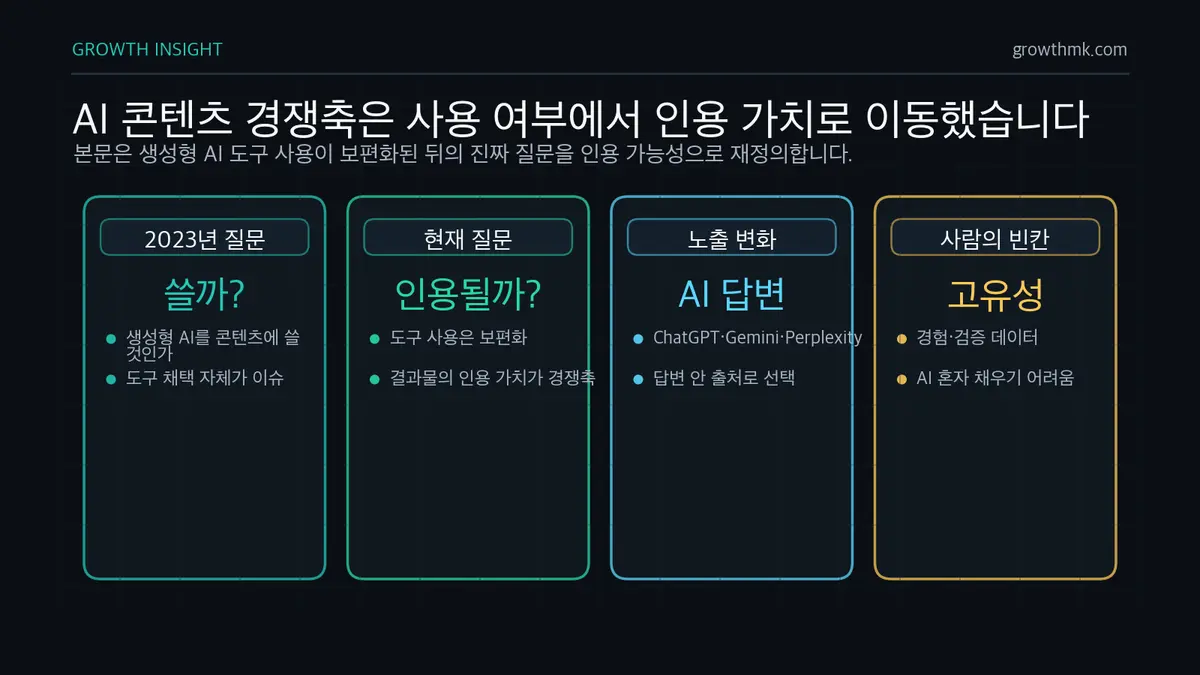
Tool adoption has already reached the mainstream stage. Advertising and marketing is regularly cited as one of the industries with the highest rate of generative AI tool use, and Gartner’s survey found that a large share of marketing leaders plan to invest further in generative AI. In other words, “are you using the tool” is no longer a differentiator. When everyone uses the same tools, the axis of competition shifts from tool usage to whether what you made with that tool is actually worth citing.
But as everyone started churning out content with the same tools, the real question changed. What matters now is “is this content I made with AI actually worth being cited by AI and search engines?” As generative engines like ChatGPT, Gemini, and Perplexity increasingly replace search, the very definition of visibility is shifting — from “a top link in search results” to “a source cited inside an AI answer.”
And here’s the paradox: AI makes content fast, but the core elements that get content cited by AI — uniqueness, experience, verified data — are exactly what AI can’t fill in on its own. Understanding this tension and designing a workflow around it is the goal of this article.
What’s search engines’ actual position on AI-generated content?
The most common misconception is “Google penalizes AI-written content.” That’s not true. Google’s official guidance explicitly states that it evaluates content based on quality and usefulness, not how it was produced. The question isn’t “who or what made this” — it’s “is this meant to help people, or to manipulate rankings?”
Google’s guide to creating helpful content doesn’t ban automation or AI use in itself. But it makes two things clear. First: “using automation — including AI generation — to produce content with the primary purpose of manipulating search rankings is a violation of the spam policies.” Second: if you’ve used AI automation substantially, you should ask yourself whether that’s “disclosed to visitors where appropriate.” In other words, AI use is permitted, but Google looks at intent and transparency.
An even more decisive signal is the “scaled content abuse” section of Google’s spam policies. Google defines this as “generating many pages with the primary purpose of manipulating search rankings, not helping users,” and explicitly lists “using generative AI tools or other similar tools to generate many pages without adding value for users” as a specific example.
To sum up: search engines’ position isn’t a binary of “AI versus human.” The problem is worthless mass production. Made with the same AI, one genuinely useful piece gets rewarded while 100 worthless, churned-out pieces become a penalty target. Here’s that standard laid out in a table.
| Category | AI use Google rewards | AI use Google penalizes |
|---|---|---|
| Primary purpose | Actually answering a person’s question | Manipulating search rankings, mass traffic generation |
| Value added | Adds unique data, perspective, experience | Recombines existing information, no added value |
| Transparency | Discloses AI use where appropriate | Hides sources and production process |
| Production method | AI draft + human review and enrichment | Automated mass production, no human review |
| Outcome | Evaluated on quality, eligible for citation | Spam policy violation (scaled content abuse) |
Where does AI content actually fail?
The reason AI-made content fails to get cited usually isn’t a penalty — it’s that the content is simply mediocre. Failure typically happens at three points.
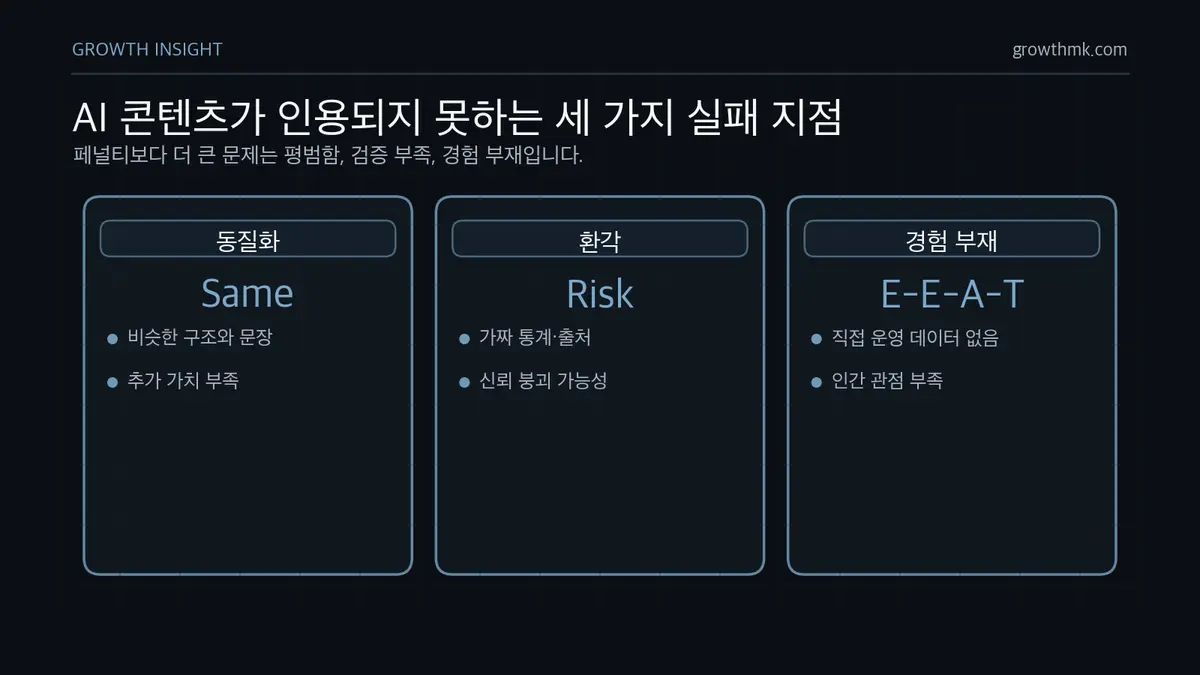
1. Sameness — everyone writes the same answer
Large language models generate the statistically most plausible expression based on their training data. As a result, asking the same model the same question produces similar structure and similar sentences, regardless of which company is asking. If ten companies write “how to generate B2B leads” using the same tool, the definitions in the intro, the lists in the middle, and the closing advice all end up looking alike. From a search engine’s or generative engine’s perspective, there’s no reason to cite yet another variant of information that already exists across the web. Content with no uniqueness gets classified as “adds no value,” which connects directly to the scaled content abuse policy we just covered. The only way to break sameness is to add what the model never learned in the first place: data and perspective that belong only to your company.
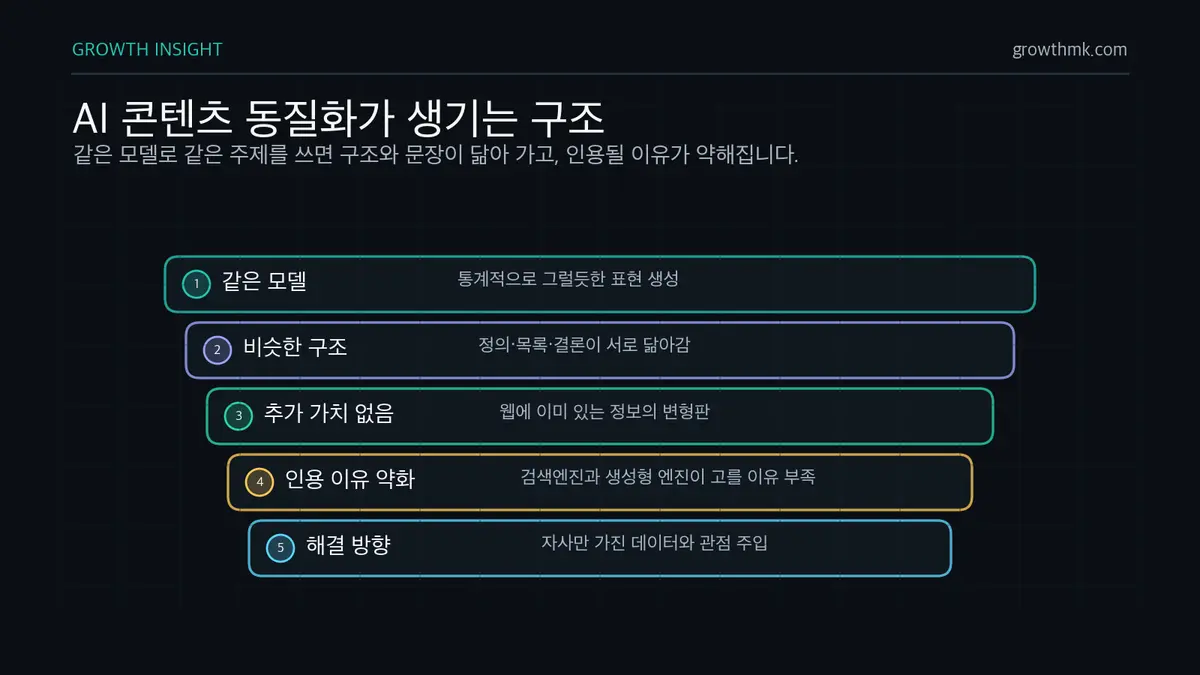
2. Hallucination — falsehood dressed up as fact
LLMs generate plausible-sounding sentences without verifying facts. Confidently inventing statistics that don’t exist, incorrect citations, and fake sources — that’s hallucination. Publish without review, and trustworthiness collapses right at the exact point Google emphasizes as “most important” in E-E-A-T. Content that fabricates sources doesn’t just fail to get cited in AI answers — a single factual error can damage the trustworthiness of your entire domain.
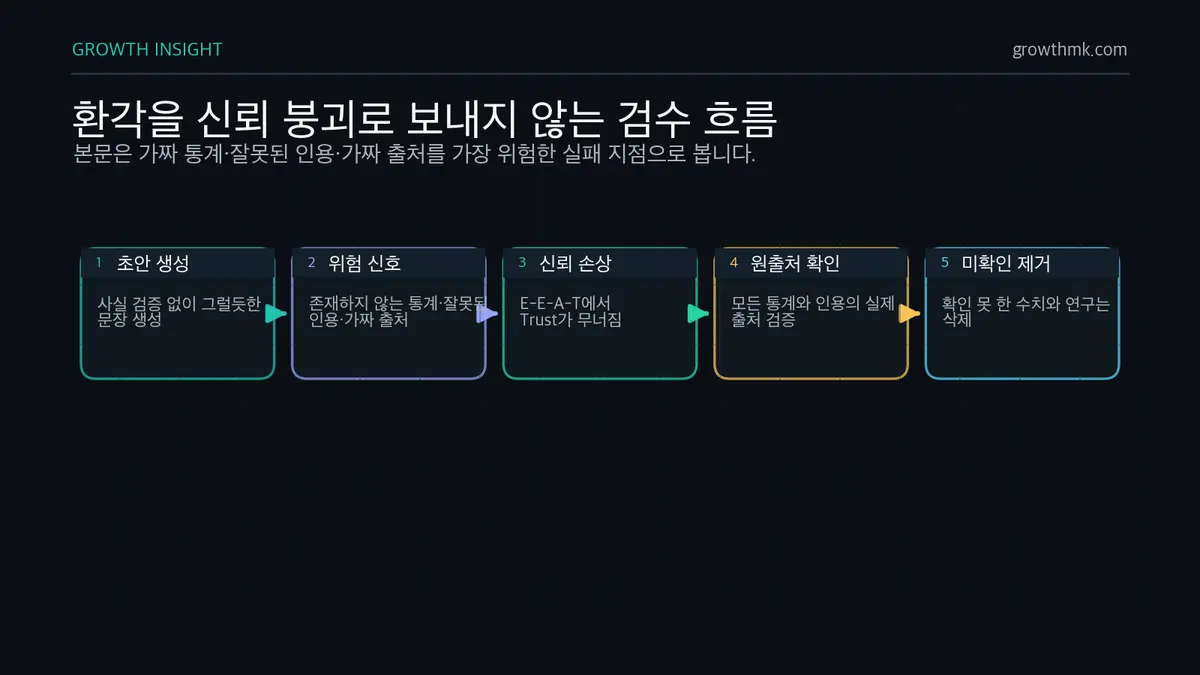
3. The absence of experience — the first “E” of E-E-A-T goes missing
Google’s quality standard, E-E-A-T, consists of Experience, Expertise, Authoritativeness, and Trust. It’s no accident that Google added “Experience” to the front of the existing E-A-T framework in December 2022. AI only reassembles its training data — it has never directly used a product, run a campaign, or met a customer. Structurally, AI content has that first “E” missing by default.

These three failure points aren’t accidental — they come from the very nature of AI generation. And these exact gaps overlap precisely with “what makes content citable by AI,” which we’ll look at next.
What makes content citable by AI — and the tension with AI generation
There’s empirical research on exactly what generative engines cite. The GEO: Generative Engine Optimization paper (arXiv 2311.09735), accepted at KDD 2024, ran experiments on commercial generative engines and found that simply adding citable sources, statistics, and quotations improved visibility in generative engine answers by up to 40%. Interestingly, the biggest gains didn’t come from traditional keyword-stuffing tactics, but from citing credible sources, adding statistics, and adding quotations.
Here’s where the paradox reveals itself: the exact elements generative engines reward happen to be the ones AI can’t generate on its own.
| What AI cites | Why it gets cited | Can AI produce it alone? |
|---|---|---|
| First-party data / original experiment results | New information not already on the web = a reason to cite | No — actual measurement and experimentation requires a person |
| A unique perspective or interpretation | Differentiation among homogenized answers | No — AI regenerates the average |
| Verified sources / accurate statistics | A trust signal, prevents hallucination | No — verification requires human confirmation |
| Real experience | Satisfies the first E in E-E-A-T | No — only someone who actually experienced it has this |
| Structured, clear summaries | Easy to extract and quote | Partially — this is an area AI is genuinely good at |
The last row of the table is the key clue. What AI is genuinely good at is “structuring and clear summarization.” In other words, AI can produce an excellent format for citation, but a person has to inject the core of what makes the content worth citing. So the real question isn’t “AI or human” — it’s a division of labor where a person’s content sits on top of the format AI is good at producing.
One more finding worth noting: follow-up analysis of the same GEO research reports that when sites properly added sources and statistics, the visibility gains were larger for sites that weren’t previously ranking highly. That means first-party data and verified sources act as an even bigger lever for challengers. The harder it is for a company to compete on traffic volume alone, the bigger the payoff from a single piece of unique content that AI has no choice but to cite.
Why does a traditional tactic like keyword stuffing have so little effect, while sources, statistics, and quotations have such a large one? It comes down to how generative engines actually work. A search engine indexes pages and ranks them to return a “list of links,” but a generative engine reads multiple sources and “synthesizes” them into a single answer, then cites the sources behind it. When choosing which sentences to use in an answer, the engine favors units that are “verifiable, specific, and easy to extract.” That’s why a number beats a vague adjective, and a sentence with a source attached beats a generality, when it comes to being selected as material for an answer.
This connects directly to Growth’s own data-science mindset. We don’t think of content as “something to be read” — we think of it as “a bundle of citable data units.” The more citable factual units a piece of content contains (verified statistics, your own experiment numbers, clearly defined concepts), the more questions it becomes source material for. That’s exactly why you should think of GEO as an additional layer stacked on top of search, not a replacement for it. We cover the full picture of this principle in more depth in our complete GEO guide.
A practical workflow for turning an AI draft into citable content
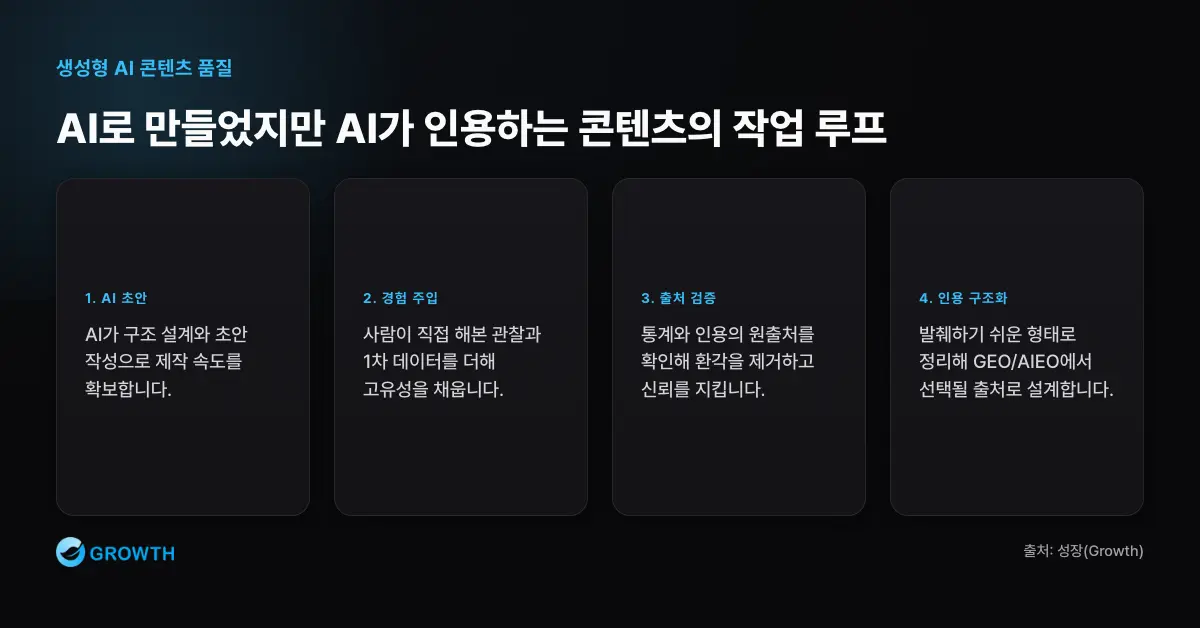
The way to resolve this tension is to split it into stages — separating what AI does well from what only a person can do, so you get both AI’s speed and human uniqueness. Here’s the 4-stage workflow Growth actually uses.
| Stage | Owner | What happens | Effect on citability |
|---|---|---|---|
| 1. AI draft | AI-led | Structure design, drafting, keyword research, phrasing polish | Establishes format and structure (speed) |
| 2. Inject experience and data | Human-led | Add your own campaign results, first-party data, real cases, and a unique perspective | Establishes uniqueness and Experience (differentiation) |
| 3. Verify sources | Human-led | Trace every statistic and citation back to its original source, remove hallucinations and fake sources, link to authoritative sources | Establishes Trust, removes hallucination |
| 4. Structure for extraction | AI-assisted | Rework into an answer-first intro, subheadings, tables, and FAQs for easy extraction | Maximizes ease of citation |
Let’s unpack each stage a bit more.
Stage 1 — AI draft. This stage reduces the time you spend staring at a blank page. The more specifically you spell out context, tone, audience, goal, and format in your prompt, the better the output. But remember: this output is “raw material,” not a “finished piece.” Just as OpenAI CEO Sam Altman has said he wants ChatGPT to be a “copilot,” AI is your starting point.
Stage 2 — Inject experience and data (the most important stage). This is where content’s fate is decided. Add the numbers from campaigns you actually ran, real customer cases, and perspectives you’ve earned from working directly in the industry. Skip this stage, and the output from stage 1 stays “average” forever. If you have proprietary data gathered through data science and growth hacking methodology, that’s your single most powerful citation asset. For example, a single line like “we improved conversion rate by 14% through A/B testing” — a number you actually measured yourself — is more citable than ten paragraphs of AI-reassembled generalities, simply because it’s first-party data that doesn’t exist anywhere else on the web. Your own observations about which message worked at which stage of the customer journey are likewise a unique asset nobody else can replicate.
Stage 3 — Verify sources. Trace every statistic and citation AI produced back to its original source and confirm it. If you can’t confirm it, soften the claim or remove it. Then link the surviving facts to authoritative sources. Remember: citation links themselves were a key factor that boosted visibility in the GEO research.
Stage 4 — Structure for extraction. Generative engines favor content that’s easy to extract. Put a self-contained answer to the question right in the intro, and break up information with subheadings, tables, and FAQs. You can safely hand this stage back to AI — polishing format is something AI does well.
Proven ways to use AI that you can adopt as-is
Even with this shift in perspective, AI’s practical utility remains exactly as valid as ever. Below are ways Growth has validated that AI reliably boosts productivity at the “raw material” stage. All of these correspond to stages 1 and 4 of the workflow above — meaning they only become a citation asset after passing through the human-led stages 2 and 3.
| Use case | Specific application | Caveat |
|---|---|---|
| Brainstorming and ideation | Discovering topics, surfacing questions readers might have, expanding keyword candidates | Ideas are just a starting point — selection and strategy are up to a person |
| Drafting and structuring | Designing an outline, quickly generating a draft, reordering paragraphs | Treat it as raw material, not a finished piece |
| Copy and headline optimization | Generating many headline candidates, ad copy and email variants | Final judgment on brand voice and policy compliance is a person’s call |
| Refreshing existing content | Suggesting update points for old articles, spotting missing topics | Re-verify the accuracy of any facts you update |
| Assisting data and market analysis | Extracting patterns and clues about target behavior from large datasets | Interpretation and decision-making remain a person’s job |
What the table consistently says is this: AI is a tool that reduces the resources you need, not a substitute for understanding your audience. The moment you stop understanding and researching your customers, even the best tool produces mediocre results. We cover the bigger picture of content strategy in our content marketing strategy guide, and designing search content that starts from the customer’s perspective in SEO Designed Around the Customer Journey.
A pre-publish checklist
Before you publish an AI-made draft as citable content, check the following. If even one answer is “no,” it’s better for your domain’s trustworthiness to hold off on publishing.
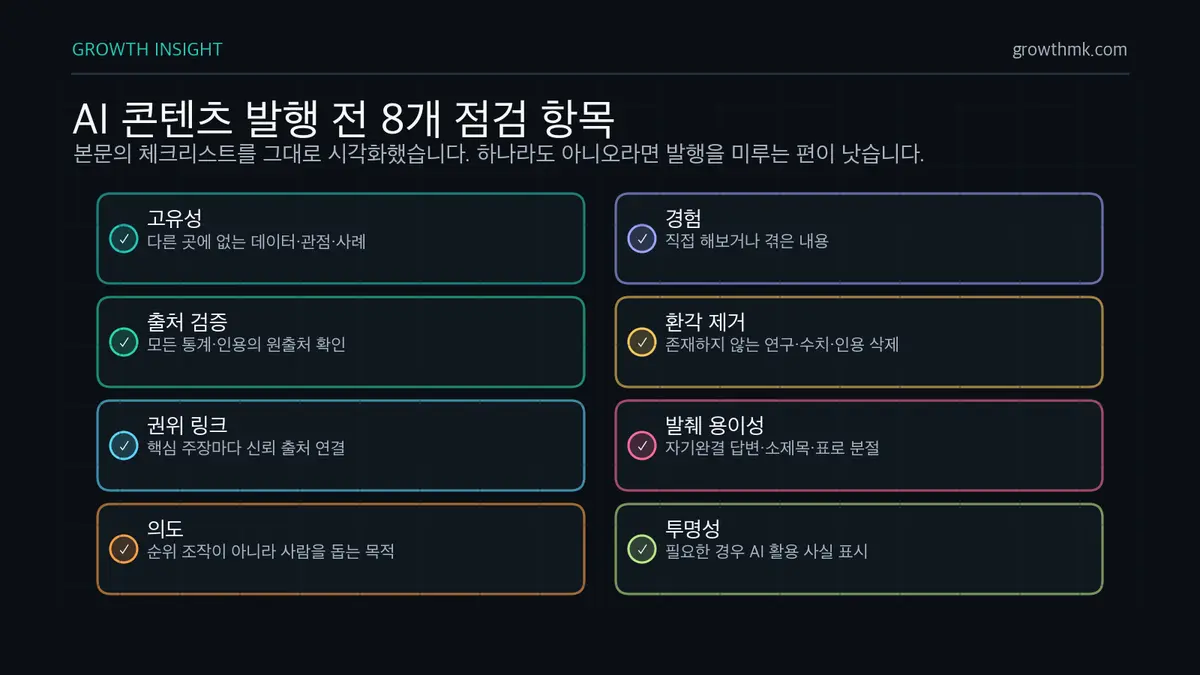
- Uniqueness — Does this piece contain at least one piece of data, perspective, or case study you can’t find anywhere else?
- Experience — Does the body clearly reflect something you actually did or went through yourself?
- Source verification — Have you confirmed the original source of every statistic and citation, and removed anything you couldn’t confirm?
- No hallucination — Are there no studies, figures, or quotes that don’t actually exist?
- Authoritative links — Is every core claim linked to a trustworthy source?
- Ease of extraction — Is the intro a self-contained answer to the question, broken up with subheadings and tables?
- Intent — Is this piece’s primary purpose to help people, not to manipulate rankings?
- Transparency — If you used AI substantially, is that disclosed where appropriate?
This checklist ultimately comes down to two questions: “Did a person fill in the blanks AI couldn’t?” and “Is this content genuinely helpful to someone, rather than mass-produced filler?” If you can answer both confidently, content made with AI has every right to be cited.
What doesn’t change in the age of AI
Generative AI changed the speed of content production, but it hasn’t changed the principle behind what gets selected. Both search engines and generative engines ultimately cite content that’s unique, trustworthy, and genuinely helpful to people. AI is just a tool for making that content faster — it doesn’t manufacture uniqueness or trust on your behalf.
That’s why Growth uses AI enthusiastically, while never skipping the stages only a human can fill — injecting experience and verifying sources. Just as a senior marketer polishes a junior colleague’s draft into a finished piece, it’s only when a human marketer adds first-party data and verified sources on top of an AI draft that content becomes something “made with AI, but cited by AI.” That’s exactly where content that reaches the one customer who will become revenue — not just traffic volume — gets made.
One last point worth emphasizing: content competition in the AI era isn’t a fight over “more, faster.” Now that everyone can mass-produce quickly, the value of sheer volume and speed converges toward zero fast. What’s left is scarcity — specifically, how much of your own unique data and experience you’ve turned into a citable form. As a paradoxical result of AI lowering the barrier to producing content, the value of genuine human experience and verification has actually gone up. Companies that treat this shift as an opportunity will be the brands that keep getting cited, not just in search, but in the age of generative engines too.
Growth offers GEO/AIEO (generative engine optimization) services that design your content to be cited not just by search engines, but by generative engines like ChatGPT and Perplexity. We work through the entire process with you — adding first-party data and verified sources to an AI draft to turn it into genuinely citable content. Explore our GEO/AIEO service or get in touch to have your own content’s citability diagnosed.
Frequently asked questions (FAQ)
Does Google penalize content written with AI?
No. Google evaluates content by quality and usefulness, not by how it was produced, and doesn’t ban AI use in itself. That said, mass-producing worthless pages with the primary purpose of manipulating search rankings counts as “scaled content abuse” and violates the spam policies. In short, content that’s genuinely helpful and unique gets evaluated normally, even if it was made with AI.
What does AI-made content need to get cited in ChatGPT or Perplexity answers?
It needs first-party data, a unique perspective, verified sources, and real experience. According to the KDD 2024 GEO research, simply adding credible source citations, statistics, and quotations improved generative engine visibility by up to 40%. The catch is that these are exactly the elements AI can’t produce on its own — which is why a human-led stage of injecting experience and data is essential.
What’s the biggest weakness of AI content?
There are three. First, sameness — everyone using the same model produces similar content, erasing uniqueness. Second, hallucination — generating nonexistent statistics and sources as if they were fact, which destroys trust. Third, the absence of experience — AI structurally can’t fill in Experience, the first element of E-E-A-T. A person has to fill these gaps before the content becomes citable.
What’s the practical process for turning an AI draft into citable content?
We recommend four stages: (1) quickly produce a draft and structure with AI, (2) have a person inject your own data, real cases, and a unique perspective, (3) verify the original source of every statistic and citation to remove hallucinations, then link to authoritative sources, and (4) structure it for easy extraction with an answer-first intro, tables, and FAQs. The key is the division of labor: AI handles stages 1 and 4, while a person handles the essential stages 2 and 3.