
What Is E-E-A-T? Common Myths About Google’s Quality Guidelines, Debunked
 임재복
임재복
Recent Google algorithm updates have made content quality evaluation stricter than ever, and E-E-A-T has emerged as the core standard for judging that quality. Yet E-E-A-T still feels like a mysterious, half-understood concept to a lot of marketers. Is E-E-A-T really a ranking factor? Is AI-written content really low quality?
E-E-A-T: The Secret Behind Content Google Loves
E-E-A-T stands for Expertise, Authoritativeness, Trustworthiness, and Experience — a quality standard Google built painstakingly to give users the best possible search experience. E-E-A-T carries real weight in how highly a page ranks on the search engine results page (SERP), and Google uses this framework to scrutinize the value of every piece of content.
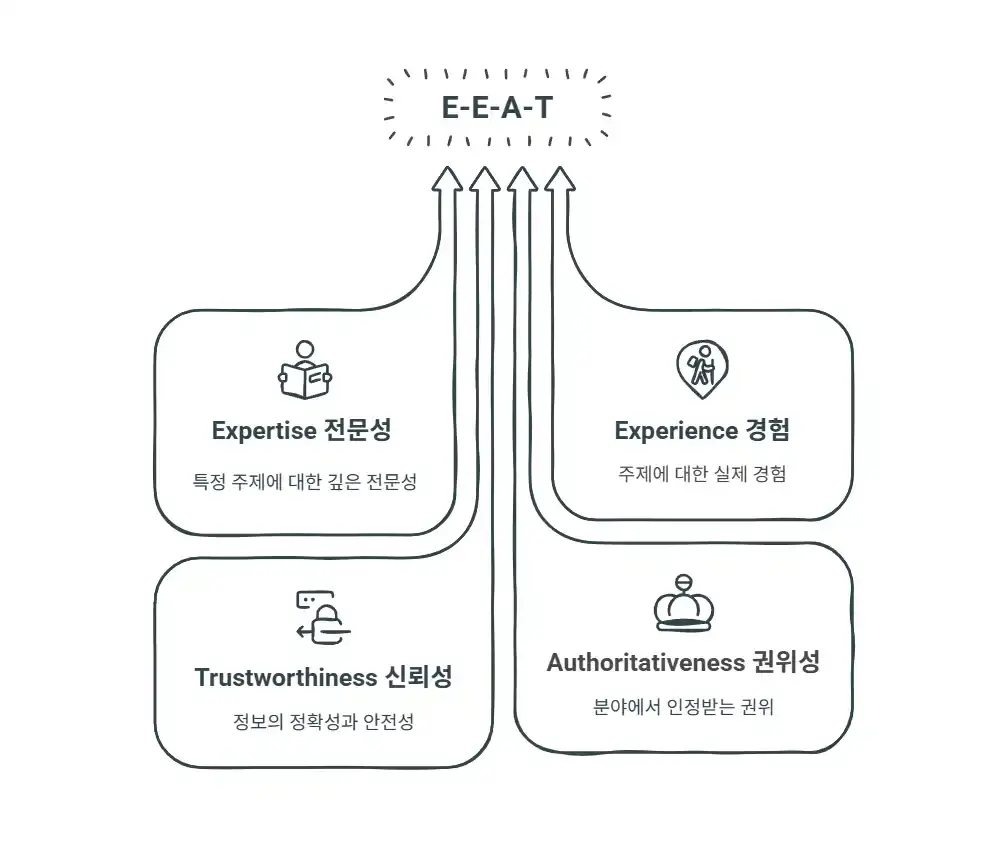
- Expertise: Whether the content was written by someone with deep, genuine knowledge of the subject. Medical content should come from a doctor, financial content from a financial professional — that’s what earns trust. Expertise is the core driver of content value.
- Experience: Whether the creator has actually lived the topic they’re writing about, and whether the information comes from firsthand experience. Google added “Experience” to the original E-A-T framework when it revised its Search Quality Rater Guidelines in December 2022. Product reviews, travel accounts, and step-by-step problem-solving all let creators hand readers more vivid, more useful information.
- Authoritativeness: Whether the content comes from a source the industry actually recognizes — an authoritative website or a respected creator. A researcher published in a leading journal, an industry-recognized leader, or an expert cited widely by others all carry high authority.
- Trustworthiness: Whether the site and its content are accurate, safe, and reliable. HTTPS security, clearly stated sources, a privacy policy, and positive user reviews all build trust. Trustworthiness is the foundation E-E-A-T is built on. Google’s own Search Central documentation states it plainly: “Trust is the most important member of the E-E-A-T family because the untrustworthy pages have low E-A-T no matter how Expert or Authoritative they may seem.”
Myths and Truths About E-E-A-T
Let’s walk through the most common misconceptions about E-E-A-T and set the record straight.
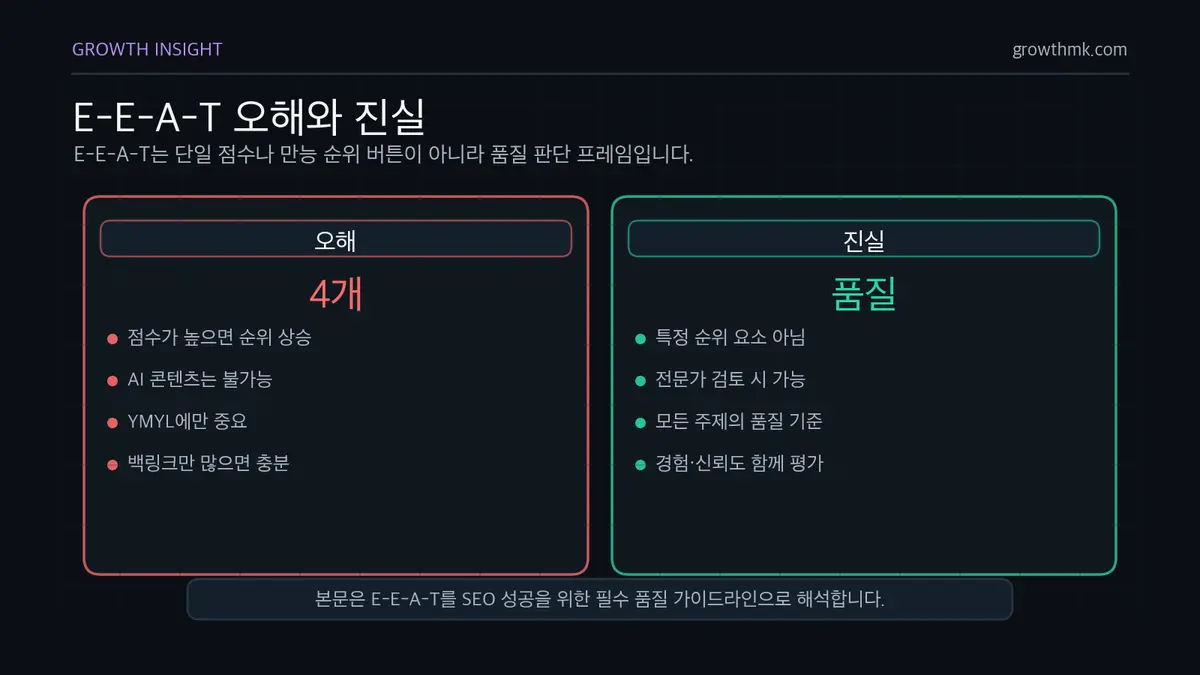
Myth 1: E-E-A-T Is a Ranking Factor
❌ Myth: “A high E-E-A-T score automatically boosts your search ranking.”
✅ Truth: E-E-A-T is an important standard Google uses to evaluate content quality, but it is not a direct ranking factor. Google stated back in 2019 that E-E-A-T is not a ranking factor, and its current Search Central documentation says the same thing today: “E-E-A-T itself isn’t a specific ranking factor, but using a combination of factors that can identify content with good E-E-A-T is useful.”
That said, E-E-A-T is closely tied to the signals ranking systems are actually trying to detect. Content with strong E-E-A-T gives users information they find useful and trustworthy, which raises satisfaction and, in turn, benefits SEO performance. So rather than treating E-E-A-T as a direct ranking lever, it’s more accurate to see it as an essential quality guideline for SEO success.
Myth 2: AI Content Can’t Satisfy E-E-A-T
❌ Myth: “AI-written content lacks expertise, authority, and trust, so it can never satisfy E-E-A-T.”
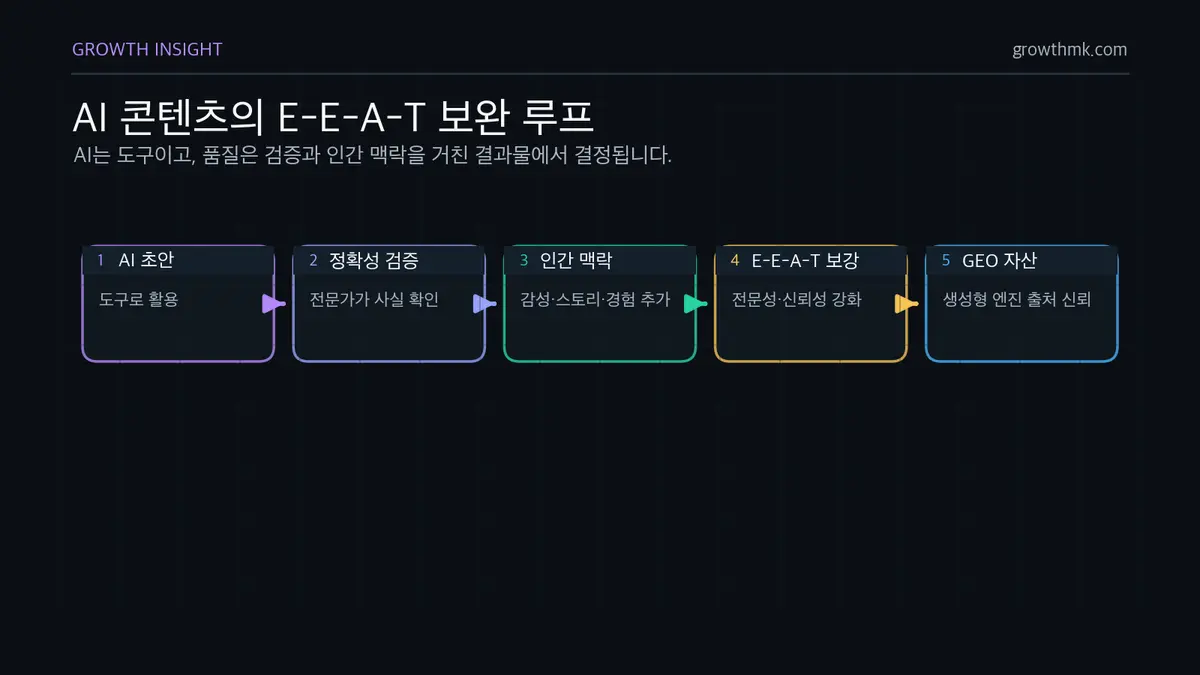
✅ Truth: AI content is improving fast, and it’s now capable of producing genuinely expert-level work. An AI-written piece’s E-E-A-T score depends entirely on the quality of the content itself. AI is just a tool — used well, grounded in real expert knowledge and experience, it can produce content with strong E-E-A-T. What matters is how it’s used.
Of course, AI content isn’t perfect across every field. Fields that demand creativity, emotional nuance, and critical judgment still need a human hand. Meanwhile, which sources generative engines like ChatGPT and Perplexity choose to cite as trustworthy has become a new visibility variable — and the expertise and trust that E-E-A-T verifies remain a core asset even in a GEO (generative engine optimization) world.
Keep these points in mind when using AI content:
- Verify accuracy: AI-generated content must always be reviewed by a subject-matter expert to confirm the information is correct.
- Add a human layer: Give AI content emotional texture, humor, and storytelling to keep readers engaged.
Myth 3: E-E-A-T Only Matters for YMYL (Your Money or Your Life)
❌ Myth: “E-E-A-T matters a lot for YMYL topics, but not much for anything else.”
✅ Truth: E-E-A-T is especially important for YMYL content, but it’s a universal quality standard that applies to every topic. Giving users useful, trustworthy information is the goal of all content, and E-E-A-T is central to reaching that goal — no matter the subject.
Myth 4: With Enough Backlinks, E-E-A-T Doesn’t Matter
❌ Myth: “Enough backlinks will push you up the rankings even with weak E-E-A-T.”
✅ Truth: Backlinks can help build authority, but they don’t satisfy every dimension of E-E-A-T on their own. The content’s own expertise, trustworthiness, experience, and user experience are all weighed together.
SEO Strategies That Strengthen E-E-A-T
SEO marketers can lift a site’s and its content’s E-E-A-T through concrete, practical strategies. Here are the core moves for improving each pillar.
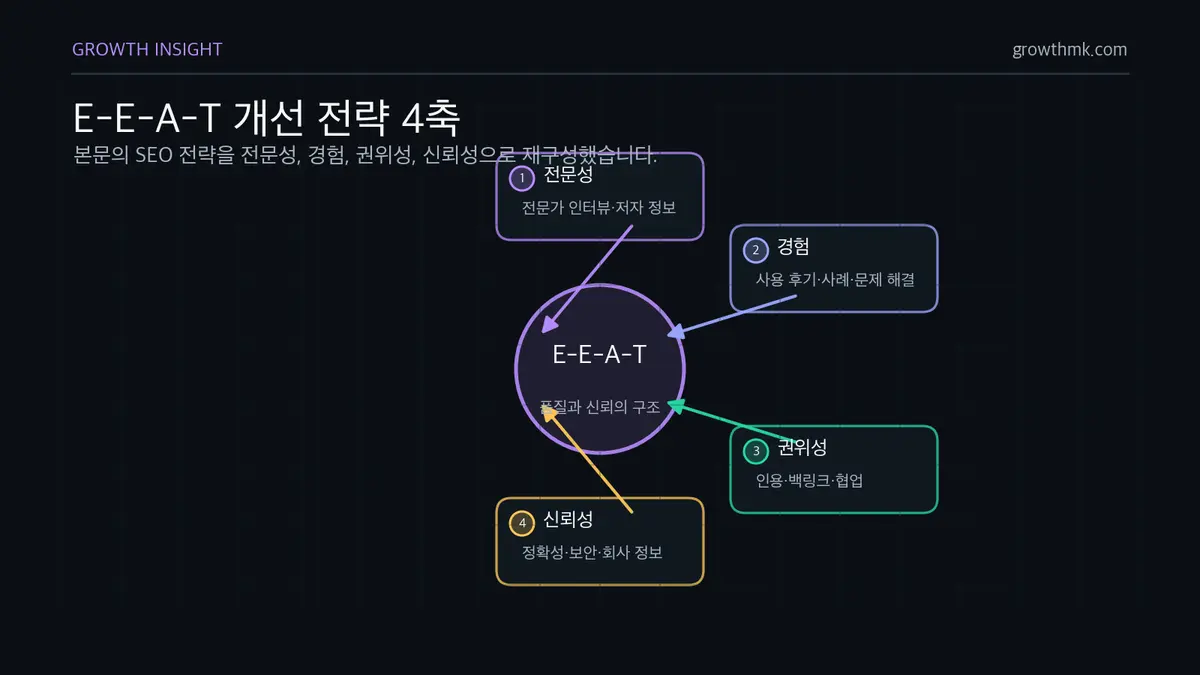
Strengthen Expertise
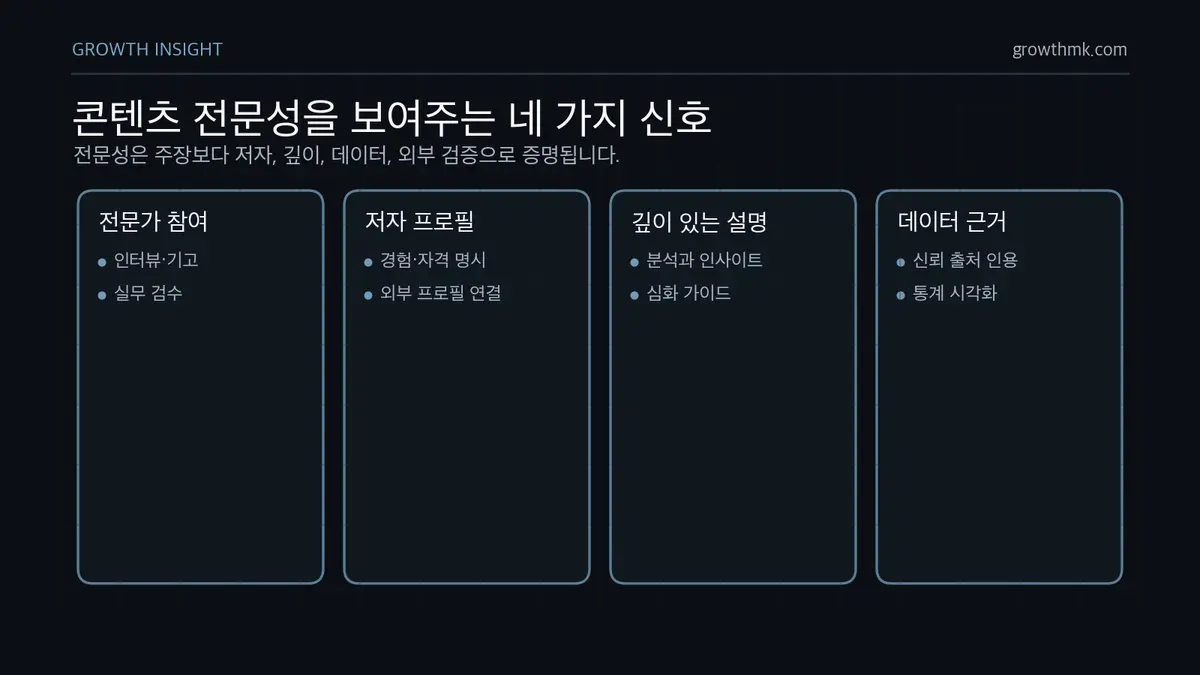
- Bring in experts: Interview or commission contributions from subject-matter experts to establish real expertise.
- Make author profiles clear: State author information clearly, including their experience, credentials, and area of expertise. Link out to the author’s social profiles or personal site to reinforce it further.
- Go deep: Cover a topic comprehensively rather than skimming the surface. Move past a list of facts to include analysis and insight, and build out multi-page guides when a topic warrants full coverage.
- Use data and statistics: Cite credible data sources and present statistics visually to raise the content’s objectivity and credibility.
Reflect Real Experience
- Build content on real experience: Ground content in actual experience — usage reviews, case studies, problem-solving walkthroughs — rather than a list of theory.
- Share expert experience: Fold in interviews or consulting insight from subject-matter experts to capture expertise and experience at the same time.
- Describe it vividly: Move past dry information delivery and use vivid description and storytelling techniques to build reader engagement and empathy.
Build Authority
- Outbound link strategy: Link to related information from trustworthy sources. Provide links to the original source of any research or statistics you cite to raise credibility, and encourage other experts or authoritative sites to cite your content in turn.
- Earn citations and backlinks: Cite authoritative outside sources, and work to get your own content cited by other authoritative sites. This sends Google a signal that the content is valuable and trustworthy.
- Guest posting and collaboration: Collaborate with other experts in the industry or guest post on authoritative platforms to gain recognized expertise and reach a wider readership.
- Use social proof: Publish customer reviews and testimonials on your site, and prominently display awards, certifications, and press coverage to raise authority.
Build Trust
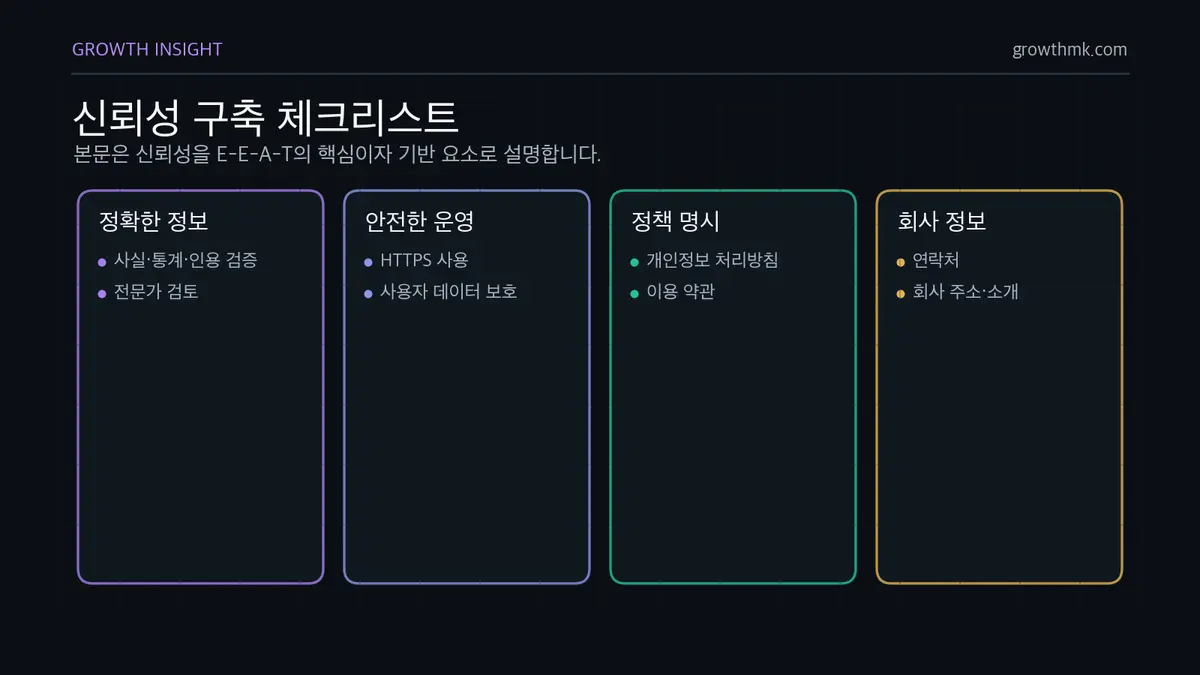
- Provide accurate information: Rigorously verify every fact, statistic, and quote so only accurate information goes out. Inaccurate information can badly damage trust, so get expert review when needed.
- Run a secure site: Use HTTPS and protect user data. State and follow a clear privacy policy to give users a safe environment.
- State your privacy policy and terms of use: Provide clear privacy policy and terms of use pages to establish transparency.
- State contact and company information: Display contact details and company address in the footer or on an “About” page to raise user trust.
Conclusion: E-E-A-T Is an Ongoing Journey Toward SEO Success
E-E-A-T is not just a technical lever for boosting SEO rankings. Behind it sits Google’s genuine philosophy: give users information that’s truly useful and trustworthy. In fact, as the 2025 SEO trends confirm, E-E-A-T’s importance keeps growing. SEO marketers should treat E-E-A-T as a core quality guideline for SEO success and keep working at it steadily, with a long-term view.
A lot of people mistake E-E-A-T for a ranking factor, when the real goal underneath it is raising user satisfaction. Use the strategies above to build content — and run a site — grounded in expertise, experience, authority, and trust.
Investing in content quality ultimately raises user satisfaction, and that drives real outcomes: more traffic, stronger brand recognition, higher revenue. Let E-E-A-T be your compass through the choppy waters of SEO, and here’s to a successful voyage.
Related Reading
- The Complete A-to-Z Guide to SEO Marketing
- How to Write Titles and Links That Raise Search Rankings (+ Prompts)
- SEO Marketing Case Studies — Content Strategy Built on Keyword Analysis
- Video Search Optimization: Using YouTube Titles, Descriptions, and Tags
- Why Image Search Optimization Matters, and How to Do It
Want to apply this to your own business? Take a look at how Growth approaches it in our SEO service, or if you need a diagnosis of your specific situation, reach out through our contact page. We answer in terms of the one lead who becomes revenue — not raw traffic volume.
Frequently Asked Questions
Is E-E-A-T a direct Google ranking factor?
No. Google has officially stated that E-E-A-T itself is not a specific ranking factor. That said, Google’s ranking systems do use a combination of signals that help identify content with strong E-E-A-T. So it’s more accurate to understand E-E-A-T as a quality guideline for SEO success rather than a direct score.
Which of the four E-E-A-T pillars matters most?
Trustworthiness. Google’s Search Central documentation explains that expertise, authoritativeness, and experience all feed into trust, and that trust is the most important of the four. Even if content doesn’t fully embody all four pillars, whether it can be trusted is the key test.
Can AI-written content satisfy E-E-A-T?
Yes. Google doesn’t treat the use of AI in content production as a guideline violation — it evaluates high-quality, genuinely useful content regardless of how it was produced. What matters is using AI as a tool grounded in expert knowledge and experience, and rigorously verifying the accuracy of whatever it generates.
Does E-E-A-T only matter for YMYL topics?
No. E-E-A-T is applied especially strictly in YMYL (Your Money or Your Life) areas like health and finance, which carry outsized impact on users’ lives — but it’s a universal quality standard that applies to every topic. Providing useful, trustworthy information is the goal of all content, regardless of field.