SEO Designed Around the Customer Journey — Start From People, Not Keywords
 임재복
임재복
SEO designed around the customer journey means starting from the stages a customer passes through on the way to a purchase decision (the Customer Decision Journey, or CDJ) instead of starting from a keyword list. On the exact same topic, someone who has just noticed a problem and someone comparing vendors use completely different search terms and want completely different kinds of answers. That’s why the key is mapping search intent to each stage of the journey, then attaching the right content and conversion design (CTA intensity) to that stage. The bottom line: instead of chasing high-volume keywords, decide first who you’re answering — what stage they’re at, right now — and while your traffic volume may drop, your accuracy in reaching the one person who becomes revenue goes up.
This article isn’t about ranking keywords by search volume. Growth, the marketing agency, treats SEO not as a technical exercise but as the work of understanding your customer. Google itself places the starting point of search rankings on people, not on the search engine. Google’s own documentation defines good content as content “created primarily for people,” not to manipulate search rankings, and explicitly tells you to avoid content created “search engine-first.” Below, we’ll walk through, in order, why a keyword-first approach hits its limits, how to map search intent to the four stages of the customer journey, and how to layer keyword research, content design, and measurement on top of that.
Why Does SEO That Starts From Keywords Hit Its Limits?
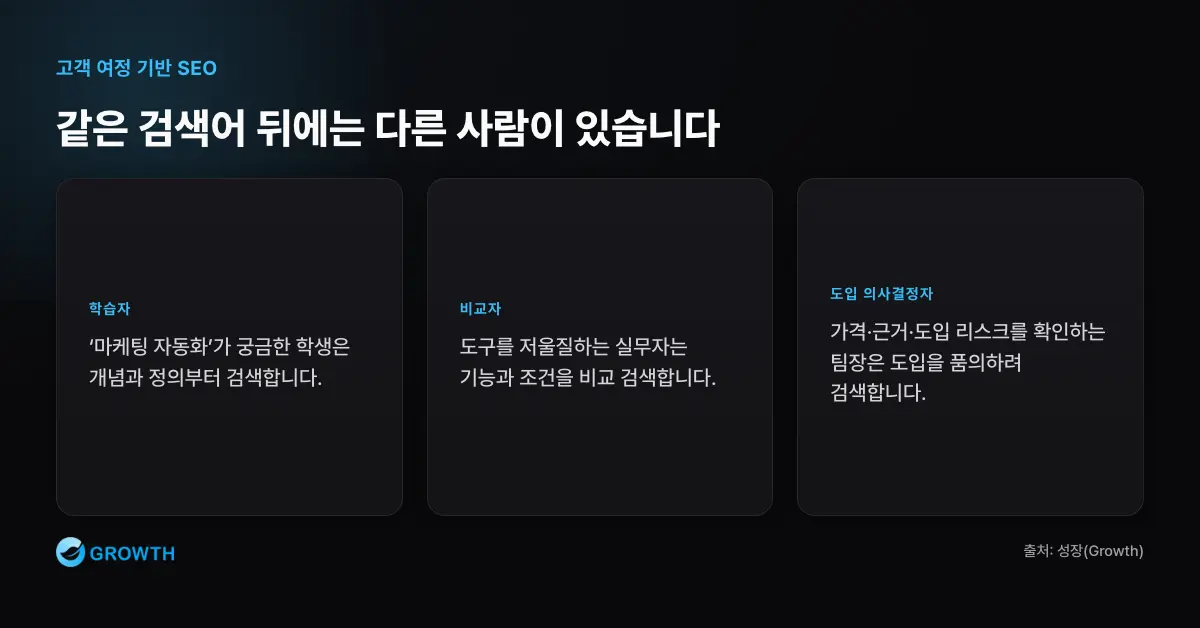
Most SEO starts with opening a keyword tool. You pull high-volume terms, check competition levels, and place those keywords into your copy. This approach works, up to a point. But it rests on one critical assumption: that a search term equals what the customer actually needs. In reality, completely different people stand behind the same search term. Someone who searches “marketing automation” might be a student curious about the concept, a practitioner comparing tools, or a team lead about to push it through for approval. Looking only at the keyword makes these three look like one group, but if you hand them the same content, you’ll satisfy none of them.
The second trap of a keyword-first approach is getting locked into “brand language.” Many companies build content centered on their own product names, industry jargon, and internal-only phrasing. Customers, meanwhile, simply don’t know those words. Even Google warns about this gap. Google’s SEO Starter Guide notes that “a user who is well versed in a topic might use different search terms” than a first-time user, and recommends anticipating that difference and writing with the reader in mind. In other words, search inherently happens in “the user’s language” — and looking only at the numbers in a keyword tool makes it easy to lose sight of whose language it is, and at what stage.
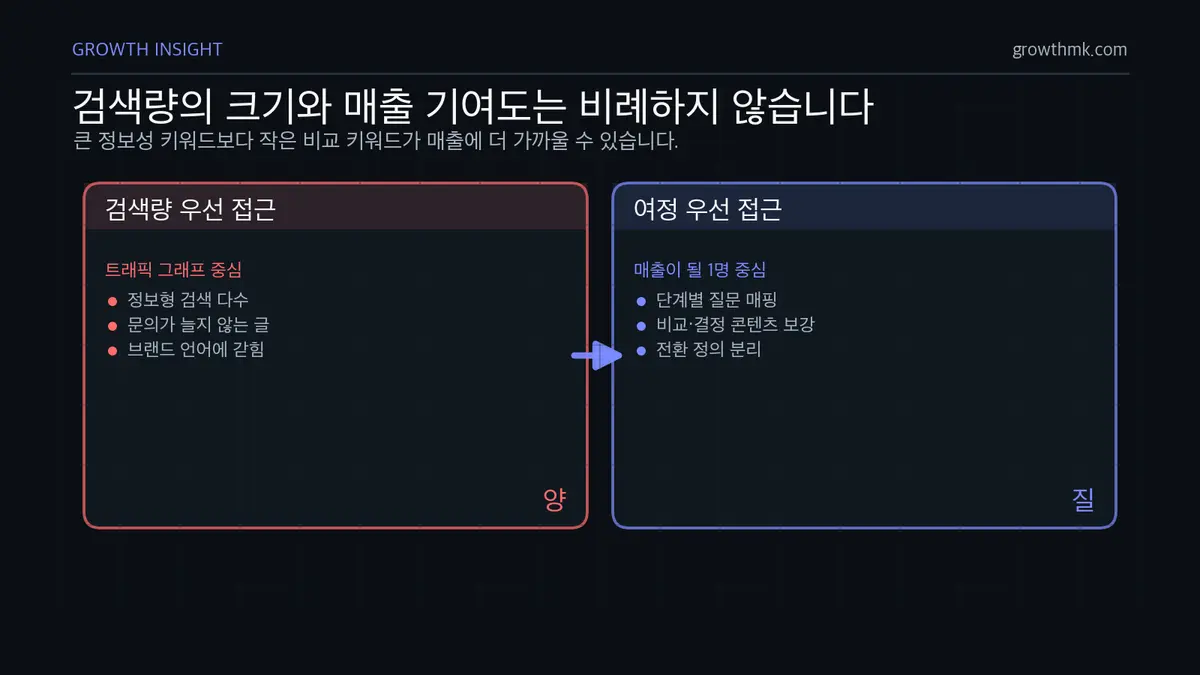
The third limitation is the most important. A keyword-first approach breeds the illusion that “a high-volume keyword equals a good keyword.” But most search volume comes from informational search — people trying to learn something (analyses generally agree informational search makes up the majority of all search). Informational traffic is high in volume but far from a purchase. If you fill your content calendar starting with top keywords by volume alone, you end up in the classic trap: the traffic graph climbs, but inquiries don’t. This is exactly why Growth talks about “the one person who becomes revenue” rather than the volume of traffic. A keyword only gains meaning once it’s placed on the map of the customer journey — it’s never the starting point. The mechanism by which ad metrics (ROI/ROAS) fall into a similar trap is covered in the ROI/ROAS trap, and traffic metrics can create the same kind of optical illusion.
Let’s walk through a simple example. Say a B2B SaaS company targets the high-volume keyword “marketing automation” and writes a conceptual explainer. The piece ranks well and pulls in visitors. But most people searching that term are learners curious about the concept — they read the piece, feel satisfied, and leave. The small number of buyers actually at the decision stage, ready to adopt a tool, are instead searching things like “marketing automation tool comparison” or “[product] pricing” — and because there’s no content filling that gap, they end up at a competitor. The end result: the piece of content that wins the most traffic contributes almost nothing to revenue. Keyword size and revenue contribution are not proportional. What’s missing doesn’t show up if you only look at keywords — it only becomes visible once you place the keyword on the coordinate system of the customer journey.
What Is the Customer Decision Journey (CDJ), and Why Is It the Starting Point for SEO?
The Customer Decision Journey (CDJ) is a framework describing the stages and behaviors a customer moves through before choosing a product or service. People don’t buy the moment they feel a need. They recognize a problem, explore solutions, compare candidates, and finally decide. At every stage of this journey, the question in someone’s head is different, and that question is what surfaces as a search term. Search is a byproduct of the journey. That’s why understanding search requires understanding the journey first. Growth’s own guide to the Customer Decision Journey (CDJ) covers the concept and its stages in depth, so this article will focus on how to apply it to SEO.
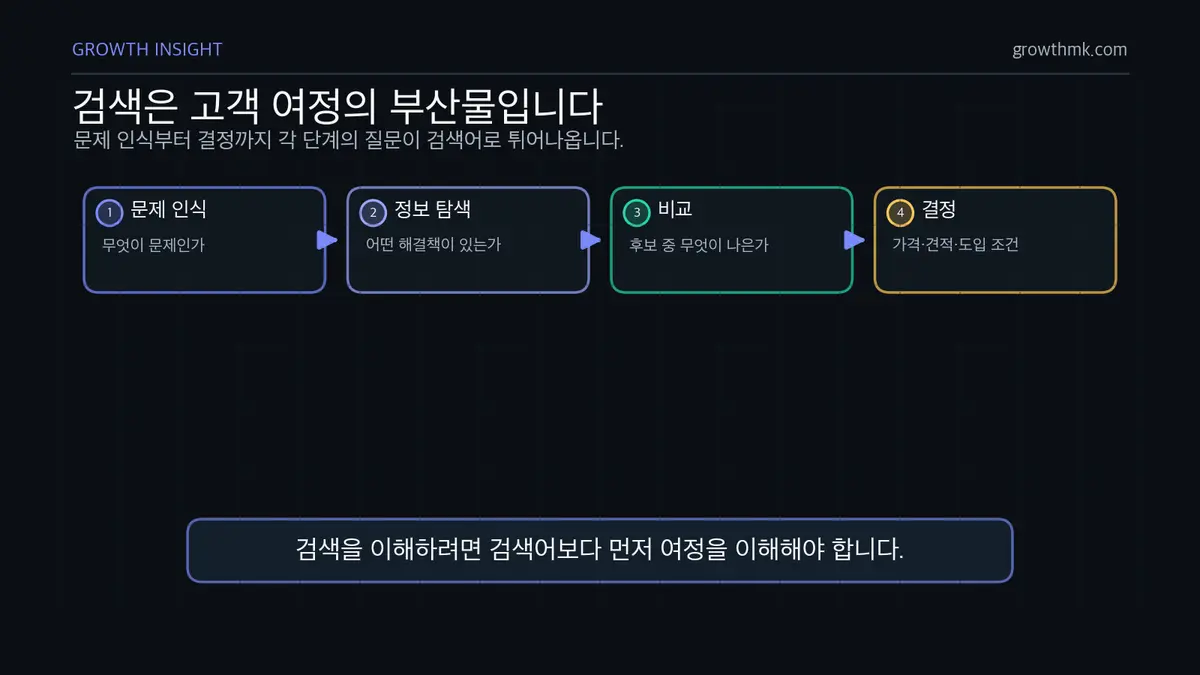
This perspective matters especially in B2B. A B2B purchase isn’t something one person wraps up on impulse — it’s a long journey that multiple people review over several months. Gartner research found that during a B2B purchase review, buyers spend only about 17% of their total time meeting directly with potential suppliers. Most of the rest is spent researching and comparing on their own. In other words, customers are already deep into their journey through search, long before sales ever gets involved. Placing the right answer at every point along that journey — that’s the essence of SEO designed around the customer journey.
One misconception worth addressing here. Drawing the journey as “awareness → research → comparison → decision” makes it look linear, but real customers rarely pass through these stages cleanly, in a single pass. They might jump back from comparison to gather more information, or after a purchase, enter a “loyalty loop” that leads to repurchase and referral. So it’s better to think of these stages not as a sequence but as states — states that describe “what question is in this customer’s head right now.” What matters from an SEO perspective is that the same person searches at different stages at different points in time. Which means content shouldn’t target just one stage — it needs to be laid out densely enough to seamlessly catch customers as they move back and forth between stages.
This is where the concept of search intent connects with the journey. Search intent is commonly split into informational, navigational, commercial, and transactional — and this classification maps almost one-to-one onto the stages of the journey. Search Engine Land argues you shouldn’t stop at this simple four-way split, explaining that “a complete and nuanced understanding helps you nurture users along their journey or funnel”. Someone looking for a movie review and someone looking for showtimes are both informational, but they’re at different stages of the journey. The moment you place intent on top of the journey, the starting question for SEO shifts — from “which keyword should I use” to “who, at which stage, should I answer with what.”
Mapping Search Intent by Journey Stage — From Problem Awareness to Decision
The most practical way to apply the customer journey to SEO is to map out, stage by stage, “what searches happen here, and what content answers them” in a table. Below is a mapping table that lays out the 4 journey stages against search patterns, search intent, content type, and CTA intensity. The key column is the last one: CTA intensity. The closer a stage sits to revenue, the higher the conversion pressure should be; the farther away, the lower.
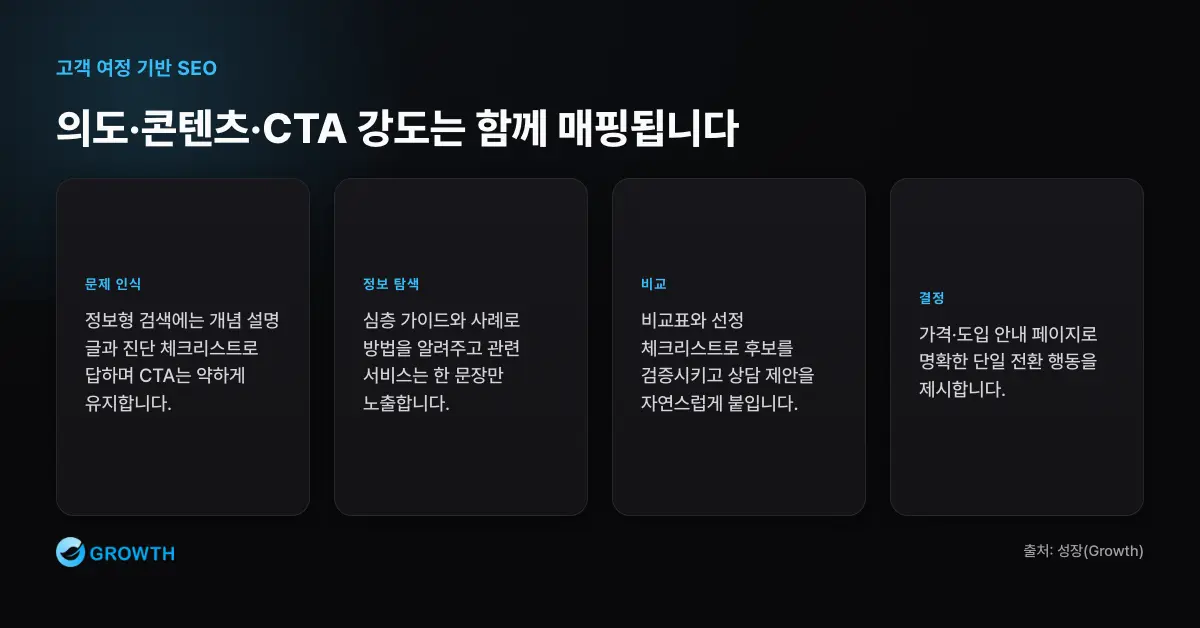
| Journey Stage | Search Pattern (Examples) | Dominant Search Intent | Suitable Content Type | CTA Intensity |
|---|---|---|---|---|
| ① Problem Awareness | “Not getting more leads,” “marketing isn’t performing,” “what is [X]” | Informational — understanding symptoms/concepts | Conceptual explainers, diagnostic checklists, glossaries | Weak — drive subscriptions/related reads (no sales pitch) |
| ② Research | “How to increase B2B leads,” “content marketing strategy,” “how to do [X]” | Informational + commercial — exploring solutions | In-depth guides, how-tos, case analyses, methodology comparisons | Medium — offer resources/newsletter, one line about your related service |
| ③ Comparison | “[X] vs [Y],” “comparing [Z] agencies,” “criteria for choosing [X] vendor” | Commercial — vetting candidates | Comparison tables, selection checklists, case studies, FAQs | Strong — naturally offer a consultation or quote |
| ④ Decision | “[X] quote,” “[Y] pricing,” “inquiry about [X],” brand name searches | Transactional — taking action | Service pages, pricing/onboarding info, implementation process | Strongest — one clear, singular conversion action |
Let’s apply this table to the real context of a B2B marketing agency. A buyer at the ① Problem Awareness stage searches a vague symptom, like “doing marketing but leads aren’t growing.” Shout “book a consultation now” at this person, and they’ll bounce immediately. What they need is diagnostic content that pinpoints why it’s not growing. Move to the ② Research stage, and they start looking for solutions, searching things like “B2B lead generation methods.” Here, it’s appropriate to thoroughly walk through the method while lightly mentioning a related service in maybe one sentence at the end. At the ③ Comparison stage, verification-style searches appear — “criteria for choosing an SEO agency,” “guarantee-based contracts.” Here, comparison tables and checklists help them decide, and it’s fine to naturally layer in a consultation offer. Finally, at the ④ Decision stage, a search like “B2B marketing agency quote” calls for a clear conversion path, offered without hesitation.
The reason this mapping matters is simple: even for the same keyword, the right content differs depending on the stage. Google treats whether content matches intent as a core ranking signal. One SEO analysis puts it bluntly: “if your page doesn’t satisfy Search Intent, it’s not going to rank.” Serve a conceptual explainer to a comparison-stage search, or a price sheet to a problem-awareness-stage search, and the intent mismatch costs you both ranking and conversion. A mapping table is the blueprint that prevents that mismatch before it happens.
Journey-Based Keyword Research — Sort by Stage, Not Search Volume
Once your journey mapping is done, the order of your keyword research flips. Instead of gathering keywords by search volume and then trying to fit them into stages afterward, you set journey stages as your vertical axis first, and then find keywords to fill each cell. Growth’s own guide to keyword research strategy walks through specific discovery techniques step by step — seed keyword expansion, using autocomplete and related searches, competitive analysis — so this article focuses on how to classify the results from a journey perspective.
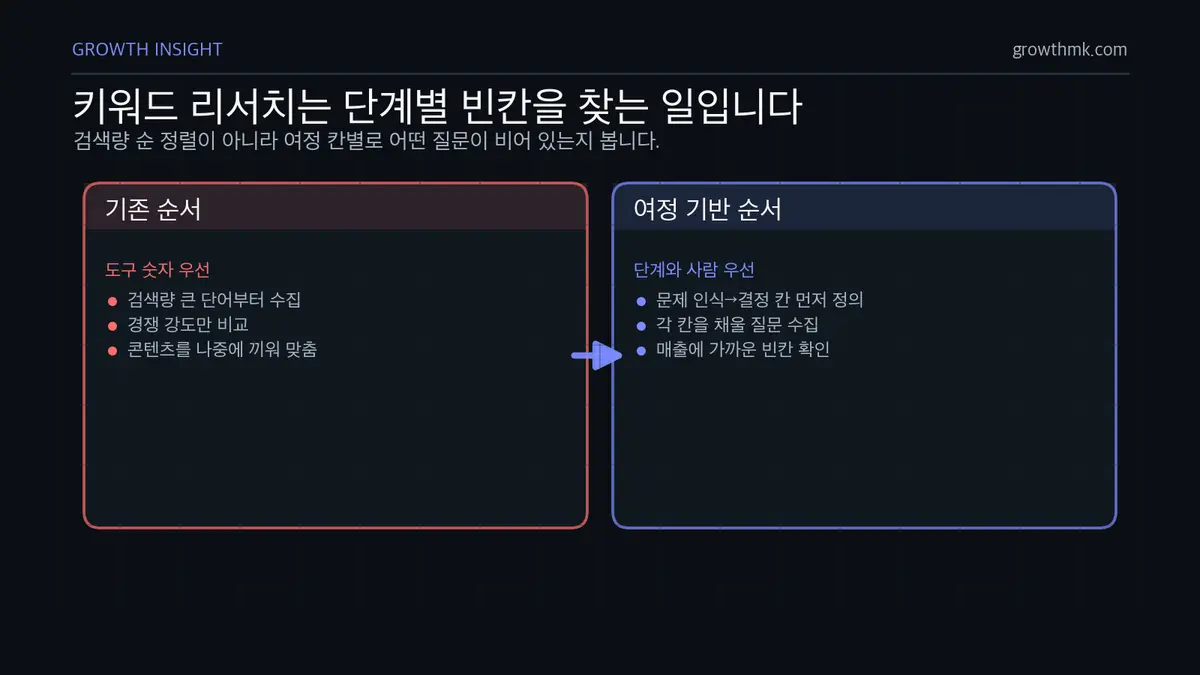
Here’s the practical process:
- Collect seed keywords in the customer’s own language — Pull real phrasing customers actually use from sales call notes, customer inquiry emails, reviews, and community questions. Symptom language (“leads aren’t coming in”) — not brand terminology — is the gold mine for stage ①.
- Tag each keyword with a stage — Label every keyword you collect with which of stages ①–④ it belongs to. “What is [X]” is ①, “how to do [X]” is ②, “[X] comparison/selection criteria” is ③, “[X] quote/pricing” is ④.
- Break down keywords with mixed intent — For keywords like “marketing automation,” where multiple stages overlap, look at what’s actually showing up on the search results page (SERP) to judge the dominant intent. The SERP is Google’s own interpretation of intent, made visible.
- Check the balance across stages — Count how many keywords fall into each stage. Most companies find their content clustered around informational stages ① and ②, with comparison/decision content at ③ and ④ nearly empty. That means the cells closest to revenue are the ones sitting empty.
- Sharpen precision with long-tail keywords — Just as “headache medicine safe for pregnant women” converts better than “headache medicine” despite less competition, the deeper the stage, the more specific long-tail keywords reach the one person who becomes revenue more precisely.
The output of this process isn’t a “list of keywords” — it’s a “journey stage × keyword × content type” matrix. That matrix becomes the skeleton of your content calendar. Applying it to the B2B SaaS example above looks like this:
| Stage | Representative Keywords for This Stage | Content to Fill It |
|---|---|---|
| ① Problem Awareness | “too much manual marketing work,” “automate repetitive tasks” | Symptom diagnosis pieces, a checklist of signs you need automation |
| ② Research | “what is marketing automation,” “how to adopt marketing automation” | Concept/adoption-stage guides, use cases |
| ③ Comparison | “marketing automation tool comparison,” “[X] vs [Y]” | Tool comparison tables, selection-criteria checklists |
| ④ Decision | “[X] pricing,” “[X] adoption inquiry/quote” | Pricing/onboarding pages, implementation process |
Laying it out this way makes it immediately obvious that in the example above, the company had crammed all its content into cell ② and left ①, ③, and ④ empty. Filling the gaps in cells ③ and ④ in particular contributes to short-term revenue the fastest, because that’s where people with clear purchase intent sit — even at lower search volume. Next, you need internal link design that channels the traffic pulled in by informational content toward comparison and decision content, so the journey doesn’t break off midway. You can see how the full picture of SEO (technical, on-page, content, backlinks) fits together in Growth’s A-to-Z SEO guide.
Content Design by Stage — What It Means to Adjust CTA Intensity
In journey-based SEO, content design hinges as much on “how hard you push” as on “what you write.” Growth’s core principle here is unambiguous: never push a consultation on someone who isn’t at the decision stage. Shouting “get a quote now” at someone who just noticed a problem is like handing someone a contract the moment you say hello. That person leaves, and the traffic you worked hard to earn leaves without generating revenue or even trust. This is the starting point of Growth’s philosophy of a “quality lead.” An inquiry generated by forcing the issue tends to become an underqualified lead that sales ends up ignoring (this mechanism is covered in depth in the quality-first guide to B2B lead generation).
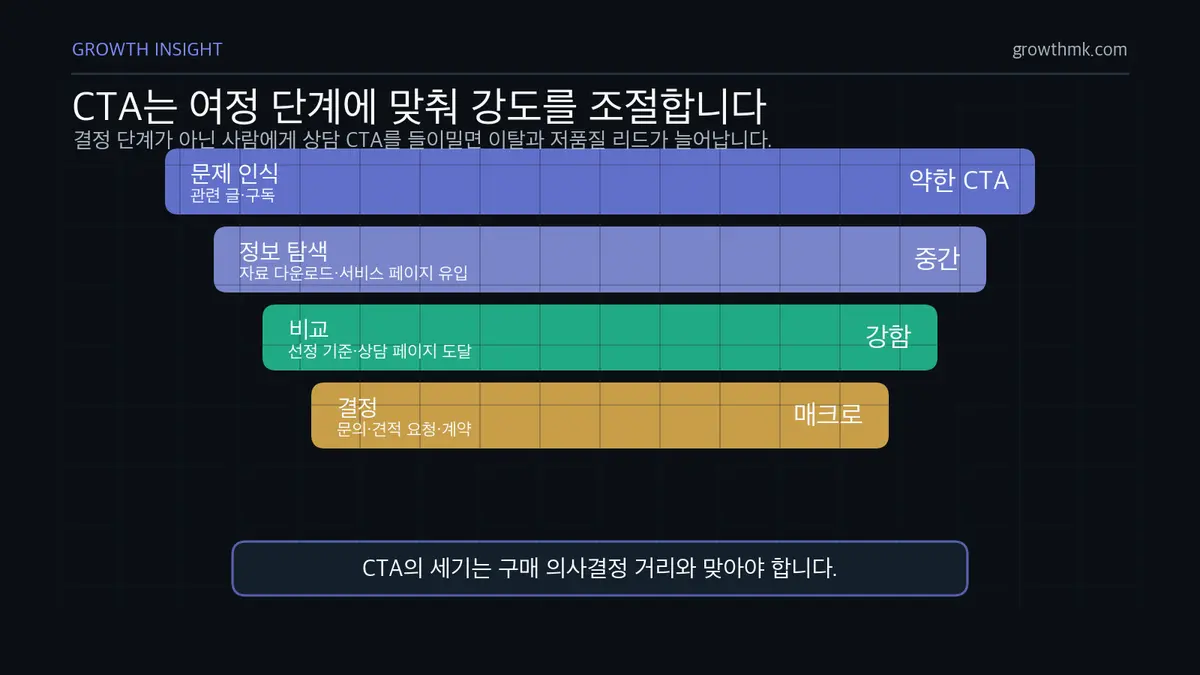
That’s why the type and intensity of every content piece’s CTA (call to action) needs to be designed differently for each stage.
| Stage | What the Customer Is Thinking | Appropriate CTA | CTAs to Avoid |
|---|---|---|---|
| ① Problem Awareness | “What even is this problem?” — doesn’t even know the solutions yet | Read more related articles, subscribe to a newsletter, diagnostic checklist | Consultation/quote/purchase (triggers instant bounce) |
| ② Research | “How do I solve this?” — gathering methods | Offer deeper resources, one sentence introducing a related service | Hard-sell conversions like “sign up now” |
| ③ Comparison | “Which one’s better?” — weighing candidates | Offer a consultation, provide case studies/quotes | Explaining the concept with no next action |
| ④ Decision | “Let’s go with this one” — right before acting | One clear, singular conversion (inquiry/quote/purchase) | Adding more options that create hesitation |
The quality of the content itself also needs to match the stage. Google is explicit that placements like featured snippets can’t be manually assigned: “It’s not possible. Google Systems determine that a page is a good match for a featured snippet and surface it as one.” In other words, since “content that answers a question well” is what the algorithm selects for, content that self-sufficiently answers each stage’s question is ultimately what wins both visibility and conversion. Problem-awareness content should clearly pinpoint the symptom, comparison-stage content should lay out decision criteria in a table, and decision-stage pages should narrow the next action down to just one. The broader principles of customer-centric content design are covered in Growth’s content marketing strategy guide.
One more thing: the basis for trust needs to be placed differently at each stage. Customers at the comparison and decision stages care most about one question: “can I trust this company?” That’s where Google’s E-E-A-T (Experience, Expertise, Authoritativeness, Trustworthiness) signals come into play. Elements like case studies, data, named authors, and cited sources need to appear in lower-funnel content to match intent. You can find common misconceptions about E-E-A-T and how to actually apply it in Growth’s guide to E-E-A-T standards.
Measurement — Defining Conversion Differently at Each Journey Stage
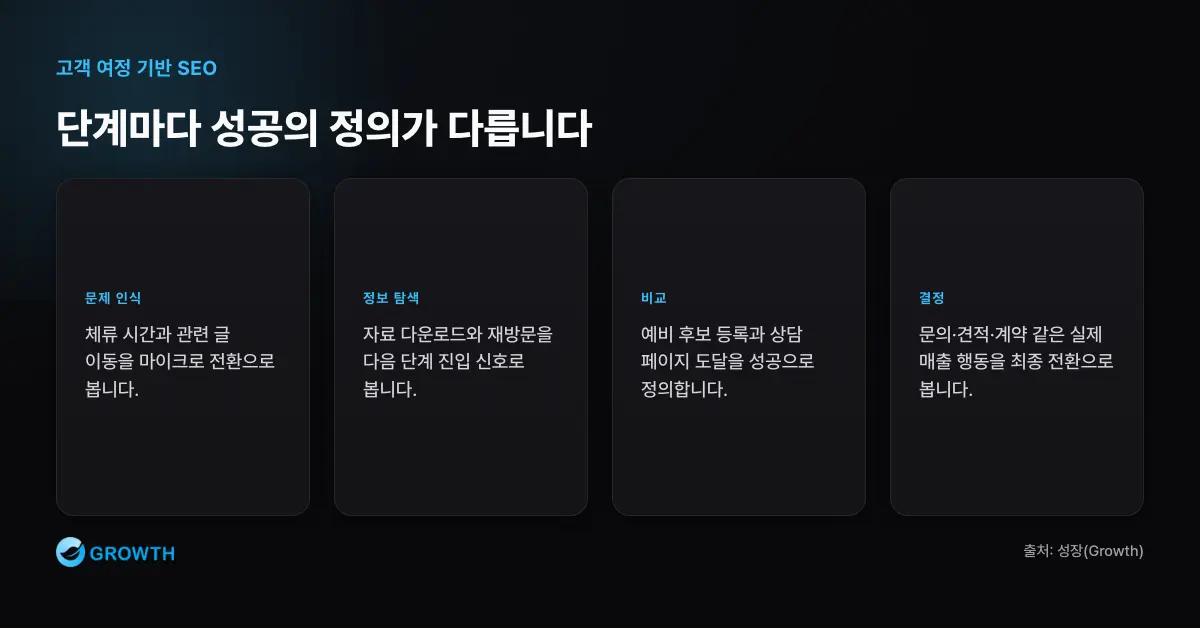
Measuring journey-based SEO can’t stop at a single line for “total traffic” or “average conversion rate.” That’s because success means something different at every stage. Slap a “failed — zero inquiries” label on problem-awareness content, and you’ll end up making the wrong call, one that blocks the entrance to the journey. That stage’s job isn’t generating inquiries — it’s advancing someone to the next stage. That’s why you need to define a separate micro-conversion for each stage.
| Stage | Success at This Stage = Conversion Definition | Representative Metrics |
|---|---|---|
| ① Problem Awareness | Advancing to the next stage (not bouncing) | Time on page, click-through to related content, newsletter subscriptions |
| ② Research | Building a relationship, intent to return | Resource downloads, repeat visits, traffic to service pages |
| ③ Comparison | Registering as a purchase candidate (sales can engage) | Comparison content → reaching the consultation page, viewing the quote page |
| ④ Decision | The action that becomes revenue (macro-conversion) | Inquiry/quote request submitted, signed contract |
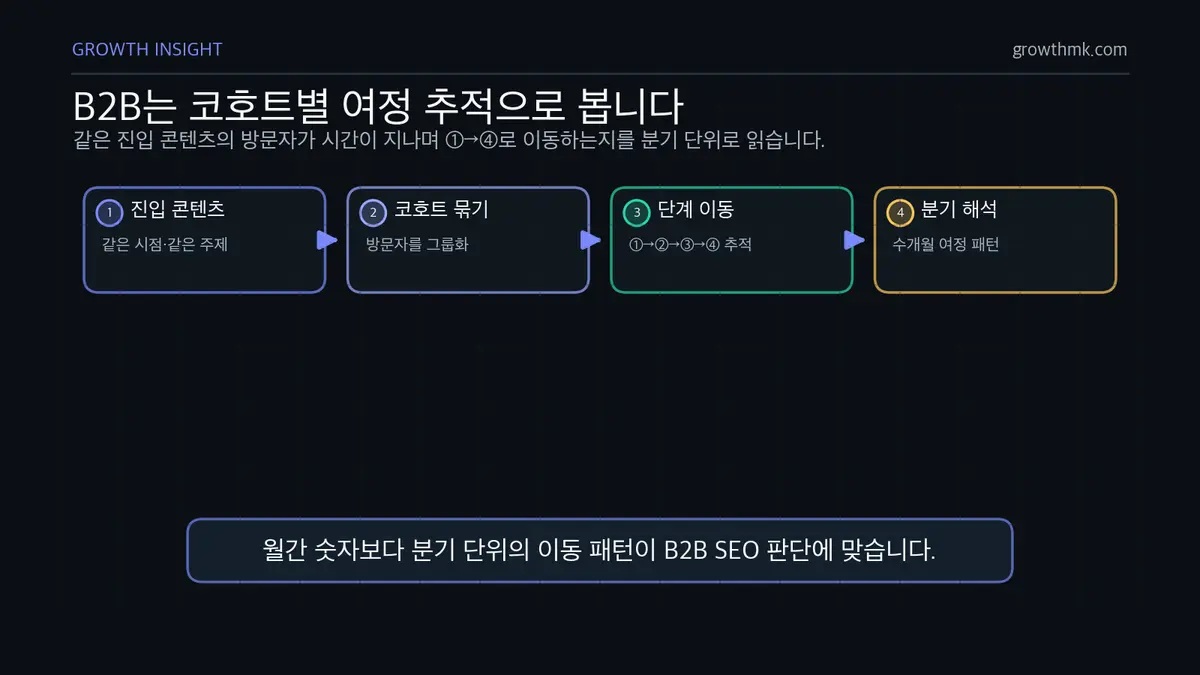
Defining it this way lets you evaluate content by “its role in the journey” instead of by “traffic.” You judge informational content by how well it hands visitors off to the next stage (its progression rate), and decision-stage pages by macro-conversion rate. Beyond that, from a data-science perspective, Growth recommends cohort-based journey tracking: grouping together visitors who entered at the same time through the same entry content, then following how far they move from ① through ② through ③ to ④ over time. Because the B2B journey plays out over months, you shouldn’t obsess over monthly swings — read the pattern on a quarterly basis instead. This kind of measurement depends on accurate tracking infrastructure being in place from the start. You can find why tracking setup matters so much in why tracking tool setup matters for B2B marketing.
Once measurement shifts to a journey basis, your decisions change too. Instead of asking “which keyword drives the most traffic,” you start asking “which content best pushes customers to the next stage” and “which entry content’s cohort actually reaches revenue.” That’s the path away from vanity metrics like search volume, toward tracking the one person who becomes revenue.
Want to Build Journey-Based SEO Together?
Growth’s SEO service doesn’t chase high-volume keywords — instead, we map search intent to every stage of the customer journey and design keywords, content, conversion, and measurement as one connected flow on top of that. If your traffic is climbing but inquiries aren’t, we recommend starting with a consultation to diagnose together which cells of the customer journey your current content is crowded into, and which are sitting empty.
Frequently Asked Questions
Does this mean I should skip keyword research entirely?
No. Keyword research is still essential. What changes is the order. Instead of collecting keywords by search volume and then fitting content around them afterward, you first set the stages of the customer journey (awareness → research → comparison → decision) as your vertical axis, then find keywords to fill each cell. Using the same keyword tool this way is what reveals whether the cells closest to revenue are actually empty. See Growth’s guide to keyword research strategy for specific discovery techniques.
How do search intent and journey stage connect?
Search intent (informational, navigational, commercial, transactional) maps almost one-to-one to journey stages. The problem-awareness stage is mostly informational (“what is [X]”), research is informational plus commercial (“how to [X]”), comparison is commercial (“[X] comparison/selection criteria”), and decision is transactional (“[X] quote/pricing”). Search Engine Land also recommends not stopping at the simple four-way split, and instead understanding intent with nuance across the journey and funnel (Search Engine Land). Once you place intent on top of the journey, it becomes clear which stage’s content a given keyword actually needs.
Why shouldn’t I put a consultation CTA on every piece of content?
Because pushing a consultation or quote on someone who isn’t at the decision stage triggers an instant bounce, and any inquiry that gets forced in tends to become an underqualified lead sales ends up ignoring. CTA intensity needs to scale with the stage. Use weak CTAs — related reading, a subscription — at the problem-awareness stage, and strong CTAs — a consultation, a quote — at the comparison and decision stages. This is Growth’s philosophy of “the one person who becomes revenue over the volume of traffic,” put into practice, and it’s how you generate quality leads (Growth’s guide to B2B lead generation).
Why does journey-based SEO matter especially in B2B?
Because a B2B purchase is a long journey that multiple people review over several months, and most of it happens during “time spent searching alone,” before sales ever gets involved. According to Gartner, B2B buyers spend only about 17% of their total time meeting directly with potential suppliers (Gartner). In other words, buyers are already defining their problem and narrowing candidates through search, long before they ever meet sales. Place the right answer at every point along that journey, and you can build trust and secure a competitive edge before sales even gets involved. You can see the full picture of B2B marketing design in Growth’s complete guide to B2B marketing.