Marketing Agency vs. In-House Hiring — When Is Each One Right?
 임재복
임재복
The answer depends on your company’s stage and the problem you’re trying to solve. In the early validation stage, when you need to test channels quickly, the broad experience of an outside agency is an advantage. Once you’ve grown past a certain size and your channels and data start compounding into an asset, you need an in-house marketer who understands the context deeply. In practice, the most common optimal setup isn’t one or the other — it’s a hybrid structure where one in-house person owns strategy and data, and a specialized agency owns execution. Whichever you choose, the decision criterion should be the same: does this structure bring in “the one person who becomes revenue” more accurately and more cheaply — not more traffic volume.
This article is written by a marketing agency. Which is exactly why we’re being more honest about it. There are clearly situations where in-house is the right call, and in those cases, the right thing to do is not recommend an agency. Below, we break down which is right by stage and by task type, what’s easy to miss in a cost comparison, and what you must keep in-house even when you do use an agency.
Agency or in-house — what should you look at first?
The most common mistake is treating this purely as a “cost” question. In reality, you need to weigh three axes together.
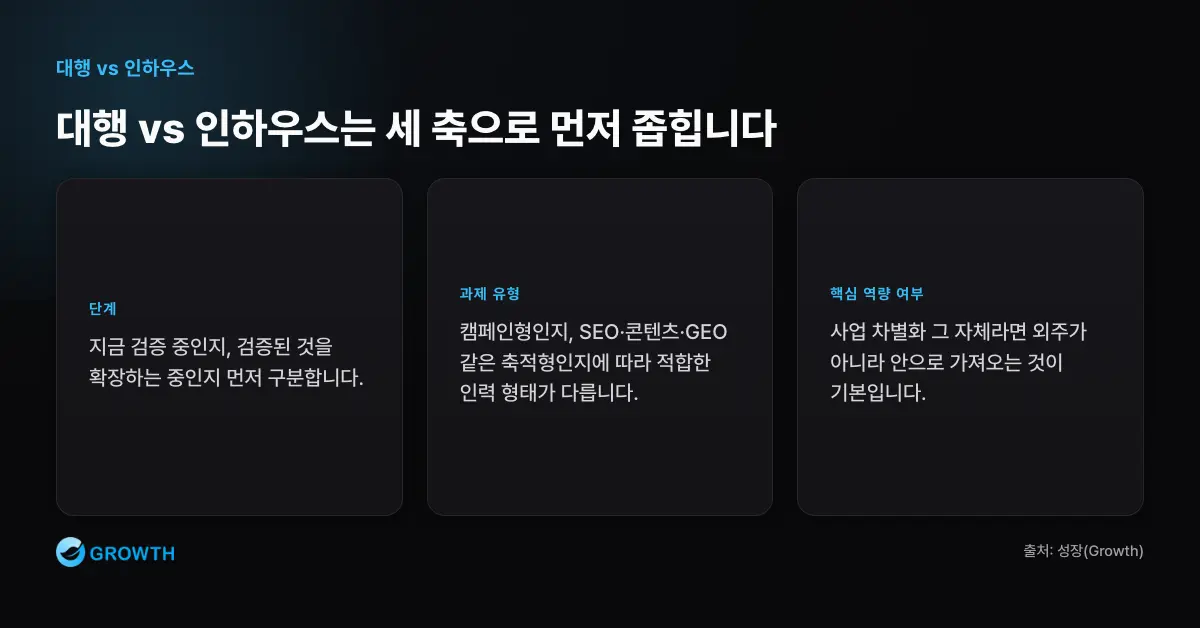
- Stage: Are you currently validating your channels, messaging, and customers, or scaling something already validated? Broad experimentation matters more during validation; deep context matters more during scaling.
- Task type: Is this a campaign-style task you switch on and off, like ad operations — or a compounding task, like SEO, content, or GEO, that builds value over time? The two require different operating models and different kinds of talent.
- Whether it’s a core capability: Is this function the actual differentiator of your business (for example, a media company where content is the product), or is it something that’s nice to do well but isn’t core? The default principle: keep core capabilities in-house, and put everything else outside.
Once you run a decision through these three axes, the simple conclusions — “an agency is always cheaper” or “hiring directly is always safer” — fall apart. So let’s start with the trap in cost comparisons.
The cost-comparison trap: what a simple salary-vs-agency-fee comparison misses
Most decisions start like this: “A marketer’s salary is $3,000/month, the agency fee is $2,200/month, so the agency is cheaper.” That math is almost always wrong. It only compares the visible salary and the visible invoice, and leaves out all the hidden costs that come with hiring.
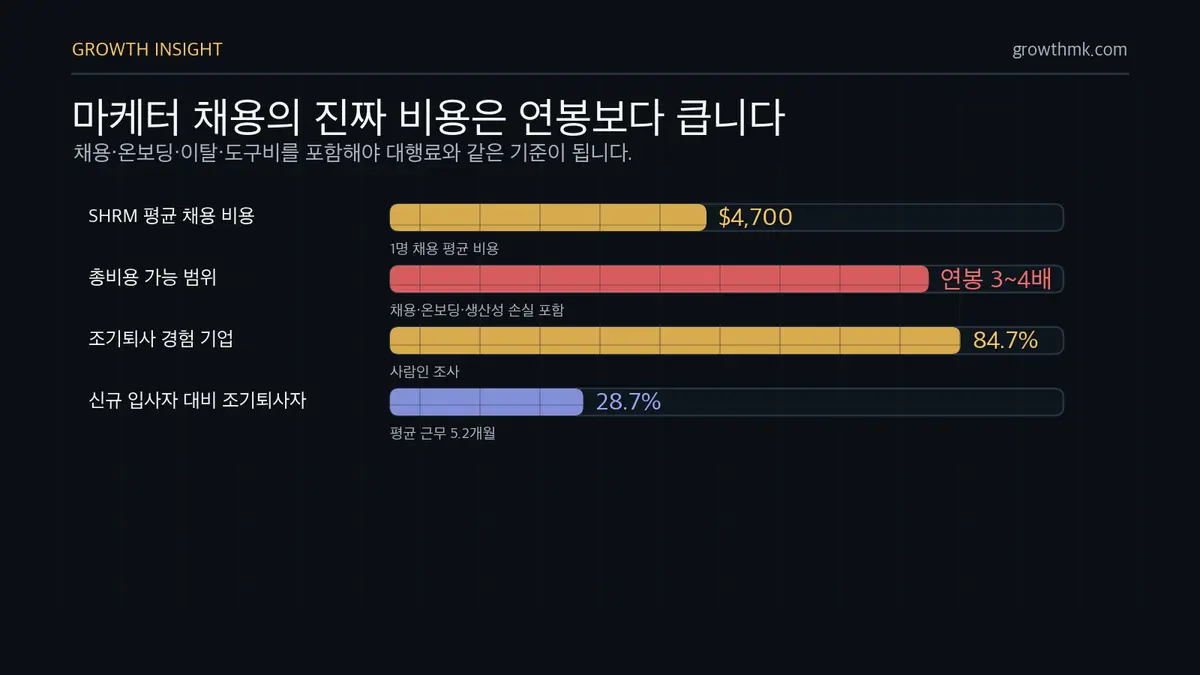
First, hiring itself costs money. According to benchmarking data from the U.S. Society for Human Resource Management (SHRM), the average cost to hire one employee is around $4,700, and the same data suggests that once you add hiring, onboarding, and lost productivity, the total cost can reach 3–4x that role’s annual salary. Hiring isn’t a one-time expense that ends the moment you post a job listing — it’s a process cost that includes leadership time spent interviewing and the lower productivity of the ramp-up period.
Second, there’s turnover risk. Domestic data here is especially unforgiving. A survey of 1,124 companies by Saramin (a Korean job platform) found that 84.7% had experienced early turnover within the first year of employment, with an average early-turnover ratio of 28.7% relative to new hires and an average tenure of just 5.2 months. If you hire a marketer and they leave before hitting six months, you don’t just lose that six months of salary — you lose the hiring cost, the time invested in onboarding, and the opportunity cost of campaigns that stalled in the meantime, all at once.
Third, there are tool and overhead costs that are easy to forget. Analytics tools, ad management and automation platforms, design and content production tools, and keyword/backlink analysis tools all need to be licensed directly by the company if you run things in-house. It’s common for a single specialized analytics tool subscription alone to run well into the hundreds of dollars a month. An agency, by contrast, already has these tools in place and spreads the cost across multiple clients, so the per-client price is lower. You have to start by acknowledging that the true cost of one marketer isn’t the salary — it’s “salary + statutory benefits + hiring & onboarding + tool costs + turnover risk” added together, before an accurate comparison is even possible.
That doesn’t mean in-house is always more expensive, though. When marketing work is constant and high-volume, the transaction cost of repeatedly briefing and coordinating with an outside party adds up, and past a certain point, hiring directly becomes cheaper. The real question isn’t “price per unit” — it’s “how often does this work happen, and how much context does it require.” Deep expertise you only need occasionally is cheaper to borrow. Context work you need every day is cheaper to keep in-house.
Agencies have their own traps, too. Reporting vanity metrics disconnected from actual performance, or contracts that guarantee results detached from what actually matters, are classic examples (we covered this separately in why SEO agencies push guarantee-based contracts). The key is putting the real costs and real risks of both options on the same table for comparison. Since the ROI/ROAS metrics commonly used here have their own traps, we’d also recommend reading the traps in ROI and ROAS.
A decision matrix by situation: stage × task type
Cross-referencing stage and task type gives you a rough recommendation. The table below isn’t an absolute rule — it’s a starting point, because every company already has different internal capabilities.

| Situation | Characteristics | Recommendation | Why |
|---|---|---|---|
| Early validation | Channel, messaging, and target audience are still undetermined. You don’t yet know what works | Agency or outside experts | What matters most is experience testing multiple channels quickly. Hiring one person and betting on a single channel is too risky |
| Growth stage | You can see which channels work; the challenge is repeating and scaling them | In-house core + agency execution | An internal person who deeply understands the product and customer owns strategy, while execution volume scales through an agency |
| Specialized domains (SEO, GEO, content) | Compounding assets that build value over time | Specialized agency + parallel in-house learning | Skilled talent is hard to hire, and results take time. Borrow the expertise, but keep the know-how in-house |
| Campaign-style (ad operations) | One-off or recurring operations turned on and off by season or budget | Either agency or in-house works | The deciding factor is operating frequency and budget scale. Constant, high volume favors in-house; intermittent favors an agency |
| Core capability areas | Marketing itself is the business’s differentiator (e.g., content = product) | In-house first | The rule is not to outsource your core competitive edge. Both the learning and the asset need to accumulate internally |
Compounding areas like SEO and GEO are especially tricky decisions. Proven experts are particularly hard to hire in Korea (why SEO experts are hard to find in Korea), and results take months to show up — if you hand the whole thing to a single in-house person, the compounding stops the moment they leave. If you do use an agency, it’s important to set clear selection criteria, so we’d recommend reading the SEO agency selection checklist alongside this. On the flip side, if you’re already running validated performance ads at high daily volume, in-house can actually be faster and more agile (we discuss this further in the complete performance marketing guide).
Why is the hybrid model the most common optimal solution?
Looking at actual budget allocation in the market, the two aren’t an either/or choice — they coexist. According to Gartner’s 2025 CMO spending survey (roughly 400 respondents across North America, the UK, and Europe), labor costs account for about 22% of marketing budgets and agency spend for about 21% — the two are nearly equal. That means most organizations are running internal talent and outside agencies at the same time.
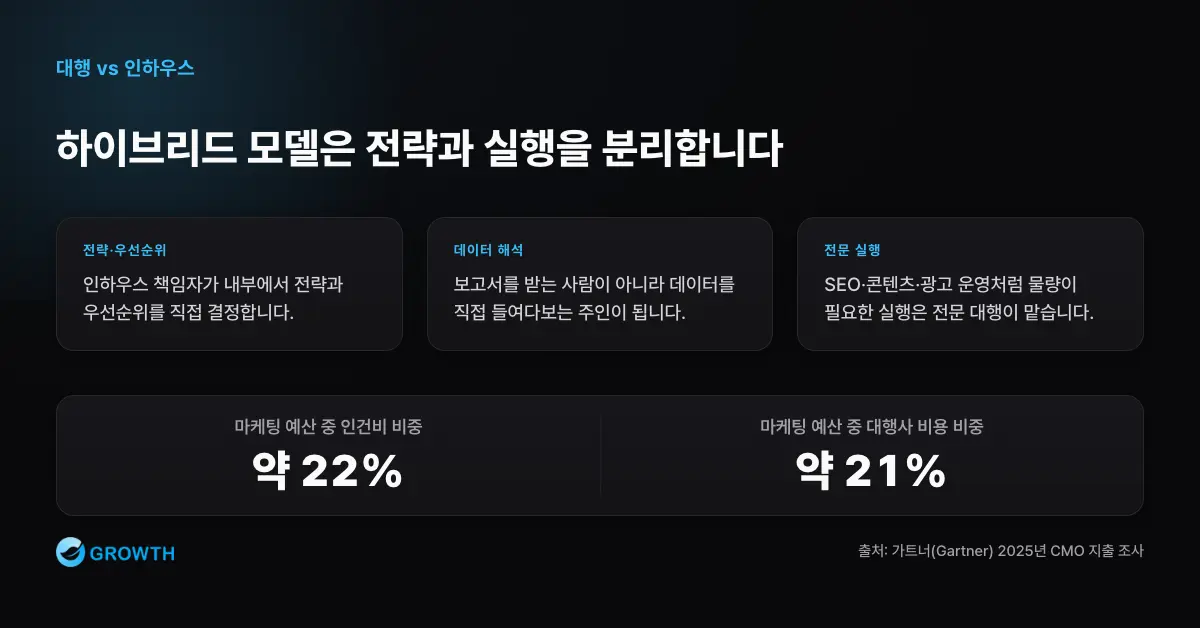
The setup that works most often is “one in-house person plus a specialized agency.” One internal marketing lead sets strategy and priorities, looks at the data directly, and manages the agency. Execution that requires deep expertise or high volume — SEO, content, ad operations — gets handed to the agency. The reason this structure is strong is clear: strategy and context (the hardest part to outsource) stay inside, while execution capacity and tools (the part that’s efficient to borrow) get sourced from outside.
For this model to work, that one internal person has to be the “owner,” not the “manager.” They can’t just transcribe the agency’s reports — they need to be the person who asks, with data, exactly where the customer journey loses “the one person who becomes revenue,” who throws hypotheses at the agency, and who interprets the results of each experiment. This kind of experiment-driven thinking is the core of growth hacking, and it’s grounded in understanding customer behavior stage by stage through the Customer Decision Journey (CDJ).
The typical way a hybrid model fails is just as clear. Either there’s no internal owner and the agency is effectively left unmanaged, or internal staff distrust the agency and try to control every decision themselves, which wastes the agency’s expertise. Both failure modes happen when the “strategy stays in, execution goes out” boundary breaks down. Before starting a hybrid setup, it’s worth documenting in advance exactly what that one internal person is accountable for and what gets delegated.
What you must keep in-house when using an agency
Using an agency isn’t the problem in itself. The problem is handing over the company’s assets wholesale along with the work. No matter how you structure the collaboration, these three things must always remain owned in-house.
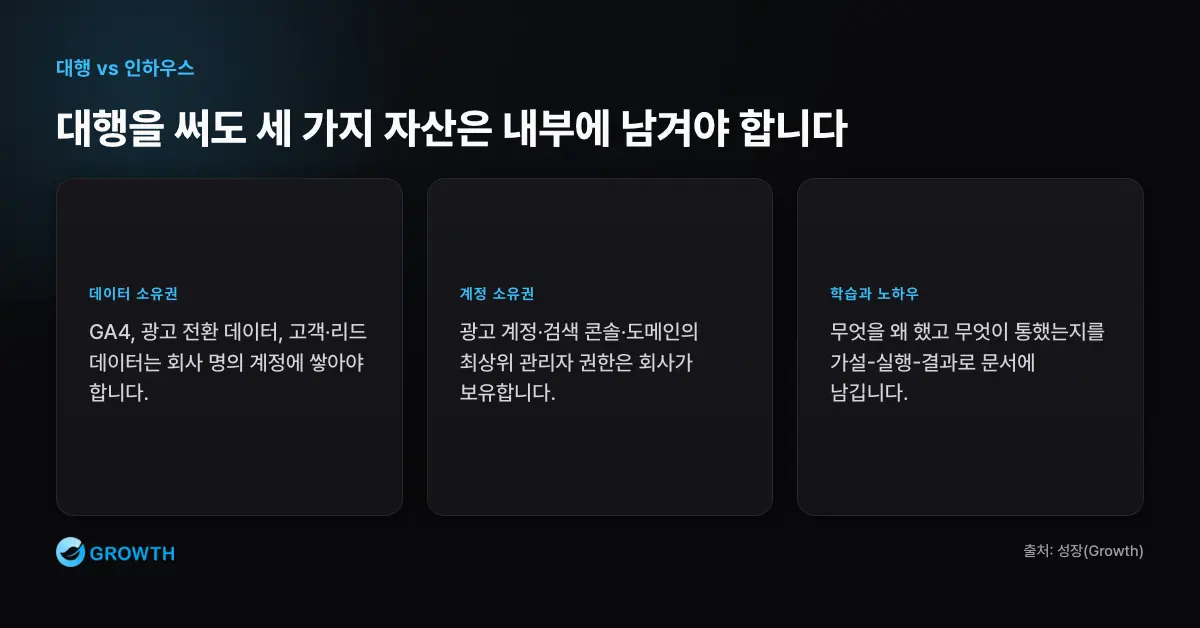
- Data ownership: Analytics accounts (like GA4), ad conversion data, and customer/lead data need to accumulate in accounts owned by your own company. If the data piles up in the agency’s account instead, everything you’ve learned disappears the moment the contract ends. We cover why setting up tracking correctly from day one matters in why tracking setup matters for B2B marketing.
- Account ownership: Your company should hold top-level admin access to ad accounts, Search Console, your domain, your website, and social channels, and grant the agency delegated access only. Ownership and operating rights need to stay separate.
- Learning and know-how: What the agency did, why they did it, and what worked needs to be documented internally. Ask for monthly reports to be delivered as a learning record — “hypothesis, execution, result, next hypothesis” — not just a results notification. Whether or not this record exists is what determines continuity when you switch agencies or move the work in-house.
Keep these three things in-house, and the agency relationship becomes “leverage” instead of “dependency.” You can switch agencies or bring the work in-house at any time, because your company holds the initiative on that decision. A genuinely good agency will actually welcome this requirement — they know that sharing data and accounts transparently is the foundation of long-term trust.
So, how should your company decide?
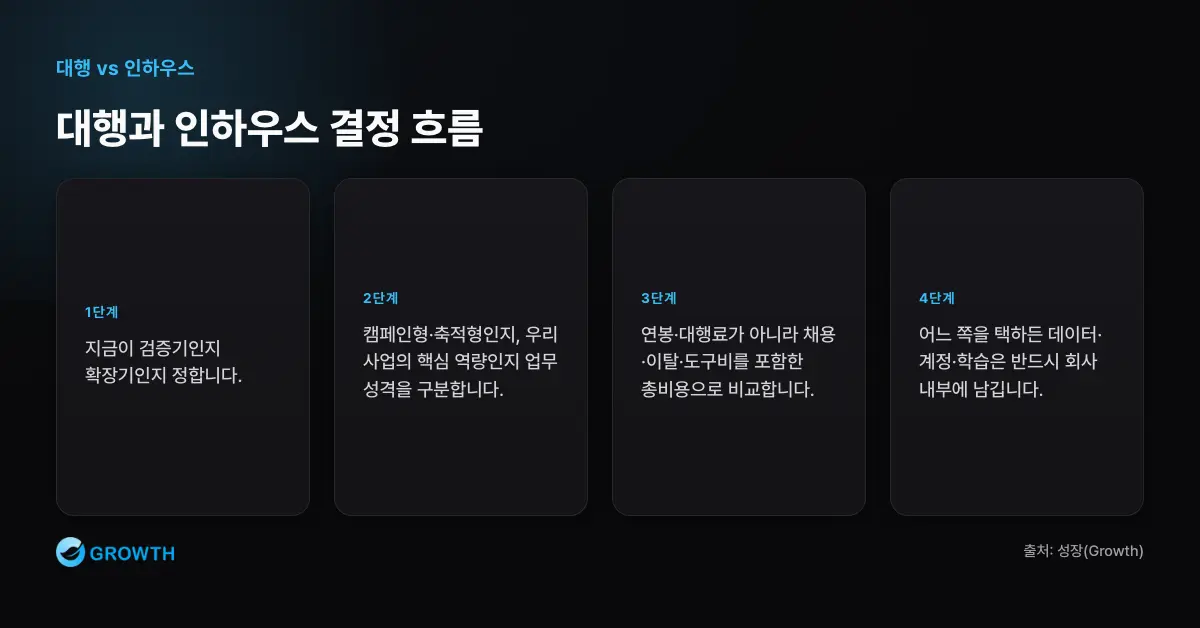
To sum up, the decision process should follow this order. First, decide whether you’re in a validation stage or a scaling stage. Second, determine whether the work is campaign-style or compounding, and whether it’s a core capability for your business. Third, when comparing costs, compare “total cost” — including hiring, onboarding, turnover, and tools — not just salary or agency fee. Fourth, whichever you choose, always keep data, accounts, and learning in-house.
And the final standard for every judgment is the same. It’s not about more clicks or more impressions — it’s whether the structure brings in “the one person who becomes revenue” more accurately. If in-house builds that structure better, go in-house. If an agency builds it faster and cheaper, go with an agency. Most growing companies end up using both.
Deciding together with Growth
Growth doesn’t tell every client that an agency is automatically the answer. Based on data science and growth hacking methodology, we first diagnose your company’s stage and challenge — and when in-house is the right call, we say so. In areas where an agency genuinely helps (especially compounding assets like SEO, GEO, and content), we keep data and accounts under the client’s ownership and collaborate in a way that lets the learning accumulate internally. Designing a structure that focuses on the one person who becomes revenue — not traffic volume — is how we work.
If you’re curious what combination fits your company’s stage and challenges, take a look at Growth’s SEO solution, or tell us about your current situation through our consultation form. We’ll give you an honest read on which side is actually right for you.
You can see the full picture of this topic in “Choosing and pricing a marketing agency — the complete guide: from 7 selection criteria to fee structures and a 90-day checkpoint.”
Frequently Asked Questions
We’re a small startup — should we hire a marketer or use an agency?
If you’re still in an early stage where your channels and messaging haven’t been validated yet, it’s often better to move fast with an agency or outside experts to test multiple channels. Hiring one person and betting everything on a single channel carries a lot of risk. That said, if marketing is your business’s core differentiator, it makes sense to build that capability in-house from the start. Either way, compare total cost, including hiring cost and turnover risk.
Is it fair to directly compare an agency fee to a marketer’s salary?
No. A marketer’s real cost is salary plus statutory benefits, hiring cost, lost productivity during onboarding, analytics/ad/production tool costs, and turnover risk, all added together. According to SHRM, the average cost per hire is around $4,700, and total cost can reach 3–4x salary. Since an agency fee already bundles all of that in, you need to convert both to the same basis for a fair comparison.
For an area like SEO or GEO, is an agency better, or should we do it ourselves?
For these compounding, specialized areas, “specialized agency plus parallel in-house learning” is often the realistic optimum. Skilled experts are hard to hire directly, and results take time, so you borrow the expertise from an agency while keeping the data, accounts, and know-how in-house. That way, the compounding doesn’t break when you eventually switch agencies or bring the work in-house.
What should we watch out for most when using an agency?
Make sure ownership of data and accounts always stays under your company’s name. Your company should hold top-level access to analytics accounts, ad accounts, Search Console, and your domain, and grant the agency delegated access only. Also ask for monthly reports to function as a learning record — hypothesis, execution, result — rather than a simple results notification, so the know-how from the collaboration stays in-house. Do this, and the agency becomes leverage you can control at any time, not a dependency.