
How to Choose a Marketing Agency and What It Costs — The Complete Guide: 7 Selection Criteria, Fee Structures, and a 90-Day Checkpoint
 임재복
임재복
The number one criterion for choosing a marketing agency isn’t “how much traffic can you bring in” — it’s “do you have a structure built to bring in the one customer who becomes revenue.” In concrete terms, check three things: ① Does the agency define success as conversions and revenue, not impressions and clicks? ② Does it separate ad spend from its own fee and share raw data transparently? ③ Does it propose a specific strategy built around your industry’s actual customer journey? Cost breaks down into two separate pots of money — the ad spend you pay the media platform, and the fee you pay the agency — and that fee is typically structured one of three ways: a percentage of media spend (10–20% by global survey benchmarks), a fixed retainer, or a performance-based arrangement. This guide covers the entire agency-selection decision, from comparing agency types, to 7 selection criteria, to a complete breakdown of cost structure, red flags to watch for before signing, and a 90-day checkpoint once the engagement begins.
What Does a Marketing Agency Actually Do?
The first reason agency selection is hard is that the single phrase “marketing agency” covers companies doing completely different jobs. A company that only runs paid ads, a company that only produces content, a company focused purely on SEO, a company that goes deep on one specific industry — all of them get called a “marketing agency” under the same name. Until you first define what your company actually needs, comparing quotes doesn’t even make sense as an exercise.
The names vary, but what agencies actually do boils down to four things: strategy (market and customer analysis, channel mix design), execution (ad operations, content production, website optimization), measurement (building a conversion tracking environment, data analysis), and reporting and improvement (regular reports, optimization through experimentation). How much weight and depth each of these four gets varies enormously by agency type.
| Type | Core Work | Good Fit For | Weakness to Check |
|---|---|---|---|
| Full-service agency | Everything from strategy to ads, content, design, and web, all in-house | Companies with no internal marketing team, or that want multiple channels managed under one roof | Expertise varies widely across disciplines. Check the actual expertise of the operating staff assigned to your account, not the polish of the proposal |
| Performance marketing agency | Search, social, and display ad operations and conversion optimization | Companies already running an ad budget who want to improve conversion efficiency | Channels outside paid ads (SEO, content, CRM) are a blind spot. If the fee scales with media spend, check the incentive to recommend budget increases |
| Content marketing agency | Planning, producing, and distributing content — blog, video, newsletters | Companies that want to build long-term inbound traffic through content assets rather than short-term ads | Volume-based contracts like “X pieces per month” have a weak link to actual performance. Ask what search demand and conversion path the content is designed to reach |
| SEO/GEO specialist agency | Technical SEO audits, keyword and content strategy, AI search (GEO/AIEO) readiness | Companies building a sustainable traffic base in search engines and AI search | Google’s own guidance states results typically take 4 months to a year to show up. Anyone promising fast rankings is itself a red flag |
| Vertical (industry-specialist) agency | Operations specialized to a specific industry — healthcare, legal, e-commerce, SaaS | Companies where regulation and customer journeys are unusual enough that industry knowledge drives results | Limited ability to expand outside that industry. If they serve multiple competitors in the same space simultaneously, check for a conflict of interest |
If you’re evaluating a performance agency, we’d recommend also reading our complete guide to performance marketing, which lays out the whole structure of running paid ads; if you’re evaluating an SEO specialist, see our SEO agency selection checklist. Whichever type you’re weighing, though, the final test stays the same: “Does this activity actually reach the one customer who becomes revenue for our company?” A full-service agency’s polished portfolio and a performance agency’s low cost-per-click aren’t, on their own, the answer.
Why “the One Customer Who Becomes Revenue,” Not “Traffic Volume”?
The proposals you’ll most commonly receive while comparing agencies are written in the language of volume: “X times more visitors,” “X hundred thousand impressions,” “X% lower cost-per-click.” The problem is that volume metrics frequently diverge from revenue. Shift budget toward cheaper media and cheaper keywords, and visitor counts climb easily. But 10,000 visitors with no purchase intent won’t produce a single signed contract. We cover why a low cost-per-click isn’t, by itself, the answer in our piece on how CPC (cost per click) actually works, and the mechanism behind ad metrics looking great while profit doesn’t budge in the trap of ROI and ROAS.
This gap is especially fatal for B2B and high-consideration businesses, where a single contract is worth a lot and the review cycle runs long. The classic symptom: inquiries are up, but sales keeps saying “these people aren’t buyers when we call them,” or the marketing report shows growth every month while revenue sits flat. In this situation, there’s nothing technically wrong with the agency’s report — impressions, clicks, and conversions all hit their targets. The problem is that the definition of “success” was wrong from the start.
Which is why the question that separates a good agency from a bad one isn’t “how much can you grow our traffic” — it’s “how do you define the one customer who becomes our revenue, where do you find them, and how do you measure it?” Few agencies can answer this question concretely, which is exactly what makes it such a powerful filter. A structure that analyzes the journey customers actually take to a purchase decision, forms and tests hypotheses at every point along that journey, and validates quality — not volume — of traffic with data: the 7 selection criteria below are all variations on the question of whether that structure exists.
For the same budget and the same channels, a volume-first agency and a quality-first agency operate differently at every point. Here’s how the two approaches compare.
| Comparison | Volume-First Agency | Quality-First Agency (“The One Customer” Standard) |
|---|---|---|
| Core metric | Impressions, clicks, visitor count, cost per click | Conversion rate, sales-accepted-lead rate, contract conversion rate, customer value relative to acquisition cost |
| Keyword/targeting choice | Maximize traffic with high-volume, cheap keywords | Focus on keywords that reveal purchase intent and actual decision-makers |
| Budget allocation | More budget to whatever generates traffic well | More budget to sources that convert to contracts; cut low-quality sources even if volume looks good |
| What the report emphasizes | “This many impressions, this many visits” | “This traffic produced X inquiries, of which sales accepted Y as qualified leads” |
| Handling failure | Visitors are up, revenue is flat — no explanation possible | Even a failed experiment becomes learning data: “this isn’t the right target” |
7 Criteria for Choosing a Marketing Agency
For every criterion below, we’ve laid out a question you can ask verbatim in a meeting, along with a table of good answers versus red flags. Almost no agency will pass all seven with a perfect score. But criteria 1 through 3 — industry understanding, defining success, data transparency — are non-negotiable. If those three break down, it doesn’t matter how good the rest looks, because you’ll have no way to actually verify the results.
Here’s a one-table summary of all 7 criteria first. Feel free to use it as-is as a pre-meeting checklist.
| Criterion | Key Question to Ask | One-Line Judgment Standard |
|---|---|---|
| 1. Industry understanding | “How do you see our customers’ purchase decision process?” | Do they lead with the customer journey, not the channel? |
| 2. Defining success | “What metrics will you report success against?” | Is the final metric conversion and revenue, not impressions and clicks? |
| 3. Data transparency | “Can we access the raw data ourselves, directly?” | Do they guarantee ad account access and cost broken out separately? |
| 4. Strategy specificity | “What will you do in the first 3 months, and in what order, and why?” | Is there a hypothesis in the proposal based on analyzing our data? |
| 5. Communication structure | “Who’s the actual person running this day to day?” | Is the operator disclosed before signing, with a documented reporting structure? |
| 6. Contract terms | “What are the cancellation terms and who owns the account?” | Is the contract easy to walk away from? |
| 7. Reference verification | “Do you have verifiable case studies and a client I can call?” | Are the case studies presented in a verifiable form? |
1. Industry Understanding — Do They Know Your Customer’s Journey?
What matters more than raw industry experience is the attitude and methodology behind understanding “the journey our customers take to a purchase decision.” The same ad channel plays a different role depending on whether the customer is exploring information or comparing and deciding. Even without direct experience in your industry, an agency that’s handled a similar purchase structure (high consideration, long review cycle, multiple decision-makers) can lay out a plan for how it’ll get up to speed. Conversely, plenty of industry references but no customer-journey analysis, just “operating the way we always have” — in that case, experience is inertia, not an asset.
| Question to Ask | Example of a Good Answer | Red Flag |
|---|---|---|
| “How do you see the process our customers go through before deciding to buy, in our industry?” | Walks through exploratory search terms, comparison channels, and decision factors stage by stage, admits what they don’t know, and proposes a plan to research it | “Marketing principles are the same in any industry,” then jumps straight into channels and product pitches without ever discussing the customer |
| “Have you worked on projects with a similar customer value and purchase cycle to ours?” | Explains experience with a similar purchase structure, even in a different industry, backed by evidence | Lists references regardless of relevance, or offers only unverifiable stories citing “confidentiality” |
2. Defining Success — Do They Talk About Conversion and Revenue, Not Impressions?
The first thing to look at in a proposal isn’t the design — it’s how they define their success metrics. Impressions, reach, and clicks are process metrics only. A good agency manages process metrics along the way, but anchors its final reporting around conversion (inquiries, purchases, sign-ups) and the quality of those conversions (sales-acceptance rate, contract conversion rate, revenue contribution). That doesn’t mean process metrics are meaningless — early on, before conversion data has accumulated, process metrics are how you read direction. The problem arises when process metrics stay the anchor of final reporting throughout the entire contract — and that gap shows up plainly in the shape of the reports 90 days in.
| Question to Ask | Example of a Good Answer | Red Flag |
|---|---|---|
| “What metrics will you define success by and report on?” | Treats impressions and clicks as process metrics, proposes conversion and conversion quality as the final metric, and counter-proposes first agreeing together on who “the one customer who becomes our revenue” actually is | Lists only volume metrics — impressions, reach, follower growth, lower cost per click |
| “If conversions go up but revenue doesn’t, what will you check?” | Explains a process for tracking contract conversion rate by inflow keyword and channel to analyze lead quality, then redefining targeting and messaging | “Marketing’s job ends at conversion — after that is sales’ problem” |
3. Data Transparency — Can You Access the Raw Data Directly?
This isn’t a matter of preference — it’s a matter of platform policy. Google’s advertiser guide states explicitly that “advertisers have the right to know, at minimum, the clicks, impressions, and cost of their Google Ads.” An agency that only sends processed summary reports and blocks access to the ad account is falling short of the media platform’s own minimum bar. Data is also meaningless, however transparent, if conversion tracking is set up incorrectly to begin with — so hold the tracking setup to the same standard, asking who builds and validates it and how. See why tracking-tool setup determines how you judge marketing performance for more.
| Question to Ask | Example of a Good Answer | Red Flag |
|---|---|---|
| “Can we access the raw data in the ad account and analytics tools directly, ourselves?” | Runs the account under the advertiser’s own name, provides the advertiser with more than read-only access at all times. Discloses cost exactly as billed by the media platform | Only provides self-processed reports, refuses account access citing “protecting our operational know-how” |
| “Does the report show media spend and your fee broken out separately?” | Media spend billed and agency fee shown separately and explicitly — the same approach required by Google’s third-party policy | Shows only a total figure, keeps the fee calculation basis undisclosed |
4. Strategy Specificity — Or Just a Proposal with the Company Name Swapped In?
Strategic specificity isn’t about “how many channels does it cover” — it shows up in “why this order.” A data-driven agency’s proposal shows a visible cycle: diagnosis (current data and market analysis) → hypothesis (where’s the opportunity) → experiment (what to test, and how) → scale (put budget behind what’s validated). This validation cycle is precisely the core of growth-hacking methodology. On the flip side, a proposal that just lists channels — the kind you could send to any company and it would still “work” — is a strong signal that the operations after signing will be at the same level.
| Question to Ask | Example of a Good Answer | Red Flag |
|---|---|---|
| “What will you do in the first 3 months, why, and in what order?” | Presents the diagnose→hypothesize→experiment→validate cycle, with the output and judgment criteria for each stage | Just a list of channels — “integrated Naver + Google + Meta operation” — with no prioritization or hypothesis |
| “What’s your basis for concluding this strategy fits our company?” | Shows concrete evidence of having analyzed our website, search demand, and competitive landscape before the meeting, backed by real numbers | A standard proposal usable for any company with the name swapped out |
5. Communication Structure — Who Reports What, and How Often?
One of the biggest factors driving satisfaction with an agency is the problem of “the person you met during the sales process isn’t the person who actually runs the account.” It’s not uncommon in this industry for a principal or senior person to show up before signing, only for a junior staffer to be assigned once the contract is in place. Who handles your account, and what the channel and cadence are for regular reporting and ad-hoc communication — all of this needs to be locked in writing before you sign. And there’s something even more important than the reporting cadence: how fast bad news travels. Does the agency flag a performance drop the moment it happens, with a response plan in hand, rather than waiting for the monthly report date? That’s the real litmus test for communication structure.
| Question to Ask | Example of a Good Answer | Red Flag |
|---|---|---|
| “Who will actually be running our campaigns after we sign?” | Brings the operating staffer into the meeting, or discloses their role and background in advance | A veteran leads the sales process while the operator is “to be assigned after signing” |
| “Who reports, how often, and in what format?” | Lays out a layered structure — regular reports, an always-on communication channel, quarterly strategy reviews — with varying cadence and depth | “Just reach out whenever you need something” |
6. Contract Terms — Is It Easy to Walk Away?
It sounds paradoxical, but the better the agency, the easier the contract they’ll offer to exit. That’s because they’re confident they’ll earn your renewal on results. Conversely, a structure that locks clients in with long minimum terms and steep penalties is a signal the agency plans to retain you through the contract, not through performance. The same logic applies to who owns the account, the data, and the deliverables. If your ad account and operating history vanish the moment you cancel, that engagement was spending with nothing left behind as an asset.
| Question to Ask | Example of a Good Answer | Red Flag |
|---|---|---|
| “What’s the minimum contract term and the early-termination terms?” | Cancellable after a reasonable notice period (e.g. 30 days), with the penalty structure spelled out transparently in the contract | A long mandatory term with steep penalties, cancellation terms kept vague |
| “Who owns the account, data, and deliverables once the contract ends?” | The contract specifies the ad account, tracking setup, and all content as advertiser-owned | The account is registered under the agency’s name — you lose the machine-learning training data and operating history if you cancel |
7. Reference Verification — Presented in a Form You Can Actually Verify?
Google’s guide to hiring an SEO professional recommends requesting and verifying past success stories. What matters is verifiability, not the mere existence of a case study. One case study with a documented period, terms, and result — plus one existing client you can actually call — is worth far more than a single line like “experience running campaigns for a major company.” Asking about failures is equally valid. Only an organization that can walk through a failure in specific detail actually has a process for not repeating it.
| Question to Ask | Example of a Good Answer | Red Flag |
|---|---|---|
| “Can you show me a case study with verifiable results, and introduce me to an existing client I could call?” | Presents a case study with a documented period and terms, and is willing to connect you with a real client | Repeats “can’t disclose that due to confidentiality” with not a single verifiable case |
| “Can you tell me about a project that failed or was cancelled?” | Explains the specific cause of the failure and what changed in the process afterward | “We’ve never had a failure” |
Marketing Agency Costs, Broken Down from the Ground Up
There’s no one-line answer to “how much does an agency cost” because the same monthly fee can buy something completely different depending on how it’s structured. You have to break down the structure before you can even compare amounts.

Ad Spend and Agency Fees Are Different Money
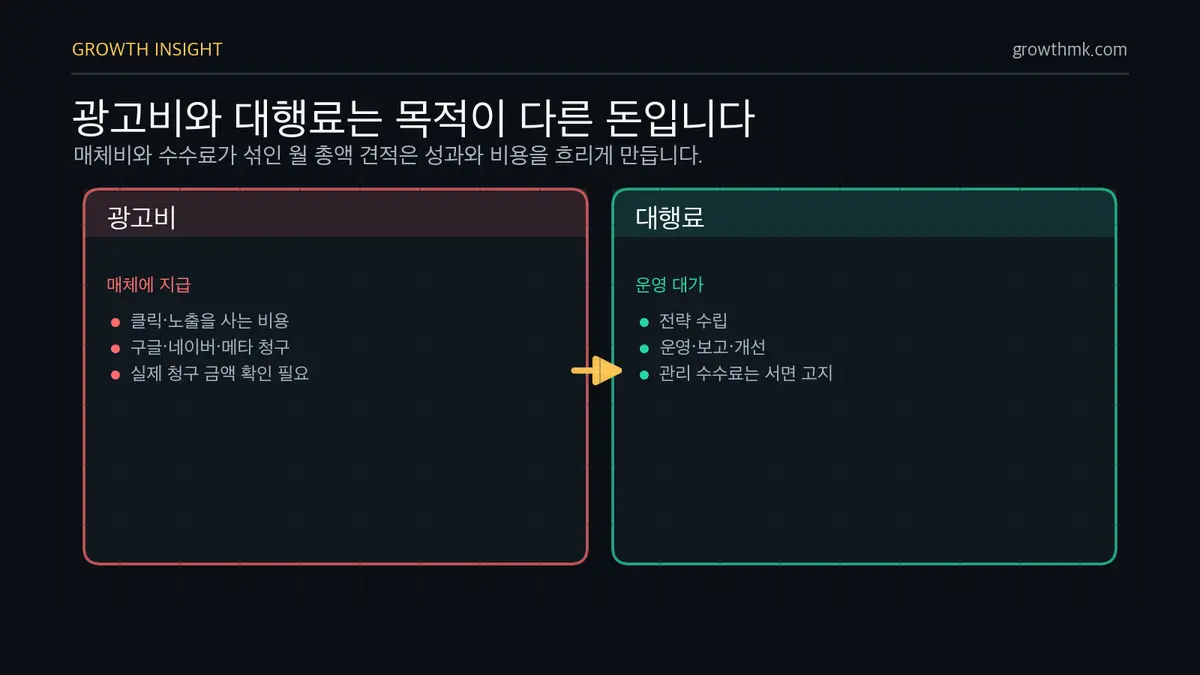
Marketing agency cost splits into two buckets. Ad spend (media cost) is what you pay platforms like Google, Naver, and Meta. The agency fee (commission) is what you pay the agency for strategy, operations, and reporting. A single blended quote — “X million won a month” — that mixes the two isn’t just impossible to compare, it’s a problem by the media platform’s own policy standards too. Google’s third-party policy requires agencies reporting cost to clients to report what Google actually billed, excluding their own fee, and if they charge a management fee, to disclose it in writing before the first transaction and state it on the invoice. Asking for “ad spend separate from agency fee” at the quoting stage isn’t a demanding request — it’s asking for the standard the platform itself has set.
3 Ways Agency Fees Get Structured
| Structure | How It Works | Advantage | What to Watch For |
|---|---|---|---|
| Percentage of media spend | A set percentage of monthly ad spend, billed as a fee. By global survey benchmarks, 10–20% of media spend is the typical range | Intuitive since ad scale and workload roughly track together, and flexible as budget shifts | Since the agency’s revenue rises alongside ad spend, there’s a built-in incentive to recommend budget increases over efficiency gains. Always ask for the data behind any increase recommendation |
| Fixed retainer | An agreed scope of work for a fixed monthly fee. Common for strategy, content, and SEO work beyond just ad operations | Easy to forecast budget, and can include strategic work regardless of ad spend scale | An ambiguous scope becomes a source of disputes. Document included/excluded work and frequency in the contract |
| Performance-based | Compensation tied to hitting agreed performance metrics — conversions, revenue, and similar | Looks like it aligns incentives cleanly | “Performance” is hard to define, and there’s room to game the numbers by manufacturing low-quality conversions. Industry survey data also flags this as hard to operate in practice due to uncontrollable variables, and it’s a red flag when combined with a ranking or performance “guarantee” |
Why “Zero Fee” Is Possible in the Korean Market
Get quotes for domestic ad management in Korea, and you’ll run into offers of “zero agency fee.” That’s not exaggerated marketing — it’s a structural byproduct. Naver Search Ads works through a structure where official agencies settle their commission from the media platform (Naver) itself, not from the advertiser, so it’s common for the agency not to charge the advertiser any separate fee at all. Global platforms like Google Ads or Meta, on the other hand, have no system for the platform to pay the agency a commission, so it’s standard for the advertiser to bear the agency fee.
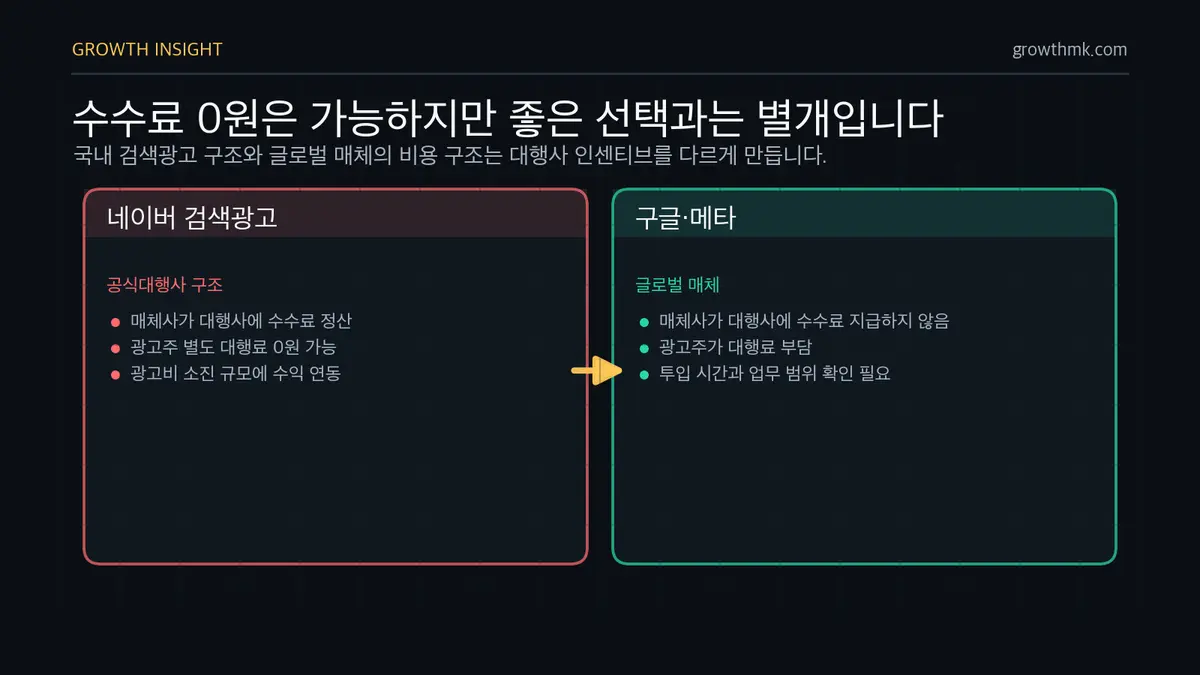
That “zero fee” is structurally possible, and that it’s a good choice, are two separate questions. Under this structure, the agency’s revenue is proportional to how much media spend the advertiser burns through. In other words, there’s a built-in incentive favoring proposals that increase ad spend over ones that improve efficiency and lower it. And a $0 fee also means the time allocated to your account gets sized to match that revenue. If you’ve been quoted zero fee, ask exactly “who’s spending how many hours a week on our account, and doing what?”
The Right Ad Budget Is Calculated Backward from Your Revenue Goal
Ask “how much should we spend on ads” and a good agency doesn’t answer with an industry average — it works backward from your revenue target instead. Here’s a worked example, with assumptions clearly stated. If your quarterly goal is 10 new contracts, and 20% of sales-qualified leads become contracts, you need 50 quality leads. If 50% of inquiries become sales-qualified leads, you need 100 inquiries. If 2% of visitors convert to an inquiry, you need 5,000 visits from people with actual purchase intent. Only once you multiply that by the cost-per-click of the channels that can generate those visits does the ad-spend number actually rest on something real.

The value of this calculation lies in its structure, not its precision. Every number starts out as an assumption, but with a structure in place, each step gets replaced with a real value as you operate, and the whole thing gets more precise over time. On the flip side, if the reasoning behind a budget is something like “companies in this industry usually spend about X million won a month” — unconnected to your company’s own conversion structure — that budget number may have been calculated backward from the agency’s revenue, not yours.
Realistic Ranges by Scale — Based on Published Survey Data
Reliable public statistics on domestic agency rates in Korea are rare. So the table below only includes verifiable, publicly available global survey data. Rather than converting these absolute figures directly to the Korean market, it’s more accurate to use them as a baseline for “what range forms around which structure,” and compare quotes from 2–3 agencies covering the same scope of work.
| Item | Range from Published Survey Data | Source |
|---|---|---|
| Monthly SEO retainer (most common band) | $501–1,000/month — agency average is around $3,209/month | Ahrefs, survey of 439 SEO service providers |
| Hourly SEO rate (most common band) | $75–100 | Ahrefs, same survey |
| Project-based SEO (most common band) | $2,501–5,000 | Ahrefs, same survey |
| PPC (ad management) commission rate | 10–20% of media spend | AgencyAnalytics PPC pricing guide |
| PPC (ad management) fixed retainer | Starting in the $500–2,000/month range; $5,000+ for large, complex accounts | AgencyAnalytics, same source |
If a quote comes in well below this range, ask “what’s missing”; well above it, ask “what’s included that isn’t standard.” What’s usually missing from a cheap quote is strategy and analysis, and that gap tends to resurface later as wasted ad spend. Which is why comparing agency fees requires a total-cost lens. If an agency charging 500,000 won a month less lets 20% of ad spend leak out to clicks with no purchase intent — that’s 2 million won on a 10-million-won monthly budget — the cheaper fee turns out to be the more expensive choice. The agency fee is only part of the total cost; the real thing to compare is “how many customers-who-become-revenue does the same ad spend produce.”
A 7-Point Checklist for Comparing Quotes
Request the same 7 things below from every agency when you’re collecting multiple quotes, and you can compare structure instead of just the total number.
- Cost breakdown: Ask for a quote broken into ad spend / agency fee / content production cost / tool cost / initial setup fee, not just a total.
- Fee calculation basis: If it’s a percentage of media spend, confirm the exact rate and the definition of “media spend” (does it include VAT and refunds?); if fixed, confirm the basis for the amount.
- Scope and frequency: Get it in writing — how many ad creatives per month, reporting cadence, whether landing-page improvements are included, and what’s explicitly excluded.
- Contract term and cancellation terms: Confirm the minimum contract term, cancellation notice period, and penalty terms.
- Ownership: Require explicit language on who owns the ad account, tracking setup, and any deliverables once the contract ends.
- Reporting metrics: Confirm whether reports include conversion and revenue metrics, not just process metrics like impressions and clicks.
- Ownership of tracking infrastructure: Confirm who’s responsible for building and validating conversion tracking and analytics, and whether that cost is included in the quote.
Red Flags to Watch for Before Signing
Spot even one of the signals below, and it’s worth pausing to verify before you sign. What they all have in common: they’re all “structures that dodge verification.”
| Red Flag | Why It’s Risky | How to Check |
|---|---|---|
| “We guarantee rankings/results” | Google’s official documentation explicitly warns against firms that claim to guarantee search rankings or claim a “special relationship” with Google. A guarantee only works if the metric is swapped for an easy one (uncompetitive keywords), a risky technique is used, or an escape clause is hidden somewhere | Request the exact terms of the guarantee, the measurement method, and the compensation for falling short, in writing. Refusal to document it means the “guarantee” was just a sales line |
| Abnormally low pricing, or a zero fee | A signal that the revenue comes from elsewhere (platform settlement, budget-increase incentives, or a junior operator handling a large volume of accounts) | Ask “who’s spending how many hours a week on our account, at this price?” |
| Opaque reporting | A processed screenshot report can’t be verified. Google’s third-party policy requires reporting account-level cost, click, and impression data | Specify read access to the ad account and access to raw data as a contract term |
| “We can do any industry, any channel” | A classic case of packaging a lack of specialization as breadth. Being good at everything means being unable to say what you’re actually good at | Ask them to name a specific case similar to your industry, and the specific person who ran it |
| Ad account registered under the agency’s name | You lose the ad account, machine-learning training data, and operating history the moment you cancel — a structure that artificially inflates switching cost to lock you in | Require the account to be registered under the advertiser’s name, with agency access granted on top |
| Pushing for a budget increase from the very first meeting | Recommending an increase before any efficiency diagnosis of the current budget is a classic distortion that emerges when a fee scales with media spend | Confirm whether they’re proposing testable hypotheses within the current budget first |
“Guaranteed” contracts in particular deserve their own callout. A guarantee looks like it reduces uncertainty, but in practice, it often functions as a device that redefines “success” in the agency’s favor. We break down the structural reason agencies push guarantee-based contracts in the first place in why SEO agencies recommend guarantee-based contracts.
On the flip side, here’s what a good sign looks like — the mirror image of the red flags above.
- In pre-contract meetings, they ask more questions about your business than they spend pitching themselves. That’s because understanding your customer is the starting point for every strategy.
- They say what they can’t do. “There are agencies better at that channel than we are” isn’t a weakness — it’s evidence of trustworthiness.
- They propose reallocating your existing budget before proposing an increase, because finding where the money you’re already spending is leaking is the core of real operational skill.
- Their reports document failed experiments and what was learned from them. A report with only successes may mean there were never any real experiments to begin with.
- The contract states cancellation terms and account/deliverable ownership in the advertiser’s favor, upfront.
What Order Should You Follow to Choose an Agency?
Knowing the criteria doesn’t help without a process — without one, the agency with the best sales pitch wins by default. Follow the 5 steps below, and control of the comparison shifts to you, the advertiser. We’d recommend budgeting 3–6 weeks total. Any shorter and verification gets skipped; any longer and internal momentum fades.
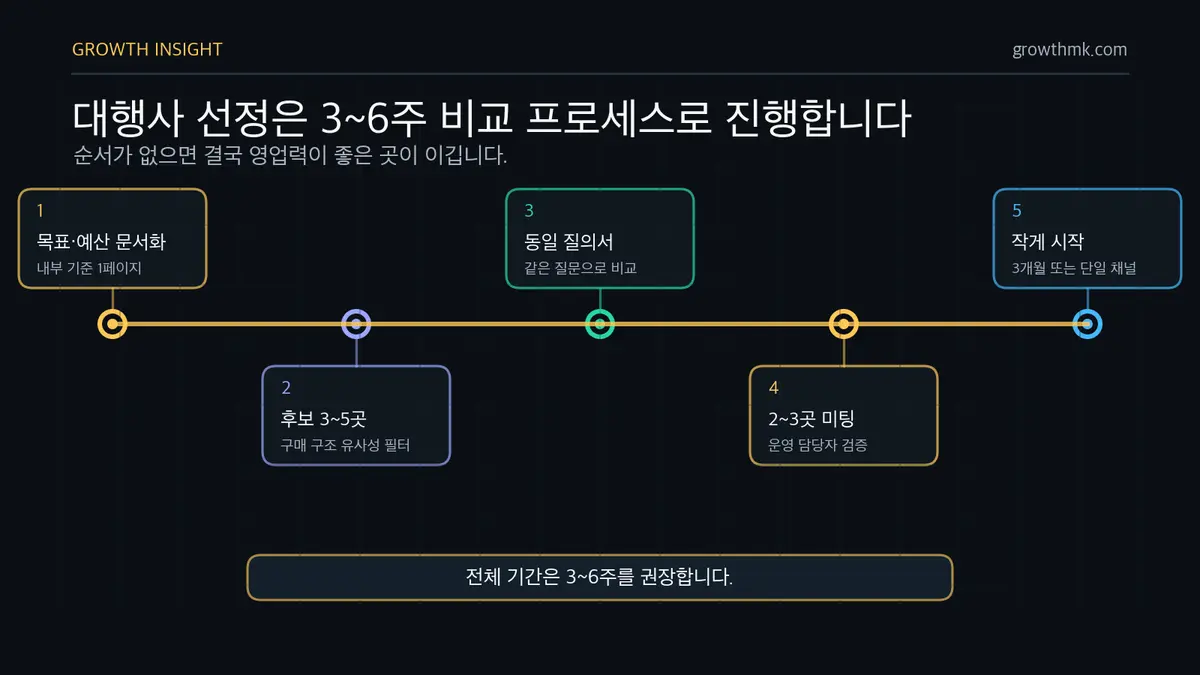
- Step 1 — Document your goals and budget internally, first: Before meeting any agency, put your goal (e.g. “X sales-qualified leads within the quarter”), your available budget range, and the boundary between what you’ll do in-house versus hand off, on a single page. Without this document, you’ll end up getting pulled along by whatever scope the agency proposes.
- Step 2 — Gather 3–5 candidates: Source candidates through search, referrals, and case-study content, then do a first-pass filter based on whether they’ve handled a similar purchase structure to yours. How a candidate markets itself — how discoverable it is in search, how deep its own content is — also counts as evidence of its capability.
- Step 3 — Send the same questionnaire to everyone: Send every candidate the same questions from the 7 selection criteria and the same 7-point quote-comparison checklist above. The difference in specificity between the answers you get back becomes your comparison table.
- Step 4 — Verify the people in a meeting: Meet with the 2–3 candidates whose written answers were strongest. Ask for the actual operating staffer to join, and probe their thinking with a scenario question like “if conversions go up but revenue doesn’t, what would you check?”
- Step 5 — Start small: If possible, start with a 3-month contract or a single-channel pilot, confirm it passes the 90-day checkpoint below, then expand scope. An agency confident in its results won’t be afraid to start small.
A 90-Day Checkpoint After the Engagement Begins
Even after choosing a good agency, selection is only half the job. The other half is verifying, over the first 90 days, that the structure actually works as promised. 90 days isn’t when revenue results are supposed to be complete — even for SEO, Google’s own guidance says results typically take 4 months to a year. The point of the 90-day window isn’t completed results — it’s verifying the structure that makes results inevitable.
| Point in Time | What to Check | Passing Criteria |
|---|---|---|
| Day 30 | Tracking environment, baseline, division of roles | Conversion tracking has been cross-checked against actual inquiries and purchases, the starting metrics (baseline) are documented, and both sides’ roles and communication channels work as agreed |
| Day 60 | First experiment cycle, lead-quality feedback | At least one full hypothesize→execute→result→learn cycle has completed, and there’s a working process for evaluating inbound lead quality together with sales and frontline staff |
| Day 90 | Connection to conversion and revenue, next-quarter plan | You can make a continue/stop/expand decision based on conversion data by channel and campaign, and next quarter’s plan is built on this quarter’s learning |
The single most important mechanism in the 90-day verification is the lead-quality feedback loop. The real measure of agency performance isn’t the conversion count in the marketing report — it’s the quality of leads as assessed by sales and frontline staff (“was this inquiry actually likely to convert?”). If that feedback reaches the agency every month and gets reflected in targeting, keywords, and messaging, the engagement gets better over time. On the flip side, if 60 days pass and the report metrics still look great while sales’ gut feeling says otherwise, that’s the exact signal that volume and quality have started to diverge — and the moment to demand a redefinition of your target audience.
Falling short of a checkpoint doesn’t mean the answer is immediate termination. Missing the day-30 checkpoint (unverified tracking) is the most common issue and the easiest to fix — set a deadline and require it to be resolved. If no experiment cycle has run even once by day 60, it means operations slipped into “set it up initially, then leave it alone” mode, and you should formally request a review of the operating system. If, even by day 90, conversion and revenue data still can’t support a real conversation, that’s the moment to go back to the 7 selection criteria in this guide and reassess. A good agency isn’t burdened by this kind of verification process — if anything, they want the chance to prove their results through the same structure.
Growth is a growth marketing agency that designs channel strategy and validation experiments around the one customer who becomes revenue — not impressions and clicks. If you’re currently evaluating agencies, feel free to put these exact questions from this guide to us directly. Check out our performance marketing services, and reach out through our consultation contact form — we’ll answer based on your current marketing structure.
More in This Cluster
- Marketing Agency Cost — Start by Separating Ad Spend from Agency Fees
- Marketing Agency vs. In-House Hiring — When Which One Is Right
- How to Choose a GEO Agency — 7 Questions to Verify Real AI Citation Results
- What Should Be Different About a B2B Marketing Agency — A Decision Guide
FAQ
How much does a marketing agency typically cost?
You need to look at ad spend paid to the media platform and the agency’s own fee separately. The fee is typically structured one of three ways: a percentage of media spend (10–20% by global survey benchmarks), a fixed retainer (for SEO, the global most-common band is $501–1,000/month, with an agency average around $3,209), or performance-based. Reliable public rate data for the Korean market is rare, so rather than focusing on an absolute figure, the most accurate approach is comparing quotes from 2–3 agencies for the same scope of work and comparing structure.
Can I trust an agency offering “zero agency fee”?
The structure itself can be genuine. Naver Search Ads works through official agencies settling their commission from Naver rather than the advertiser, so it’s common not to charge the advertiser a separate fee. That said, under this structure the agency’s revenue is proportional to how much ad spend gets burned, so there’s a built-in incentive to recommend a budget increase, and the operating hours allocated to your account get sized to match that revenue too. If you confirm “who’s spending how many hours on what work” and ask for the data behind any increase recommendation, this structure is entirely usable.
Is a small company better off using an agency, or hiring in-house?
During the validation phase, when you don’t yet know which channel will work, moving fast with an agency that has multi-channel experience has the advantage; once your core channel is locked in, a common path is bringing that channel in-house while keeping the rest with the agency. The judgment criterion is “does what we learn in 90 days stay with the company as an asset?” Secure account ownership and data access up front, and the learning carries over whenever you decide to bring it in-house.
What are the signs it’s time to switch agencies?
Report metrics keep looking good while revenue hasn’t moved for several quarters running; asked “why,” they answer with rhetoric instead of data; they refuse ad account access; the same report format repeats month after month with no new experimental hypothesis. Before switching, try demanding once that they redefine success around conversion and revenue. How they respond to that request is itself the best data point for deciding whether to switch.
Why should you avoid an agency that guarantees results?
As Google states in its own documentation, no one can guarantee search rankings, and ad performance is likewise driven by market, competitive, and product variables, so an honest guarantee is hard to construct. Cases where a guarantee looks achievable usually involve swapping in an easy metric (rankings for uncompetitive keywords, low-quality conversions), using a risky technique, or hiding an escape clause somewhere. Request the exact terms, measurement method, and compensation for falling short in writing from anyone claiming a guarantee — and treat a refusal to document it as a sales line, not a real guarantee.