
A/B Testing: How to Steadily Improve Your Ad Performance
 임재복
임재복

The concept is similar to the scientific method. If you want to know what effect changing one factor has, you need to set up a situation where only that one factor changes.
Think back to an experiment from elementary school: put two seeds in two cups of soil, leave one in a locker and the other by a window, and you can observe the difference in the results.
That kind of experiment is exactly what A/B testing is. The results this single variable produces have an outsized influence on marketing and drive business metrics.
A/B testing in marketing
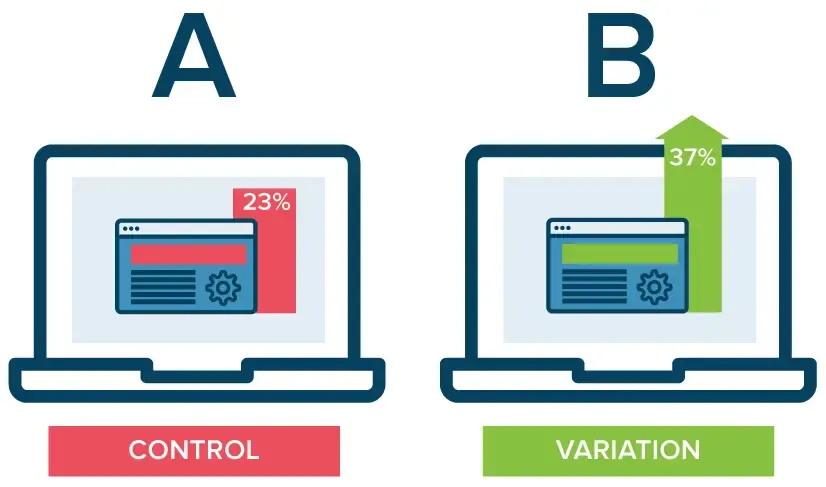
Why A/B testing matters to marketers
Through A/B testing, marketers create two versions of a digital asset and check which one gets a better response from users.
Examples of these assets include landing pages, display ads, marketing emails, and social media posts. In an A/B test, half of the audience automatically receives version A and the other half receives version B. Each version’s performance is judged against a conversion goal — the share of people who click a link, fill out a form, or complete a purchase.
A/B testing isn’t some new strategy that emerged alongside digital marketing. Companies have run A/B tests in various forms long before that; what’s changed now is that it’s built on digital capabilities, which lets it produce more specific, more reliable results, faster.
When you’re trying to grow a business, it’s often hard to tell which marketing approach will resonate most with your audience. That’s exactly where A/B testing helps — through repeated experimentation, it improves your content, delivers the best possible customer experience, and helps you hit your conversion goals faster.
What does A/B testing look like in the digital era?


A/B testing in digital marketing is a form of content experiment: you create two variants of a landing page or webpage and pick whichever one best serves your marketing goal. The testing platform Optimizely defines A/B testing as a methodology that randomly shows two versions and uses statistical analysis to identify which one performs better against a conversion goal. The best way to understand A/B testing is in relation to the two most common related test types: split testing and multivariate testing.
Split testing (or split-URL testing) shows two completely different landing pages to different customer groups and measures conversion rates — it’s essentially a content experiment to see which landing page performs better overall. A/B testing, by contrast, doesn’t use two completely different landing pages. Instead, marketers change only a subset of elements — the call-to-action copy, the sales copy, or the color and placement of page elements.
The difference between A/B testing and A/B/n testing

While split testing measures the performance gap between two completely different pages, A/B testing is a strategy for finding improvements by changing only part of a page and measuring the resulting shift in conversion rate. Some digital marketers use A/B/n testing to improve website performance as well.
Unlike A/B testing, A/B/n testing uses at least three variants of a landing page or webpage. The “n” in A/B/n stands for the number of variants being tested. Once the test ends, you check the conversion count for each variant and pick the one with the highest conversion rate. A/B/n testing is generally considered a preliminary step before moving on to more advanced multivariate testing.
Multivariate testing is similar to A/B testing, but it creates multiple variants of multiple elements on a page at once. These variants are combined in different ways and shown to consumers, letting you see which combination of changes produces the best campaign results.
A/B testing: why marketers should take it seriously
Why should marketers run A/B tests at all? At Growth, we run A/B tests continuously, week after week.
In other words, A/B testing isn’t a short-term, one-off marketing tactic.
So why does Growth keep running A/B tests continuously? Because it’s essentially the only way to keep producing consistent results.
Solving visitor problems
Visitors come to your website with a specific goal in mind. That could be wanting to understand your product or service better, buying a specific product, learning more about a specific topic, or simply browsing.
Whatever their goal, visitors are likely to hit a handful of common obstacles along the way.
For example, they might struggle to find the CTA button for “buy now” or “request a demo.” Accounting for that, marketers should use A/B testing to determine which landing page or webpage feels more accessible and convenient.
Generate a better ROI from your existing traffic
As most of you already know, acquiring high-quality traffic to a website is extremely expensive. A/B testing lets you make the most of the traffic you already have and raise your conversion rate without spending extra money to acquire new traffic.
A/B testing sometimes shows just how much impact even a tiny website change can have on your overall business conversion rate. That, in turn, helps a company secure a better ROI.
Reduce bounce rate
One of the most important metrics to track when judging a website’s performance is bounce rate. A high bounce rate can have a lot of different causes — too many options to choose from, a mismatch with visitor expectations, or confusing, cluttered navigation.
Because every website serves a different goal and targets a different audience segment, there’s no one-size-fits-all solution for reducing bounce rate.
But running A/B tests can help lower it. That’s because A/B testing lets you vary and test different elements until you find the best possible version — one of the reasons Growth keeps A/B testing on an ongoing basis.
It doesn’t just surface the elements that are getting in visitors’ way; it improves the overall website experience. That, in turn, goes a long way toward getting visitors to spend more time on your site and convert into paying customers.
Achieve statistically significant improvement

A/B testing is a data-driven strategy with no room for subjective judgment. That means you can quickly decide on the most effective approach based on statistically meaningful improvements — time on page, raw numbers, and so on. That said, “statistically significant” here means the probability of seeing the observed result by chance alone, assuming there’s actually no real difference between the two versions, is low enough — so you need to run the test long enough to reach statistical significance, or at minimum cover one full business cycle, before you can trust the conclusion.
Redesign your website for future business gains
A redesign can range from something minor, like adjusting CTA copy or color, all the way to a complete website overhaul. Once you’ve decided which version to implement from an A/B test, that choice should always be grounded in data.
How to implement A/B testing
So how should you actually run A/B testing in a marketing campaign? Here’s the basic process to follow.
Step 1: Decide which campaign element to test
First, marketers need to decide what to test. Evaluate underperforming landing pages, ads, or past campaigns. Then use web analytics and other research tools to form a hypothesis about why performance has been weak. For example, you might consider whether the CTA button is too small or hard to notice. Rank each element and start testing with the highest-priority one first.
Step 2: Create two variants of that element
Once you’ve decided what to test, create two variants. For example, design two versions of a banner ad — one with an image, one without. Or you can test an existing element against a new one: leave one landing page as is, and prepare an otherwise identical page with a larger CTA button for comparison.
Step 3: Set up a plan for measuring results
First, confirm you have a strategy in place for tracking campaign metrics. Check which metric you’re actually measuring — an increase in sales, more newsletter sign-ups, more comments on a post. You also need to define how much of a change counts as statistically meaningful. As the Harvard Business Review points out, ending a test too early — before you’ve reached a sufficient sample size and significance — can lead you to mistake a chance fluctuation for a genuine improvement, which is why defining your measurement criteria up front matters. If you’re testing an existing campaign element, you can also use its current performance as your baseline.
Step 4: Set a test timeline
Set how long the test will run. Make sure the test period isn’t too short or too long — either way, you risk getting inaccurate results.
Step 5: Run the test

Now it’s time to actually run the test. Test one element at a time so you can tell which one is actually driving the result. To avoid factors that could skew the outcome, run both variants at the same time. Try to keep group size, demographics, and other variables comparable across both versions. If you’re testing email marketing, you can create two test customer groups with similar or identical demographics.
A/B testing has to be consistent
Check results and implement changes
Review the results of a test after it’s run for the predetermined amount of time. If the test didn’t produce a clear result, adjust your hypothesis and run a different one. If you do get a clear result, implement the better-performing option. Feeding the analytics data into a data management platform helps improve the campaign you’re currently running — and you can use it to build future campaigns as well.
Final step: repeat the process (the Growth approach)
Marketers should keep using A/B testing to continuously improve marketing campaigns for better results. Once you finish your first test, move on to the next item on your priority list. You also need to repeat A/B tests over time as trends and customer preferences shift. Sometimes the results for two variants will be very similar — in cases like that, it can be more valuable to simply run the test again rather than force yourself to find a difference.
This is why Growth doesn’t treat A/B testing as a short-term campaign, but instead runs it continuously and repeatedly, in the way described below.
Growth’s approach to A/B testing: small experiments, compounding data

Run small experiments. Let the data compound.
This is a direction Growth takes seriously in how we work. Each individual step might seem minor, but it’s our proven, in-house strategy: keep experimenting steadily and consistently until meaningful data accumulates.
To help you understand how this plays out in practice, here’s a brief look at how Growth actually ran an A/B test. What follows is an A/B test we ran for a client.
The first A/B test
At the time, we split the client’s approach to adoption into two broad hypotheses:
- Direct adoption by leadership or senior decision-makers
- Adoption after grassroots buzz among rank-and-file employees, shared internally within the company
With these hypotheses in place, we ran an A/B test structured as follows:
- Targeting split: decision-makers / executives vs. rank-and-file employees
- Everything else — budget, timing, creative — kept identical
- Ad creative built around a “subscription service for employee benefits” concept, to measure content response
Here’s what we found:
- Ad response metrics were weaker among rank-and-file employees than among decision-makers and executives.
- Rather than driving adoption by increasing mentions among rank-and-file employees and letting it spread internally,
we saw a stronger, more direct response from company decision-makers and executives actively looking into employee benefits — so we adjusted the targeting for future ad campaigns accordingly.
The second A/B test
After determining from the first round that decision-makers and executives responded better to the ads, we went on to analyze how that translated into actual lead volume.
- Targeting: decision-makers / executives
- Used Meta Instant Forms to provide an actual inquiry (adoption request) form


Here’s what we found:
- Click-through rate, cost per click, and cost per result (Instant Form submission) were all lower overall for the executive-targeted segment.
- We determined that direct adoption by executives was, by far, the most common path to actual adoption. That insight let us adjust the primary target audience for future Meta campaigns.
- After that campaign adjustment, website inquiries rose 140% and cost per result dropped more than 50% compared to the period right before.
The whole point of A/B testing is to determine, piece by piece, which elements or features genuinely serve your brand better.
It’s equally important to focus on the deeper insight you gain from understanding and analyzing the reasons behind customer behavior.
Marketers who use that data end up with real skill in making informed decisions. That’s because it’s the marketer who invests time in results over the long run — not shortsightedly — and makes the most of every piece of feedback, who can actually lead a product and brand toward success.
Related reading
- What is growth hacking? Definition, AARRR, experiment design, and real cases — the complete growth-strategy pillar guide
- Marketing channel mix
- CDJ (Customer Decision Journey)
- Persona
- The difference between customer needs and wants
If you’d like to apply this to your own business — you can see Growth’s approach in our performance marketing service, and if you need a concrete assessment of your situation, reach out through our consultation form. We answer based on the one customer who becomes revenue, not on traffic volume.
Frequently Asked Questions
How is A/B testing different from A/B/n testing and multivariate testing?
A/B testing compares two versions that differ in a single element, like CTA copy or color. A/B/n testing compares three or more variants of the same element at once — the “n” stands for the number of variants. Multivariate testing goes a step further and combines multiple variants of multiple elements to see which combination produces the best result.
What does it mean for A/B test results to be “statistically significant”?
It means that, assuming there’s actually no real difference between the two versions, the probability of seeing the observed performance gap purely by chance is low enough to trust. In other words, the result is more likely to be a real difference than a fluke. You need to run the test until it reaches statistical significance, or cover at least one full business cycle, before the conclusion can be trusted.
Do I only need to run an A/B test once?
No. A/B testing isn’t a one-off campaign — it’s a strategy you need to sustain and repeat. Once you finish testing one element, move to the next item on your priority list, and keep repeating tests as trends and customer preferences shift over time. Growth runs tests consistently under the philosophy of “small experiments, compounding data.”
What kind of results can I realistically expect from A/B testing?
You can make more efficient use of your existing traffic to raise conversion rate without extra spend, and lower your bounce rate to improve ROI. In one of Growth’s actual B2B cases, adjusting targeting based on data led to a 140% increase in website inquiries and a cost-per-result drop of more than 50%, compared to right before the adjustment.