
GEO Performance Measurement: 4 Ways to Track AI Citations
 임재복
임재복
You can’t measure GEO (Generative Engine Optimization) performance with a single metric. ① a GA4 AI-referral segment, ② monthly AI citation monitoring, ③ brand mentions and third-party signals, and ④ conversion-quality evaluation — you need to run all four axes together to see the real picture. That’s because AI answers are so often consumed without a click that traffic metrics alone will systematically undercount your performance. This article covers how to set up and operate each of the four axes, plus a monthly measurement template you can put to use right away.
Why is measuring GEO performance so hard?
SEO has standard measurement infrastructure — rank trackers and Search Console. GEO doesn’t have that yet. If GEO and AIEO are new concepts to you, we recommend starting with Generative Engine Optimization (AIEO). There are three reasons measurement is difficult.
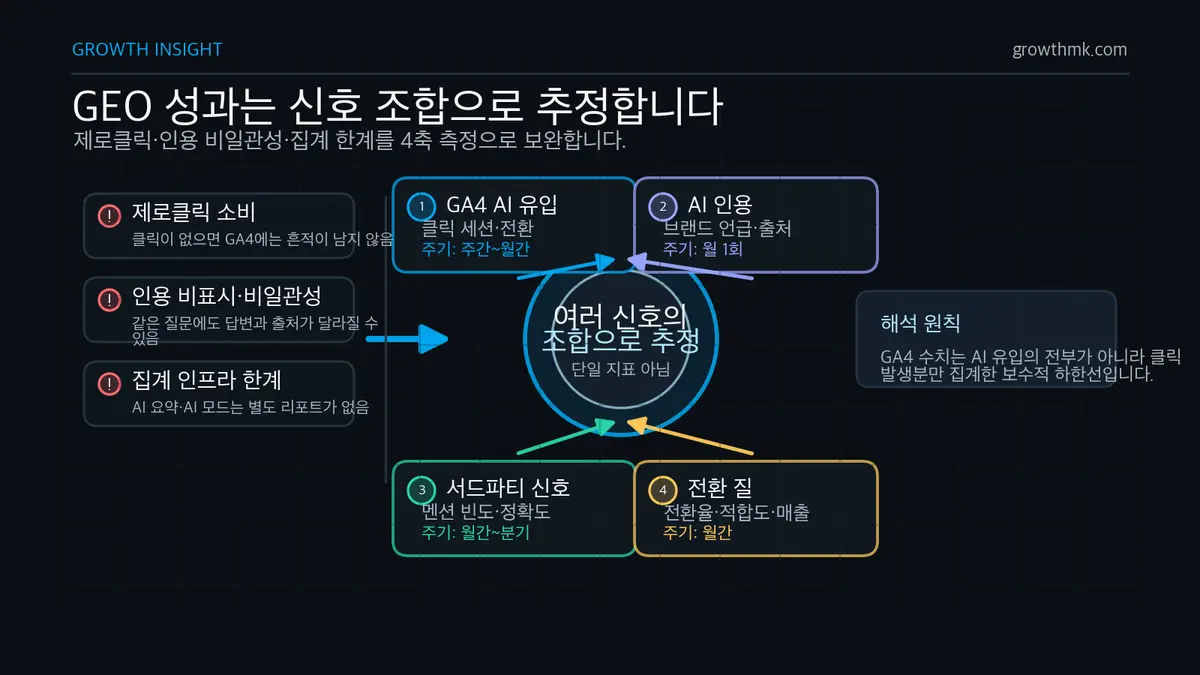
- Zero-click consumption — When AI summarizes the answer for the user, a large share of users read the answer and leave without clicking. If no click happens, nothing shows up in GA4 at all. Even if your brand was cited, the data treats it as if it never happened.
- Unlabeled and inconsistent citations — Even for the same question, the AI’s answer and cited sources can change every time. Even when you are cited, the link is often hidden behind a collapsed UI element, or your brand is simply named without a link at all.
- Limits of aggregation infrastructure — Different platforms log referrals differently. Some register as referral traffic; others aren’t distinguished at all.
In particular, traffic from Google’s AI Overviews and AI Mode is folded into the general “Web” search type in Search Console’s performance report. According to Google’s official documentation, no separate markup or file is required to appear in AI features, but by the same token, there is no report that isolates AI Overview performance either. In other words, click data alone can’t tell you whether your article was cited in an AI Overview. So the right conclusion about GEO measurement isn’t “it’s impossible” — it’s “you estimate it by combining multiple signals.”
The 4 axes of GEO measurement at a glance
Here are the four axes Growth applies to its own measurement, and to its clients’. Each axis compensates for a different blind spot in the others.
| Axis | What it captures | Core tool | Cadence | Limitation |
|---|---|---|---|---|
| ① GA4 AI-referral segment | Sessions and conversions from users who clicked a link from an AI service | GA4 Explore / custom channel groups | Weekly–monthly | Only captures click-throughs — a floor, not the full picture |
| ② AI citation monitoring | Whether the brand is mentioned or cited in answers to representative questions | ChatGPT, Perplexity, Gemini, Google Search | Monthly | Answers are non-deterministic — treat as a sample |
| ③ Brand mentions & third-party signals | How often and how accurately the brand is mentioned off-site | Google Alerts, mention-tracking tools | Monthly–quarterly | Causal link to citations is indirect |
| ④ Conversion-quality evaluation | Conversion rate, fit, and revenue contribution of AI-referred leads | GA4 key events + CRM | Monthly | Small sample size — read as a trend, not a point value |
Axis ① — Building an AI-referral segment in GA4
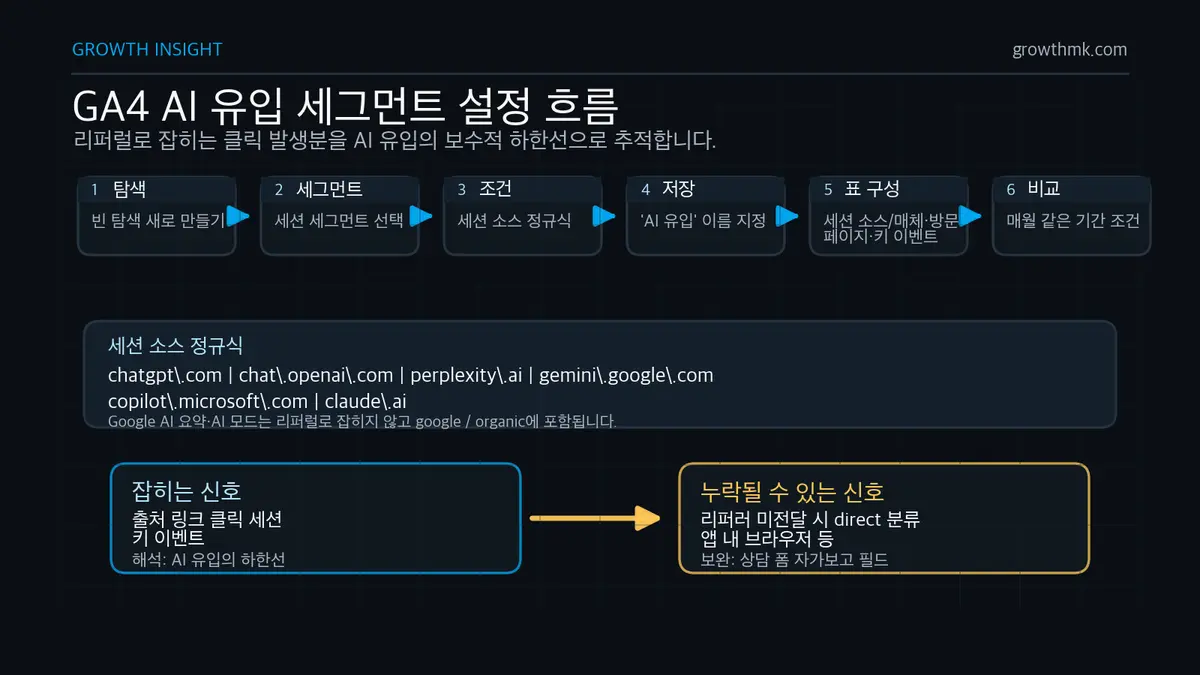
You can identify visitors who clicked a source link in a ChatGPT or Perplexity answer as referral traffic in GA4. As GA4’s default channel grouping documentation defines it, traffic that arrives via a link from another site is classified with medium = referral. In practice, the AI referrer domains you’ll most commonly see are these.
| Platform | Referrer domain | Notes |
|---|---|---|
| ChatGPT | chatgpt.com (formerly chat.openai.com) | Domain migrated in the past — include both domains |
| Perplexity | perplexity.ai | Displays source links in answers by default |
| Google Gemini | gemini.google.com | Identify by full hostname so it isn’t confused with google.com search traffic |
| Microsoft Copilot | copilot.microsoft.com | Tallied separately from Bing search (bing.com) traffic |
| Claude | claude.ai | Anthropic’s AI assistant |
| Google AI Overviews / AI Mode | Not captured as referral | Rolled into google / organic — combined into the “Web” type in Search Console |
Setup takes about 10 minutes. Here are the steps using an Explore report.
- Open Explore in the left GA4 menu and start a new “Blank” exploration.
- In the Variables panel, click “+” under Segments and choose Session segment.
- Set the condition dimension to Session source, change the operator to “matches regex,” and enter the pattern: chatgpt.com|chat.openai.com|perplexity.ai|gemini.google.com|copilot.microsoft.com|claude.ai
- Save the segment as “AI referral.”
- Build the table with “Session source/medium” and “Landing page” as dimensions, and “Sessions,” “Engagement rate,” and “Key events” as metrics. The landing page dimension gives you a clue for tracing back which articles are being cited by AI.
- Compare the trend month over month, using the same date range each time. If you need to check this on an ongoing basis, go to Admin → Data display → Channel groups and create a custom “AI” channel with the same condition so you can track it in standard reports too.
One thing to keep in mind when interpreting this: GA4 processes source and medium from referrer data (see GA4’s traffic-source collection documentation), but in some in-app browser environments, referrer information isn’t passed at all, so the session gets classified as direct. That means this segment’s numbers aren’t “all AI referrals” — they’re a conservative floor. And none of this matters if your key-event (conversion) setup itself is shaky to begin with — check your foundation in Why Tracking Setup Matters for B2B Marketing.
Axis ② — AI citation monitoring: a monthly question-set protocol
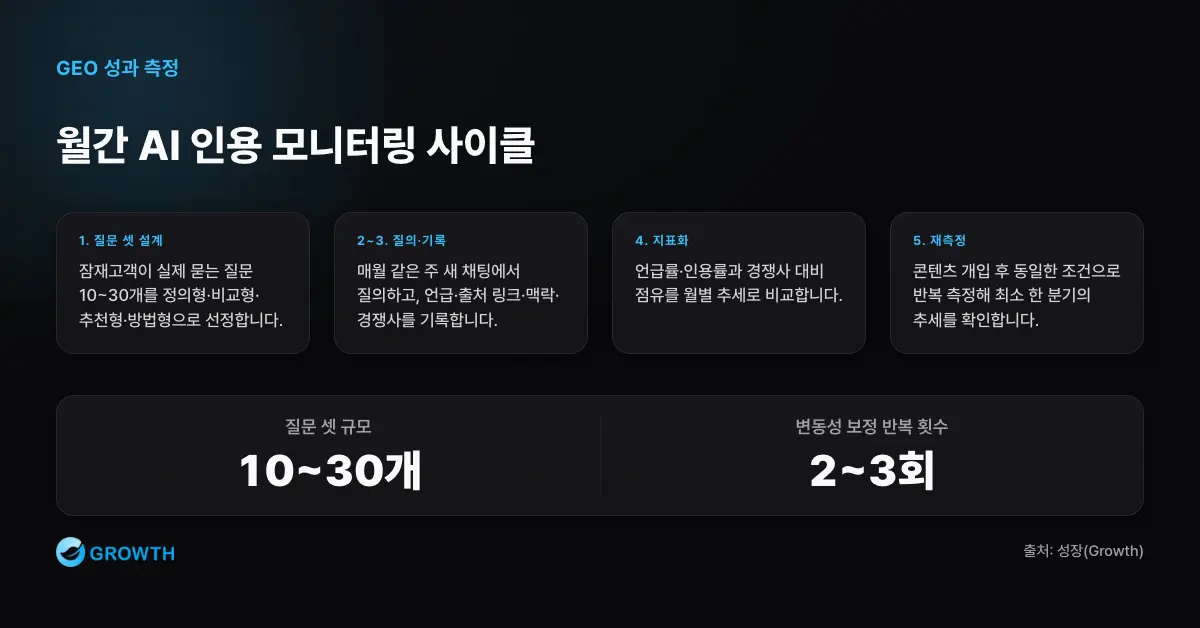
The way to catch the “zero-click citations” that click data can’t see is to simply ask. Build a representative set of questions that your prospects would actually ask, query the major AI engines under the same conditions every month, and log any brand mentions. Here’s the protocol Growth runs.
| Step | Task | Execution standard |
|---|---|---|
| 1. Design the question set | Pick 10–30 questions your prospects actually ask — definitional (“What is GEO?”), comparative (“A vs. B”), recommendation-seeking (“recommend an agency”), how-to (“how do I do X”) | Distribute across customer-journey stages, refresh quarterly |
| 2. Run the queries | Enter the same questions into ChatGPT, Perplexity, and Gemini in the same week each month + check for AI Overview appearance in Google Search for the core questions | Run in a fresh chat with no prior conversation context |
| 3. Log results | Whether the brand was mentioned / whether the source link was cited / the tone of the mention (positive, neutral, inaccurate) / competitors mentioned alongside | Accumulate in a question × engine matrix spreadsheet |
| 4. Turn it into metrics | Mention rate (questions mentioned ÷ total questions), citation rate (share including a link), share of mention versus competitors | Compare month over month as a trend — don’t overreact to a single month’s swing |
One premise is worth remembering: because AI answers can change every time for the same question, a single query is just “one sample.” For your five or so most critical questions, running them 2–3 times and logging the variance reduces misinterpretation. What matters isn’t any single month’s snapshot — it’s the quarterly trend.
This protocol actually works. In June 2026, when Growth queried Google Search for “recommended B2B marketing agency,” we confirmed firsthand that the AI Overview cited and mentioned our own service page. What’s notable is that this exposure showed up neither in GA4 referrals nor as a separate line item in Search Console. Without question-set monitoring, this result would have gone completely unnoticed. Your brand may already be getting cited somewhere too — if you never check, that performance simply doesn’t exist.
Axis ③ — Brand mentions and third-party signals
For AI to cite a brand, it first has to “know” the brand. Generative engines encounter brands through two paths: the model’s training data, and real-time web browsing at the moment an answer is generated. Perplexity, for example, has its Perplexity-User agent visit relevant web pages directly when a user asks a question, and includes links to those pages in its answer (see Perplexity’s official documentation). What determines the outcome on both paths is the set of signals that exist “off” your own site.
- Whether your brand is listed in industry directories and comparison sites, and how accurately it’s described
- Mentions in press, blogs, and communities — including mentions without a link
- Reviews and ratings on review platforms
- Consistency across how third-party documents describe your brand
Princeton researchers’ GEO paper showed experimentally that content interventions — like adding citations, statistics, and source references — can boost visibility in generative engines by up to 40% (see arXiv 2311.09735). Ultimately, brands that are mentioned frequently and accurately by trustworthy sources get cited — E-E-A-T operates on the same underlying logic in GEO.
You can start measuring this simply. Track new mentions monthly using Google Alerts or a mention-tracking tool, and every quarter, ask an AI directly, “What kind of company is [your brand]?” to check the accuracy of how it’s described. If inaccurate information keeps recurring, tracking down and correcting the third-party source behind it is the necessary follow-up work on this axis. We go deeper on where a brand should position itself in the B2B market in the AI era in B2B Marketing Positioning in the AI Era.
Axis ④ — Conversion-quality evaluation: the standard is “the one person who becomes revenue”
The last axis is the most important, and the one most often skipped. AI-referred traffic is typically a much smaller absolute volume than search traffic. If you only look at session counts, it’s easy to conclude “GEO isn’t working.” But the standard Growth has consistently emphasized isn’t traffic volume — it’s “the one person who becomes revenue.”
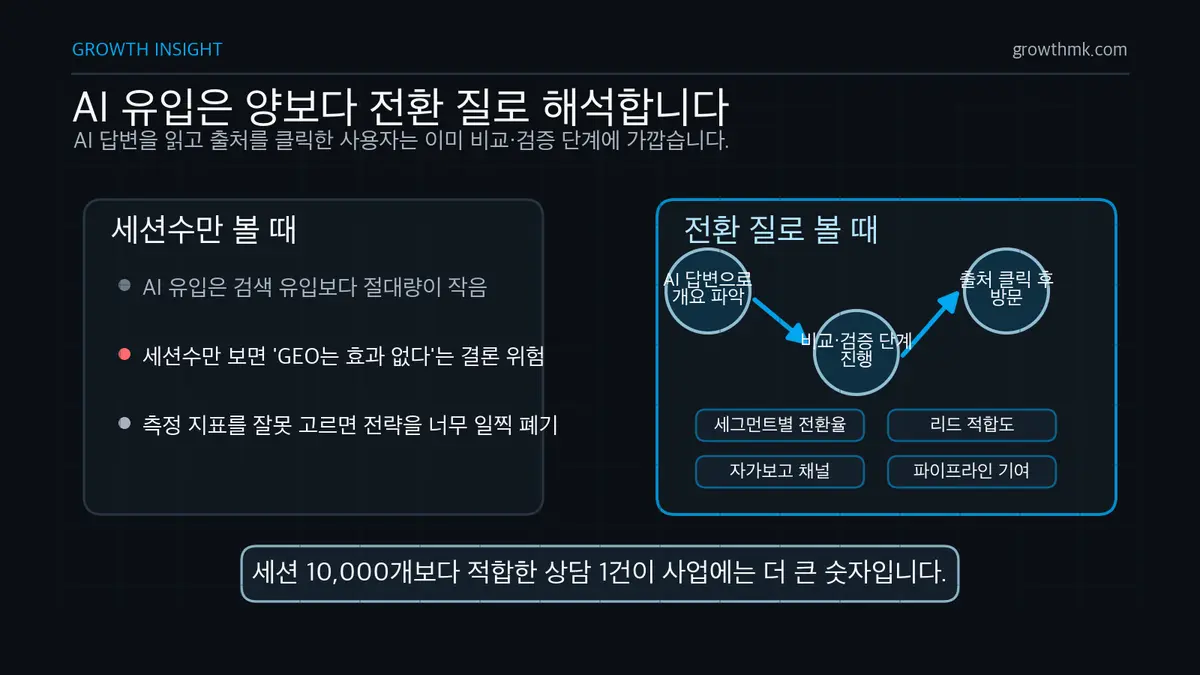
Think about a user who reads an AI’s answer and still bothers to click through to the source. They’ve already grasped the overview from the summary and are visiting having already made it to the comparison-and-verification stage. Google’s official documentation also notes that clicks arriving via AI features tend to lead to higher-quality engagement. That’s why the metric for axis ④ is quality, not quantity.
- Conversion rate by segment — compare the AI-referral segment’s key-event conversion rate against the overall average
- Lead fit — evaluate whether AI-referred leads match your target industry, company size, and job title
- Self-reported channel — add a “How did you hear about us?” field to your consultation form to cover gaps from missing referrer data
- Pipeline contribution — in your CRM, tag AI-referral leads and track their consultation conversion and deal-win rates
Choosing the wrong metric leads you to abandon the right strategy too soon. The exact trap we covered in The ROI and ROAS Trap happens even more often in GEO. One well-fit consultation is a bigger number for the business than 10,000 sessions.
Monthly GEO measurement operating template
So you don’t have to rethink the four axes from scratch every time, we recommend locking your cadence into a single operating routine table. Feel free to copy the template below and start from it directly.
| Cadence | Task | Tool | Output |
|---|---|---|---|
| Weekly | Check sessions and key events in the GA4 “AI referral” segment — watch for spikes or drops | GA4 Explore | Weekly notes |
| Monthly | Query the full question set against ChatGPT, Perplexity, Gemini, and Google Search; log mentions and citations | Each AI engine + spreadsheet | Monthly trend of mention rate / citation rate |
| Monthly | Review AI-segment conversions and lead fit; tally self-reported form responses | GA4 + CRM | Conversion-quality report |
| Quarterly | Refresh the question set, audit brand mentions, check accuracy of how AI describes the brand | Google Alerts / mention tools + direct AI queries | Quarterly GEO review |
The key is repeating under identical conditions. The first month’s numbers aren’t a pass/fail verdict — they’re a baseline, and meaningful judgment only becomes possible once you’ve accumulated at least a quarter’s worth of trend data. Just like a growth-hacking experiment cycle, running the loop of “measure → hypothesize → intervene with content → re-measure” is what turns GEO from luck into an operating discipline.
GEO investment only becomes a real decision once a measurement system is in place. Through our GEO/AIEO service, Growth builds everything with you — from setting up your AI citation measurement system to designing content that earns citations. Start with our GEO/AIEO service or request a consultation.
Frequently Asked Questions
How quickly does GEO performance show up?
Because there’s a lag before content gets crawled, indexed, and reflected in AI answers, it’s generally safer to expect this on a timescale of weeks to months. That’s why it’s important to manage the trend through monthly monitoring under consistent conditions, rather than a one-off check. Treat your first measurement as establishing a baseline, not as a pass/fail verdict.
Where can I check whether I’ve been cited in a Google AI Overview?
Right now, Search Console rolls AI Overview and AI Mode performance into the general “Web” search type and doesn’t provide a separate report. So question-set monitoring (Axis ②) — directly searching your core questions on Google and visually checking for AI Overview exposure — is currently the most reliable way to confirm this.
Can AI-referred traffic sometimes show up as “direct” in GA4?
Yes. In some environments, like in-app browsers, referrer information isn’t passed along, so the session gets classified as direct. That’s why GA4 referral-segment numbers should be read as a floor for AI referrals, and we recommend covering the gap with a self-reported field (“How did you hear about us?”) on your consultation form.
Can AI citation monitoring be automated?
You can automate it with API-based querying or a dedicated GEO tracking tool. That said, because AI answers can vary even for identical questions, you still need to interpret results with sample variance in mind, even with automation. If your question set is 30 items or fewer, a monthly manual protocol alone is enough to get started without a heavy operating burden.