Where Does B2B Marketing Position Itself in the AI Era?
 임재복
임재복
In an era where we can genuinely feel how far AI technology has come, many of us find ourselves gripped by a kind of anxiety, wondering whether we should be learning to code before it’s too late. I’ve had that same thought myself. And yet the most unexpected answer to that worry comes from someone you wouldn’t expect — Jensen Huang, CEO of Nvidia, the company that controls roughly 90% of the global AI chip market.
Speaking at the World Governments Summit in Dubai, Huang said humanity is entering a new industrial revolution, and declared his ambition plainly: “No one has to program anymore. We’re going to make it possible for everyone to use a programming language.” He added that if he went back to college today, he’d study biotechnology instead of computer science.
That might sound like a death knell to programmers and developers, but plenty of people in the industry still believe humans won’t be replaced anytime soon. With opinions this divided, it feels like the right moment to ask where each of us actually stands. Marketers in particular — how should we respond to the AI era? As the saying goes, history is both a mirror reflecting the present and a compass pointing toward the future, so it’s worth taking a careful look at exactly that.
From the Birth of 20th-Century Marketing to Marketing in the AI Era
Marketing’s origins go back a surprisingly long way. The concept of marketing as we typically think of it today took shape in the 20th century, but you could argue that marketing’s prototype already existed in ancient times, wherever trade and commerce happened between people.
Between roughly 3000 BCE and the 5th century CE, ancient civilizations — Mesopotamia, Egypt, Greece, Rome — carried on active early commerce, exchanging goods and services. Back then, the prototype of “marketing” essentially meant whatever means merchants used to sell their goods.
One of the earliest known advertising records is a cuneiform inscription on a clay tablet from ancient Mesopotamia. One surviving example is a cuneiform letter of complaint about a shipment of copper ore that arrived at the wrong grade after a Gulf voyage.
From there, ancient Egypt used papyrus posters for political campaigns, and mass production became possible with the rise of printing technology in the late 15th century. That’s when text-based media like newspapers and flyers first emerged.
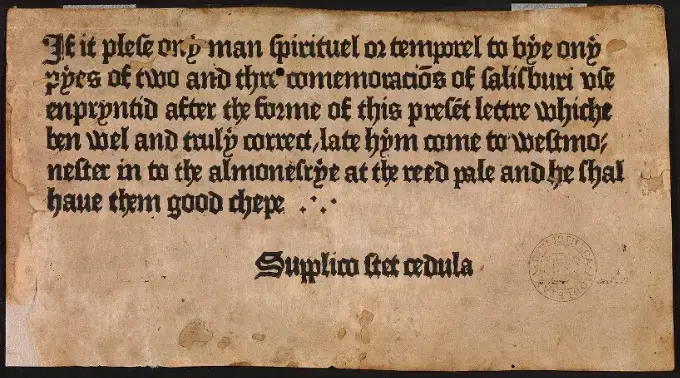
The first known print ad is widely credited to William Caxton’s book advertisement, printed to sell a religious text known as the Sarum Ordinal, or “Pye.” Alongside the promotional copy for the book, the flyer included a request not to damage the notice itself.
After the 20th century, radio and TV opened up an era of sound and moving images, and advertising became a far more visceral medium. It was a one-way channel, but an enormously powerful one — this is the era when TV drama product placement began, jingles became popular, and the concept of “branding” emerged in earnest. From this point on, creativity, alongside ad spend, became central to marketing.
In 1941, Bulova, the American watchmaker, aired the first legally sanctioned TV commercial in the US, on New York’s WNBT channel. The 10-second ad showed an image of a watch alongside the slogan “America runs on Bulova time.” At the time, there were only 4,000 TV sets in New York, making the $9 ad spend a technical failure by any commercial measure — but it holds enormous significance as the very first TV ad ever aired.
After the 2010s, the rise of the internet and smartphones shifted marketing from a one-way broadcast into something far more conversational. Brands could get customer feedback in real time, and as consumption patterns shifted quickly, short-form text and video ads took off. More recently, the center of gravity has been shifting away from “brand” fandom and toward “individual” influencers instead.
Every time a new technology emerged, marketing strategy kept changing right alongside it. In other words, technology isn’t just a tool — it’s the environment itself. Succeeding at marketing over the long run has always meant genuinely understanding the nature of the technology driving each industrial shift, and reading the paradigm that comes with it. And now, we’ve entered the AI era.
How Search Engine Marketing Is Changing in the AI Era
Changes to Google’s Search Algorithm
AI’s rapid advance is also driving a transformation in search engines — and Google sits right at the center of that shift.
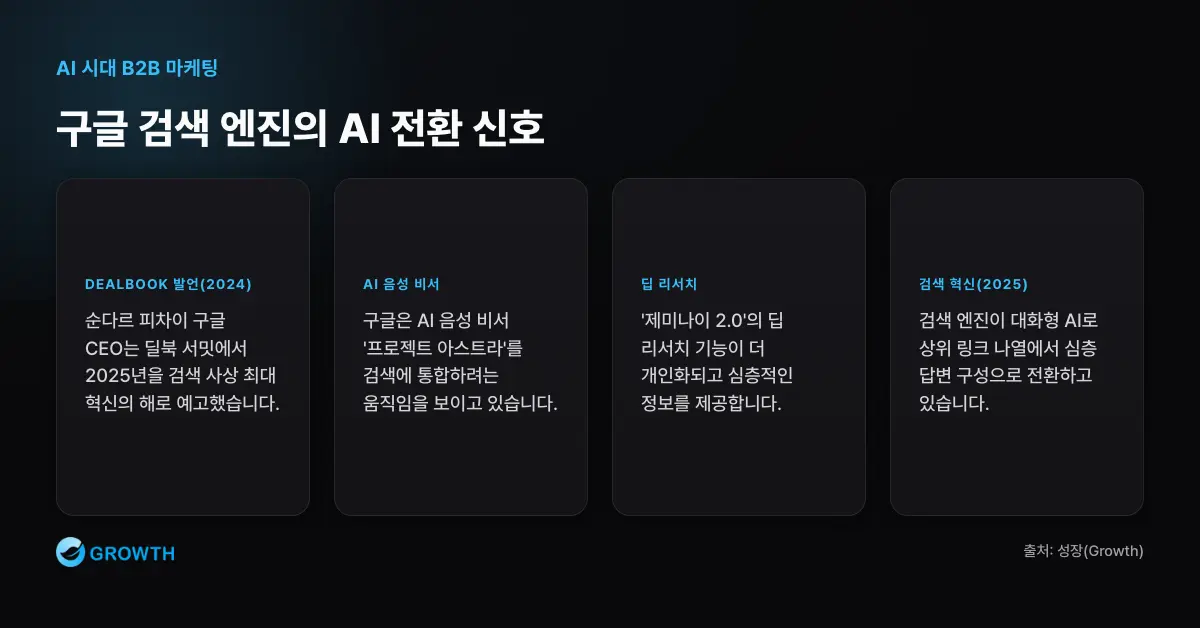
Google is clearly moving to strengthen its position by integrating AI deeper into its search engine. Google CEO Sundar Pichai said at the New York Times’ 2024 DealBook Summit that “2025 will be the biggest year for innovation we’ve ever seen in search,” previewing sweeping changes to AI-powered search.
As part of that strategy, Google has rolled out AI voice assistants like “Project Astra,” and said its “Deep Research” feature within Gemini 2.0 would deliver more personalized, in-depth information to users. Google has also said that advances in AI would strengthen the search engine’s underlying capabilities, and confirmed plans to add conversational AI functionality directly into search. All of this reflects Google’s effort to hold onto its leading position in search even as the AI era unfolds.
Search Engines’ Shifting Influence on Domestic B2B Business
So why bring up Google at all? Given the current direction of change, this shift actually carries real implications for the domestic B2B business environment too.
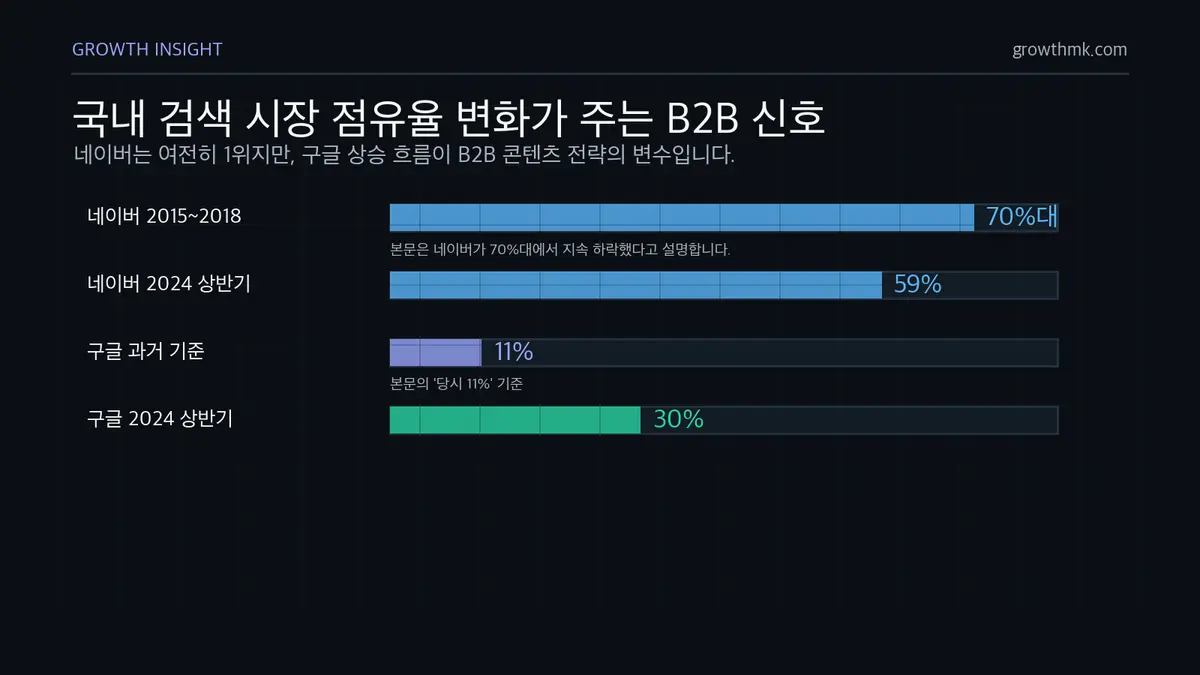
Traditionally, Korea’s search engine market has been led by Naver, but Google’s share has been climbing steadily. As of the first half of 2024, Naver held roughly 59% of the market and Google roughly 30%. You might reasonably ask, “so why does Google matter?” looking at those numbers alone — but what matters is the direction of the trend. Naver’s share sat around 70% between 2015 and 2018 and has been declining ever since, while Google, which held just 11% back then, has climbed all the way to 30%.
Naver still holds the top spot in Korea’s overall search market, but B2B is something of an exception. Naver’s chronic, unresolved problem — ad fatigue — is likely to become an increasingly significant factor in the B2B space. Anyone who’s used it can feel this problem firsthand: the sheer fatigue of wading through ad after ad. Search “how to learn to code,” for instance, and instead of finding real information, you’ll typically run into a wall of ads for coding bootcamps and services.
So why can we make the case that Google is set to become the more important search engine going forward? Because of the arrival of generative AI — namely, ChatGPT.
Win Over the Large Language Models, and the Traffic Follows
Search powered by GPT has been on the rise recently. Chances are, if you’re reading this, you’ve tried ChatGPT yourself at least once — that’s how widely it’s used. The numbers back this up: as of February 2025, ChatGPT’s weekly active users worldwide surpassed 400 million globally. That’s up 33% from 300 million just two months earlier, in December 2024.
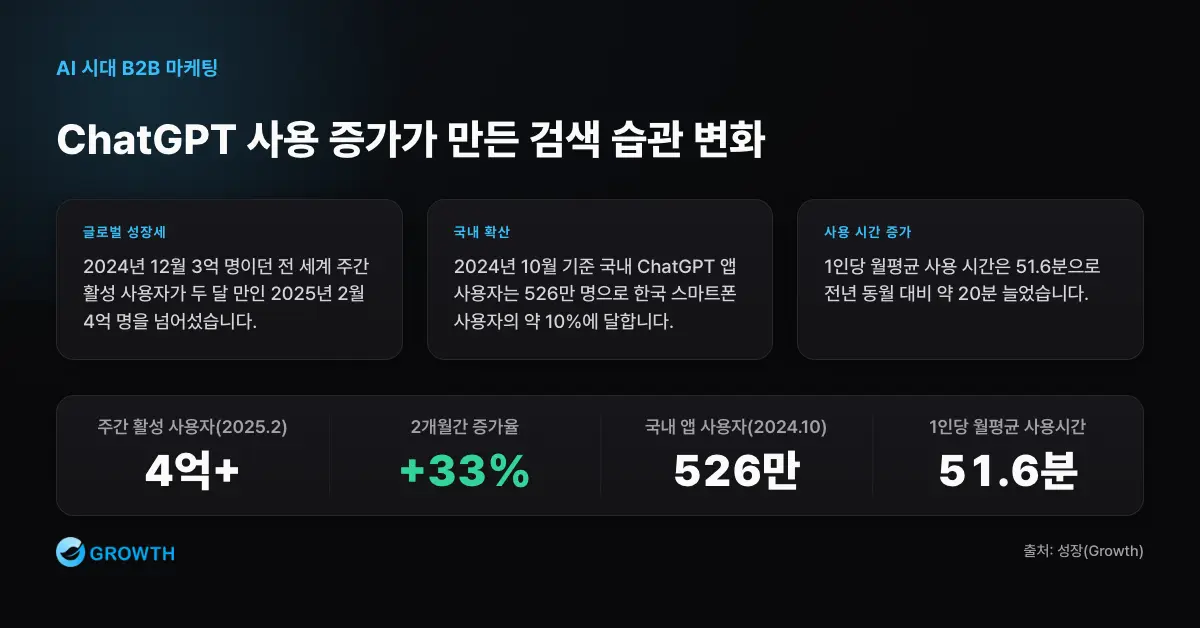
The domestic market tells a similar story. As of October 2024, ChatGPT’s app had 5.26 million users in Korea — roughly 10% of all Korean smartphone users. Average monthly usage time per user on the ChatGPT app reached 51.6 minutes, up roughly 20 minutes from the same month a year earlier. That points to AI increasingly establishing itself as an alternative to traditional search engines, and to a real shift underway in how people search.
When I actually searched “how to learn to code” on GPT, the results looked strikingly different from what Naver returned. Rather than promotional content, it gave me information genuinely tailored to what I was looking for — walking me through the steps of learning to code, compiling a curated list of related resources, and even pointing me toward free learning platforms I could use at no cost.
The key thing to notice here is where GPT’s content actually comes from. The content it drew on wasn’t optimized for Naver — it was written and optimized for Google SEO. That points to something important: going forward, marketing strategy needs to move beyond simply chasing Naver’s or Google’s logic, and focus instead on publishing content built for AI’s logic.
If You Need B2B Marketing, SEO Content Is Non-Negotiable
SEO, and AI Search Engine Optimization (AIEO)
AI’s arrival is changing the very nature of search. Where “who ranks higher” used to be what mattered most, “whose content AI actually cites and recommends” is now what separates the marketing winners from everyone else. Google itself is reshaping the search results page with generative AI answers (AI Overviews), and the strategy for boosting content visibility in this environment, where AI synthesizes and cites answers, is what’s known as generative engine optimization (GEO). We’ve broken down exactly how GEO overlaps with and differs from traditional SEO in our GEO vs. SEO comparison.
This shift lands even harder in B2B marketing. Unlike a B2C product like shampoo or toilet paper — something we buy quickly, on impulse, in everyday life — a single B2B purchase decision typically involves an average of 6.8 stakeholders.
Given the higher price points, the risk that comes with switching systems, and the ripple effects that follow a signed contract, B2B buyers skip the impulse purchase entirely and instead move through a customer decision journey (CDJ) built on learning, comparing, and reviewing trustworthy content. That means B2B marketers need a content strategy built on detailed, expert-level persuasion around a product’s features, benefits, results, and implementation outcomes — not short, punchy ad copy.
At the center of that strategy sits SEO-driven evergreen content: content that doesn’t lose its credibility over time, is structured to be discoverable through search, and — above all — content AI has no real choice but to trust and recommend.
An AI Search Optimization Strategy Built on Evergreen Content
One company that’s put evergreen content to good use is Zapier, a workflow automation platform used globally. Zapier helps people automate repetitive tasks across thousands of apps — Slack, Gmail, Google Sheets, Salesforce, HubSpot, and more — without needing a developer, boosting productivity along the way.
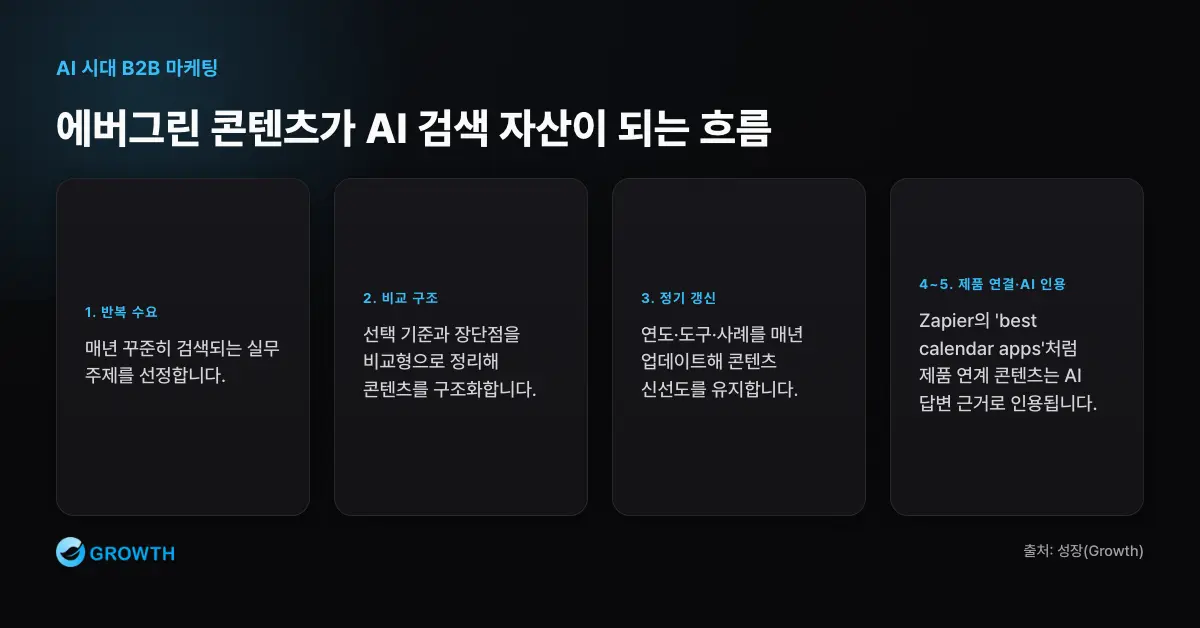
Zapier consistently builds out evergreen content centered on “topics that generate steady search traffic.” Take a look at a good example of that content: “The 5 Best Calendar Apps in 2025.” It’s a comparison-style piece built around one of Zapier’s core keywords — “best calendar apps.”
The keyword “calendar apps” ties directly to workplace productivity, which makes it a topic B2B professionals search for often, and the piece is structured so it can simply be updated with a new year and reused indefinitely. The content lays out the pros and cons of each app, recommends the right app for different types of users, and then ties it all back to how you can automate it through Zapier — an effective structure from start to finish.
A Competitive Marketing Strategy for the AI Era
This is exactly where marketers need to focus going forward. Marketing competition in the AI era is turning into a contest over who holds the largest stockpile of “trustworthy information assets.” In other words, how much authority you carry in AI search has become the thing that matters.
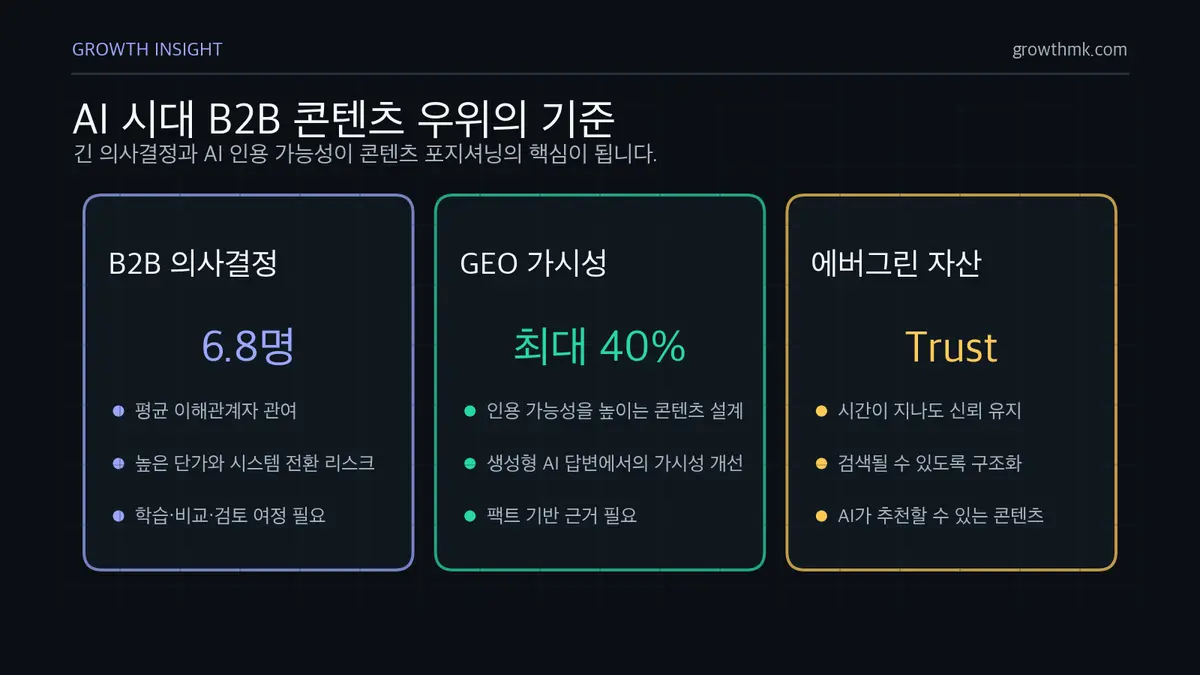
Which means the core of where we need to position ourselves going forward comes down to who builds content that AI cites and customers trust first, and in the greatest volume. This isn’t just a claim — GEO research (Aggarwal et al., 2024) on generative engine optimization has empirically demonstrated that content designed to boost citation likelihood can lift visibility in generative AI answers by up to 40%. Evergreen content built on clear, fact-based evidence doesn’t just drive clicks from your target audience today — it positions you to win in AI-powered search, which is coming sooner than you might think.
Related reading
- The Complete Guide to B2B Marketing — Strategy, Channels, ABM, Lead Generation, and Measurement
- What Should Be Different About Marketing to B2B Decision-Makers?
- How Do B2B Marketing Channels Differ From B2C?
- B2B Content Marketing: Video vs. Text
- Do B2B Newsletters Actually Drive Revenue?
If you want to apply this to your own business — you can see Growth’s approach on our B2B marketing services page, and if you need a concrete assessment of your situation, reach out through our consultation contact form. We answer in terms of the one customer who becomes revenue, not raw traffic volume.
FAQ
How should B2B marketers position themselves in the AI era?
Marketing competition in the AI era is turning into a contest over who holds the largest stockpile of “trustworthy information assets.” B2B marketers need to focus on building evergreen content that AI cites and customers trust — content built on expert-level persuasion around a product’s features, benefits, results, and implementation outcomes, not short, punchy ad copy — and doing it first and at greater volume than the competition.
For B2B business, should you focus on Naver or Google?
Naver still leads Korea’s overall search market, but B2B looks different. Naver’s chronic ad-fatigue problem remains unresolved, while Google’s share has climbed steadily from around 11% to roughly 30%. More importantly, the content AI tools like ChatGPT tend to cite is largely written and optimized for Google SEO. That’s why a content strategy targeting both Google SEO and AI search is becoming increasingly important for B2B.
What is AIEO (AI search engine optimization), or GEO?
AIEO/GEO is the strategy of optimizing content so generative AI tools like ChatGPT and Google AI Overviews cite and recommend it when generating an answer. Where traditional SEO was about “earning clicks through top rankings,” GEO aims for “being cited and referenced within an AI-generated answer.” That said, AI answers ultimately still draw on a search index, so GEO doesn’t replace SEO — it’s an extension built on top of it. See our linked GEO vs. SEO comparison above for a detailed breakdown.
Why does evergreen content matter so much in the AI search era?
Evergreen content is content that doesn’t lose credibility over time, is structured to be discoverable through search, and is genuinely worth AI trusting and recommending. Like Zapier’s “best calendar apps” content covered above, building content around topics with steady search demand, structured so it can simply be refreshed and reused every year, drives clicks today and raises the odds of ongoing citation in AI-powered search too.