
GEO vs SEO: What’s the Same, What’s Different, and Why You Need Both
 임재복
임재복
GEO (Generative Engine Optimization) and SEO (Search Engine Optimization) share the same goal — “get found in search” — but they’re aiming at different things. SEO aims to rank higher and earn clicks on the search results page, while GEO aims to be cited, mentioned, and recommended inside AI answers from tools like ChatGPT, Perplexity, and Google AI Overview. And because both operate on the same foundation — crawlability, structure, trustworthiness — they aren’t an either-or choice; they’re a pair that has to move together.
This article lays out the differences, the shared foundation, and how to prioritize between the two, backed by data, so marketers and decision-makers can answer clearly: “what’s the difference between GEO and SEO?” and “do we still need to do SEO in the AI era?”
The 3-line summary — how GEO and SEO differ
Before the long explanation, here’s a self-contained answer to the question we get asked most often.
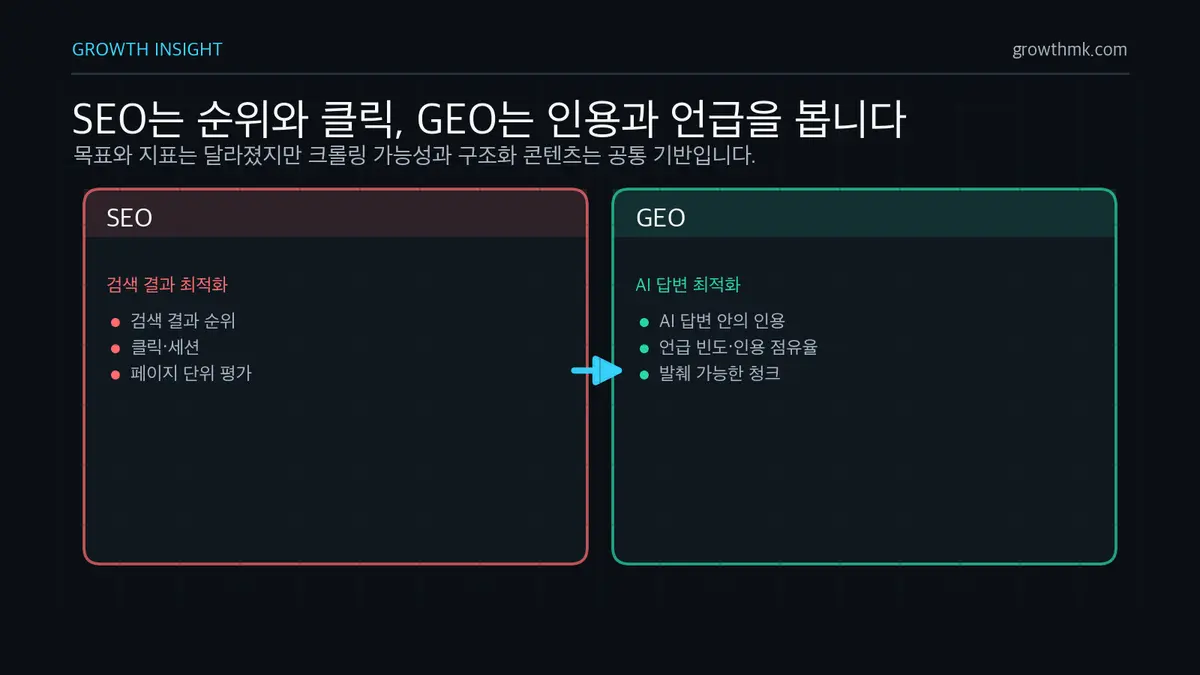
- The goals differ. SEO targets search-result ranking; GEO targets citation inside AI answers.
- The performance metrics differ. SEO looks at clicks and sessions; GEO looks at mention frequency and citation share of voice.
- The foundation is the same. Crawlability, structured content, and E-E-A-T (Experience, Expertise, Authoritativeness, Trustworthiness) are prerequisites for both.
In other words, GEO doesn’t replace SEO — it’s an expansion that builds on top of it. Search Engine Land puts it plainly: “Traditional SEO optimizes for rankings and clicks, while GEO optimizes for mentions, citations, and recommendations within AI-generated responses. The two work together” (Search Engine Land, What is GEO).
What’s different — three core distinctions
The difference between GEO and SEO isn’t an abstract philosophical debate — it boils down to three concrete distinctions that change what you build and what you measure in practice. Let’s lay them out in a table first, then unpack each one.
| SEO (Search Engine Optimization) | GEO (Generative Engine Optimization) | |
|---|---|---|
| Ultimate goal | Rise in search ranking | Citation/mention in AI answers |
| User behavior | Click a link → visit the site | Brand exposure within the answer → awareness/trust |
| Content unit | Evaluated at the page level | Evaluated at the extractable chunk (paragraph/sentence) level |
| Core metrics | Ranking, CTR, sessions, conversions | Citation frequency, citation share, sentiment within answers |
| Surfaces | Google, Naver SERPs | ChatGPT, Perplexity, AI Overview, Gemini |
1. From ranking to citation
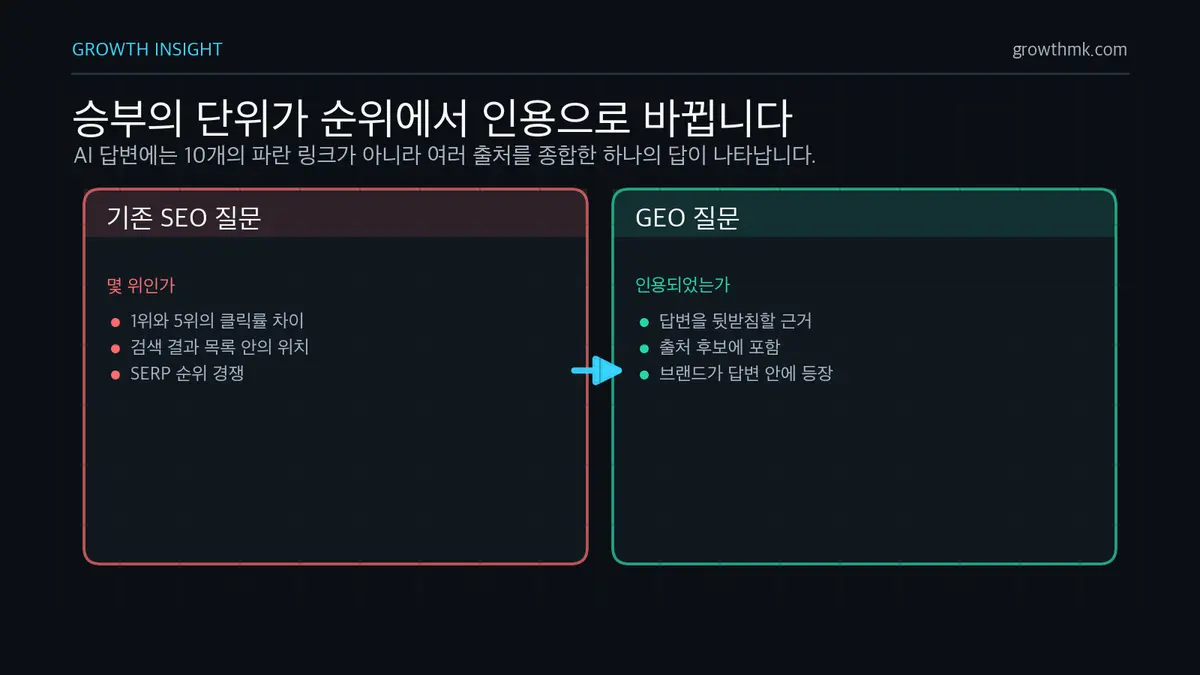
In the world of SEO, the contest was where you landed among “ten blue links.” The gap in click-through rate between rank 1 and rank 5 was directly a gap in revenue. But AI answers don’t have a ranked list. AI synthesizes multiple sources into a single answer, and cites a handful of pages as the evidence backing that answer. So GEO’s question isn’t “what rank am I?” — it’s “was I cited in this answer?” We cover the mechanics of the SEO SERP in more depth in the Complete Guide to SEO Marketing, and the principles of AI answer optimization in Generative Engine Optimization (AIEO).
2. From clicks to mentions
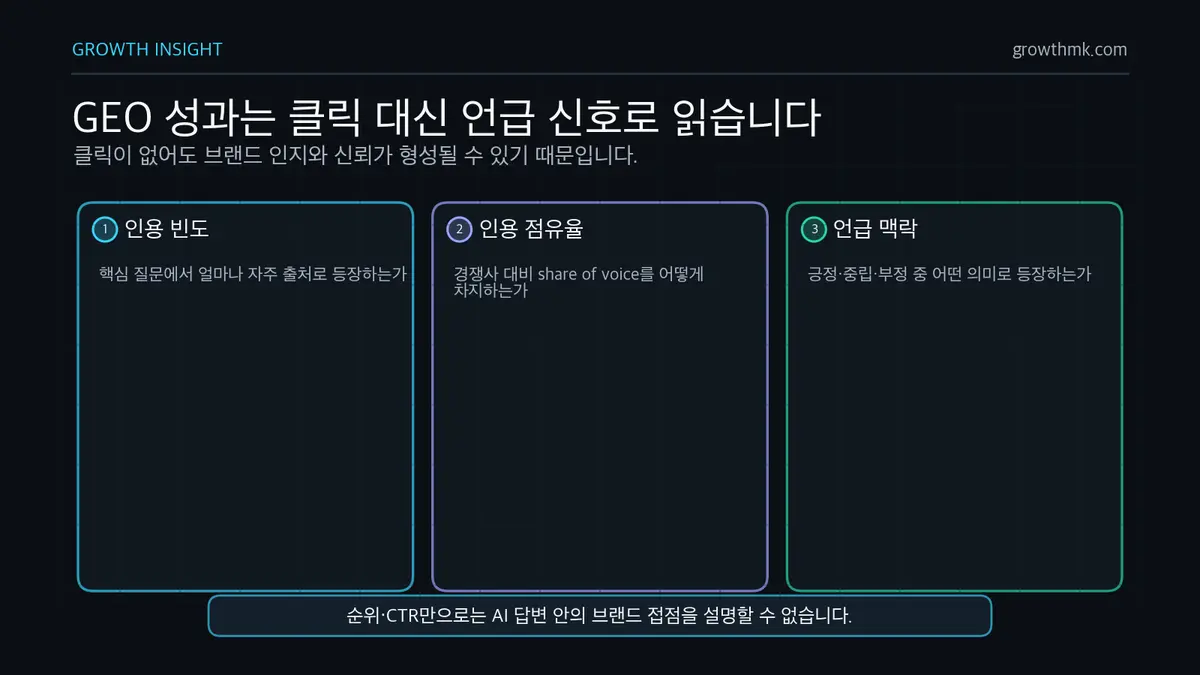
SEO performance is measured by clicks and the sessions that follow. A brand mention inside an AI answer, by contrast, builds awareness and trust even if the user never clicks. This difference changes how you measure. In GEO, instead of ranking and CTR, you need to track citation frequency, your citation share relative to competitors, and the context (positive, neutral, negative) in which the brand is mentioned within the answer.
3. From pages to chunks
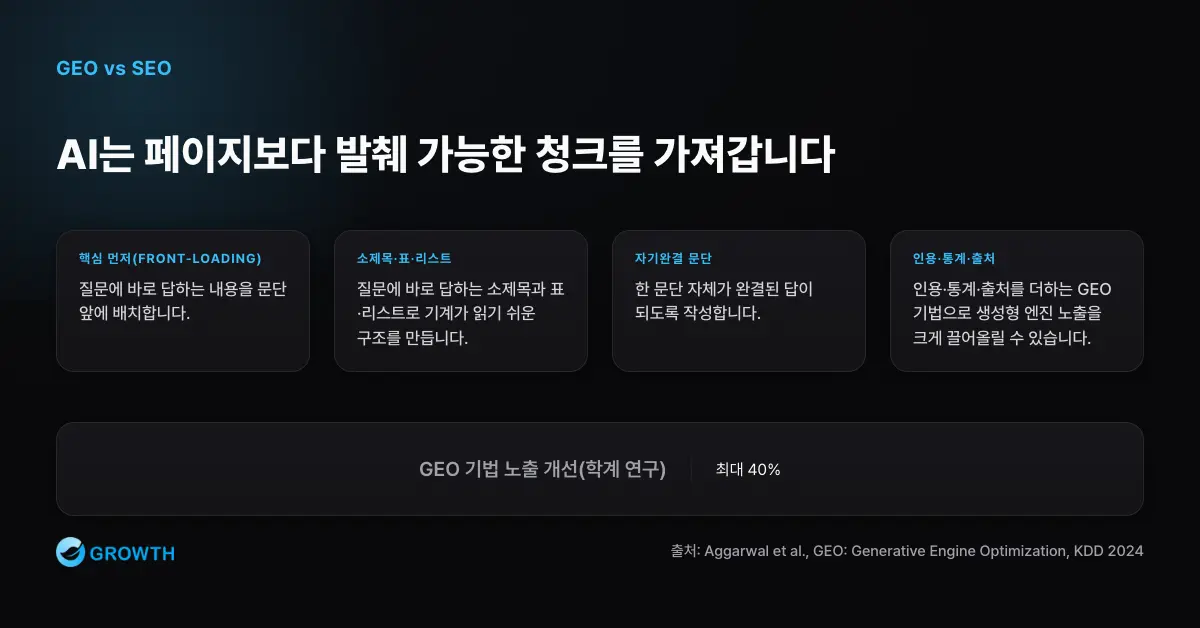
Search engines have long evaluated the whole page as a single unit. AI is different. AI pulls out self-contained paragraphs that directly answer the question from a page and uses those. So GEO is fundamentally about raising “extractability” — front-loading the core point, structuring content with clear subheadings and tables/lists, and writing each paragraph so it functions as a complete answer on its own. Academic research has actually reported that GEO techniques like adding citations, statistics, and sources can boost visibility in generative engines by up to 40% (Aggarwal et al., GEO: Generative Engine Optimization, KDD 2024).
What’s the same — the foundation they share
Looking only at the differences, GEO and SEO can feel like separate disciplines, but in practice, their foundations overlap almost entirely. To be cited in an AI answer, content first has to be readable, understandable, and trustworthy — and those three conditions are exactly SEO’s fundamentals.
| Shared foundation | Role in SEO | Role in GEO |
|---|---|---|
| Crawlability | Prerequisite for indexing | Prerequisite for becoming an AI training/citation candidate |
| Structure (schema/HTML) | Rich results, conveying meaning | Facilitates chunk extraction and context comprehension |
| E-E-A-T | Quality/ranking signal | Signal for judging whether a source is worth citing |
First, crawlability. A page bots can’t access can’t show up in a search index or in an AI answer. Second, structure. Clear heading hierarchy, schema markup, and tables/lists both help search engines understand the content and let AI pull out exactly the piece it needs for its answer (the fact that only about 6% of enterprise content includes a table is itself a differentiation opportunity). Third, E-E-A-T. Google states it uses “signals to help determine which content demonstrates experience, expertise, authoritativeness, and trustworthiness,” and cites, as a representative example, “whether other prominent sites link to or reference the content” (Google, How Search ranks results). This same signal is exactly what AI uses to judge “is this a source I can cite?” You can learn how to build E-E-A-T in What Is the E-E-A-T Standard?
Why you shouldn’t abandon SEO
You often hear “everyone just asks AI now, so SEO is dead.” But that stems from a misunderstanding of how AI search actually works. AI search still runs on top of a search index.
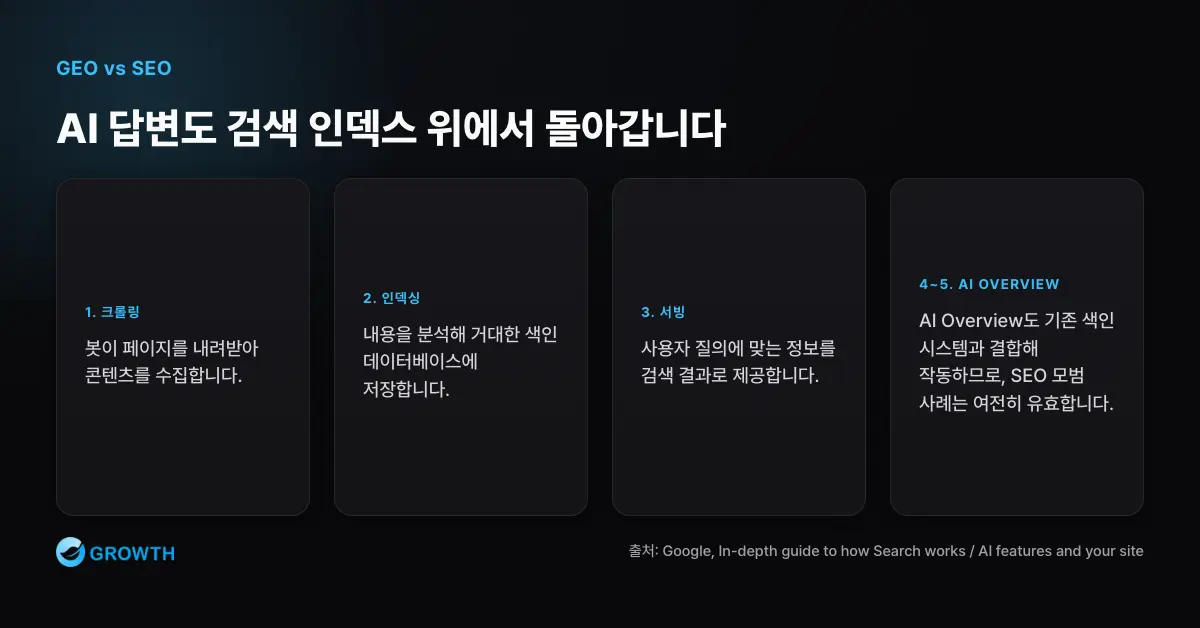
Google states that Search operates in three stages: crawling, indexing, and serving. Bots download pages (crawling), analyze the content and store it in a massive index database (indexing), and deliver information matching a user’s query (serving) (Google, In-depth guide to how Search works). What matters is this: a page that isn’t indexed can’t surface anywhere, for anything.
AI Overview is no exception. Google has stated that AI Overview uses “a custom Gemini model” for Search, but that it operates “combined with our core ranking and quality systems” (Google, Generative AI in Search). In other words, even when AI generates the answer, the raw material still comes from a search index that was shaped by SEO.
Critically, Google’s own documentation states it directly: “There’s no additional markup or requirements for appearing in AI Overviews or AI Mode”, and “SEO best practices still apply for AI features on Search” (Google, AI features and your site). In other words, there’s no separate magic for GEO — good SEO is GEO’s starting line. Abandoning SEO is the same as abandoning the opportunity to be cited in an AI answer in the first place.
What the data on two kinds of traffic shows — conversion quality isn’t the same
There’s one principle Growth has consistently observed across the many channels it runs: it’s not the volume of traffic that matters — it’s whether that traffic contains the one person who becomes revenue. The same lens is needed when comparing GEO and SEO.
The two paths represent different stages of a user’s decision-making journey. A user who clicks in from search results is usually actively researching information; a user who first becomes aware of a brand through an AI answer may be at an earlier awareness stage. Evaluating both kinds of traffic against the same yardstick — like immediate conversion rate — badly misjudges the value of one of them. They touch different points on the same Customer Decision Journey (CDJ).
That’s why Growth recommends a framework for observing the two traffic sources separately. Bundle sessions arriving via AI citation into their own segment (based on referrer and landing patterns), place it alongside SEO-driven traffic, and compare ① entry intent, ② depth of engagement and exploration, and ③ lead quality (real fit after a consultation converts). Making this kind of observation possible requires tracking design to come first — the concrete method is covered in Why Tracking Setup Matters for B2B Marketing. The point isn’t “which channel is bigger” — it’s answering, with data, “which channel brings in the better single person.”
Deciding priority — which companies should do what first?
Ideally, you’d do both, but resources are always limited. So where do you start? The answer depends on where your company currently stands. The table below lays out recommended priorities by situation.
| Company situation | Do this first | Why |
|---|---|---|
| New site with almost no search visibility | SEO fundamentals (crawling, structure, content) | GEO is impossible without indexing — the foundation comes first |
| Solid SEO, but invisible in AI answers | GEO layer (extractability, entity, citability) | The foundation exists, so expand into AI visibility |
| B2B or high-consideration purchase decisions | Weight toward GEO | Buyers rely heavily on AI during comparison and research |
| Local or immediate-conversion businesses | Prioritize SEO and local | “Right now, right here” search intent leads directly to clicks and visits |
The common principle is clear: the foundation — crawling, structure, E-E-A-T — always comes first, no matter what. On top of that, adjust the balance between GEO and SEO based on where your buyers actually go looking for information. Especially in areas like B2B, where decision cycles are long and comparison shopping is heavy, being cited in AI answers is becoming increasingly important. You can explore what this shift means for B2B positioning in B2B Marketing Positioning in the AI Era.
One more thing: the AI search era hasn’t erased the influence of search engines. Google has stated that links included in AI Overview “receive more clicks than when that same page appeared for the same query as a traditional web listing” (Google, Generative AI in Search). That means content built well through SEO can become an AI answer’s citation source and actually earn even better clicks. The two aren’t competitors — they reinforce each other.
Want to design GEO and SEO together?
Growth’s GEO/AIEO solution designs everything as a single flow — from diagnosing your SEO fundamentals, to strengthening AI-answer citability, to the data architecture that measures the conversion quality of both traffic sources separately. The standard isn’t “volume of traffic” — it’s “the one person who becomes revenue.” Learn more about our GEO/AIEO service or request a consultation, and let’s map out the right priorities for your business together.
Frequently Asked Questions
Does GEO completely replace SEO?
No. GEO doesn’t replace SEO — it’s an expansion built on top of it. AI answers (including AI Overview) still run on top of a search index, and Google’s own documentation states that “SEO best practices still apply for AI features.” Content that isn’t indexed can’t be cited in an AI answer either, so SEO is a prerequisite for GEO.
Should we still spend budget on SEO in the AI era?
Yes — it’s actually become more important. Just as Google observed that links cited in AI Overview get more clicks than they would in a standard search listing, well-built SEO content can become an AI answer’s citation source and gain extra visibility. Crawlability, structure, and E-E-A-T — the fundamentals of SEO — are the foundation of GEO performance, so cutting your SEO budget also cuts your AI visibility opportunity.
How do you measure GEO performance?
Unlike SEO, which tracks ranking, CTR, and sessions, GEO tracks citation frequency within AI answers, citation share of voice relative to competitors, and the sentiment of the context in which the brand is mentioned. Growth also recommends separating AI-citation-driven sessions into their own segment to compare conversion quality against SEO-driven traffic — because the standard isn’t traffic volume, it’s whether you’re bringing in “the one person who becomes revenue.”
What should we change first for GEO?
Start by raising your content’s extractability: front-load the core answer at the start of the paragraph, structure with clear subheadings and tables/lists, and write each paragraph so it stands as a complete answer on its own. Academic research has reported that GEO techniques like adding citations, statistics, and sources can boost visibility in generative engines by up to 40%. From there, clarify your entity with schema markup and secure authoritative external mentions (reviews, media coverage) to raise your citation likelihood further.