How to Choose a GEO Agency — 7 Questions to Verify Their AI Citation Track Record
 임재복
임재복
The single most reliable way to vet a GEO agency is to ask: “can you actually show me a screen where AI cited our brand?” GEO (generative engine optimization) is the work of designing content and technical structure so that answer engines like ChatGPT, Perplexity, and Google AI cite a specific brand as a source when responding to a user’s question. But just like search rankings, no one can guarantee AI citation — a good agency doesn’t offer a “guarantee,” but presents “a structure that raises the probability of citation” along with a way to measure it. This article lays out 7 vetting questions to ask before you ever meet a vendor, and the criteria for telling a good answer from a red flag on each one.
What a GEO agency actually does — first, let’s align expectations
Before you start asking vetting questions, you need to align on what a GEO agency does and doesn’t do. If your expectations are off, you’ll end up filtering out the agencies that are actually good and picking the ones that oversell. Unlike traditional search engine optimization (SEO), which aims to raise a web page’s ranking, GEO aims to influence how AI models understand and summarize information and generate answers. Growth uses the unified term AI Engine Optimization (AIEO) for this, but it refers to the same work commonly called GEO in the market.
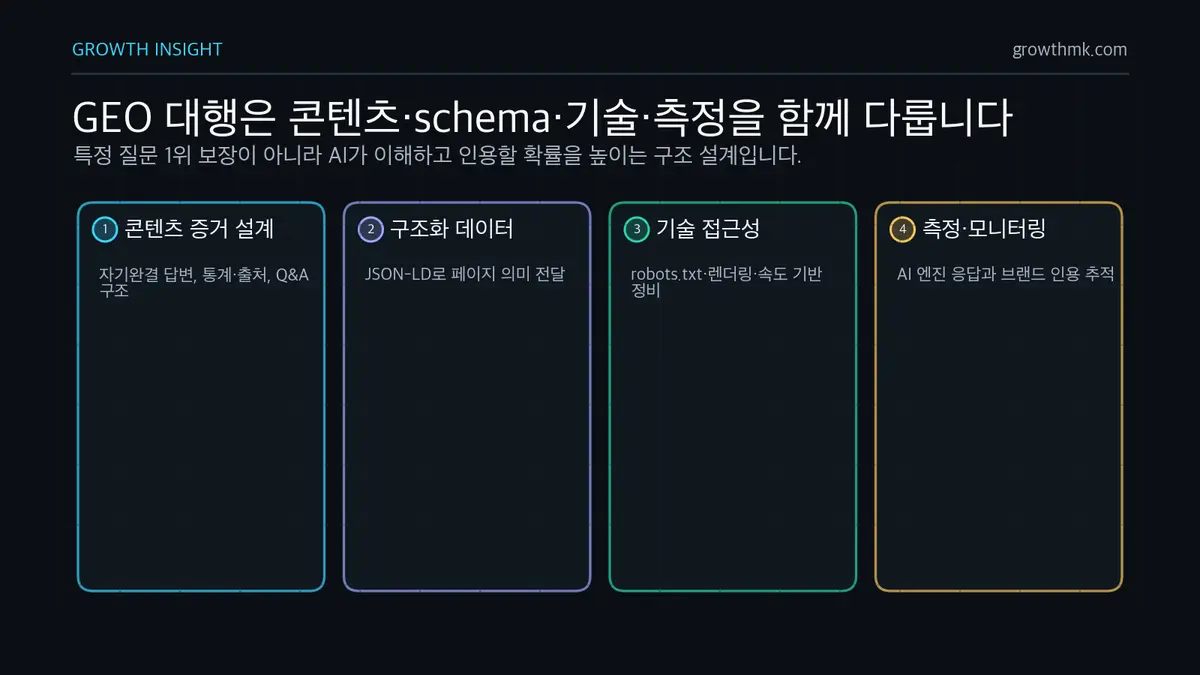
In practice, GEO agency work falls into four broad areas.
- Content evidence design — restructuring content into a form AI likes to cite (self-contained answers, inserted statistics/sources/quotations, question-answer structure).
- Structured data (schema) — using JSON-LD markup so machines can understand the meaning of a page.
- Technical accessibility — shoring up the technical SEO foundation (robots.txt, rendering, speed, etc.) so AI crawlers can access the content.
- Measurement and monitoring — tracking which AI engines respond how to key questions, and whether your brand gets cited.
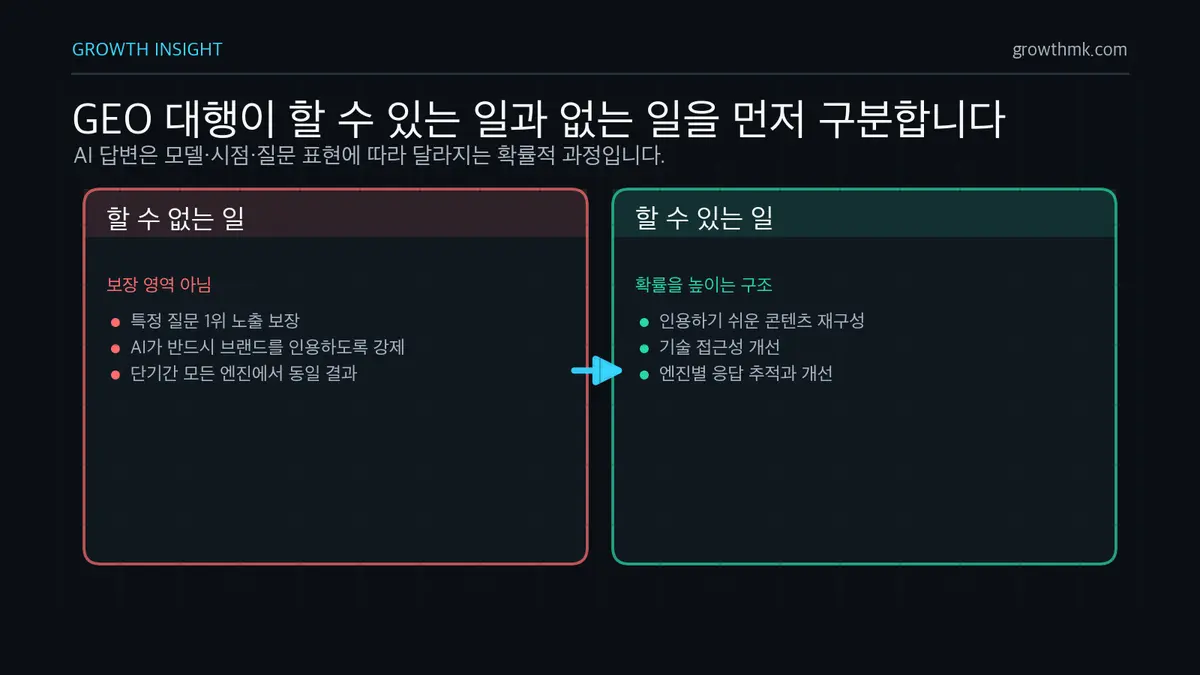
Conversely, there are things a GEO agency cannot do. It’s impossible to guarantee the #1 spot for a specific question, to force AI to always cite your brand, or to produce identical results across every engine in a short period of time. That’s because AI answer generation is a probabilistic process that varies by model, point in time, and how a question is phrased. Whether an agency states this premise honestly is your first trust signal. For background on how search visibility works, see our complete A-to-Z guide to search engine optimization marketing.
Why is the side with “a standard for judging others” the real expert?
Search for GEO, and the first thing you’ll see is a ranked list like “Top 10 GEO Agencies.” The problem is that most of these lists are content designed to put the list-maker’s own agency at #1 — the party being evaluated wrote the evaluation criteria. So rather than claiming “agency X is good,” we’re offering a question framework you can use to vet an agency yourself.
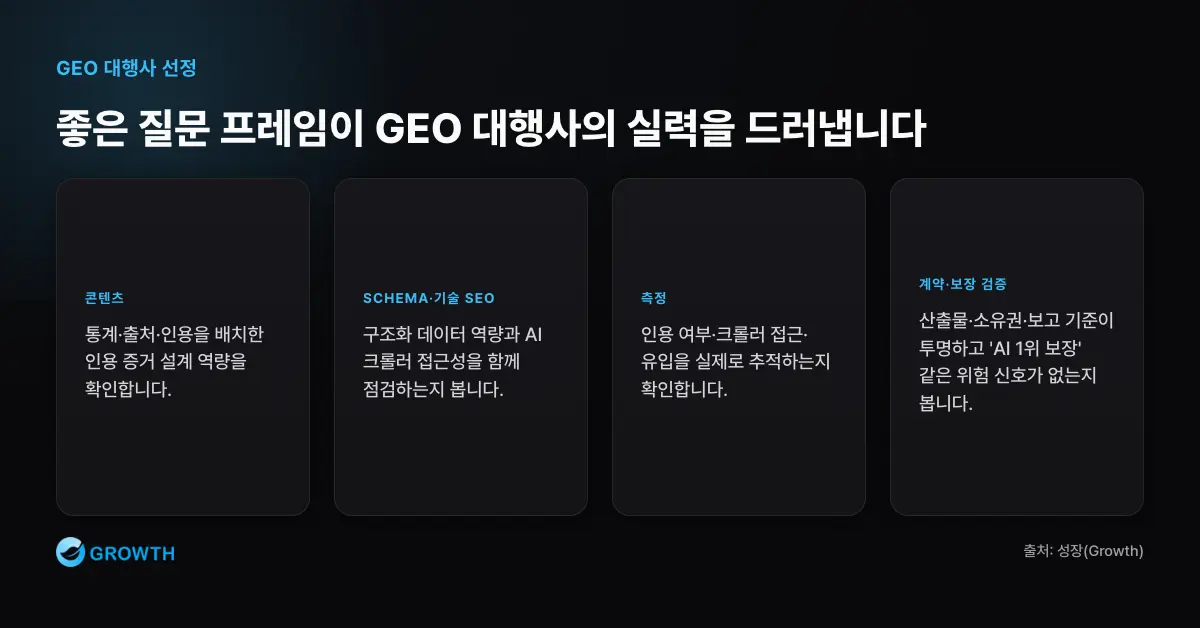
There’s a clear reason for this approach: in any field, the side with enough depth to define the standard is more likely to be the one with real skill. Once you’ve read the table distinguishing good answers from red flags, you’ll be able to judge for yourself, in a sales meeting, whether an answer comes from real practice or a sales script. The same principle applies when choosing an SEO vendor — it’s the same logic behind our SEO vendor selection checklist.
The 7 questions below are structured to verify all four axes of GEO: content, technical, measurement, and contract. We recommend taking them straight into your meeting and asking them one by one.
Vetting question 1 — Can you demonstrate a real AI citation?
This is the first and most powerful question. Ask: “can you show me right now a screen where a client you worked with got cited in a ChatGPT or Perplexity answer?” Look for proof on screen, not just words. That said, because AI answers vary over time, they shouldn’t just show you a single screenshot — they should be able to explain the pattern of which questions produce citations and how.
| Category | Good answer | Red flag |
|---|---|---|
| Form of evidence | A screen showing the actual question text, a screenshot of the AI’s answer, and the client’s URL appearing among the cited sources | Just a claim of “we’re getting cited a lot,” with no screen to show |
| Reproducibility | They give you a verifiable question you can try yourself, saying “try entering this kind of question” | They only repeat one specific screenshot, and avoid letting you verify it yourself |
| Explaining variability | They explain that “it varies by engine and point in time, and we track citation frequency” | They flatly claim “we’re always cited #1” |
How AI answer engines fetch external pages differs by platform. For example, Perplexity distinguishes between PerplexityBot, which surfaces sites in search results, and Perplexity-User, which fetches a page when a user asks a question. A genuinely skilled agency should be able to explain the citation mechanism based on differences like these.
Vetting question 2 — Do you have a measurement system?
“How do you measure results?” is the dividing line among GEO agencies. GEO without measurement is just a repeated claim of “we’re working hard.” This is exactly why Growth emphasizes a data-science methodology — without a measurable hypothesis and a verification loop, there’s no improvement.
| Category | Good answer | Red flag |
|---|---|---|
| What’s tracked | Regularly monitors citation status, citation frequency, and share versus competitors for a core set of questions | Only presents metrics not directly tied to GEO, like “visitor count went up” |
| Connecting to business outcomes | Attempts to trace AI-driven traffic all the way to revenue contribution — inquiries, leads, etc. | Stops at vanity metrics like impressions or mention volume |
| Log-based evidence | Uses server logs and GA4 to separately confirm AI crawler access and referral traffic | Can’t answer specifically about which measurement tools or methods they use |
The starting point for measurement is confirming that AI crawlers actually visit your site. You need to separate out user-agents like GPTBot, OAI-SearchBot, PerplexityBot, and ClaudeBot in your server logs or analytics tool. We cover why the GA4 setup underlying this kind of tracking matters in Why Tracking Tool Setup Matters for B2B Marketing. Because Growth focuses on the one customer who becomes revenue rather than traffic volume, our measurement also looks at whether citation actually leads to a real inquiry, not just citation volume.
Vetting question 3 — Do you have schema (structured data) capability?
Structured data is a machine-readable marker that helps AI and search engines accurately understand what a page means. Google’s own documentation directly recommends “providing explicit clues about the meaning of a page through structured data,” recommending the JSON-LD format for most sites (Google Search Central, Introduction to structured data). The same documentation cites cases where structured data led to rich results that boosted click-through rate (a 25% increase for Rotten Tomatoes, an 82% CTR increase for Nestlé).
| Category | Good answer | Red flag |
|---|---|---|
| Implementation format | Designs the right type for your content — Article, FAQPage, Organization, etc. — using JSON-LD | Explains “what schema is” itself vaguely |
| Consistency | Manages markup so it stays consistent with the information actually visible on the page | Uses markup that violates guidelines — invisible information, fake ratings, etc. |
| Verification | Checks for errors with tools like the Rich Results Test and shares the results | Adds markup and stops — no verification or monitoring |
Keep in mind: schema isn’t “magic that gets you cited just by adding it.” Structured data is only a foundation that helps AI accurately understand your content — it doesn’t guarantee citation on its own. A good agency explains schema as part of a package with content and technical work; it doesn’t claim schema alone solves everything.
Vetting question 4 — Do you design “citation evidence” into content?
Which sentences AI chooses to cite depends heavily on the form of the content — and this isn’t speculation, it’s backed by research. A paper by researchers including a team from Princeton, GEO: Generative Engine Optimization, showed that visibility in generative engine answers can be improved by up to 40%. In particular, citing sources, adding quotations, and adding statistics were the most effective methods, producing a relative improvement of 30–40% by the Position-Adjusted Word Count metric. Traditional keyword stuffing, by contrast, produced only a marginal improvement of about 17.8%.
| Category | Good answer | Red flag |
|---|---|---|
| Content form | Deliberately places statistics, sources, and expert quotations in the body and explains the reasoning | Relies on old-school SEO tactics centered on keyword repetition and padding word count |
| Answer fit | Designs paragraphs and FAQs that self-sufficiently answer anticipated questions | Focuses on sales copy, lacking the objective information AI would cite |
| Rationale | Explains, with data, “why this format is favorable for citation” | Uses vague phrases like “content AI likes” |
The key isn’t a gut feeling of “content AI would probably like” — it’s whether they design a citation-inducing structure grounded in data. This connects to a customer-question-first perspective on content, rather than a sales-first one. We cover how to design content from the customer’s perspective in more depth in SEO Marketing: Starting from the Customer’s Perspective. For the pitfalls of using generative AI to produce content, see Can Content Made with AI Get Cited by AI?
Vetting question 5 — Do you build a solid technical SEO foundation?
Before AI can cite your content, an AI crawler first has to be able to read it. No matter how good a piece of content is, if a crawler can’t access it, it doesn’t even become a candidate for citation. That’s why GEO only works on top of solid technical SEO. Each platform publishes its own crawler and guides you on controlling it through robots.txt. For example, OpenAI’s official documentation states that it operates OAI-SearchBot to surface sites in ChatGPT search, and that blocking it means your site won’t appear in ChatGPT search answers. Anthropic likewise provides guidance on controlling ClaudeBot through robots.txt.
| Category | Good answer | Red flag |
|---|---|---|
| Crawler access | Deliberately designs and explains allowing/blocking AI crawlers in robots.txt | Doesn’t know about AI crawlers, or hasn’t checked robots.txt |
| Rendering | Ensures core content is readable without JavaScript (server rendering) | Hasn’t even confirmed whether a crawler sees a blank page |
| Fundamentals | Includes technical SEO checks — speed, indexing, structure — as a precondition for GEO | Only emphasizes content and never addresses the technical foundation |
In short: GEO doesn’t replace existing SEO — it builds on top of it. Without a well-built technical SEO foundation, GEO content won’t get its due either. You can see comprehensively how crawling, indexing, rendering, and speed connect in our complete technical SEO guide.
Vetting question 6 — Are they avoiding inflated “guarantees”?
This is a filtering question. If an agency promises to “guarantee AI citation” or “get you #1 on ChatGPT within a month,” it’s safest to filter them out right there. For the same reason no one can guarantee search rankings, AI citation isn’t something that can be guaranteed either. A good agency offers, instead of a guarantee, “a structural design that raises the probability, along with a way to measure it.”
| Category | Good answer | Red flag |
|---|---|---|
| How they phrase the promise | “We design a structure that raises citation probability and measure the results” | “Guaranteed #1 AI citation,” “100% visibility guaranteed” |
| Disclosing uncertainty | Honestly explains up front the variability that comes from different engines and points in time | Hides the risk and presents only rosy outcomes |
| Legitimacy of tactics | Uses only above-board methods that comply with platform guidelines | Implies guideline-violating techniques — mass low-quality pages, manipulation, etc. |
The reason to be wary of guarantees is a pattern already well established in the SEO industry. Agencies that claim to guarantee rankings usually either target only easy keywords, or dodge accountability with results that look good but have nothing to do with real performance. Even Google officially advises “be wary of SEO firms that claim to guarantee rankings.” We’ve analyzed the structure and pitfalls of guarantee-conditional contracts in detail in Why SEO Agencies Push Guarantee-Conditional Contracts — we strongly recommend reading it before your meeting. We also cover the structural reasons genuine experts are hard to find in Korea in Why It’s Hard to Find SEO Experts in Korea.
Vetting question 7 — Is the contract structure transparent?
The last question is about the contract. Because GEO isn’t a short-term event but ongoing work that accumulates content, technical improvements, and measurement over time, the contract needs to clearly spell out what’s produced each month and how it’s reported. A contract with vague deliverables and reporting standards leads to disputes later about “what actually got done.”
| Category | Good answer | Red flag |
|---|---|---|
| Defining deliverables | Specifically states monthly deliverables — content revisions, schema, technical checks, reports | Scope is vague, like “comprehensive GEO optimization” |
| Reporting cadence | Shares progress and measurement results through regular reports and review meetings | Result reporting is irregular, or only provided on request |
| Accountability and termination | Clear process for review and adjustment if results fall short, and clear termination terms | Forces a long-term commitment, with unclear early-termination and refund terms |
| Asset ownership | Ownership of produced content, accounts, and data belongs to the client | You can’t take your assets with you when the contract ends |
Asset ownership in particular is easy to overlook. Content and measurement data need to remain your asset even after the engagement ends, so you can carry them into the next stage. An agency that explains its contract structure this transparently is also likely to have solid answers to the previous six questions.
How is GEO agency pricing structured?
There’s no fixed price list for GEO — costs vary widely based on scope of work (content volume, scale of technical fixes, depth of measurement) and industry competitiveness. So rather than looking at the price tag itself, it’s more reasonable to look at “what’s included at this price.” Here are the common billing structures.
| Billing structure | Characteristics | Good fit for |
|---|---|---|
| Monthly retainer | Fixed deliverables and monitoring provided every month | Companies looking to continuously accumulate content and measurement |
| Project-based | Performs a specific scope (e.g. building schema, redesigning core content) as a one-time job | Companies looking to quickly fix a limited task |
| Partially performance-linked | A base fee plus a link to some measurable metrics | Cases where both sides can agree on the measurement standard |
The structure to be wary of is “100% performance-based.” Betting an unguaranteeable outcome like AI citation entirely on a performance fee tends to push agencies toward disguising easily-displayed vanity metrics as results, or resorting to guideline violations. It’s the same trap that arises when ad performance gets oversimplified into a single ROI or ROAS number (see The Limits of Ad Budgets — the ROI and ROAS Trap). The right standard for judging price is “transparent deliverables and measurement,” not “the cheapest quote” or “the strongest guarantee.”
Why should you be wary of GEO agencies that promise a “guarantee”?
Boil down everything we’ve covered into a single principle, and it’s this: AI citation isn’t something to be guaranteed — it’s something you design a structure to raise the probability of. This is also central to how Growth works. Instead of promising unreliable success, we design content, technical, and measurement structures that raise citation probability, and show you the results with data.
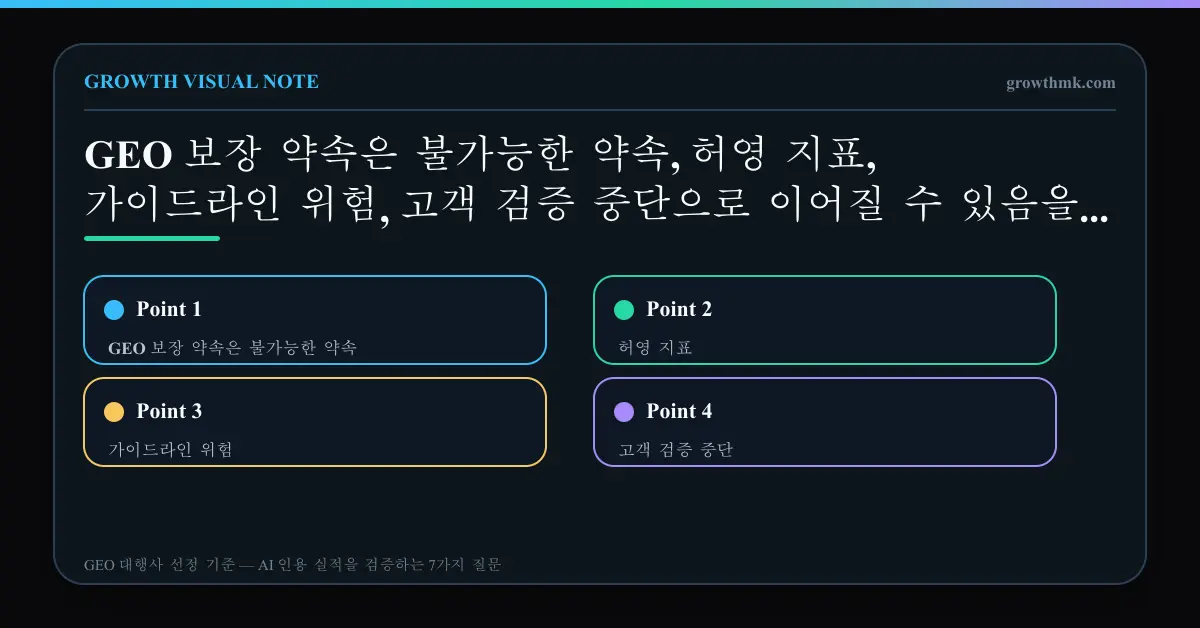
The word “guarantee” is dangerous for two reasons. First, a guarantee is an impossible promise, so keeping it inevitably drifts toward easily-measured fake results (vanity metrics) or guideline violations. Second, a guarantee paralyzes the client’s own instinct to verify. The moment you relax because “well, they guaranteed it anyway,” you stop asking the seven questions that actually matter. We recommend reading all the way through Why SEO Agencies Push Guarantee-Conditional Contracts to see exactly whose interests a guarantee-conditional contract actually serves.
A healthy GEO partnership starts with honesty — an agency that says what won’t work, and shows what will with data. And above all, the right partner is one that focuses on citations that bring in the one customer who becomes revenue, not traffic volume.
Growth’s GEO/AIEO solution doesn’t promise “guaranteed #1 on AI” — instead, we design content, schema, and technical structures that raise citation probability, and measure and show you exactly how each engine responds. We work off verifiable structure, not guarantees, and off the one customer who becomes revenue, not vanity metrics. If you’d like to start with a diagnosis of how your brand is currently handled in AI answers, get in touch through our contact page.
You can see the full picture of this topic in “Choosing a Marketing Agency and Its Cost — The Complete Guide: From 7 Selection Criteria to Fee Structures and a 90-Day Checkpoint.”
Frequently asked questions (FAQ)
What’s the difference between GEO and SEO?
SEO focuses on raising a web page’s ranking on search engine results pages. GEO (generative engine optimization, which Growth calls AIEO) focuses on getting answer engines like ChatGPT, Perplexity, and Google AI to understand, summarize, and cite your content when responding to a question. The two aren’t a replacement relationship but a complementary one — GEO works on top of a well-built technical SEO foundation.
Can I trust an agency that promises to guarantee AI citation?
We don’t recommend it. AI answers are a probabilistic process that varies by model, point in time, and how a question is phrased, so just like search rankings, no one can guarantee citation. A trustworthy agency offers, instead of a “guarantee,” “a structural design that raises citation probability, along with a way to measure it.” Agencies that push a 100% guarantee carry a high risk of drifting toward fake, showy results or guideline violations.
How do you measure the performance of GEO work?
We regularly track, for a core set of questions, whether each AI engine cites your brand, how often, and how you compare to competitors. At the same time, we use server logs and GA4 to confirm access from AI crawlers like GPTBot, OAI-SearchBot, and PerplexityBot and AI-driven traffic, and connect that traffic all the way to whether it leads to real inquiries or leads. Be wary of any agency that can’t answer specifically about their measurement methods.
Is there a content form that’s especially effective for GEO?
Yes. According to the GEO paper by researchers including a Princeton team, citing sources, adding quotations, and adding statistics produced the largest gains in generative engine visibility (a relative improvement of 30–40% by the Position-Adjusted Word Count metric), while old-school tactics like keyword stuffing had minimal effect. In other words, designing content with self-contained answers, objective statistics and sources, and a question-answer structure raises citation probability.