
Long-Tail Keyword Case Studies and How to Apply Them in Marketing
 임재복
임재복
If you’re just getting started with SEO, or you’re running a young business that’s still building its footing, chasing a competitive head-term keyword from day one usually isn’t the smartest use of resources. It’s often far more efficient to build authority gradually by owning a handful of long-tail keywords first, then use that momentum to take on competitors for the main keyword later.

What is a long-tail keyword?
A long-tail keyword is a search query made up of a longer, more specific phrase than a typical search term.
The reason long-tail keywords matter so much in marketing is simple: the longer the phrase someone searches, the more specific information they’re looking for. Ahrefs defines long-tail keywords the same way — search terms that get lower volume but tend to convert better because they’re longer and more specific.
Specific searches signal strong purchase intent, which means they’re more likely to lead to an actual conversion.
On top of that, long-tail keywords are far easier to rank for than the broad head terms that represent an industry, category, or business (the high-volume ones). In fact, a Backlinko study that analyzed roughly 306 million keywords found that 91.8% of all search queries are long-tail keywords with low monthly search volume. That’s how much opportunity is sitting in the less-contested long tail.
In content marketing, figuring out which keywords to build and publish content around is one of the most important decisions you’ll make. The reason a particular website or blog ranks well on search engines almost always comes down to keywords.
Which leads to a fairly simple conclusion: using the right keywords is the shortest path to ranking well.

Among the many keyword strategies out there, understanding and using long-tail keywords well is especially important.
That’s because long-tail keywords are a core lever for visibility, user engagement, and conversion rate.
In this article, we’ll walk through what long-tail keywords are and how to build an optimal strategy around them.
We’ll also look at real-world case studies to see exactly how brands have put long-tail keywords to work in their marketing.
Long-tail keyword case studies
Improving user engagement with long-tail keywords
Long-tail keywords act as signposts, guiding users to content that matches their search query precisely.
By tailoring content to an audience’s specific needs through long-tail keywords, a business can unlock a number of benefits.
In this section, we’ll take a closer look at the specificity and user relevance that make long-tail keywords so effective.
Zappos

Zappos is a popular online shoe and apparel retailer.
They’ve successfully used long-tail keywords to improve both user engagement and conversion rate.
They built content around specific products, features, sizes, colors, and customer needs.
For example, simply targeting the keyword “shoes” is both highly competitive and hard to rank for on page one — and it’s nearly impossible to know exactly what the searcher actually wants.
Instead, Zappos focused on long-tail keywords like “wide women’s running shoes” and “men’s leather slip-on loafers” to attract users who were much more likely to buy.
By using these long-tail keywords, Zappos was able to attract users who were actively searching for that exact product.
As a result, the company’s website traffic grew 20% and conversion rate grew 15%. Zappos’ average order value also increased by 10%.
Users who search long-tail keywords are also closer to a purchase decision, so they’re more likely to convert into customers.
By focusing on specific customer needs and using relevant keywords, a business can drive higher-quality traffic to its website and significantly increase revenue.
Etsy

Etsy also used a long-tail keyword strategy to drive targeted traffic to sellers’ product listings.
Etsy is a platform for selling handmade and vintage items.
Recognizing the diversity and niche nature of the items listed on its platform, Etsy committed to a long-tail keyword strategy. It encouraged sellers to focus on specific, product-related keywords like “hand-painted ceramic mug” and “vintage brass candlestick.”
When product listings and descriptions are optimized with long-tail keywords like these, sellers can rank higher in search results.
It also increases the odds that buyers who are genuinely interested in those specific product traits will actually land on the listing.
This strategy didn’t just boost visibility for individual sellers within the platform — it also contributed to Etsy’s overall growth and success.
Growth

Growth recognizes the importance of long-tail keywords too, and we’ve built content that analyzes user intent around them.
For example, we studied the intent behind users searching the keyword “cafeteria” (구내식당) and built content around it.
We created content analyzing which option would benefit a company more in the long run — lunchbox delivery or building an in-house cafeteria.
We also mapped out the practical difficulties a company would face when actually setting up an in-house cafeteria.
The goal was to draw in users who searched “cafeteria” and were genuinely interested in building one, and guide them toward conversion.
Check out Growth’s marketing references!
Long-tail keywords in search engine optimization
As search engines keep evolving, long-tail keywords play an increasingly important role in improving search engine optimization (SEO).
Let’s look at a case where long-tail keywords contributed to better search rankings and reshaped the SEO landscape.

NerdWallet, a personal finance site, used long-tail keywords to improve its search engine rankings and drive organic traffic to its website.
In particular, it targeted long-tail keywords tied to specific financial products and services, like “best student loan refinance companies” or “how to save on car insurance.”
By using these long-tail keywords, NerdWallet was able to attract users who were actively looking for financial information and solutions.
Users who searched long-tail keywords were also more likely to engage further with NerdWallet’s content — subscribing to a newsletter or downloading a guide, for example.
Long-tail keywords can help a brand demonstrate expertise on a specific topic and establish itself as an authority in its industry.
They can also help anticipate customer needs and deliver the exact information customers are looking for, creating a more positive customer service experience.

Moz, which offers SEO tools and resources, is another well-known example of pairing SEO with long-tail keywords.
They built comprehensive guides, blog posts, and infographics that address specific SEO problems and questions.
They achieved results by targeting long-tail keywords related to SEO best practices, technical SEO issues, and keyword research strategy.
In particular, these long-tail keywords were effective at driving high-quality traffic — SEO professionals, website owners, digital marketers — to the site.
That’s because these visitors could find exactly the guide they were interested in, and needed, right there on the site.
Users who arrived via long-tail keywords were also more likely to engage with the content than other visitors — downloading a guide, subscribing to a newsletter, or signing up for a free demo.
How to collect long-tail keywords and apply them to marketing

Keyword collection and application process
Implementing long-tail keywords effectively requires a strategic blueprint.
Decision-makers need to build actionable steps and guidelines to smoothly weave long-tail keywords into their content marketing strategy.
Here’s the process Growth uses to collect long-tail keywords and apply them to content marketing.
Keyword research and content planning
- Comprehensive keyword research
- In-depth research is the foundation of any successful long-tail keyword strategy.
- Use keyword research tools, customer surveys, and competitor analysis to identify niche phrases relevant to your industry and audience.
- Look beyond broad terms to find the specific queries and interests your target audience actually has.
- This step can become the bedrock of a solid content strategy.
- Prioritize relevance and intent
- Focus on how well a long-tail keyword aligns with your business goals and your audience’s intent.
- Understand the user journey, and tailor keywords to the different stages from awareness to conversion.
- Prioritize keywords that reflect your target audience’s specific needs and interests, so that your content resonates with what they’re actually searching for.
- Use long-tail keyword tools
- Advanced keyword research tools like Google Keyword Planner, SEMrush, or Ahrefs can help you uncover hidden long-tail keywords. Keyword Planner is a free tool from Google Ads that generates keyword ideas along with search volume and forecasts.
- These tools provide insight into search volume, competition, and variations, helping you make informed decisions.
- Leverage technology to streamline the keyword research process.

- Analyze user queries and search trends
- Take a close look at user queries across search engines, forums, and social media platforms.
- Analyzing real-time conversations helps you pick up on the nuances of language and popular topics within your industry.
- Weaving these insights into your content lets you address current, relevant concerns, which boosts overall content appeal.
Creating content
- Create targeted, valuable content
- Develop content around the long-tail keywords you’ve identified.
- Create compelling content that directly addresses the questions or interests reflected in the chosen phrase.
- At this stage, focus not just on ranking well in search engines, but on making the content genuinely useful and valuable to your potential customers.

- Optimize on-page elements
- Strategically place long-tail keywords in key elements like your title, headers, meta description, and alt tags.
- This signals content relevance to search engines and can earn you favorable SEO scoring.
- Monitor and iterate
- Use analytics tools to regularly monitor content performance.
- Track keyword rankings, user engagement, and conversion rate.
- Use these insights to iterate on your strategy and keep refining your approach.
Which metrics should you track?
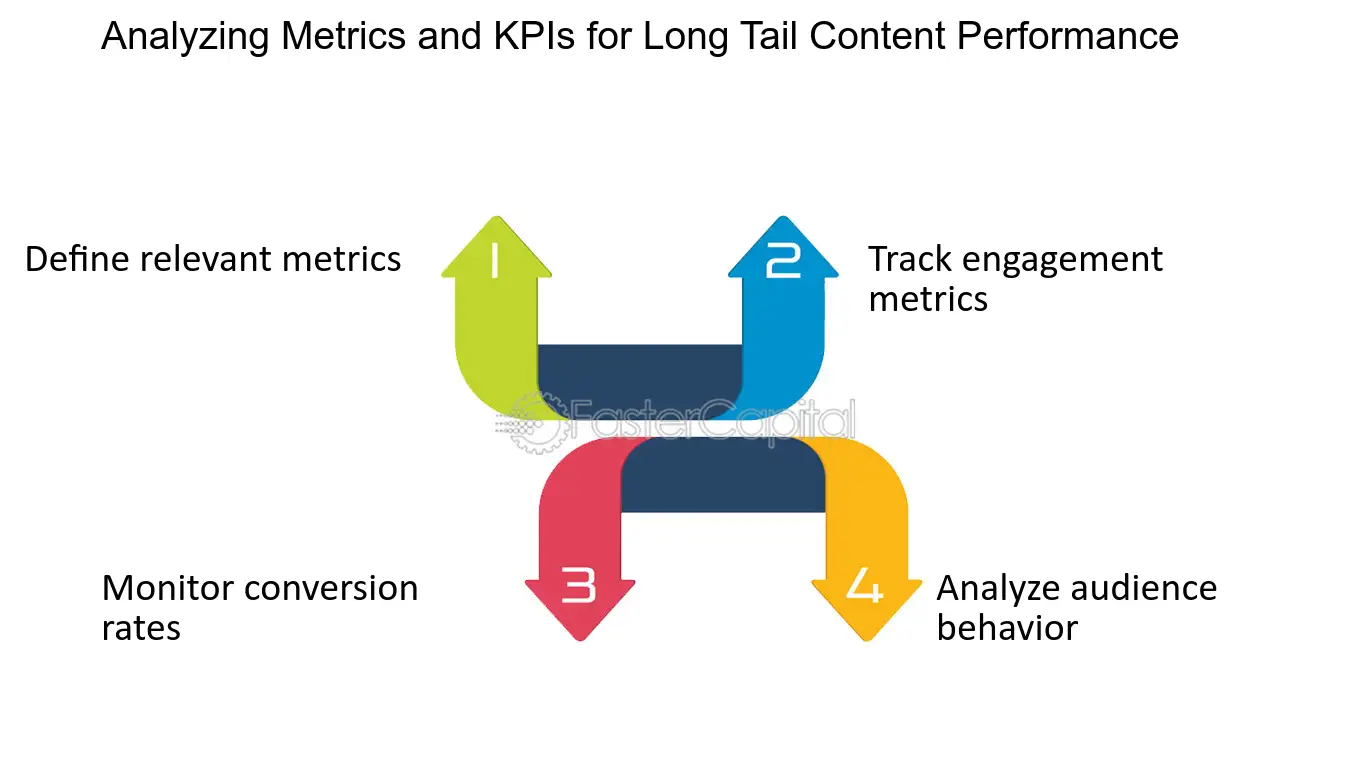
In a data-driven digital marketing world, measuring the impact of your strategy is essential.
Decision-makers need to know the key performance indicators (KPIs) that tell them whether their long-tail keyword execution is actually working.
To evaluate the performance of content built around long-tail keywords, you need to track a range of metrics that quantify the effectiveness of your content marketing efforts.
- Organic traffic
- Keyword rankings
- Click-through rate (CTR)
- Bounce rate
- Time on page
- Conversion rate
- Social shares and engagement
- Backlinks
- Unique page views
- Return on investment (ROI)
- Lead generation
Organic traffic measures how many visitors reach your content through organic search.
It shows how often your content is being surfaced to users who are actively searching specific long-tail keywords.
Click-through rate — the share of users who click your content after seeing it in search results — matters for a similar reason.
It’s a signal of how well your title and meta description fit, and how relevant they are to the searcher.

A longer time on page means users found the content satisfying.
A high bounce rate, on the other hand, can mean the content fell short of user expectations or wasn’t relevant enough to the long-tail keyword.
Conversion rate and leads show how effectively your content turns visitors into customers or leads, and how that translates into business impact.
They highlight the role content plays in attracting and converting potential customers.
Backlinks refer to the number and quality of external websites linking to your content.
High-quality backlinks contribute to content authority and can positively influence your search engine rankings.
It’s also worth monitoring the social shares, comments, and likes your content receives on social platforms.
Beyond a content’s social appeal, this tells you whether your audience resonates with it outside of search engine channels too.
Conclusion: a precise long-tail keyword strategy can transform your content
As we’ve seen above, choosing specific, clearly targeted keywords lets a business reach its intended audience accurately and effectively.
Long-tail keywords act as a guide, leading content to the right potential customers.
By tailoring our content to the nuanced questions and concerns of our target audience, we can position ourselves as the expert who delivers solutions and insights suited to specific needs.
This precision not only improves content relevance, it also has the added benefit of fostering deeper relationships with customers.
Long-tail keywords play a pivotal role in capturing share in the search engine landscape. By responding to specific user queries, you can boost visibility while also differentiating yourself from competitors.
This strategic approach lets your content stand out in an increasingly crowded digital space.
It also helps your brand establish itself as an authoritative voice within its industry.
In conclusion, bringing long-tail keywords into your content marketing isn’t just an improvement — it’s a strategic necessity. It’s a way to elevate your content, resonate with your target audience, and secure a real competitive edge.
At Growth, we’re constantly researching how a well-built long-tail keyword strategy can transform our content marketing.

If you’d like to apply this to your own business — you can see Growth’s approach on our SEO services page, and if you need a specific diagnosis for your situation, reach out via consultation inquiry. We’ll answer based on the one customer who becomes revenue, not just traffic volume.
Long-tail keyword FAQ
Definition and benefits of long-tail keywords
What is a long-tail keyword, and how is it different from a short-tail keyword?
A long-tail keyword is a specific, multi-word phrase tailored to a niche search, offering more detailed and focused content. Short-tail keywords, by contrast, are broad terms that are more competitive and less targeted.
Why are long-tail keywords considered essential to SEO and content marketing strategy?
Long-tail keywords are important because they capture specific user intent, driving higher conversion rates. They also let businesses rank for a broader range of searches, increasing visibility and attracting more qualified prospects.
What role do long-tail keywords play in improving user experience on a website or digital platform?
Long-tail keywords contribute to a better user experience by delivering more relevant content, addressing specific user queries, and guiding users precisely to what they want. This can increase engagement and satisfaction.
Learn more about how to build a successful website!
Are there specific industries or business types that benefit more from incorporating long-tail keywords into their content strategy?
Every industry can benefit, but niche or specialized businesses often find long-tail keywords especially advantageous. Local businesses, e-commerce sites, and companies offering specific products or services can use long-tail phrases to target a more defined customer base.
How do long-tail keywords contribute to improving search engine rankings and organic traffic?
Because long-tail keywords are often less competitive, it’s easier for businesses to rank higher for them in search results. By targeting these specific phrases, businesses can attract more qualified traffic interested in niche products.
Long-tail keyword strategy and analysis
How can businesses conduct effective keyword research to identify relevant long-tail phrases?
Effective keyword research involves using tools like Google Keyword Planner, SEMrush, or Ahrefs to identify relevant long-tail phrases.
Analyzing user queries, understanding industry trends, and monitoring competitors can also provide valuable insight.
What challenges do businesses face when implementing long-tail keywords, and how can they overcome them?
Common challenges include limited search volume and the need to create extensive content.
Overcoming these challenges requires building high-quality, comprehensive content around long-tail keywords and leveraging other SEO strategies to boost overall visibility.
How can businesses measure the success of a long-tail keyword strategy using analytics and key performance indicators (KPIs)?
Success can be measured through KPIs like organic traffic growth, improved search engine rankings for specific long-tail phrases, and higher conversion rates.
Analytics tools like Google Analytics can provide valuable data on user behavior.
How often should businesses revisit and update their long-tail keyword strategy to keep pace with evolving search engine algorithms and user behavior?
Regular review is essential. Businesses should revisit their long-tail keyword strategy whenever there’s a significant industry shift, a change in user behavior, or a search engine algorithm update. Staying adaptable ensures ongoing effectiveness.
Related reading