
SEO Marketing Case Study: A Content Strategy Built on Keyword Analysis
 임재복
임재복
Why do SEO marketing case studies matter?
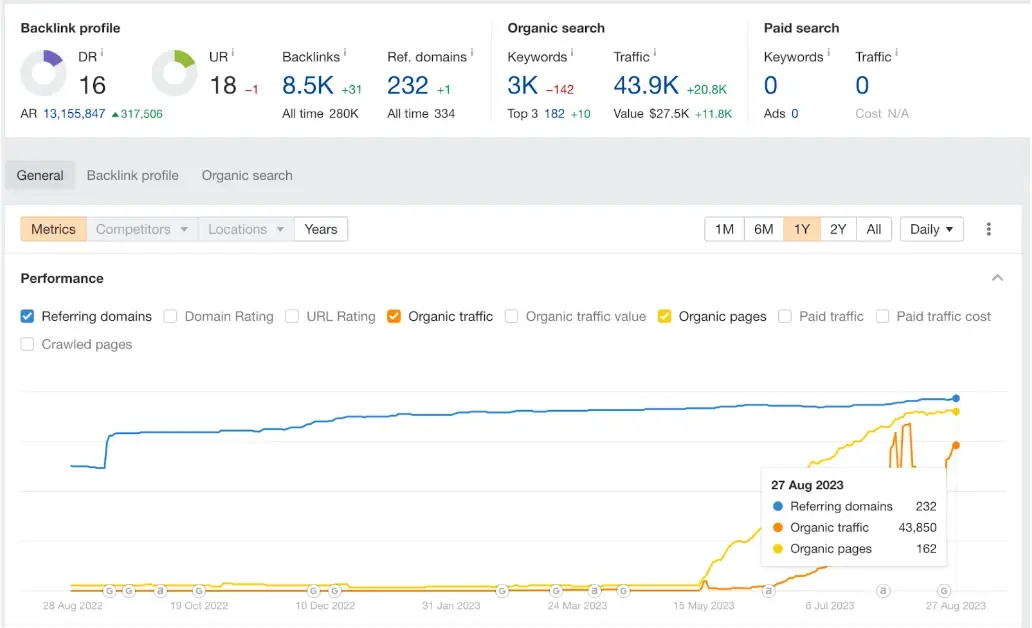
The orange line is organic traffic — visitors who arrived through search, with no advertising
You can see it climbing sharply
SEO marketing is the work of optimizing a website to be discovered through search engines. When collaborating with an agency on SEO marketing, analyzing reference cases plays a genuinely important role — it’s what lets you achieve stronger search visibility and build an effective marketing strategy.
So analyzing SEO marketing case studies can surface a range of useful information: competitor keywords and landing page analysis, what content and links are performing well, and how competitors are behaving on social media.
How should you actually read an SEO marketing case study?

DataHunt is a subsidiary of the global company FiscalNote, offering a differentiated AI data collection and processing service.
DataHunt had previously used its blog to publish content on AI-tech insights, paper reviews, and success stories.
It only started focusing seriously on content marketing this year. Alongside a homepage redesign, the company began producing content with a genuine focus on SEO.
They started by gathering keywords likely to interest decision-makers and engineers working in the AI industry, then began researching, based on multiple reference points, how to rank higher on the highest-volume keywords.
That process eventually led them to focus on creating content that answered what industry professionals were actually curious about. As a result, they grew organic traffic from 6.6K to a peak of 43.9K.
Plenty of companies can confidently show off reference results for their SEO (search engine optimization) marketing.
But to actually understand a result like this in concrete terms, you need to dig into the specific factors below.
- Keyword optimization
Check which keywords a given company is focusing on. This shows you exactly which target audience they’re prioritizing, which helps you judge whether that audience overlaps with yours. - Site structure and user experience
SEO matters not just for search engines but for real users too. Check whether the website is easy to use and well organized, so people can find information easily. - Content quality
SEO is hard to pull off without good content. Check whether the content a company publishes — blog posts, product descriptions, and the like — actually provides useful, valuable information.
Beyond that, you can also look at a website’s mobile optimization metrics for search traffic coming from mobile devices.
And if a business operates in a specific region, it needs a local SEO strategy.
Reference material on local SEO strategy — registering and managing a Google Business Profile (formerly Google My Business), optimizing for local keywords, and more — matters too. Accurate business information is the foundation for being discovered by local customers on Google Search and Maps.
What’s different about Growth’s SEO marketing case study?

The foundation of an effective SEO strategy is choosing the right keywords.
That means understanding what your customers are actually searching for. What sets Growth Inc.‘s SEO marketing apart from other companies is that it has consistently grown organic traffic through aggressive keyword research.
Here’s a summary of Growth’s keyword research process.
First, it’s essential to deeply understand your business and the products or services you offer. That’s what helps you identify which keywords are actually the most relevant.
You also need to figure out what search terms your target customers use to find information. That requires understanding your customers’ problems and needs, and how they express those problems and needs in their own words.
On top of that, checking which keywords your competitors are focusing on can yield genuinely useful insights.
Tools like Google Keyword Planner, SEMrush, and Ahrefs let you generate keyword ideas and analyze search volume and competition levels for each one. Google Keyword Planner provides keyword suggestions and estimated monthly search volumes related to your products, services, and website.
Long-tail keywords are longer, more specific search terms that map to a niche topic or a precise question. They typically have lower competition, and because they satisfy a very specific search intent, they’re more likely to convert. Google itself, in its SEO Starter Guide, recommends thinking ahead of time about the range of phrasings users might search with, and reflecting that in your content.
You can’t target every possible keyword, so you need to prioritize by importance and feasibility.
You then need to continuously monitor whether the keywords you’ve chosen actually contribute to growing website visitors and hitting your goals (like increasing sales), and adjust as needed.
The process above describes the basic keyword research workflow, but in practice, it plays out a little differently for every business, depending on its particular characteristics.
Conclusion
The core of SEO marketing is using keyword research to get your name in front of people where your customers are already gathering in large numbers.
DataHunt, for example, is a relative latecomer in the AI data-processing industry and didn’t spend heavily on advertising — yet its organic traffic metrics rivaled results you’d expect from a much larger company.
The most fundamental part of keyword research is understanding your business and your customers. You need to know what products or services you offer, and exactly what value they deliver to customers.
You also need to understand what terms your customers search with, and how they express their problems and needs in their own words.
Worth reading next
- The Complete A-to-Z Guide to SEO Marketing
- How to Write Titles That Boost Search Rankings (+ Prompts)
- Video Search Optimization: How to Use YouTube Titles, Descriptions, and Tags
- Why Image Search Optimization Matters, and How to Do It
- An SEO Strategy for Infographics and Visual Content
If you’d like to apply this to your own business — you can see Growth’s approach on our SEO service page, or if you need a diagnosis of your specific situation, reach out via consultation. We’ll answer with the one customer who becomes revenue in mind — not traffic volume.
Frequently asked questions (FAQ)
What’s the very first thing to look at in an SEO marketing case study?
Start by checking which keywords the company is focused on. That shows you which target audience they’re aiming at, and gives you a basis for judging whether it overlaps with your own business’s target customers. From there, looking at site structure, user experience, and content quality together gives you a much more accurate read on the substance behind the results.
How do you verify an organic traffic result?
Don’t just look at the raw numbers on a graph, as in the case study above — check which keywords and content that traffic actually came from, and whether it translated into real visitor growth and goal completions (like inquiries or sales). It’s also important to confirm the traffic actually came through search, with no advertising involved.
What tool should you use to start keyword research?
You can start with Google Keyword Planner to get keyword ideas and estimated monthly search volumes. If you need to compare competitor keywords or analyze difficulty, bring in tools like SEMrush or Ahrefs as well. What matters isn’t the tool — it’s understanding the actual phrasing your customers use when they search.
Why is it advantageous to target long-tail keywords?
Long-tail keywords have low search volume, but low competition and a specific search intent, which makes them more likely to convert. Even as a late entrant, if you build up content that precisely answers specific questions, you can generate meaningful organic traffic without a large ad budget.