
Marketing Agency Cost: Separate Ad Spend From Agency Fees First
 임재복
임재복
Marketing agency costs generally break down into two things: ad spend (media budget) and agency fees. Ad spend is money executed directly with platforms like Google, Meta, or Naver, and it converts directly into impressions and clicks. Agency fees are what you pay the agency for its strategy, operations, and management work. The biggest reason quotes get confusing is that these two get lumped into a single line — “₩X million per month.” To judge a cost properly, you first need to separate ad spend from agency fees, then figure out which pricing structure the agency fee is built on (a percentage of media spend, a fixed retainer, or performance-based).
This is a guide built to give anyone about to hire a marketing agency the transparency to look at a quote and judge for themselves “is this number reasonable, and what else should I be asking.” We’ve only cited specific rates and figures where a publicly verifiable source exists; everywhere else, we focus on structure and judgment criteria. Because Growth measures success by “the one person who becomes revenue” rather than traffic volume, we believe cost needs to be viewed through the same lens — namely, “how efficiently does this money bring in customers who convert into revenue.”
Why is marketing agency pricing so confusing?
The most common complaint from anyone who’s requested marketing agency quotes isn’t the price itself — it’s that the quotes simply can’t be compared. Agency A quotes “₩3 million/month, all-inclusive.” Agency B quotes “ad spend separate, plus a 15% fee.” Agency C quotes “pay per result.” For the same scope of work, the units of the quote are all different, so there’s no common basis to judge which one is actually cheaper or more expensive. Three practices sit at the root of this confusion.

1) The practice of presenting ad spend and agency fees as one lump sum
This is the most common trap. When a number like “₩5 million/month” mixes together the ad spend that goes to the platform and the fee the agency keeps for itself, you have no way of knowing how much is actually going toward ads (money that converts into impressions and clicks) versus how much is going toward the agency’s own operating costs. These are two fundamentally different things. Increase ad spend, and impressions go up. Increase the agency fee, and impressions don’t go up at all. These are the two line items you need to separate first when reading any quote.
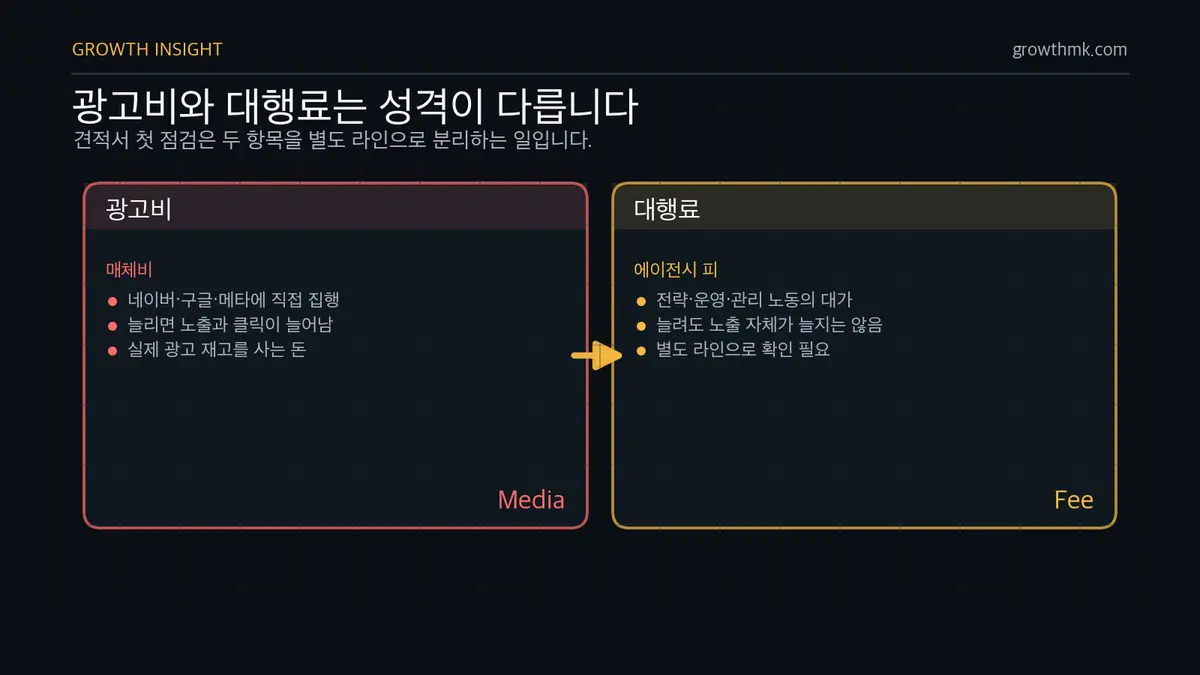
2) The practice of not disclosing the pricing structure
Whether the agency fee is “a percentage of media spend,” “a flat retainer,” or “performance-based” can drastically change your total cost, even with identical ad spend. Under a percentage-of-media-spend structure, for example, agency income automatically grows as ad spend grows — which means there’s a built-in incentive for the agency to recommend “let’s increase the budget,” regardless of whether it’s actually good for you. If you don’t know the pricing structure, you can’t even see that conflict of interest.
3) The practice of quotes engineered to look cheap
Search results are full of bait phrases like “lowest price” or “starting at $X/month,” mixed in with a fair amount of spammy quotes. Cheap quotes tend to hide cost in one of two ways: either by carving out ad spend separately and showing only a low agency fee, or by having a single staff member manage dozens of accounts at once, running them through automated templates. The latter looks cheap on paper, but often ends up more expensive in practice, because it burns ad spend on traffic that never converts into revenue (we cover the exact mechanism behind this below, in “why cheap agencies end up expensive”).
Three agency fee structures — which fits which kind of company?
Agency fees are typically priced in one of three ways: ① a fee proportional to media spend, ② a flat monthly retainer, or ③ performance-based pricing. Each has its own pros, cons, and ideal fit. For reference, in the US market, media management fees are commonly set at 10–20% of ad spend, typically on a sliding scale that decreases as budget grows. Rates in the Korean market vary widely by platform, industry, and contract type, so treat the figures in the table below as reference points for understanding the structure, not as a benchmark.
| Category | ① Fee proportional to media spend | ② Fixed retainer | ③ Performance-based |
|---|---|---|---|
| Pricing method | A percentage of executed ad spend (reference: typically 10–20%, decreasing as budget grows) | A fixed monthly amount (based on agreed scope) | Result-based: CPA (per conversion), revenue share, per lead, etc. |
| Pros | Cost automatically scales with ad spend, intuitive | Easy to forecast cost, well-suited to strategy/content work not tied to media | Aligns agency and client goals, low risk for the client |
| Cons | Creates an incentive to push ad spend higher (conflict of interest); hard to reflect the value of non-ad work | Fixed spend regardless of results; requires active scope management | Disputes over defining and attributing “results”; poor fit for foundational work |
| Good fit for | Performance-driven companies where ad spend is large and media management is the core work | Companies wanting non-ad work — SEO, content, brand — and a long-term partnership | Companies with clear conversion tracking and already-validated unit economics |
① Fee proportional to media spend — the most common, but watch for the conflict of interest
Charging a percentage of ad spend as the agency fee is the oldest and most common model in media advertising management. In fact, this structure’s roots go back more than a century. Its prototype is the “15% media commission” that took hold in the late-19th-century newspaper advertising era, where agencies received roughly 15% of ad spend as a commission from the media itself — a practice that remained the industry standard for nearly a century (UCLA Anderson Review). It was rapidly replaced by labor-based fee models starting in the 1990s, but the underlying mindset of “a percentage of media spend” carried straight through into the digital advertising era.

Its strength is that it’s intuitive. Grow ad spend, and the fee grows proportionally; shrink it, and the fee shrinks. The problem is a structural conflict of interest. Because the agency’s income is directly tied to the size of your ad spend, you always need to check whether a recommendation to increase spend is actually serving your revenue, or just the agency’s income. This model also has the limitation that value beyond ad management — strategy, creative, data analysis — gets buried under the single yardstick of “a percentage of media spend” and often doesn’t get properly recognized. You can find more on how cost per click works and how ad spend actually gets consumed in our definition of CPC (cost per click).
② Fixed retainer — predictable, but scope management is everything
This model involves paying a set monthly amount for an agreed scope of work. Because cost is predictable and set independently of ad spend size, it’s well suited to work not tied to media advertising — SEO, content production, brand strategy, data infrastructure. It’s also free of the conflict of interest built into the media-spend-proportional model, since increasing ad spend doesn’t make the agency any more money.

In exchange, there are two things you need to manage. First, the fixed cost still goes out the door even during a bad month. Second, “scope creep” — work requests beyond the agreed scope quietly piling up. Retainers only earn their value when the contract specifically spells out monthly deliverables, hours committed, and reporting cadence. We cover why retainers are common in areas like SEO where results accumulate over time, and why you should be wary of contracts that promise “guaranteed rankings,” in why SEO agencies push guarantee-based contracts.
③ Performance-based — attractive, but “the definition of results” is everything
This model prices the agency fee against results — cost per conversion (CPA), cost per lead, or a percentage of revenue (revenue share). It’s attractive because it appears to carry the lowest risk for the client, and it’s a big plus that it aligns the agency’s and client’s goals in the same direction.

That said, pure performance-based pricing is rarely applied to foundational or strategic work, because the agency also carries fixed costs — labor, tools — and can’t absorb all the risk itself. The more fundamental trap is how you define “results” in the first place. Set “one lead” as the metric, and the agency optimizes for hitting a lead count, while whether that lead actually turns into revenue becomes an afterthought. There’s also the question of attribution: when a single conversion is driven by multiple channels working together, disputes arise over whose “result” it counts as. Get the performance metric wrong, and you get the paradoxical outcome where ROAS looks great but actual profit gets worse — we walk through this trap in detail in the limits of ad budgets: the ROI and ROAS trap.
In practice, rather than using any of these three in pure form, most agencies use a hybrid model (e.g., a small fixed retainer + a percentage of media spend + a bonus tied to a core KPI). What matters isn’t the name of the model — it’s whether each line item on the quote is clearly separated so you can see exactly what you’re paying for.
How should you read a quote? — a checklist of what to verify
When you receive a quote, check whether each of the following is spelled out. If a good number of these are missing, that’s not a pricing issue — it’s a transparency issue.
- Ad spend separated from agency fee — Is the ad spend going directly to media kept on a separate line from the agency’s fee? If it’s just “all-inclusive, ₩X million,” ask them to break it apart.
- Pricing structure disclosed — Does it say whether the agency fee is a percentage of media spend, a fixed retainer, performance-based, or a hybrid? If it’s a percentage, what’s the exact rate, and are there sliding-scale tiers?
- Scope of work and deliverables — What work gets done monthly, and how many times or how many items? Are campaign setup, operations, reporting, and creative production included, or billed separately?
- Staffing and seniority — Who’s actually running your account? How many accounts does that person manage at the same time? (Cheaper quotes tend to correlate with more accounts per person.)
- Definition of the performance metric — What exactly counts as “results”? Is it agreed to be conversions, revenue, and lead quality — not vanity metrics like impressions and clicks?
- Measurement and tracking setup — Is conversion tracking (GA4, conversion pixels, etc.) properly configured? Without measurement, you can’t verify results or value for money at all. See why proper tracking setup matters for marketing.
- Contract term and termination conditions — Is there a clear minimum commitment period, an early-termination penalty, and clarity on data/account ownership (who keeps the ad accounts and data after termination)?
- Reporting cadence and transparency — How often do you get reports, and in what format? Do you have direct access to raw ad account data, or only processed reports?
That last item in particular is decisive. If the agency controls the ad account and only hands you processed reports, you have no way to verify where and how your money is actually being spent. Access to raw data is the bare minimum condition for cost transparency.
Value for money — why does a cheap agency end up more expensive?
Look at cost purely as a price tag, and the cheapest option always looks the most rational. But in marketing agency work, the real cost isn’t the agency fee — it’s ad spend wasted on the wrong thing, and the opportunity cost of leads that never turn into revenue. Here’s the mechanism behind why cheap agencies get expensive.
The hidden cost of low-quality leads
Operations optimized purely to hit a lead count look good on paper, but most of those leads never convert into revenue. Data from the B2B world illustrates this well. A MarketingSherpa survey found that 61% of B2B marketers pass every lead straight to sales, but only 27% of those leads are actually qualified (via HubSpot). The remaining 73% just burn the sales team’s time without ever becoming revenue.
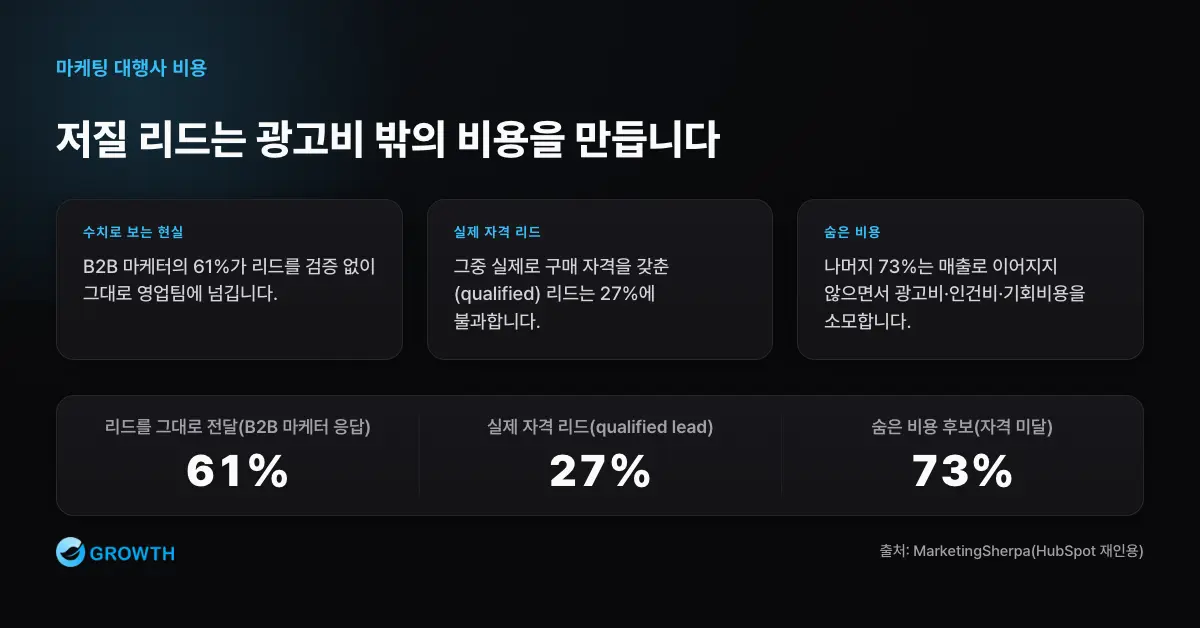
That 73% is exactly the “hidden cost.” Low-quality leads simultaneously consume three things: ① the ad spend that brought that lead in, ② the sales/CS headcount spent filtering and responding to it, and ③ the opportunity cost of resources that should have gone toward real customers. When a cheap agency boasts about “lots of traffic, lots of leads,” these three layers of cost are frequently hiding behind that volume.
Reframing cost through the lens of “the one person who becomes revenue”
Growth judges cost not by the “volume” of traffic or leads, but by the efficiency of bringing in “the one person who becomes revenue.” Spend the same ₩1 million to generate 1,000 unqualified leads versus 50 leads with a high chance of converting into revenue, and while the surface numbers make the former look overwhelmingly better (1,000 vs. 50), the latter can actually win on real revenue contribution. Value for money needs to be judged by cost per customer who becomes revenue (CAC), not cost per lead.

Data backs up the idea that investing in lead quality is actually more efficient. Forrester Research found that companies skilled at lead nurturing generate 50% more sales-ready leads at 33% lower cost (via HubSpot). In other words, operations aimed at quality can lower unit cost more, over the long run, than operations aimed purely at volume. We continue this thread in our B2B lead generation guide, covering how to define and generate quality leads, and in B2B decision-maker marketing strategy, covering how to design marketing that reaches actual decision-makers.
So is a more expensive agency always the right choice?
No. A higher agency fee doesn’t automatically guarantee higher value. What matters isn’t the absolute price — it’s whether that money is being spent on a structure that brings in customers who become revenue. Before comparing prices, check whether these three conditions are met: ① is “results” defined by revenue and conversion quality, ② is the measurement infrastructure in place to actually verify it, and ③ are ad spend and agency fee separated so you can see where the money goes. We cover, in depth, how most cases of “performance marketing that fails” trace back to missing one of these three conditions, in our complete guide to performance marketing — why it fails.
What’s realistic at each budget level?
There’s no single “correct” price point, but the right direction to take does shift depending on your available budget. What follows isn’t an absolute dollar guide — it’s direction on what to prioritize and which pricing structure fits at each budget level (rates and amounts vary by platform and industry, so focus on the structure, not the specific numbers).
| Budget stage | Realistic priority | Fitting pricing structure | What to avoid |
|---|---|---|---|
| Small (validation stage) | Focus on a single channel — set up conversion tracking and validate unit economics first | A small fixed retainer, or partial-scope outsourcing (limited scope) | Spreading budget across multiple channels at once; “all-inclusive lowest price” bait quotes |
| Medium (growth stage) | Expand validated channels, run asset-building channels like content/SEO in parallel | Hybrid (retainer + percentage of media spend) — on the condition that line items are clearly separated | Relying solely on a media-spend-proportional model (neglecting asset-building channels); expanding without measurement |
| Large (scale stage) | Optimize your channel portfolio, mature your attribution model, consider building in-house capacity in parallel | Hybrid + a bonus tied to core KPIs; a strategic partner contract | Fully outsourcing data and strategy control to the agency; accepting black-box reporting |
The common principle is clear. The smaller your budget, the more you need to invest in “measurement” and “validating a single channel” first. Spread budget across multiple channels without a measurement setup, and money just leaks out without you ever knowing what actually worked. As your budget grows, investing in the data infrastructure and strategic capability to judge where to put more money is the path to higher value for money — not simply increasing ad spend. For general criteria on what to look for when choosing an agency, see our agency selection checklist as well.
Talk to Growth about a cost structure that’s transparent all the way through
Growth presents ad spend and agency fees as separate line items, and we define success by the efficiency of bringing in “the one person who becomes revenue” — not by traffic volume. Building the measurement setup first, and only executing budget within a structure you can verify with data, is how Growth works. If you’re looking for a marketing partner with a transparent cost structure, take a look at Growth’s performance marketing services and reach out via consultation inquiry. We’ll work with you to design a reasonable cost structure that fits your current situation and goals.
You can see the full picture of this topic at a glance in “Choosing a Marketing Agency and Its Cost — The Complete Guide: From 7 Selection Criteria to Fee Structures and a 90-Day Checkpoint.”
Frequently asked questions
What’s the difference between ad spend and agency fees in marketing agency costs?
Ad spend (media budget) is money executed directly with platforms like Naver, Google, or Meta, converting into impressions and clicks. Agency fees are what you pay the agency for its strategy, operations, and management work. Increase ad spend, and impressions go up; increase the agency fee, and impressions don’t. These two need to appear as separate line items on any quote — if you see something like “all-inclusive, ₩X million,” you should ask them to break it out.
What’s the typical rate for an advertising agency’s fee?
Rates vary widely by platform, industry, contract type, and budget size. Based on publicly available data from overseas (US) markets, media management fees are commonly set at 10–20% of ad spend, with the percentage tending to decrease as budget grows — but this figure doesn’t translate directly to the Korean market. What matters more than the number itself is confirming which structure you’re dealing with — percentage of media spend, fixed retainer, or performance-based — and what each line item is actually paying for.
Is performance-based pricing always the best deal for the client?
It looks lower-risk, but it’s not automatically the better choice. Pure performance-based pricing is hard to apply to strategic or foundational work, and results vary enormously based on how you define “results” in the first place. Set “lead count” as the metric, and you can end up with a flood of leads that never convert into revenue. There are also frequent disputes over attribution when multiple channels contribute to a single conversion. This model only works well when the performance metric is clearly defined around revenue and conversion quality, and the measurement infrastructure is actually in place.
Why shouldn’t you just pick the cheapest agency?
Because in marketing agency work, the real cost isn’t the agency fee — it’s ad spend wasted on the wrong thing, and the opportunity cost of leads that never turn into revenue. Cheap operations tend to optimize for lead “volume,” but research shows only 27% of leads handed off to sales are actually qualified. The rest simultaneously burn ad spend, headcount, and opportunity cost. Cost needs to be judged by cost per customer who becomes revenue (CAC), not cost per lead — and what matters isn’t the sticker price, it’s whether the money is being spent on a structure that actually brings in customers who become revenue.