
CPC (Cost Per Click)
 임재복
임재복
What Is CPC (Cost Per Click)?
CPC (Cost Per Click) is one of the most widely used pricing models in digital advertising — it refers to the amount an advertiser pays each time their ad gets clicked. Google Ads’ own documentation defines CPC bidding as a model where “you pay for each click.” Because cost is only incurred when a user shows interest and actively clicks, CPC is used as an important metric for improving ad spend efficiency and measuring performance.

The basic formula for CPC is as follows.
Average CPC = Total ad spend ÷ Total clicks
If a campaign spends ₩100,000 and generates 500 clicks, the average CPC is ₩200 (₩100,000 ÷ 500 = ₩200).
CPC is one of the core metrics in performance marketing and plays an important role in building effective ad campaigns. To learn more about performance marketing overall, see The Performance Marketing Reference — For When You Need Real Results.
How CPC Works and Its Key Characteristics
The Basic Process
CPC advertising works through the following process.
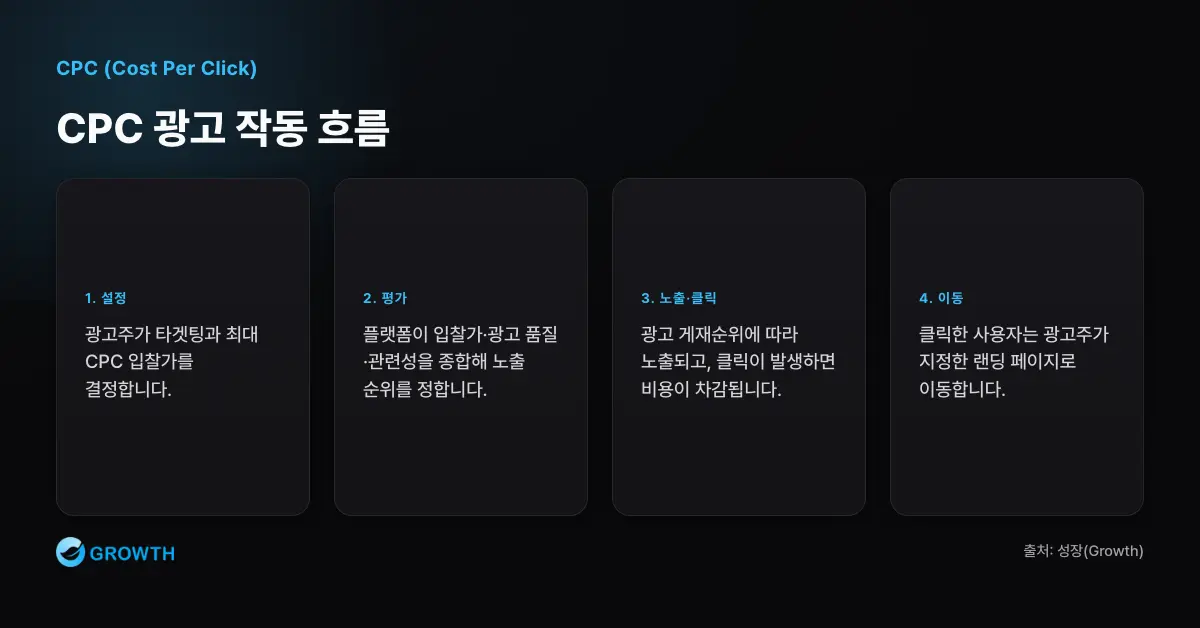
- The advertiser sets targeting and decides a maximum CPC bid.
- The ad platform weighs the bid, ad quality, relevance, and other factors together to determine ad rank. (For Google, Ad Rank is determined by the bid amount along with ad and landing page quality.)
- When a user clicks the ad, the cost of that click is deducted from the advertiser’s account.
- After the click, the user is taken to the landing page the advertiser specified.
Key Characteristics
- Performance-based pricing: impressions alone don’t cost anything — cost is only incurred when an actual click happens.
- A bidding system: most CPC advertising runs on a real-time auction, and the actual CPC paid is determined by the competitive landscape.
- Quality score is factored in: more than just the bid amount, ad quality and landing page relevance influence ad rank and the actual CPC.
- Easy budget control: setting a daily budget lets you clearly cap your spending.
Max CPC vs. Actual CPC
- Max CPC: the maximum amount the advertiser is willing to pay for a single click.
- Actual CPC: the cost per click actually paid, which is generally lower than the max CPC.
According to Google Ads’ own documentation, the actual CPC is often lower than the max CPC, and it’s calculated with the following formula.
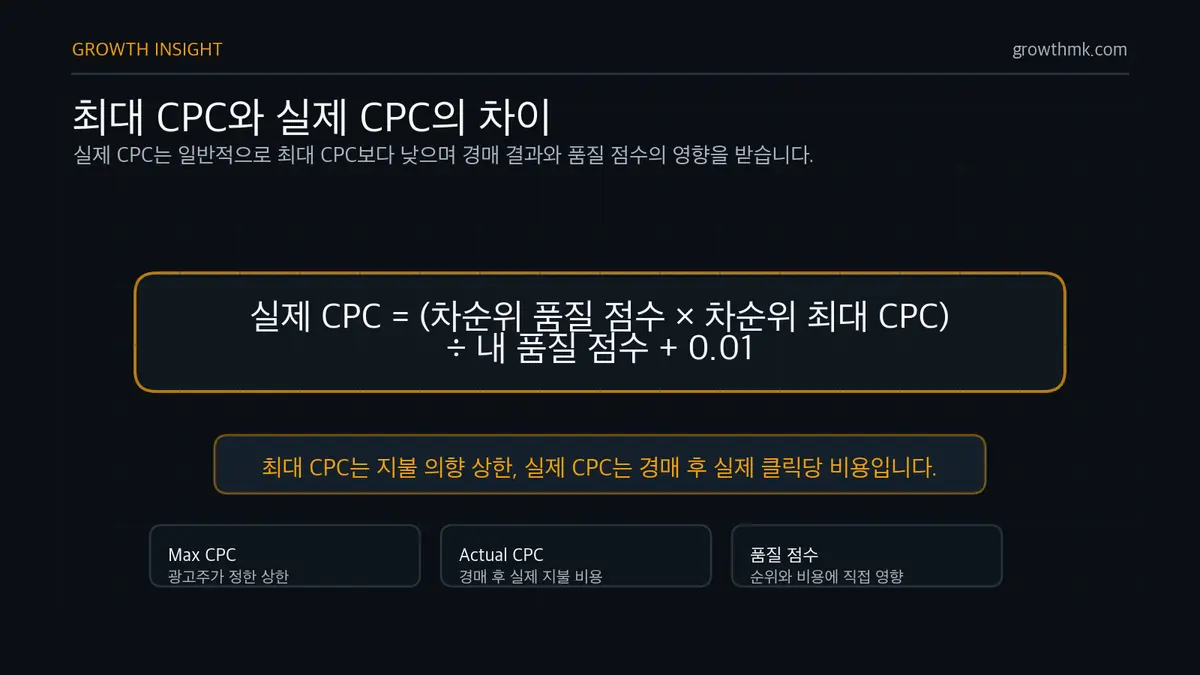
Actual CPC = (Next-ranked advertiser’s quality score × next-ranked advertiser’s max CPC ÷ your ad’s quality score) + 0.01
Average CPC
This is the average value you get by dividing total ad spend over a given period (daily, weekly, or over the full campaign, for example) by total clicks. It’s a standard metric used to gauge overall cost-per-click efficiency and track performance across a campaign, ad group, or keyword. On ad platforms like Naver Search Ads and Google Ads, you can easily check this figure through the “Average CPC” field in your reports.
How CPC Differs Across Major Platforms
Search Ad Platforms
- Google Ads: uses a keyword-based bidding system and quality score to determine ad rank and CPC
- Naver Search Ads: a platform with a strong share of the Korean market, offering formats like Power Link and shopping search ads
- Bing Ads: Microsoft’s search-engine-based advertising platform
Managing CPC on a domestic platform like Naver requires a different approach than global platforms. If you’re curious how to get started with Naver Search Ads, see How to Outsource Your Naver Search Ads to Growth.

Social Media Ad Platforms
- Facebook/Instagram Ads: offers CPC advertising with a wide range of targeting options — demographics, interests, and behavior
- LinkedIn Ads: strong for B2B targeting, with professional targeting options like job title, seniority, and industry
- X (Twitter), Pinterest Ads: each platform offers CPC advertising options suited to its own strengths
On Facebook (Meta), there are strategies for lowering CPC through shopping campaigns. For more on Meta’s ASC campaigns, see Meta ASC (Advantage Shopping Campaign).
Display Ad Platforms
- Google Display Network (GDN): ads served as banners across websites, mobile apps, and more
- Programmatic ad platforms: automated systems that buy ads through real-time bidding (RTB)
CPC Strategy
Keyword and Targeting Optimization
Running effective CPC advertising starts with selecting highly relevant keywords and fine-tuning your targeting. When grouping keywords that connect directly to your ad goals, it’s important to accurately understand search intent.
Optimizing CPC matters because it’s directly tied to how efficiently your ad budget gets spent. But focusing only on lowering CPC can hurt your overall marketing performance. For more on this, see The Limits of Ad Budgets — the Trap of ROI and ROAS.
For instance, you should separate keywords with clear purchase intent — like “buy,” “discount,” “price” — into a different group from keywords that signal information-seeking intent, like “how to,” “compare,” “reviews.” It’s also worth actively using negative keywords to keep your ad from showing up on irrelevant search terms, which reduces wasted ad spend.
It’s also important to raise ad efficiency by fine-tuning granular targeting elements like location, time of day, day of week, and device. In particular, using data analysis to identify when and where your target audience is most active, and allocating more budget to that segment, is an effective strategy.
Improving Quality Score
Quality score is a core factor that directly affects ad rank and the actual CPC you pay on most CPC ad platforms. Google Ads’ quality score documentation explains that quality score is calculated from the combined performance of three factors: “expected click-through rate (CTR),” “ad relevance,” and “landing page experience.” To raise your quality score, the first priority is strengthening the relevance between your ad copy and your keywords. Make sure your search keywords appear naturally in your ad headline and description, and deliver a message that precisely matches the user’s search intent.

The landing page a user lands on after clicking your ad also needs to stay consistent with your ad message while immediately delivering the information or service the user expects. Elements that improve the user experience (UX) — faster page load speed, mobile optimization, clear content structure — also have a positive effect on quality score.
Click-through rate (CTR) in particular is an important component of quality score, so it’s worth putting effort into raising CTR through compelling, differentiated ad copy and ad extensions (sitelinks, callouts, structured snippets, and so on).
Optimizing Your Bidding Strategy
Managing CPC efficiently requires a systematic, data-driven bidding strategy. Start by choosing the right bidding approach for your campaign goal — driving more traffic, maximizing conversions, or raising brand awareness, for example. If you’re using manual bidding, you’ll need a strategic approach: regularly analyze performance data, allocate more budget to high-performing keywords or targets, and lower bids or pause underperforming elements.
It’s also effective to analyze performance across different segments — time of day, day of week, device, location — and apply differentiated bids accordingly. Machine-learning-based automated bidding strategies (maximize conversions, maximize conversion value, target ROAS, and so on) have become increasingly popular in recent years, and these automated tools are best adopted once enough data has accumulated. You should also factor in external variables — competitor trends, seasonal demand shifts, promotional schedules — and adjust your bidding strategy flexibly.
Running A/B Tests
Systematic A/B testing is essential for continuously improving CPC ad performance. An A/B test is a method of running two or more variations of an ad element at the same time to compare which version performs better.

To lower CPC, you need to continuously test and improve elements like ad copy, design, and the landing page. For an effective A/B testing methodology, see A/B Testing: How to Steadily Improve Ad Performance.
For example, you can run two ads at the same time — using the same target and bid, but with a different headline for each — and measure which headline drives a higher click-through rate or conversion rate. The landing page is another important target for A/B testing; you should test different elements like page design, content layout, CTA button placement and color, and the number of form fields to find the version that delivers the best user experience.
Judge test results once you’ve gathered a statistically meaningful sample size, and keep an ongoing improvement cycle going, using the winning variant as your new baseline.
How CPC Compares With Other Ad Pricing Models
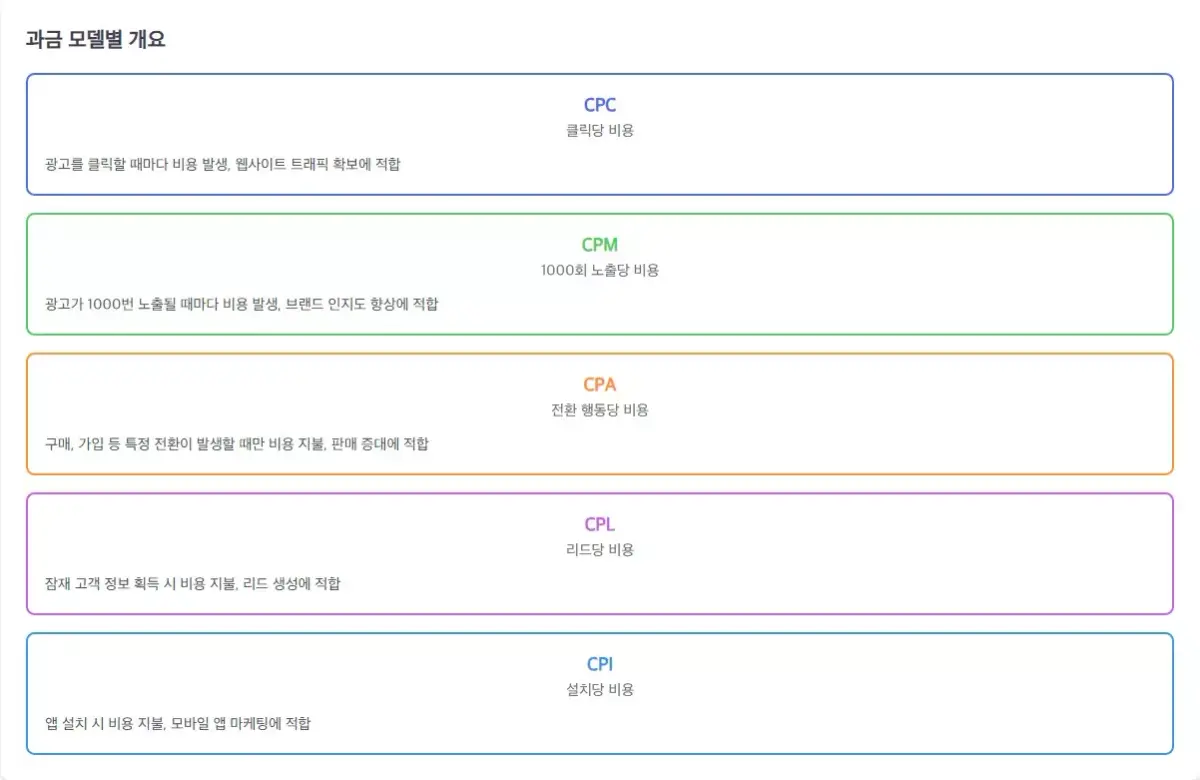
CPM (Cost Per Mille)
CPM, which charges per 1,000 impressions, is well suited to goals centered on brand awareness. It can spread a brand message across the market quickly through large-scale exposure, but because it doesn’t guarantee user behavior (clicks, conversions), it’s harder to directly measure ROI.
CPA (Cost Per Acquisition)
CPA, where you only pay when a specific conversion happens — a purchase, a signup — ties directly to business outcomes. Because you can precisely track cost per conversion, ROI measurement is straightforward, but the unit cost tends to be higher, and initial setup and optimization are more complex.
CPL (Cost Per Lead)
CPL, where you pay per piece of prospective-customer information gathered, is effective for B2B companies or high-priced products/services where lead generation matters. It lets you build a sales pipeline through clearly defined lead generation, though its unit cost tends to run higher than CPC.
CPI (Cost Per Install)
CPI, which charges per app install, is specialized for mobile app marketing. It directly drives more app downloads, but it doesn’t guarantee post-install activation or in-app purchases.
CPC simply represents the cost of a click — but to evaluate whether that translates into real business outcomes, you need to analyze it alongside a metric like ROAS. For more on ROAS, see ROAS (Return on Ad Spend).
When Should You Use CPC?
When Growing Website Traffic Is Your Primary Goal
Driving website traffic is a core goal in the early stage of digital marketing for many companies. CPC ads show up when a target customer searches a specific keyword or browses related content, driving direct traffic to your site. It’s especially effective for launching a new website, introducing a new product or service, or expanding blog readership as part of a content marketing strategy.
Important metrics here include click count, visitor count, and session duration — and it’s important to consider not just the quantity of traffic but also its quality (bounce rate, time on site). Growing traffic is a critical step that lays the groundwork for building brand awareness, forming a first touchpoint with prospective customers, and improving conversion rates over the long term.
When Targeting Users With Clear Search Intent
The CPC model is highly effective when targeting users who are actively searching for specific information or products. Search ads show up when a user enters a query with clear intent, giving you access to customers with high potential interest.
For example, keywords like “best dentist in downtown Seattle” or “men’s winter jacket discount” carry specific intent and needs — running ads against keywords like these gives you a strong chance of high relevance and conversion potential.
You can also segment keywords by search intent — informational, consideration, and ready-to-buy — and take a strategic approach of delivering the right message and landing page for each stage. The clearer the search intent, the higher the ad relevance, which leads to a higher click-through rate and quality score, ultimately lowering CPC as well.
When You Need to Measure Performance on a Limited Budget
Because the CPC model only charges for actual clicks rather than impressions, it’s well suited to small businesses and startups that need to run efficient advertising on a limited marketing budget. You can precisely control spending by setting a daily budget cap, and because you’re only charged based on real user behavior (a click), you can minimize wasted budget.
CPC advertising also provides performance data in real time, enabling quick analysis and optimization. You can continuously improve by monitoring metrics like cost per click, conversion rate, and cost per conversion (CPA), and it’s easy to flexibly adjust your budget — shifting spend toward high-performing campaigns or keywords. A/B testing in particular lets you validate, at relatively low cost, which message or targeting approach works best — a major advantage when working with a limited budget.
When Lead Generation Is Your Goal

For B2B companies, or companies offering products/services with a complex purchase decision process, gathering prospective customer information is a critical marketing goal. CPC ads can effectively drive interested prospects to a lead-capture page on your website — a quote request form, newsletter signup, whitepaper download, or consultation request, for example. This works especially well when paired with a landing page that offers valuable content or an offer tailored to your target customer’s characteristics and needs, driving a strong lead capture rate.
This approach aims for long-term results built on relationships with prospects rather than an immediate sale, and the leads you gather get nurtured step by step — through email marketing, retargeting, and sales team follow-up — toward eventual conversion. Lead generation through CPC campaigns can be a cost-efficient customer acquisition channel, and it’s important to build a strategy that considers both the quality and quantity of leads.
When You Need Data for Conversion Rate Optimization
CPC advertising provides rich insight for optimizing conversion rates by collecting and analyzing user behavior data. In the early stage, you can test a range of targeting options, ad messages, and landing pages, building up data on which elements drive the highest conversion rate. The data you collect this way can be analyzed across many dimensions — keyword performance, ad group efficiency, user demographics, interests, device type, location, and time of day.
Integrating with a website analytics tool in particular lets you track the post-click user journey, conversion path, and drop-off points, which is a major help for optimizing your conversion funnel. This kind of data-driven insight can inform decisions across the whole business — not just improving ad performance, but also product development, refining marketing messages, and improving website UX. Once enough data has accumulated, you can introduce machine-learning-based automated bidding strategies for even more sophisticated conversion rate optimization.
Related Content
- Chasing a low CPC alone often ends up hurting conversion rate or overall ROI. For more on why performance marketing fails and how to fix it, see Why Performance Marketing Fails, and How to Fix It.
- CPC and overall efficiency can vary dramatically by marketing channel. If you need the latest analysis of channel effectiveness as of 2025, we’d also recommend reading Which Marketing Channel Actually Works? The Latest 2025 Analysis.
Related Reading
- The Complete Guide to Performance Marketing — From Definition to Platforms, Attribution, and Fixing Failure
- Engagement Rate
- Remarketing
- CPC (Cost Per Click)
- Meta ASC (Advantage Shopping Campaign)
If you’d like to apply this to your own business — you can see Growth’s approach on our performance marketing service page, and if you need a specific situational diagnosis, reach out through Contact Us. We’ll answer based on the one customer who becomes revenue — not the volume of traffic.
Frequently Asked Questions (FAQ)
How is CPC calculated?
Average CPC is total ad spend divided by total clicks. For example, if you spend ₩100,000 and get 500 clicks, the average CPC is ₩200. Note that the actual CPC you’re charged is often lower than the max CPC you set, since it depends on the auction outcome.
If I set a high max CPC, am I guaranteed a top position?
No. Google Ads’ Ad Rank factors in more than just the bid amount — it also considers the quality of your ad and landing page, expected CTR, and ad relevance. So if your quality score is low, raising your bid may not improve your ad rank, or it may just mean you end up paying a higher CPC.
What’s the most effective way to lower CPC?
Raising your quality score is the key. Since quality score is made up of expected CTR, ad relevance, and landing page experience, having ad copy that matches search intent, a consistent landing page, fast load times, and mobile optimization can secure the same rank at a lower cost. Using negative keywords and A/B testing are effective too.
When should I choose CPC vs. CPM or CPA?
CPC, which charges per click, fits well when you’re driving website traffic, targeting users with clear search intent, or need to measure performance on a limited budget. If your goal is spreading brand awareness, CPM, which charges per impression, fits better; if your goal is a specific conversion like a purchase or signup, CPA, which charges per conversion, fits better. That said, a click isn’t the same as revenue, so you should look at conversion metrics like ROAS alongside it.
Marketing Insights
Marketing insights, delivered weekly
Practical growth and GEO/B2B marketing insights, summarized in your inbox every week.
Subscribe for insights