
Applying Maslow’s Hierarchy of Needs to Marketing
 임재복
임재복
Maslow’s hierarchy of needs is a theory built around self-actualization, and in that sense it’s one of the foundational contributions to humanistic psychology.

Maslow made a major contribution to how we understand human behavior in organizations by proposing that individual behavior runs on a layered system of needs.
Since then, his hierarchy of needs has been applied far beyond academia — in everyday life, business, and marketing alike.
Maslow’s Five Levels of Need, with Marketing Examples
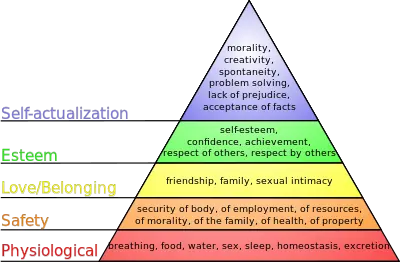
Maslow’s hierarchy of needs holds that human needs form an ordered series of levels, ranked by importance. The theory first appeared in Abraham Maslow’s 1943 paper in Psychological Review, “A Theory of Human Motivation,” where he argued that “once physiological and safety needs are reasonably satisfied, the need for love and belonging emerges” — in other words, a lower need has to be met before a higher one can act as a motivator.
Once the need at the very bottom is satisfied, the next need up in the hierarchy surfaces, and people try to satisfy that one instead.
The need that comes first is stronger than the one that follows it, and people only start craving the next level once the previous one has been satisfied.
Maslow split human needs into the following five levels:
- Physiological needs
The most basic survival needs — food, clothing, and shelter. - Safety needs
The need to protect yourself from danger and threats, and to avoid anxiety. - Love and belonging
The social need to build relationships with family, friends, and relatives, and to belong to a group you want to be part of. - Esteem
Needs around self-respect, confidence, achievement, and being respected by others. - Self-actualization
The growth need to keep developing yourself and make the most of your potential.
What Marketers Should Know About Maslow’s Five Levels and Consumer Needs
Maslow split human needs into five levels, from physiological needs all the way up to self-actualization.
As a marketer, the important thing now is deciding which of those levels your brand aims to satisfy for your customers.
Let’s look at a few examples of brands that target different levels of need.
- Physiological needs — food companies (Nestlé, Pepsi, Coca-Cola)
- Safety needs — insurers (ICICI Prudential, Tata AIG, HDFC Life)
- Love and belonging — social networks (Facebook, Twitter, Instagram)
- Esteem — luxury brands (iPhone, Mercedes, Estée Lauder)
- Self-actualization — nonprofits and NGOs (UNICEF, Teach for India)
Marketing also has another way of breaking down needs, which sorts consumer needs into five different types as well.

- Stated needs
What the consumer explicitly says they want. For example, a consumer says they need a phone. - Real needs
A more specific version of the stated need. When a consumer wants a phone, what they actually need might be good battery life and good call quality. - Unstated needs
Things the consumer wants but doesn’t necessarily say out loud — for instance, wanting a warranty and after-sales service when buying a phone. - Delight needs
Things the consumer would love to get but doesn’t explicitly ask for, like a free gift, a phone case, or a screen protector thrown in with the purchase. - Secret needs
Needs the consumer is reluctant to admit to. For example, a consumer could easily get by with an affordable entry-level phone, but wants the latest premium model as a status symbol — while feeling uncomfortable admitting that this matters to them.
Looking at the examples above, responding only to the stated need — “I need a phone” — won’t do much to convert that person into a customer.
It’s important for marketers to dig deeper and understand not just the customer’s real needs, but their unstated needs, delight needs, and secret needs as well.
Strengthening Your Marketing with Maslow’s Hierarchy of Needs
If you understand Maslow’s hierarchy of needs at this point, you’ve already built a solid foundation for content marketing. Working from this theory, marketers can build their audience and steer the brand in a better direction.
Because it’s labeled a “theory,” a lot of marketers don’t take Maslow’s hierarchy of needs seriously enough. But the pyramid Maslow proposed is genuinely a compelling, practical model.
Once you start viewing your audience through the lens Maslow opened up, you’ll be able to reframe a lot of your existing data almost immediately.
5 Ways to Strengthen Content Marketing with Maslow’s Hierarchy
Let’s start with how you can use this theory to take your content marketing to the next level. One caveat worth flagging: as Simply Psychology notes in its overview of Maslow’s theory, “people often pursue several needs simultaneously,” so the levels don’t necessarily operate in strict sequence, and concepts like self-actualization are hard to prove empirically. So it’s more useful in practice to treat this model not as an absolute law, but as a helpful “lens” for structuring how you think about your audience’s needs.

- Target the right customers for your product
- We’re operating in the middle of the most product-saturated, competitive market in human history.
- Marketing indiscriminately to an unspecified mass audience won’t reach anyone in particular.
- Successful marketing requires precisely identifying the customers most likely to buy your product.
- And then creating content that’s genuinely useful and relevant for that audience.
- Build out personas for your audience
- A persona represents a key segment of your audience.
- Modeling personas lets you identify and prioritize content marketing goals, and produce content tailored to each one.
- Building audience personas in the first place requires a lot of data. Marketers need to gather qualitative information more strategically.
- Write compelling copy that persuades your audience
- Once you’ve built a persona you can genuinely relate to, you’re already 90% of the way to writing compelling copy.
- That’s because your copy isn’t going out to an anonymous mass audience — it’s reaching one specific, well-understood person.
- You understand that customer. You know their pain points and vulnerabilities.
- Which means you know what they want. From there, a marketer just has to write copy the way they’d talk to that person directly.
- Build content around the sales funnel, the customer journey (CDJ), and each stage of trust
- Marketers should apply Maslow’s five levels to identify a customer’s most urgent need at any given moment.
- That most urgent need helps you locate where the customer sits in the sales funnel.
- From there, marketers can deliver content that’s genuinely relevant and useful to that audience.
- Optimize content for readability and ease of use
- Compelling, effective content needs to be readable and easy to consume, so your audience can stay focused on the message.
- Check your headlines and subheads for how well they grab attention, your font and letter-spacing for readability, and your content’s length and flow.
Reaching Consumers Through Maslow’s Hierarchy of Needs
Helping Customers Toward Self-Actualization
Where Freud, psychology’s great pioneer, explored neurosis and pathology, Maslow studied health and well-being instead.
Maslow believed our ultimate need is self-actualization — developing ourselves to live a productive life through our innate abilities and talents.
He grouped human needs into five levels, but believed people move through those levels on their way toward self-actualization.
And he argued that the needs at each level have to be met before a person can move on to the next one.
If marketers can lay out that journey for consumers, the customer will end up following the brand on their own.
Understanding the Ideal Self

As covered above, marketers get the fortunate opportunity to connect people’s self-actualization needs to their purchasing behavior.
To pull that off successfully, marketers need to identify what the buyer’s ideal self actually looks like.
Is it prettier, more convenient, more eco-friendly, more premium — and does it influence other buyers too? Keep in mind that the more refined this process gets, the more purchases it can drive.
Tapping Into Personal Factors: Personality and Self-Concept
Personality describes an individual’s disposition. It’s what makes each person different, and it covers their unique traits.
How open someone is to new experiences, how conscientious and diligent they are, whether they’re extroverted or shy, how agreeable they are — personality, shaped by all these traits together, explains a lot about a buyer.
Understanding this kind of personality and these traits helps you predict consumer purchasing behavior.
So how can a company market a specific product based on people’s personalities?
For example, consumers who score high on “openness” to new experiences and more conservative consumers tend to respond differently to the same ad creative. In other words, personality traits shape how people receive ads and messaging. That said, broad generalizations like “this personality type responds better to this kind of message” vary by product category and context, so it’s safer to test and validate them against your own data.
Companies now need to tap into consumers’ self-concept in order to predict their purchasing behavior.
Making Your Brand Stand Out with Maslow’s Hierarchy of Needs
Consumer Self-Concept Drives Brand Attachment and Loyalty

Because consumers also weigh a company or brand’s social standing and role when choosing a product, marketers need to account for how consumers perceive that company’s or brand’s traits and image as well.
When a company builds a brand personality that feels close to how consumers see themselves, consumers naturally start relating to that company and brand, and begin identifying with it.
A simple example: premium apartment brands in Korea have leaned on emotional appeal rather than rational appeal in their marketing.
Rather than emphasizing safety or how complete a living space feels, these brands have built their image around glamorous celebrity endorsers.
Looking back at apartment ads Korean developers have run over the years, you’ll notice they’ve leaned heavily on A-list stars to build a sleek, premium apartment image.

For a product category like apartments, functional attributes obviously matter, but you can only really evaluate those attributes after living there — which is exactly why a “premium image” can become such an important purchase criterion in the meantime.
From that angle, apartments as a brand and product category in Korea have shifted into emotional territory, where an emotional advertising strategy becomes essential.
Which tells us something important: sometimes the feeling or image a brand conveys plays a bigger role in the purchase decision than laying out concrete information ever could, because it speaks directly to consumers’ sense of self-esteem.
That’s because self-concept is such a critical factor in purchase decisions. Self-congruity theory (Sirgy), from consumer behavior research, similarly holds that “a brand is evaluated more favorably and is more likely to be chosen when its image aligns with the consumer’s self-concept” — and that this effect on brand attitude, emotional attachment, and loyalty is even stronger for product categories with high symbolic value.
Consumers come to believe that living in a sleek, premium apartment will make them a better version of themselves — and, by extension, improve their life overall.
In the same way, plenty of cosmetics and aesthetic procedures market themselves by appealing to the ideal self people are chasing. Buyers want products that help them improve their life through their own self-concept.
If you approach an apartment purely as a product that solves the physiological need for shelter, you’re missing something. Approach it instead from the broader lens of a product that solves an esteem need, and your view of the marketing opportunity opens up considerably.
Once you understand how Maslow’s hierarchy of needs applies in consumer psychology, you’ll be far more effective at targeting what your audience actually needs and wants.
Related reading
- What Is Growth Hacking? Definition, AARRR, Experiment Design, and Real Cases — the Complete Growth Strategy Pillar
- What Is Marketing Channel Mix?
- CDJ (Customer Decision Journey)
- What Is a Persona?
- Needs vs. Wants: What’s the Difference?
If you want to apply this to your own business — if you need a concrete assessment of your situation, reach out through our consultation contact form. We answer in terms of the one customer who becomes revenue, not raw traffic volume.
FAQ
What is Maslow’s hierarchy of needs?
A theory Maslow proposed in 1943 that sorts human needs into five levels: (1) physiological needs, (2) safety needs, (3) love and belonging, (4) esteem, and (5) self-actualization. Maslow held that once a lower need is reasonably satisfied, the need at the next level up starts acting as a motivator.
How do you apply Maslow’s theory to marketing?
The starting point is defining which level of need your brand satisfies for customers. Food, for instance, maps to physiological needs; insurance to safety; social networks to belonging; luxury brands to esteem. From there, define your target audience, build personas, and create content and copy tailored to their needs.
Is Maslow’s theory scientifically proven?
It’s a widely used and genuinely useful framework, but modern research pushes back on the idea that the levels operate in strict sequence. People often pursue multiple needs at once, and concepts like self-actualization are hard to demonstrate empirically. It’s best treated not as an absolute law, but as a lens for structuring how you think about consumer needs.
Why isn’t it enough to look only at stated needs?
Because responding only to an explicit statement like “I need a phone” makes it hard to convert that person into a customer. Consumers also carry real needs, unstated needs, delight needs, and secret needs they’re reluctant to admit to. Brand attachment and loyalty grow strongest when you appeal to higher-level needs — esteem and self-actualization — and to self-concept.