How to Write Title Links That Boost Search Rankings (+ Prompts)
 임재복
임재복
What actually catches a user’s eye on a search results page? The title link. Since it’s the very first thing that determines whether someone clicks or scrolls past, out of dozens of results, optimizing it sits right at the core of any SEO strategy.
In this article, we’ll dig into how to write a title link that grabs attention in search results, and exactly how it affects SEO.
Why title links matter for SEO
How title links affect search engine rankings
A title link is represented in a page’s HTML structure by the <title> tag, and search engines use that information to figure out a page’s topic and relevance. Google and other search engines treat the title link as the single most important summary of a page’s content, so it carries significant weight in algorithmic evaluation.
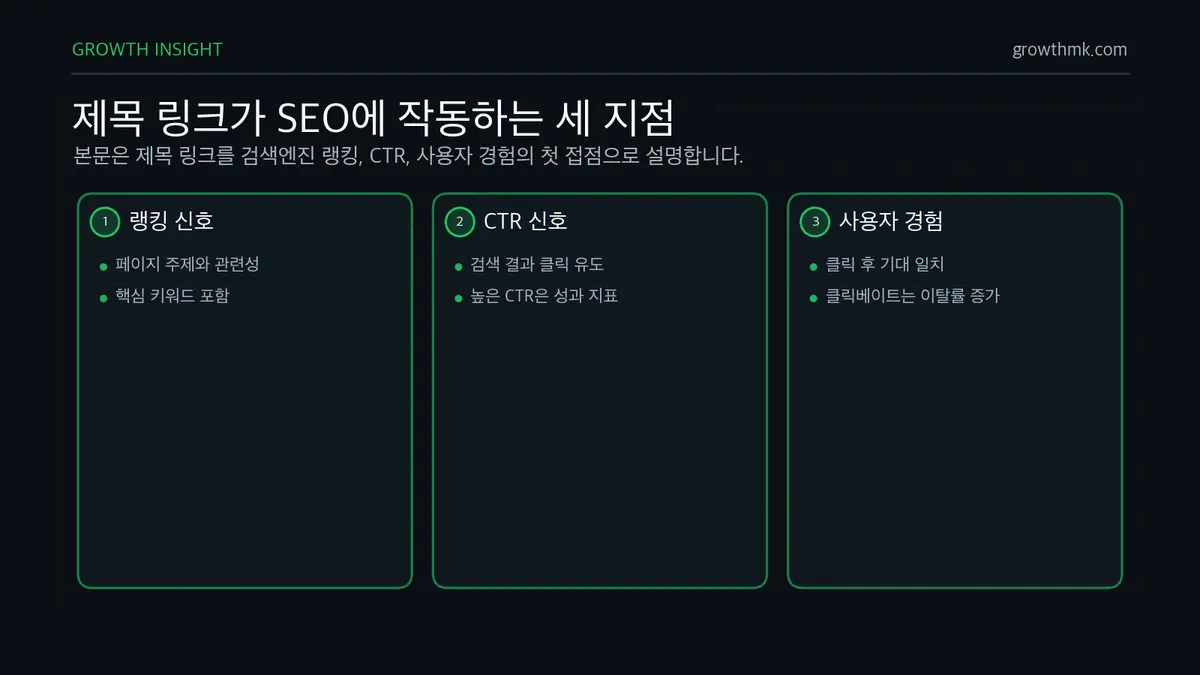
In practice, when a title link includes your core keyword, the odds of ranking higher for that keyword’s search results go up significantly.
How click-through rate (CTR) relates to title links
Click-through rate on a search results page is a key metric for measuring SEO performance. A compelling title link drives clicks, and a higher CTR in turn feeds back into higher rankings.
Because Google factors user behavior data into ranking, content with a higher CTR — even at the same rank — tends to climb further over time.
How title links connect to user experience
A title link shapes a user’s very first impression of your content. A clear, accurate title link lets users find what they expected after clicking, which boosts satisfaction.
On the other hand, “clickbait” — using an exaggerated title purely to drive clicks — can lift CTR in the short term, but it also raises bounce rate, which ultimately hurts both your search ranking and your brand’s credibility.
Strategies for writing an effective title link
The technique of placing your core keyword up front
Both search engines and users pay more attention to the front of a title. Placing your core keyword near the start boosts search relevance and grabs the user’s eye.
For example, “Effective Marketing Methods and Strategy” is weaker from an SEO standpoint than “Marketing Strategy: Effective Ways to Build Brand Awareness.” That said, it’s important to place keywords without breaking natural sentence structure.
Using emotionally engaging words
Humans instinctively respond to emotion. Including emotionally engaging words in a title link can significantly boost CTR.
Words like “surprising,” “essential,” “game-changing,” “secret,” and “instant” trigger curiosity and a sense of urgency in readers. That said, overdoing the emotional language can undermine credibility, so it should only be used to the extent it genuinely matches the content.
Using concrete numbers and data
Specific numbers and data boost a title’s credibility and specificity. “Boost Revenue With Marketing Strategy” comes across as far more concrete and persuasive as “7 Marketing Strategies That Increased Revenue by 32%.”
Numbers give users a clear expectation and create the impression that the content contains precise information. This tactic is especially effective for list-format content.
Prompts for optimizing title links with generative AI
With the recent rise of generative AI tools like ChatGPT and Claude, you can now put these tools to work writing SEO title links too. Generative AI can quickly produce a range of title ideas and suggest keyword-optimized, attention-grabbing phrasing. Let’s look at some example AI prompts for writing effective title links.
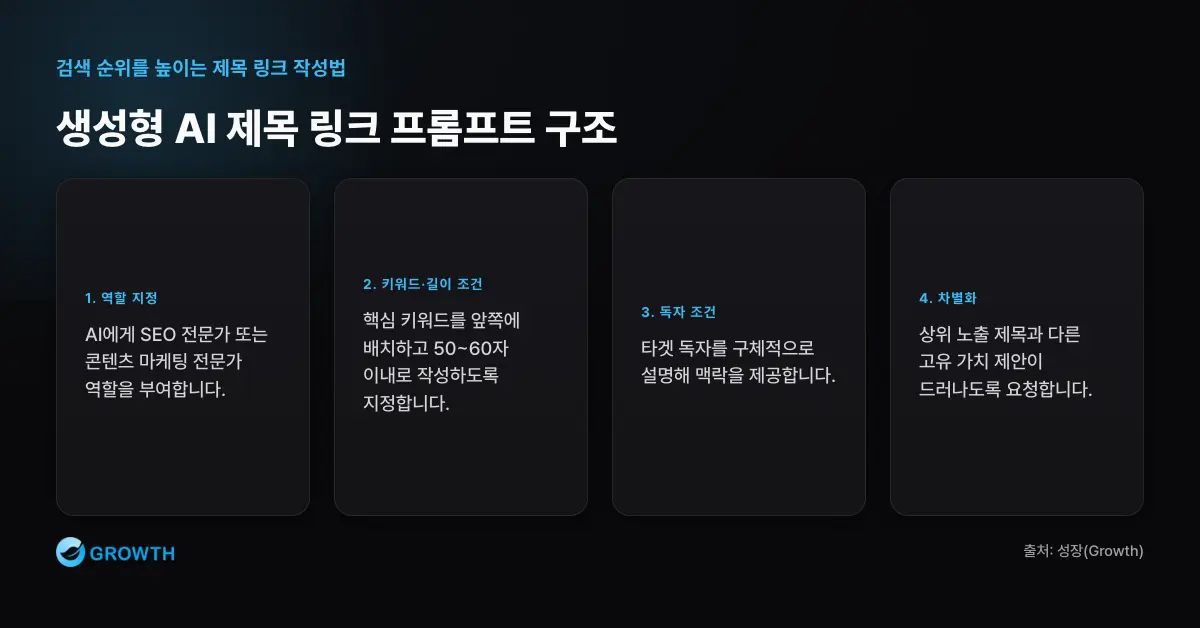
The first sample prompt works well for keyword-based title generation.
“You are an SEO expert. Write 10 title links for a blog post on the topic of ‘[core keyword].’ The titles should be optimized for search engines, placing the core keyword near the beginning, and should be no more than 50-60 characters. Include phrasing that sparks the reader’s curiosity and drives clicks, but avoid exaggerated clickbait. The target reader is [description of target reader].”
The second example is useful for generating differentiated titles based on an analysis of competing content.
“You are a content marketing expert. The topic I’m writing about is ‘[topic],’ and here are the titles of the top-ranking search results on this topic: [list of competing content titles]. Suggest 5 title links that are SEO-optimized while standing apart from this competing content. Each title must include the core keyword ‘[keyword],’ and should make clear what unique value our content offers and what benefit the reader will get.”
When using generative AI, the key isn’t to use every suggested title as-is — it’s to combine the best elements across several suggestions and adjust them to fit your own brand’s tone and style.
It’s also essential to verify that whatever title AI suggests actually matches your real content. Remember: AI is just a tool, and the final call always belongs to the content writer.
Making a title link that stands out in search results
How to optimize title length
Once a title link passes a certain length, search results truncate it. Google generally displays up to roughly 600px (about 50-60 characters), so you need to optimize so your core message is fully conveyed within that range.
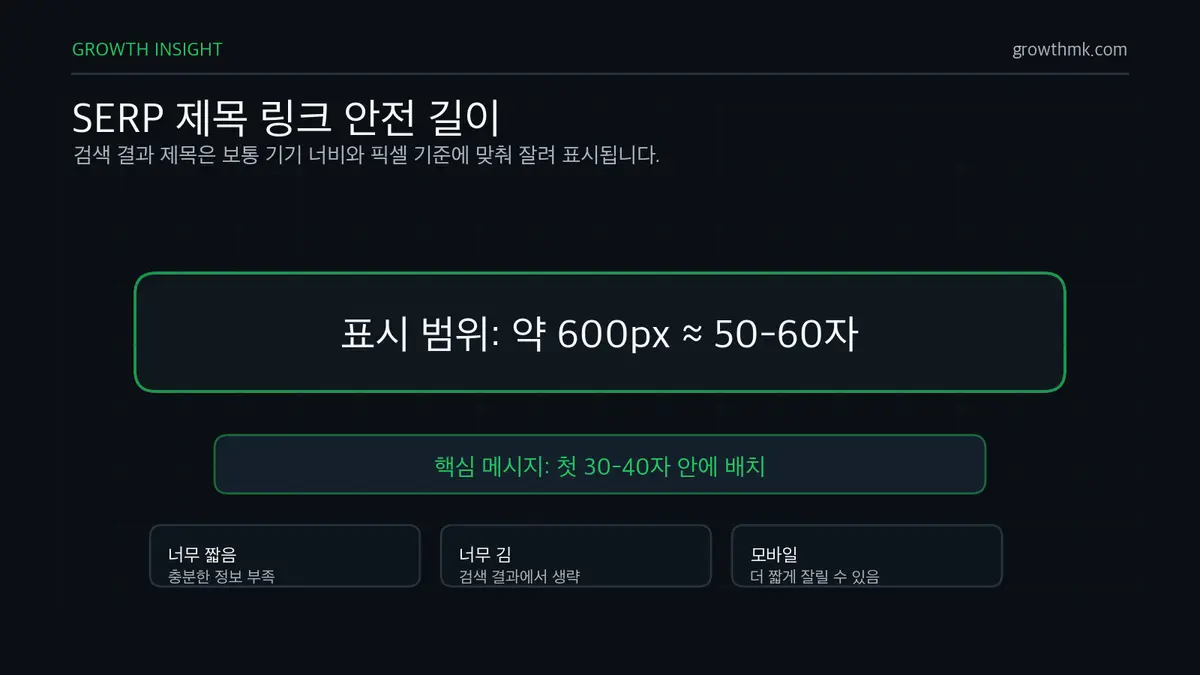
Mobile devices can truncate even shorter, so it’s best to pack your core message into the first 30-40 characters wherever possible. At the same time, a title that’s too short may fail to convey enough information, so the ideal length should be adjusted based on your topic and keyword.
Using curiosity-driven, question-format titles
A question-format title is an effective way to spark curiosity and drive engagement. A question like “Why Is Your Website’s Traffic Declining?” makes users want to click to find out the answer.
Framing a problem your target readers are actually likely wrestling with as a question can generate empathy and interest at the same time. That said, the question needs to be clear and specific, and your content needs to actually deliver the answer.
Writing titles that highlight the reader’s benefit
Readers instinctively ask themselves, “what value does this content offer me?” That’s why it’s important to clearly express the benefit or value a reader will get right in the title. For example, “How to Optimize Title Links” is less effective than “How Optimizing Your Title Links Doubles Website Traffic.”
The benefit needs to be specific and achievable, and it needs to actually be delivered through the content — only then does it maintain credibility.
If you’d like to apply this to your own business — you can see Growth’s approach on our SEO services page, and if you need a diagnosis tailored to your specific situation, reach out for a consultation. We’ll answer based on the one person who becomes revenue, not traffic volume.
You can see the full picture of this topic in “The Complete Guide to Writing SEO Content — From Search Intent Analysis to Publishing and Updates.”
Common mistakes when writing title links

Let’s walk through the main reasons title-link optimization fails, with concrete examples. Understanding these failure patterns helps you avoid making the same mistakes in your own content.
Check whether your title is too short or too long
A title that’s too short fails to give search engines and users enough information. For example, a title like “SEO Tips” is so generic and terse that it’s hard to tell what specific content it covers. A title like this may have high keyword density, but with no differentiation, it ends up with a low CTR on competitive keywords.
Conversely, a title that’s too long gets truncated in search results. A title like “The Latest 2025 Search Engine Optimization Guide: A Complete Collection of SEO Strategies and Practical Techniques Learned Step-by-Step From Beginner to Expert” is information-rich, but more than half of it gets cut off in search results.
Google search results display only about 600px of title (roughly 50-60 characters), so you need to structure your title so the core message still comes through even if it gets truncated. Mobile search results in particular display even shorter titles, so it’s important to always place your core information and keyword at the front.
Make sure your keyword placement is up front
The most common keyword-placement mistake is putting your core keyword toward the back of the title. “Digital Marketing and SEO Techniques Worth Knowing in 2023” is weaker from an SEO standpoint than “SEO Techniques: Digital Marketing Strategies Worth Knowing in 2023.”
Search engines assign more weight to the front of a title, and users tend to pay more attention to the first few words of a title as well.
Another common failure pattern is keyword stuffing. A title like “Best SEO Title Link SEO Optimization SEO Keyword Strategy SEO Tips” makes its intent to boost keyword density so obvious that it damages user experience — and it can actually trigger a search-engine penalty. Google’s spam policies explicitly define this kind of keyword stuffing — repeatedly cramming in keywords to manipulate rankings — as a violation.
Google’s algorithm is getting increasingly sophisticated at detecting this kind of artificial keyword insertion, so it’s important to weave keywords in within a natural sentence structure.
Does your page title match your SERP title?
It’s fairly common for a page’s HTML <title> tag and the title that actually shows up in search results (the SERP title) to differ. This mismatch can happen for a few different reasons.
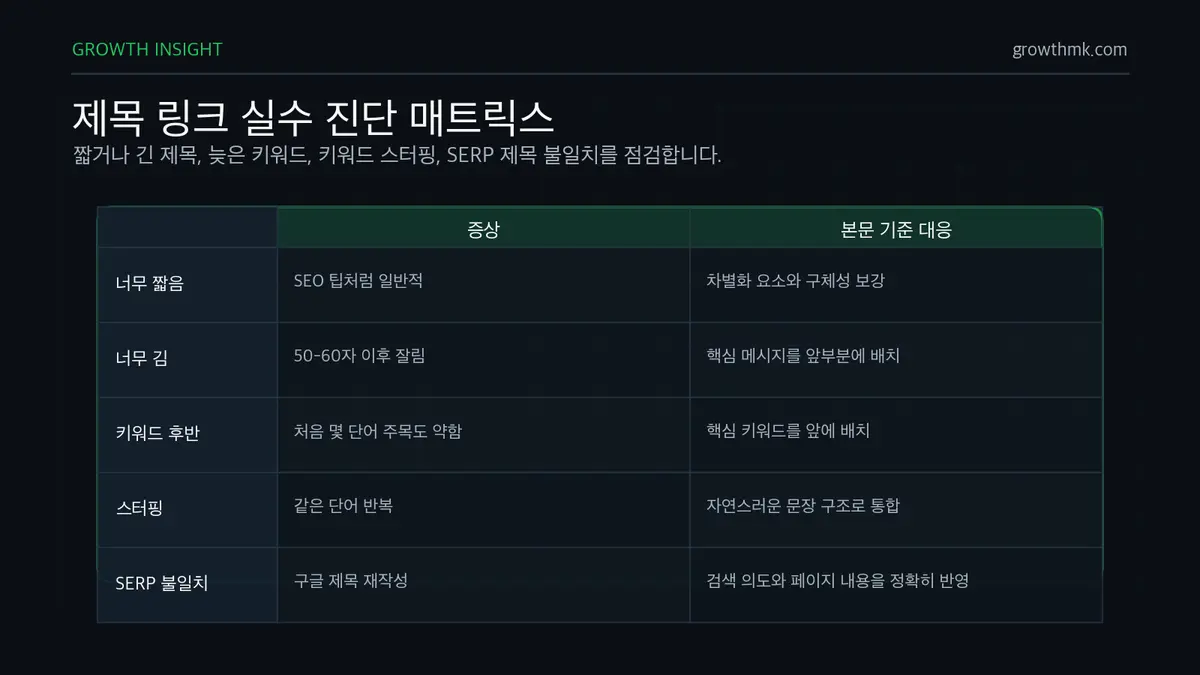
- Google rewriting your title: if Google decides its own version better fits a user’s search intent, it can ignore your page’s original title and generate one of its own. Google’s official documentation explains that when it detects a problem with a page, it can generate a better title link from anchor text, body text, and other sources. For example, if a website’s title is “The Best SEO Strategies – Company Name,” Google might display it instead as “2023 Search Engine Optimization Guide – Company Name.” This tends to happen especially when a title has low relevance to the user’s query, or is too generic.
- Blending meta description and title: Google sometimes folds part of the meta description into the title, or extracts especially relevant text from the page content to use as the title instead. This is more likely to happen when the original title doesn’t match search intent.
- Removing branding elements: if a page title includes a brand name, Google can remove it or reposition it to emphasize more relevant content instead.
This kind of mismatch can hurt user experience. If the title a user saw in search results differs significantly from the actual page title, they can feel confused, or even perceive it as “clickbait.” That leads to a higher bounce rate and shorter time on page, which ultimately can drag your search ranking down.
To prevent this, it’s important to write a clear, specific title that accurately reflects the page’s content.
Google’s main reason for rewriting a title is that it judges the original title doesn’t match the user’s search intent, or doesn’t accurately reflect the content. So it’s important to precisely identify search intent and write a specific, relevant title that matches it.
Measuring and improving title-link performance
Using CTR-analysis tools
To objectively measure title-link performance, using the right tools is essential.
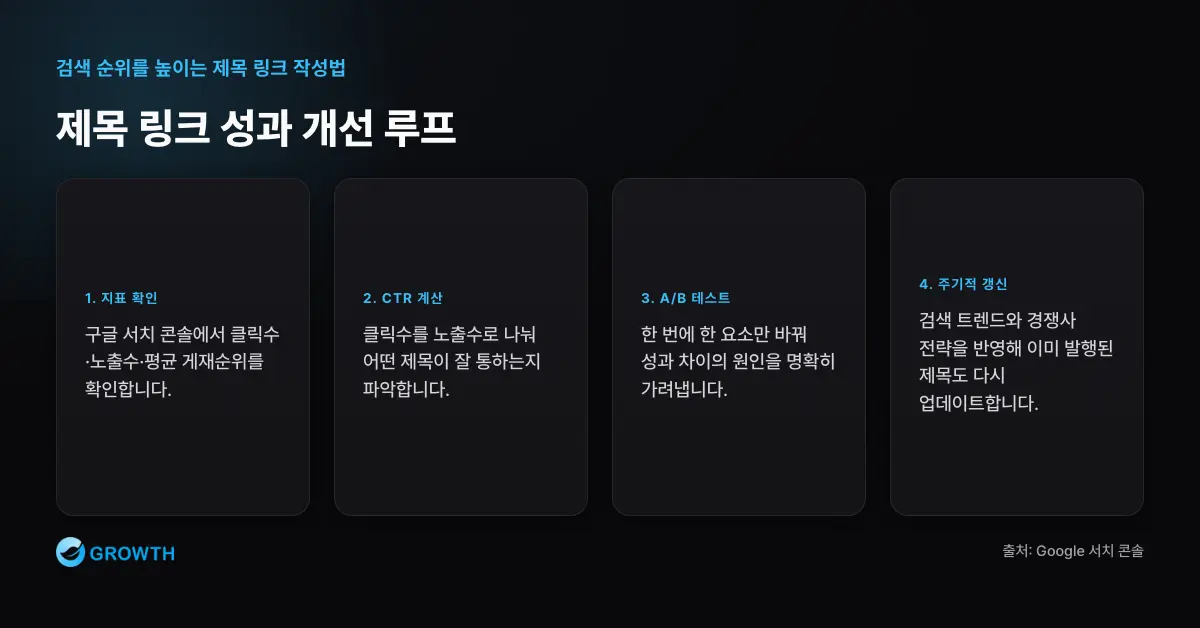
Google Search Console is a powerful tool that gives you click-through rate, impressions, and average position in search results. The Search Console performance report defines its metrics as clicks, impressions, CTR (clicks ÷ impressions), and average position. Connecting it with Google Analytics lets you track user behavior by search keyword too, for even deeper analysis.
These tools let you spot patterns in which title links achieve the highest CTR — an important basis for future title-link optimization.
Optimizing title links through A/B testing
Finding the most effective title link takes systematic A/B testing. You can apply different titles to identical content and compare which version achieves a higher CTR and conversion rate.
Testing different titles for the same piece of content via email marketing or social media promotion is also a useful method. When testing, it’s important to change only one element at a time, so you can clearly identify which element drove the performance difference.
A strategy for continuously improving title links
SEO and user behavior patterns keep evolving, so title-link optimization needs to be an ongoing process, not a one-time task. You need the habit of regularly analyzing performance data, monitoring search trends, and benchmarking competitors’ strategies.
In particular, you should revisit and, if needed, adjust your title-link strategy whenever there’s a search-engine algorithm update. And periodically updating the titles of already-published content based on performance is also a core part of a long-term SEO strategy for securing sustained traffic.
Conclusion
A title link is a user’s very first point of contact in search results, and the single most important factor driving clicks. An effective title link isn’t just a list of keywords — it needs to accurately capture the user’s search intent and spark their interest and curiosity.
If you optimize your title links based on the strategies covered in this article, you can achieve both goals at once: higher search rankings and a higher CTR.
Above all, it’s critical that your title actually matches your real content. No matter how compelling a title is, if the content falls short of expectations, bounce rate climbs and it ends up hurting your SEO.
Remember: true title-link optimization starts from a balanced approach that satisfies both users and search engines.
Worth reading together
- The A-to-Z Guide to SEO Marketing
- SEO Marketing Case Studies — A Keyword-Analysis-Based Content Strategy
- Video Search Optimization: Using YouTube Titles, Descriptions, and Tags
- Why Image Search Optimization Matters, and How to Do It
- Infographic and Visual Content SEO Strategy
Frequently Asked Questions (FAQ)
How many characters should a title link be?
Google doesn’t impose a hard limit on <title> length, but search results typically truncate it to fit the device width (roughly 600px, or about 50-60 characters). So it’s best to place your core keyword and message within the first 30-40 characters, so the meaning still comes through even if the title gets cut off.
Why is the title I set different from the one showing up in search results?
If Google judges there’s a problem with your page, it can generate and display a better title link directly from anchor text or body content. This mainly happens when a title is disconnected from search intent, too generic, or contains repetitive phrasing or keyword stuffing — so writing a specific title that accurately reflects your page’s content reduces the chance of a rewrite.
Does stuffing more keywords into a title help ranking?
No. Keyword stuffing — repeating the same word over and over — violates Google’s spam policies, hurts user experience, and makes your result look spammy. Placing your core keyword once, near the front of the title, within a natural sentence structure, is effective for both search relevance and CTR.
How do you measure title-link performance?
You can check clicks, impressions, CTR (clicks ÷ impressions), and average position in Google Search Console’s performance report. After identifying which titles achieve a high CTR, it’s best to gradually improve your titles through A/B testing that changes just one element at a time.