
Early-Stage Startup Marketing Budgets: Allocate by Validation Stage, Not “% of Revenue”
 임재복
임재복
An early-stage startup’s marketing budget shouldn’t follow the formula “some % of revenue” — it should be allocated based on “what do we need to validate right now.” Before product-market fit (PMF) and unit economics are confirmed, spreading budget evenly across unproven channels just burns cash without teaching you “what actually works.” In practice, you should start with most of the budget going to exploration (finding out which channels, messages, and customers respond), a smaller share going to solidifying what’s already validated, and only a minimal amount reserved for scaling — then gradually flip that weighting as validation progresses. In other words, the core question for an early marketing budget isn’t “how much do we spend,” but “what did we learn from this money.”
This guide is written so seed-to-pre-A founders and solo marketers can decide for themselves where, why, and in what order to allocate a limited budget. Industry benchmark figures are cited only where a public source could be confirmed; everything else focuses on a framework for judgment rather than absolute figures. Growth Inc. measures success not by traffic volume but by bringing in “the one person who will become revenue” — and budget should be viewed the same way: how quickly and cheaply does this spend validate a hypothesis about customers who will convert to revenue?
Why doesn’t the “N% of revenue” formula work for early-stage startups?
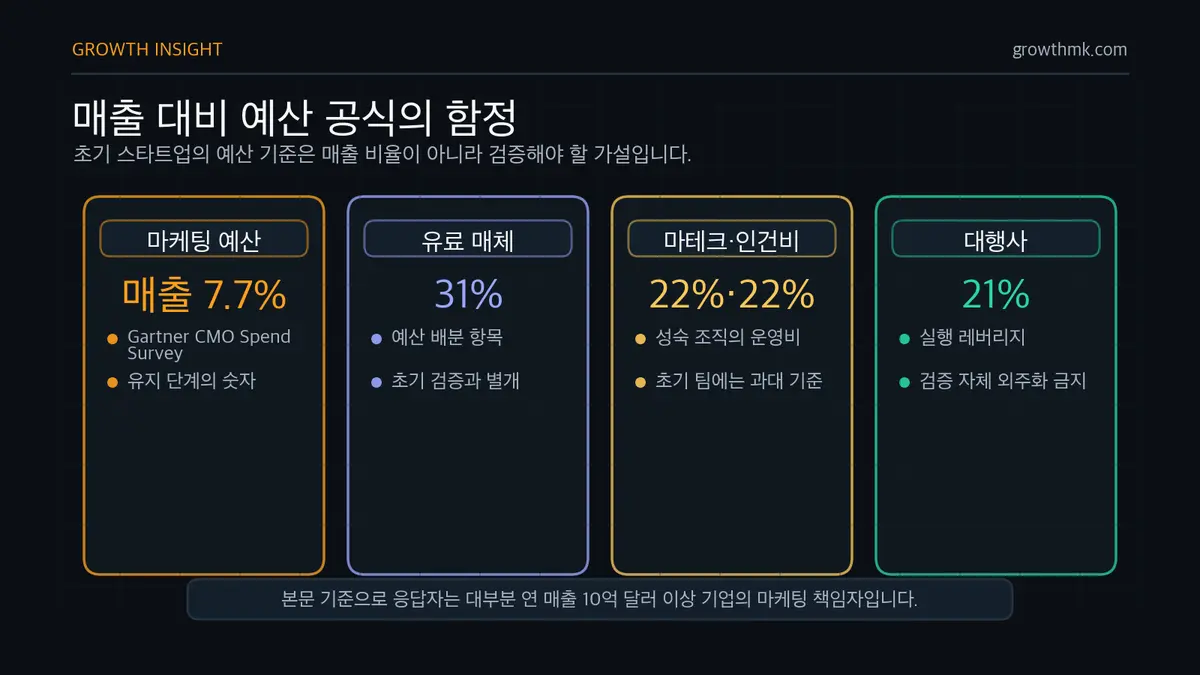
The first thing most people search when asking about marketing budgets is “what % of revenue should go to marketing.” The most widely cited benchmark is Gartner’s annual CMO Spend Survey. According to the 2025 Gartner CMO Spend Survey, company marketing budgets average 7.7% of revenue, split across paid media (31%), martech (22%), headcount (22%), and agencies (21%) (as cited by Marketing Brew). Apply that number directly to an early-stage startup, though, and you’ll almost certainly lose your way. There are three reasons why.
1) The benchmark’s sample isn’t startups
Respondents to this survey are overwhelmingly marketing leaders at large companies with over $1B in annual revenue. In other words, “7.7% of revenue” is the share that companies which have already found PMF and generate stable revenue spend to sustain and grow that revenue. Apply that ratio to an early-stage startup with small or erratic revenue, and either the denominator (revenue) is so small the budget becomes meaningless, or — if you treat investment capital like revenue to inflate the ratio — you end up over-investing in unproven channels. The benchmark is a “sustain” number, not an “explore” number.
2) “% of revenue” mistakes the result for the cause
The revenue-percentage formula assumes “we have revenue, so we spend a portion of it on marketing.” But for an early-stage startup, marketing isn’t a byproduct of revenue — it’s an investment to validate the hypotheses that will eventually generate revenue. The order is backwards. When you don’t yet know which channel brings in customers, or even what it costs to acquire one (CAC), setting “N% of revenue” tells you nothing about where that money should actually go. The basis for your budget should be “the list of hypotheses that need validating and the cost of validating them,” not revenue.
3) Scaling before unit economics are validated just replicates losses
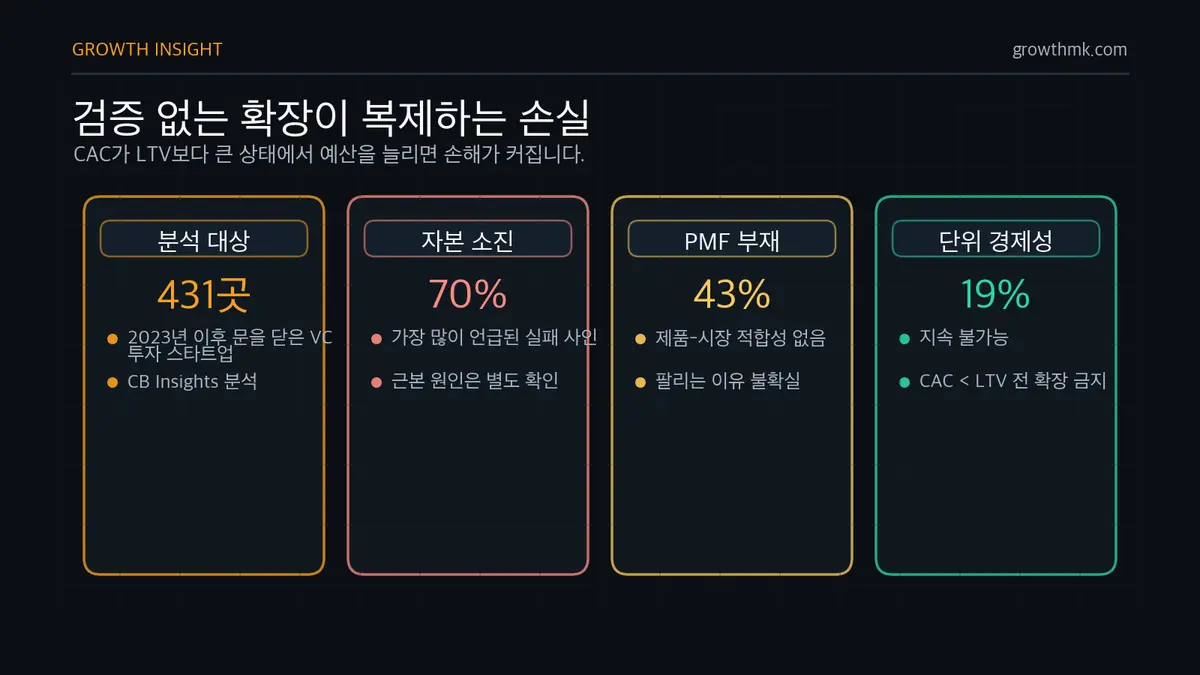
This is the most dangerous trap. If the cost of acquiring a customer (CAC) is higher than the value you recover from that customer (LTV), increasing your budget only increases your losses. This paradox — where revenue rises as you spend more on ads while the business actually loses more money — shares the same root cause as the problem covered in the trap of ROI and ROAS. Even when ROAS looks strong, ignoring margin and payback period puts you on a path to “efficiently going broke.” Startup failure data backs this up. CB Insights analyzed 431 VC-backed startups that shut down since 2023 and found that 70% failed due to “running out of cash,” 43% cited “lack of product-market fit,” and 19% cited “unsustainable unit economics.” CB Insights notes that “running out of cash” is usually just the final symptom, not the root cause — companies burn money on unvalidated hypotheses until the cash runs out first. That’s why the first principle of early budget allocation is: “don’t scale before unit economics are validated.”
So what should budgets be based on? — A validation-stage framework
Instead of a percentage of revenue, Growth Inc. recommends allocating based on “what validation stage is this budget currently serving.” Split marketing activity into three categories by purpose.
- Explore — Spend aimed at discovering which channels, messages, and customer segments respond. A bundle of small, fast experiments. Since you don’t yet know the answer, the goal is “run many cheap hypotheses.”
- Validate — Spend that repeats a channel or message that showed a signal during exploration, under the same conditions, to confirm the signal is reproducible rather than a fluke, and that CAC is at a manageable level.
- Scale — Spend that increases budget on channels where unit economics have already been validated, in order to grow volume.
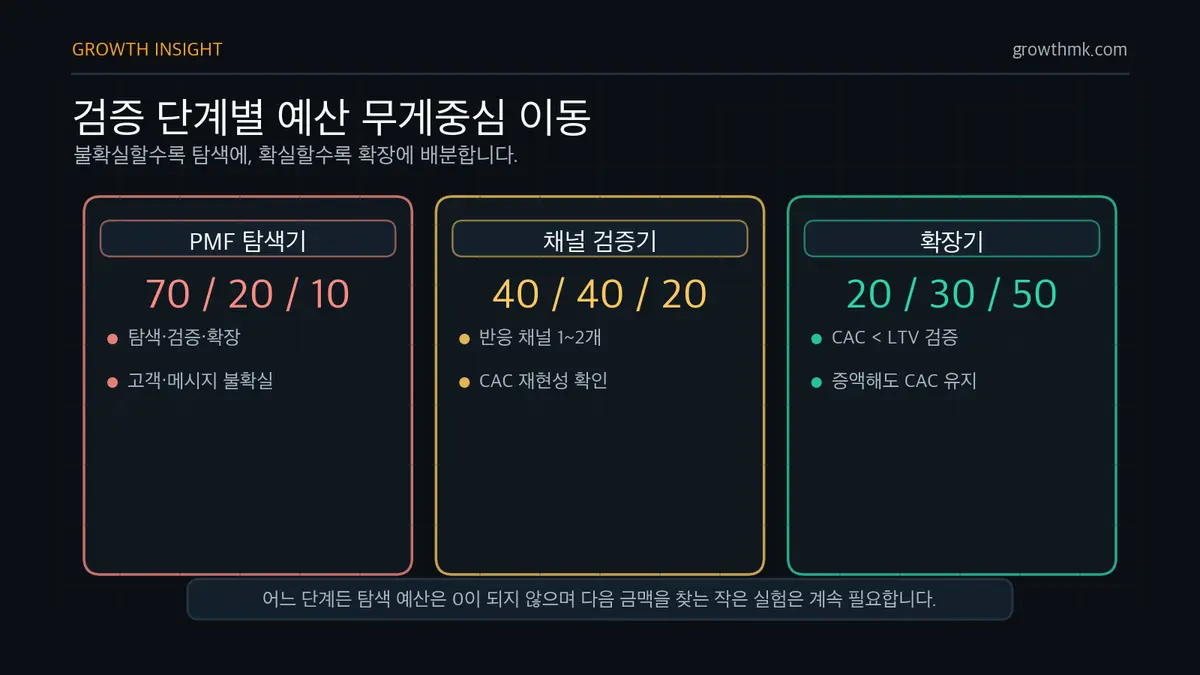
The key point is that the weighting of these three activities changes by stage. The ratios below are a direction of thinking, not an absolute figure — the exact numbers will vary by industry, product, and market. What matters is the logic that “as validation progresses, the center of gravity shifts from exploration to scale.”
| Stage | Situation | Explore | Validate | Scale | Signal of success at this stage |
|---|---|---|---|---|---|
| 1. PMF exploration | Still unclear which customers buy, and why | ~70 | ~20 | ~10 | A segment of repeat-purchasing, returning customers starts to emerge |
| 2. Channel validation | 1–2 responsive channels have emerged | ~40 | ~40 | ~20 | CAC on a specific channel reproduces consistently |
| 3. Scaling | A channel with confirmed CAC < LTV secured | ~20 | ~30 | ~50 | CAC doesn’t degrade significantly even as budget grows |
The principle running through this table is “the more uncertain, the more you explore; the more certain, the more you scale.” Spending half your budget on scale in stage 1 is betting without knowing the answer, and spending 70% on exploration even in stage 3 means digging new ground while a validated gold mine sits untouched. As stages progress, exploration shrinks (70→20) and scale grows (10→50), and the ratio flips. And at every stage, exploration should never hit zero — markets and channels keep changing, so small experiments hunting for the next gold mine should always be running somewhere. This “hypothesize → experiment → measure → reallocate” cycle is itself the core mechanism of growth hacking, and running an early-stage startup’s budget is essentially running the growth hacking loop with money.
And to judge “what stage am I actually at,” you need to understand where customers come from and how they arrive at a purchase. The tool that structures this flow is the Customer Decision Journey (CDJ) — because it shows which touchpoints are under-budgeted and where customers drop off at each stage, it’s a natural starting point for prioritizing exploration.
A line-item budget guide — what kind of money should go where?
If the validation-stage framework answers “how should the total be split,” the following answers “what kind of money should go into each line item.” Marketing spend at an early-stage startup breaks into three characters — asset investment (compounds over time), experiment spend (intentionally burned to validate something), and infrastructure (the minimum setup without which you can’t even measure the rest of your spend). Confuse these characters and you’ll make the mistake of cutting off asset spend too early like it were an experiment, or pouring experiment money in endlessly like it were an asset.

| Line item | Character of spend | Early allocation principle | Common mistake |
|---|---|---|---|
| Content / SEO | Asset investment (compounds) | Small but consistent from day one. Returns come slowly, but once built up they persist — unlike paid traffic, which drops to zero the moment you turn ads off | Cutting it early because “we’re not seeing revenue yet” → never giving the asset time to build |
| Paid ads | Experiment spend (validation tool) | Start it as a “hypothesis-validation tool,” not a “revenue channel.” Compare messages, targets, and channels quickly with small amounts, and increase spend only on what’s validated | Committing a large budget before validation → burning cash without understanding what’s working |
| Measurement / analytics tools | Infrastructure (minimum required) | Not an expensive tool — a minimum setup that accurately measures conversions comes first. Spend without measurement can’t be validated | Running ads before measurement is set up → never knowing what actually worked |
| Brand / design | Situation-dependent | Only the minimum that directly touches conversion (landing pages, core messaging). Large-scale awareness campaigns come after PMF | Over-investing in branding before revenue is validated → beautifully packaging something that doesn’t sell yet |
| Agencies / outsourcing | Leverage (optional) | Outsource expertise you don’t have internally, but limit it to already-validated areas. Don’t outsource validation itself wholesale | Handing everything off with “just take care of it” → learning never stays inside the company |
Why should content/SEO be treated as an “asset”?
Paid ads are closer to renting — traffic only flows in while you’re paying. Turn the budget off, and traffic drops to zero the next day. Content that ranks in search, by contrast, is an asset that keeps bringing in customers without additional spend once it settles into a top position. That’s why, paradoxically, the smaller your budget, the more you should treat content/SEO as “a little from the start” rather than “later, once we have room to spare.” That said, content only becomes an asset if it answers the customer’s actual search intent — not if you simply publish more of it. To decide what to write, it’s efficient to confirm demand through keyword research and follow the principles of content SEO that starts from the customer’s perspective.
Why should paid ads start as “experiment spend”?
The most common mistake early-stage startups make with paid ads is treating them as “a channel that buys revenue.” But before validation, the real value of paid ads isn’t revenue — it’s learning speed. Running several messages, targets, and channels simultaneously with small amounts lets you learn within days which customers respond to which message. A/B testing is how you systematize this learning, and how cost-per-click determines your learning cost is explained in the definition of CPC (cost per click). Putting a large budget into an unvalidated channel all at once is like “paying a whole semester’s expensive tuition in one lump sum” — splitting the same money into smaller pieces across more attempts teaches you far more.

Why should measurement/tools get a “minimum setup” first?
Without a measurement environment, everything above becomes meaningless. If you don’t know which ad or which piece of content actually drove conversions, validation itself is impossible — and without validation, there’s no basis for reallocating budget. What you need early on isn’t an expensive analytics solution, but a minimum setup that accurately captures conversions — tracking where visitors came from, what they did, and who purchased or inquired. Why this measurement infrastructure is a precondition for marketing is covered in detail in why tracking-tool setup matters for marketing. The order is clear: set up measurement first, then start spending.
The 5 most common ways early-stage startups waste budget
Half of budget allocation is “where to spend,” and the other half is “where not to spend.” Here are the five waste patterns that burn through a limited budget the fastest. Most share a common thread: skipping validation and jumping straight to scale.
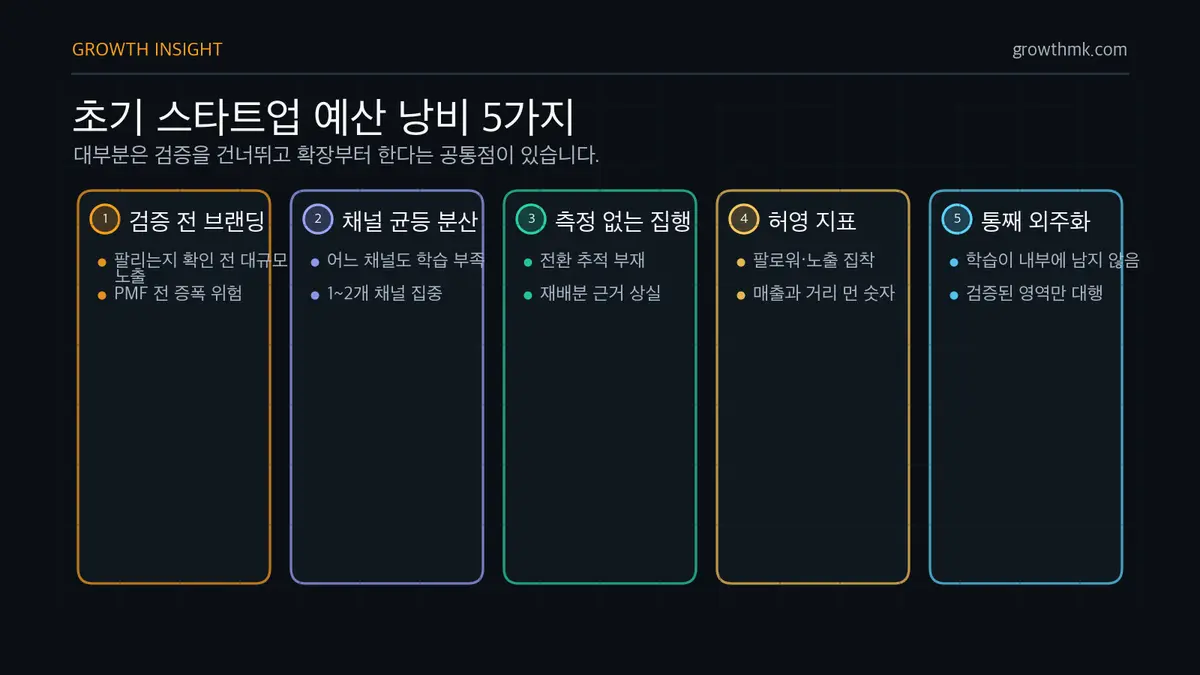
- Brand-awareness campaigns before validation — Pouring budget into large-scale exposure and branding before confirming whether the product even sells. Awareness only pays off once PMF is validated and unit economics work — before that, brand campaigns tend to become “telling more people about something that doesn’t sell.” Looking at real B2B startup marketing-failure case studies, a repeated pattern emerges: good products collapsing because spend scaled up before a validated growth channel and unit economics were secured. If you’re in B2B, it’s worth checking the full picture that ties strategy, channels, and measurement together in the complete B2B marketing guide.
- Spreading budget evenly across channels — Splitting budget evenly across Naver, Google, Meta, Instagram, and YouTube “just in case.” Too little money goes into any single channel to generate meaningful learning anywhere. Early on, it’s far faster to concentrate on 1–2 channels to pick up a signal.
- Spending without measurement — Running ads before conversion tracking is set up. Money goes out, but you can never determine afterward what actually worked, so you end up repeating the same mistake with the same money.
- Chasing vanity metrics — Targeting numbers that look good but aren’t tied to revenue, like followers, impressions, likes, or visitor counts. This runs directly against Growth Inc.’s standard that 10 people who will become revenue matter more than 10,000 visitors. The same trap repeats in the lead-gen space — the perspective of growing “leads that will become revenue” rather than lead “count” is covered in the B2B lead generation guide.
- Outsourcing validation wholesale — Handing everything to an agency with “just handle it,” so that learning about what actually works never stays inside the company. Learning during the validation stage is a startup’s most important asset, so outsourcing should be limited to execution leverage in already-validated areas. Most performance-marketing failures stem from outsourcing execution without measurement or validation — this is covered in the complete guide to why performance marketing fails.
Is the budget set once and done? — A monthly reallocation rhythm
No. An early-stage startup’s budget shouldn’t be a fixed “plan” set at the start of the year — it should be a “loop” that’s periodically reallocated. Markets, channels, and customers all change quickly; if the budget stays fixed, you keep pouring today’s money into yesterday’s answers. Growth Inc. recommends a monthly reallocation rhythm — treating each month as one experiment cycle, answering the same questions every month, and letting the budget flow again.

| Step | Monthly review question | Action |
|---|---|---|
| 1. Measure | What was each channel’s CAC and conversion rate last month? Where did revenue-generating customers come from? | Tally unit economics by channel (based on conversions/revenue, not vanity metrics) |
| 2. Learn | Which hypotheses were right, which were wrong? Did any new channel get validated? | Classify experiments that showed a signal as “validated,” and end dead experiments |
| 3. Reallocate | Add more to what’s validated, pull from what’s dead — what’s next month’s mix? | Adjust the explore/validate/scale weighting to match the current stage (scale ↑ as stage advances) |
| 4. New hypotheses | What small experiment will you run this month to find the next gold mine? | Launch 1–2 new channel/message hypotheses with the exploration budget |
These four steps are exactly the growth hacking experiment loop applied to budget — a cycle of forming a hypothesis (4), running a small experiment, measuring (1), learning (2), and reallocating resources to what’s validated (3). Running this loop on a short, one-month cycle turns your budget from “one big bet” into “many small lessons,” which lowers the odds of a fatal failure. This discipline — pulling money out of dead channels every month and moving it to validated ones — is nearly the only way a budget-constrained startup can out-compete a large company’s big budget.
Want to bring in “the one person who becomes revenue” with a limited budget?
Growth Inc. splits budget not by “% of revenue” but by “what is this money validating,” and defines success not by traffic volume but by the efficiency of bringing in “the one person who becomes revenue.” Set up your measurement environment first, validate with small experiments, and only then expand budget — this growth hacking loop is how an early-stage startup with a limited budget grows while wasting the least amount of money. If you need a partner to help design where and in what order to deploy your early marketing budget, take a look at Growth Inc.’s performance marketing service and reach out for a consultation. We’ll help you build a budget allocation structure that fits your current validation stage and unit economics.
You can see the full picture of this topic in “Startup Marketing Strategy — It’s About Validation Order, Not Budget (A Seed-to-Series-B Guide).”
Frequently Asked Questions (FAQ)
What percentage of revenue should an early-stage startup spend on marketing?
At the early stage, “what % of revenue” is itself the wrong question. The most-cited “7.7% of revenue” figure from the Gartner CMO Spend Survey is what large companies with over $1B in annual revenue spend to sustain and grow revenue that’s already validated — it doesn’t apply to a startup whose PMF and unit economics aren’t yet confirmed. Your early budget should be based on “the list of hypotheses that need validating and the cost of validating them,” not a revenue ratio, and the first principle is not to scale before unit economics (CAC < LTV) are validated.
Should an early-stage startup invest first in content/SEO or paid ads?
The two have different characters, so it’s not “one or the other” but “both, in different ways, at the same time.” Start paid ads small, as “experiment spend that quickly validates a hypothesis” rather than a “revenue channel,” and increase spend only on what’s validated. Content/SEO pays off slowly, but once built up it persists even after you turn ads off — it’s an “asset” — so it pays to accumulate it steadily from the start, even in small amounts. Either way, set up a minimum setup that accurately measures conversions before you spend.
How often should a marketing budget be revisited?
For an early-stage startup, we recommend monthly reallocation. Treat each month as one experiment cycle, and run the growth hacking loop every month: ① measure CAC and conversion by channel, ② learn which hypotheses were right, ③ move budget to what’s validated, and ④ launch a small experiment for a new hypothesis. Markets and channels change quickly, so fixing a budget set at the start of the year means pouring today’s money into yesterday’s answers. The key is the monthly discipline of pulling money from dead channels and moving it to validated ones.
What’s the most common budget waste in early-stage marketing?
The most common waste is “skipping validation and jumping straight to scale.” Specifically: ① brand-awareness campaigns before confirming the product sells, ② splitting budget evenly across channels so no single channel generates learning, ③ spending without measurement — running ads before conversion tracking exists, ④ chasing vanity metrics like followers and impressions that aren’t tied to revenue, and ⑤ outsourcing validation wholesale, so learning about what works never stays inside the company. All five share the same thread: skipping the learning that comes from the validation stage.