Why SEO Alone Isn’t Enough in the Age of AI Search — Zero-Click and the AI Dark Funnel
 임재복
임재복
This article is part 1 of 20 in Growth’s GEO Whitepaper series — Part I, Sub-Pillar (WHY). The full table of contents and PDF are available on the whitepaper page.
SEO alone can no longer sustain brand visibility in the age of AI. Two structural shifts — “the rise of zero-click search” and “the emergence of the AI dark funnel” — are dismantling the core assumptions behind traditional search marketing. This article maps out the big picture behind both shifts, then points you to two deeper chapters: Zero-Click Search and AI Dark Funnel.
The scariest moment in marketing is realizing the market has moved on while your strategy hasn’t. Many marketing leaders are living that moment right now. Search engine optimization has been the backbone of digital marketing for two decades. The logic — “create great content, rank it high, and customers will click, land on your site, and convert” — was intuitive, and it worked. But the first link in that chain, the “click,” is disappearing. That’s the backdrop behind Generative Engine Optimization (GEO), which designs brand visibility inside AI answers rather than search rankings.
The First Structural Shift: Zero-Click Search Goes Mainstream
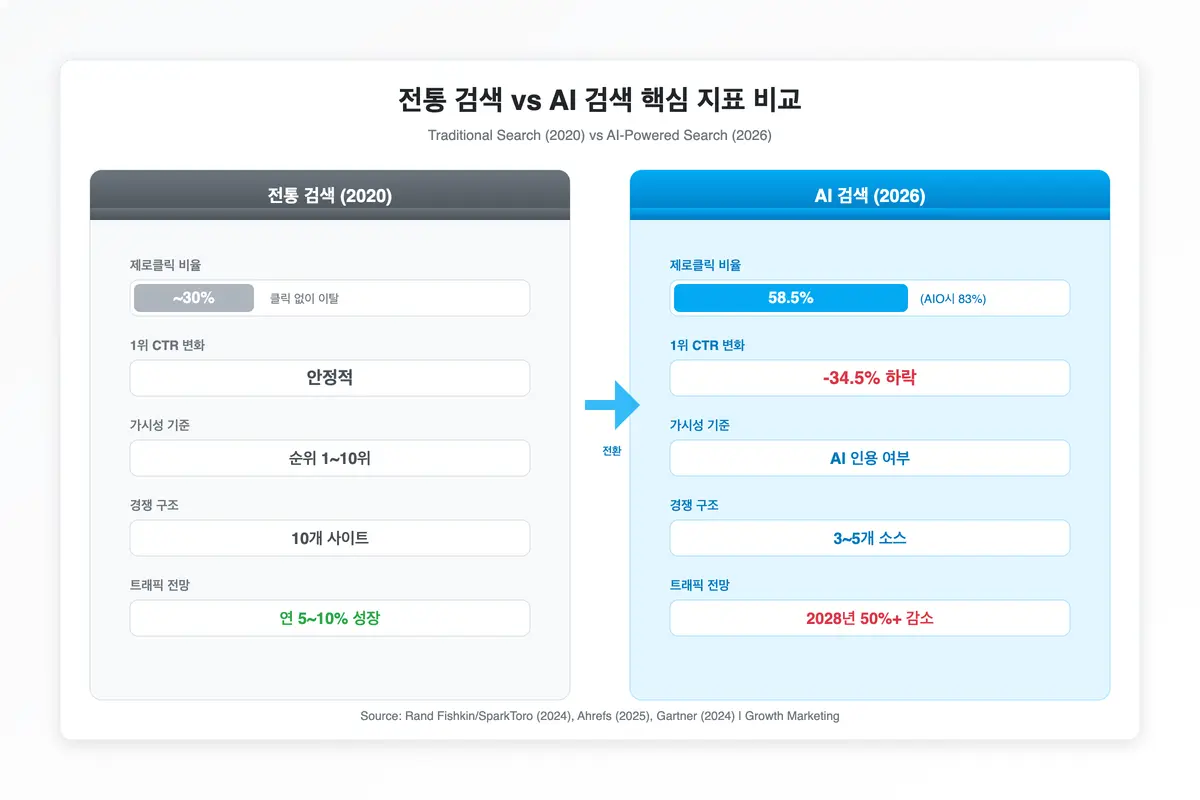
As the data in the zero-click search chapter shows, more than half of Google searches now end without a single site visit. For queries where AI Overviews activate, that share climbs even higher. Ranking #1 on page one barely matters once AI hands the user an answer directly. This isn’t a tactical shift — it’s a structural one.
The phenomenon is even more layered in Korea. The Korean search market now runs on a triple structure: Google AI Overviews, Naver’s AI briefings, and ChatGPT/Perplexity. For marketers, that means managing three simultaneous arenas of AI-answer competition instead of one search engine. What each axis of Korea’s triple search structure actually means for marketers is broken down in detail in the next chapter.
Major global research firms agree this trend isn’t temporary. Traditional search volume is shrinking while the AI search market grows rapidly — at the same time. This isn’t a matter of tweaking tactics; it calls for rebuilding channel strategy from the ground up. Specific figures and forecasts are covered in the next chapter.
The Second Structural Shift: The Rise of the AI Dark Funnel
If the shift in search is a crisis of “traffic,” the shift in the customer journey is a crisis of “persuasion.” What Google once called the “Messy Middle” — the winding process of exploring and evaluating options before reaching a purchase decision — is now being compressed by AI. As AI takes over the comparison-shopping that consumers used to do by visiting multiple sites themselves, the window in which brands can observe and influence customer decisions is shrinking fast.
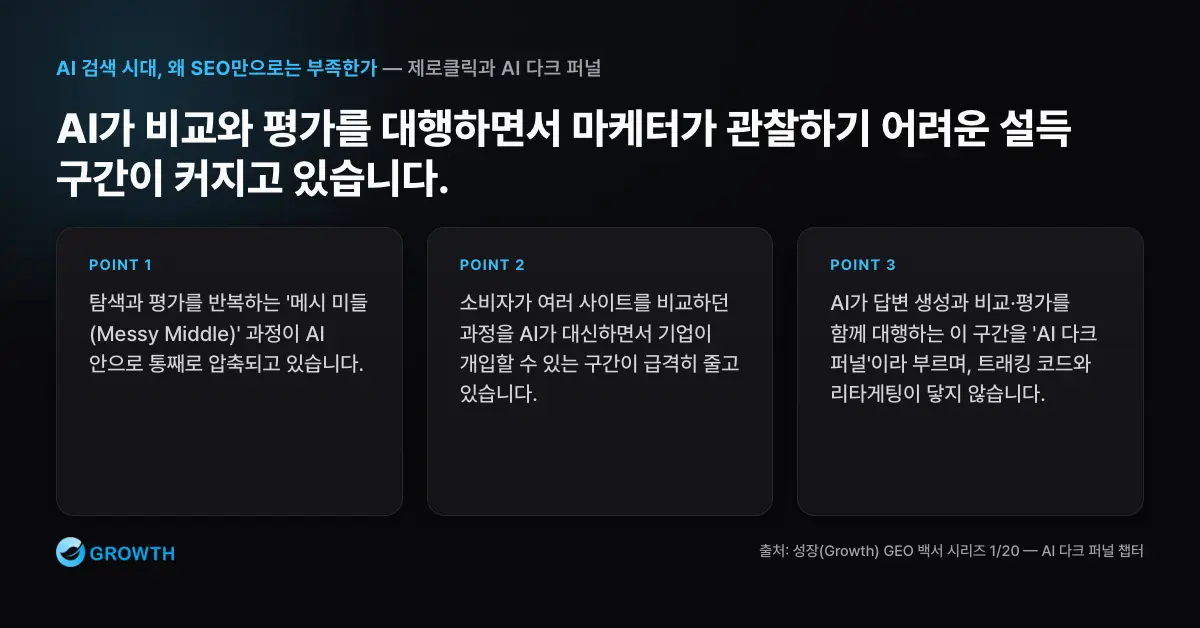
According to the data covered in the AI dark funnel chapter, a significant share of B2B buyers already begin product research inside AI tools. An equally striking share end up choosing a different vendor than they originally intended, simply by following AI’s recommendation. The audience marketers need to persuade is shifting from “people” to “a combination of AI and people.”
Together, these two zones — where AI generates the answer directly, and where AI stands in for customers doing comparison and evaluation — make up what we call the “AI dark funnel.” No tracking code, no retargeting campaign reaches inside it. How customers form an impression of your brand, and how AI describes that brand to them, is a complete black box.
Why Act Now
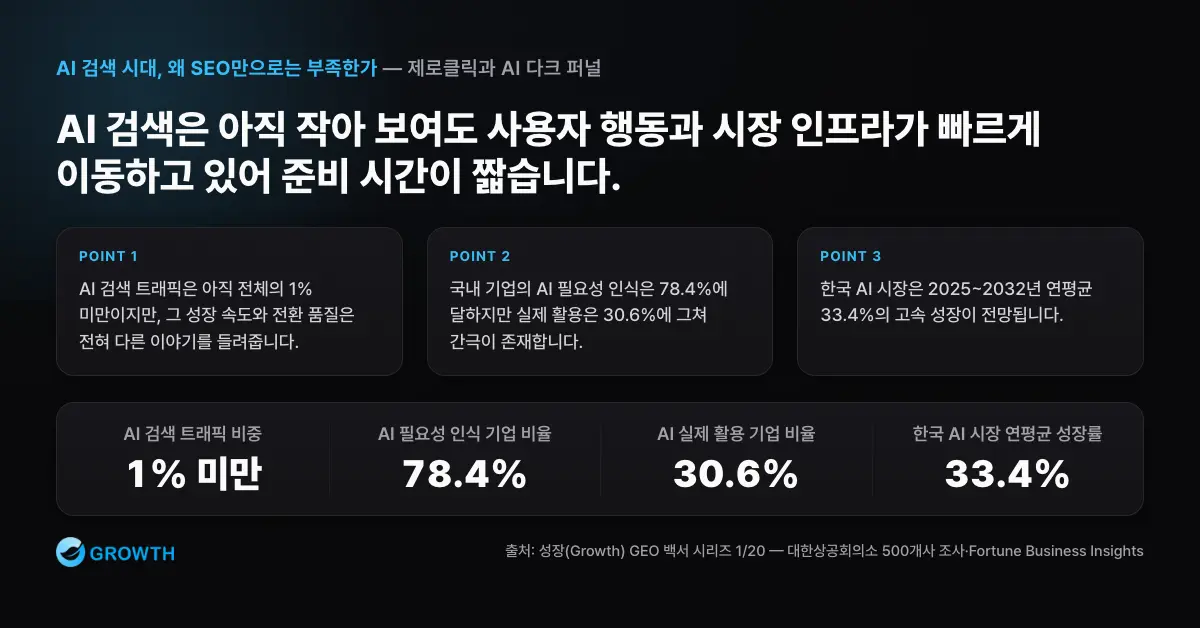
Some marketing leaders might reason, “AI search traffic is still under 1% of the total, so we can afford to wait and see.” That’s true — in raw volume, AI traffic’s share is still tiny. But its growth rate multiplies several times over each year, and conversion data from AI-driven visits tells a completely different story than volume alone. The quantity may still be small, but the quality is already overwhelming.
Take a moment to consider what these numbers really mean. A customer who arrives via AI has already completed their comparison and evaluation inside the AI itself — they’re a “convinced visitor.” Where traditional search traffic is “a visitor here to look around,” AI-driven traffic is “a visitor who has already decided and is here to confirm it.” That’s because AI has handled the upper stages of the marketing funnel on the customer’s behalf. AI search isn’t “just another channel” for traffic — it’s a “quality filter” that surfaces the customers with the highest purchase intent.
User behavior is already changing. It just hasn’t fully shown up on your analytics dashboard yet. In a survey of 500 Korean companies by the Korea Chamber of Commerce and Industry, 78.4% recognized the need for AI, yet only 30.6% were actually using it. How fast that gap closes is exactly how much preparation time you have left. According to Fortune Business Insights, Korea’s AI market is projected to grow from $7.17 billion in 2025 to $53.87 billion by 2032 — a 33.4% compound annual growth rate. Given how quickly the infrastructure is falling into place, “waiting and watching” leaves less time than you’d think.
This article has mapped the big picture behind two structural shifts. The Zero-Click Search Era digs into the structural shift in search and the AI answer economy with data and industry-specific scenarios, while AI Dark Funnel analyzes the restructured customer journey and the new decision-making process across B2B and B2C contexts. After reading both chapters, you’ll be able to gauge the precise scale of the challenge your own brand faces — and why the GEO strategy covered later in the GEO Whitepaper matters. For how GEO relates to traditional SEO, see our separate GEO vs. SEO comparison.
Curious how your brand currently shows up in AI answers? Reach out for an AI answer share diagnostic. You can also download the full GEO Whitepaper PDF.
Frequently Asked Questions
What is zero-click search?
It’s when a user completes their search without clicking through to any website from the results page. As AI increasingly generates answers directly, this share has climbed quickly — and with it, the effectiveness of the traditional SEO formula of “rank → click → visit” has declined.
What is the AI dark funnel?
It’s the decision-making stage where customers complete their comparison, evaluation, and shortlisting entirely inside AI. Brands can neither observe nor influence this stage. It’s beyond the reach of tracking codes or retargeting, so by the time customers reach your website, they’ve often already made up their mind.
AI search traffic is still small — do we really need to respond now?
The volume is small, but the quality is different. Visitors who arrive via AI have already completed their comparison and evaluation, so their purchase intent is high. AI search usage itself is also multiplying year over year. It pays to start preparing before the gap between awareness and adoption closes.
Does this mean traditional SEO no longer matters?
No. Well-structured content and a solid technical foundation are still the starting point for AI citations. But the “click-through traffic” that SEO used to guarantee is no longer enough on its own to manage your brand’s visibility inside AI answers. You need to broaden your strategy to include GEO.
GEO Whitepaper series: Full table of contents · Next chapter →