The Zero-Click Search Era — 58.5% of Google Searches End Without a Click
 임재복
임재복
This article is part 2 of 20 in Growth’s GEO Whitepaper series — Ch.1, The Structural Shift in Search. The full table of contents and PDF are available on the whitepaper page.
58.5% of Google searches end without a click. When AI Overviews appear, the #1 result’s click-through rate drops 34.5%. Korea is the only market in the world running a “triple AI search” structure — Naver AI, Google AIO, and ChatGPT coexisting — which makes the shift here faster and more complex than anywhere else.
The Vanishing Click, the Rising Answer Economy
For marketers, “rank #1” was long the north star. Do the keyword research, optimize the content, build the backlinks, land at the top of the results — and traffic followed, conversions followed, revenue grew. For nearly two decades, this virtuous cycle was digital marketing’s most reliable growth formula.

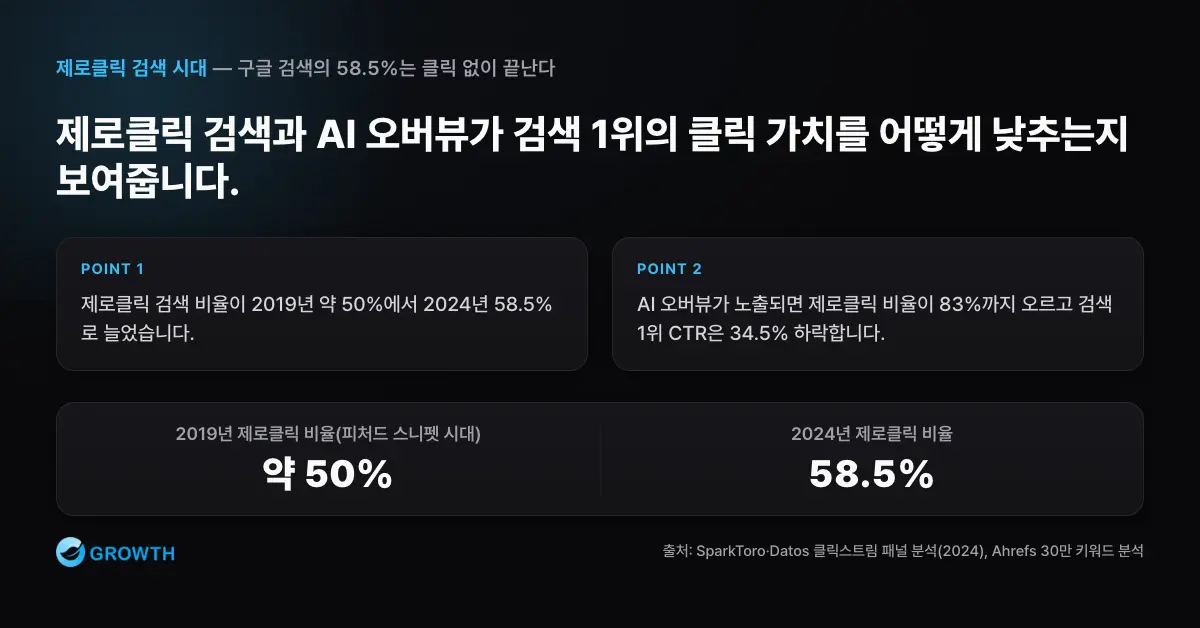
But the core assumption behind this formula — “rank high → get clicked → drive traffic” — has begun to crack. The picture painted by SparkToro and Datos’ large-scale clickstream panel analysis is sobering. As of 2024, 58.5% of Google searches in the US are zero-click: the user leaves the results page without clicking a single link. Nearly six out of every ten searches end without a single site visit. And that figure was reached before AI Overviews had even fully rolled out — back in the era of featured snippets and knowledge panels.
The arrival of AI Overviews pushed this trend into overdrive. Multiple industry analyses show that for queries where AI Overviews (AIO) appear, the zero-click rate spikes to 83%. A user types a question, AI synthesizes information from multiple websites into a direct answer, and the user is satisfied with that answer — with no reason left to visit the original source site. When Ahrefs analyzed 300,000 keywords, it found that the #1 result’s click-through rate dropped by 34.5% whenever an AI Overview appeared. In other words, the top spot you fought so hard to earn loses more than a third of its value the moment an AI answer shows up.
It’s more accurate to call this a shift toward the “Answer Economy” than a “search crisis.” Search used to be a service that “found you links.” You asked a question, it handed you a list of relevant pages, and you clicked through to find your answer yourself. Search today is a service that “generates an answer.” AI synthesizes dozens of sources in real time into a single, complete answer. The winner in this shift isn’t “the most-clicked site” — it’s “the source AI cites most often.” The discipline built around systematically winning that citation competition is Generative Engine Optimization (GEO).
Gartner’s forecasts suggest we’re still in the early innings of this shift. Traditional search engine volume is projected to fall 25% by 2026, and brands’ organic search traffic is projected to drop more than 50% by 2028. McKinsey estimates that by 2028, $750 billion (roughly ₩1,000 trillion) in spending in the US alone will flow through AI search, describing AI search as becoming the internet’s “new front door.” Looking back a decade from now, 2025-2026 will likely be remembered as the turning point when the entire search paradigm flipped.
Korea’s Triple Search Structure — the World’s Most Complex AI Search Market
Korean marketers face a situation one layer more complex than the global market. In most countries, marketers build their strategy around a single dominant search engine — Google. Just responding to AI Overviews is already a challenge there. Korea, however, is the only market in the world where three independent AI search ecosystems operate simultaneously.
The first axis is Naver’s AI briefing. According to search-market tracker Internet Trend, Naver held a 62.86% average market share in 2025 and has been rapidly expanding AI briefing coverage, with a stated goal of reaching about 20% of all queries. In the Places vertical, where AI briefings have already been deployed, user dwell time rose 10.4% and clicks on business “see more” tabs jumped 137% compared to before rollout. Naver’s strategic quirk is that it blocks external AI crawlers: by denying access to major crawlers like GPTBot and PerplexityBot across core services such as Blog and Cafe, Naver effectively confines its ecosystem’s content to Naver’s own AI briefing. For marketers, that means Naver optimization has to be built as its own, standalone strategy.
The second axis is Google’s AI Overviews (AIO). By the same survey, Google holds 29.55% of the Korean search market and applies its global AI Overview feature here as well. According to BrightEdge’s enterprise-scale data analysis, 54.5% of the sources cited in AI Overviews overlap with pages already ranking in organic search — good news, since it means traditional SEO still forms the foundation of AI visibility. But the remaining 45.5% are cited from entirely new sources outside the organic rankings. Traditional SEO alone covers, at best, about half the battlefield.
The third axis is the standalone AI search platforms led by ChatGPT and Perplexity. According to Opensurvey’s AI Search Trend Report 2026, 54.5% of Koreans aged 10 to 50 had used ChatGPT as of December 2025, and 30% of ChatGPT users also cross-use other AI services. A large-scale survey by Korea’s Ministry of Science and ICT (covering 25,509 households and 60,229 people nationwide) found that generative AI adoption doubled year-over-year to 33%, then climbed to 44.5% the following year — evidence that these platforms are no longer early-adopter toys but mainstream search tools. Pew Research found that 62% of US adults under 30 frequently encounter AI summaries in their search results. The younger the demographic, the more AI search has become the default behavior.

What this triple structure means for marketers is clear: the era of a single SEO strategy covering everything is over. You now need to design and execute three strategies simultaneously — one to earn citations in Naver’s AI briefing, one to get selected as a source in Google’s AI Overviews, and one to be mentioned as a recommended brand on ChatGPT and Perplexity. There is a shared foundation across all three — strong E-E-A-T, structured data, authoritative external citations — but each platform’s AI collects and evaluates content differently, and failing to understand those differences can mean losing on all three battlegrounds at once. The concrete execution steps for building that shared foundation are covered in our AI search optimization execution guide, and the full strategic map spanning all three arenas is laid out in the GEO Whitepaper.
A Shockwave That Hits Every Industry Differently
Zero-click search and the answer economy aren’t hitting every industry with the same force. In some, it’s already a towering wave crashing down; in others, it’s still just a shape on the distant horizon. But the direction is the same everywhere. The only real difference is timing.
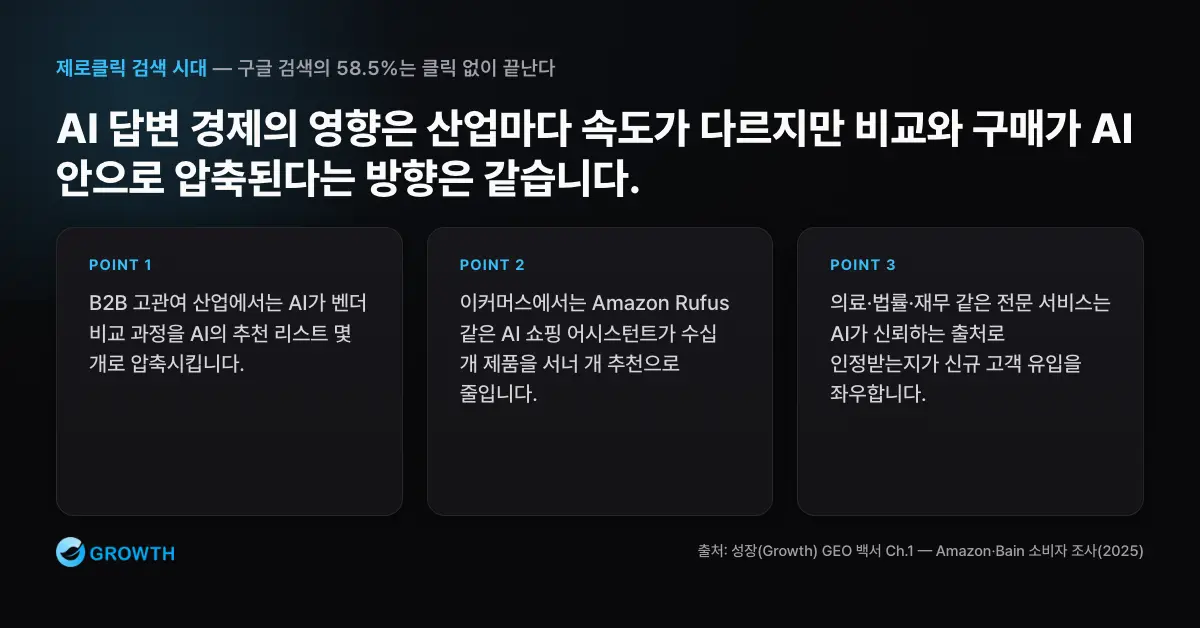
High-consideration B2B industries — SaaS, consulting, professional services — feel the shock first and hardest. Informational, research-heavy keywords like “compare marketing automation platforms” or “ERP implementation guide” are exactly the kind of query AI handles best. The moment an IT director asks ChatGPT, “recommend a CRM solution for a mid-size company,” a vendor comparison that used to take two weeks of clicking through the top ten results gets compressed into a 30-second list of five AI recommendations. Vendors who don’t make that list don’t even make it into the running.
In B2C e-commerce, Amazon’s AI shopping assistant Rufus is estimated to handle around 270 million queries a day (rebranded “Alexa for Shopping” in May 2026), compressing search results that once listed dozens of products down to just three or four recommendations. According to Amazon, customers who use Rufus are more than 60% more likely to complete a purchase during that shopping session. That’s a better user experience — but it also means products AI didn’t choose lose their shot at visibility entirely. In professional-services fields like healthcare, legal, and finance, where “accuracy of the answer” is everything, being recognized as the source AI trusts most becomes a matter of survival for acquiring new clients.
Bain’s 2025 consumer survey reveals just how deep this shift runs. About 80% of consumers said more than 40% of their searches end on the results screen with no click at all, and Bain estimates this has cut organic web traffic by 15-25%. Even the act of cross-checking an AI answer against another source is increasingly happening inside yet another AI tool. Opensurvey’s Korean data — showing a 30% cross-usage rate across AI services — backs this up. In the end, consumers cycle through the AI ecosystem to reach their decision, and the traditional website visit shrinks down to a final confirmation step.
Traditional Search vs. AI Search: Key Metrics Compared
Here’s a snapshot of everything described above.

| Dimension | Traditional Search (2019-2020 baseline) | AI Search (as of 2026) | Direction of Change |
|---|---|---|---|
| Result format | List of 10 blue links | AI-generated answer + source citations | List → Answer |
| Zero-click rate | ~50% (2019, featured-snippet era) | 58.5% (overall), 83% (AIO-active) | Steadily rising |
| Impact on #1 CTR | Minimal fluctuation | -34.5% when AIO appears | Sharp decline |
| User behavior | Visit and compare multiple sites directly | Settle for a single AI answer, or cross-check with another AI | Fewer site visits |
| Visibility criterion | Search ranking (positions 1-10) | Whether AI cites you (cited or ignored) | Ranking → Citation |
| Traffic outlook | Steady growth | Organic traffic projected to drop 50%+ by 2028 (Gartner) | Growth → Decline |
| Competitive structure | Competition among 10 sites | Competition among 3-5 AI-selected sources | Narrower field |
| Korea’s specificity | Dual structure: Naver + Google | Triple structure: Naver AI + Google AIO + ChatGPT | Rising complexity |
The most important takeaway from this table is that the unit of competition has shifted from “ranking” to “citation.” In the old world, you competed for one of ten spots, ranks 1 through 10. Now it’s binary: either you’re one of the 3-5 sources AI selects to cite, or you’re ignored entirely. There’s no middle ground.
Key Takeaways
The structural shift in search is already underway, and the Korean market sits in the world’s most complex environment — a triple AI search structure. To maintain your brand’s AI visibility through this shift, you need to expand your strategic focus beyond “search rank optimization” toward “AI citation optimization.” How SEO and GEO differ, and how they complement each other, is covered in depth in our GEO vs. SEO comparison. In the next chapter, AI Dark Funnel, we’ll look at how this shift in search is reshaping the entire customer purchase journey — and the new black box, the “AI dark funnel,” that’s creating fresh challenges for marketing.

Curious how your brand currently shows up in AI answers? Reach out for an AI answer share diagnostic. You can also download the full GEO Whitepaper PDF.
Frequently Asked Questions
What is zero-click search?
It’s when a user ends their search without clicking any link on the results page. According to SparkToro and Datos’ 2024 analysis, 58.5% of US Google searches end zero-click, and industry analyses show that share climbing to 83% for queries where AI Overviews appear.
How much does an AI Overview cut into clicks?
When Ahrefs analyzed 300,000 keywords, it found that the click-through rate (CTR) for the #1 result dropped by an average of 34.5% whenever an AI Overview appeared. In other words, the value of the #1 spot is structurally shrinking as AI answers take over.
What is Korea’s “triple search structure”?
It refers to the distinctive setup of the Korean market, where Naver’s AI briefing, Google’s AI Overviews, and standalone AI search tools like ChatGPT and Perplexity all operate at once. Because each of the three ecosystems collects and evaluates content differently, you need a tailored optimization strategy for each.
Does search ranking still matter in the zero-click era?
Yes. BrightEdge’s analysis found that 54.5% of the sources cited in AI Overviews overlap with organically ranked pages, so traditional SEO remains the foundation of AI visibility. But since roughly the other half are cited from sources outside the rankings, ranking optimization alone isn’t enough.
GEO Whitepaper series: ← Previous chapter · Full table of contents · Next chapter →