The AI Dark Funnel — Where Customer Purchase Decisions Are Made Out of Sight
 임재복
임재복
This article is part 3/20 of Growth’s GEO Whitepaper series — Ch.2, The Reshaping of the Customer Journey. The full table of contents and the complete PDF are available on the whitepaper page.
51% of B2B buyers now start product research with AI, and 69% choose a vendor other than the one they originally intended based on an AI recommendation. The “AI dark funnel” — where customers complete comparison, evaluation, and shortlisting entirely inside AI — is fundamentally disabling companies’ marketing funnels.
From the Messy Middle to the AI Compressed Middle
Looking back at the history of the marketing funnel, its evolution is really a history of attempts to understand customer behavior. The traditional AIDA model (Awareness → Interest → Desire → Action) was linear and predictable. A customer sees an ad, gets interested, develops desire, and buys. Clean, but far from reality.
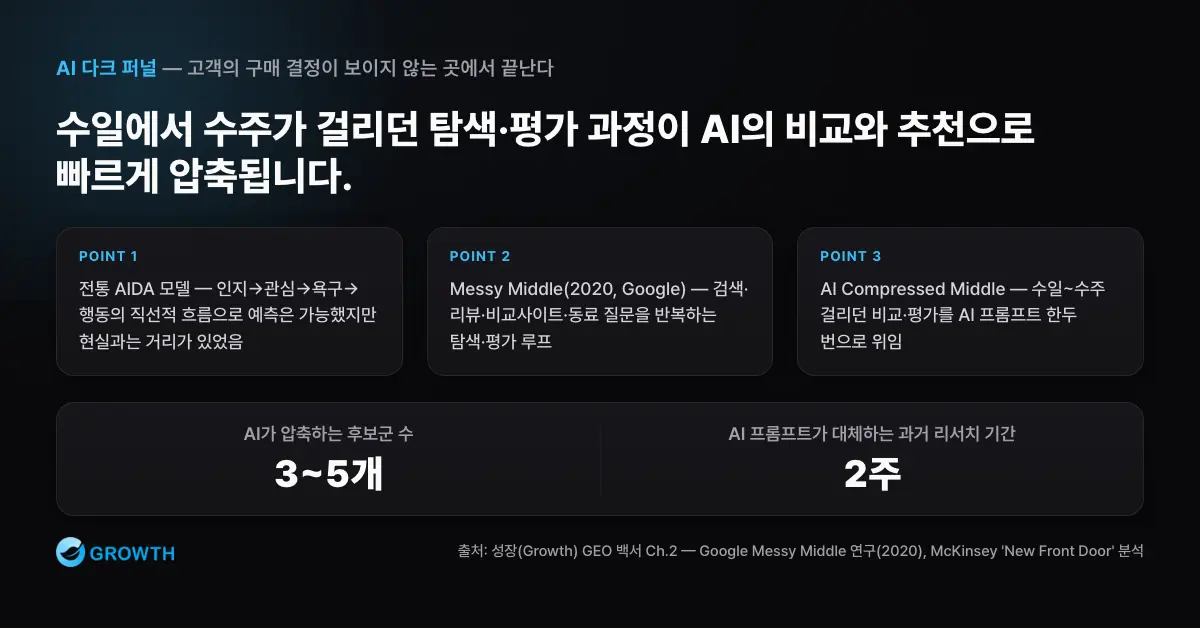
In 2020, a Google research team acknowledged the limits of this linear model and introduced the concept of the “Messy Middle.” Between awareness and purchase, they argued, customers loop chaotically between Exploration and Evaluation. They search, read reviews, visit comparison sites, ask peers, and search again. This complex process was precisely the battleground where marketers exerted influence through content marketing, SEO, and retargeting ads.
But now, AI has compressed that Messy Middle. What we can call the “AI Compressed Middle” is the phenomenon of customers delegating to AI, in one or two prompts, a comparison and evaluation process that used to take days or weeks of visiting multiple sites directly. “Just compare three project management tools that fit a company our size (50 people). Focus on price, features, and Korean-language support.” That one sentence replaces what used to be two weeks of research.
This is the context behind McKinsey calling AI search the “new front door” to the internet. Before a customer even reaches your website, AI has already narrowed the field to three to five candidates, compared their pros and cons, and even delivered a conclusion like “given your situation, we’d recommend A.” By the time a customer visits your site, they’ve often already gathered enough information from AI and are just there for a final check. A significant share of the influence marketers once wielded in the Messy Middle has shifted to AI.
Defining the AI dark funnel — the deal decided out of view
The term “dark funnel” was originally used in B2B marketing to describe untrackable touchpoints. A colleague’s Slack message, a conversation at a conference, a recommendation heard on a podcast — these were “dark” touchpoints with no UTM parameter attached, untraceable by any marketing automation tool.
The AI-era dark funnel extends this concept a level further. The “AI dark funnel” refers to the decision-making territory a company can neither observe nor influence, which forms while AI handles a customer’s information gathering, comparison, evaluation, and shortlisting on their behalf. This definition is one Growth’s GEO Whitepaper has systematized for a Korean-market context.
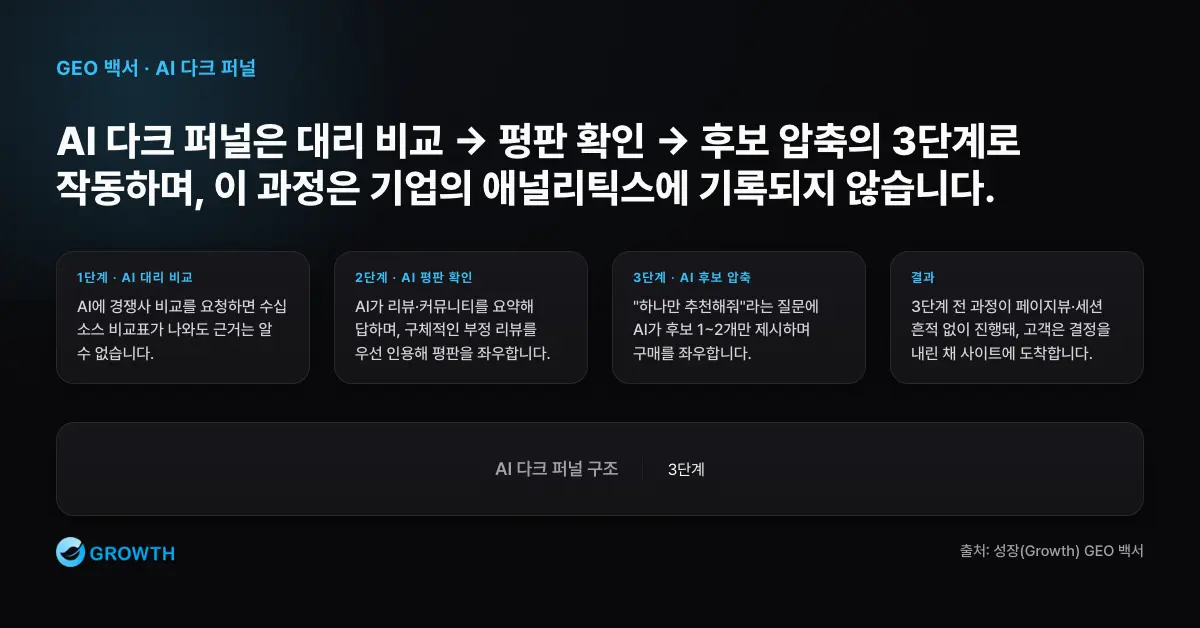
The AI dark funnel operates in three stages. The first is the AI-proxy comparison stage. When a customer asks AI to “compare A vs. B vs. C,” the AI analyzes dozens of sources to generate a comparison table. Neither the customer nor the company can see which sources the AI referenced or what criteria it used to compare them. If your brand is excluded from this comparison, the customer moves to the next stage without ever learning your brand exists.
The second is the AI reputation-check stage. Through follow-up questions like “What are the downsides of Solution A?” or “Summarize the reviews for Service B,” customers delegate reputation research to AI. AI gathers and summarizes information from Reddit, community posts, review sites, and blogs. The problem is that your brand’s reputation ends up determined by which reviews AI happens to select and cite. If negative reviews are more specific and detailed, AI may judge them “more useful information” and cite them preferentially.
The third is the AI candidate-compression stage. At the decisive question — “just recommend one, final answer” — AI synthesizes all the prior comparison and evaluation into one or two final recommendations. If Gartner’s forecast from its 2025 IT Symposium comes true — that 90% of B2B purchases will be processed through AI agents by 2028 — this compression stage becomes the actual final gate for purchase decisions. More than $15 trillion in B2B spending would then pass through this single gate.
What all three stages share is that none of it leaves any trace in your company’s GA4. No pageviews, no sessions, no events are logged. By the time a customer finally visits your site, they arrive already in a “highly ready to buy” state. That’s exactly why Ahrefs’ data shows AI-referred traffic converting at 23x the rate of regular search — because these are visitors who have already made it through the AI dark funnel. Comparison, evaluation, and the decision are all already done. Ironically, the single most important marketing activity now happens in the single least measurable place.
A B2B scenario: a procurement director’s new buying journey
To make this shift concrete, let’s walk through a specific scenario. Meet Mr. Kim, a procurement director at a mid-sized manufacturing company in Seoul.
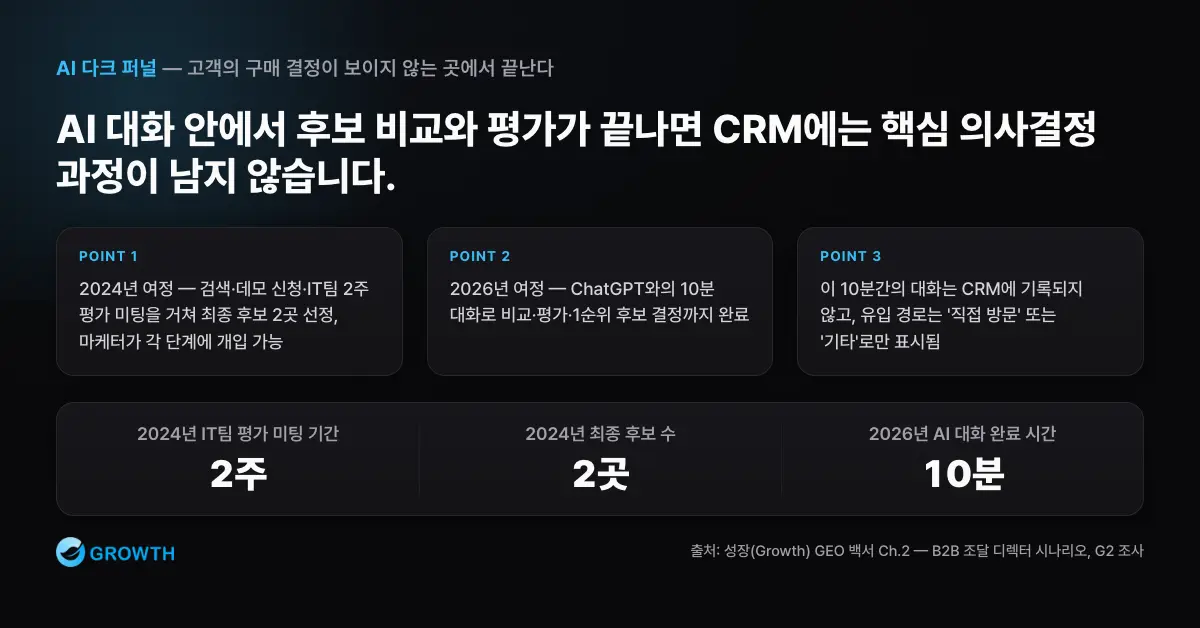
Back in 2024, when Mr. Kim was evaluating an ERP replacement, he searched “ERP recommendations for mid-sized companies” on Naver and Google, clicked through the top 10 results, requested demos from three vendors, spent two weeks in evaluation meetings with the IT team, and narrowed it down to two final candidates. At every one of those stages, marketers could exert influence through search ads, SEO content, demo-request landing pages, and email nurture sequences.
The 2026 version of Mr. Kim is different. He types into ChatGPT: “Recommend three cloud ERP systems for our company (manufacturing, 50 billion won in revenue, 200 employees). I’ve heard SAP is expensive, so include alternatives too.” Thirty seconds later, AI delivers a detailed comparative analysis. Mr. Kim follows up: “Which of these has the best Korean-language support?” “Show me real manufacturing case studies.” “Are there any hidden costs?” This conversation wraps up in ten minutes, and by the end of it, Mr. Kim already has a “top pick” in his head.
The key point here is that none of this ten-minute conversation gets logged in the company’s CRM. When Mr. Kim eventually visits a vendor’s site and requests a demo, the traffic source shows up as “Direct” or “Other.” The marketing team has no idea where this lead actually came from, how AI described their company, or how it compared them to competitors. G2’s research found that 69% of B2B buyers chose a different vendor than originally intended based on an AI recommendation — meaning these invisible ten minutes can determine the outcome of a contract worth hundreds of millions of won.
Forrester’s buyer journey research found that 89% of B2B buyers already use GenAI somewhere in their purchase process, which means this scenario is fast becoming the standard rather than the exception. And if Gartner’s forecast holds — 90% of B2B purchases processed through AI agents by 2028 — then even Mr. Kim typing his own prompts may turn out to be a transitional phase. Ultimately, we may reach an era where a company’s own AI purchasing agent negotiates automatically with a vendor’s AI sales agent — at which point marketing’s audience shifts from “people” to “AI.”
A B2C scenario: the consumer’s compressed shopping journey
The shift in B2C shares the same underlying logic but plays out differently. Take Ms. Lee, a 30-something office worker, as an example.
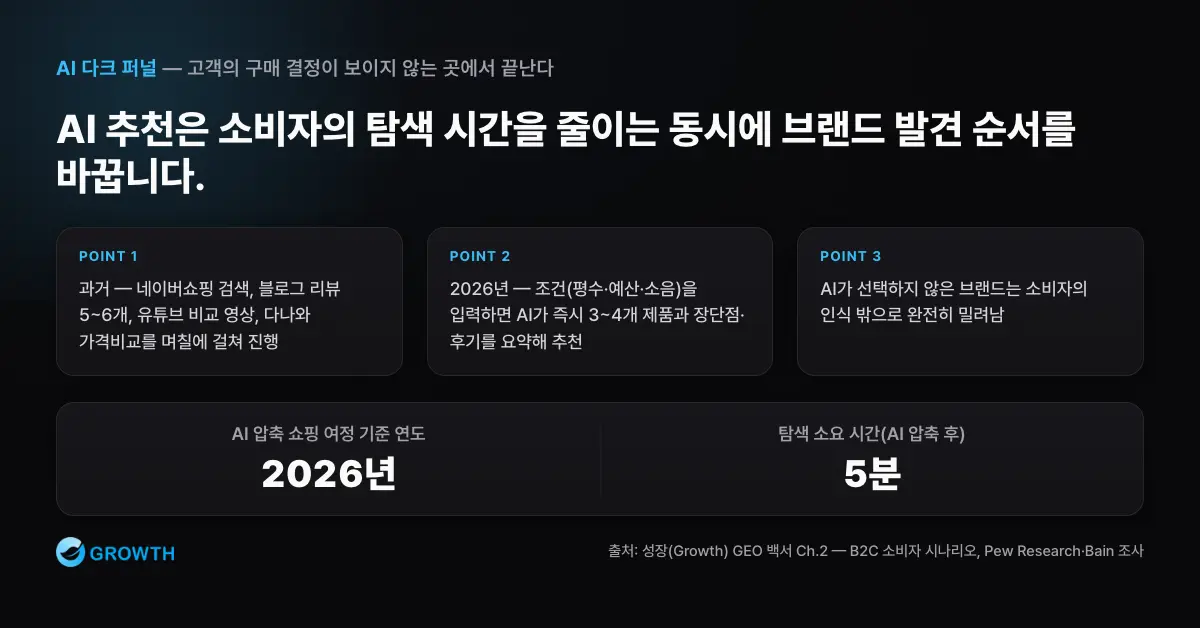
In the past, if Ms. Lee wanted to buy an air purifier, she’d spend several days searching on Naver Shopping, reading five or six blog reviews, watching a comparison video on YouTube, checking prices on Danawa, and cross-referencing review counts and star ratings on Coupang and Naver. At every touchpoint in that process, a brand could influence her choice through SEO, influencer marketing, review management, and competitive pricing.
The 2026 version of Ms. Lee asks AI: “I have a 20-pyeong apartment and a pet. Recommend an air purifier under 300,000 won. I’d prefer something quiet.” AI instantly recommends three or four products, summarizing the pros, cons, and real user reviews for each. Ms. Lee follows up: “Which one has the cheapest filter replacement cost?” — and buys directly through the recommendation link. What used to take several days of searching has been compressed into five minutes.
Pew Research found that one in five American adults (20%) who’ve encountered AI summaries rate them as “very useful,” and 62% of those under 30 say they encounter them often — a sign that this compressed shopping journey is already becoming mainstream. Bain’s data shows that 80% of consumers now end more than 40% of their searches on the results screen without a single click — meaning AI is no longer a supplementary tool but a primary decision-making channel.
What’s especially worth noting in B2C is “the invisibility of brands AI doesn’t choose.” Just as Amazon’s AI shopping assistant compresses dozens of search results into a handful of recommendations, AI typically offers a consumer only three to five recommendations for any given question. The remaining dozens of brands fall completely outside the consumer’s awareness. G2’s research found that one in three buyers (33%) purchased “a brand they’d never heard of before” based on an AI recommendation — meaning AI recommendations can overturn existing brand-awareness rankings entirely. This is both a crisis and an opportunity for smaller brands: fail to get chosen by AI, and you disappear from view; get chosen, and you can share the same stage as much larger competitors.
An evolution model: the traditional funnel → the Messy Middle → the AI Compressed Middle
The evolution of the customer journey can be summarized in three stages.
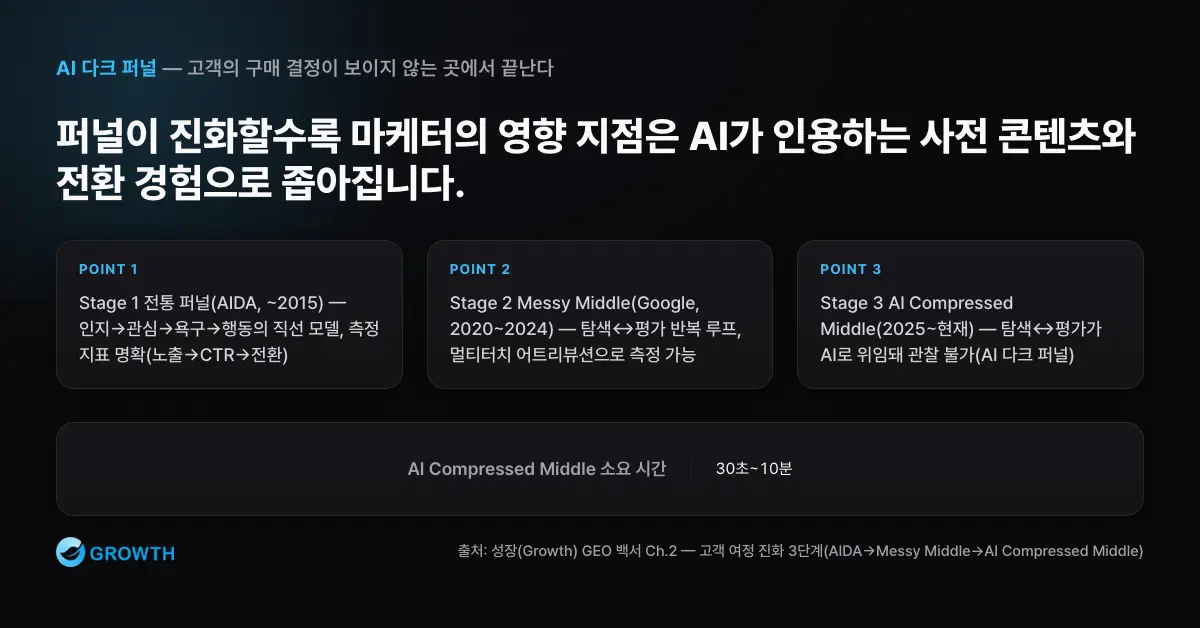
Stage 1: The traditional funnel (AIDA, through ~2015)
A linear model: awareness → interest → desire → action. Marketers could intervene at every stage, and metrics were clear (impressions → CTR → conversion). Its limitation was that real customer behavior isn’t actually linear.
Stage 2: The Messy Middle (Google, 2020–2024)
A repeating loop of exploration and evaluation exists between awareness and purchase. Customers gathered information by visiting multiple sites directly, and marketers could intervene in that loop through SEO, content, and retargeting. Measurement was complex, but still possible (multi-touch attribution).
Stage 3: The AI Compressed Middle (2025–present)
The exploration-and-evaluation loop is delegated to AI and compressed to somewhere between 30 seconds and 10 minutes. AI handles comparison, evaluation, and recommendation all at once, and companies can’t observe this process (= the AI dark funnel). Customers reach a company’s touchpoint “already decided,” and whether AI cites you becomes a precondition for even entering the funnel.
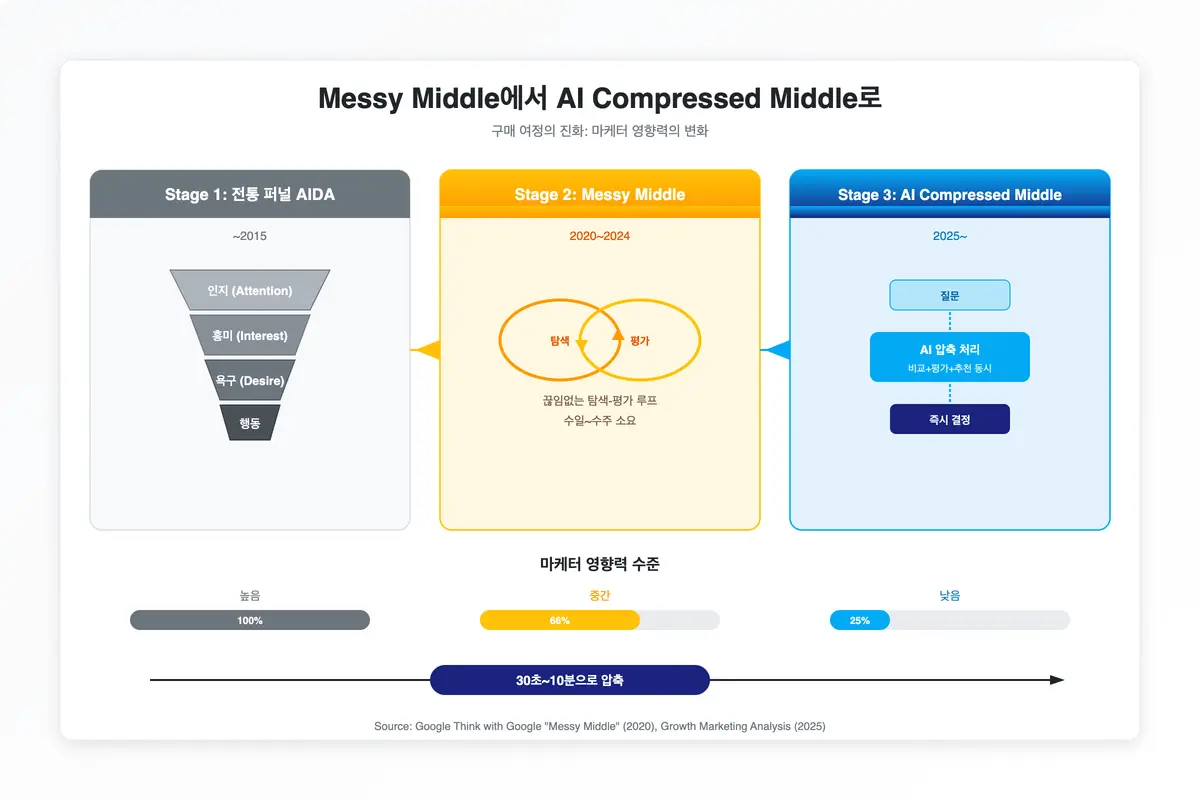
The key implication of this evolution is that the window where marketers can exert influence keeps narrowing. In Stage 1, marketers could control the entire funnel. In Stage 2, they could control the Messy Middle. In Stage 3, there are essentially only two points left where a marketer can still exert influence. One is optimizing, in advance, the content that AI learns from and cites — that is, GEO (generative engine optimization). The other is the on-site experience that converts customers who arrive by way of AI. The GEO strategy covered in the WHAT and HOW parts of this whitepaper series is exactly the methodology for maximizing that first point of influence.
The measurement paradox companies now face
The most fundamental challenge the AI dark funnel poses to marketing is, ironically, that “the single most important activity is the single hardest one to measure.” Digital marketing’s strength has always been measurability — every click, every pageview, every conversion could be tracked. But in the AI dark funnel, at the exact moment a customer forms their most important impression of your brand, none of your analytics tools are running at all.
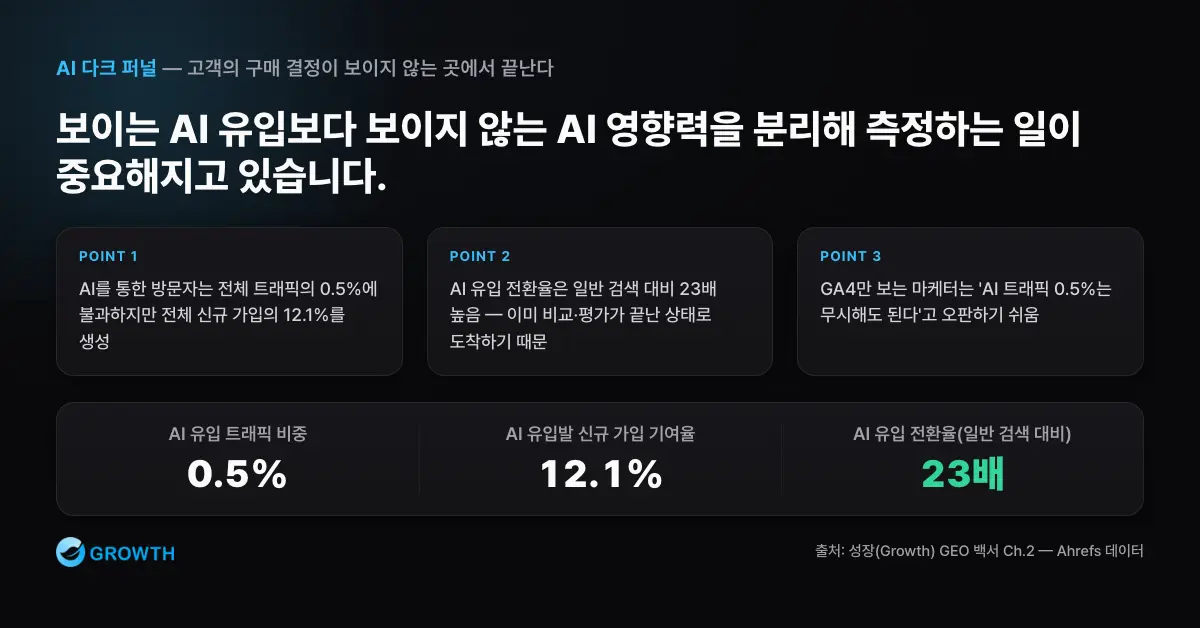
Ahrefs’ own case illustrates this paradox clearly. AI-referred visitors made up just 0.5% of total traffic, yet generated 12.1% of all new sign-ups. The reason the conversion rate is 23x higher is simple: these visitors had already made it through the AI dark funnel. Comparison done, evaluation done — they arrive on the site already convinced “Ahrefs is the right tool for me.” A marketer looking only at GA4 might conclude, “AI traffic is only 0.5%, we can ignore it.” But in reality, that same 0.5% was generating 12% of new sign-ups.
This measurement paradox becomes even more serious against the backdrop of Forrester’s finding that “89% of B2B buyers have adopted GenAI” and G2’s finding that “51% start their research in an AI chatbot.” Even if the traffic your GA4 dashboard classifies as “AI referral” is under 1%, the number of customers actually influenced by AI could be far higher. That’s because a customer who first discovers your brand through AI, and then later searches your brand name directly on Google, gets logged as “Branded Search” or “Direct” instead.
Previsible’s analysis of 1.96 million LLM sessions found that ChatGPT-referred sessions grew 4.29x in a single year — a sign that this invisible influence is growing exponentially. McKinsey’s warning that brands unprepared for AI search could see their traditional search traffic drop 20–50% is an estimate that accounts not just for visible traffic loss, but for lost opportunity in this invisible space as well. The practical work of quantifying this invisible influence — separating AI referrals within GA4, designing “How did you hear about us?” (HDYHAU) surveys, and similar techniques — is covered separately in the GEO measurement guide.
Key takeaway
The AI dark funnel is fundamentally rewriting the rules of marketing. The single most important moment in a customer’s buying decision has moved outside a company’s field of view, and how your brand is represented inside this black box — where AI handles comparison, evaluation, and recommendation on your behalf — now directly determines real revenue. Responding to this new reality requires a strategy that systematically engineers AI to recognize and cite your brand as a “trustworthy source” — in other words, GEO. The next chapter, the GEO Framework, digs deep into exactly what GEO is and what it takes for a brand to get chosen by AI.
If you’re curious how your brand currently shows up in AI answers, reach out for an AI answer share assessment. You can also request the full GEO Whitepaper PDF.
Frequently Asked Questions
What is the AI dark funnel?
It’s the decision-making territory a company can neither observe nor influence, formed while AI handles a customer’s information gathering, comparison, evaluation, and shortlisting on their behalf. This process leaves no pageviews or sessions in analytics tools like GA4.
How is this different from the “dark funnel” in traditional B2B marketing?
Where the traditional dark funnel referred to untrackable touchpoints like peer recommendations, communities, and podcasts, the AI dark funnel is different because the core stages of a purchase decision itself — comparison, reputation checking, candidate compression — have moved inside an AI conversation. Its scope of influence is far broader and more decisive.
How can I gauge the impact of the AI dark funnel?
Direct tracking isn’t possible, but you can estimate it through indirect signals: changes in direct branded-search volume and direct traffic, the conversion rate of AI-referral traffic, and “How did you hear about us?” survey responses are the main ones. A concrete measurement framework is covered in the GEO measurement guide.
Does this apply to B2C brands too?
Yes. As more consumers hand off shopping recommendations, product comparisons, and review summaries to AI, the same structure plays out in B2C. A brand that doesn’t make AI’s short list of three or four recommendations ends up completely outside consumer awareness.
Where can a company still intervene in the age of the AI dark funnel?
In two places. First, GEO — optimizing, in advance, the content and reputation AI learns from and cites. Second, the on-site experience that captures visitors who arrive “already decided” by way of AI.
GEO Whitepaper series: ← Previous chapter · Full table of contents · Next chapter →