The GEO Framework: 3 Conditions for Brands AI Chooses to Cite
 임재복
임재복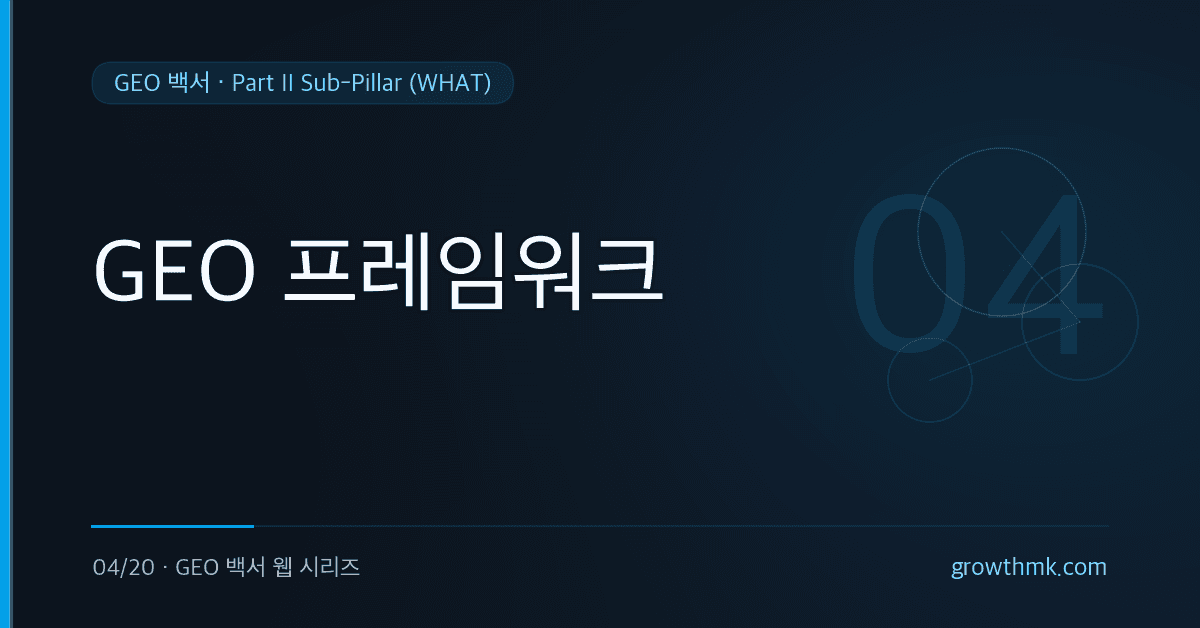
This article is chapter 4/20 of Growth’s GEO Whitepaper series — Part II, Sub-Pillar (WHAT). You can find the full table of contents and the complete PDF on the whitepaper page.
GEO is not a technology — it’s a strategic shift. Only when three axes — technical infrastructure, content structure, and brand authority — work together organically does AI choose your brand as a “source worth citing.” This article corrects three common misconceptions about GEO, explains why the rules of the game have changed from “exposure” to “selection,” and then walks through the full structure of the GEO framework, from how AI generates answers to Entity Authority, the new standard of trust.
In the previous article, Why SEO Alone Isn’t Enough in the Age of AI Search, we confirmed that the search ecosystem is being fundamentally restructured. We faced the reality that traditional search traffic is declining and that the customer’s purchase journey has moved inside the black box of AI. The data we examined in Part I of the whitepaper — the surge in zero-click search, projected traffic losses for AI-unprepared companies, and consumers’ deepening reliance on AI search — all converge on one clear message: the fundamental rules of search marketing have changed. So now there’s only one question left: “How do we respond to this shift?” Part II of the whitepaper is where that journey for an answer begins. Here, we’ll systematically examine exactly what GEO is, how the mechanism behind AI-generated answers works, and how brand trust is evaluated in the age of AI. Reading alongside the Generative Engine Optimization (GEO) Guide, which consolidates GEO’s definition and overall execution strategy in one place, will help you grasp the full picture faster.
3 Common Misconceptions About GEO
There are three misconceptions that come up again and again among marketers who are new to GEO. Before diving in, let’s correct them.
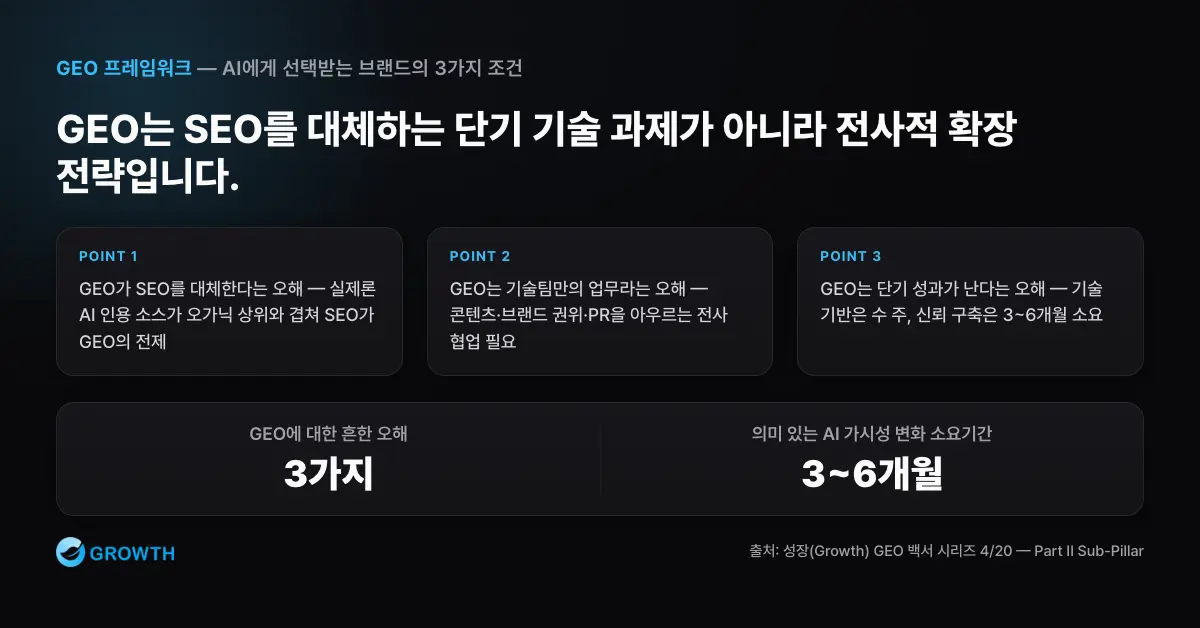
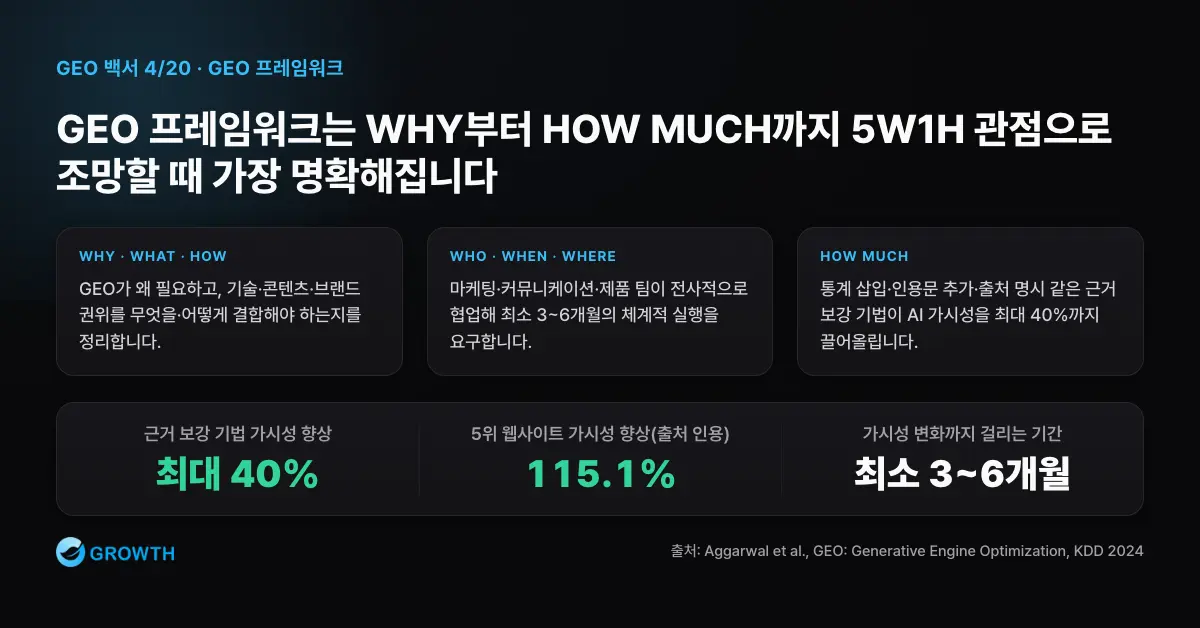
Misconception 1: “GEO replaces SEO” — GEO does not deny or replace SEO. As we cover in detail in the next article, SEO, AEO, GEO, AIEO: The Complete Breakdown of the Differences, a substantial share of the sources cited in AI Overviews (AIO) overlap with pages that already rank in organic search. A solid SEO foundation is a prerequisite for GEO performance — GEO is an expansion strategy that builds a new layer on top of the SEO foundation. Also see GEO vs SEO, which compares the two concepts item by item.
Misconception 2: “GEO is purely a technical-team job” — Technical elements like allowing AI crawlers or applying schema markup are just one axis of GEO. It requires a company-wide approach spanning content strategy, brand authority building, and digital PR — and without organic collaboration between marketing, communications, and product teams, meaningful results are hard to expect.
Misconception 3: “GEO delivers results quickly” — GEO’s technical foundation (allowing crawlers, applying structured data) can be completed within a few weeks, but it takes sustained content accumulation and third-party validation before AI recognizes your brand as a trustworthy entity. As you’ll see later in the series in the 90-Day GEO Rollout Roadmap, meaningful shifts in AI visibility require at least 3–6 months of systematic execution.
Why We Need a “Framework”
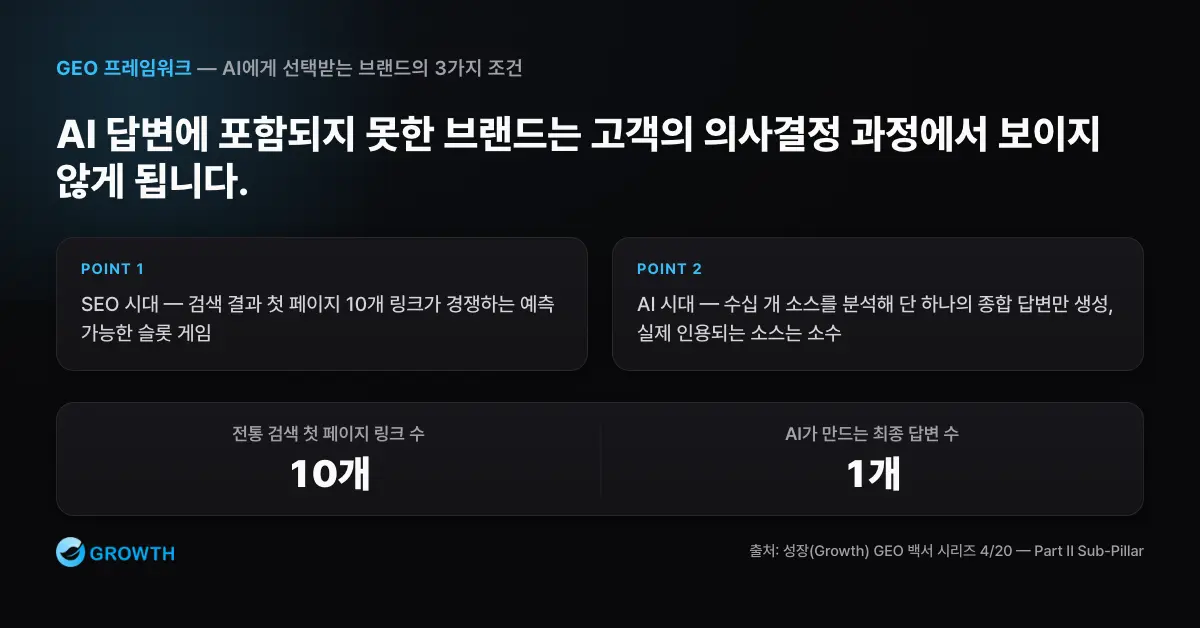
To understand GEO, you first have to accept one premise: marketing in the AI era is a game of “selection,” not “exposure.” In traditional SEO, ten blue links were laid out on the first page of search results, and the structure was simple — the user clicked one of them. It was a relatively predictable game where competitors fought over ten slots, and moving up just a rank or two could be expected to bring a meaningful traffic increase. But generative AI analyzes dozens of sources and produces a single, synthesized answer. In this process, only a handful of sources actually get cited, and as the large-scale response analysis data in How AI Generates Answers shows, different AI engines have notably different preferences for which sources they cite. In other words, if you’re not included in the AI’s answer, your brand effectively doesn’t exist in the customer’s decision-making process at all. GEO is precisely the strategic framework for making sure you’re one of that “chosen few.”
This selection mechanism is qualitatively different from traditional search. In SEO, the algorithm evaluated relatively clear ranking factors — keyword relevance, backlinks, site speed. Marketers could raise their rankings by optimizing these factors one by one, and the process was systematized. AI’s citation decisions, by contrast, are far more complex. AI simultaneously evaluates the factual accuracy of content, the authority of the source, how well-structured the information is, and the consistency of the brand’s presence across the entire web. That’s exactly why we need an integrated “framework” in which all these elements work together organically, rather than a piecemeal approach that optimizes each factor in isolation.
The Essence of GEO — A Strategic Shift, Not a Technology
Many marketers, however, tend to understand GEO as little more than “AI search optimization.” That’s the same mistake as reducing SEO to “the technique for ranking first on Google.” GEO is an integrated strategy in which three axes — technical optimization, content strategy, and brand authority building — are organically connected. Without technical infrastructure in place, AI crawlers can’t read your content; without structured content, AI can’t extract information to cite; and without brand authority, AI won’t trust the source. Strengthening just one axis alone is unlikely to produce meaningful results.
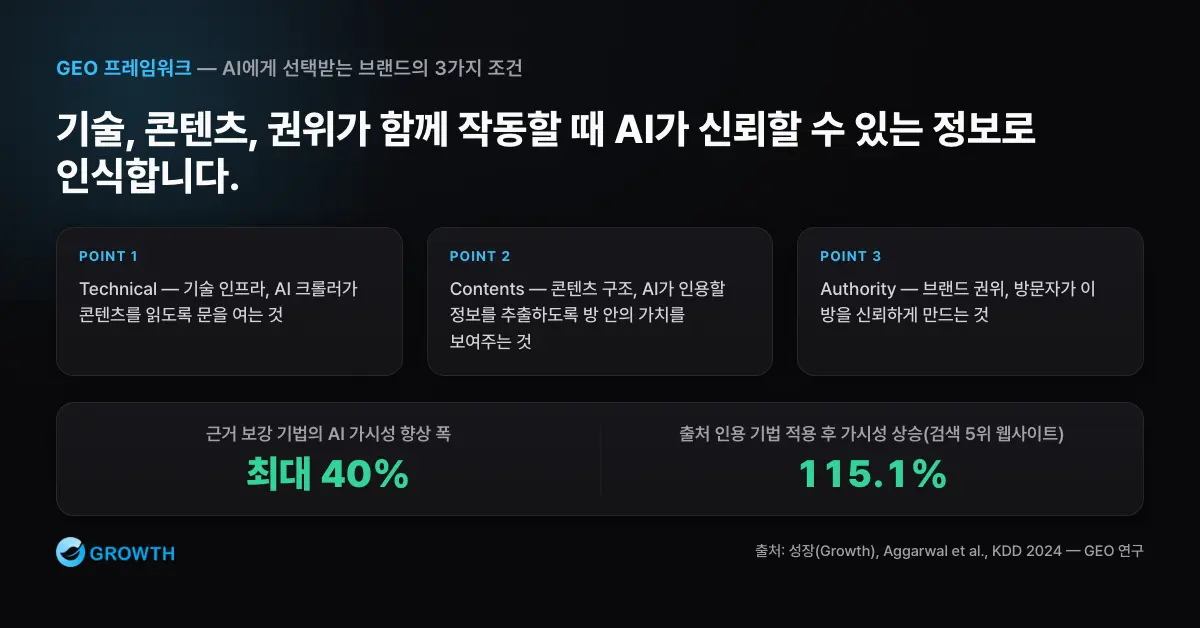
To use an analogy, technical infrastructure is “opening the door,” content strategy is “showing the value inside the room,” and brand authority is “making the visitor trust the room.” If the door is locked, no one can get in; if the door opens but there’s no value inside, no one stays; and no matter how valuable the room is, if there’s no trust, it won’t be cited. It’s not merely a technique when GEO research by a joint team including researchers from Princeton (Aggarwal et al., KDD 2024) found that evidence-reinforcement techniques — inserting statistics, adding quotations, citing sources — boosted AI visibility by up to 40%, and that a website stuck at position 5 in search results raised its visibility by as much as 115.1% through source-citation techniques alone. It’s evidence of a structural principle: AI systematically favors “well-substantiated, trustworthy information.”
More importantly, GEO does not deny or replace SEO. As we’ll confirm with data in the next article, a substantial portion of AIO citation sources overlap with pages that already rank in organic search. A solid SEO foundation is a prerequisite for GEO performance. GEO builds a new layer on top of the foundation that is SEO — it doesn’t tear SEO down and rebuild it. Understanding this relationship correctly is the first step toward avoiding unnecessary confusion and wasted resources.
What You’ll Get from Part II
The three articles in Part II are designed to build this framework step by step. Each article has value on its own, but reading them in order gives you the clearest picture of GEO as a whole.
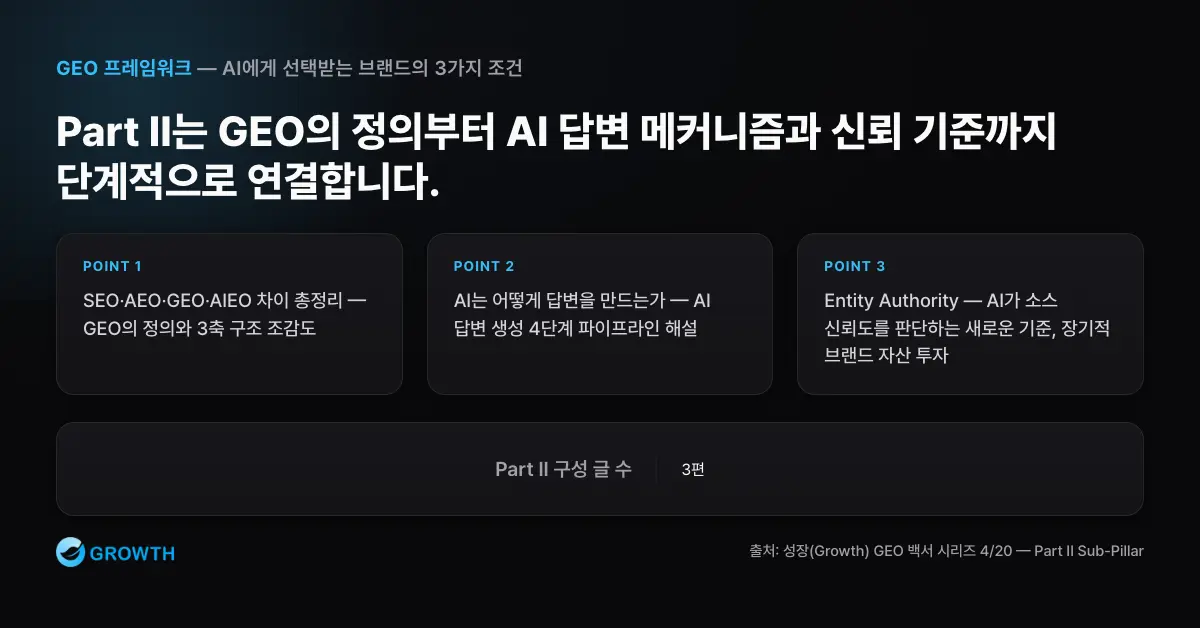
First, SEO, AEO, GEO, AIEO: The Complete Breakdown of the Differences lays out GEO’s definition, its relationship to existing concepts (SEO, AEO, AIEO), and a bird’s-eye view of the three-axis structure. It also gives you a clear, data-backed answer to practitioners’ most frequent question: “Does GEO replace SEO?” After reading it, you’ll have clear language to explain to leadership exactly what GEO is and why it matters to your organization.
Next, How AI Generates Answers breaks down the concrete mechanism behind AI-generated answers in a marketer’s language. Understanding how AI actually works is the only way to answer the question of “which content gets cited, and which gets ignored.” The goal isn’t a computer science lecture — it’s the level of technical understanding you’d need in a marketing strategy meeting. By following a concrete scenario of a marketing director asking ChatGPT a question, you’ll naturally come to understand the four-stage pipeline happening behind the scenes.
Finally, Entity Authority introduces the new standard AI uses to judge a source’s credibility. Just as Google created the E-E-A-T framework, in the AI era, existing as a consistent entity across the entire web becomes the core condition for trust. This article matters especially for brand marketing leads and executives, because building Entity Authority is a long-term, company-wide brand-asset investment, not a short-term campaign.
One message runs through all three articles: GEO isn’t a technical trick — it’s a strategic shift toward being recognized as a “trustworthy expert” within the digital ecosystem. The large-scale citation-analysis data you’ll see in the Entity Authority article shows that AI doesn’t select sources based on mere “technical optimization” of content, but based on the brand’s own “presence and trust.” As we saw in The AI Dark Funnel, the shift of customers’ purchase journeys into AI is already a reality, and brands that respond without a framework are losing customers in places they can’t even see. Through Part II, you’ll come to understand this structure of preference precisely, and gain the foundation for the concrete execution covered in The Three-Axis Execution Strategy: Technical, Content, Off-Page. The full structure of the whitepaper and the complete PDF are available on the GEO Whitepaper page.
Curious how your brand currently shows up in AI answers? Request an AI Answer Share diagnostic. You can also download the full GEO Whitepaper PDF.
Frequently Asked Questions
Does GEO replace SEO?
No. Because a substantial share of the sources cited in AI Overviews already overlap with pages ranking in organic search, a solid SEO foundation is a prerequisite for GEO performance. GEO is an expansion strategy that adds a new layer — being cited in AI answers — on top of the SEO foundation.
What are the three axes of the GEO framework?
Technical infrastructure, content structure, and brand authority (off-page). Technical infrastructure opens the door for AI crawlers, structured content provides the information to be cited, and brand authority guarantees the trustworthiness of that information. If any one axis is weak, the effectiveness of the other two is cut in half.
Which team should own GEO?
It’s not solely a technical team’s job. AI crawler configuration and schema markup are just one axis — you need a company-wide approach spanning content strategy, brand authority building, and digital PR. Organic collaboration between marketing, communications, product, and IT teams determines the outcome.
How quickly does GEO produce results?
Technical foundations like allowing crawlers or implementing structured data can be in place within a few weeks, but it takes sustained content accumulation and third-party validation before AI recognizes your brand as a trustworthy entity. Meaningful shifts in AI visibility require at least 3–6 months of systematic execution.
GEO Whitepaper series: ← Previous chapter · Full table of contents · Next chapter →