B2B SaaS Lead Generation: The PQL Structure That Increases Demo Requests
 임재복
임재복
Lead generation for B2B SaaS works differently than ordinary B2B. That’s because SaaS has one defining trait: prospects can try the product themselves before they buy. So the core question shifts from “how many leads did we collect” to “which trial users actually experienced real value in the product.” This article covers how to design the SaaS-specific funnel that runs from free trial or freemium sign-up to demo, built around the concept of the PQL (Product Qualified Lead). In other words, it’s about building the “structure” that increases demo requests and paid conversions.
We already laid out how to design B2B lead generation broadly around lead quality rather than lead quantity in What Is B2B Lead Generation and How Do You Do It. This article builds on that foundation and goes one level deeper, specifically for SaaS businesses where the product itself becomes the most powerful salesperson. Read both together and you’ll have both the general principles and the SaaS-specific practice.
Why Are SaaS Leads Different From Ordinary B2B Leads?
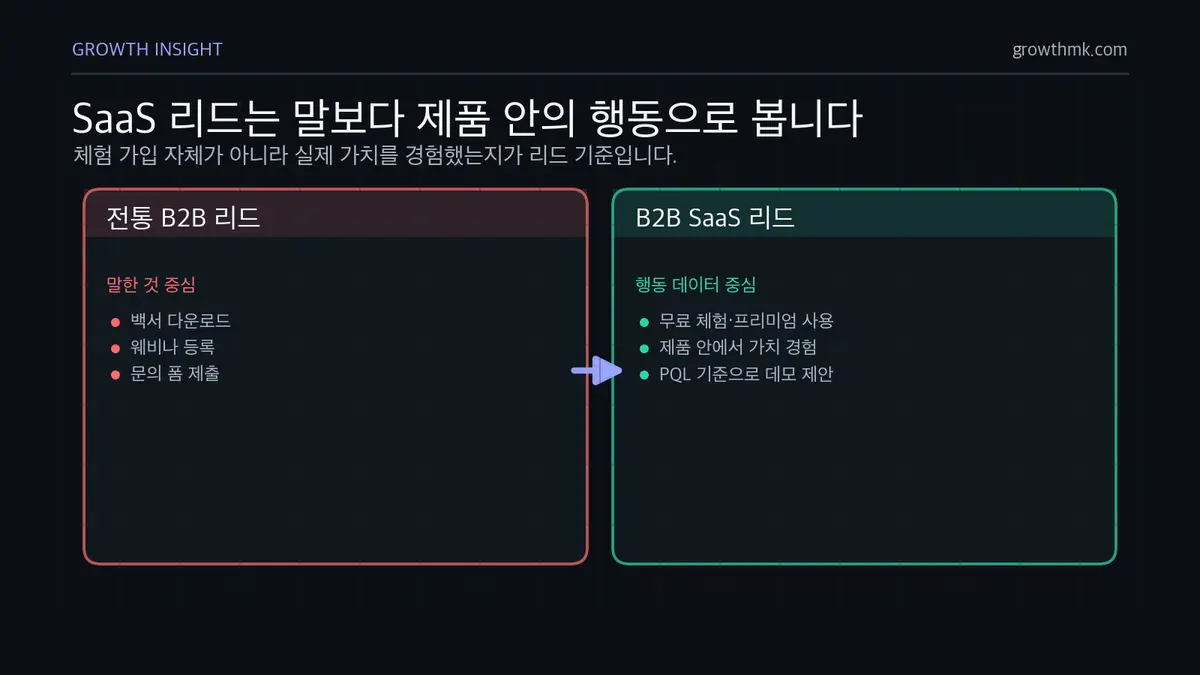
In traditional B2B, a lead is “someone who expressed interest” — someone who downloaded a whitepaper, registered for a webinar, or filled out a contact form. These people are judged by what they said. In SaaS, by contrast, prospects use the product directly through a free trial or freemium plan before they ever pay. That means a SaaS lead can be judged not by what they said, but by what they did inside the product.
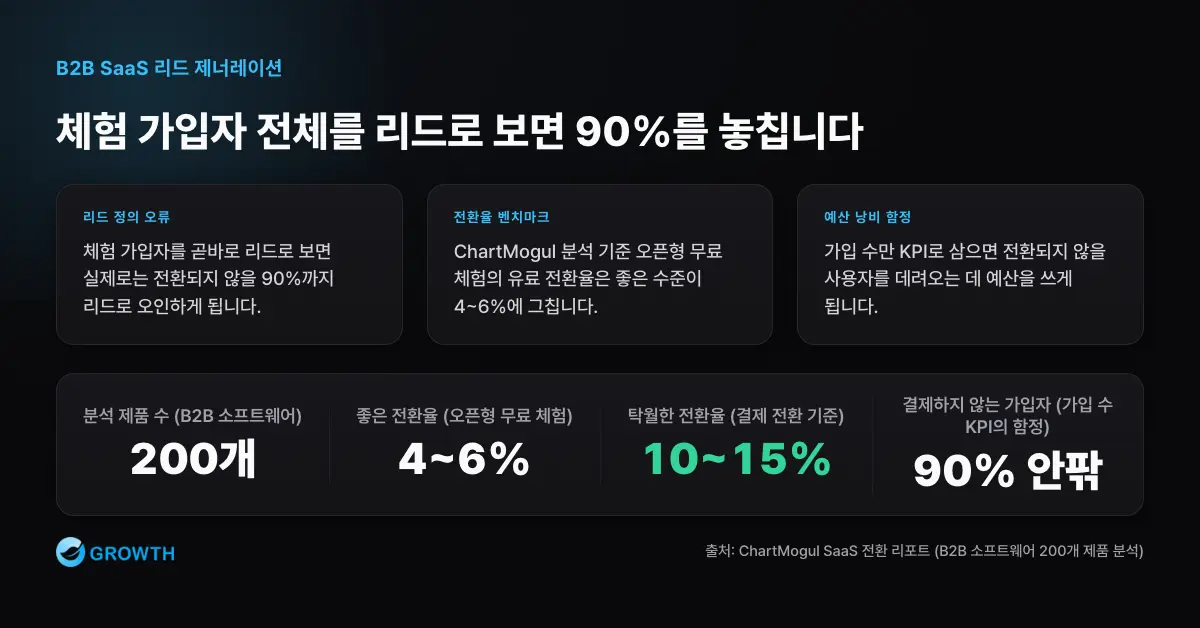
This distinction matters because the equation “trial sign-up = lead” is almost always wrong in SaaS. Most people who sign up for a trial log in once and never come back. According to ChartMogul’s SaaS conversion report, which analyzed 200 B2B software products, the paid-conversion rate for open, opt-in free trials that don’t require a credit card is only 4-6% for a “good” result and 10-15% for an “excellent” one. That means roughly 90% of sign-ups never pay. If sign-up count is your only KPI, your marketing team ends up spending budget to bring in the “90% who will never convert.” That runs directly against the growth principle of focusing on the one person who will become revenue, rather than the volume of traffic.
So the starting point for SaaS lead generation is redefining a single term. The bar for a “lead” shouldn’t be “signed up” — it should be “experienced value in the product.” That bar is exactly what a PQL is.
What Is a PQL (Product Qualified Lead)?
A PQL is a prospect who has signaled purchase intent through product usage behavior, not by responding to a marketing message. According to SaaS investor OpenView’s definition, a PQL is “a user who has experienced value via the product and is a strong sales opportunity, as opposed to a traditional marketing- or sales-qualified lead.” The key is that the basis for evaluation is behavioral data, not words.
What makes PQLs powerful is their conversion rate. OpenView reports that leads who have validated themselves inside the product convert at roughly five times the average conversion rate. The same company’s PQL guide explains that PQL conversion rates commonly reach 15-30%, far outpacing MQLs. Data cited by Gainsight from the 2022 Product-Led Growth Index also shows that free trials that use PQLs convert 2.8 times better than those that don’t.
So how does a PQL differ from the traditional lead grades? The table below shows the key differences.
| Category | MQL (Marketing Qualified Lead) | SQL (Sales Qualified Lead) | PQL (Product Qualified Lead) |
|---|---|---|---|
| Basis for qualification | Content engagement (downloads, forms) | Sales conversation, BANT | Product usage behavior data |
| Representative signal | Whitepaper download, webinar registration | Budget and authority confirmed | Core feature use, teammate invites, usage limit reached |
| Confidence in purchase intent | Low to medium | Medium to high | High (proven by behavior) |
| Best-fit model | All B2B | Sales-led | Product-led (PLG), trial/freemium |
One common misconception is that “activated user = PQL.” OpenView draws a clear distinction between the two. Activation is the one-time “aha moment” when a user first experiences the product’s core value, while a PQL is a state where multiple layers of usage behavior have accumulated to signal readiness to buy. Activation is a necessary condition for becoming a PQL, but not a sufficient one.
Designing the SaaS Lead Path — From Content to Paid
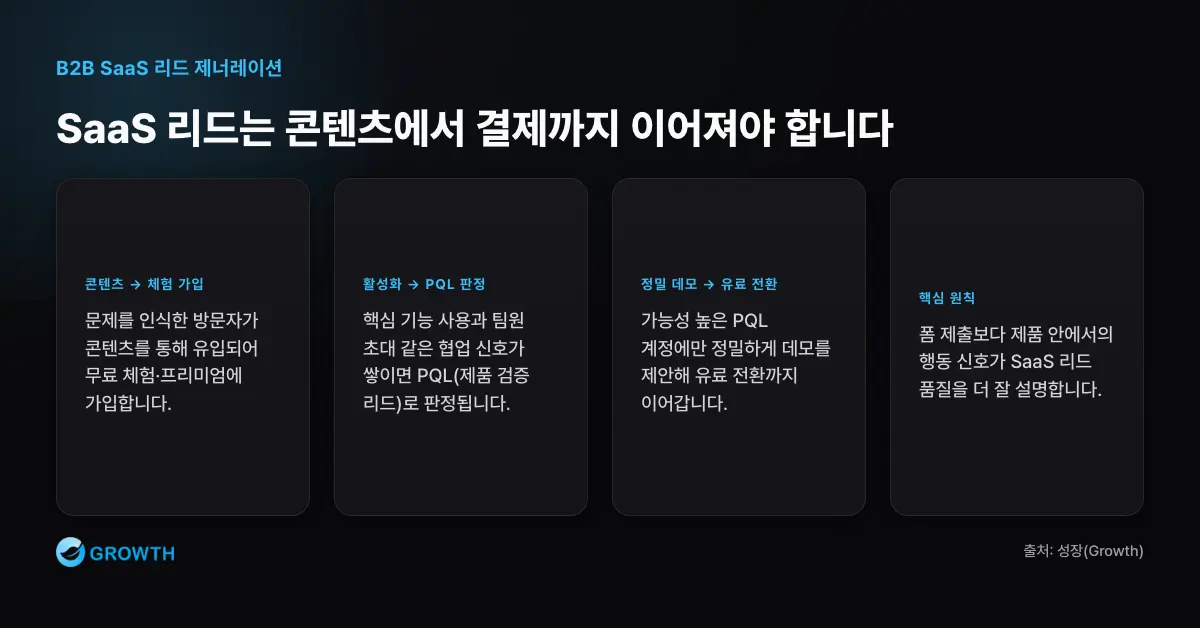
Every stage of a SaaS lead path needs a clear “pass criterion.” Without one, every sign-up gets treated the same way, and the sales team wastes time chasing leads that were never going to convert. The recommended path has six stages: content → trial/freemium sign-up → activation → PQL → demo/sales → paid. The key is spelling out the goal and conversion criteria for each stage, as shown below.
| Stage | Goal | Sample criterion to advance to the next stage | Core metric |
|---|---|---|---|
| 1. Content | Problem awareness, search acquisition | Arrival via relevant search keyword + lead magnet conversion | Visit-to-signup conversion rate |
| 2. Trial/freemium sign-up | Product entry | Account creation completed | Sign-up count, sign-up source |
| 3. Activation | First value experienced (“aha moment”) | Core feature completed once (e.g., first report generated) | Activation rate, time to value (TTV) |
| 4. PQL | Purchase-intent behavior confirmed | PQL score threshold reached (e.g., 2 teammates invited + core feature used 3 times + 80% of usage limit) | PQL generation rate |
| 5. Demo/sales | Remove adoption barriers, negotiate the deal | Demo requested or sales outreach accepted | PQL-to-demo conversion rate |
| 6. Paid | Payment, adoption | Paid plan purchased | Trial-to-paid, PQL-to-paid conversion rate |
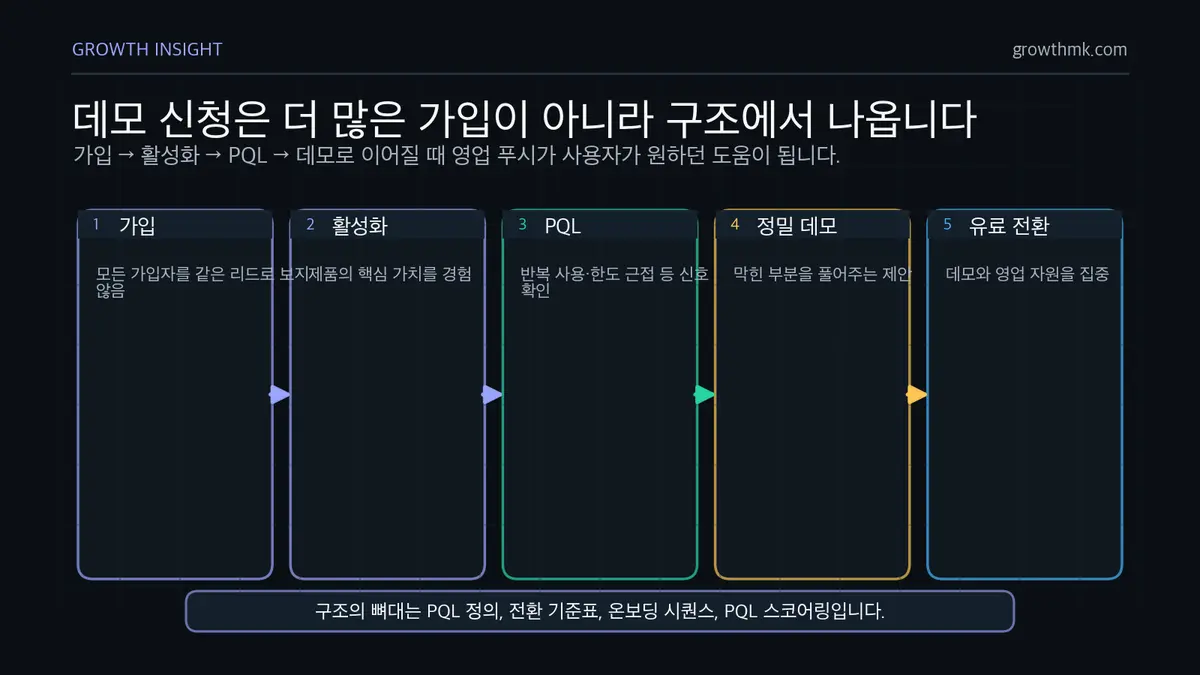
Here, a demo shouldn’t be offered to every sign-up in the same way. The single most reliable way to increase demo requests is to offer the demo precisely to PQLs. Offering a demo to a user who hasn’t yet experienced value just drives up your no-show rate. On the other hand, if you tell a PQL who has repeatedly used your core features and is close to their usage limit, “let’s clear up what’s blocking you right now in a 30-minute demo,” the demo stops feeling like a sales push and becomes the help the user actually wanted. That’s when demo requests naturally rise. Breaking this entire path into testable units and improving it iteratively is the same approach as the AARRR growth-hacking funnel.
What Lead Magnets Work Best for SaaS?
A lead magnet is a value exchange for a prospect’s contact information. In ordinary B2B, whitepapers and checklists are common, but in SaaS, magnets that let prospects feel the product’s value in advance, or that accelerate activation right after sign-up, work far better. Purely informational magnets produce MQLs, while product-linked magnets lead to PQLs much faster.
| Lead magnet type | Role in SaaS | Fit |
|---|---|---|
| Benchmark report (industry metrics) | Shows “where does my company stand vs. the average,” turning the problem into a number | High — connects directly to the metric the product measures |
| ROI / cost-savings calculator | Calculates the savings from adoption directly, giving the buyer a business case | Very high — directly persuades the decision-maker |
| Templates / ready-to-use setup | Fills the empty state right after sign-up, speeding up activation | Very high — shortens time to value |
| Interactive product tour / sandbox | Lets prospects try the product before signing up | High — raises the quality of trial sign-ups |
| Generic whitepaper / ebook | Captures awareness-stage traffic | Medium — good for MQLs, weak product linkage |
In particular, an ROI calculator sits at the top of the SaaS lead-magnet hierarchy. The more expensive the product or the more approvals adoption requires, the more the practitioner needs a “number” to convince the people above them. A calculator lets the prospect generate that number themselves. We go deeper into designing messages that move decision-makers in B2B Decision-Maker Marketing Strategy. It’s also worth reading alongside the lead generation chapter of The Complete Guide to B2B Marketing to see how contacts captured through a lead magnet develop into a nurture series.
Nurturing — Structuring the Onboarding Email Sequence
Getting the sign-up from a lead magnet isn’t the finish line. In SaaS, the primary goal of nurturing isn’t to “persuade someone to buy” — it’s to activate the user and move them toward becoming a PQL. The most effective tool for this is a behavior-triggered onboarding email sequence. A trigger-based approach that responds to what the user actually does inside the product is far more powerful than a uniform, time-based drip.
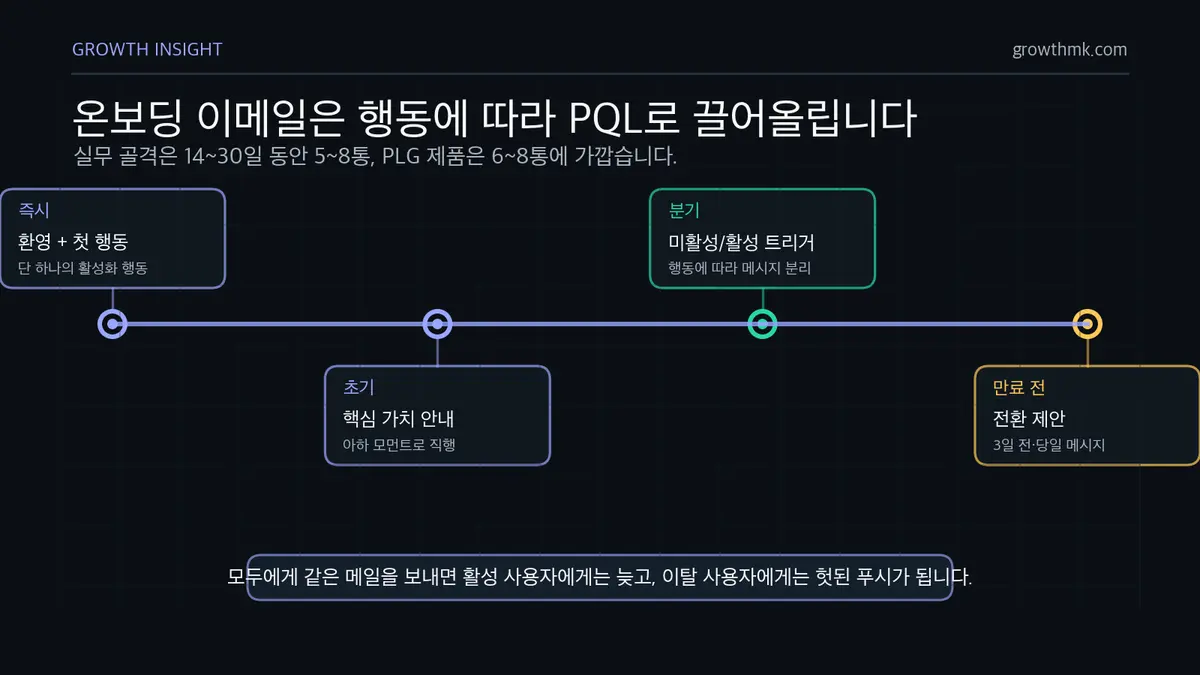
In practice, proven onboarding sequences generally run 5-8 emails over 14-30 days, and product-led (PLG) products tend toward the 6-8 end since they need more automated guidance. A recommended skeleton looks like this.
- Welcome + a single first action: Sent immediately after sign-up. Don’t list features — point to exactly one action that leads to activation (e.g., “create your first project”). The welcome email is typically the highest-opened message in the onboarding sequence.
- Core value walkthrough: How to get straight to the product’s “aha moment.”
- Behavioral trigger — not yet activated: Re-engagement sent only to users who haven’t used the core feature yet.
- Behavioral trigger — activated: Encourages users who have activated to go one level deeper (e.g., invite teammates) → drives PQL signals.
- Social proof: Builds trust with case studies from similar customers.
- Conversion offer: Before the trial expires, offers a demo or paid upgrade to PQLs.
The key is branching by behavior, as in emails 3 and 4. Send the same email to everyone, and users who already activated get a redundant message while churned-out users get a pointless push. There’s one more critical timing detail: a large share of B2B free-trial-to-paid conversions happen right as the trial is about to expire. So the conversion emails sent three days before and on the day of expiration should never be missing from the sequence. You can find email design principles and common mistakes in 7 Strategies Failing Companies Miss in Email Marketing, and the conditions under which newsletters actually drive revenue in Does a B2B Newsletter Really Drive Revenue?
Measurement — Designing PQL Scoring With Data
A PQL has to be defined with data, not gut feeling, if it’s going to be reproducible. PQL scoring is the work of finding, with data, “which behaviors actually predict a paid conversion.” Interestingly, according to Userpilot’s SaaS conversion rate benchmarks, the average free-to-paid conversion rate across all models is about 9%, but companies that identify high-intent users through PQLs convert at roughly three times that rate (≈25%) — and yet only 24% of companies actually use PQLs today. In other words, PQL scoring is a clear, largely untapped opportunity.
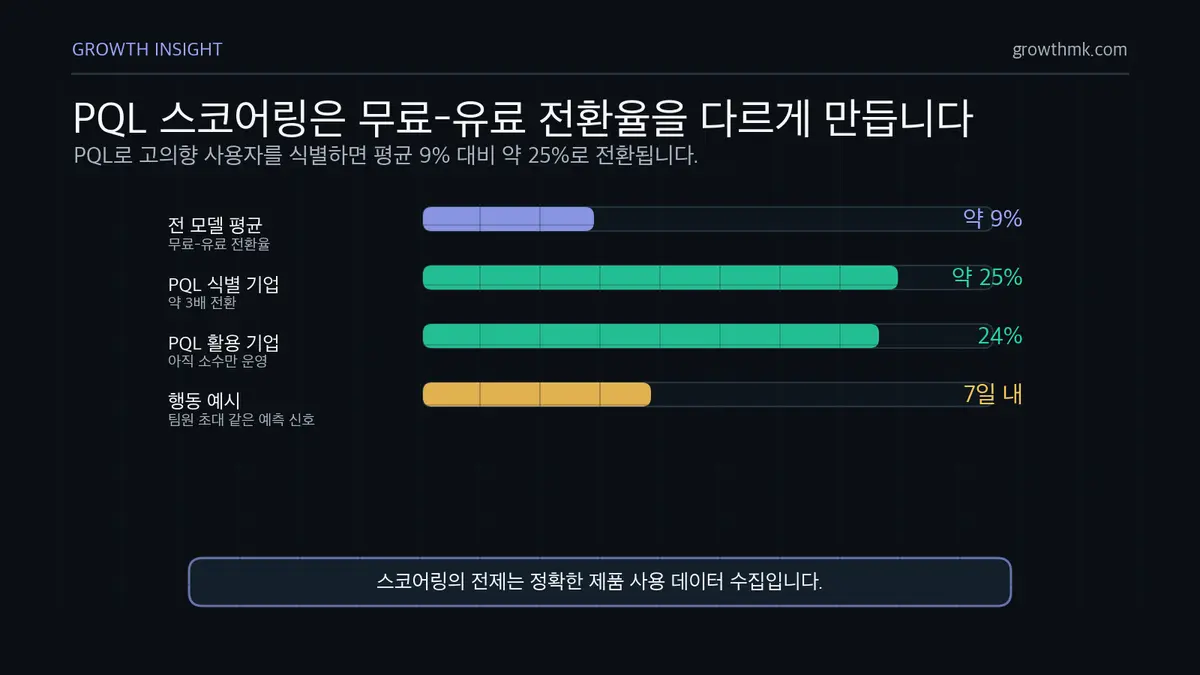
In practice, the design process follows these steps.
- Analyze the past behavior of converted customers: Trace back what paying users commonly did during their trial (e.g., accounts that “invited a teammate within 7 days” converted at 4x the rate).
- Shortlist predictive signals: Consider usage frequency (core feature use count), usage breadth (variety of features used), collaboration (teammate invites), and limit proximity (nearing usage or seat limits).
- Set weights and a threshold: Score each signal, and classify a user as a PQL once the combined score crosses the threshold.
- Automate the sales handoff: When a PQL is generated, alert the sales team and surface a demo offer to the user.
- Keep recalibrating: Periodically retrain the weights against actual conversion outcomes.
This process is essentially data science: forming a hypothesis about which behaviors correlate with revenue, measuring it, testing it against reality, and refining the model. But reliable scoring depends on accurate product usage data collection. If your event tracking is off, you’ll qualify PQLs based on the wrong signals. We cover why setting up measurement infrastructure properly is foundational to B2B marketing in Why Tracking Tool Setup Matters for B2B Marketing, and how to test hypotheses about which signals to adopt in How to Improve Performance With A/B Testing.
Getting Started — A Structure That Increases Demo Requests
To sum up, SaaS demo requests and paid conversions don’t come from “more sign-ups” — they come from a structure that runs sign-up → activation → PQL → demo. Don’t treat every sign-up the same way. Offer the demo precisely to the people who have already experienced value inside the product. The skeleton of that structure is: ① a clear PQL definition, ② a stage-by-stage conversion criteria table, ③ a behavior-based onboarding sequence, and ④ data-driven PQL scoring.
Growth designs the B2B SaaS lead path with a data-science, growth-hacking methodology focused on finding the one person who will become revenue, not on the volume of traffic. If you’d rather build a PQL structure that leads to demo requests and paid conversions than run another campaign that just inflates trial sign-ups, check out Growth’s B2B Marketing service, or reach out via Contact Us if you’d like us to diagnose your product’s funnel together.
You can see the full picture of this topic in “The Complete SaaS Marketing Guide — PLG vs. SLG, CAC and LTV, and the Korean Market.”
Frequently Asked Questions (FAQ)
What’s the difference between a PQL and an MQL?
An MQL (Marketing Qualified Lead) is a lead qualified by content engagement, like downloading a whitepaper or registering for a webinar. A PQL (Product Qualified Lead) is qualified by actual product usage behavior during a free trial or freemium plan — using core features, inviting teammates, or hitting a usage limit. The key difference is that the basis for evaluation is “behavioral data,” not “words,” and OpenView reports that leads who validate themselves inside the product convert at roughly five times the average conversion rate.
Should every trial sign-up be treated as a lead?
No, that’s not recommended. According to ChartMogul’s analysis, the paid-conversion rate for free trials that don’t require a credit card is only 4-6% at a “good” level, meaning most sign-ups never pay. If sign-up count is your only KPI, you end up spending budget bringing in users who will never convert. You need to define your real lead as someone who moved past activation and became a PQL, so sales and demo resources go to the people most likely to convert.
What’s the first thing to do to increase demo requests?
Instead of offering a demo to every sign-up, first build a structure that offers it precisely to PQLs. Offering a demo to a user who hasn’t experienced value yet just raises your no-show rate. If you tell a PQL who has repeatedly used core features and is near their usage limit, “we’ll clear up what’s blocking you right now with a demo,” the demo stops feeling like a sales push and becomes the help the user wanted — and request rates rise.
What’s the most effective lead magnet for SaaS?
Magnets that let prospects feel the product’s value in advance, or that accelerate activation right after sign-up, work best. Notable examples include an ROI/cost-savings calculator that directly computes the savings from adoption, templates that fill the empty state right after sign-up to shorten time to value, and benchmark reports that compare a company’s own metrics to the industry average. Purely informational whitepapers work for awareness-stage traffic, but their weak product linkage makes them less effective at driving PQLs.