
7 Strategic Mistakes That Sink B2B Email Marketing
 임재복
임재복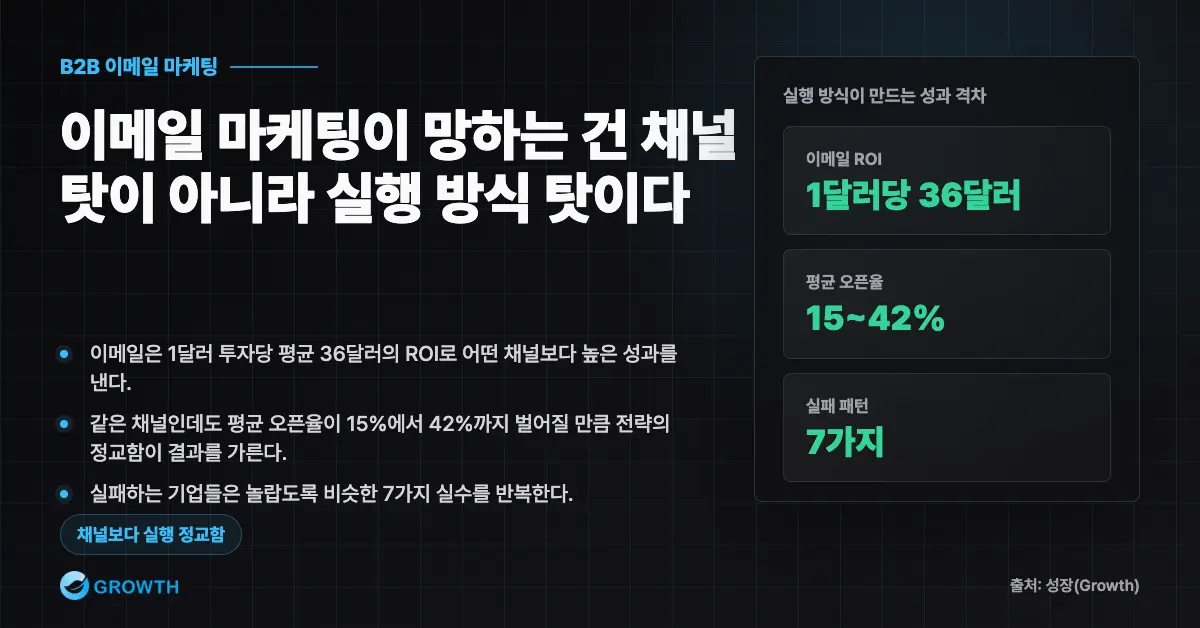
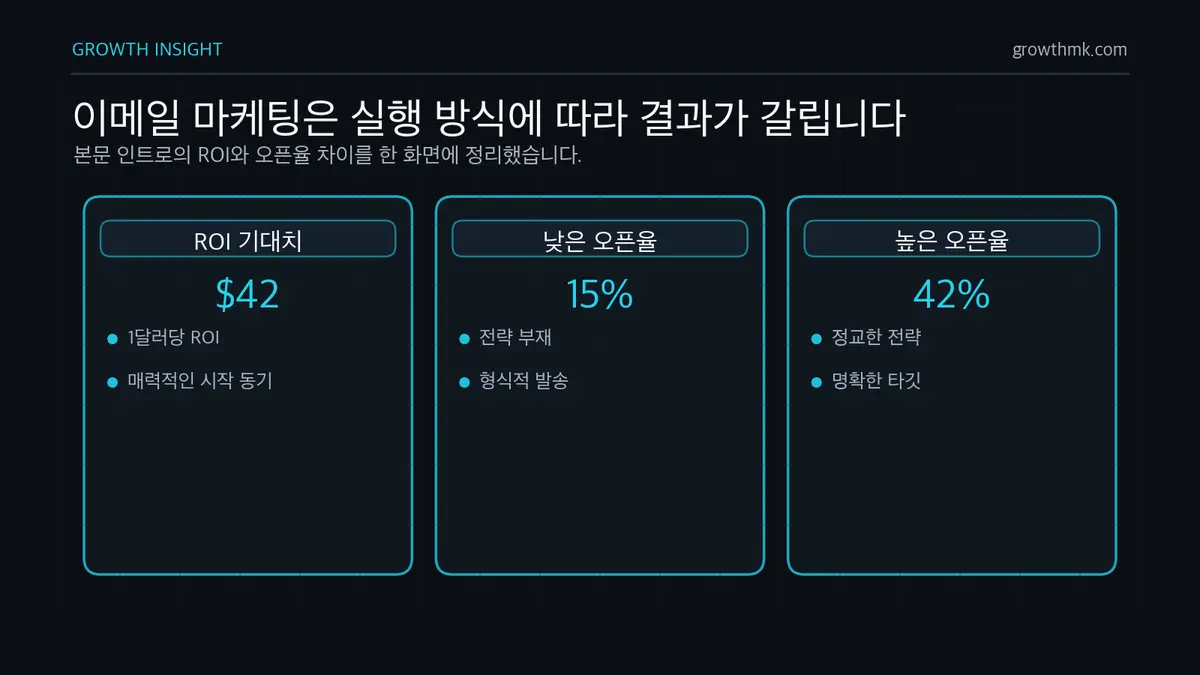
In our last article, we looked at the surprising potential of B2B newsletters. Litmus, an email marketing analytics firm, found that email generates an average ROI of $36 for every $1 spent — higher than any other channel (and campaigns with more maturity report even more). Add in outsized lead-generation power and the ability to build long-term relationships, and it’s no surprise that HubSpot’s compiled email marketing statistics still rank email among the channels marketers trust most. But what does reality look like? Plenty of companies get pulled in by these compelling numbers, launch an email marketing program, and end up disappointed and giving up when results fall short of expectations.
The problem isn’t that “newsletters don’t work” — it’s how you run them. Average open rates swing anywhere from 15% to 42%, and results diverge sharply depending on how sophisticated the strategy is. Having watched countless companies run email marketing, we’ve noticed that the ones who fail tend to repeat a strikingly similar set of mistakes.
Today we’ll walk through the fatal mistakes we see most often in the field, concrete ways to avoid them, and a practical, realistic resource-allocation guide broken down by company size.
Mistake 1. “Let’s Just Get Started” Syndrome — Launching Without a Clear Goal
The Most Common Mistake: Starting With No Goal
More companies than you’d think start with an attitude of “let’s just make a newsletter.” Seduced by attractive numbers, they dive in without a concrete goal or strategy. The outcome is predictable: after three or four months, the effort either quietly fizzles out under a vague sense that “it doesn’t seem to be doing much,” or it limps along as a purely formal, going-through-the-motions send.
When you actually analyze companies that run successful newsletters, they share one thing in common: they set a clear goal before they ever started. “Lead generation,” “retaining existing customers,” “building brand awareness,” “establishing thought leadership” — they picked a specific goal and set KPIs to match.
The Fix: SMART Goals and a Staged Approach

A successful B2B newsletter starts with a clear, measurable goal. If lead generation is the target, spell out a concrete number and timeframe, like “50 new leads a month from the newsletter within 3 months.” If retention is the goal, it’s more effective to frame it as an improvement over your current baseline — something like “maintain a 70% newsletter subscription rate among existing customers and lift repurchase rate by 15%.” If brand awareness is the goal, use an objectively measurable indicator, such as “reach the Top 5 in an industry-expert brand awareness survey.”
Once the goal is clear, everything else — content strategy, targeting, how you measure success — falls naturally into place. A newsletter with no goal is bound to lose direction and drift.
Want to dig deeper into why a systematic content-marketing plan matters? Take a look at [How to Write a Content Marketing Plan].
Mistake 2. Ignoring Company Size — No Realistic Resource-Allocation Strategy
From Startups to Enterprises: Different Realities
A five-person marketing team at a startup can’t run the same newsletter strategy as a large enterprise with a 100-person marketing org. Yet plenty of companies try to copy a success story wholesale — and fail.
Check whether any of the mistakes below sound familiar.
- Common startup mistake: Trying to build an enterprise-grade, polished newsletter, running out of resources partway through, and either abandoning it or sending out something low-quality that ends up hurting the brand.
- Common mistake for small and mid-sized companies: Caught in an awkward middle — keeping it simple like a startup looks unprofessional, but doing it like an enterprise strains resources, leading to an inconsistent strategy.
- Common enterprise mistake: Content publication gets delayed by complex org structures and approval chains, or the message gets diluted as multiple departments’ competing interests get tangled into it.
A Realistic Resource-Allocation Strategy by Company Size
For startups, with small teams of 5 to 20 people, the key is not overreaching. It’s wise to start with a monthly cadence and focus on quality. Building content around the personal insight of the CEO or a key executive can create a distinctiveness that sets you apart from larger competitors. Keep production simple — use existing templates to cut down design time, and lean on all-in-one tools like Stibee or Mailchimp. A realistic budget is roughly 50,000–100,000 KRW a month in tool subscriptions, and if you need outside design help, 500,000–1,000,000 KRW per quarter is a reasonable starting point.
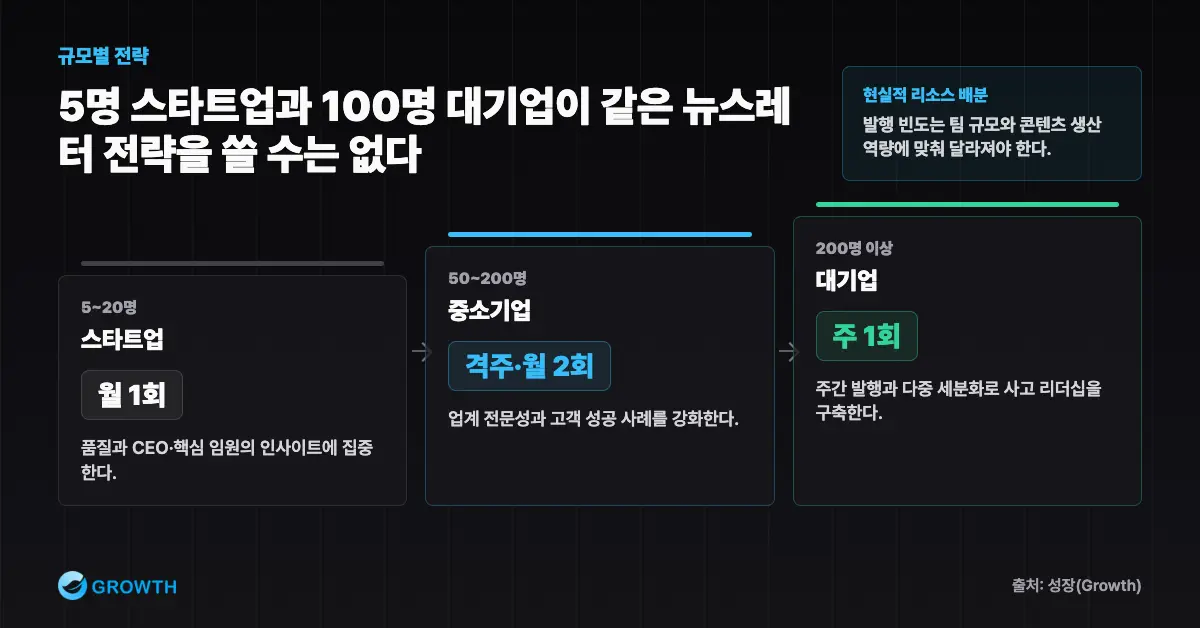
For small and mid-sized companies in the 50-to-200-person range, a biweekly or twice-monthly cadence allows for more active engagement. At this stage, it’s important to strengthen industry expertise — content built around industry trend analysis or customer success stories tends to work well. On the production side, build a small in-house content team and set up a collaboration process with sales or customer success so you can gather real stories straight from the field.
For enterprises with marketing organizations of 200 or more, a weekly cadence enables a far more systematic approach. Running multiple segmented newsletter tracks lets you deliver tailored messages to different targets. Content strategy should focus on building thought leadership, differentiated through high-quality content backed by industry reports or proprietary data. On the production side, build a dedicated team and a system where each department contributes specialized content. Budget-wise, you’ll typically need 10 million KRW or more a month for tools and staffing, plus 5–10 million KRW a month for premium content production, to produce competitive results.
Mistake 3. The Perfectionism Trap — Trying to Cram Everything Into the First Newsletter
Companies That Give Up Waiting for the Perfect First Send
It’s surprisingly common for companies to get stuck on the idea that “the first newsletter has to be perfect.” Trying to perfect everything — design, content, technical setup — often delays the launch by months, or the project never even gets off the ground before it’s abandoned.
Track actual successful newsletters, though, and you’ll find most of them launched with something simple and basic. What mattered wasn’t a perfect start, but consistent improvement.
The Fix: An MVP (Minimum Viable Product) Approach
Just like product development, an MVP approach works well for newsletters. For the first three months, it’s best to launch with a basic template covering just one or two core content sections. During this period, focus on consistency over perfection while you watch how subscribers respond. In months four through six, actively incorporate subscriber feedback, adding sections as needed and refining the design. By this point, you’ll have data showing which content resonates and where the gaps are. From months seven through twelve, it’s a good idea to introduce personalization and add more advanced features to raise the overall polish.
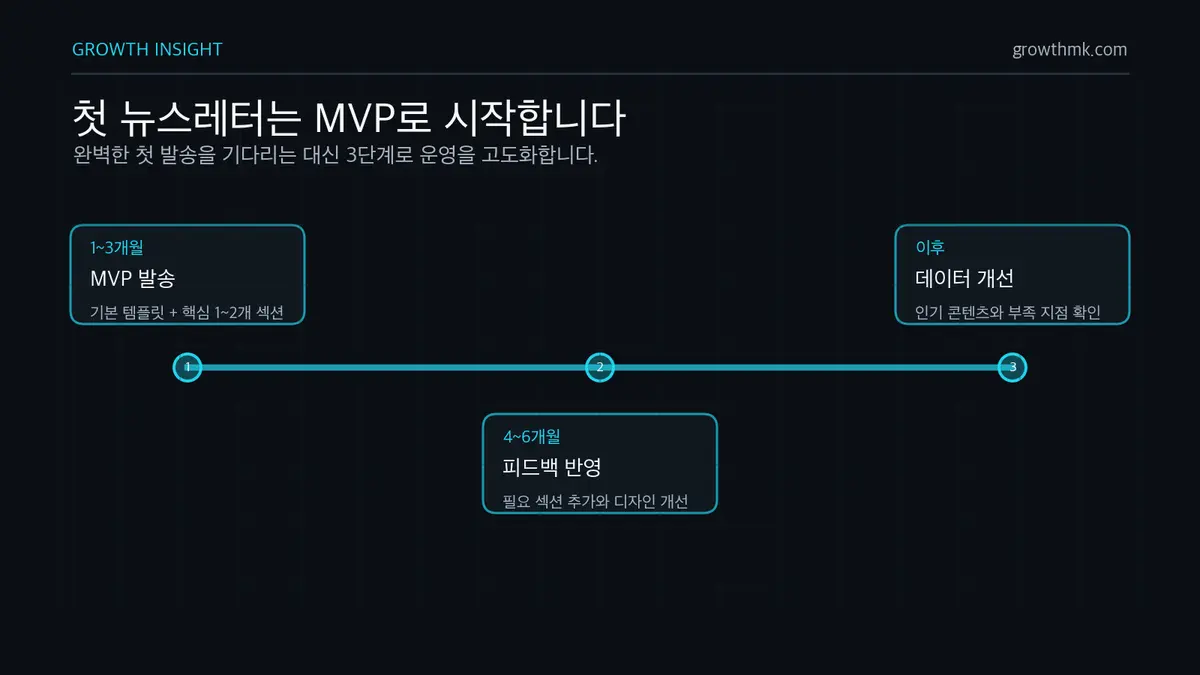
Building things up in stages like this lets subscribers adapt naturally, and lets your production team improve quality without being overwhelmed.
Mistake 4. Skipping Segmentation — The Illusion That “Our Customers Are All Similar”
The Fatal Limits of Blast Sends

Plenty of companies assume that “our customers are all in similar industries, so the same content should work for everyone.” But even within the same industry, company size, seniority, decision stage, and interests vary enormously. Customer ‘Needs’ and ‘Wants’ are inevitably different from each other.
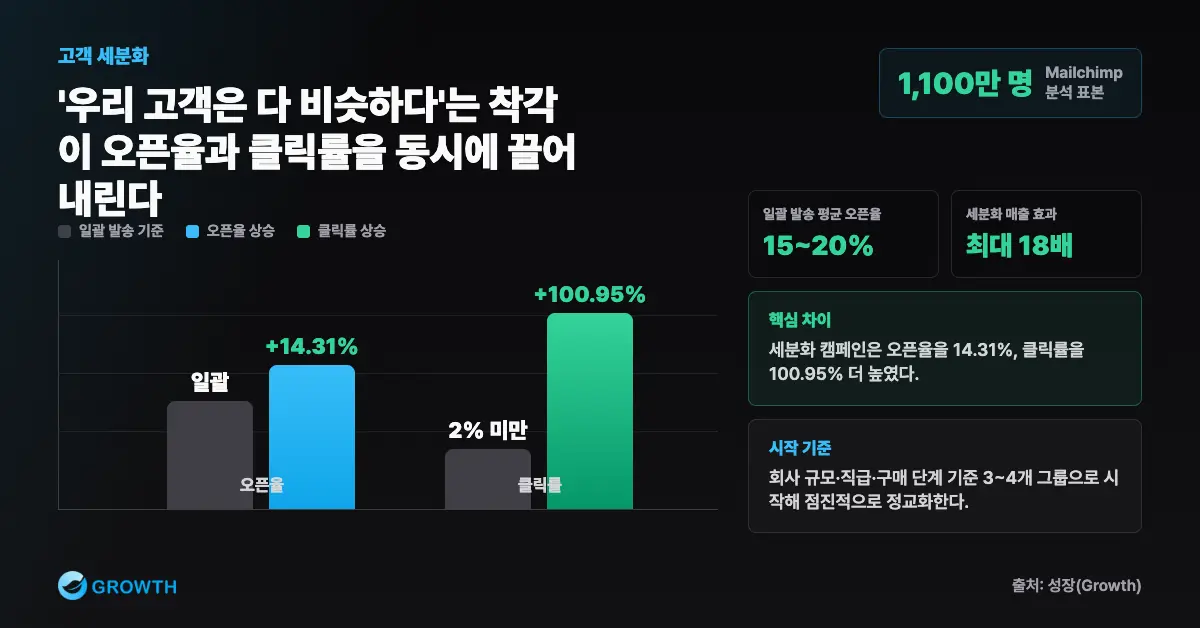
The real data shows the power of segmentation is remarkable. Mailchimp’s analysis of campaigns sent to roughly 11 million recipients backs this up as well.
- Segmented campaigns lift open rates by 14.31%
- Click-through rates rise by 100.95%
- In some cases, revenue increases by as much as 18x
By contrast, blast newsletters typically stay stuck at 15–20% open rates, with click rates dropping below 2%.
A Realistic Segmentation Strategy
When you start segmenting, don’t overcomplicate it — begin with basic distinctions. The most fundamental segmentation is by company size: startup, SMB, or enterprise. Each size bracket has entirely different interests and decision-making processes.
Second, segmenting by seniority matters — individual contributors, mid-level managers, and executives all want a different depth of information and perspective, even on the same topic. Third, segment by purchase stage: customers who are still just becoming aware of a problem, those already evaluating solutions, and those about to make a concrete decision each need a different approach.
Once a newsletter matures, more sophisticated segmentation becomes possible. Analyzing engagement with past content reveals which topics resonate most, while behavior patterns on your website show what information someone is currently looking for. The type of resource someone downloaded, or the webinar topic they attended, can pinpoint a customer’s current interests and needs even more precisely.
What matters is not attempting complex segmentation from day one — start with 3 or 4 basic groups and refine gradually.
Mistake 5. Misjudging Content Ratio — Failing to Balance Promotion vs. Value
The 80% Promotion, 20% Value Trap
Many companies think of a newsletter purely as a tool for promoting products or services. Most newsletters end up dominated — over 80% — by promotional content like “news about our product,” “new feature launch,” or “discount events.”
But what subscribers actually want is different. B2B buyers are looking for practical information that helps with their work, industry insight, and ways to solve problems. If all they get is promotional messaging, they unsubscribe or simply stop opening your emails.
The Winning 80/20 Rule
Successful B2B newsletters maintain a golden ratio of 80% value content to 20% promotional content. Value content includes things like industry analysis, hands-on tips, case studies, and expert interviews; promotional content covers product news, event announcements, and webinar invitations.
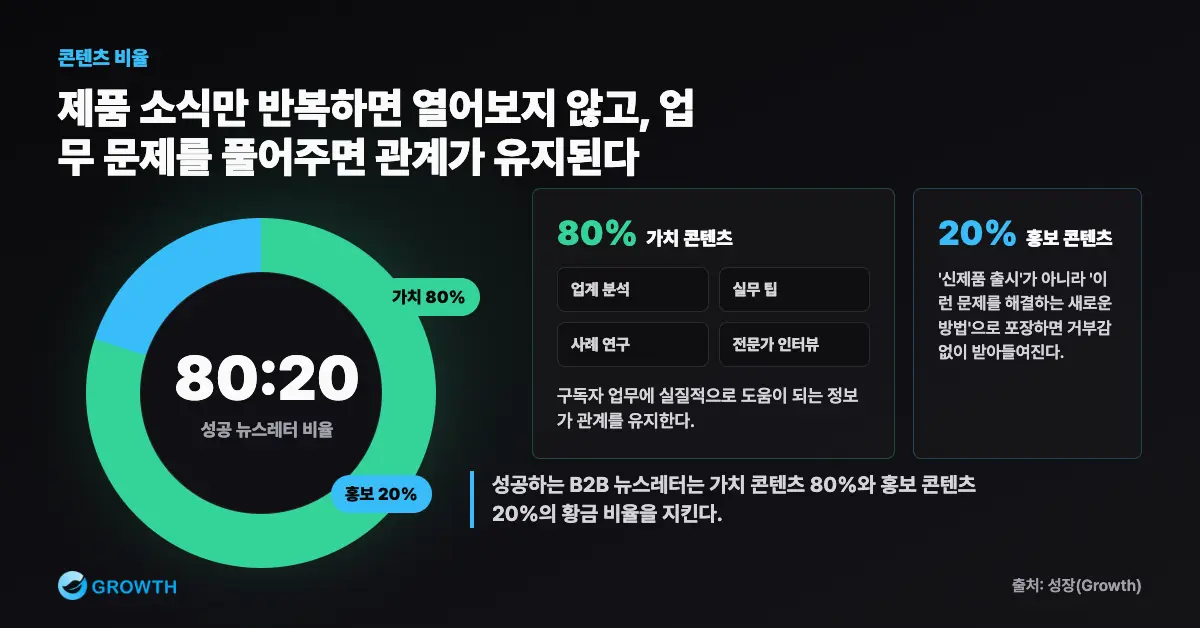
To create genuinely valuable content, focus on solving the challenges subscribers actually face at work. Industry trend reports that help readers anticipate what’s coming, or curated content like “3 stories worth your attention this week” that lets busy readers grasp the essentials quickly, both tend to perform well.
For working-level readers, ready-to-use checklists or templates land very well, and customer success stories become genuinely valuable content when they focus on “how this challenge got solved” rather than on promoting the product. Interviews and insights from industry experts also carry high value, since they surface information readers rarely encounter elsewhere, and providing templates or tools people can use immediately tends to get a great response too.
What matters is packaging even promotional content in a way that feels valuable. Rather than pitching directly with “new product launch,” framing it as “a new way to solve this problem” comes across as far more natural and useful.
Mistake 6. Measuring Performance the Wrong Way — Obsessing Over Open Rate Alone
Marketers Stuck in the Open-Rate Trap
Many marketers judge newsletter performance by open rate alone. They’ll be satisfied thinking “our open rate was 25% this month, that seems fine,” or conclude “open rate dropped, so we need punchier subject lines.”
But open rate is only part of the picture. What matters more is whether you’re actually achieving your business goals. A high open rate means nothing if click-through is low, or if clicks aren’t converting into anything.
A True Performance Metrics Framework
Real performance measurement needs a staged approach. Tier-1 metrics measure engagement: open rate reflects trust in your subject line and sender, click-through rate reflects how relevant and compelling the content is, and unsubscribe rate is a key indicator of overall satisfaction.
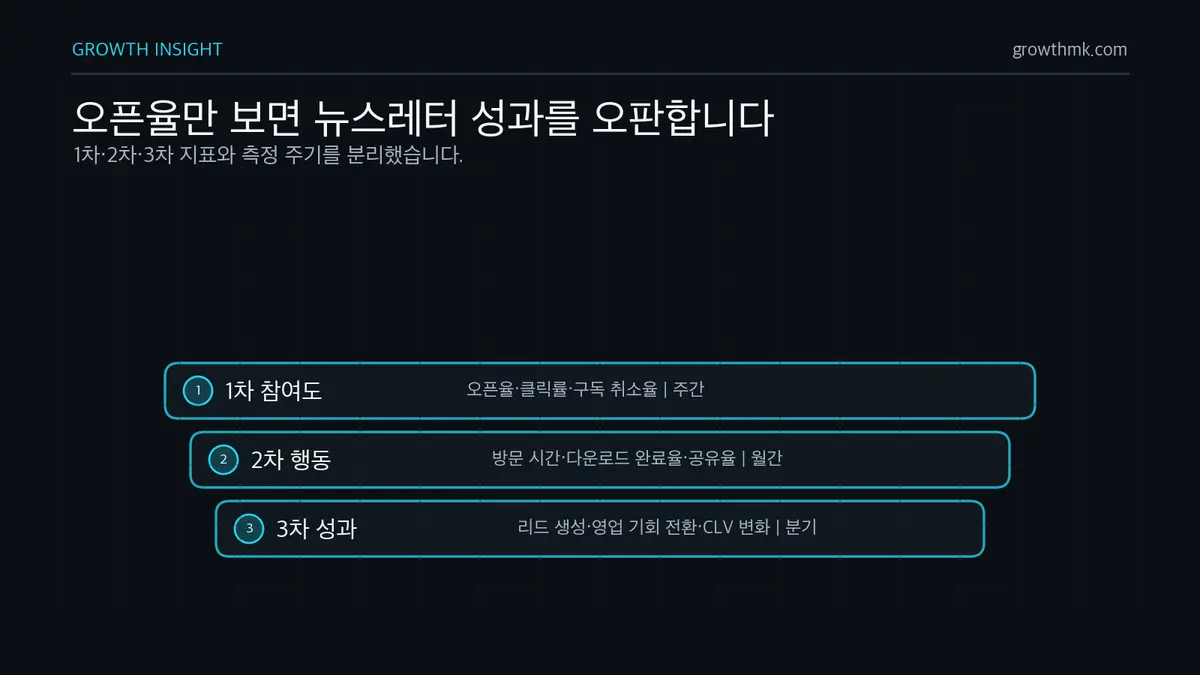
Tier-2 metrics measure actual behavior change: time spent on your website after a click shows how genuinely interested someone is, download-completion rate reflects the effectiveness of your lead magnet, and social share rate signals whether content was truly seen as valuable.
The most important tier-3 metrics tie directly to business outcomes. Number of leads generated shows how many real sales opportunities were created; opportunity conversion rate measures how much you contributed to the sales funnel; and change in customer lifetime value is the key indicator of long-term relationship-building impact.
Your measurement cadence should also match the nature of each metric. Basic metrics like open rate and click-through rate are best monitored weekly; changes in lead generation or website traffic are best analyzed monthly; and ROI or customer-lifetime-value shifts deserve a deeper quarterly review.
For more detail on measuring content marketing performance, take a look at [the Content Marketing KPI Measurement Guide].
Mistake 7. Lacking Consistency — The “It’s Fine to Skip When We’re Busy” Mindset
The Most Fatal Mistake: Irregular Sending
One of the single most important things about a newsletter is consistency. Yet plenty of companies undermine it with thinking like “we’re busy this month, let’s skip it” or “we’re short on content, so let’s send twice next month.”
Subscribers want predictable value. Irregular sending erodes trust and leads subscribers to give up expecting anything from your newsletter. Research shows that newsletters with a consistent sending schedule maintain, on average, over 30% higher subscriber retention than those sent irregularly.
Setting a Sustainable Sending Cadence
When setting a realistic sending cadence, you need to accurately gauge your company’s size and capacity. Startups are wise to start monthly and focus on quality; small and mid-sized companies can operate stably at roughly biweekly. Enterprises with sufficient resources can manage a weekly cadence, but it’s more important to start at a sustainable level than to push frequency higher than you can handle.
Building a content backlog system is also essential. Keep 3 to 4 pieces of content prepared in advance at all times, and plan around seasonal situations like year-end holidays or vacation periods. It’s also wise to keep a few pieces of evergreen content on hand that you can use anytime in case of a sudden, urgent situation.
Make active use of automation as well. It’s efficient to finish content production two weeks before send, wrap up review and approval a week before, and have the send itself fire automatically at a fixed, pre-scheduled time.
What matters most is only committing to what you can actually deliver — and then always keeping that commitment. Promising a weekly send and failing to keep up is far less effective than promising a monthly send and delivering it reliably, every time.
Email Marketing: A Roadmap for Turning Failure Into Success
Avoiding the 7 mistakes above and building a successful B2B newsletter requires a systematic, staged approach.
The first 1 to 2 months are about laying the foundation. Start by setting a clear goal and defining concrete KPIs. At the same time, put together a realistic resource plan suited to your company size, and build a basic subscriber-segmentation framework. Build an MVP-style newsletter template, and finalize editorial guidelines that apply the 80/20 content rule during this period as well.
Months 3 through 6 are about stabilization. The priorities here are firmly establishing a consistent sending cadence and building a system to collect and act on subscriber feedback. Sophisticate your performance-measurement framework further, and work on improving content quality while diversifying it. This is also the period to refine the segmentation you set up early on.
Months 7 through 12 move into optimization. Introduce advanced personalization features and finish integrating with your marketing automation systems. Systematize continuous improvement through A/B testing, work on ROI measurement and strategic refinement, and aim to finish building an operating system that can scale going forward.
The key to success isn’t a perfect start — it’s steady, continuous improvement. Avoid these seven mistakes and take a staged approach, and a striking 42x ROI is far from an unrealistic dream. What matters is starting today. Rather than waiting for the perfect plan, set a realistic goal and take the first step.
Worth Reading Next
- The Complete Guide to B2B Marketing — Strategy, Channels, ABM, Lead Generation, and Measurement
- What Makes B2B Decision-Maker Marketing Different
- Where Should B2B Marketing Position Itself in the AI Era?
- B2B Marketing Channels: How Do They Differ From B2C?
- B2B Marketing Formats: Video vs. Text Content Marketing
If you’d like to apply this to your own business — visit our B2B Marketing service to see how we approach growth, or reach out for a consultation if you need a diagnosis tailored to your specific situation. We’re paid based on results, not on traffic.
Frequently Asked Questions (FAQ)
How often should a B2B newsletter actually go out?
The answer isn’t about frequency — it’s about consistency. Startups should start monthly and focus on quality; small and mid-sized companies can go biweekly, and enterprises can scale up to weekly. What matters is reliably keeping whatever cadence you commit to. Committing to weekly and failing to keep up is far less effective, for subscriber trust and retention, than committing to monthly and delivering it every time.
What’s the right ratio between promotional and value content?
We recommend 80% value content to 20% promotional content. Most of your content should genuinely help subscribers with their work — think industry analysis, hands-on tips, case studies, expert interviews. Even promotional content lands better when it’s framed not as “new product launch” but as “a new way to solve this problem.”
Is it okay to judge performance by open rate alone?
Open rate is only a tier-1 metric that reflects trust in your subject line and sender. A high open rate doesn’t translate into business results if click-through is low or clicks aren’t converting. You need to measure engagement (open rate, click-through rate, unsubscribe rate), behavior change (time on site, downloads), and business outcomes (leads generated, conversion, customer lifetime value) together, in stages, to know what’s really working.
Should segmentation be sophisticated from day one?
No. Attempting complex segmentation from the start actually makes things harder to operate. It’s more realistic to begin with 3 or 4 basic groups — by company size, seniority, or purchase stage — and refine gradually. Once your newsletter matures, you can use data like past content engagement or website behavior patterns to segment more precisely.