
Engagement Rate
 임재복
임재복
Definition and Core Concepts of Engagement Rate
Engagement rate is a key performance indicator (KPI) that measures how actively users interact with and engage with a specific piece of content or campaign. It’s used across a range of digital marketing channels — social media, content marketing, email marketing, and more — to evaluate how effective content is and how interested users are, and it’s typically expressed as a percentage (%).
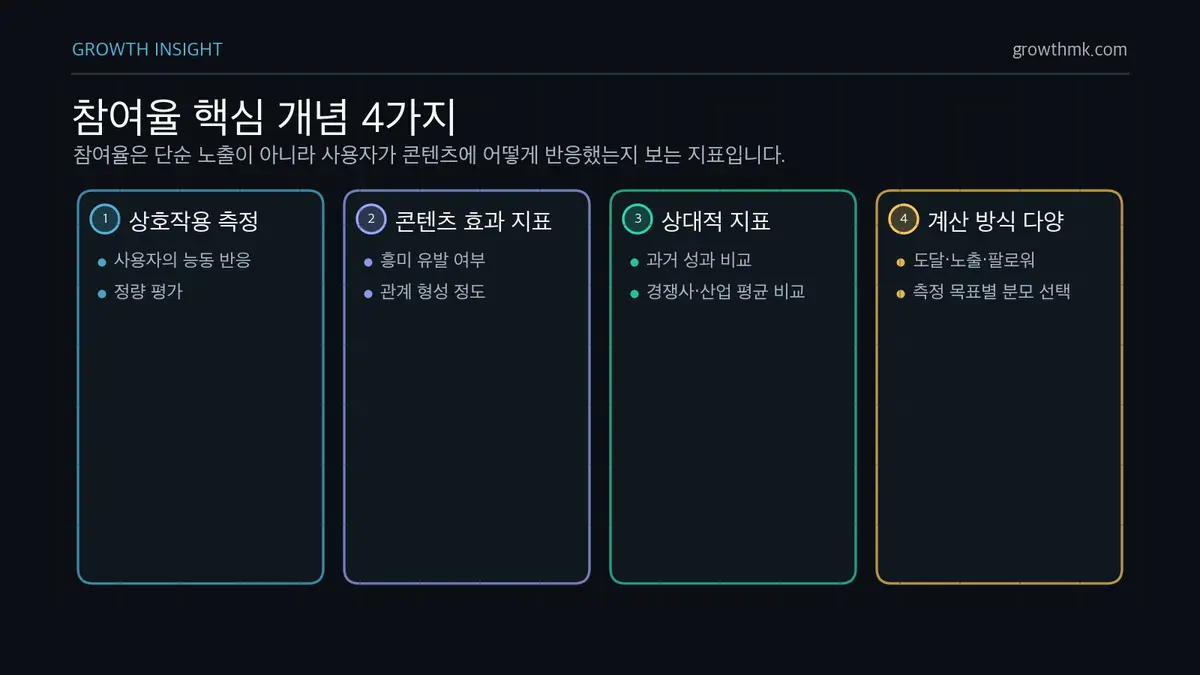
Here are the core concepts behind engagement rate.
- Measuring interaction: it quantifies users’ active response to content.
- A content-effectiveness metric: it shows how much content sparks user interest and builds a relationship.
- A relative metric: rather than looking at an absolute number, it’s typically evaluated against past performance, competitor averages, or industry averages.
- Multiple calculation methods: different formulas exist depending on the platform, what you’re measuring, and the data available (reach, impressions, follower count, and so on).
Engagement is an important stage in the consumer purchase journey. For a systematic understanding of these stages of consumer behavior, see the AISVAS Consumer Purchase Decision Model.
Why Engagement Rate Matters, and What Counts as a “Good” Rate
The Strategic Importance of Engagement Rate
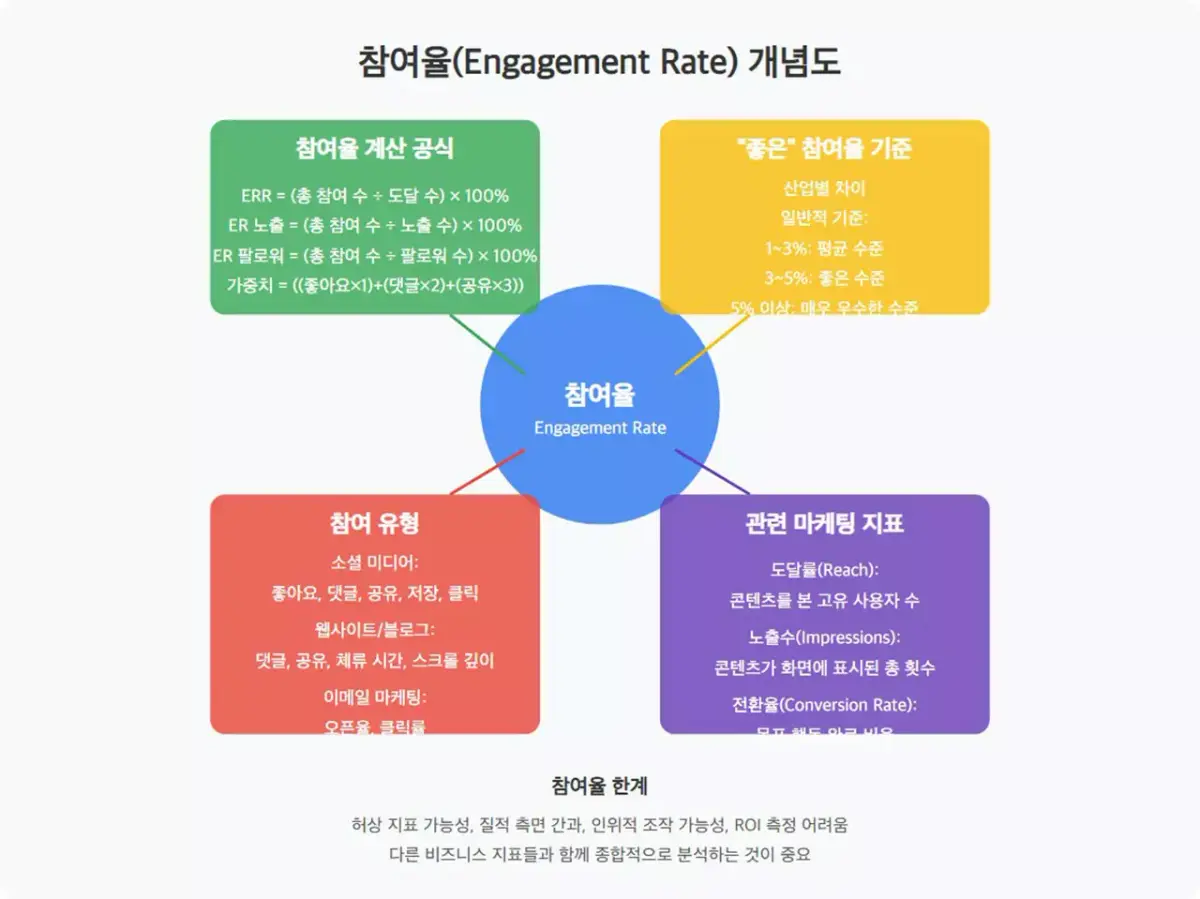
Engagement rate has become a core performance metric in digital marketing strategy. It goes beyond simply measuring how many people content reached — it lets you measure what kind of relationship that content actually built with users. Engagement rate data gives marketers an objective way to judge whether the content they’ve produced is delivering real value to their target audience.
Analyzing engagement rate also helps you understand which topics, formats, and tones of voice capture customer interest and drive a response — letting you build a more effective content strategy going forward.
On social media platforms, content with a higher engagement rate tends to get shown to more users by the algorithm, so raising engagement rate creates a virtuous cycle that expands organic reach. Actively interacting with users plays an important role in building and strengthening a brand community, which contributes to brand loyalty and trust over the long term. Especially in a digital environment where building customer relationships has gotten harder, engagement rate has become an important metric for measuring the real connection between a brand and its customers.
What Counts as a “Good” Engagement Rate Is Relative
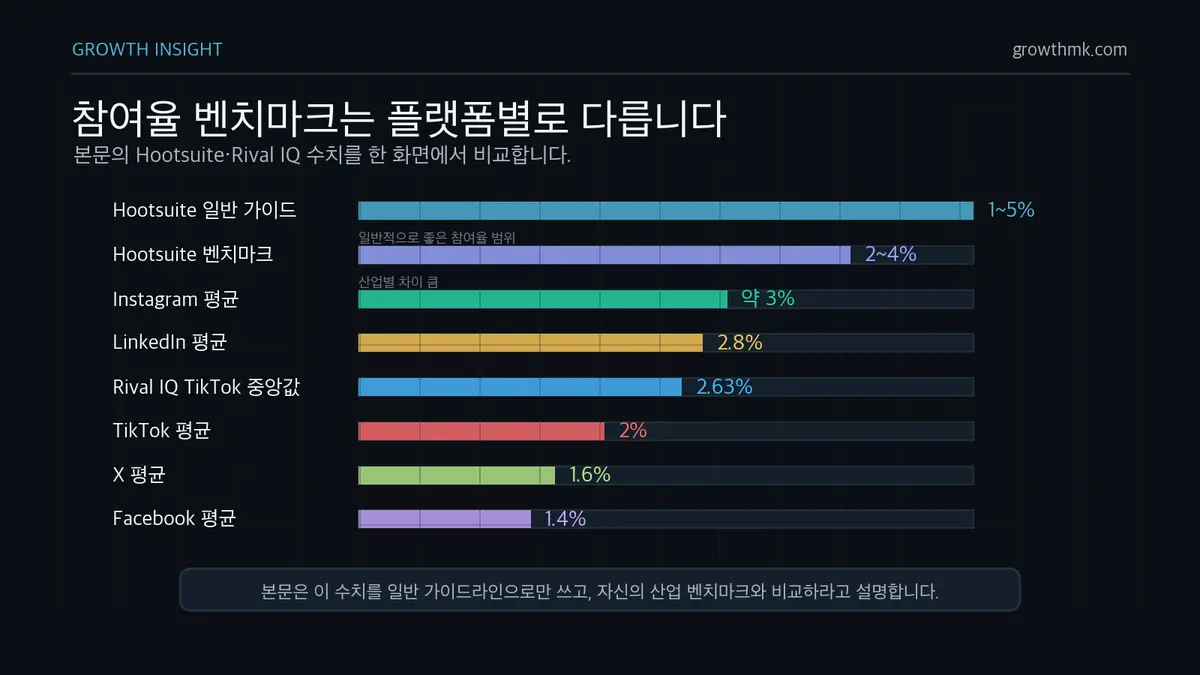
Defining what counts as a “good” engagement rate is hard to pin down as an absolute number, since it depends on a range of contextual factors. Because the competitive landscape and customer behavior patterns differ by industry, an engagement rate considered high in one industry might be just average in another. Hootsuite notes that a good engagement rate is generally around 2–4%, but that this varies significantly by industry (for example, 5.4% for education brands and roughly 3.7% for marketing agencies on Instagram), and recommends always comparing against your own industry benchmark.
For example, the B2B sector generally tends to see lower engagement rates than consumer markets. For the latest trends and benchmarks in B2B marketing, see B2B Marketing Trends 2024: The Complete A-to-Z Analysis.
Engagement rate also varies significantly across platforms — Instagram and TikTok generally see higher engagement rates than Facebook or X (formerly Twitter). In fact, Rival IQ’s 2024 benchmark report found TikTok dominated every other channel with a median engagement rate of 2.63%. This comes down to differences across platforms in user interface, the makeup of the core user base, and how content gets consumed.
Follower count is also an important factor that affects engagement rate. Accounts with a large following generally tend to see a lower engagement rate than accounts with fewer followers, because smaller accounts find it easier to connect with a tightly focused niche audience and maintain personalized interaction. Hootsuite generally considers 1% to 5% a good engagement rate, with platform averages of roughly 3% on Instagram, 2.8% on LinkedIn, 2% on TikTok, 1.6% on X (formerly Twitter), and 1.4% on Facebook. That said, these figures are just general guidelines that vary significantly by platform and industry.
But these numbers are only general guidelines — what matters most is comparing against your own past performance and making steady improvement. Engagement rate is one of many marketing KPIs, and it’s important to analyze it comprehensively alongside other metrics. For more on various marketing performance metrics, see The Content Marketing KPI Measurement Guide.
How to Calculate Engagement Rate
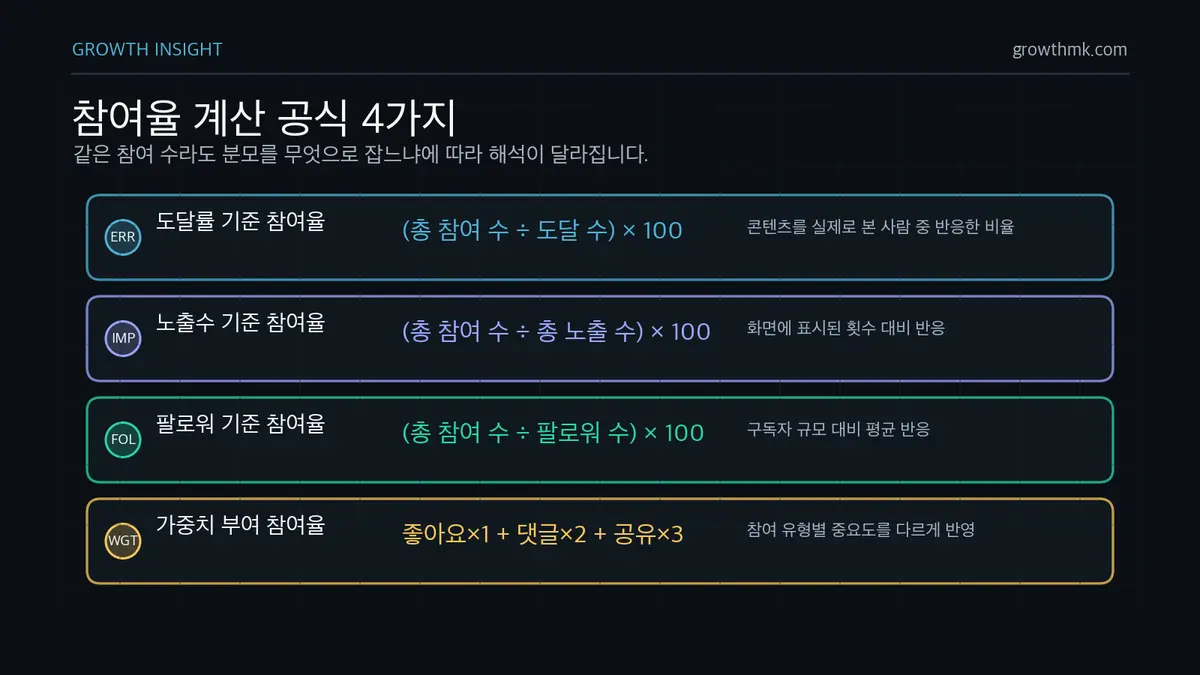
The formula for calculating engagement rate varies based on what you’re measuring, what denominator you use as the baseline (reach, impressions, follower count), and what you count as “engagement.”
Common items counted as “engagement”:
- Social media: likes, comments, shares, saves, clicks, mentions, DMs, and so on
- Website/blog: comments, social shares, time on page, a low bounce rate, scroll depth, file downloads, and so on
- Email marketing: open rate, click-through rate, and so on
The main engagement rate formulas:
- Engagement rate by reach (ERR):
- ERR = (total engagements ÷ post reach) × 100(%)
- Shows how many of the people who actually saw the content engaged with it.
- Engagement rate by impressions:
- ER Impressions = (total engagements ÷ total post impressions) × 100(%)
- Based on the total number of times the content was shown on screen.
- Engagement rate by followers/subscribers:
- ER Followers = (total engagements ÷ total followers) × 100(%)
- Shows the average response to a post relative to follower count.
- Weighted engagement rate:
- This method applies different weights to different types of engagement.
- Example: ((likes × 1) + (comments × 2) + (shares × 3)) ÷ reach × 100(%)
- Engagement rate in apps is measured through metrics like time spent, feature usage frequency, and in-app actions. You can find effective app marketing strategies and engagement-rate success stories in [Explore App Marketing Cases and Strategy].
Various Factors That Influence Engagement Rate

Whether engagement rate runs high or low is determined by a complex mix of factors, and systematically understanding and optimizing those factors is central to building an effective digital marketing strategy. Above all, content quality and relevance have the most direct impact on engagement rate.
Content that delivers real value to your target audience and speaks to their interests, concerns, and needs naturally drives more engagement. Content that solves a customer’s immediate problem or offers a genuinely useful insight tends to be more effective than content that’s simply promoting the brand.
A high engagement rate often leads to successful virality. For more on planning content that drives engagement, see [Viral Marketing Starts and Ends With Planning].
The format of content also plays an important role. Visually compelling images, emotionally resonant video, infographics that communicate information clearly, and storytelling that delivers a message through narrative can each capture user interest in their own way. Adding interactive elements raises the odds that users will actively engage with the content.
Having a clear call to action (CTA) also matters for directly driving user engagement. Specific prompts like “leave a comment with your thoughts” or “share this if you found it useful” give users a clear direction for how to engage. You can learn effective user-centered writing techniques in [UX Writing: Why User-Centered Writing Matters, With Examples].
How Engagement Rate Relates to Other Key Marketing Metrics
Engagement rate is closely connected to other key metrics used in digital marketing, and understanding the relationships between them is essential for evaluating marketing performance comprehensively.
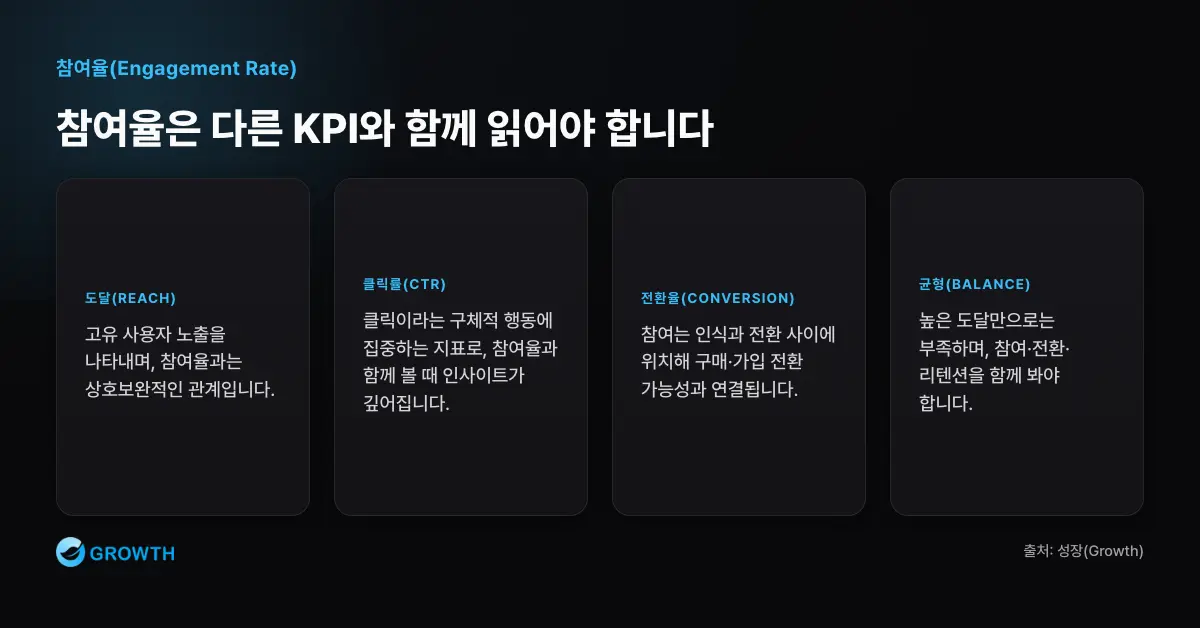
Reach and engagement rate have a complementary relationship. Reach shows how many unique users content was exposed to, while engagement rate shows how many of those reached users actually responded to the content. A high reach doesn’t always mean successful marketing — even if content reaches a lot of people, its impact is limited if those people show no interest in it.
Balancing reach and engagement rate is central to an effective content strategy. Impressions refer to the total number of times content was displayed on a user’s screen, which differs from reach in that the same user can be counted multiple times. Calculating engagement rate against impressions helps you understand how often content needs to be shown before it drives a response — useful information for optimizing an ad campaign.
Engagement rate is also closely related to the “Retention” stage of the AARRR framework. For more on a marketing strategy centered on user behavior, see What Is AARRR? Applying the AARRR Framework to App Marketing.
Click-through rate (CTR) is a metric focused on “clicks” — one specific form of engagement — and it’s especially important in ads and email marketing. Where engagement rate is a broader concept covering various interactions like likes, comments, and shares, CTR focuses on the more direct action of a user clicking a specific link or button. The two metrics are complementary, and analyzing them together gives you deeper insight into user interest levels and behavior patterns.
From a marketing funnel perspective, there’s also an important link between engagement rate and conversion rate. Engagement sits in the middle stage of the customer journey, between awareness and conversion. A high engagement rate doesn’t always translate directly into a high conversion rate, but users who actively engage with content generally have greater interest in and trust in a brand, making them more likely to eventually convert — through a purchase, a signup, and so on. So raising engagement rate can have a positive long-term effect on improving conversion rate.
The Limits of Engagement Rate
Engagement rate is a useful metric, but it comes with the following limitations:
- It can become a vanity metric: if it’s not directly connected to an actual business goal, a high engagement rate by itself may not mean much.
- It can overlook the quality of engagement: if a post has a large number of plain “likes” or a lot of spam-like comments unrelated to the content, the engagement rate number can look high even though genuinely meaningful interaction is low.
- It can be artificially manipulated: engagement rate can sometimes be inflated artificially through abuse or specific tools.
- It’s hard to directly measure ROI from it: a high engagement rate doesn’t necessarily mean a high return on investment (ROI).
- Different calculation methods can cause confusion: unless you’re clear about which formula you used to calculate engagement rate, comparing it against other data or interpreting performance can be misleading.
So rather than evaluating engagement rate on its own, you should analyze it comprehensively alongside other key business metrics to judge the effectiveness of your content and marketing strategy. Recognizing engagement rate’s limits calls for a more comprehensive growth strategy. For more on growth strategy built on a range of data and experimentation, see What Is Growth Hacking?
Related Reading
- The Complete Guide to Performance Marketing — From Definition to Platforms, Attribution, and Fixing Failure
- CPC (Cost Per Click)
- Remarketing
- CPC (Cost Per Click)
- Meta ASC (Advantage Shopping Campaign)
If you’d like to apply this to your own business — you can see Growth’s approach on our content marketing service page, and if you need a specific situational diagnosis, reach out through Contact Us. We’ll answer based on the one customer who becomes revenue — not the volume of traffic.
Frequently Asked Questions (FAQ)
How do you calculate engagement rate?
There are several methods, depending on what denominator you use. The most common is engagement rate by reach (ERR), calculated as “total engagements ÷ post reach × 100.” Other methods include an impressions-based formula (total engagements ÷ total impressions), a follower-based formula (total engagements ÷ total followers), and a weighted formula that assigns different weights to likes, comments, and shares. Being clear about which formula you used prevents confusion when comparing against other data.
What percentage counts as a good engagement rate?
There’s no absolute standard, since it varies significantly by platform and industry. Hootsuite generally considers 1–5% (typically 2–4%) a healthy range, with platform averages of roughly 3% on Instagram, 2% on TikTok, and about 1.4% on Facebook. What matters most isn’t hitting some universal benchmark — it’s steadily improving relative to your own past performance and your industry’s benchmark.
Does a high engagement rate mean higher revenue too?
Not necessarily. Engagement rate is a mid-funnel metric that sits between awareness and conversion, and a high engagement rate doesn’t always translate directly into a high conversion rate. That said, users who actively engage with content tend to have more interest in and trust in a brand, which raises the odds of conversion over the long run. That’s why engagement rate should be viewed alongside business metrics like conversion rate and ROI, not in isolation.
Can engagement rate become a vanity metric?
Yes. If it’s not tied to an actual business goal, a high engagement rate by itself doesn’t mean much. If a post has a large number of plain “likes” or a lot of spam-like comments unrelated to the content, the number can look high even though meaningful interaction is low, and there’s also a risk it’s been artificially inflated through abuse. So it’s important to look at the quality of engagement, not just the quantity, and interpret it alongside other core metrics.
Marketing Insights
Marketing insights, delivered weekly
Practical growth and GEO/B2B marketing insights, summarized in your inbox every week.
Subscribe for insights