
Remarketing
 임재복
임재복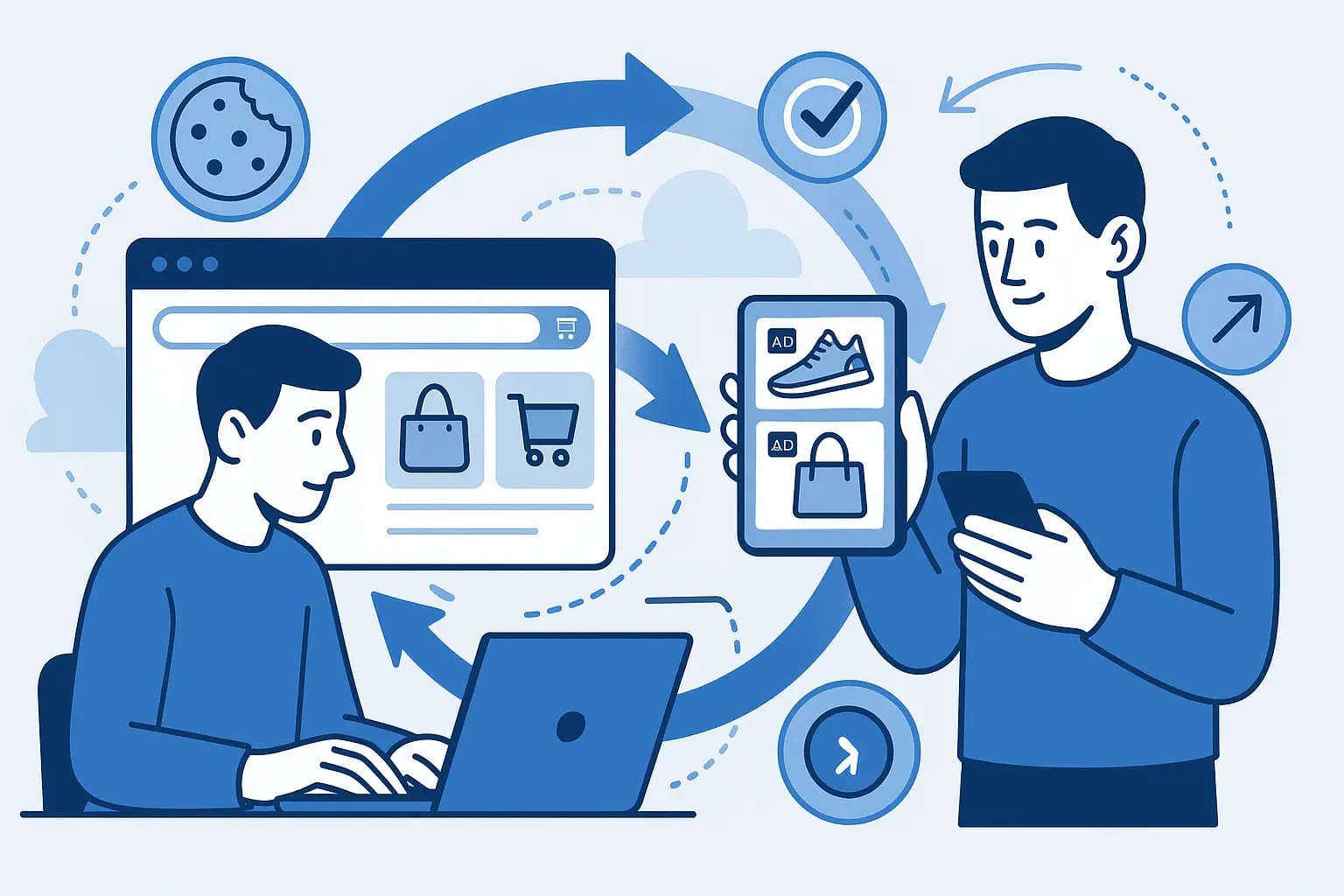
Definition of Remarketing
Remarketing is a digital marketing strategy that shows ads again to users who have previously visited a company’s website or used its mobile app, or to prospects who took a specific action (like adding an item to their cart or viewing a particular page), in order to drive a return visit and conversion (a purchase, a signup, etc.). Because it targets users who’ve already shown some level of interest in the brand or product, it tends to be more effective than a typical ad.
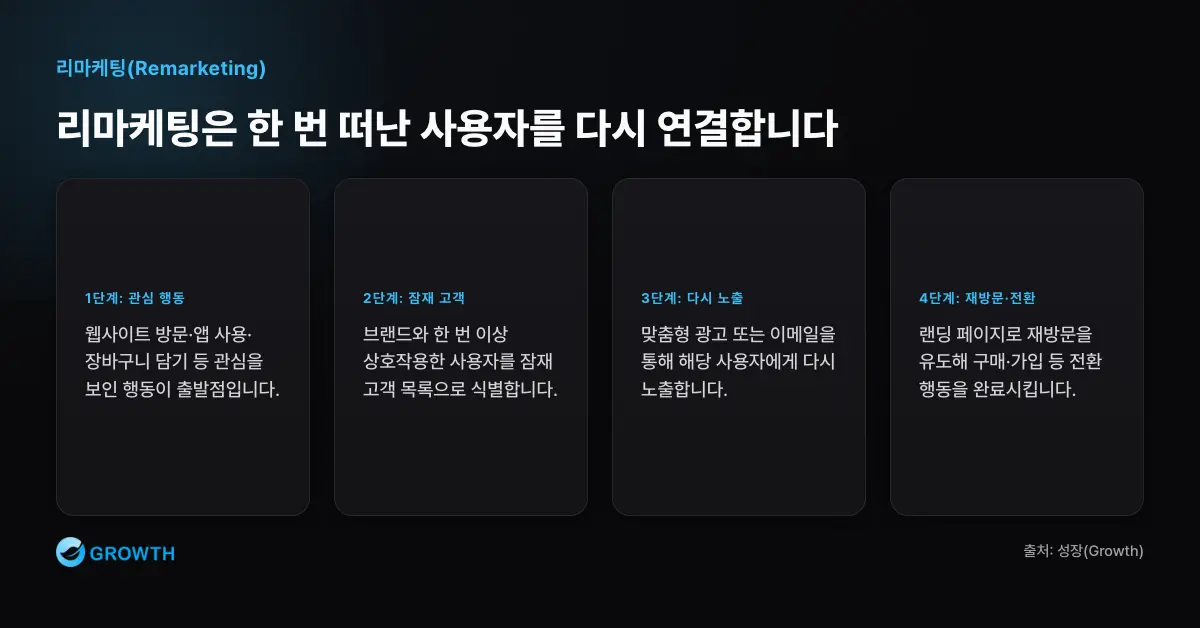
Remarketing is often used interchangeably with the term “retargeting.” Generally speaking, retargeting refers mainly to a cookie-based approach of showing website visitors ads on other websites or social media, while remarketing is sometimes used to mean a broader set of re-engagement strategies that include email marketing — but in day-to-day marketing practice, the two terms are frequently used to mean nearly the same thing.
The Definition and Core Purpose of Remarketing
The core purpose of remarketing is to reawaken interest among users who’ve interacted with the brand at least once, and nudge them toward the next step in their purchase journey. Most visitors don’t buy on their first visit. In fact, usability research firm Baymard Institute, aggregating 50 studies, found the average online shopping cart abandonment rate to be around 70.22%. Remarketing plays an important role in raising conversion rates by giving these lost prospects a chance to reconnect with the brand instead of losing them entirely.
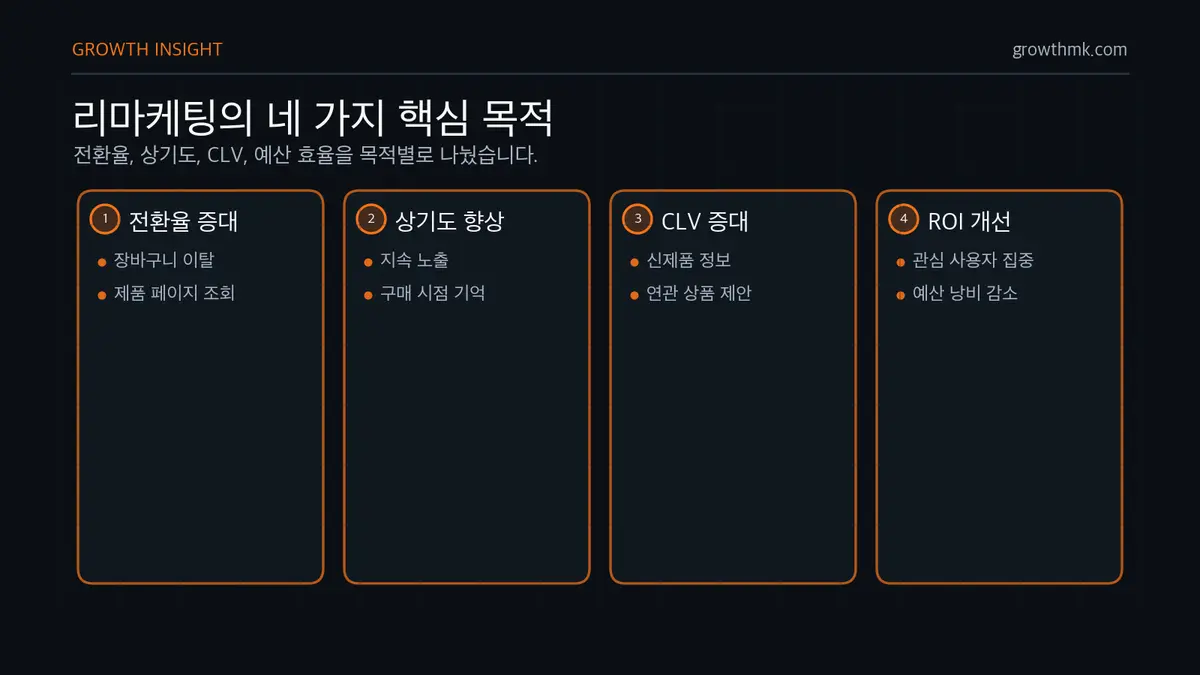
Remarketing’s first major purpose is raising conversion rates — delivering a tailored message to high-intent users, like people who abandoned their cart or viewed a specific product page, to nudge them toward completing the purchase.
The second purpose is improving brand awareness and recall. Consistent brand exposure keeps the brand top of mind for prospects, so it’s the first one they consider when they’re ready to buy.
The third purpose is growing customer lifetime value (CLV). This means encouraging repeat purchases and building a long-term customer relationship by showing existing customers information about new products or related items.
Finally, maximizing targeting efficiency — concentrating ad spend on users who’ve already shown interest in the brand — is an important purpose of remarketing, since it reduces wasted ad budget and improves ROI.
The Importance and Benefits of Remarketing
Remarketing has become an essential part of any digital marketing strategy, and it offers a range of benefits.
First, because remarketing reaches users who are already familiar with the brand, rather than a generic prospect audience, it tends to produce a much higher conversion rate than typical ads.
Second, a higher conversion rate means more revenue for every dollar of ad spend, which translates into more efficient use of the marketing budget and a better ROI (return on investment).
Third, remarketing lets you build highly specific audience lists based on a user’s on-site behavior — the pages they visited, the products they viewed, how long they stayed — and deliver a tailored ad message to each group, enabling sophisticated targeting and personalization.
Fourth, prospects repeatedly see the brand’s logo or products while browsing the web or using social media, which naturally reinforces brand recall.
Fifth, as customers go through the various stages of researching information before making a purchase decision, remarketing effectively supports the customer journey by delivering the right information at the right moment or resolving whatever’s making them hesitate to buy.
Finally, remarketing helps prevent prospects from drifting to a competitor by continuously keeping your own brand top of mind — contributing to a stronger competitive position.
How Remarketing Works (The Technical Basics)
Remarketing primarily works through web browser cookies and tracking code (a pixel or tag) provided by an ad platform. Here’s the general process.
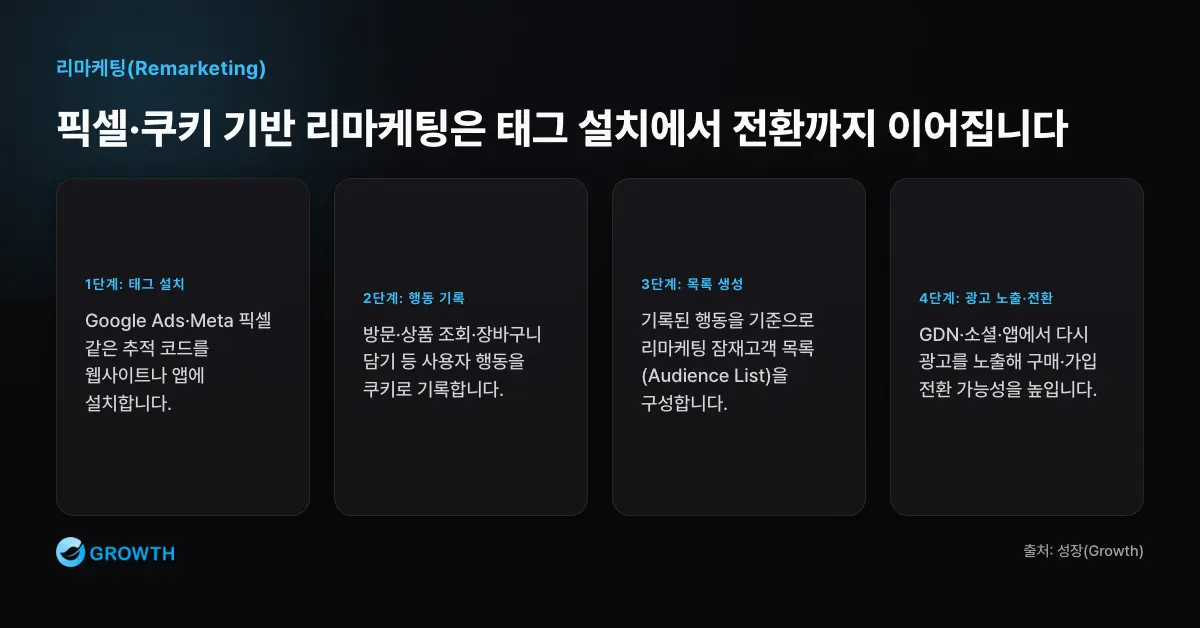
In the first step, a marketer installs a small piece of code (a pixel or tag) provided by an ad platform, like Google Ads or Facebook, on their website or mobile app. For example, the Meta pixel is a JavaScript snippet that tracks website visitor activity to build custom audiences for ad targeting, and Google Ads similarly describes, in its official documentation, showing ads again to users who’ve previously interacted with a brand across Google and its partner sites. In the second step, when a user visits the website or takes a specific action, this tracking code fires and an anonymous browser cookie gets assigned to them. (For mobile apps, an advertising ID is used instead.)
In the third step, an audience list is built within the ad platform based on the tracked user information — for example, visiting a specific page, or adding an item to a cart without checking out. This list is made up of users who meet certain criteria.
In the fourth step, when a user included in that audience list visits another website within the ad network (Google Display Network, Facebook, Instagram, etc.) or uses social media, the remarketing ad set up earlier gets shown to them. In the final step, a user who clicks the ad is directed back to a specific landing page on the website, raising the odds they’ll complete a conversion action like a purchase or a signup.
4. Types of Remarketing
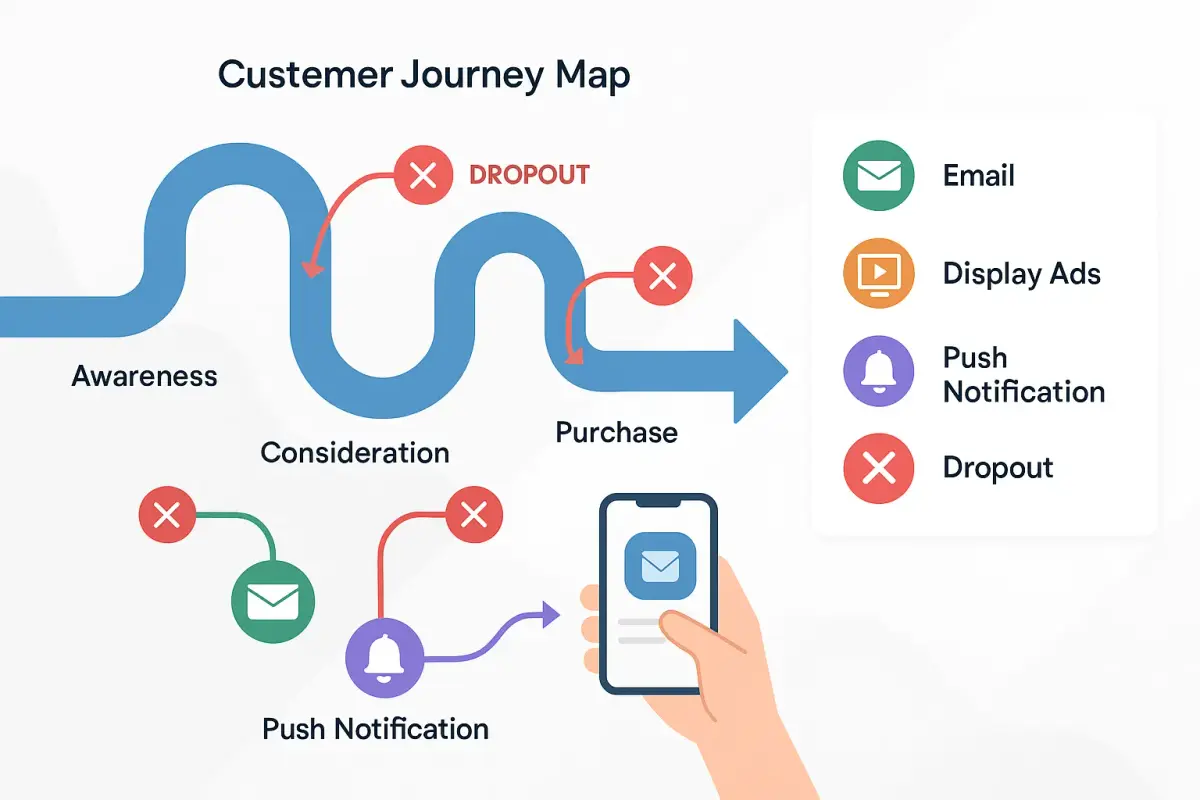
Remarketing can be broken down into several types based on target audience, method, and platform. Each type offers different advantages depending on your specific marketing goal and target audience.
Standard Remarketing
Standard remarketing is the most common form — showing website visitors display ads (banner ads) on other websites or apps within an ad network. It’s effective for boosting brand awareness and driving people back to your website, keeping the brand top of mind as users browse elsewhere.
Dynamic Remarketing
Dynamic remarketing is a personalized approach that automatically includes information about the specific products or services a user previously viewed or showed interest in, directly within the ad. This type is especially effective for e-commerce websites, since showing users products they’ve genuinely shown interest in helps push them toward a purchase decision. It automatically pulls from a product catalog to generate a tailored ad for each user.
Remarketing Lists for Search Ads (RLSA)
Remarketing Lists for Search Ads (RLSA) show tailored search ads, or adjust bids, when a website visitor searches for a related keyword again on a search engine like Google. This lets you show ads in a more prominent position on the search results page to users already familiar with the brand, and deliver a tailored message for specific search terms.
Video Remarketing
Video remarketing shows follow-up video ads to users who watched a specific video or interacted with a YouTube channel. Because it targets based on a viewer’s prior watch behavior or interests, it can deliver the brand message effectively through relevant video content. It’s especially well-suited to brands where storytelling or product demos matter.
Email Remarketing
Email remarketing uses a collected list of customer email addresses to send a tailored email to users who took a specific action — like abandoning their cart or subscribing to specific content — to drive re-engagement. Its advantage is delivering a specific call to action through a direct communication channel. Strictly speaking, this is sometimes considered the domain unique to “remarketing” rather than “retargeting.”
Social Media Remarketing
Social media remarketing shows tailored ads on platforms like Facebook, Instagram, and LinkedIn to website visitors or users who took a specific action. It tracks and targets users through each platform’s pixel (like the Facebook pixel). In a social media environment, user engagement runs high and ads blend naturally into the content feed, making it effective for driving re-engagement.
Customer List Remarketing
Customer List Remarketing (or Customer Match) works by having a company upload its own customer data — email addresses, phone numbers, etc. — to an ad platform, which then matches that data against its own user records to serve ads. Its major advantage is being able to show online ads to offline customers, creating a bridge between online and offline marketing channels.
App Remarketing
App remarketing shows ads to users who installed a mobile app but aren’t using it, or who took a specific action within the app, to encourage them to re-engage with the app or complete a specific action. This strategy plays an important role in preventing app user churn and retaining active users. It’s also used as part of an integrated strategy, combined with push notifications, to lift app engagement.
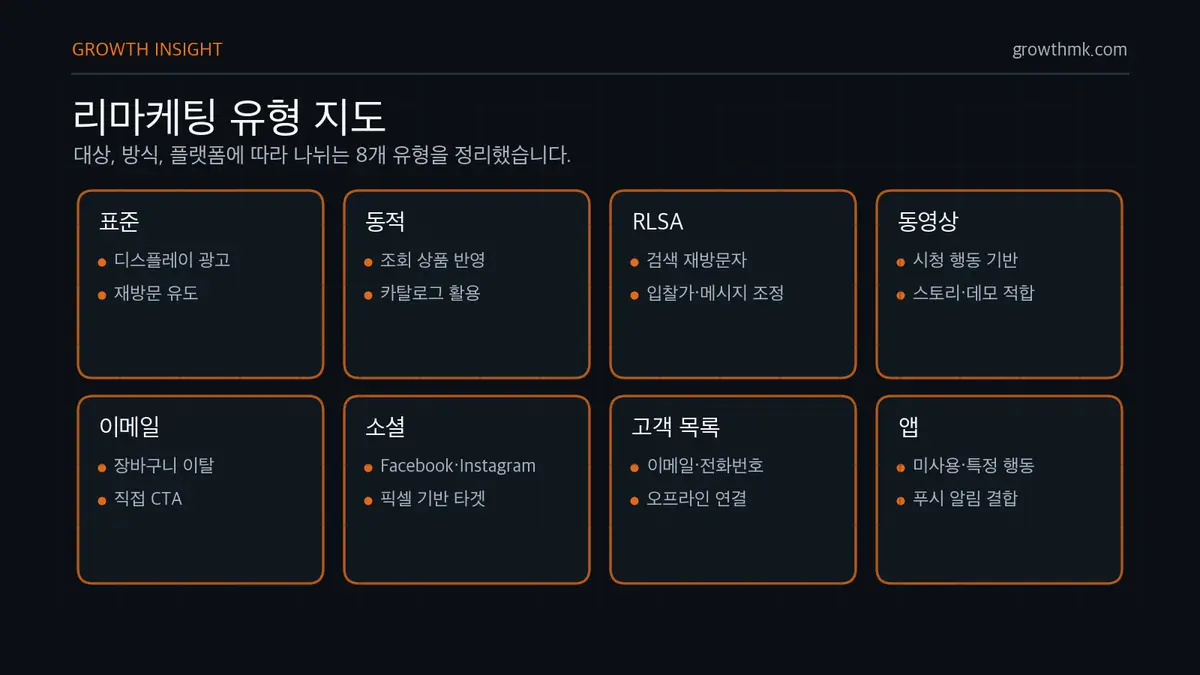
Each type of remarketing has its own distinct characteristics and advantages, and an effective digital marketing strategy typically combines several types to fit the brand’s goals and target audience. In particular, applying the right remarketing type to each stage of the customer journey helps raise conversion rates and maximize customer lifetime value.
5. Major Remarketing Platforms
A range of ad platforms offer remarketing functionality. Here are the major ones.
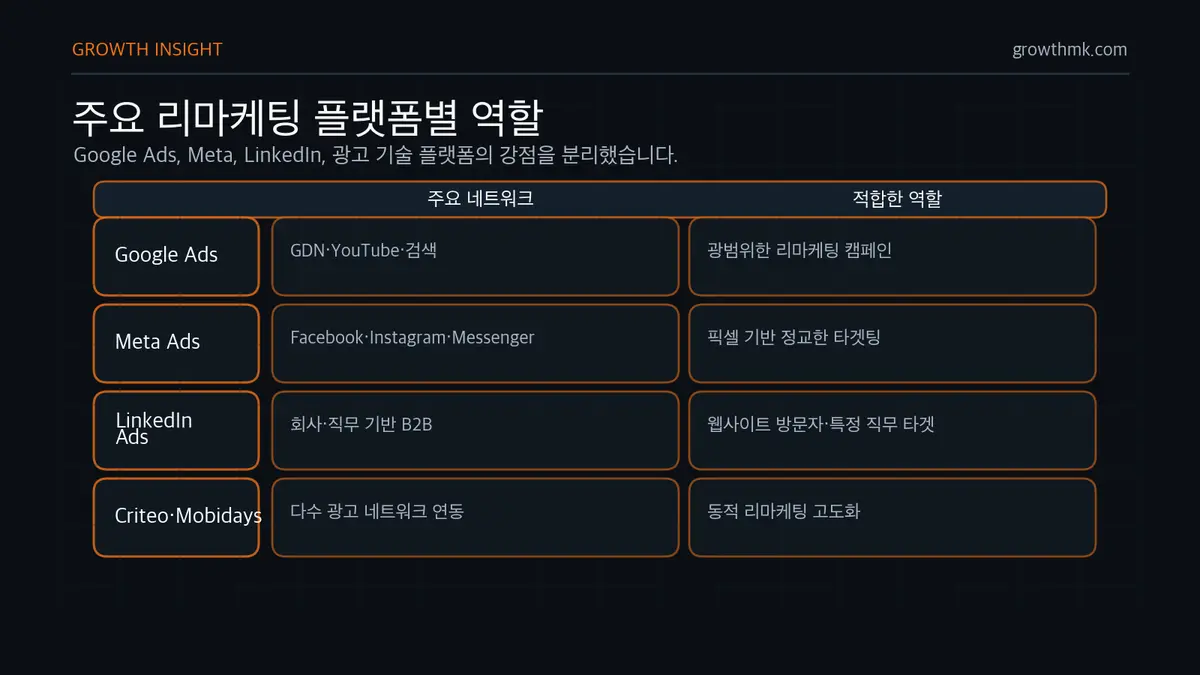
Google Ads lets you run remarketing campaigns in a range of formats across its broad network — the Google Display Network (GDN), YouTube, and Google Search (via RLSA).
Meta Ads lets you run remarketing campaigns with sophisticated targeting options across Meta’s platforms — Facebook, Instagram, Messenger, and Audience Network — using the Facebook pixel.
LinkedIn Ads is a platform built for B2B marketing, letting you show remarketing ads to website visitors or prospects at specific companies or job roles, using the LinkedIn Insight Tag.
Ad-tech platforms like Criteo and Mobidays integrate with numerous ad networks to offer advanced retargeting solutions, including dynamic remarketing, as specialized platforms.
Amazon Advertising lets you show related product ads, both on and off Amazon, to users who viewed a product or added it to their cart on Amazon’s website or app.
Curious which ad channel would actually be most effective for you right now? See Which Marketing Channel Actually Works? A 2025 Analysis.
6. Effective Remarketing Campaign Strategy
A successful remarketing campaign requires several strategic considerations.
Sophisticated audience segmentation matters — rather than lumping all website visitors into one group, it’s important to segment your audience lists by behavior (like viewing a specific product page, abandoning a cart, downloading content, or completing a purchase) or by stage of the purchase journey.
A tailored messaging and creative strategy means using ad copy, imagery, and CTA buttons suited to each segment’s characteristics and interests, and using dynamic remarketing to raise the level of personalization.
Frequency capping is a strategy for setting an appropriate limit on how often the same user sees an ad, so it doesn’t create ad fatigue or damage the brand’s image. Excluding converters is another important tactic — removing users who’ve already completed a purchase or the desired action from a remarketing list to avoid wasted ad exposure and budget.
Setting a campaign duration means capping how long a specific product or promotion stays in remarketing rotation, based on the idea that an ad becomes less effective the longer it’s been since a user first showed interest. A/B testing is a method for finding the optimal combination by testing different creative, CTAs, landing pages, and audience segments.
A clear landing-page strategy means making sure the landing page a remarketing ad links to stays consistent with the ad’s content, and is optimized so users can easily complete the desired action. Using a range of ad formats — beyond simple banner ads, including video and carousel ads — is another way to boost attention.
How Remarketing Differs From General Ads and Prospecting
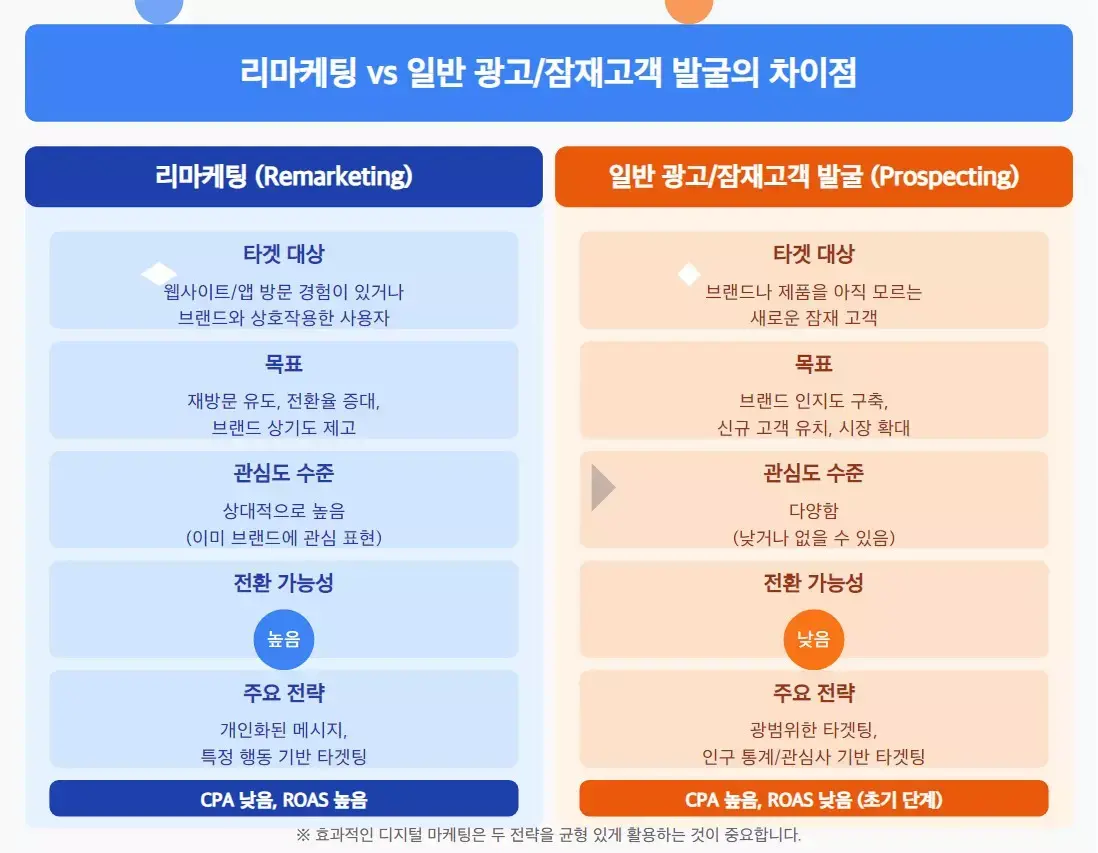
Remarketing and prospecting are complementary — effective digital marketing needs to use both strategies in balance.
8. Metrics for Measuring Remarketing Success
There’s a range of key metrics for measuring how a remarketing campaign is performing.
Conversion rate is the share of users who clicked an ad and went on to complete a target action, like a purchase or signup. Cost per acquisition (CPA) or cost per conversion is the ad spend it took to generate one conversion.
Return on ad spend (ROAS) measures the ratio of revenue generated to ad spend. Click-through rate (CTR) is the ratio of clicks to ad impressions — remarketing audiences tend to have a higher CTR than a general audience.
View-through conversions (VTC) measure cases where a user didn’t click the ad, but converted later through a different path after seeing it — helping capture the indirect impact of a remarketing ad.
Audience list size is the number of users a remarketing campaign can target. Engagement rate measures how much users interact with the ad — likes, comments, shares, and so on.
Challenges and Considerations With Remarketing
Remarketing is an effective strategy, but it comes with several challenges and considerations. Ad fatigue and annoyance is the problem where the same ad shown too many times causes users to ignore it or feel a negative reaction — which is exactly why frequency capping matters.
Concerns about privacy and tracking keep coming up around cookie use and behavioral tracking — this includes complying with relevant regulations (like GDPR and CCPA) and being transparent with users about consent.
Inaccurate targeting or segmentation is a challenge where poorly configured audiences can lead to wasted ad budget. A small audience list size is a limitation where low website traffic can make it hard to build an audience large enough to run an effective remarketing campaign.
Sending the wrong message — like showing an ad urging a customer to buy a product they’ve already purchased — can hurt the user experience, which is why managing a converter-exclusion list matters.
The complexity of measuring performance is a challenge, since accurately tracking user behavior and attributing it across multiple channels and devices can be difficult.
The Future of Remarketing (Changes in a Privacy-First World)
As privacy awareness rises and related regulation tightens (including the move to phase out third-party cookies), the remarketing landscape is changing too.

First-party data is becoming more important — customer data a company collects and manages itself (website member data, purchase history, app usage data, CRM data) carries growing value, which is likely to make customer list remarketing even more important.
Contextual targeting is having a resurgence — rather than tracking an individual user’s behavior, showing relevant ads based on the content or context of the webpage where the ad runs is drawing renewed attention. Google officially describes its Privacy Sandbox as providing “privacy-preserving ad APIs” to support advertising use cases without third-party identifiers, and new technologies are being developed and rolled out to measure ad effectiveness and deliver personalized ads while protecting privacy, without relying on third-party cookies (examples include the Topics API and FLEDGE/Protected Audience API).
Consent-based marketing is strengthening — getting clear consent from users before using their data matters more than ever, and clearly disclosing your data-handling policy has become essential. The use of machine learning and AI is expanding too — even in a data-constrained environment, there’s growing effort to use AI and machine learning to predict prospect behavior, optimize ads, and deliver a personalized experience.
Managing an integrated customer experience is becoming more important — remarketing strategy is evolving beyond simply repeating ad exposure, toward understanding the customer journey as a whole and delivering a consistent, valuable experience across channels.
Related Reading
- The Complete Guide to Performance Marketing — From Definition to Platforms, Attribution, and Overcoming Failure
- Engagement Rate
- CPC (Cost Per Click)
- CPC (Cost Per Click) Explained
- Meta ASC (Advantage Shopping Campaign)
Want to apply this to your own business? — Visit our performance marketing service page to see our approach to growth, or get in touch for a specific diagnosis of your situation. We measure success by the one customer who becomes revenue, not by traffic volume.
Frequently Asked Questions (FAQ)
Is remarketing different from retargeting?
In practice, they’re used to mean almost the same thing. Drawn narrowly, retargeting tends to refer to a cookie-based approach of showing website visitors ads on other sites or social media, while remarketing tends to refer to a broader set of re-engagement strategies that include email. That said, the two terms are frequently used interchangeably in the field.
How does remarketing actually work?
It starts with installing tracking code (a pixel or tag) provided by an ad platform on your website. A Meta pixel or Google Ads tag logs a visitor’s behavior to build an audience list, and when users on that list visit other sites or use social media, the ad you’ve set up gets shown to them again.
If third-party cookies go away, does remarketing stop working?
The method changes, but remarketing doesn’t disappear. First-party data that a company collects and manages directly (member information, purchase history, etc.) and customer list remarketing are becoming more important, and technologies that support advertising without third-party identifiers — like Google’s Privacy Sandbox — are being rolled out. Consent-based data use and contextual targeting are also seeing renewed attention.
How do you avoid annoying people by showing ads too often?
Set frequency capping so the same user doesn’t see an ad excessively often, and move users who’ve already completed a purchase onto a converter-exclusion list. Capping your campaign duration to avoid showing ads long after a user’s initial interest has faded is also effective for reducing ad fatigue.
Marketing Insights
Marketing insights, delivered weekly
Practical growth and GEO/B2B marketing insights, summarized in your inbox every week.
Subscribe for insights