
Triple Media
 임재복
임재복
What Is Triple Media?
Triple Media is a core framework in modern marketing communication strategy — an integrated marketing model that sorts every media channel available to a business into three categories: Paid Media, Owned Media, and Earned Media. As the digital landscape has evolved and the consumer’s role has shifted, weaving these three media types together into a coherent whole has become a core factor in marketing success, and its importance has only grown.
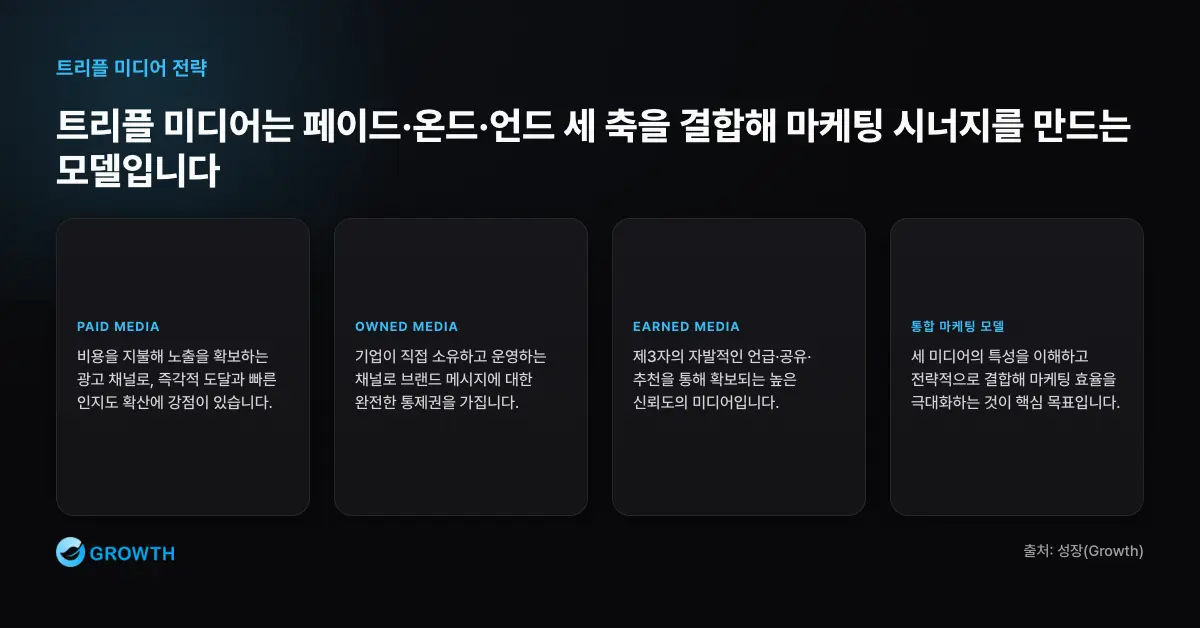
This concept is the theoretical foundation for the integrated approach discussed in [B2B Marketing Trends A to Z] and [The Performance Marketing Reference — When You Need Guaranteed Results]. Understanding each media channel’s characteristics and strategically combining them to maximize marketing efficiency is the core goal of a Triple Media strategy.
The History and Origins of Triple Media
The concept of Triple Media emerged alongside the rapid growth of digital marketing in the late 2000s. As two-way communication with consumers began to matter more than traditional, one-directional advertising, businesses found they needed a systematic way to manage a growing range of media channels.
As social media took off and blogs and online communities spread, consumers shifted from passive recipients of information into active content producers and opinion-shapers. This shift in the media landscape led businesses to start distinguishing between media they could control (Owned) and media they couldn’t control but that still carried real influence (Earned).
Through the 2010s, as [content marketing] and [SEO marketing case studies — content strategy built on keyword analysis] gained importance, Triple Media became the standard framework for integrated marketing strategy. In particular, as data-driven marketing advanced and made it possible to measure and optimize the performance of each media type, its practical adoption grew significantly.
The Key Components and Characteristics of Triple Media
Paid Media
Paid media covers every advertising channel where a business pays for message exposure. Its main purpose is to expand reach and build awareness quickly, and its key advantage is the ability to target the right audience precisely using data.
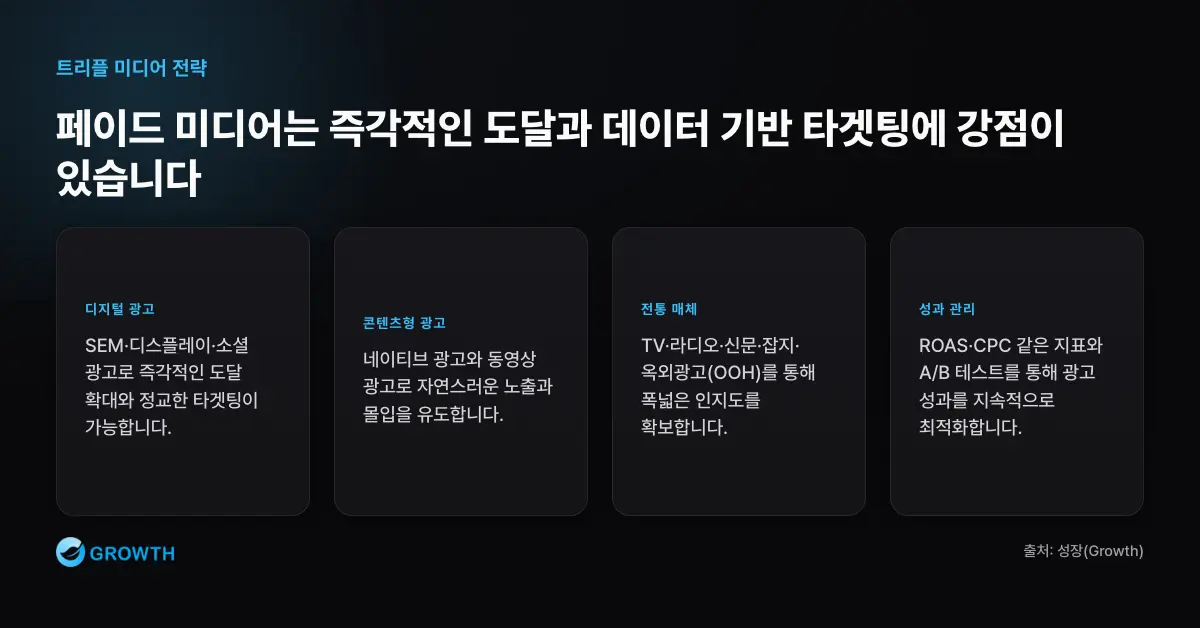
Digital paid media includes search engine marketing (SEM), display ads, social media ads, native ads, and video ads. Traditional channels include TV, radio, newspapers, magazines, and out-of-home (OOH) advertising. Performance can be measured with metrics like [ROAS (Return on Ad Spend)] and [CPC (Cost Per Click)], and it’s characteristically refined continuously through [A/B testing, a method for steadily improving ad performance].
Owned Media
Owned media is any media channel a business directly owns and operates, giving it full control over the brand message. This includes the company website, brand blog, official social media accounts, email newsletters, and branded apps.
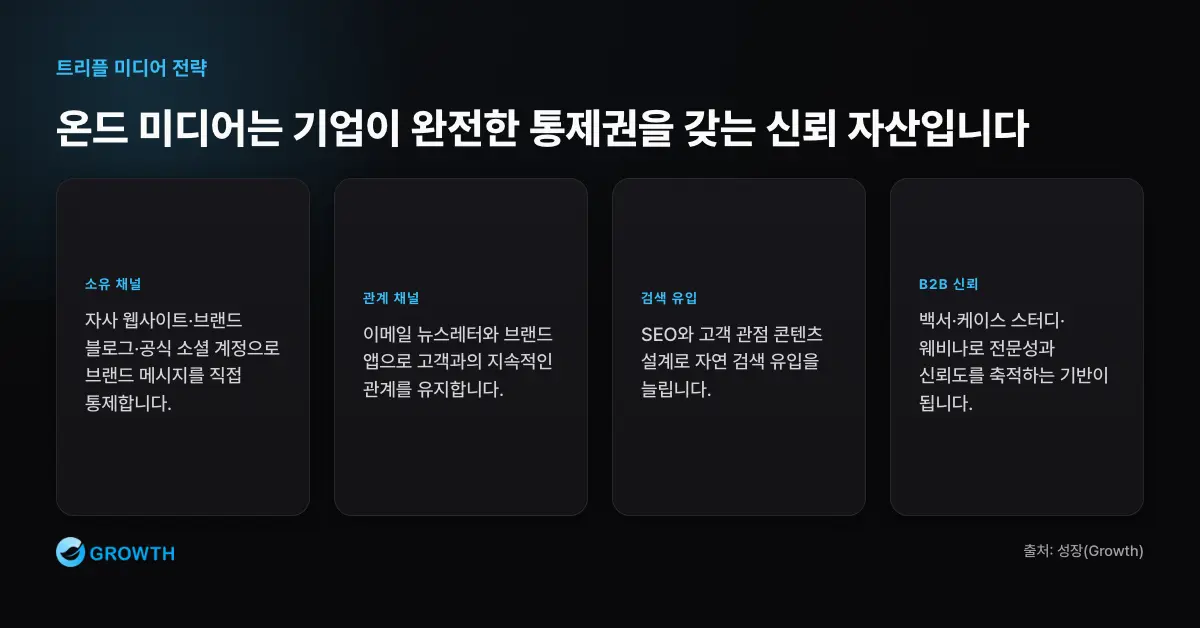
At the core of owned media is delivering genuinely valuable content, as covered in [Content Marketing: A Guide from Definition to Strategy]. It’s also important to grow organic search traffic with strategies like [an SEO-friendly translation guide] and [content SEO that starts from the customer’s perspective], and to improve user experience by applying [the importance of user-oriented UX writing, with examples]. B2B companies in particular benefit from content like white papers, case studies, and webinars that build expertise and credibility.
Earned Media
Earned media is media a business can’t directly control, built instead from voluntary mentions, shares, and recommendations by third parties. This includes press coverage, customer reviews, social media mentions, blog posts, and organic spread through viral marketing.
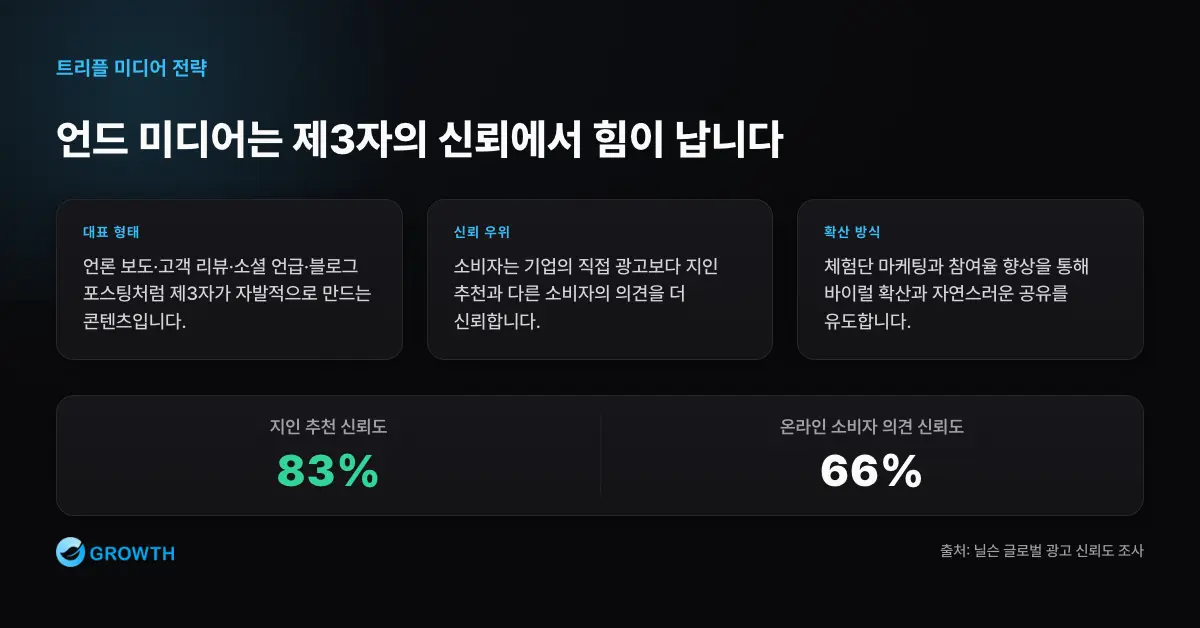
Earned media’s biggest strength is its high credibility and influence. Consumers tend to trust the opinions of other consumers or experts more than a company’s own advertising, which gives it outsized influence on purchase decisions. In fact, Nielsen’s global survey on trust in advertising found that 83% of respondents trust recommendations from people they know, and 66% trust opinions from other consumers posted online — both figures that back up earned media’s influence. You can encourage earned media to form through strategies like how to run a product-experience marketing program well and remarketing, and the key is lifting [engagement rate] so that it spreads naturally.
Real-World Use Cases and Strategies for Triple Media
B2B Use Cases
For B2B companies, using all three media types in balance matters especially. Combine them strategically with the target-account approach described in [What Is ABM (Account-Based Marketing)?].
Paid media reaches decision-makers through LinkedIn ads, industry trade publication ads, and trade show sponsorships. Owned media educates prospects and builds trust with expert content like [Do B2B Newsletters Actually Drive Revenue?]. Video content built around [a YouTube marketing guide for B2B companies] is also effective. On the earned media side, customer success stories, endorsements from industry experts, and press coverage all lift brand credibility.
Integrated Marketing Synergy Strategy
A successful Triple Media strategy depends on how organically the three media types connect to each other. Apply the growth-oriented approach described in [What Is Growth Hacking?], and you can funnel traffic captured through paid media into owned media, then let a genuinely valuable content experience carry it naturally into earned media.
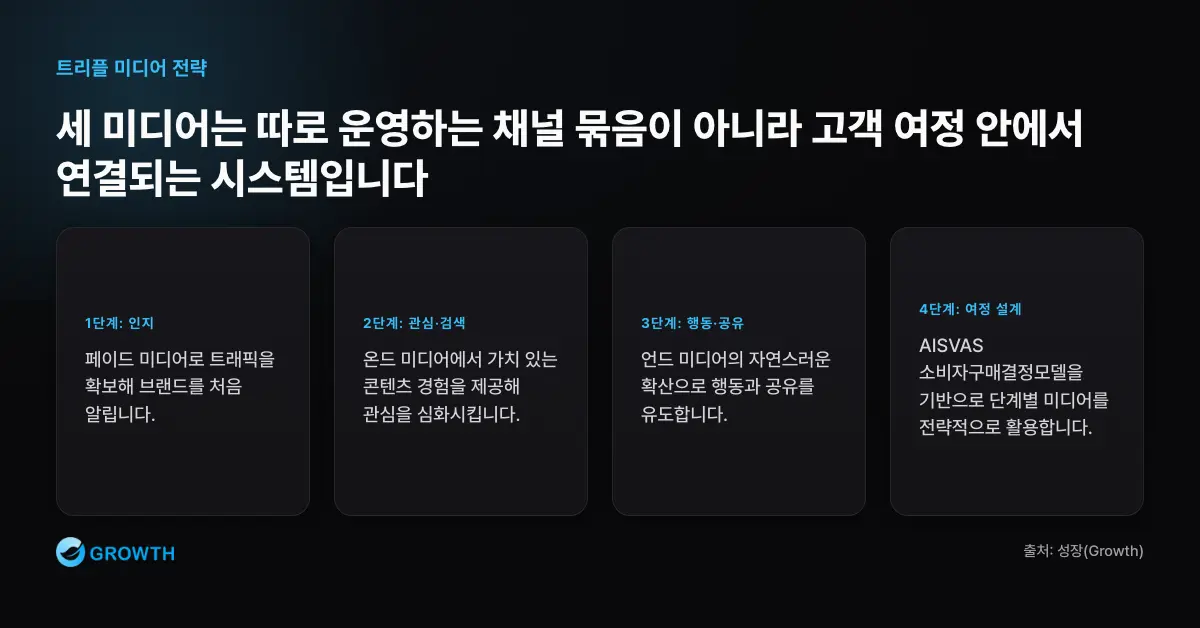
Building on the [AISVAS consumer purchase decision model], it matters to choose the right media for each stage of the customer journey. Paid media tends to do the heavy lifting at the awareness stage, owned media at the interest and search stage, and earned media at the action and sharing stage. This can also be paired with [applying Maslow’s five stages of need to marketing] to tailor your media strategy to different levels of customer need.
Related Concepts and Where Triple Media Is Headed
Relationship to the PESO Model
The PESO model (Paid, Earned, Shared, Owned Media) is an extended version of the Triple Media concept. This framework is widely credited to Gini Dietrich, who laid it out in her 2014 book Spin Sucks. Shared media refers to the space where brands and consumers co-create content on social media platforms. Some experts treat shared media as a subcategory of earned media, but as social media’s weight has grown, there’s a growing case for treating it as its own category.
Connection to Performance Marketing
As [Why Performance Marketing Fails, and How to Fix It] discusses, an integrated Triple Media approach is essential even in performance-driven marketing. To avoid [the ROI and ROAS trap, and the limits of ad budgets], you have to consider each media type’s long-term value rather than relying on a single one.
Data-driven measurement through [a step-by-step guide to initial Google Analytics 4 setup] and [a marketing keyword research strategy, from kickoff to feedback] is central to optimizing a Triple Media strategy. Use [a guide to measuring content marketing KPIs] to precisely understand each media type’s contribution and adjust your budget allocation accordingly.
Connection to Future Marketing Trends
The advance of AI technology raised in [Should You Use Generative AI for Content Marketing?] is also having a major impact on Triple Media strategy. AI-assisted content generation, personalized ad targeting, and social listening are all being used as tools to boost the effectiveness of each media type.
Privacy policy shifts like Chrome’s phase-out of third-party cookies are also affecting Triple Media strategy. In 2024, Google announced via its Privacy Sandbox update that it was shifting course from a blanket removal of third-party cookies to a model where users choose directly — but that hasn’t changed how much weight first-party data carries in strategy. Collecting first-party data through owned media in particular has become even more important, and creating long-term value through [evergreen content] is getting more attention as well.
Related Reading
- Content Marketing: A Guide from Definition to Strategy
- Earned Media
- Evergreen Content
- A Guide to Brand Content Marketing
- ESG Content Marketing Case Studies and a Practical Strategy
Want to apply this to your own business? See Growth Inc.’s approach in our content marketing service, and if you need a diagnosis specific to your situation, reach out for a consultation. We’ll answer based on the one person who becomes revenue, not the volume of traffic.
Frequently Asked Questions
How is Triple Media different from the PESO model?
Triple Media is a model that sorts media into three categories: Paid, Owned, and Earned. The PESO model is an extended framework that adds Shared media (the space where brands and consumers co-create content on social platforms), laid out by Gini Dietrich in 2014. It emerged from a growing move to manage shared media separately from earned media as social media’s weight increased.
Which of the three media types should you start with?
The right answer depends on your business goals and stage. That said, the common pattern is to build on owned media (your website, blog, content) as the foundation since you control it and it accumulates as an asset, use paid media to capture initial traffic, and then let a genuinely valuable experience carry that naturally into earned media. The key is designing a virtuous cycle where paid-driven traffic flows into owned, which then connects into earned.
Is earned media really free?
Since it’s built on voluntary third-party mentions and shares, there’s no direct media-buying cost, but it isn’t free. Earning press coverage, customer reviews, and recommendations requires investing first in a genuinely good product, content, and PR effort. Negative content can spread just as quickly, so you also need social listening and a response plan in place.
Does Triple Media work for B2B too?
Yes. In B2B, a balanced combination matters especially — paid media like LinkedIn ads and trade show sponsorships to reach decision-makers, owned media like white papers, case studies, and webinars to build trust, and earned media like customer success stories and endorsements from industry experts to add validation.
Marketing Insights
Marketing insights, delivered weekly
Practical growth and GEO/B2B marketing insights, summarized in your inbox every week.
Subscribe for insights




![[Why Performance Marketing Fails, and How to Fix It]](https://storage.googleapis.com/growth-mk-wp-media/wp-content/uploads/2023/09/AnyConv.com__performance-marketing-reference_growthmk.webp)