
What Are SSL Certificates and HTTPS, and Why Do They Matter?
 임재복
임재복
SSL certificates and the HTTPS protocol are the foundation of modern website security and a non-negotiable part of business trust. If your company handles customer information or payment data online, this is technology you need to understand and put in place.
In this article we’ll walk through what SSL certificates and HTTPS actually are, why they matter, and how to implement them — in a way that’s easy to follow even if you’re starting from zero.
The basics of SSL certificates and HTTPS
If you run a website or you’re starting an online business, you’ve probably heard the terms SSL and HTTPS at some point. But many people don’t know exactly what they mean or what they do.
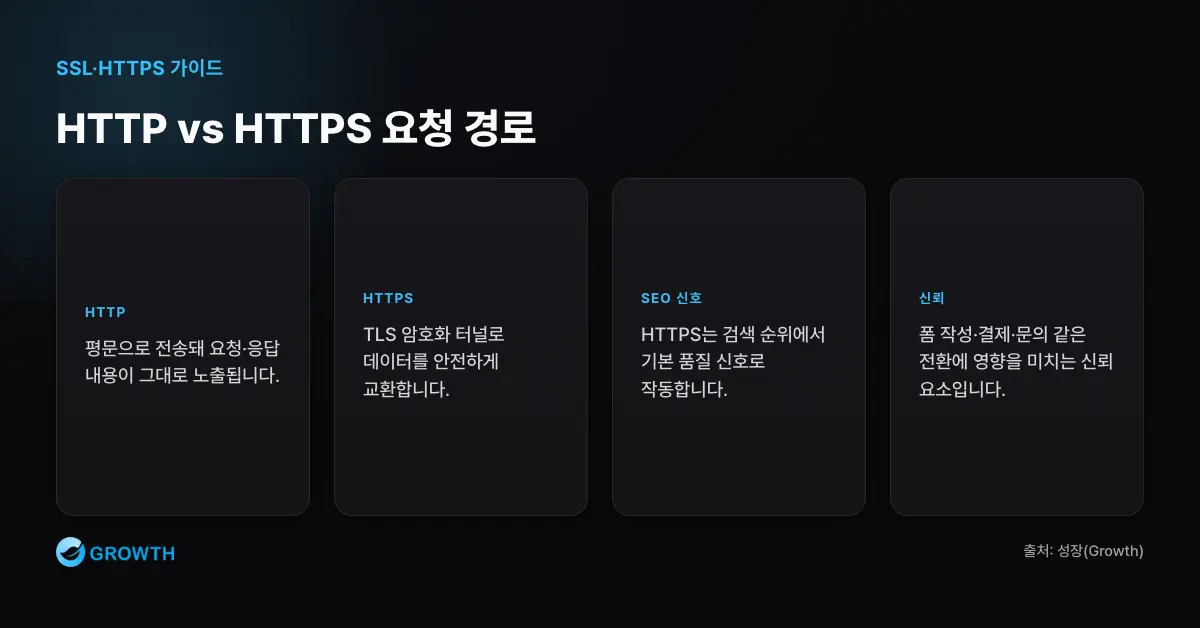
When a browser flashes a “Not Secure” warning on a checkout page or a page that asks for personal details, users hesitate to type anything in — or they leave altogether. Google explains in Why HTTPS Matters that HTTPS protects the communication between a site and a user’s browser from eavesdropping and tampering. It’s a technical concept, but it feeds straight into business trust, so let’s go through the fundamentals one by one.
What is an SSL certificate?

An SSL (Secure Sockets Layer) certificate is a digital certificate that encrypts the communication between a website and its visitors. Think of it as a ‘digital lock’ that keeps the information passed between a site and a user safe. It stops a third party from eavesdropping on — or tampering with — whatever data is being exchanged over the internet.
In practice, SSL certificates now run on the newer TLS (Transport Layer Security) protocol, but because the name “SSL” stuck around historically, people still commonly call them SSL certificates. Technically, “TLS certificate” is the more accurate term, but the industry still overwhelmingly uses “SSL.”
An SSL certificate contains the following key information:
- Domain name: the domain of the website the certificate was issued for
- Certificate Authority (CA): the trusted organization that issued the certificate
- Digital signature: a signature that verifies the certificate’s authenticity
- Validity period: the period during which the certificate is valid
- Public key: the key used for encryption
Certificates are issued by a trusted third party known as a CA (Certificate Authority). Because these organizations verify identity before issuing a certificate, visitors can trust that the website really is the company or organization it claims to be.
Well-known certificate authorities include DigiCert, Comodo, and Let’s Encrypt, each with its own service scope and pricing.
SSL certificates are now indispensable for any business website — even more so for sites that handle customer personal information or payment data. Services that deal with tax filings or financial information need solid SSL security in place to protect sensitive customer data. It goes beyond a technical requirement; it’s something that shapes customer trust and business reputation.
What is HTTPS, and how is it different from HTTP?
HTTPS (Hypertext Transfer Protocol Secure) is the secure version of HTTP. HTTP is the basic protocol used to exchange data between a web browser and a website’s server, but it doesn’t encrypt that data, which means a third party could intercept or alter the information in transit.
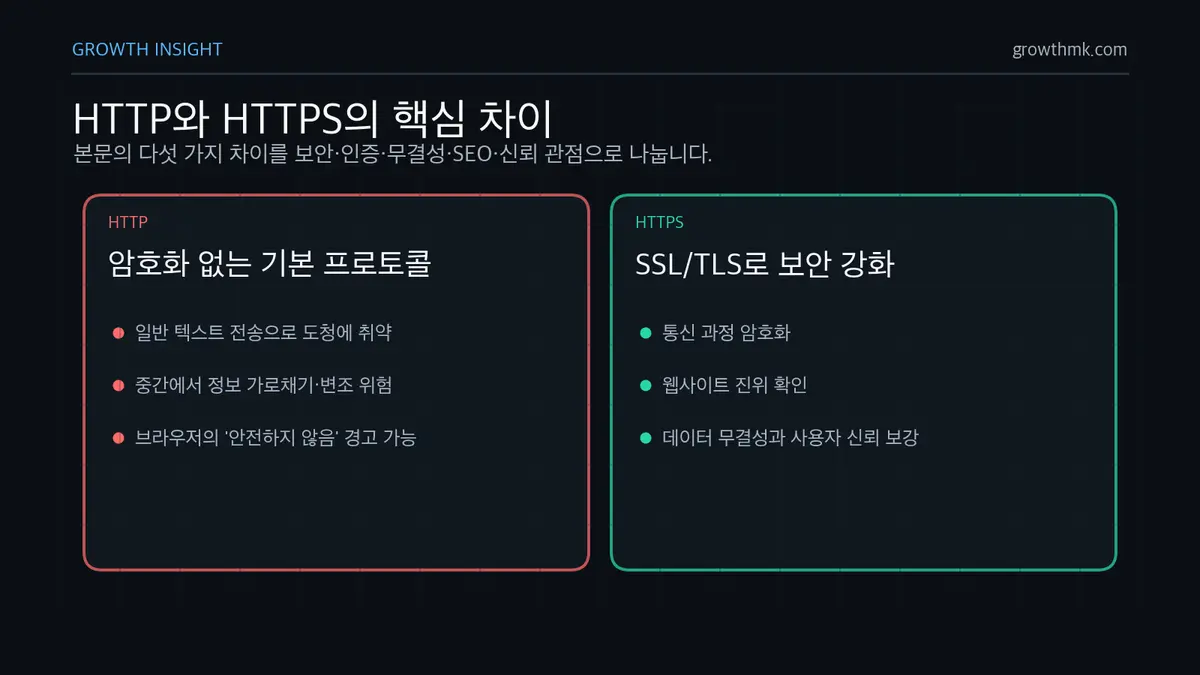
HTTPS, on the other hand, is a protocol that strengthens security by encrypting this communication using an SSL/TLS certificate.
The ‘http://’ or ‘https://’ you see in your browser’s address bar marks which protocol is in use. Most modern browsers now show a padlock icon for sites running HTTPS, and a “Not Secure” warning for sites that are HTTP-only.
Thanks to these indicators, visitors can tell a site’s security status at a glance.
The key differences between HTTP and HTTPS are as follows:
- Security: HTTP sends data as plain text, leaving it vulnerable to eavesdropping, while HTTPS encrypts it before sending.
- Authentication: HTTPS verifies a website’s authenticity, protecting users from risks like phishing sites.
- Data integrity: HTTPS guarantees that data hasn’t been tampered with in transit.
- SEO impact: Google and other major search engines tend to rank HTTPS websites more favorably.
- User trust: Websites using HTTPS give users a stronger sense of trust.
HTTPS is essential in particular for any website that handles sensitive data such as login credentials, personal information, or payment details. Companies offering services like tax filing or financial management must have HTTPS in place to protect customers’ personal and financial data. It’s both a matter of regulatory compliance and a starting point for building customer trust.
Why SSL certificates and HTTPS matter
Having SSL certificates and HTTPS in place has gone from optional to essential — especially for any company running a business in a digital environment. Let’s look at why this goes beyond a technical concern and directly shapes business outcomes and customer trust.

Data security and privacy protection
The most important role an SSL certificate plays is protecting user data. Because all communication between a website and its users is encrypted, the risk of sensitive data — personal information, login credentials, credit card details — leaking to a third party drops sharply.

This matters even more for companies handling highly sensitive personal information. National ID numbers, income data, and account information are exactly the kind of high-value information hacking attempts target first. The strong encryption that SSL certificates and HTTPS provide is the first line of defense protecting this kind of data.
Protecting personal data is also a legal obligation. Privacy laws and credit information laws, among other regulations, require companies to properly safeguard the personal information they collect. Implementing an SSL certificate is one of the most basic steps toward meeting these legal requirements.
This matters even more for global businesses, as international privacy regulations like GDPR (the EU General Data Protection Regulation) and the CCPA (California Consumer Privacy Act) continue to tighten.
A data breach can do more than cause financial loss — it can deal a fatal blow to a company’s reputation. Services built on tax or financial trust are especially vulnerable: lose that trust to a security incident, and the business itself can be at risk. SSL certificates and HTTPS are one of the most basic and effective ways to head off that risk before it happens.
Search engine optimization (SEO) and website credibility
SSL certificates and HTTPS matter for more than just security — they carry real weight for marketing and user experience too. Google and other major search engines tend to rank HTTPS websites more favorably.
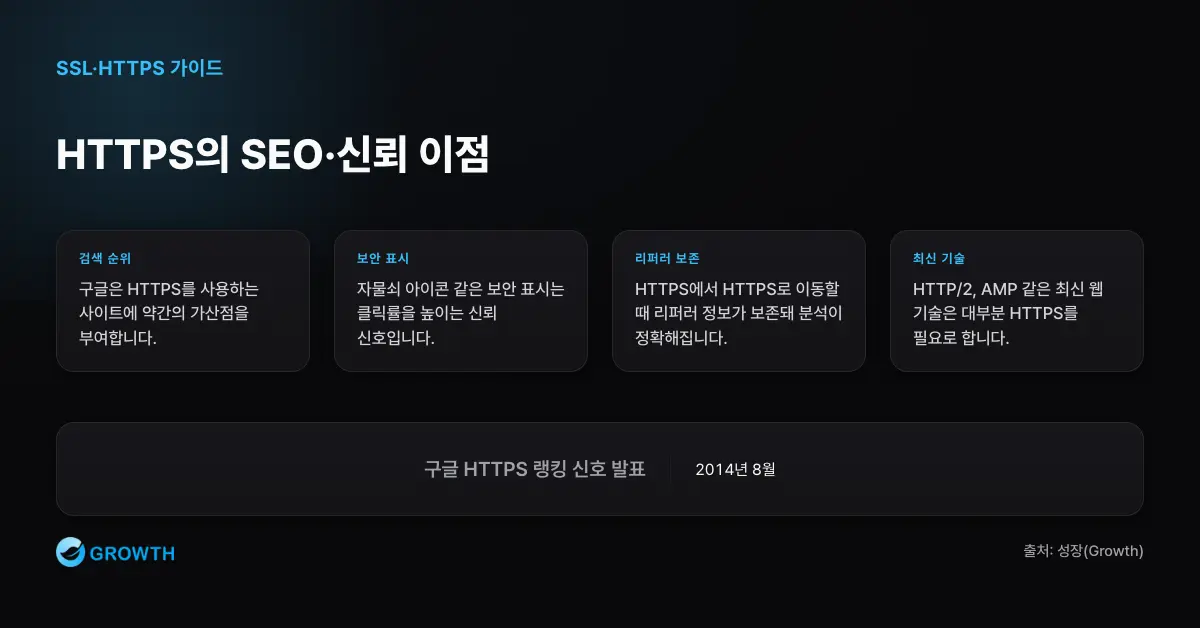
This trend has continued since Google officially announced on its blog in August 2014 that it would use HTTPS as a ranking signal.
From an SEO perspective, implementing HTTPS brings the following benefits:
- Improved search ranking: Google gives a small ranking boost to websites using HTTPS. In highly competitive keywords, that small edge can decide whether you make it to the top results.
- Increased user trust: The security indicators shown in the browser (like the padlock icon) signal to users that the site is safe — which can lift click-through rate (CTR).
- Preserved referrer data: Referrer information is preserved when a user navigates from one HTTPS site to another. But that data can be lost when moving from HTTPS to HTTP. Accurate analytics data depends on HTTPS.
- Support for newer web technologies: Modern web technologies like HTTP/2 and AMP (Accelerated Mobile Pages) mostly require HTTPS. These technologies improve website speed and user experience, which indirectly helps SEO as well.
SSL certificates also carry significant weight for website credibility. Modern web browsers show a “Not Secure” warning for sites that don’t use HTTPS. That warning damages the first impression right away, and for sites handling financial or personal information, it can send visitors straight to the exit.
Major browsers like Chrome and Firefox show even stronger warnings for sites without a secure connection, especially on pages that include input forms.
Using a premium certificate like an EV (Extended Validation) SSL certificate displays the company name in the browser’s address bar, boosting trust another notch.
SSL certificates and HTTPS aren’t just a technical checkbox — they’re the foundation of business credibility and brand image. For companies handling sensitive services like tax filing or financial management, this is an investment that isn’t optional.
User experience and website performance
SSL certificates and HTTPS have a positive impact not just on security and SEO, but on user experience and website performance too. It’s an easy thing to overlook, but it matters especially now, with mobile usage continuing to climb.

HTTPS supports the HTTP/2 protocol. Because HTTP/2 communicates more efficiently than the older HTTP/1.1, it significantly speeds up page load times. Specific benefits include:
- Concurrent multiplexed requests: HTTP/2 handles multiple requests over a single connection, reducing resource load time.
- Server push: The server can send resources to the client before they’re even requested, cutting down overall page load time.
- Header compression: HTTP/2 compresses header information, reducing the amount of data transferred and improving network efficiency.
These performance gains matter especially for mobile users. As more people handle complex tasks on mobile devices, fast page loading directly drives user satisfaction and conversion rates.
HTTPS is also a prerequisite for using modern web technologies and APIs. According to Google’s web.dev documentation, powerful web platform features — camera and microphone access (getUserMedia), offline experiences via service workers, and Progressive Web Apps (PWA) — only request user permission within an HTTPS secure context, and even long-standing APIs like Geolocation have moved toward requiring HTTPS.
Finally, HTTPS blocks man-in-the-middle (MITM) attacks, preventing malicious ads or unwanted content from being injected into a page. That reduces the risk of users encountering unwanted ads or malicious content, and keeps the overall browsing experience cleaner and safer.
This matters especially for keeping users from running into confusing or misleading content while they’re in the middle of an important task.
In this sense, implementing SSL certificates and HTTPS is an investment that goes beyond a simple security measure — it lifts your website’s overall performance and user experience. For any service that needs to hold onto users’ focus and trust, this kind of technical improvement translates directly into business results.
So far we’ve covered what SSL certificates and HTTPS are and why they matter. Both are indispensable security elements for any modern website. They’re not just a technical choice — they’re a fundamental foundation for customer trust and business success.
Implementing HTTPS through an SSL certificate creates a secure communication channel between your website and your customers, sharply reducing the risk that important data is exposed to or tampered with by a third party. That padlock icon in the browser’s address bar sends visitors an instant signal: “This site is safe.”
Because Google and other search engines treat HTTPS as an important ranking factor, there are real SEO benefits too. No matter how good your content or service is, weak website security can still let competitors outrank you in search results.
SSL certificates also help you comply with legal regulations like privacy laws. Protecting customer data has gone from a recommendation to a legal obligation, and an SSL certificate is the first step toward meeting that obligation.
Online security threats keep growing, but properly implementing SSL certificates and HTTPS builds a solid baseline defense. On top of that, it pulls its weight across multiple fronts — customer trust, data security, search engine optimization, and regulatory compliance.
If you haven’t implemented an SSL certificate yet, start preparing today. This basic step to protect your business and your customers makes a big difference in the long run.
Related reading
- The Complete Technical SEO Guide: A Practical Hub Connecting Crawling, Indexing, Rendering, Speed, and Structure
- Canonical Tags
- Why Sitemaps Matter and 3 Ways to Create One
- How to Fix Open Graph Tag Errors
- What Is the H1 Tag, and How Do You Use It Correctly?
If you want to apply this to your own business — you can see Growth’s approach on our SEO service page, and if you need a concrete diagnosis of your situation, reach out through contact us. We answer based on the one customer who becomes revenue — not on traffic volume.
Frequently Asked Questions (FAQ)
Are SSL certificates and TLS certificates different?
Certificates issued today actually run on TLS (Transport Layer Security). But because the name “SSL” became established first, the industry still commonly calls them ‘SSL certificates.’ Technically speaking, “TLS” is the more accurate term, and both serve the same purpose: encrypting the connection.
Does HTTPS actually affect search rankings?
Yes. Google announced on its official blog in August 2014 that it uses HTTPS as a search ranking signal. That said, the boost itself is small. It’s more accurate to think of HTTPS as sitting on top of the fundamentals — content quality and satisfying search intent — rather than replacing them.
Is a free SSL certificate (Let’s Encrypt) secure enough?
In terms of pure encryption strength, certificates from a recognized authority like Let’s Encrypt perform exactly the same as paid certificates. That said, if you need an EV (Extended Validation) certificate that displays your company name in the address bar, or you need warranty coverage and technical support, a commercial certificate is worth considering. Choose based on how sensitive your data is and how much trust signaling you need.
What should I check when migrating an HTTP site to HTTPS?
After installing the certificate, confirm that every HTTP request redirects to HTTPS, and check that internal resources like images and scripts aren’t still loading over HTTP and triggering ‘mixed content’ warnings. Google’s guide to site moves with URL changes recommends using 301 or 308 permanent redirects for the HTTP-to-HTTPS migration, adding a self-referencing canonical tag to each new URL, and submitting a new sitemap to Search Console.
Marketing Insights
Marketing insights, delivered weekly
Practical growth and GEO/B2B marketing insights, summarized in your inbox every week.
Subscribe for insights