
What Is AARRR? Applying the AARRR Framework to App Marketing
 임재복
임재복
Once an app marketer has identified the key metrics that matter, the next step is tracking them and testing different strategies to improve them. This is where the AARRR framework comes in — by analyzing performance at each stage, you can get an objective read on exactly where your app marketing stands today.

AARRR is a startup measurement framework that stands for Acquisition, Activation, Retention, Referral, and Revenue. Coined by Dave McClure in 2007, it’s also known as “Pirate Metrics.” The model comes from 500 Startups founder Dave McClure’s “Startup Metrics for Pirates” presentation, which breaks the customer lifecycle into five measurable stages: Acquisition, Activation, Retention, Referral, and Revenue.
It looks deceptively simple, but it’s a framework widely used across the startup world — a practical tool for measuring and improving the customer lifecycle.
The real key to app marketing AARRR isn’t working through the stages in order. It’s assigning importance by service and applying the framework in that priority order instead.
From here, let’s break down each metric inside the app marketing AARRR framework and how to put it to work.
App marketing AARRR
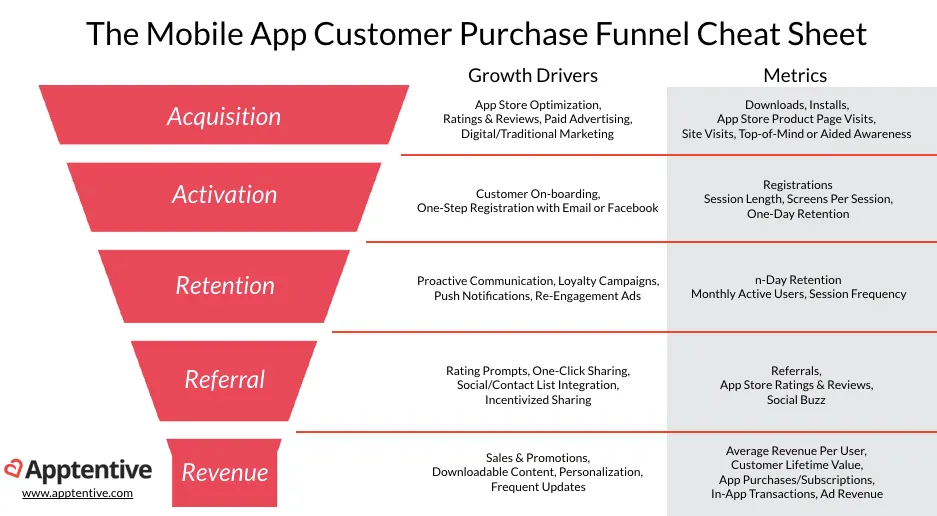
Acquisition
Acquisition is the process of attracting and winning new customers.
It’s the first stage of the AARRR framework, and an essential one for any startup that wants to grow. Startups have plenty of acquisition channels to choose from — paid advertising, organic search, social media, and content marketing, to name a few.
A startup might use paid ads to win new customers, for example.
You can target ads at people who search for keywords related to your product or service. You can also target people who’ve already visited your website or social media pages.
Let’s apply this to app marketing. At this stage, you’re mainly figuring out which channel brought a user in, and evaluating how efficient each channel is.
You need to track metrics like conversion rate (CVR), cost per acquisition (CPA), and cost per install (CPI) across visitors coming from paid ads or organic traffic.
- Track new downloads generated by each acquisition channel
- Track the cost of each acquisition channel and calculate return on investment (ROI)
- Track the conversion rate from download to install
Activation

Activation is the process of getting new customers to actually use your product or service and experience its value.
This stage is critical in the AARRR framework because it determines whether a customer will keep using your product at all.
A startup might try to activate new customers by offering a free trial. That way, new customers can try the product and confirm it’s a good fit before paying anything.
For an app, this is the stage where a visitor who has just converted into a customer experiences the actual service for the first time. It’s important to understand user behavior metrics here — bounce/uninstall rate, time spent, and customer acquisition cost (CAC).
- Track the number of new users who complete a key action, such as creating an account or making a first purchase.
- Track how long it takes new users to complete that key action.
- Track how many users drop off before completing the key action.
Retention
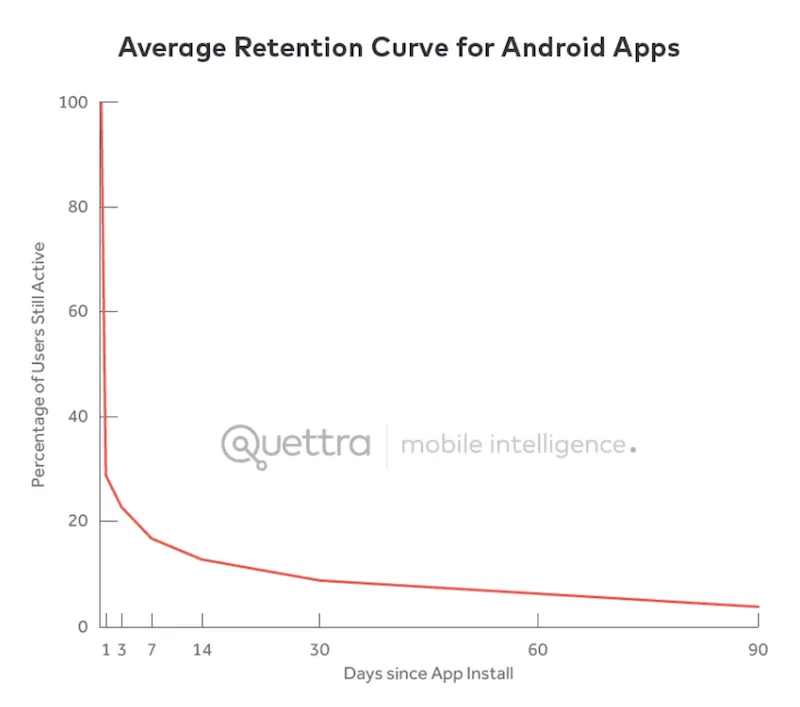
Retention is the process of getting customers to come back. It matters because keeping an existing customer is far cheaper than winning a new one. Harvard Business Review found that acquiring a new customer costs 5 to 25 times more than retaining an existing one, and research by Bain & Company’s Frederick Reichheld found that a 5% increase in customer retention can boost profits by 25% to 95%. Startups have plenty of retention strategies to draw on — loyalty programs, email marketing, product updates, and more.
You might try to retain customers through a loyalty program, for instance, where customers earn points for using the product and redeem them for discounts or upgrades.
App marketers need to watch this stage more closely than any other. It’s where you find out whether users are actually coming back to your service. If new customer acquisition keeps flowing in but existing customers don’t return, sustaining the service becomes extremely difficult.
To keep existing users active, it’s important to lean on owned media — social posts, push notifications — to re-engage them.
Promotional offers, like perks or benefits, are also a useful lever for converting both new and existing users into loyal customers.
- Track daily, weekly, and monthly active users.
- Track average sessions per user.
- Track average session length.
- Track churn rate — the share of users who stop using the app over a given period.
Referral
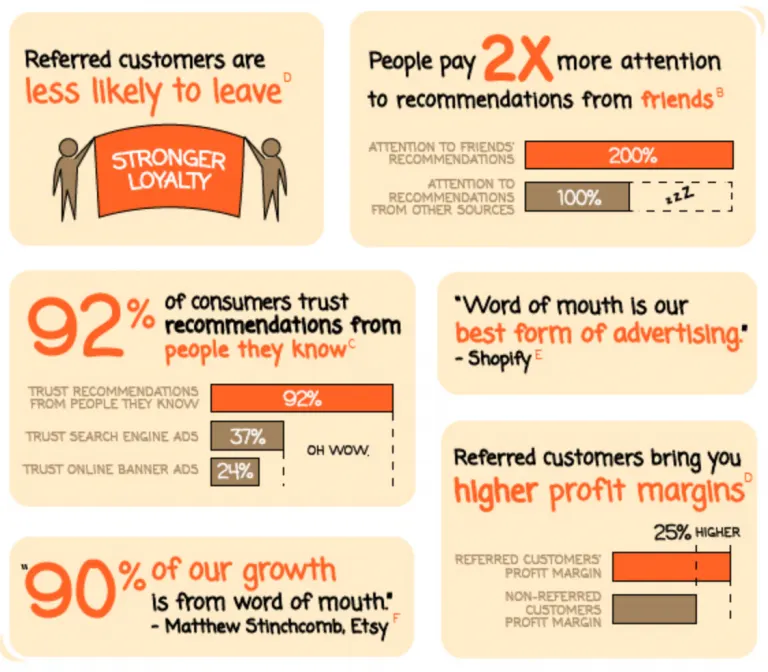
Referral is the process of getting customers to recommend your product or service to friends and colleagues.
Referral marketing can be highly effective for startups because it’s a low-cost way to acquire new customers. There are several ways to encourage referrals — offering referral rewards, or simply making it easy for customers to share your product or service with friends.
As an example, a startup might discount a customer’s subscription every time they refer a friend. This gives customers an incentive to share the product with friends, and it’s also a low-cost way for the startup to acquire new customers.
So how does this play out in app marketing? The referral stage is where you find out whether customers are satisfied enough with your service to recommend it to the people around them.
We’re now in an era where building 100 loyal customers matters far more than building 10,000 lukewarm ones. That’s why it’s so important to keep users satisfied and using your app frequently. Nielsen’s global research found that 92% of consumers trust a recommendation from someone they know more than any other form of advertising — which means voluntary referrals from satisfied users are one of the most powerful acquisition channels you have.
It’s also important to grow organic traffic through promotions that encourage voluntary participation, like social shares and mentions.
- Track how many new users download the app through a referral link.
- Track the conversion rate from referral to install.
- Track the conversion rate from referral to purchase.
Revenue

In-app purchase policies built into some apps, much like subscription fees, carry a bigger long-term obligation to keep current users satisfied — and they’re not nearly as dependent on acquiring new users.
Revenue is the money a startup earns from selling its product or service. It’s the ultimate goal of the AARRR framework, since revenue is what fuels a startup’s growth and success. There are several ways to generate revenue — charging subscription fees, selling one-time products or services, offering ad space, and more.
A startup might generate revenue by charging a subscription fee for its product, for example, giving customers access for a set period like a month or a year.
Applied to app marketing, this stage is about generating revenue through the app itself. It’s important to analyze what characteristics define the customers who contribute most to revenue growth.
Based on that data, you should track revenue and value metrics like ROAS, ROI, and LTV.
- Track total revenue generated by the app.
- Track average revenue per user (ARPU).
- Track the conversion rate from free to paid users.
Things to watch when tracking app marketing AARRR
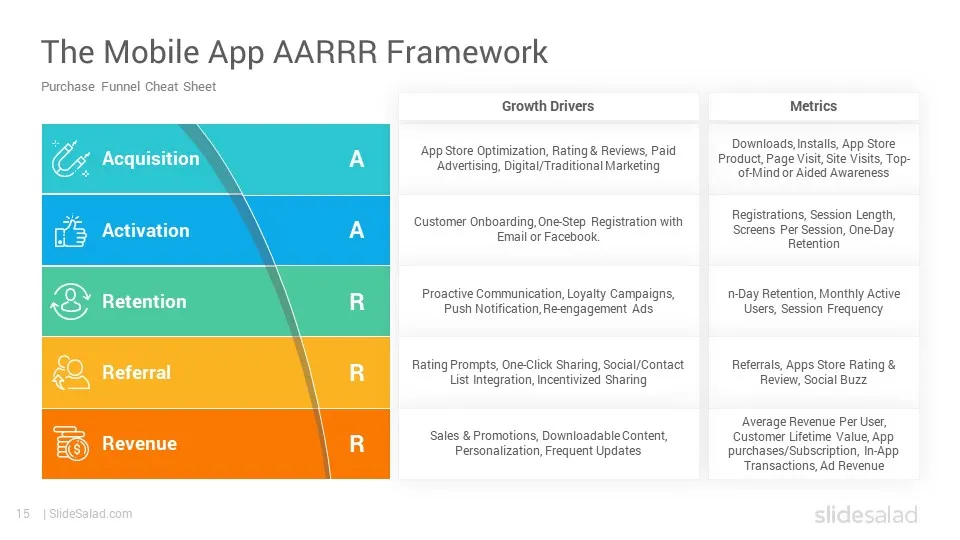
AARRR is a genuinely useful framework for tracking app marketing performance. That said, there are a few things worth keeping in mind.
Choose metrics that fit your business
Which metrics you track depends on your specific app and business model. A freemium app, for example, might track new downloads, active users, and in-app purchases. A paid app might track new downloads, installs, and average revenue per user (ARPU).
Use multiple data sources
There are several data sources you can draw on to track AARRR metrics. Common ones include mobile analytics platforms, app store analytics dashboards, and customer relationship management (CRM) systems. Using a mix of data sources gives you a more complete picture of app performance.
Segment your users
Segmenting users helps you better understand behavior and spot areas for improvement. You might segment by device type, operating system, country, or in-app purchase history, for example.
Track trends over time
It’s important to track app marketing AARRR metrics over time so you can spot trends and patterns. This helps you identify what’s working and what needs improvement.
Set benchmarks
Once you understand your app’s performance well, you can set your own benchmarks. This helps you track progress over time and see how you stack up against other apps in the same category.
Stage-by-stage metrics and a tailored app marketing AARRR strategy
Tracking and analyzing AARRR metrics helps you pinpoint exactly where your app marketing performance can improve.
With that, you can acquire more users, activate them more effectively, retain them longer, encourage more referrals, and generate more revenue.
Need to build a stage-by-stage strategy as you analyze app marketing performance? Working with an agency that can make data-driven decisions using these metrics is often the most effective choice.
At Growth, we use a range of strategies to improve AARRR metrics across app marketing campaigns.
For example, we run paid ad campaigns to acquire new users. We build compelling content to activate and retain users. And we actively use tactics like referral rewards to encourage users to invite their friends.
We believe AARRR is an essential framework for tracking app marketing performance, and we’re committed to using it to help our clients grow their businesses successfully.
If you’re interested in app marketing, check out these related pieces too.
Related reading
- What is growth hacking? Definition, AARRR, experiment design, and real-world cases — the complete growth-strategy pillar
- Marketing channel mix
- CDJ (Customer Decision Journey)
- Persona
- The difference between customer needs and wants
If you’d like to apply this to your own business — if you need a specific diagnosis for your situation, reach out via consultation inquiry. We’ll answer based on the one customer who becomes revenue, not just traffic volume.
Frequently asked questions
Do the five AARRR stages have to be worked through in order?
No. As emphasized above, the key to AARRR isn’t following the stages in sequence — it’s assigning importance by service and applying the framework starting with whichever stage matters most. If repeat visits are your service’s lifeblood, prioritize Retention; if word of mouth matters most, prioritize Referral. Weighting the framework to fit your business is what makes it effective.
Which stage should app marketers watch most closely in AARRR?
This article emphasizes watching the Retention stage most closely. No matter how many new customers you acquire, if existing customers don’t come back, sustaining the service becomes extremely difficult. Retention is also more cost-efficient than acquisition, since keeping an existing customer is far cheaper than winning a new one — which is why it’s worth leaning heavily on owned media (push notifications, social posts) and benefit-driven promotions.
What metrics does each stage track?
Acquisition tracks new downloads by channel, CPA, CPI, and ROI. Activation tracks users who complete a key action and drop-off rate. Retention tracks DAU/WAU/MAU, session count, and churn rate. Referral tracks referral-link installs and referral-to-install/purchase conversion. Revenue tracks total revenue, ARPU, and free-to-paid conversion rate. Refer to the tracking items outlined under each stage above to pick the right core metrics for your service.
Where does the data for AARRR metrics come from?
Combining multiple data sources — mobile analytics platforms, app store analytics dashboards, and CRM systems — gives you a more complete picture of app performance. As recommended above, it’s important to segment users by device, OS, country, or in-app purchase history, track trends over time, and set benchmarks against comparable apps in your category.