
The SEO Guide: A Complete Map of Search Engine Optimization (And AI Search, Too)
 임재복
임재복
SEO (Search Engine Optimization) is the practice of making search engines like Google and Naver find and understand your website well enough that you meet customers consistently in search results, without paying for ads. In practice, the most efficient way to work through it is to check four pillars in order: ① technical foundation (crawling, indexing) ② content (matching search intent) ③ on-page (page-level optimization) ④ off-page (backlinks, reputation). And even now, as AI Overviews and ChatGPT are reshaping search, the starting point is the same. Google states explicitly in its official documentation that there are “no additional requirements” for showing up in AI search — a solid SEO foundation is already the foundation for AI search too.
This is the full map of SEO. It covers how search engines actually work, how to prioritize the four pillars, what AI search does and doesn’t change, how strategy differs by business type, the timeline Google officially states for results, and a 10-question self-diagnostic to check where your company stands. Each area links out to a dedicated guide with implementation detail, so use this as a starting point and drill down wherever you need to. One lens runs through the whole thing, start to finish: it’s not about the volume of search traffic, it’s about getting the one person who becomes revenue to find you.
What is SEO, and why does it still matter?
Google’s own SEO Starter Guide defines it this way: “helping search engines understand your content, and helping users find your site.” Both halves matter. SEO isn’t a trick for fooling a search engine — it’s the sum of making something machine-readable (the first half) and making it genuinely useful to a person (the second half).
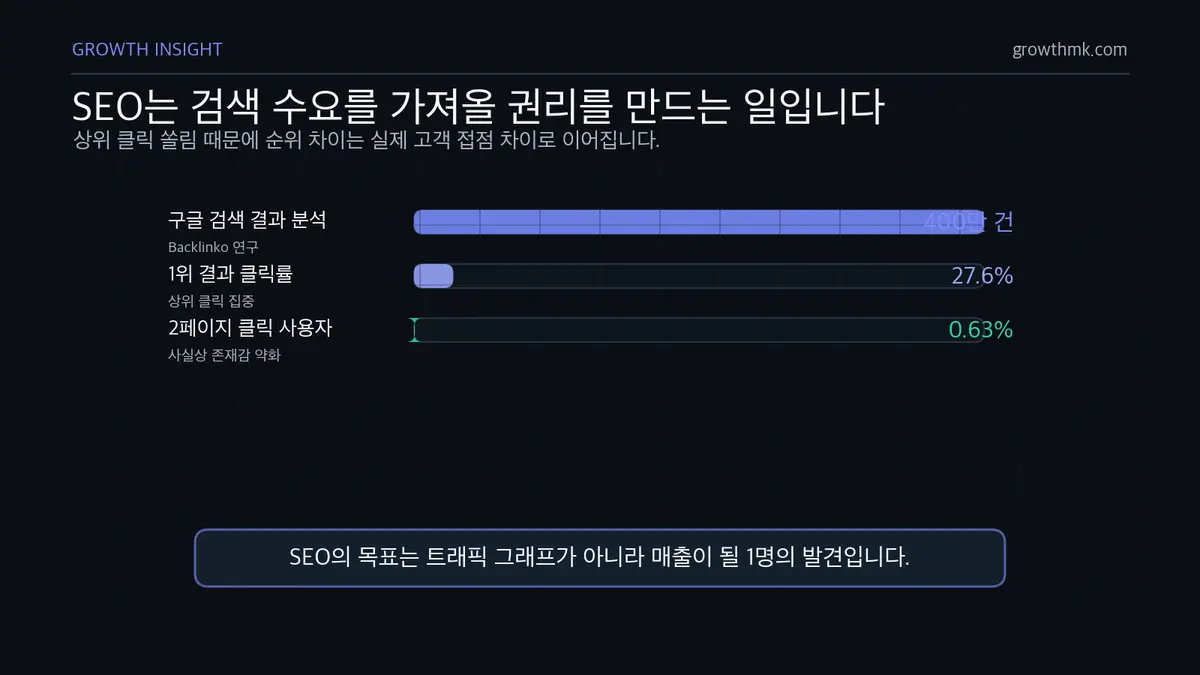
Why is it worth spending time on this? Because clicks in search results are extremely concentrated at the top. Backlinko’s analysis of 4 million Google search results found that the #1 result gets a 27.6% click-through rate — ten times more likely to be clicked than #10. And only 0.63% of users ever click through to page two. Position 11 might as well not exist. In any market with real search demand, whether you rank at the top determines whether you capture that demand at all.
The contrast with paid ads is stark. Search ads are a rental channel — exposure disappears the instant the budget stops. Rankings and content earned through SEO, by contrast, are an asset that stays on your site. Over time, pieces of content start reinforcing each other, and the marginal cost of bringing in the same visitor keeps falling. Ads win on short-term speed, but over a horizon of 12+ months, SEO is what structurally lowers your customer acquisition cost.
There’s one extra variable in the Korean market: search share is split between Google and Naver, and the two engines assemble their results differently. Which one to invest in first depends on where your customers actually search, and that judgment call is covered in detail in how shifting search share in South Korea is changing SEO trends. The principles in this article apply regardless of which engine you’re optimizing for, but execution priority should be set based on your specific market structure.
One last, and most important, premise: the goal of SEO is not a traffic graph. You can rank #1 for an informational keyword with 10,000 monthly searches and generate zero revenue, while ranking #1 for a comparison keyword with 100 monthly searches lands your biggest deal of the quarter. The right criterion for choosing a keyword isn’t search volume — it’s whether the person behind that search could become our customer.
How SEO actually works — crawling, indexing, ranking
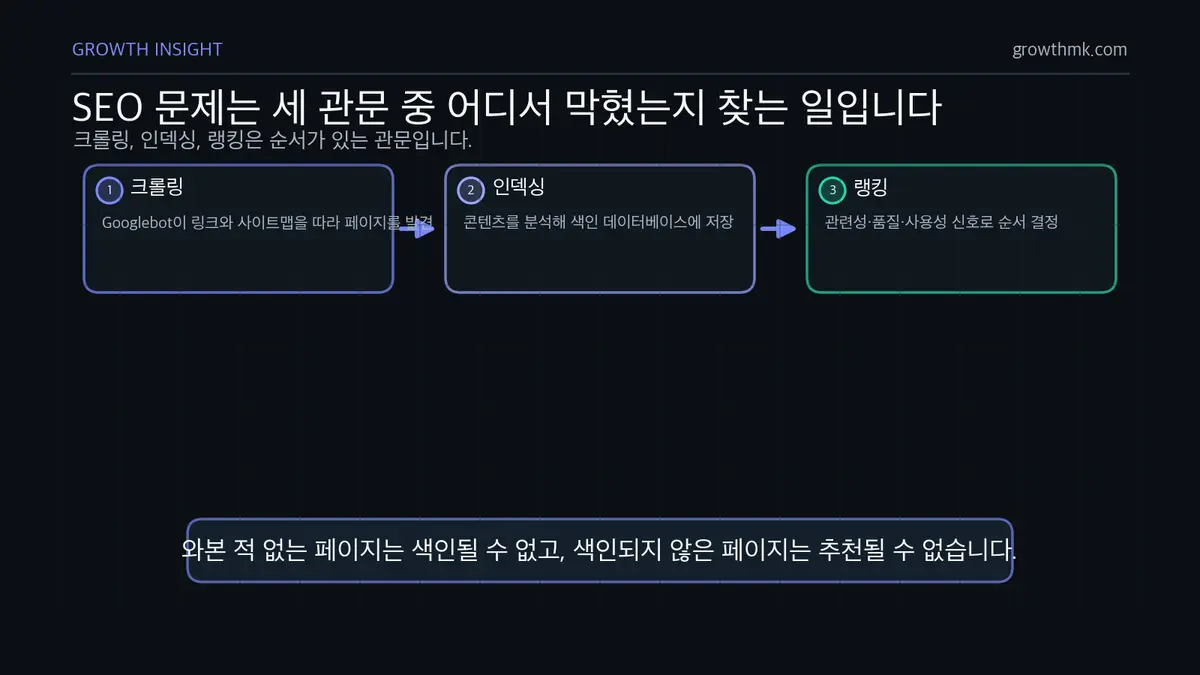
Google’s own documentation on how search works breaks it into three stages: crawling (discovery), indexing, and serving results (ranking) — adding one important line: “not all pages make it through each stage.” Most SEO problems start with figuring out which of these three gates a page is actually stuck at.
| Stage | What the search engine does | What you do | Symptom when blocked |
|---|---|---|---|
| 1. Crawling | Googlebot follows links and sitemaps to download pages | Check robots.txt, submit sitemap.xml, link pages internally | Even great content is never discovered in the first place |
| 2. Indexing | Analyzes text, images, and video and stores them in the index database | Clean up duplicates (canonical), check for noindex mistakes, add structured data | Your page doesn’t exist even when you search for it (zero results on a site: search) |
| 3. Ranking (serving) | Determines order based on relevance, quality, and usability signals | Match search intent, build E-E-A-T signals, improve page experience | Indexed, but no visibility or clicks |
As an analogy: crawling is “has Google ever visited our store,” indexing is “is our store registered on Google’s map,” and ranking is “does Google recommend us when someone asks for a good place.” The order is absolute. You can’t put a store on the map if Google’s never visited it, and you can’t recommend a store that isn’t on the map. So before you worry about ranking factors like content quality or backlinks, confirm you’ve actually cleared the crawling and indexing gates.
At that final ranking stage, what the search engine is ultimately evaluating is: “will the person who typed this query get what they want from this page, and be satisfied?” Even the same word can favor different results depending on intent. Someone searching ‘laptop’ gets buying guides and shopping results; someone searching ‘laptop overheating fix’ gets a step-by-step troubleshooting article at the top. Search intent generally splits into informational (want to know), navigational (want to reach a specific site), and transactional (want to buy) — and if the intent behind your target keyword doesn’t match your page’s format, no amount of effort on the content itself will produce a ranking. A lot of what looks like a ranking problem is actually an intent-matching problem.
This article summarizes the underlying principles; for a step-by-step way to check technical elements like meta tags, canonicals, and site structure, see the complete definition and build guide for on-page SEO. The one thing to remember at this stage: if a search engine can’t see you, you never even get a chance to be judged on quality.
The four pillars of SEO — where do you start?
SEO work looks broad, but it ultimately organizes into four pillars — and there’s a specific order to check them in. Build the upper floors on a broken foundation, and you’ll end up doing the construction twice.
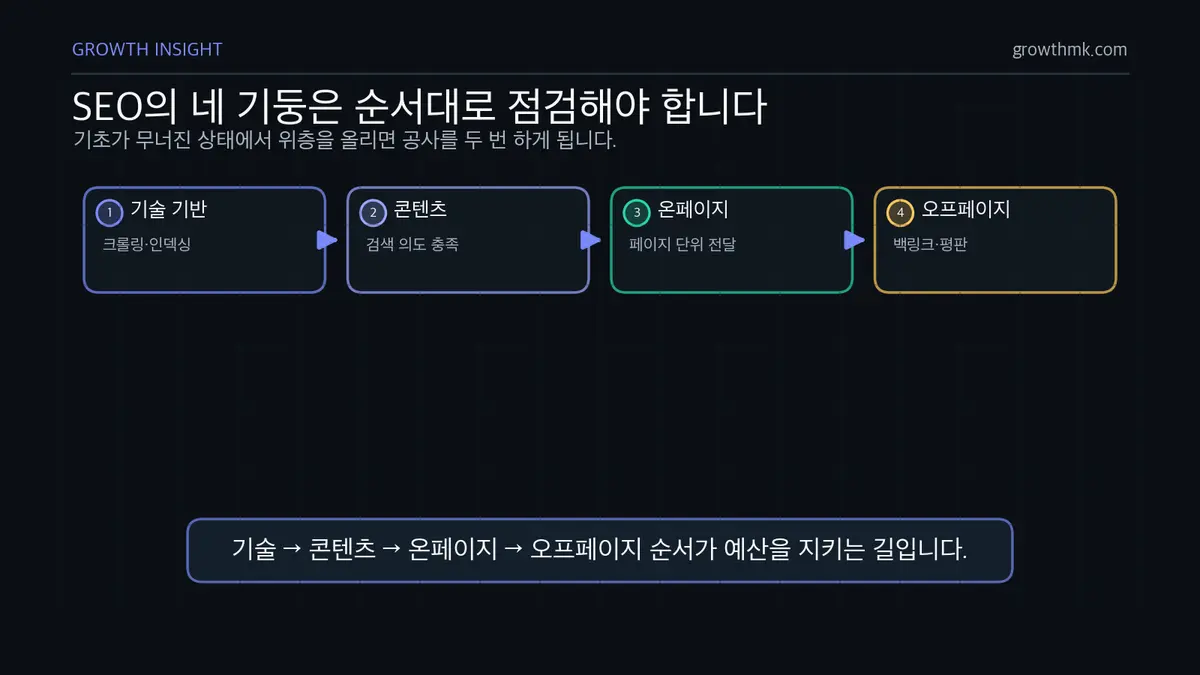
The most common failure we see in practice is skipping this order. A content team publishes 100 articles over six months and half never get indexed; a company spends its budget on a backlink campaign, only for every linked page to share the exact same title tag. Do it in order instead, and each stage’s investment raises the return on the next one. Content sitting on a readable site gets seen; content that gets seen earns links.
| Priority | Pillar | Question to answer | Representative work |
|---|---|---|---|
| 1 | Technical foundation | Can search engines actually read our site? | Crawling, indexing, speed, mobile support |
| 2 | Content | Does it actually solve the searcher’s problem? | Keyword research, search intent analysis, E-E-A-T |
| 3 | On-page | Does each page communicate its topic clearly? | Title, meta description, headings, internal links |
| 4 | Off-page | Does the outside world signal that it trusts us? | Earning backlinks, digital PR, brand mentions |
Pillar 1. Technical foundation — make it readable to search engines
This is the work that clears the crawling and indexing gates covered above. It’s not glamorous, but it has the most reliable return on investment of any pillar. Getting 100 previously unindexed pages indexed is easier and pays off faster than pushing an already-indexed page up five ranking positions. Factors like site speed and mobile usability, which Google treats as page experience signals, also belong to this pillar.
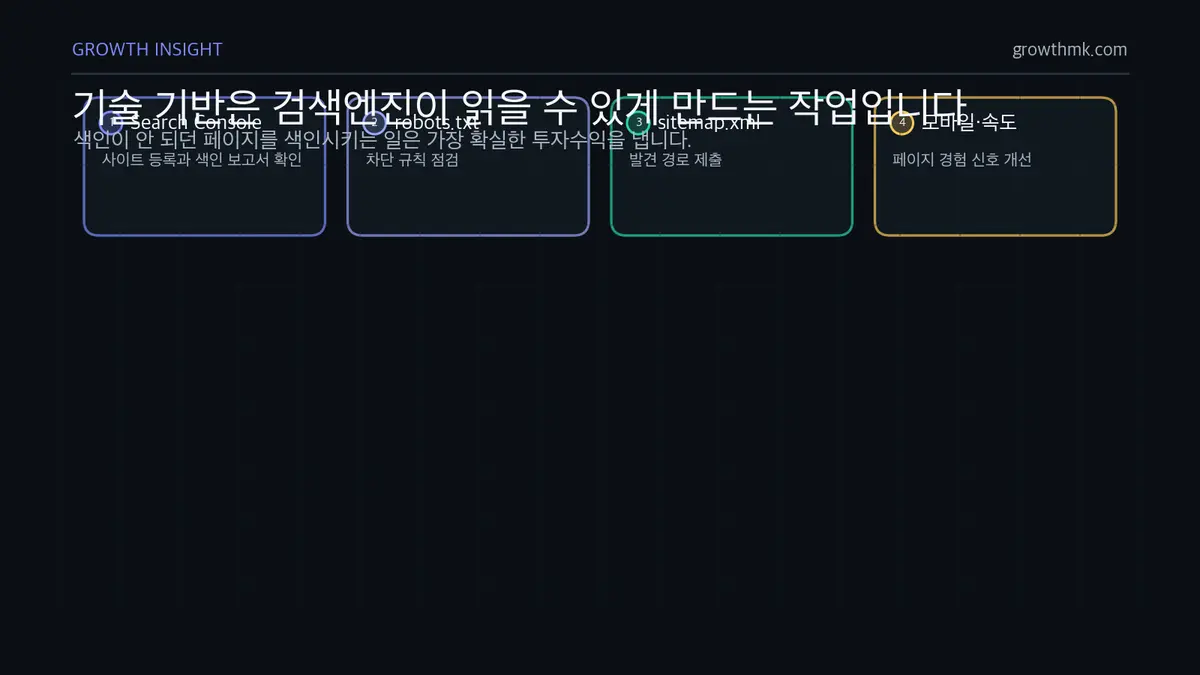
- Start here 1. Register your site with Google Search Console (or Naver Search Advisor), and check the “indexed” page count in the index report.
- Start here 2. If the number of results for a site:yourdomain.com search differs sharply from your actual page count, check robots.txt, sitemap.xml, and noindex settings first.
- Start here 3. Confirm that key pages show their core content within 3 seconds on mobile. PageSpeed Insights is enough to measure this.
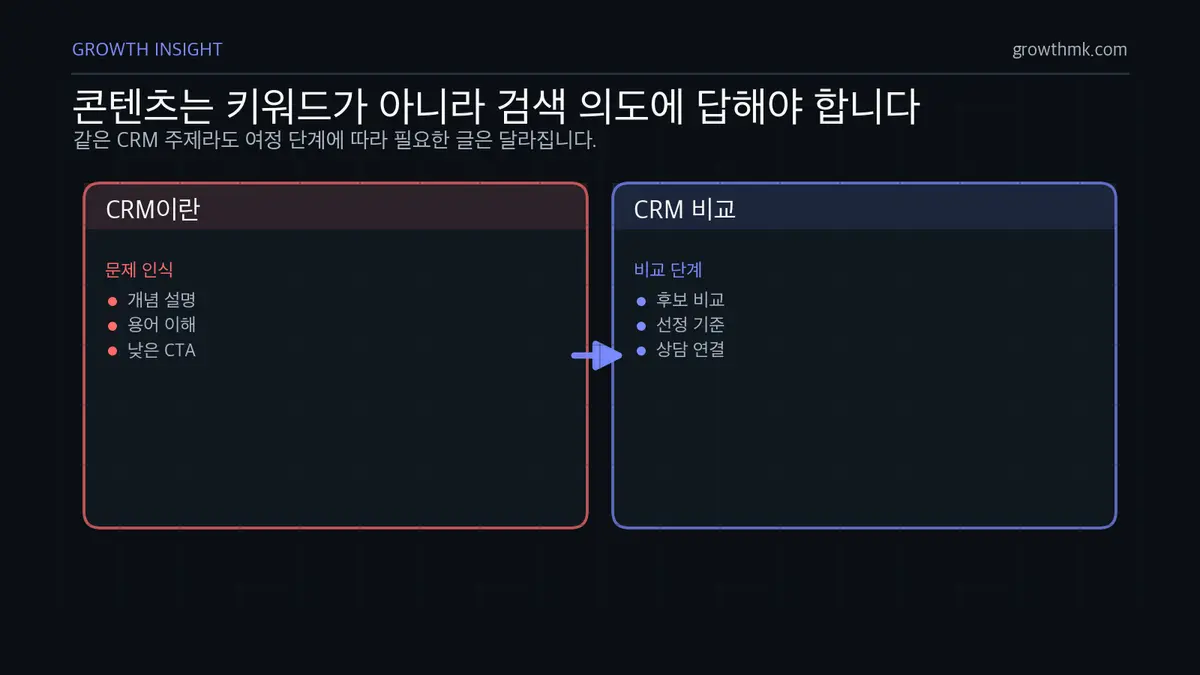
Pillar 2. Content — search intent is the real keyword
If the technical foundation is about being “readable,” content is about giving the search engine “a reason to recommend you.” The common mistake here is treating a keyword as just a word. A keyword is actually one scene in a customer’s journey. Someone searching ‘CRM comparison’ and someone searching ‘what is a CRM’ are standing at different points in that journey, and they need different content. For a way to start from the customer’s journey rather than a search-volume spreadsheet, see content SEO that starts from the customer’s perspective; for the practical process of collecting, categorizing, and validating keywords, see the marketing keyword research strategy guide.
Google has already published its quality bar: E-E-A-T, from the guide to creating helpful content — Experience, Expertise, Authoritativeness, and Trust. Worth noting: Google itself states that “E-E-A-T is not a direct ranking factor.” It’s not a scorecard, but a bundle of attributes shared by content that’s genuinely good, and trust is the core of it. The common misunderstandings around this standard, and how to apply it in practice, are covered in what’s true and false about the E-E-A-T standard.
- Start here 1. Search your target keyword yourself and look at the format and depth of the top 10 results. That’s Google’s interpretation of the search intent.
- Start here 2. Attribute every article — who wrote it (author), and what it’s based on (sources). “Who, How, Why” is the self-check framework Google itself recommends in its documentation.
- Start here 3. Sort your keyword list by customer journey stage (problem awareness → comparison → purchase decision), and start filling the emptiest stage first.
Pillar 3. On-page — the same content, delivered differently, gets different results
Once you have good content, the next step is confirming the page communicates that topic clearly to both search engines and users. Title tags, meta descriptions, heading structure (H1–H3), URLs, and internal links are the tools. This is the highest-ROI area in SEO — it costs almost nothing while lifting both click-through rate and index quality at once. Our pre-publish checklist for this is laid out in a 4-step content checklist for Google SEO optimization.
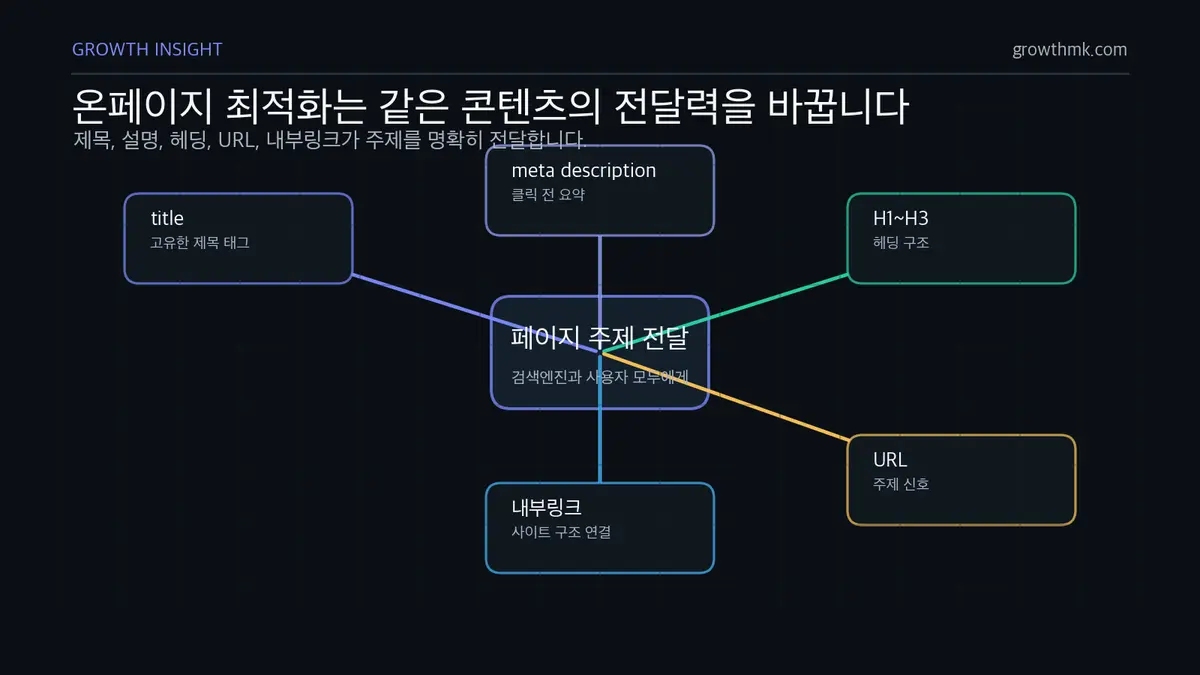
Internal links are also a site-structure strategy, not just a page-level one. Build a topic-cluster structure that connects a central pillar article on a broad topic to detailed cluster articles, and search engines pick up a signal about more than any single page — that “this site has real expertise on this entire topic.” The article you’re reading right now is the pillar for the topic of SEO, and the keyword research, E-E-A-T, and backlink guides linked throughout are its cluster articles — the same structure.
- Start here 1. Write a unique title and meta description for every core page. Duplicate titles are exactly what causes Google to rewrite what’s shown at will.
- Start here 2. One H1 per page; structure H2s and H3s so they read logically even as a table of contents.
- Start here 3. Every time you publish a new article, link to it internally from at least 3 related existing articles with natural anchor text. Internal links are the only links you fully control.
Pillar 4. Off-page — external proof of trust
Search engines don’t judge trust purely on what your own site says about itself. Whether other trustworthy sites link to you — backlinks — serves as external proof. When a government agency or a news outlet cites your material, some of that trust flows back to you. A step-by-step way to audit and grow a healthy backlink profile is covered in a beginner’s guide to managing backlinks.
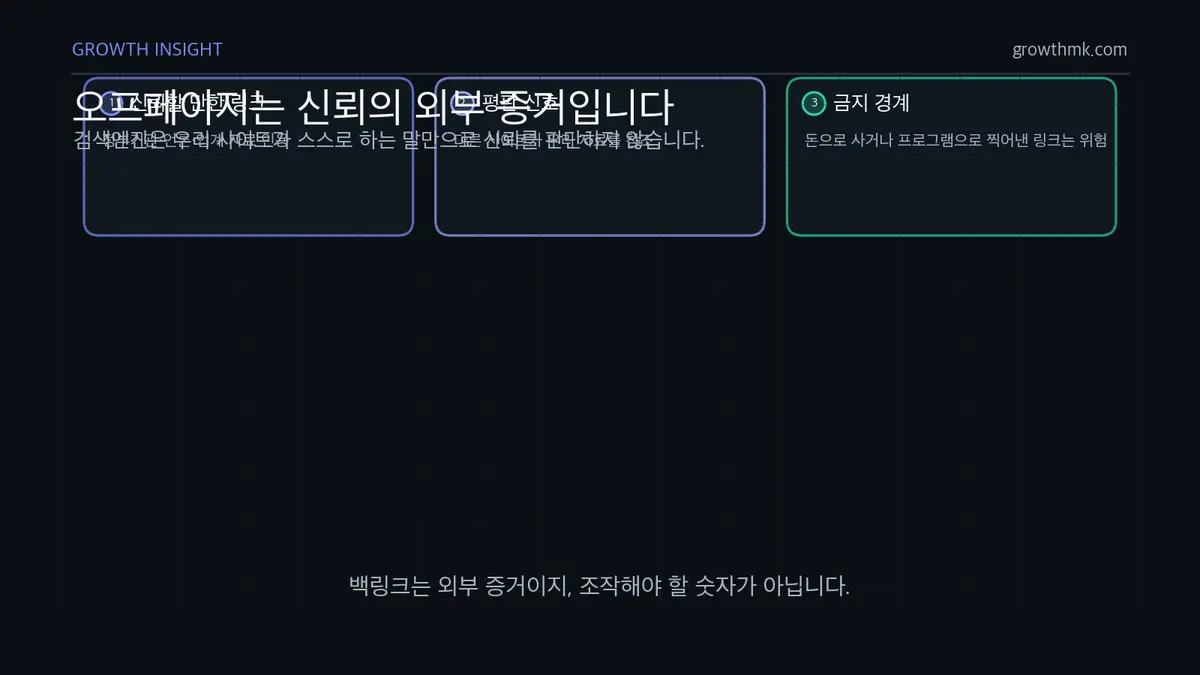
There’s a line you need to know in this pillar. The moment you buy links with money or mass-produce them through a program, you’ve left SEO and entered spam. Google’s official spam policies documentation explicitly prohibits link spam, keyword stuffing, and scaled content abuse, warning that violations “can result in lower rankings or even removal from search results entirely.” Trading away domain trust for a short-term ranking bump is always a loss in the end.
- Start here 1. Audit your current backlink profile and figure out what share comes from spammy, unidentifiable sources first.
- Start here 2. Build one asset other people genuinely want to reference — proprietary data, industry research, a definitive guide. Links you earn last far longer than links you beg for.
- Start here 3. Turn down offers to buy links, and redirect that budget toward white-hat channels like press releases, partnerships, and guest contributions.
These four pillars have been described separately, but in practice they run as a virtuous cycle. A technical foundation makes content visible to search engines; visible content that satisfies users earns natural backlinks and branded search; that trust signal lifts the site’s overall evaluation, which raises the starting rank of the next piece of content. This is exactly why SEO is a compounding channel that gets stronger over time. The flip side: while any one pillar is empty, the investment in the other three can’t earn its full return either.
Search is changing — is SEO over in the age of AI search?
The short answer: no. If anything, the bar just got higher. AI-synthesized answers (AI Overviews) now show up at the top of search results, more users go straight to ChatGPT or Perplexity for recommendations, and the old “ten blue links” assumption about exposure is clearly under pressure. But look underneath it, and the story changes.
Google states, in its official documentation on AI features and websites: “there are no additional requirements to appear in AI Overviews or AI Mode, and no special optimization is needed.” It explicitly says you don’t need to build a new AI-specific file or markup. AI search works by query fan-out — splitting one question into multiple sub-searches — which actually gives a wider range of pages a chance to be cited than before. A site that isn’t crawled doesn’t exist for AI either. In other words, the four pillars are the precondition for AI search, not an alternative to it.
That doesn’t mean nothing has changed, though. The unit of competition has shifted.
| Traditional search (SERP) | AI search (generative engines) | |
|---|---|---|
| Result format | A list of 10 links | A synthesized answer + cited sources |
| Unit of competition | Page vs. page | Paragraph/claim vs. paragraph/claim |
| Core signal | Relevance, links, page experience | Citability (clear answers, sources/stats, structure) |
| Measurement | Rank, clicks | Citations, brand mentions, AI-referred traffic |
| Technical foundation | Crawling, indexing | Identical — blocked means no citation is even possible |
The methodology for handling this new unit of competition is GEO (Generative Engine Optimization). A GEO research paper (arXiv 2311.09735, KDD 2024) from researchers including a team at Princeton found that adjustments like citing sources, adding statistics, and clear structuring can lift visibility in generative engines by up to 40%. Interestingly, all of these tactics overlap with the attributes E-E-A-T demands from good content anyway. Sites that have been doing SEO properly already start ahead on GEO.
Of course, there’s a genuinely uncomfortable shift for businesses in here too. When AI summarizes the answer, more searches end without a click at all, so the same visibility can still mean less traffic to your site. Which makes it more important than ever to figure out “which traffic is okay to lose.” A search where AI answering it costs you nothing — a definition, basic information — is different from a search that only ends once the user actually meets a provider, like comparison, evaluation, or purchase. Becoming the source AI cites and the name AI recommends for that second category is the search marketing challenge of the next five years, and that standing gets built on top of the four pillars in this article. The full methodology for AI search optimization is covered in the complete guide to GEO (Generative Engine Optimization). If this article is the map of SEO, that one is the map of AI search.
SEO strategy by business type — same principles, different priorities
The logic of the four pillars is the same for every business, but which pillar deserves more resources depends on your business model. Bad benchmarking — a B2B SaaS company copying an e-commerce traffic strategy, for instance — is a common cause of SEO failure.
| B2B | E-commerce | Local business | |
|---|---|---|---|
| Core keywords | Low-volume but high-intent problem-solving and comparison keywords | Product/category keywords + buying modifiers (“best,” “cheapest”) | “[location] + [business type]” keywords |
| Content focus | Guides, case studies, white papers (paired with a long evaluation journey) | Category descriptions, reviews, buying guides | Location/service pages, customer reviews |
| Technical focus | A topic-cluster content hub structure | Faceted navigation, duplicate URLs, out-of-stock page handling | Business profile management, local structured data, consistent contact info |
| Conversion metric | Inquiry/lead quality, pipeline-attributed revenue | Revenue, cart conversion rate | Calls, directions, visit bookings |
| Common mistake | Mass-producing informational keywords based on volume alone | Copy-pasting manufacturer product descriptions (duplicate content) | Neglecting reviews, missing per-location pages |
The gap is most extreme for B2B. One decision-maker’s search can turn into a contract worth tens of thousands of dollars, so ranking #1 for a “[product category] comparison” keyword with 100 monthly searches is far closer to revenue than ranking #1 for an informational keyword with 10,000. Turning search traffic into qualified leads only comes together when you pair this with the B2B lead generation guide.
E-commerce has so many pages that the technical pillar carries more weight. Fail to clean up the tens of thousands of duplicate URLs that filter combinations generate, and your crawl budget gets wasted while your genuinely important pages fall behind on indexing. Local businesses should prioritize map visibility and review management over general ranking competition — half the battle is decided off-site, in the business profile.
Whatever the type, there’s one common denominator: don’t start with the conversion metric row left blank. Defining “how we’ll measure SEO success” has to come before the decision to “do SEO” at all — only then do keyword selection, content format, and reporting all align to that standard. SEO without a measurement standard ends up as bragging about traffic, no matter what type of business is running it.
Timeline and expectations — when does SEO start to show results?
Google has an official answer to this question. In its official guide on whether you need an SEO provider, Google states that “it typically takes 4 months to a year for changes you make to have an impact.” In the same document, it also states directly that “no one can guarantee a #1 ranking on Google” and warns you to be wary of any provider claiming to guarantee rankings or a special relationship with Google. Why a “#1 in 3 months, guaranteed” pitch is a red flag is covered in the truth about guarantee-based SEO contracts, and standards for choosing a healthy partner are covered in an SEO agency selection checklist.
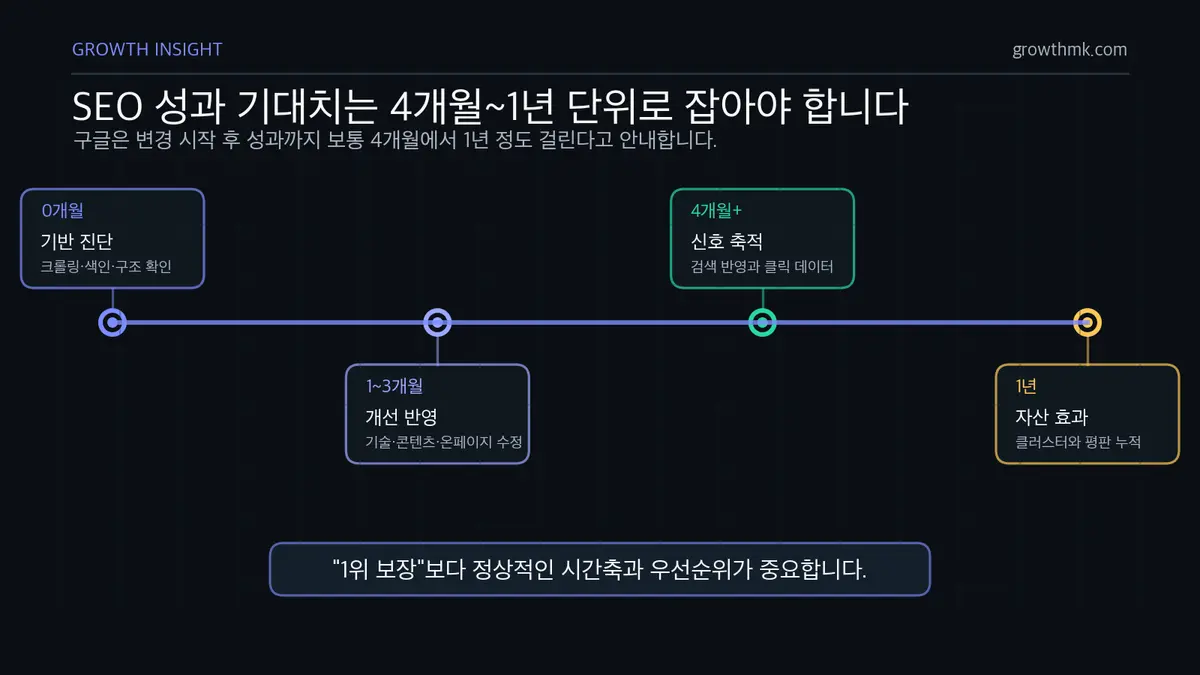
Why does it take this long? Not because search engines are slow, but because signals have to accumulate. Google has to re-crawl your revised page, re-evaluate it, let user response build up — and meanwhile, competing pages are moving too. Trust in particular is never built instantly. It’s structurally rare for a brand-new site to out-rank an established, authoritative site’s accumulated signals with a single article. Once you understand this lag, the question changes from “why hasn’t ranking moved in a month” to “which leading indicator moved this month.”
That said, “4 months to a year” isn’t a silent stretch where nothing happens. There’s simply a different leading indicator to check at each stage.
| Timeframe | Stage | What’s happening | Metric to watch |
|---|---|---|---|
| Month 0–1 | Diagnose & plan | Technical audit, keyword and customer-journey mapping | Indexed page count, crawl error count |
| Month 1–3 | Build the foundation | Fix technical issues, start publishing core content | Improved index rate, rising impressions |
| Month 4–6 | Early signals | Long-tail keywords enter rankings, clicks start | Click-through rate on impressions, first organic conversion |
| Month 6–12 | Compounding zone | Core keywords climb, natural backlinks increase | Leads/revenue attributed to organic search |
One more thing that matters for managing expectations: the unit of measurement. A ranking report is only a mid-level metric. Growth Inc. runs SEO as a set of experiments — forming a hypothesis per keyword group, isolating organic traffic in an analytics tool like GA4 to trace it all the way to inquiries and revenue, and revising the keyword map whenever the data rejects a hypothesis. Only when your reporting unit is “this cluster generated N leads,” not “rankings went up,” does SEO budget get allocated by data instead of by gut feel.
A 10-question SEO self-diagnostic for your company
Now let’s apply the map above to your own company. Answer each question yes or no, and reinforce whichever pillar has the most ‘no’s.
| # | Area | Question | If ‘no’ |
|---|---|---|---|
| 1 | Technical | Registered with Search Console, and you check the index report monthly | Start with Pillar 1 |
| 2 | Technical | The site: search result count is close to your actual page count | Audit crawling and indexing |
| 3 | Technical | Key pages load their core content within 3 seconds on mobile | Improve speed and page experience |
| 4 | Content | Your target keyword list is organized by customer journey stage | Redo keyword research |
| 5 | Content | Every article is attributed to an author with cited sources | Reinforce E-E-A-T signals |
| 6 | On-page | Every core page has a unique title and meta description | Do a full on-page cleanup |
| 7 | On-page | Every new article links internally to related existing ones | Build an internal linking system |
| 8 | Off-page | You audit your backlink profile every quarter | Start managing backlinks |
| 9 | AI search | You’ve checked whether ChatGPT/Perplexity cite you when asked about your field | Start a GEO check |
| 10 | Measurement | You report organic search’s contribution to inquiries/revenue separately | Design conversion tracking |
If you scored 8 or more ‘yes,’ your foundation is solid and it’s time to move on to advanced stages like expanding content clusters and GEO. If you scored 5–7, reinforce things in the order this article lays out (technical → content → on-page → off-page). If you scored 4 or fewer, start with a technical foundation audit before anything else. Respecting the order is how you protect your budget.
This diagnostic isn’t a one-time test — treat it as an operating routine you run every quarter. Your site keeps changing (redesigns, new pages, plugins) and so does search (algorithm updates, expanding AI features), so a ‘yes’ from last year is never guaranteed to still be a ‘yes’ this year. Question 9 in particular (AI citation) becomes the cheapest measurement tool you have for tracking your brand’s position in AI search, if you log the same question set every quarter.
If you’re not sure where to start after this diagnosis, Growth Inc.’s SEO consulting covers this entire map together with you — from a technical audit through customer-journey-based keyword design to revenue-attribution measurement. Take a look at our SEO service, and if you want to know the right priorities for your specific situation, reach out for a consultation.
Frequently Asked Questions
Can I do SEO myself, or do I need to hire a professional?
Google’s own official guide states that a small local business can handle most of this work in-house. Registering with Search Console, basic on-page cleanup, and review management are all well within reach internally. That said, in highly competitive keyword markets, on sites with a large number of pages, or on sites carrying significant technical debt, paying for an expert’s time at the diagnosis stage is cheaper than the cost of trial and error. The structural reasons verified experts are hard to find domestically are covered in why it’s hard to find SEO experts in Korea.
How is SEO different between Naver and Google?
Google evaluates websites worldwide based on open web standards, while Naver’s own ecosystem content — blogs, cafes, Knowledge iN — occupies a large share of its search results. That means responding to Naver requires running content operations inside the Naver ecosystem alongside website optimization (Search Advisor registration, sitemap submission). That said, both engines point in the same direction: trustworthy content that matches search intent wins in the end. Confirm with data which engine your customers actually search on first, and allocate resources accordingly.
Which should I do first, SEO or search ads?
They’re not substitutes for each other — they’re complements on different timelines. Search ads show up the same day you turn them on, which makes them well-suited for validating demand at a new business, while SEO takes 4 months to a year by Google’s own standard but builds an asset that doesn’t disappear the moment you stop. An effective combination in practice: find the keywords that actually converted in your ad platform’s search term reports, and target those exact keywords with your SEO content. Ad data becomes the hypothesis for your SEO experiments.
Is AI-written content bad for SEO?
Google’s official standard is ‘is it useful to people,’ not ‘how was it made.’ The fact that AI was involved isn’t itself a penalty. That said, mass-producing low-value pages whose primary purpose is manipulating search rankings falls under the spam policy’s ‘scaled content abuse,’ which can lead to lower rankings or removal from search results. A workflow where a human takes ownership and edits an AI draft, adding real experience, data, and verified sources, is fine — and E-E-A-T is exactly the framework that demonstrates that accountability.
What metrics should I use to measure SEO performance?
Rankings and traffic are mid-level metrics. The metric that actually matters sits at the end of the chain: impressions → clicks → conversions → revenue contribution. Isolate organic search as its own segment in your analytics tool, and track conversion events like inquiries or purchases connected to specific keyword clusters. What matters more than 100,000 monthly visits is how many of those visitors became customers. Judge by the one person who becomes revenue, not by the volume of traffic, and every SEO decision changes — from which keywords you pick to how you format your reports.