
The Beginner’s Guide to Managing Backlinks
 임재복
임재복
If you have more than 200 backlinks and your rankings still aren’t moving, a good chunk of them may actually be dragging your rankings down. In practice, a single low-quality backlink can cancel out the effect of ten good ones.
By the end of this guide, you’ll be able to tell for yourself which of your backlinks are helping you and which ones carry penalty risk. We’ll walk you through a backlink audit process — from Google Search Console to Ahrefs — that you can complete in 30 minutes.
What Are Backlinks, and Why Do They Matter?
A backlink is an inbound link from another website that points to your site. Google’s own documentation states that it uses links as a signal for judging a page’s relevance and as a path for discovering new pages.
Put simply, the more links you get from high-quality websites, the more likely search engines are to judge your content as valuable.
How Backlinks Influence SEO
Backlinks aren’t just a channel for driving traffic — they’re a core factor in building your site’s domain authority. Google’s PageRank algorithm still treats the quality and quantity of backlinks as an important ranking factor.
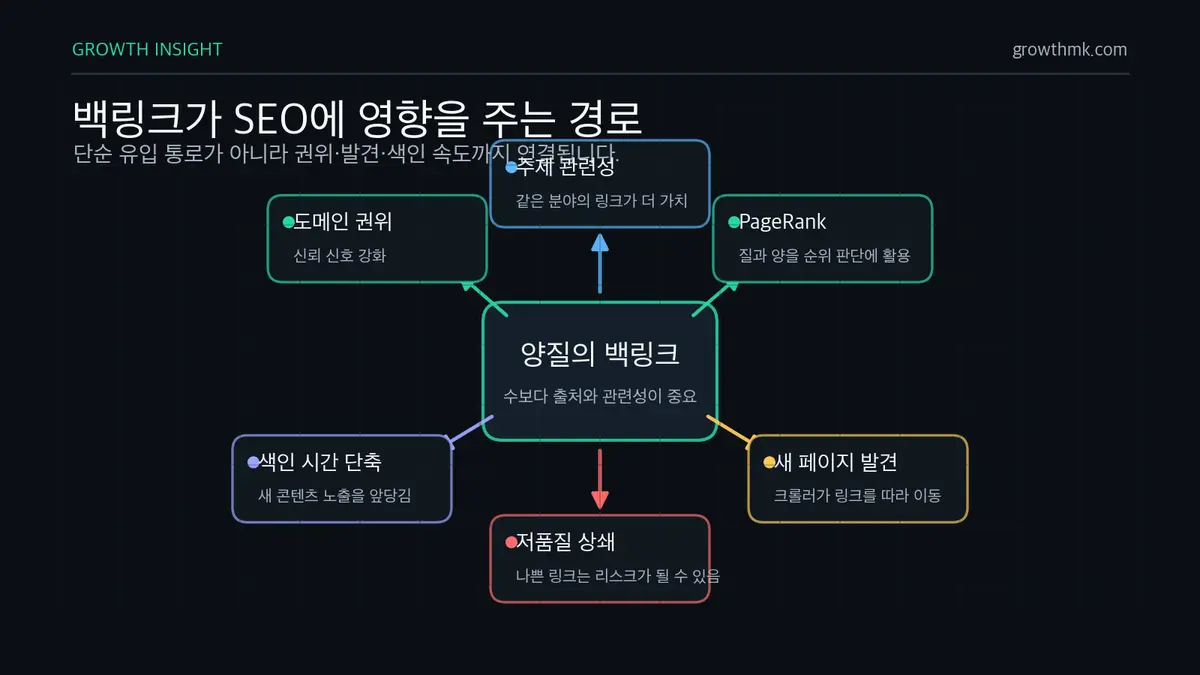
A single backlink from an authoritative site can carry more weight than dozens of backlinks from low-quality sites.
Backlinks are also a primary way for search engine crawlers to discover new pages. Just as Google explains that crawlers follow links to find new pages, when a newly created page is linked from another site, search engine bots can follow that link to quickly discover and index your site. This can significantly shorten the time it takes for new content to appear in search results.
Types of Backlinks and Their Value
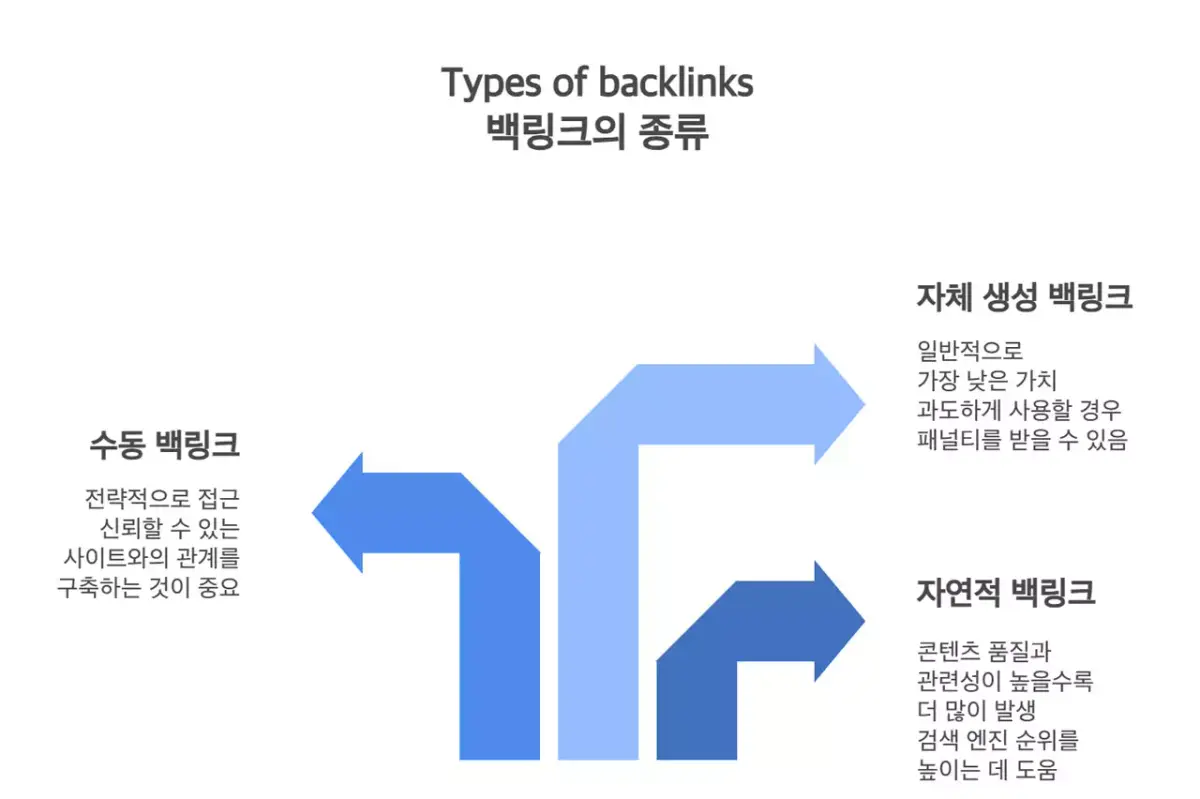
Not every backlink carries the same value. Broadly, backlinks fall into three categories.
- Natural backlinks: Links that other site owners add voluntarily because your content is genuinely valuable. This is the most ideal form of backlink and ranks highest in Google’s algorithm.
- Manual backlinks: Backlinks you deliberately acquire through guest posting, directory submissions, forum participation, and similar tactics. Used properly, these can be effective, but overusing them risks being treated as spam.
- Self-created backlinks: Links you insert yourself into blog comments, forum signatures, user profiles, and the like. These generally carry the lowest value, and overusing them can trigger a penalty, so use caution.
A backlink’s value isn’t determined by type alone — it also depends on factors like the authority of the linking site, topical relevance, link placement, and anchor text.
For example, if your cooking blog gets a link from a well-known cooking site on the same topic, that’s far more valuable than getting dozens of links from low-quality, unrelated sites.
💡 Curious about your site’s backlink health?
Get Growth’s backlink profile diagnosis and see your current backlink quality and improvement opportunities.
Effective Backlink Analysis Tools and How to Use Them
Using Free Backlink Analysis Tools
For beginners just starting to analyze backlinks, free tools with no cost barrier can be a huge help. Popular free backlink analysis tools include Google Search Console, Bing Webmaster Tools, the Ahrefs Backlink Checker (limited functionality), and SEMrush (limited functionality).
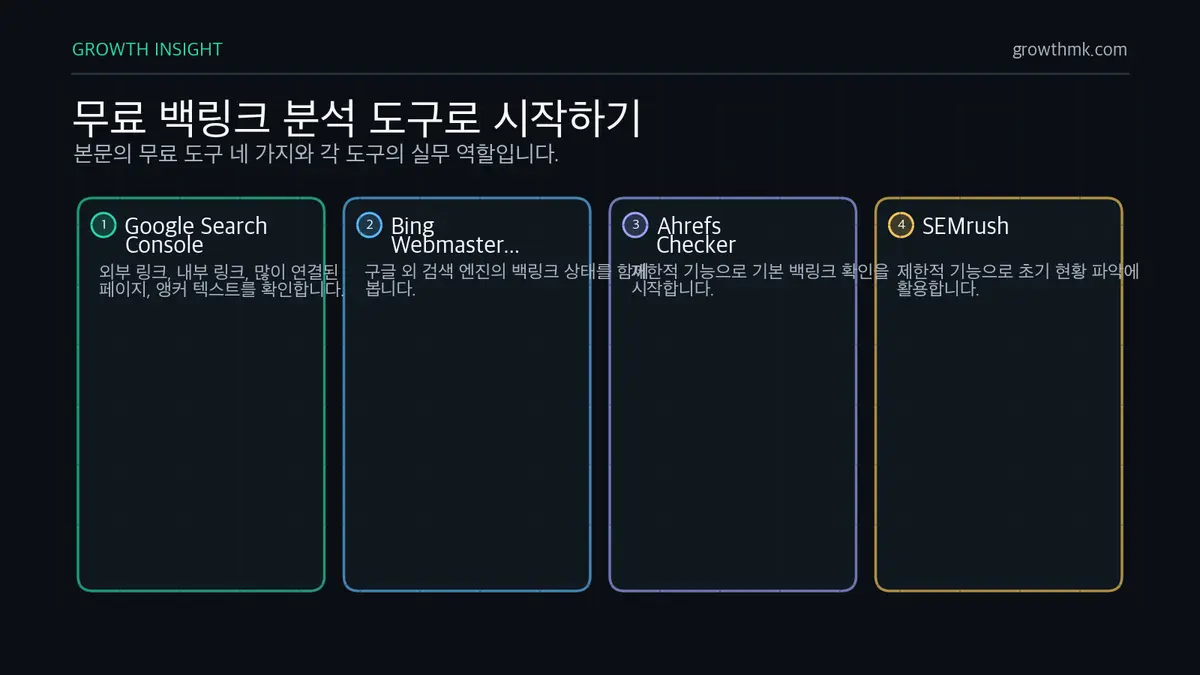
Google Search Console, in particular, is a free tool straight from Google — it not only shows the backlinks pointing to your site, but also which pages get the most backlinks and which anchor text is being used. It isn’t perfect, but it gives you plenty of information to understand your basic backlink situation for free.
It’s simple to use, too. After you register your site with Google Search Console, click the “Links” section in the left-hand menu to see external links, internal links, and your most-linked pages. Get in the habit of checking this data regularly so you can track how your backlink profile changes over time.
Bing Webmaster Tools also provides backlink data, which helps you understand your backlink standing on search engines beyond Google. Using both tools together lets you gather backlink data across a wider net.
Advanced Features of Paid Backlink Analysis Tools
For deeper backlink analysis and competitor research, it’s worth considering a paid tool. Popular paid backlink analysis tools include Ahrefs, SEMrush, Moz Pro, and Majestic. These tools provide far more comprehensive backlink data and advanced analysis features.
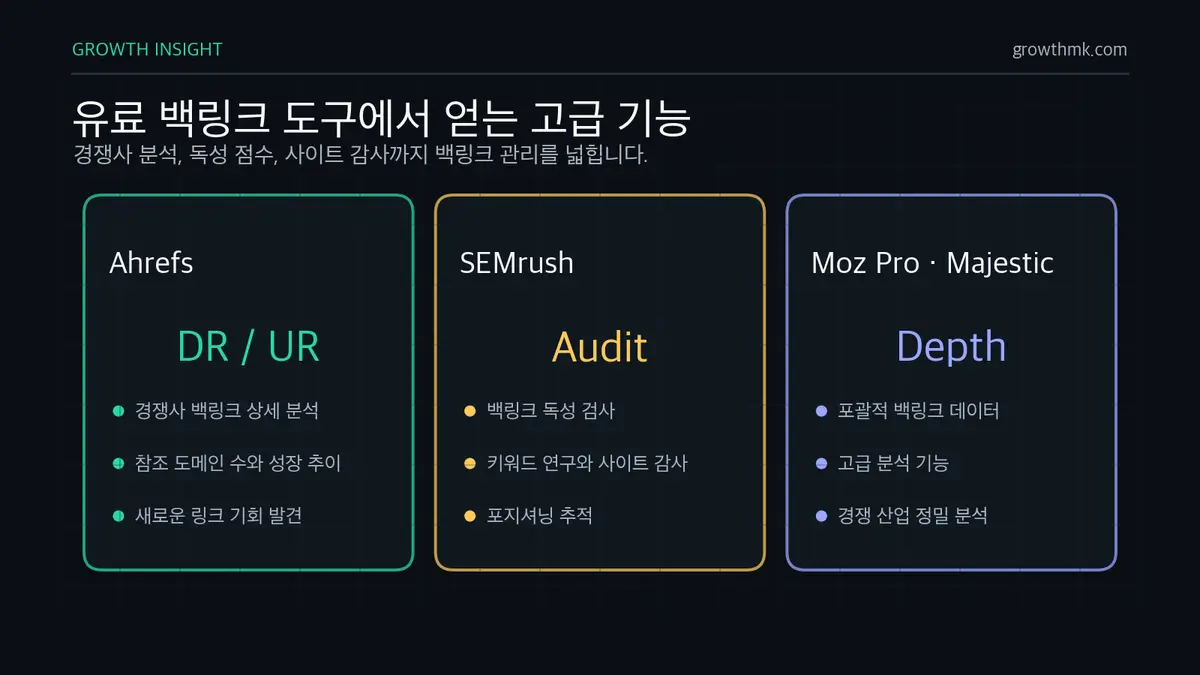
Ahrefs, for example, can analyze not just your own site’s backlinks but your competitors’ in detail, and it provides a range of reports that help you spot new backlink opportunities. Metrics like Domain Rating, URL Rating, referring domain count, and backlink growth trends let you comprehensively assess the health of your backlink profile.
SEMrush provides comprehensive SEO features beyond backlink analysis, including keyword research, site audits, and rank tracking. Its Backlink Audit Tool, in particular, is a big help for identifying and managing harmful backlinks.
There’s an upfront cost, but these paid tools can deliver strong ROI for building and executing a long-term SEO strategy. If you’re operating in a highly competitive industry, the precision analysis these tools provide can play an important role in securing a competitive edge.
Building an Effective Backlink Management System
Backlinks aren’t a one-and-done asset — they need ongoing management. Effective backlink management plays a critical role in maintaining and improving your SEO performance over the long run. Let’s walk through backlink management practices that even beginners can follow easily.
Three Core Principles of Backlink Management

When approaching backlink management, keep three core principles in mind: build more good backlinks, cut back the bad ones, and keep your backlink profile balanced and diverse.
First, regular monitoring is the foundation of backlink management. You need to routinely check for new backlinks pointing to your site as well as ones that have disappeared. The right monitoring cadence depends on your site’s size and competitive landscape, but roughly once a month works for smaller sites and once a week for mid-size to large sites.
Second, quality assessment is a critical step in determining a backlink’s value. Not every backlink carries equal value, and some can actually be harmful. Keep the high-quality backlinks that bring stable traffic, and clean up the harmful ones.
Third, strategic response is where backlink management gets executed. You need a strategic approach that strengthens high-quality backlinks while removing or disavowing harmful ones. The most important thing in backlink management is “balance.” Disavow too aggressively and you can lose good opportunities; stay too passive and you can be exposed to real risk.
Approach backlink management with these principles in mind, and even a beginner can manage it systematically and effectively.
Keep in mind, especially, that backlink management is better approached as a long-term perspective than a short-term win. Consistent backlink management improves your site’s search engine health over time.
Building a Backlink Monitoring System
The first step to effective backlink analysis and management is building a monitoring system. Monitoring lets you quickly spot new backlinks you’ve gained, status changes in existing backlinks, and problem backlinks.

The most basic monitoring method is regularly checking Google Search Console. The “Links” section in Search Console gives you an at-a-glance view of the external links pointing to your site. But for more systematic monitoring, it’s worth building out a system like the one below.
- Set up weekly backlink reports: If you’re using a tool like Ahrefs or SEMrush, set up weekly email alerts for new and lost backlinks. This lets you track link-gain and link-loss patterns continuously. For example, if a particular piece of content suddenly picks up a lot of backlinks, you can analyze what made it succeed and apply that to your other content strategy.
- Build a backlink database: Use a spreadsheet to build a simple database for tracking your important backlinks. It’s a good idea to include the link URL, anchor text, date acquired, domain authority, and link type (natural, manually acquired, etc.). This kind of systematic tracking gives you insight over time into which type of backlink is most valuable and which content attracts the most backlinks.
- Monitor competitor backlinks: It’s important to monitor not just your own backlinks but your key competitors’ as well. Analyzing the new backlinks your competitors have picked up can reveal similar opportunities for you. For example, if a competitor is listed in a particular industry directory, you can try getting listed there too. This strategy is commonly called “competitor backlink analysis,” and many SEO professionals rely on it.
- Check the health of existing backlinks: It’s also important to regularly check the status of your existing backlinks. Older backlinks in particular can end up pointing to deleted pages or broken links. These “broken backlinks” not only lose their SEO value but can also hurt user experience. So check your backlink status regularly, and if there’s a problem, reach out to the site’s administrator to request a fix.
Build a monitoring system like this and you can easily grasp the overall state of your backlinks and respond quickly when problems arise. If you’re a beginner, it’s best to start simple and gradually build the system out further.
For example, you might start with just Google Search Console, then gradually expand to spreadsheet management and dedicated tools. What matters most is building a consistent habit of monitoring.
🔍 Need expert help?
Start a systematic SEO strategy with Growth’s SEO audit service, from backlink analysis to competitor benchmarking.
A Guide to Evaluating Backlink Quality
A Checklist for Evaluating Backlink Quality
Check these four core factors when evaluating backlink quality.
- Domain authority reflects how trustworthy the linking site is. You can check it via Moz’s DA or Ahrefs’ DR metric.
- Relevance is how closely the linking site’s topic matches your own.
- Traffic volume signals how likely the link is to send you real visitors. Placement matters too — a natural link within body content is more valuable than one in a footer or sidebar.
- Check the diversity and naturalness of anchor text. If every backlink uses the exact same keyword, it can look manipulated.
How to Identify Low-Quality Backlinks
Harmful backlinks can hurt your SEO, so identify them quickly. Warning signs of suspicious backlinks include links from spam sites or PBNs (Private Blog Networks), links from sites on completely unrelated topics, and links using over-optimized anchor text. Google’s spam policies classify links intended to manipulate rankings — buying and selling links, excessive link exchanges, low-quality directory links, and unnatural anchor text stuffed with keywords — as violations.
Backlinks from gambling, adult content, or illegal drug sites, or from hacked sites, need immediate attention in particular. And if you see an abnormally large number of new backlinks appear in a short period, consider whether you might be facing a negative SEO attack. A paid tool’s Toxic Score or Spam Score can make the call much easier.
How to Write and Submit a Disavow File
If you find harmful backlinks, use Google’s disavow links tool. Google itself notes that this is “an advanced feature, and if used incorrectly, it can harm your site’s performance in Google Search results,” and explains that most sites don’t need it at all because Google already ignores untrustworthy links on its own. First, write your list of backlinks to disavow as a plain text (.txt) file. The file format is simple: list one domain or URL per line. To disavow an entire domain, use the format “domain:example.com”; to disavow only a specific URL, enter the full URL as-is.
Once the file is ready, go to Google Search Console, navigate to “Links” → “Disavow links tool,” and upload it.
It typically takes Google several weeks to process this information, so be patient. Treat disavowing as a last resort, and if possible, try requesting link removal from the webmaster first.
A Step-by-Step Approach to Backlink Cleanup
Approach backlink cleanup systematically. The first step is to sort your backlink list by quality into three groups: “good,” “suspicious,” and “harmful.” Leave the good backlinks as they are, and keep an eye on the suspicious ones through additional monitoring.

For harmful backlinks, start by politely emailing the site’s administrator to request removal. Only use the disavow tool if you get no response or removal isn’t possible.
Backlink cleanup isn’t a one-time job — it should happen regularly, on a quarterly basis. It’s especially important to re-review your backlink status after any algorithm update or ranking shift.
📈 Curious about real results from backlink management?
Check out Growth clients’ SEO success case studies and find strategies you can apply to your own site.
Frequently Asked Questions (FAQ)
Is more backlinks always better?
No. Quality matters more than quantity. A single backlink from a relevant, authoritative site can be worth far more than dozens of links from irrelevant, low-quality sites. Too many spammy links can actually hurt your rankings, so you should manage both link acquisition and link cleanup together.
Do harmful backlinks always need to be disavowed?
The disavow tool should be a last resort. Google notes that most sites already have their trustworthy links automatically identified without any action needed, and that the disavow tool is an advanced feature that can actually cause harm if misused. So first request link removal from the site’s administrator, and only consider disavowing if you get no response or you’re seeing a large number of clearly manipulative, spammy links.
How quickly do backlinks show results?
Treat backlinks as a long-term asset rather than a short-term win. It takes time for new links to be indexed and reflected in rankings, and disavow files typically take Google several weeks to process as well. Realistically, monitor consistently — about once a month for smaller sites and once a week for mid-size to large sites — and watch the trend over time.
Can I do backlink analysis with free tools alone?
You can absolutely get started on basic status checks with free tools like Google Search Console and Bing Webmaster Tools. But for deeper analysis — comparing competitor backlinks or assessing toxic scores — paid tools like Ahrefs and SEMrush provide far more comprehensive data. For beginners, we recommend starting with free tools and expanding gradually.
Related Reading