
Evergreen Content
 임재복
임재복
What Is Evergreen Content?
Evergreen content is content that, like an evergreen tree that stays green through every season, keeps its value and relevance over time and continues delivering usefulness to readers long after it’s published. The SEO analytics company Ahrefs defines evergreen content as “content built around a topic with steady demand that stays valid long after it’s published”. Because it covers topics that aren’t tied to a specific moment or trend, it’s able to drive search traffic and hold readers’ interest over a long stretch of time.
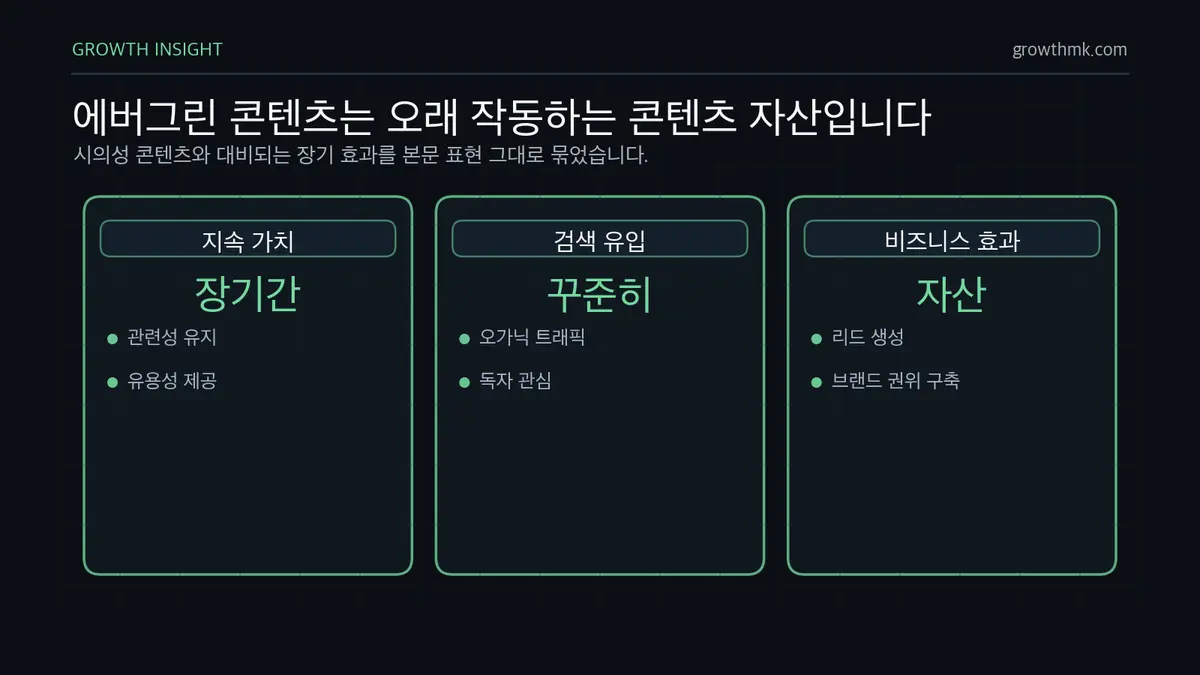
When done well, this kind of content becomes an important asset for a website, contributing to a steady stream of visitors, lead generation, and stronger brand awareness and authority. Unlike time-sensitive content — news articles or an analysis of a seasonal trend — whose value drops off sharply once time passes, evergreen content pays off over the long run from a single round of production, which is why it’s valued as a strategic asset with strong cost efficiency.
The Origins and Evolution of Evergreen Content
Changes in the Digital Marketing Landscape
The concept of evergreen content started drawing attention in the late 2000s, as search engine optimization (SEO) and content marketing took off in earnest. In the early internet, simply producing a large volume of content was what mattered — but as search engine algorithms grew more sophisticated, content quality and durability became far more important factors.

In particular, Google’s Panda update, rolled out in February 2011, was a shift big enough to affect roughly 12% of all search results, and it pushed the ecosystem toward filtering out low-quality content and rewarding high-quality content that delivered real value to users. Amid this shift, companies came to recognize the need for content that could create value over the long term rather than chasing short-term buzz, and evergreen content established itself as a core digital marketing strategy.
The Maturing of Content Marketing
As content marketing matured through the 2010s, the importance of evergreen content grew even further. The spread of social media dramatically sped up how fast information was produced and consumed, but — somewhat paradoxically — that also deepened the appetite for genuinely valuable information. Users came to want content that went beyond simple news or trend updates and actually solved their problems in depth, and that need became the foundation for evergreen content strategy.
Today, AI and automation have made content production easier than ever, but that’s only made high-quality evergreen content shaped by real human insight and expertise even more valuable.
Key Characteristics and Components of Evergreen Content
Durability That Transcends Time
The most defining trait of evergreen content is that it keeps delivering value to readers regardless of the passage of time. That’s because the topics it covers aren’t confined to a specific moment — they stay relevant to readers’ interests or needs over a long stretch. Content like “the right way to brush your teeth” or “the basic principles of stock investing” doesn’t lose its value as time goes by.
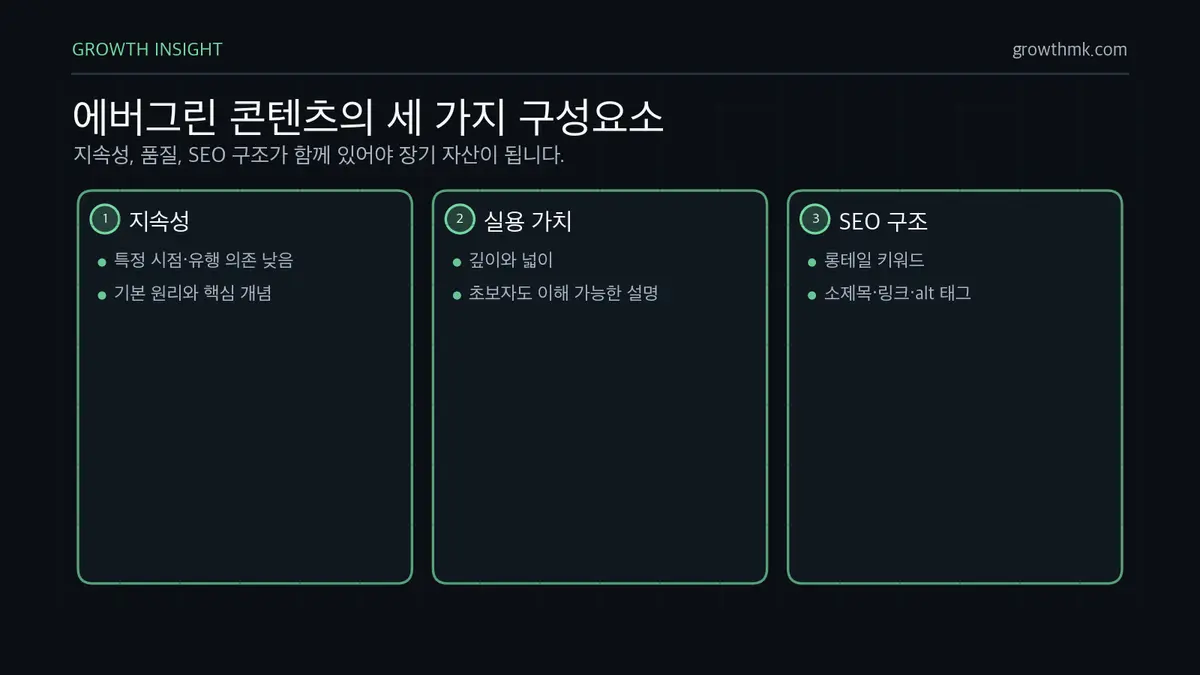
This durability is possible because the content covers universal or foundational topics that don’t depend heavily on a particular year, season, or current event. Foundational, fundamental material, the basic principles or core concepts of a given field, and frequently asked questions (FAQs) are all representative examples. With this kind of content, the core substance doesn’t change, but you can keep it valuable over time by refreshing minor statistics or examples with up-to-date information.
High Quality and Practical Value
Evergreen content needs to provide readers with deep, comprehensive information that actually meets their needs — not just surface-level facts. It shouldn’t be thin content written merely to show up in search results; it needs enough depth and breadth to answer most of what someone would want to know about the topic, all in one place.
It’s also often written to be beginner-friendly. It’s important to minimize jargon or explain it in plain terms so that people who don’t know much about the topic can still easily understand it and come away with useful information. It should also offer practical value by giving readers tips, methods, or solutions they can actually apply in their day-to-day life or work. That practicality is a big part of why evergreen content stays beloved for so long.
An SEO-Friendly Structure
Evergreen content is inherently very SEO-friendly. It’s often built around long-tail keywords that see steady search volume without facing overly fierce competition, and topics that include keywords like “how to,” “definition,” “guide,” or “tips” tend to make good candidates.
It can also naturally incorporate SEO optimization elements — using a structure that boosts readability (short paragraphs, bullet points, subheadings), building out internal links and using outbound links where appropriate, and adding alt tags to images. Thanks to these traits, well-made evergreen content keeps ranking near the top of search results and drives steady, long-term organic traffic. Search Engine Land likewise notes that evergreen content keeps working long after it’s published, generating steady organic traffic, conversions, and backlinks.
Main Types of Evergreen Content and Use Cases
Educational Content Types
The most representative form of evergreen content is educational in nature. How-to guides are content that walks through the steps for performing a specific task — think “how to tie a tie,” “how to make a great kimchi stew,” or “how to start a blog.” Because the underlying principles don’t change over time, this kind of content can keep delivering value indefinitely.
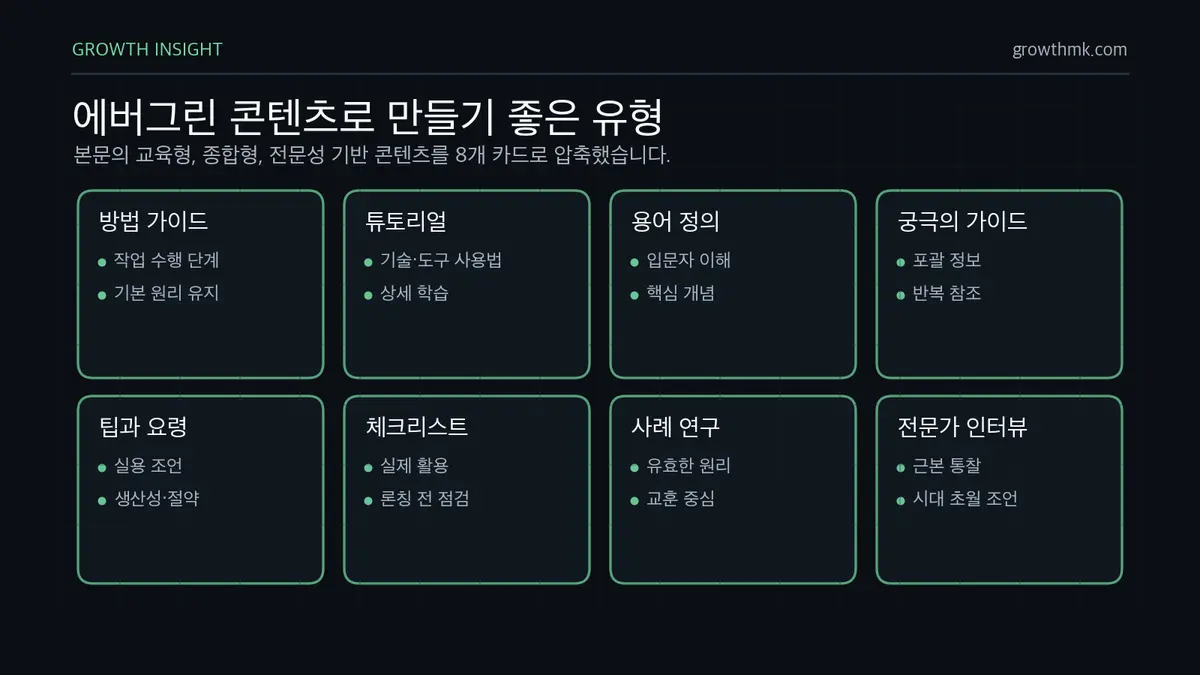
Tutorials are another important type — content that walks through, in detail, how to use a specific skill or tool. Something like “a beginner’s tutorial for Photoshop” or “an introduction to Python programming” fits here. Glossaries and term-definition content are also highly useful; something like “key digital marketing terms explained” or “core blockchain terminology explained” keeps delivering value to newcomers in that field over time.
Comprehensive Reference Content
Ultimate guides are long-form content that provides extremely comprehensive, in-depth information on a specific topic. Something like “the complete guide to content marketing” or “stock investing A to Z for individual investors” is a good example. Because these comprehensive guides are built to cover everything someone might want to know about a topic in a single place, they’re often bookmarked or referenced repeatedly.
Tips-and-tricks content is also popular — collections of practical advice like “10 time-management tips to boost your productivity” or “how to cut down on travel costs.” Checklist-style content is useful too; something like “an international travel packing checklist” or “things to check before launching a website” tends to be highly practical and often becomes content people love for a long time.
Expertise-Driven Content
Case studies can also be evergreen content, as long as they’re written around principles or strategies that stay valid over time. This kind of content analyzes a specific problem-solving process or success story and draws a lesson from it for the reader. Historical information can make good evergreen content too — content that explains the historical background of a particular event, figure, or technology, since it’s built around facts that stay meaningful and unchanged today.
Expert interview content can become evergreen if it captures insight that transcends any particular moment — content built around the fundamental insights or advice drawn from an interview with an expert in a given field often holds its value over time. Listicles, too, can be excellent evergreen content when what’s on the list doesn’t go out of date — things like “the 10 most influential books in history” or “7 basic principles for a healthy diet.”
How to Create and Optimize Evergreen Content
Topic Selection and Planning
The first step in producing effective evergreen content is choosing the right topic. It’s important to identify problems your target audience consistently cares about or struggles with, and questions they frequently search for. To do that, you should look comprehensively at your customer service team’s FAQs, related keyword search volume on search engines, and competitor analysis.
Keyword research is also a critical part of the process — the key is finding long-tail keywords with steady search volume that aren’t overly competitive. You need to use a systematic keyword research strategy to select keywords that suit evergreen content. Topics that include keywords like “how to,” “definition,” “guide,” or “tips” can make good candidates. It’s also a good strategy to consider content that answers the kind of fundamental questions beginners in a given field tend to have, since those basic questions keep drawing new people who wonder about them, no matter how much time passes.
Content Creation and Structuring Strategy

Once you’ve chosen a topic, you need in-depth research and information gathering. You should collect thorough, accurate information about the chosen topic based on trustworthy sources. What matters here is building comprehensive, in-depth content — it needs enough depth and breadth to give readers most of what they’d want to know about the topic in one place.
Clear, easy-to-understand language matters too. Write it so beginners can follow along, by minimizing jargon or explaining it in plain terms. Using visuals is essential as well — infographics, charts, images, and video all help boost comprehension and make the content more engaging. Above all, delivering real, practical value is what matters most. You should include concrete examples or actionable advice so readers can genuinely learn something or solve a problem after reading.
Ongoing Optimization and Updates
Evergreen content isn’t “make it once and you’re done.” Its core value holds up over time, but keeping it fresh and accurate takes continued effort. You should review your content at least once every six months to a year to confirm the information is still accurate and valid.

You should update anything that needs it — statistics, examples, relevant regulations, technology changes — with current information, and regularly check that both internal and external links haven’t broken.
It’s also worth adding new information or more relevant examples over time as they come up, to deepen the content further. A strategy of recycling and updating existing content can keep raising the value of your evergreen content over time. Take reader feedback from comments or inquiries into account to strengthen or correct content, and when you’ve made a meaningful update, it’s a good idea to promote it again through social media to draw in new readers.
Related Concepts and Marketing Theory
Comparison With Timely Content
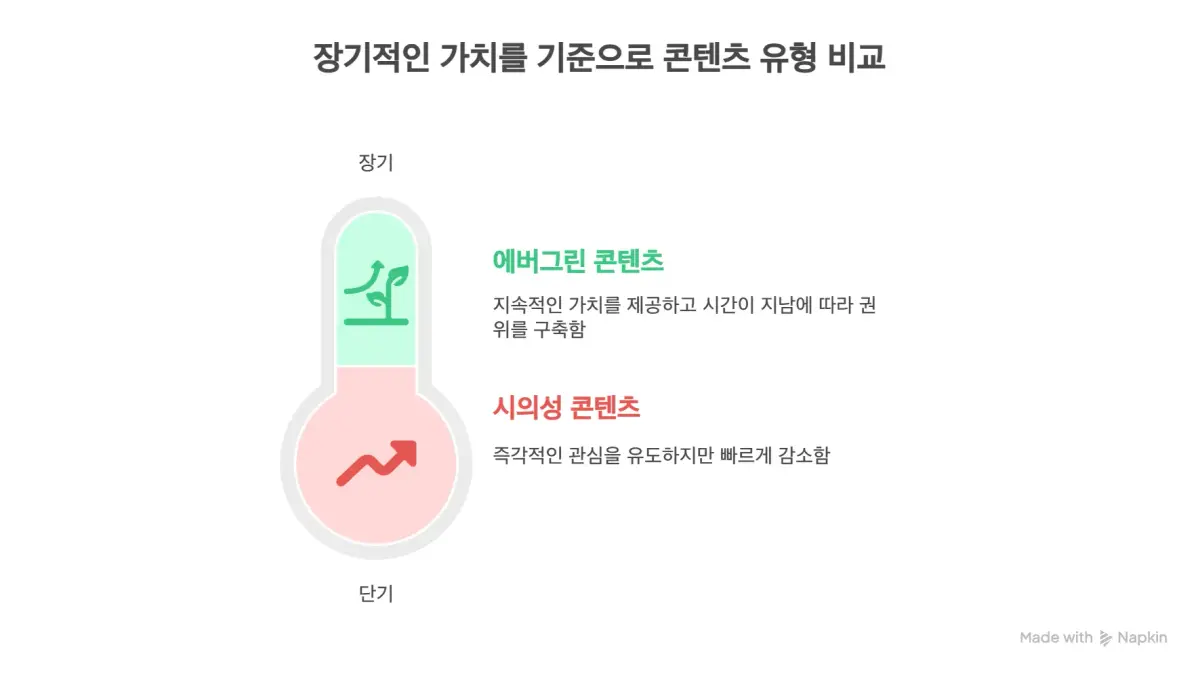
To really understand evergreen content, you need to be clear on how it differs from timely content (also called topical content). In terms of how long the value lasts, evergreen content holds up over a long period, while timely content loses value fast. The core subject matter differs too — evergreen content covers fundamental, foundational, universal questions, problem-solving, methodology, and definitions, while timely content covers breaking news, trends, events, issues tied to a specific moment, and seasonal information.
Traffic patterns are clearly different as well. Evergreen content might start slow but builds steadily over the long run, adding up to a large cumulative effect, while timely content tends to spike right after publishing and then drop off quickly. Their core purposes differ too: evergreen content aims at sustained traffic and lead generation, building brand authority, and turning content into an SEO asset, while timely content aims at driving short-term interest, prompting immediate engagement, and hoping for a viral effect. A successful content strategy is one that combines evergreen and timely content in the right balance, pursuing both short-term interest and long-term value.
Its Role in SEO and Content Strategy
Evergreen content serves as the foundation of a content strategy and a core pillar of SEO. It forms a website’s core information asset and the backbone of its content marketing strategy, and it’s the hub around which you can plan a variety of timely or supporting content. It’s important to plan content systematically around evergreen content as that central axis. Since search engines aim to serve users useful, trustworthy information, well-made evergreen content has a strongly positive impact on SEO.
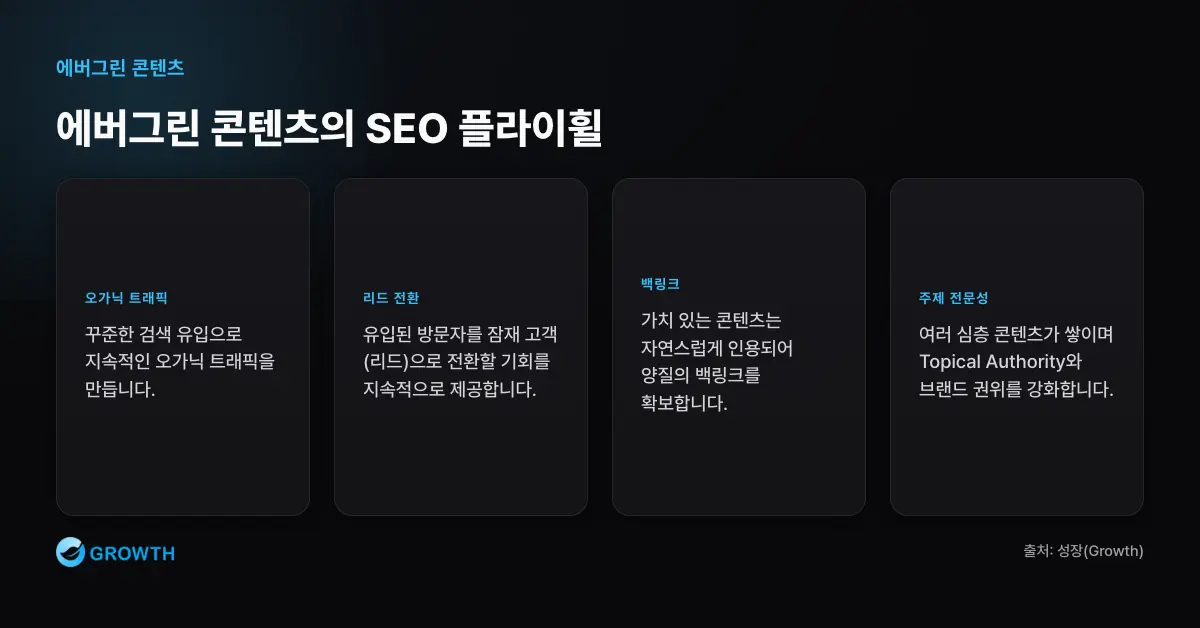
By ranking near the top of search results for specific keywords, it drives sustained organic traffic and also acts as a link magnet. Valuable evergreen content is more likely to get cited and linked to naturally by other websites and bloggers, which works in its favor for earning quality backlinks. In particular, dofollow links can maximize the SEO benefit. It also plays an important role in building topical authority — publishing multiple in-depth pieces of evergreen content on a given subject raises a website’s expertise in that area and earns more trust from search engines.
Its Place in the Digital Marketing Ecosystem
Evergreen content plays an important role across the whole digital marketing ecosystem. It brings in a steady stream of prospective customers through sustained organic traffic and continuously creates opportunities to convert them into leads. It shows a strong return on investment (ROI), since a single round of production can pay off over the long term, making it highly cost-efficient.
It also plays an important role in building brand authority and trust. By demonstrating deep expertise on a specific topic, it raises a brand’s authority and credibility in that space. And since it tends to get shared on social media for longer than timely content does, you can expect a more sustained social-sharing effect from it as well. Thanks to this range of benefits, evergreen content has become an indispensable core strategy in modern digital marketing.
The Future Outlook for Evergreen Content
Evergreen Content in the AI Era
Even in an environment overflowing with digital information, where how users consume information keeps changing rapidly, the importance of evergreen content remains — and if anything, it may only grow. Using generative AI in content marketing can help with finding evergreen content topics, drafting, and updating existing content, but the final depth, insight, and creativity will still depend heavily on human input.
As search engine algorithms grow ever more sophisticated, high-quality evergreen content that delivers real value and a satisfying experience — not just content that repeats keywords — will only become more important. A stronger focus on quality and user experience is expected to be a key trend. Amid the flood of AI-generated content, the scarcity and value of content genuinely shaped by human expertise and insight will stand out even more.
Diverse Formats and Personalization Trends
Beyond traditional text-based blog posts, evergreen content will keep spreading across formats like video, podcasts, and interactive content. Video content in particular can cover a wide range of evergreen topics, from tutorials like “how to boil the perfect egg” to educational content like “explaining the basics of investing.”
Personalized evergreen content — adapting or customizing part of existing evergreen content to fit a user’s specific needs or interests — is also worth considering. For example, the same “basic investing guide” could be delivered in different versions depending on a user’s age, income level, or investing experience. This kind of personalization trend is expected to be a direction that further maximizes the impact of evergreen content.
🚩 B2B Marketing Approaches: Video vs. Text Content Marketing
Related Reading
- The Content Marketing Guide — From Definition to Strategy
- Earned Media
- The Brand Content Marketing Guide
- ESG Content Marketing Case Studies and a Realistic Strategy
- Content Marketing Case Studies and the Latest 2025 Trends
If you’d like to apply this to your own business — you can see Growth’s approach on our content marketing service page, and if you need a specific situational diagnosis, reach out through Contact Us. We’ll answer based on the one customer who becomes revenue — not the volume of traffic.
Frequently Asked Questions (FAQ)
How is evergreen content different from timely content?
The biggest difference is how long the value lasts. Evergreen content covers fundamental, foundational, universal topics — definitions, methodology, guides — and keeps generating traffic steadily long after it’s published. Timely content, by contrast, covers breaking news, trends, and seasonal issues, so traffic spikes right after publishing and then drops off quickly. The most effective strategy is combining both to capture short-term interest and long-term value at the same time.
What kinds of topics make good evergreen content?
Topics that include keywords like “how to,” “definition,” “guide,” or “tips,” with steady search volume that isn’t too competitive, tend to work well. Formats like how-to guides, tutorials, glossaries, ultimate guides, and checklists — where the underlying principles don’t change over time — are classic examples. Content that answers fundamental questions beginners in a field consistently have is also a strong candidate.
Can I just leave evergreen content alone once I’ve made it?
No. Even though its core value holds up, you should review it at least once every six months to a year to keep it fresh and accurate. Update anything that needs it — statistics, examples, relevant regulations, technology changes — with current information, and check that internal and external links haven’t broken. Adding new information or more relevant examples deepens the content and keeps raising its value over time.
Does evergreen content still matter in the AI era?
If anything, it matters more. Generative AI can help with finding topics, drafting, and updating, but the final depth, insight, and creativity still depend on people. The more AI floods the space with content, the more the scarcity and value of high-quality evergreen content built on real expertise and insight stands out.
Marketing Insights
Marketing insights, delivered weekly
Practical growth and GEO/B2B marketing insights, summarized in your inbox every week.
Subscribe for insights