
B2B Content Marketing: Video vs. Text — Which Format Wins?
 임재복
임재복
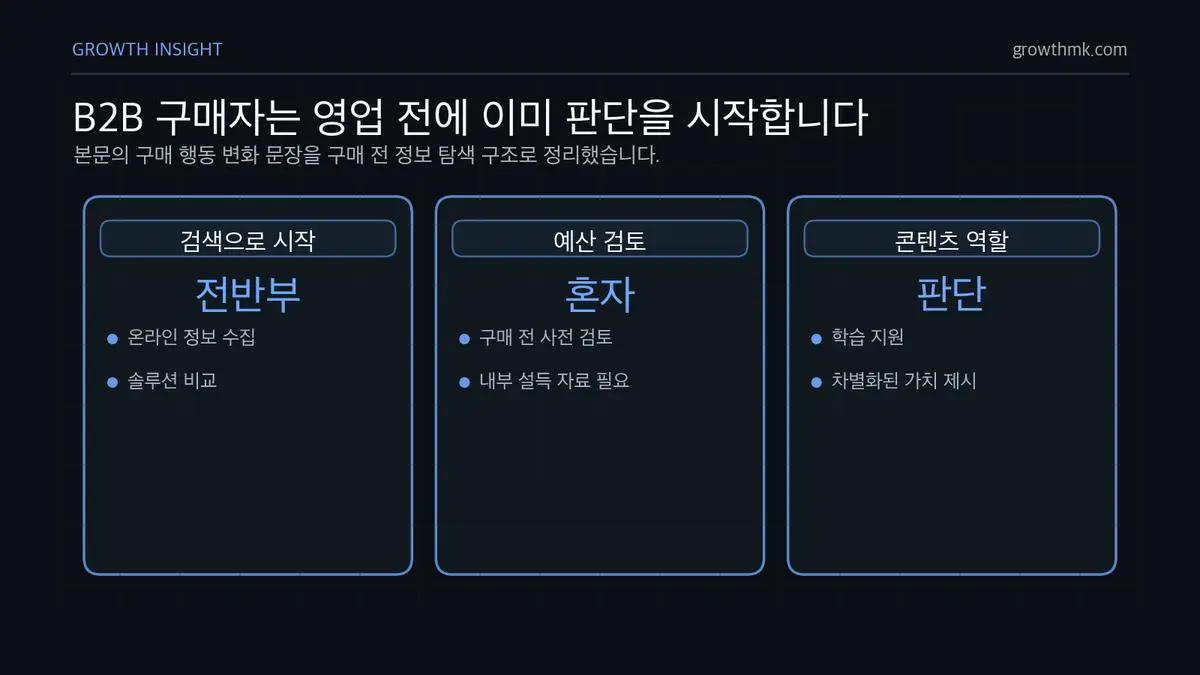
The way B2B marketing works — and the way buyers behave — has changed enormously. Buyers now say they complete more than half of their purchase journey on their own before ever talking to a salesperson. In fact, 6sense’s 2024 B2B Buyer Experience Report found that roughly 69% of the buying process happens before any contact with a sales rep, and 81% of buyers have already picked a preferred vendor before they ever talk to sales. They’re researching online, comparing solutions, and even reviewing budgets entirely on their own. The days of relying solely on a salesperson’s pitch are well and truly over.
This shift hands marketers a new assignment: create content that lets buyers learn everything they need and make the right call entirely on their own, while also making it unmistakably clear what sets you apart from the competition. And that raises an obvious question — which content format actually gets you there?
87% of B2B marketers say content marketing has increased brand awareness. 74% credit it with generating leads, and 62% say it has helped nurture subscribers and audiences. (Source: 2025 Content Marketing Statistics: Key Data to Shape Your Strategy)
Most companies already know content marketing matters. The trouble is deciding whether to focus on text or video, which often means resources end up scattered across both without a clear plan. With a limited budget and limited people, you can’t do everything well — so picking the content format that actually fits your company’s situation and goals is the real decision that matters.
Choosing a content format isn’t a matter of taste — it’s not about “we just prefer video.” It’s a strategic decision that has to weigh your customers’ characteristics, how complex your product is, what works in your industry, and the nature of the purchase decision itself, among many other factors.
So what specific strengths do text and video content each bring to the table? Let’s start with text.
B2B Marketing Format #1: The Unmatched Strengths of Text Content
The Foundation for Building Expertise and Trust
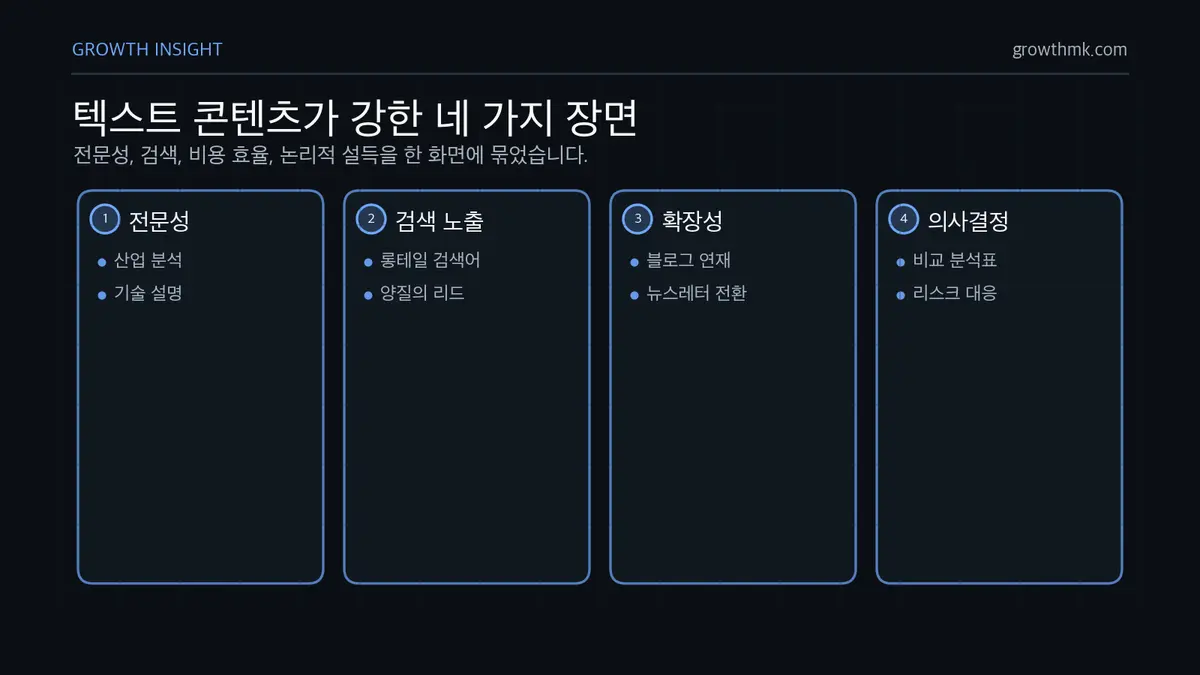
Text content’s biggest strength in B2B marketing is its ability to clearly demonstrate expertise. In-depth industry analysis, complex technical explanations, and logical solution walkthroughs are the kinds of content that come across most completely in text.
Here’s an example. A CFO evaluating an ERP rollout wants to know exactly how to calculate the ROI, what risks come up during implementation, and what results other companies actually achieved. That level of detail is hard to convey through video. Text content lets you meet that need in full, while naturally building the impression that “this company really knows what it’s doing.”
A Clear Edge in Search Engine Optimization
Most B2B buyers today start their research with an online search. And given how search engines find and rank content, text content still has an overwhelming advantage — which means it dramatically raises the odds that prospects will discover you in the first place.
This is especially true for longer, more specific searches. Someone searching for something like “what to check before rolling out an HR system at a small business” is far more likely to find text content than video. These searchers already have strong purchase intent, which makes text a powerful channel for bringing in high-quality leads almost automatically.
You can find detailed methodology for effective keyword research and SEO strategy in Keyword Research Strategy for Marketing, from Kickoff to Feedback and SEO Content Marketing: Start From the Customer’s Perspective.
Cost Efficiency and Scalability
Let’s be realistic about budget. Text content typically costs less to produce and keeps working for a long time. A well-made whitepaper or guide can keep generating leads for years, and it’s easy to update or repurpose whenever you need to.
It’s also remarkably versatile. Write one in-depth report, and you can turn it into a blog series, source material for infographics, and content for your email newsletter. That kind of reusability is a genuinely important advantage in B2B marketing, where you’re always trying to get the most out of limited resources. You can find a systematic approach to content marketing strategy in The Complete Guide to Content Marketing: Definition to Strategy and How to Write a Content Marketing Plan.
Logical Persuasion and Decision Support
In B2B, logic matters far more than emotion. The people making the purchase decision often have to explain to their boss or colleagues, later, exactly why they picked a particular vendor — logically. Text content is exceptional at supplying the concrete evidence that job requires.
Detailed comparison tables, step-by-step implementation plans, and anticipated risks with mitigation plans are things only text can convey effectively. And when multiple stakeholders need to review the same information together, text is far easier to share and review than any other format.
B2B Marketing Format #2: The Distinct Value of Video Content
Instant Trust and Relationship-Building
Now that we’ve covered text’s strengths, let’s talk about what makes video content uniquely compelling.
Video’s greatest strength is showing the “human face” behind a brand — something text simply can’t do. A CEO delivering a message directly, an engineering team’s genuine enthusiasm, a real customer telling their success story in their own words — these have real impact when delivered on video.
You already know how important trust-building is in B2B deals. Video excels here. Even with a company you’ve never heard of before, video can build the kind of familiarity you’d normally only get from meeting someone in person — fast. In a relationship-driven business like B2B, that can be a genuine competitive edge.
Making Complex Concepts Intuitive
Nothing explains complex technology or processes as effectively as video. Explaining how a manufacturing process was reengineered, how a piece of software actually works, or how system integration unfolds could take dozens of pages of text — but video can make it crystal clear in a few minutes.
For products where seeing them actually work matters — IT solutions, automation equipment, and the like — video is close to a requirement. Letting customers see with their own eyes what the product looks like and how it operates dramatically boosts their confidence in buying it.
Emotional Engagement and Memorability
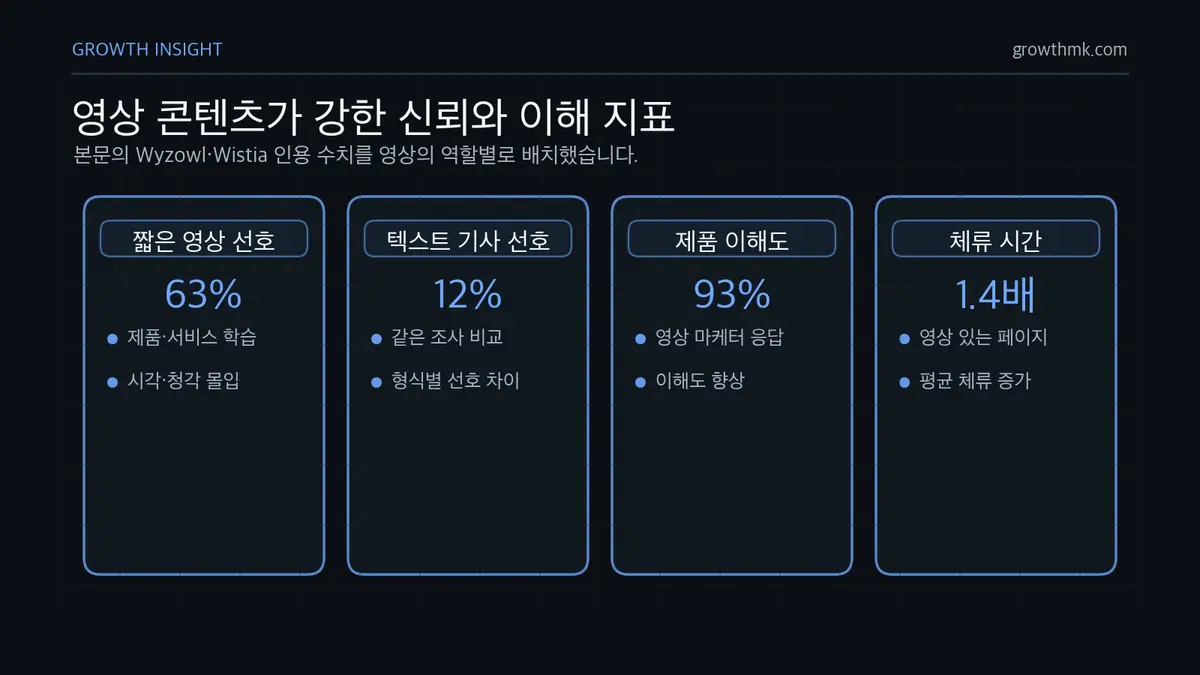
Video engages sight and sound at once, leaving a far deeper impression. A Wyzowl survey found that 63% of people prefer to watch a short video to learn about a product or service, compared to just 12% who prefer a text article, and 93% of video marketers say video has increased customer understanding of their product. That makes your company or product far more likely to come to mind at the exact moment a purchase decision is being made.
Video is also a natural fit for storytelling. Lay out the problem a customer was facing, what happened as they adopted your solution, and what results they ultimately achieved as a single narrative, and viewers see themselves in it — and get pulled in far more deeply.
Expressing Brand Personality and Differentiation
Video effectively conveys your company’s culture and values in ways text alone struggles to capture. Show what your office feels like, how your people think about their work, what philosophy your leadership operates by — and you come across not as just another vendor, but as a genuine partner.
For companies that want to emphasize innovation or creativity in particular, video is close to essential. Showing a product built on the latest technology, or a creative problem-solving process, on video lets you demonstrate your company’s capability and culture at the same time.
We’ve now covered the strengths of both text and video. So when, exactly, in the actual purchase decision process, is each format more effective?
Choosing a B2B Marketing Format: Content Effectiveness by Buyer Journey Stage
The Role of Content at the Awareness Stage
When a customer first recognizes a problem and starts looking for a solution, they mainly gather information through search. This is the stage where SEO-strong text content has the clear edge.
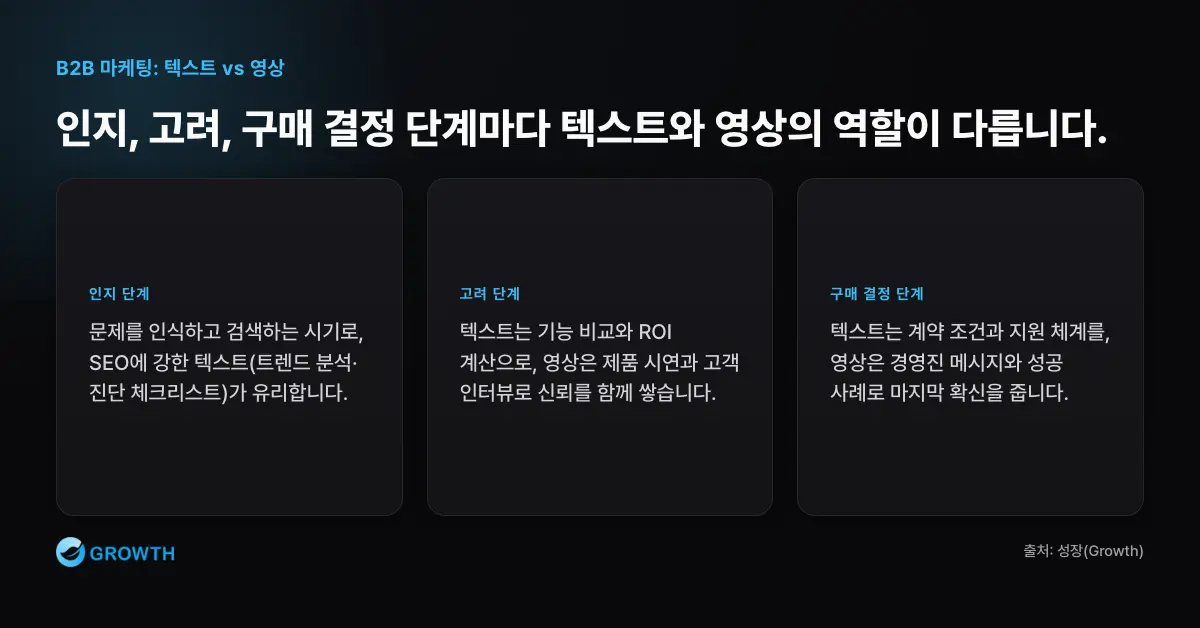
For someone searching with a still-vague query — “how to boost productivity” or “ways to cut costs” — text content works brilliantly: industry trend analysis, problem-diagnosis checklists, guides that summarize the solution methodology. Video can help build brand awareness or a strong first impression, but it still has real limits when it comes to “discoverability” — getting found by customers in the first place.
Selection Criteria at the Consideration Stage
Once a buyer starts seriously evaluating solutions, both content formats play an important role. Text supports the logical decision-making with detailed feature comparisons, case studies, and ROI calculations, while video builds credibility and confidence through actual product demos, customer interviews, and expert explanations. Wyzowl notes that pages with video see visitors stay 1.4x longer on average (per Wistia research).
What matters most at this stage is credibility. Text builds one kind of trust through precise data and evidence, and video builds another through vivid, real user experiences. The two are at their most effective when they complement each other.
Final Persuasion at the Purchase Decision Stage
In the final decision moment, what matters most is removing risk and building confidence. Here, text needs to resolve any last-minute worries with concrete details — contract terms, implementation plans, support structures.
Video needs to land the closing argument — a direct message from leadership, or a customer success story in a similar situation. Especially for large contracts, a video where the vendor’s CEO personally introduces themselves and the company’s vision can genuinely influence the final decision.
We’ve now walked through how to use content at each buying stage — but the right approach also varies a great deal by industry. Let’s look at what actually works for a few major sectors.
Setting Your B2B Marketing Format by Industry
The Content Approach for Manufacturing
Video content matters enormously in manufacturing B2B marketing. How efficiently your production line runs, how precise your products are, how you manage quality — no amount of explaining in words beats actually showing it. A factory tour video, a sped-up timelapse of the manufacturing process, footage of quality testing — customers who see these come away genuinely convinced.
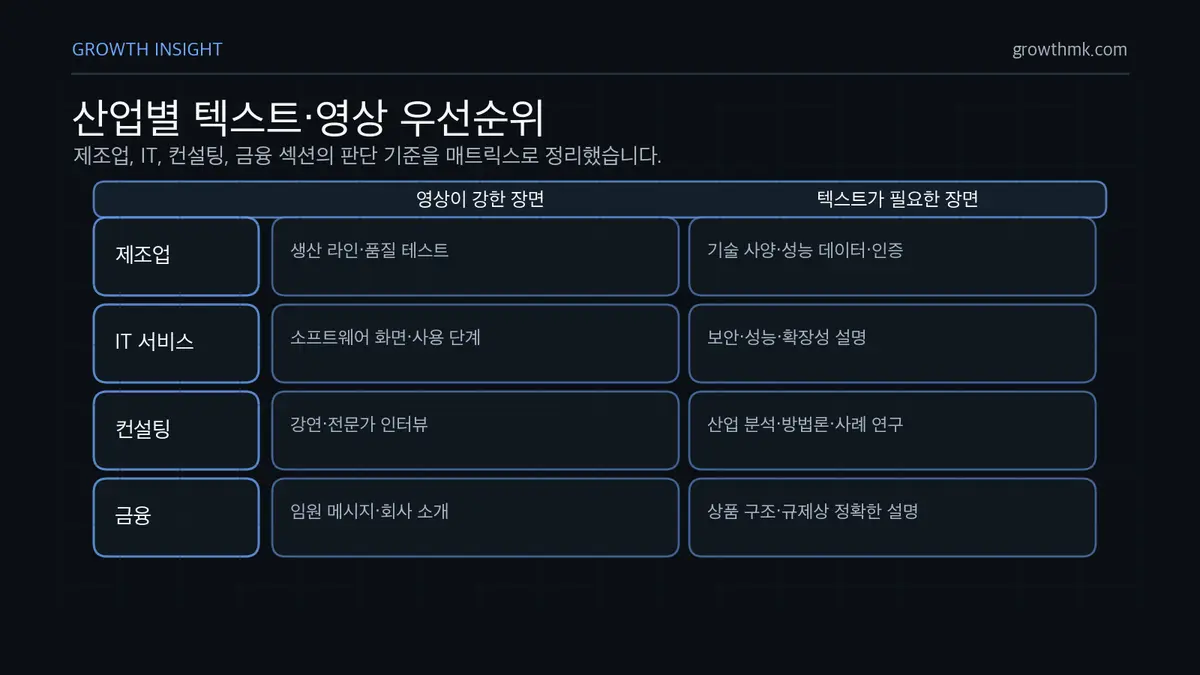
That said, detailed information — technical specs, performance data, certification status — absolutely must be provided as precise, well-organized text. Manufacturing customers scrutinize numbers and data closely. Systematically organized technical documentation and whitepapers are essential here.
Content Strategy for IT Services
Because IT services are intangible, customers genuinely struggle to experience the outcome in advance. Overcoming that limitation makes video demonstrations and explanations especially important. Screen-capture footage showing the software actually in use, a step-by-step walkthrough of how to use it, or a detailed look at the implementation process are all far more effective on video than in text.
But explaining technical requirements — security, performance, scalability — still needs text. CTOs and IT leads need to know exactly how the technical architecture is put together, what security protocols are used, and what the performance benchmarks look like. This kind of detail has to come as technical documentation.
Where video clearly wins, though, is making complex concepts intuitive. For a practical playbook on using video marketing effectively in B2B, see The YouTube Marketing Guide for B2B Companies, which offers strategies practitioners can put to use right away.
Consulting and Professional Services
In consulting, expertise and credibility are the top purchase criteria. Text content — in-depth industry analysis, proprietary methodology explanations, and case studies — plays a genuinely central role in proving both. Customers mostly assess a consultant’s depth of thinking and approach through what they write.
But video is also crucial for showcasing an individual consultant’s expertise and credibility. Footage of them speaking at an event, an expert interview, or an actual conversation with a client can show both professional competence and human warmth at the same time.
Financial and Insurance Services
In financial services, trust and stability are everything. Explaining the structure of a complex financial product or service requires detailed text, but showing how stable and trustworthy your company is — that’s where a direct message from leadership or a company overview video is genuinely effective.
Financial services in particular operate under strict regulation, so every marketing message has to be precise — which makes the accuracy of text content even more critical. On the other hand, when it comes to explaining the benefits of a complex financial product simply, or sharing a success story, video can be far more effective.
Building an Integrated B2B Marketing Format Strategy
Setting Priorities Under Budget and Resource Constraints
A strategy tailored by industry matters, but in practice, budget and staffing constraints often dictate the real decision. How should you prioritize to get the most out of limited resources?
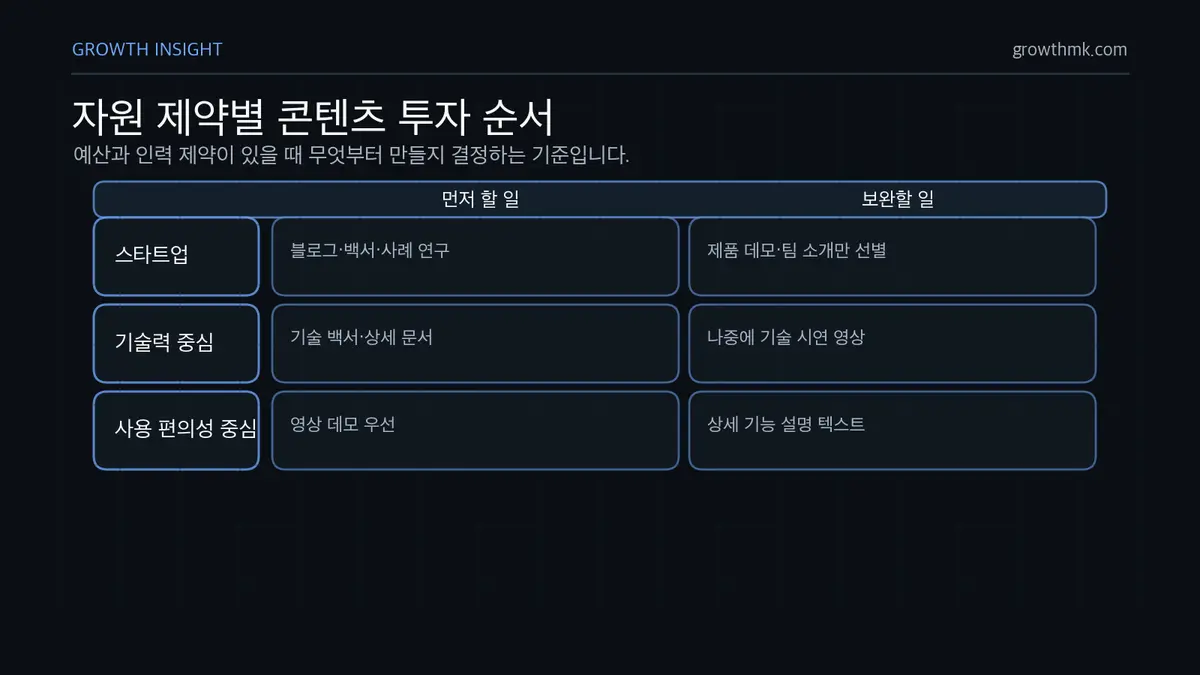
If you’re a resource-constrained startup, focus is everything. Starting with text content is usually the more efficient path. Blog posts, whitepapers, and case studies tend to cost less to produce while still delivering SEO value and showcasing your expertise. You can find concrete B2B marketing strategy for startups, along with real success stories, in B2B Startup Marketing Case Studies and Strategy.
It’s especially valuable if your founder or core team members can write directly — you get a steady stream of quality content without adding headcount cost. Video works best when reserved for the things that genuinely need it, like a product demo or a team introduction.
If you’re a mid-size company with more scale and resources, you can combine text and video appropriately. But you still need to make strategic choices — weigh what your company’s strength is and what your target customers are like to decide where to focus more.
For example, if technical capability is your core differentiator, invest first in technical whitepapers and detailed documentation, then follow up with a video that actually demonstrates the technology. If ease of use is your solution’s strength, lead with a video demo and back it up with supporting text.
A Priority Matrix for Maximizing ROI
Build a simple checklist for deciding where to invest in content. It helps to evaluate, together: the expected payoff relative to production cost, what content format your target customers actually prefer, whether you can meaningfully differentiate from competitors, and whether you have the in-house capability to produce it well.
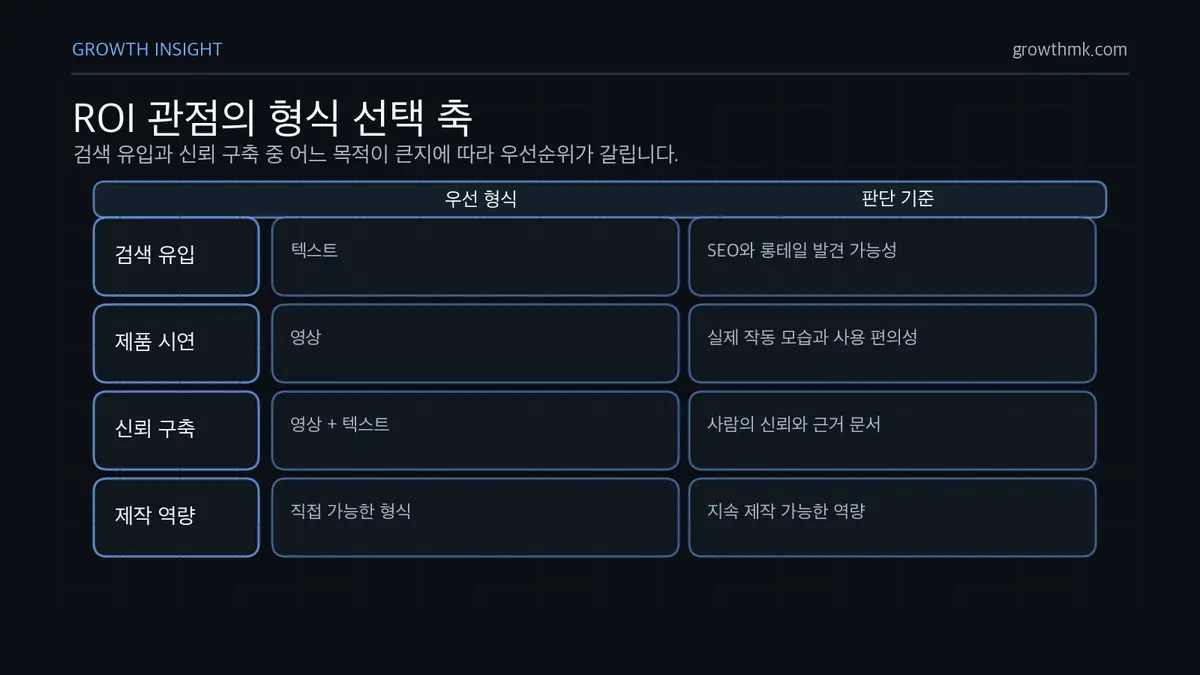
As a general rule, text content ranks higher for businesses where search acquisition matters most, while video ranks higher where product demonstration or trust-building matters most. But there are real pitfalls to watch for when allocating marketing budget and measuring ROI. The Advertising Budget Ceiling: The Trap of ROI and ROAS explains in detail how to avoid these mistakes.
We’ve now covered when and how to use text and video individually — but honestly, the real question is how to combine the two to create genuine synergy.
A Staged Strategy for Maximizing Synergy
Text and video aren’t competing formats — they’re complementary. The most effective B2B marketing combines the strengths of both to create something more powerful than either alone.
Here’s a real example: write an in-depth industry analysis report as text first, then pull out the core insights into a summary video, and you reach a much wider audience. Or make a product demo video first, then back it up with detailed feature explanations and FAQs in text, and you end up with a genuinely polished set of marketing materials.
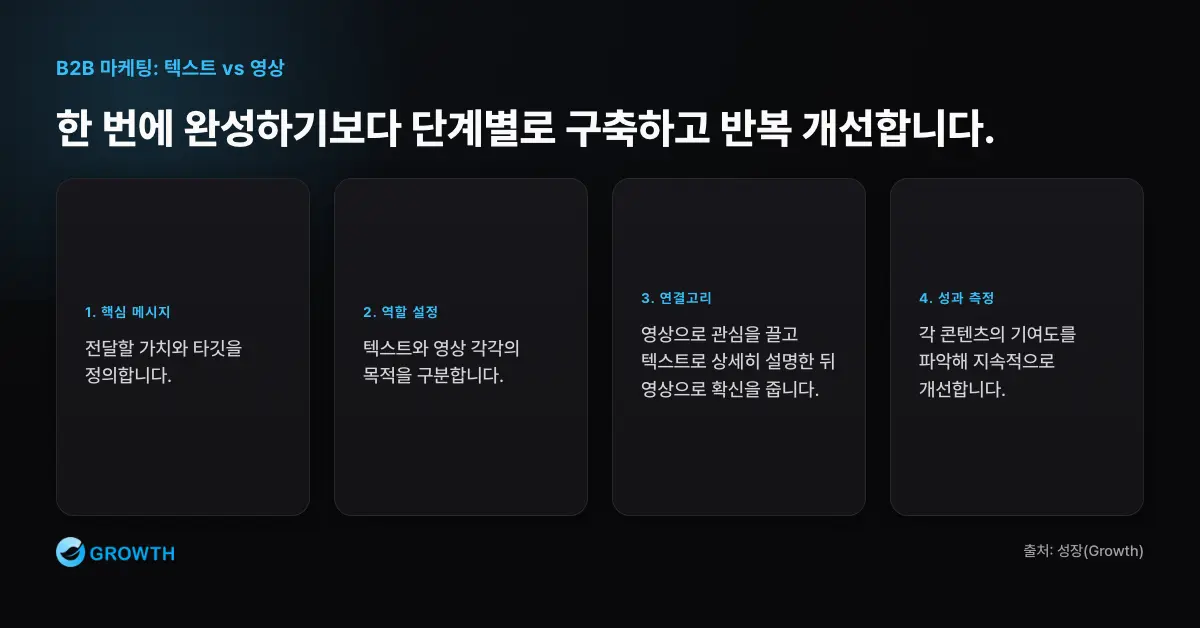
An effective integrated content strategy doesn’t get built all at once — you have to construct it step by step. Start by clearly defining the core message you want to deliver and exactly who your target customer is. Next, spell out concretely what role each content format will play and what goal it’s meant to achieve.
In the third step, design the connective tissue between your content pieces. Sketch out the customer journey in advance: video draws in attention, text supplies detailed information, and another video reinforces confidence. Finally, decide how you’ll measure results and keep improving from there.
Measuring Performance and Continuous Improvement
Don’t judge content marketing performance by views or downloads alone — you need to see what actual business impact it had. Evaluate holistically: how many leads it generated, how good those leads were, whether it shortened the sales cycle, and what the actual close rate looked like. You can find a systematic methodology for measuring B2B marketing performance in How to Set B2B Marketing KPIs and A Guide to Measuring Content Marketing KPIs.
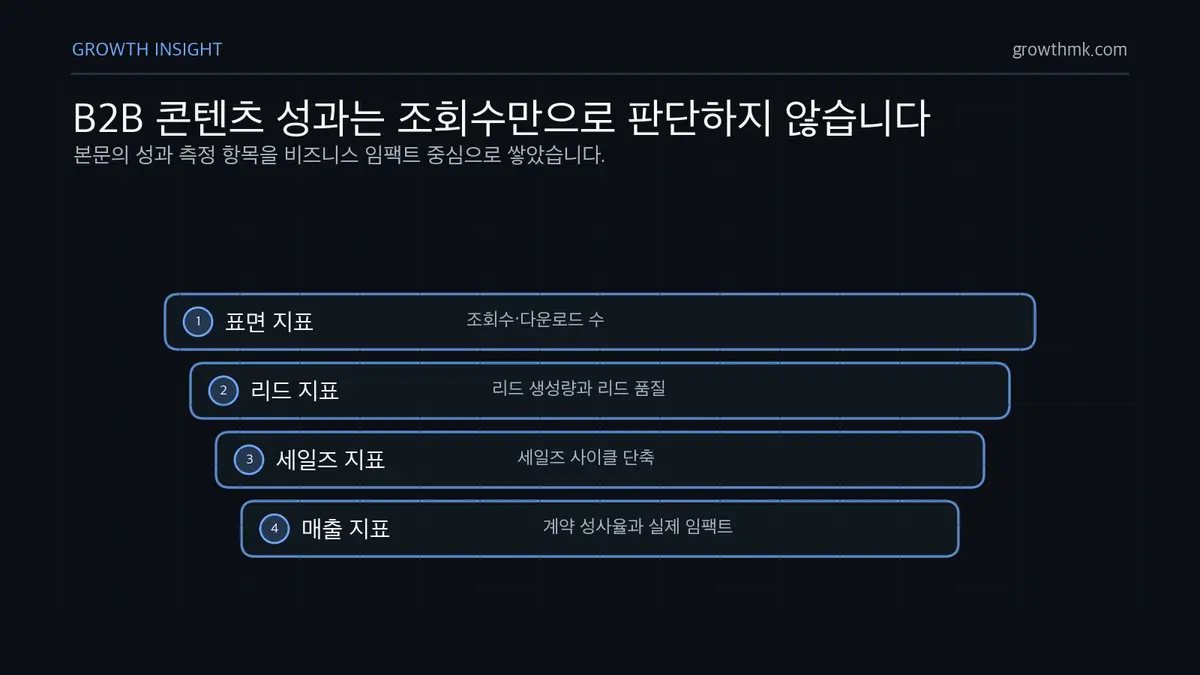
To pin down exactly how much text and video each contributed, you need a genuinely precise tracking system. You have to know which content brought a customer in first and which content proved decisive at the moment of purchase — that’s what lets you actually correct course next time. For a systematic approach to improving performance, see A/B Testing: How to Consistently Improve Ad Performance, which walks through the execution steps.
A successful B2B marketing format strategy ultimately starts with genuinely understanding your customers’ needs and buying process, then delivering content optimized for exactly that. Whether you choose text or video is really just a question of means — the goal, delivering real value to the customer, stays the same either way.
The key to marketing success is understanding your company’s situation and your customers’ characteristics precisely, then finding the content mix that fits. You don’t need to get it perfect from day one. Start small, keep testing and iterating, and you’ll find your own formula for success.
More Related Reading
- A to Z Analysis of B2B Marketing Trends: A comprehensive report analyzing shifts in the B2B marketing landscape and the major trends driving them.
- Content Marketing Case Studies — From Customer Intent Analysis to Highlighting Your USP: Practical, ready-to-use insights drawn from successful content marketing examples.
- A Guide to Brand Content Marketing: A guide to producing content and building a branding strategy that reflects your brand identity.
- What Is B2B Marketing Lead Generation and How Do You Do It: Concrete methodology for generating and managing leads through content.
Related Reading
- The Complete Guide to B2B Marketing — Strategy, Channels, ABM, Lead Generation, and Measurement
- What Should Be Different About Marketing to B2B Decision-Makers
- Where Does B2B Marketing Fit in the Age of AI
- B2B Marketing Channels: How Are They Different From B2C?
- Does a B2B Newsletter Really Drive Revenue?
Want to apply this to your own business? See how Growth approaches this in our B2B Marketing service, or reach out via Contact Us if you’d like a specific diagnosis of your situation. We answer based on the one person who becomes revenue, not the volume of traffic.
Frequently Asked Questions (FAQ)
Should B2B marketing start with text or video?
The right answer depends on your company’s situation. If you’re a resource-constrained startup, it’s usually more efficient to start with text content (blogs, whitepapers, case studies), since it costs less and delivers SEO value at the same time. It’s even better if your founder or core team members can write directly. It’s more realistic to invest in video selectively, for things that genuinely need it, like a product demo or a team introduction.
Which content format is more effective at each stage of the buyer journey?
At the awareness stage, discoverability through search matters most, so SEO-strong text content has the advantage. At the consideration stage, text (feature comparisons, ROI calculations) and video (product demos, customer interviews) build trust in different ways, and using both together is most effective. At the purchase decision stage, use text to resolve last-minute concerns like contract terms and support structures, and use video — leadership messages, success stories — to add confidence.
Why does text content have an advantage for SEO?
Because the way search engines find and rank content still gives text an overwhelming edge. Text content in particular performs well for specific, longer queries (long-tail keywords) like “checkpoints before rolling out an HR system at a small business” — and people searching that way already have high purchase intent, which makes them high-quality leads.
How should I combine text and video for real synergy?
The two formats complement each other rather than compete. Write an in-depth industry analysis report in text first, then summarize the core insights in a video — or make a product demo video first, then back it up with detailed feature explanations and an FAQ in text. The approach is: define your core message and target audience → set the role each content format will play → design the connective tissue between pieces of content (video draws interest → text supplies detail → video reinforces confidence) → measure results and keep improving.