
The AI Search Optimization Playbook — How to Get Your Brand Cited in AI Answers
 임재복
임재복
AI search optimization is the work of designing your content and your site so that generative answer engines — ChatGPT, Perplexity, Google AI Overviews — cite and recommend your brand when they answer a user’s question. It comes down to five steps: (1) let AI crawlers actually read your site by opening the right paths in robots.txt, (2) structure your content into self-contained chunks that fully answer one question each, (3) let machines parse your meaning with FAQ and Article structured data, (4) raise your evidence density with citations, statistics, and primary sources, and (5) reinforce trust with third-party signals — directories, reviews, communities. This guide is reverse-engineered from a single moment: the instant a customer asks ChatGPT a question.
Traditional SEO asked “where do we rank on the results page?” AI search optimization asks a different question: “are we the ones cited inside the answer the AI generates?” The whole game can be won without a single click — what matters is whether your brand shows up inside the answer itself. And the winner isn’t whoever pulls the most traffic; it’s whoever has organized their content in the form AI trusts most and can cite most easily. At Growth, we frame this as “one person who becomes revenue, not traffic volume.” Being cited accurately once inside an AI answer is closer to an actual purchase decision than 10,000 meaningless impressions.
Why start AI search optimization now?
Because search behavior itself is changing. Users are increasingly typing full questions instead of keywords, and they want a synthesized answer instead of a list of links. The moment an AI names two or three specific brands in response to “recommend a B2B marketing agency,” any company not on that list disappears from consideration. Zero visibility — and you’ve already lost the competition.
The academic evidence has caught up too. A paper on Generative Engine Optimization (GEO) from researchers including a Princeton team (arXiv:2311.09735) reported that applying optimization techniques aimed at generative engines improved answer visibility by up to 40%. The same paper is careful to note that the effect varies significantly by domain. There’s no single magic technique — you need a combination suited to your specific content.
One thing needs to be clear from the start: AI search optimization isn’t a replacement for existing SEO. It’s built on top of it. The conceptual definition of AI search optimization is covered in more depth in Generative Engine Optimization (GEO/AIEO), and the technical foundation it depends on is covered in our complete technical SEO guide. We’d recommend reading both alongside the execution steps below.
Step 1 — Let AI crawlers actually read your site (robots.txt)
To be cited by AI, your pages have to be readable by AI in the first place. A surprising number of sites block AI crawlers over security or traffic concerns, then ask, “why aren’t we showing up in AI answers?” robots.txt is the first thing to check.
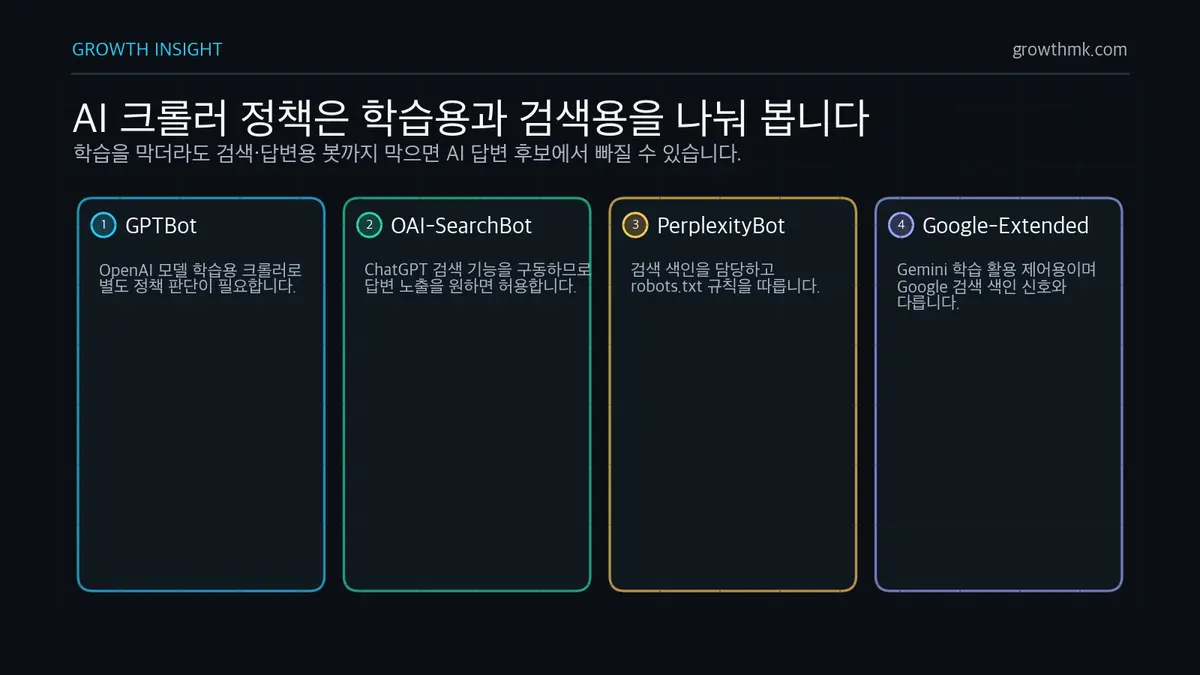
There’s a critical distinction here. AI companies’ crawlers split into “used for model training” and “used for search and answers.” Per OpenAI’s official bot documentation, GPTBot is for training generative models, OAI-SearchBot powers ChatGPT’s search feature, and ChatGPT-User handles browsing requests a user triggers directly inside ChatGPT. So if you don’t want to feed the training set but do want to appear in ChatGPT’s search answers, you need to block GPTBot while still allowing OAI-SearchBot. Block both at once and you disappear from ChatGPT search results entirely.
Perplexity works the same way. According to Perplexity’s crawler documentation, PerplexityBot, which handles search indexing, follows robots.txt rules — so it needs to be explicitly allowed. Perplexity-User, which visits pages to answer a user’s question in real time, “generally ignores” robots.txt because the user initiated the request. Anthropic likewise distinguishes ClaudeBot (training), Claude-User (user-initiated search), and Claude-SearchBot (search quality improvement) in its own documentation.
Google is a slightly different case. Per the Google-Extended documentation, Google-Extended is a separate token that controls whether your content is used to train Gemini models. Blocking it “doesn’t affect a site’s inclusion or ranking in Google Search.” If you want to appear in Google AI Overviews, the priority — regardless of your Google-Extended setting — is making sure regular Googlebot can index you normally, as it always has.
| Execution checklist (Step 1) | How to verify | What to look for |
|---|---|---|
| Allow OAI-SearchBot in robots.txt | Open your domain’s /robots.txt directly | It should not be caught by a Disallow rule |
| Allow PerplexityBot, Claude-SearchBot | Check the rule for each user-agent | Search-facing bots should never be blocked outright |
| Decide your training vs. search bot policy | Align internally on GPTBot/ClaudeBot access | “Refuse training, allow search” is the common default |
| Remove noindex / login walls on key pages | Check meta robots and access permissions | Any page you want cited must be public and indexable |
| Check firewall/WAF bot IP blocks | Cross-check against each company’s published IP ranges | Legitimate crawler IPs should never be blocked |
Step 2 — Structure answer-ready content: write in self-contained chunks
AI doesn’t cite a whole page at once. It pulls out “the one block that directly answers the question.” That means you need to write in self-contained chunks — units you could lift out of the page entirely, and a reader would still know exactly what question they answer and find the full answer right there.
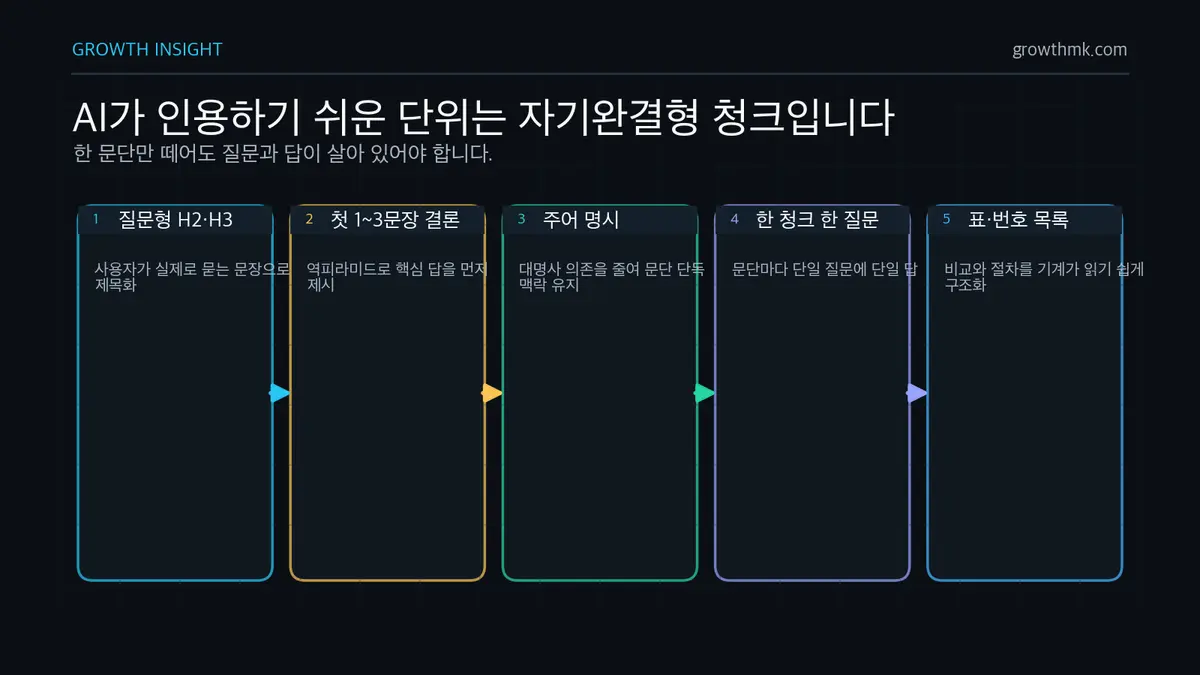
The practice is simple. First, phrase every H2 and H3 as a question a real user might actually type (“How is AI search optimization different from SEO?”). Second, put the conclusion in the first one to three sentences right underneath it — inverted pyramid style. Third, never lean on pronouns (“this,” “that”) to point back at the previous paragraph; name the subject explicitly so a single paragraph, lifted out on its own, still makes complete sense. Fourth, structure comparisons, numbers, and steps as tables or numbered lists — AI parses tables cleanly.
This structure is really just the fundamentals of good writing. Reading SEO writing that starts from the customer’s question alongside the Customer Decision Journey (CDJ), which covers how a customer’s questions evolve stage by stage, will help you prioritize which chunk to write first.
| Execution checklist (Step 2) | Weak example | Strong example |
|---|---|---|
| Phrase headings as questions | “Features of our service” | “What problem does this service solve?” |
| Conclusion first (inverted pyramid) | Background, then the conclusion at the very end | The core answer in the first sentence, evidence after |
| Cut pronoun dependence | “This reduces cost” | “Setting up conversion tracking reduces wasted ad spend” |
| One chunk = one question | Multiple topics mixed into one paragraph | Each paragraph: a single question, a single answer |
| Use tables and numbered lists | Comparisons written out as prose | Items and criteria organized into rows and columns |
Step 3 — Improve machine readability with FAQ and Article structured data
Structured data (Schema.org) is how you attach machine-readable labels — “this is the question,” “this is the answer,” “this is the author,” “this is the publish date” — to content a human already reads normally. Getting FAQPage and Article schema right lets answer engines read the structure of your content as an explicit signal instead of having to guess at it.
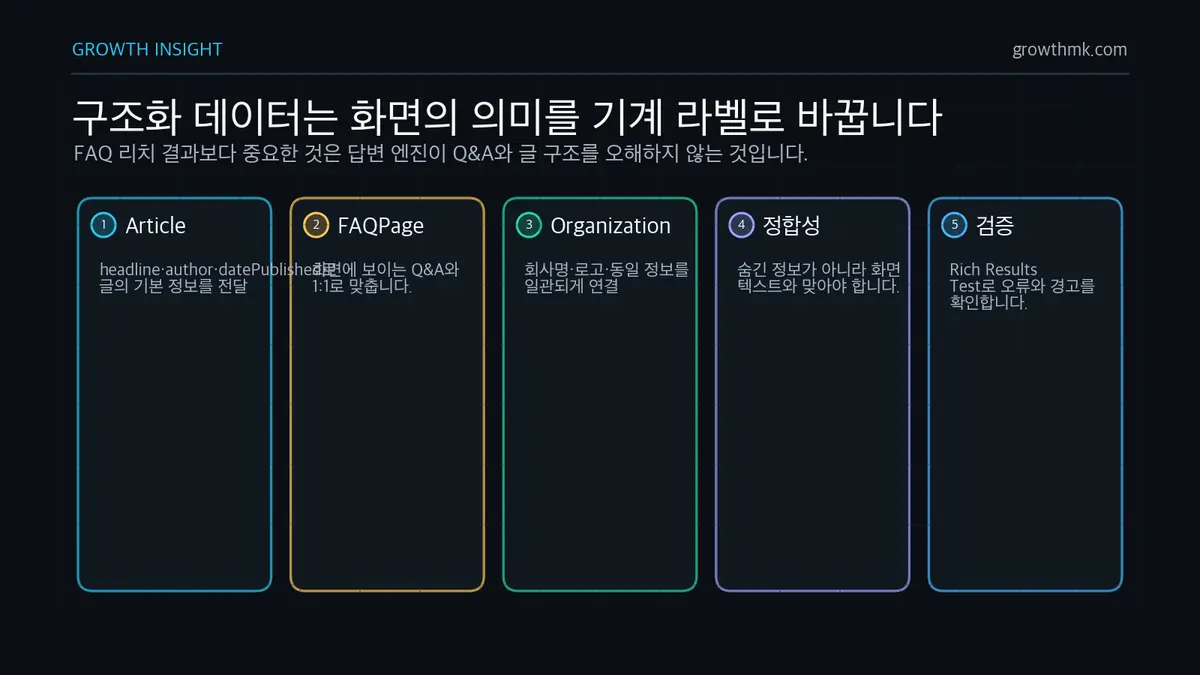
Let’s clear up a common misconception here. Google’s own FAQPage documentation states that, as of May 2026, it’s effectively discontinuing the FAQ rich result (the expandable Q&A UI in search results) for most sites. That makes it easy to assume “FAQ schema is pointless now.” But that change is only about the visual rich result in search. The structured question-and-answer format itself is still an advantage for helping answer engines extract question-answer pairs accurately. Think of it as something you use for machine readability, not for the display UI.
Google actually emphasizes a different principle more strongly. In its documentation on Search’s AI features, Google states plainly that “there’s no special requirement or unique optimization to appear in AI Overviews or AI Mode” — what matters is that “a page is indexed and eligible to appear in Search with a snippet.” It also notes that “you don’t need to create a separate text file or new markup for AI, and structured data should match the content visible on the page.” Schema isn’t a magic key — it’s a supporting device that helps machines read well-made content without misinterpreting it.
| Execution checklist (Step 3) | Where to apply it | Watch out for |
|---|---|---|
| Article/BlogPosting schema | Every piece of content | Fill in headline, author, and datePublished |
| FAQPage schema | Pages that contain Q&A | Must match the on-screen Q&A one-to-one |
| Organization schema | Brand homepage / about page | Keep company name, logo, and details consistent |
| Consistency with visible text | All schema | Never mark up hidden information |
| Validate with the Rich Results Test | Before publishing | Confirm zero errors and warnings before you ship |
The full picture of page-level optimization, schema included, is covered in our on-page SEO definition and setup guide.
Step 4 — Raise your evidence density (citations, statistics, primary sources)
AI answer engines prefer “content backed by evidence” over “content that just asserts things.” What the visibility-boosting techniques in the GEO paper cited above actually had in common, in the end, was strengthening trust signals. Explicitly including statistics, citations, and authoritative sources in the body of your content raises the odds you get selected for an answer.
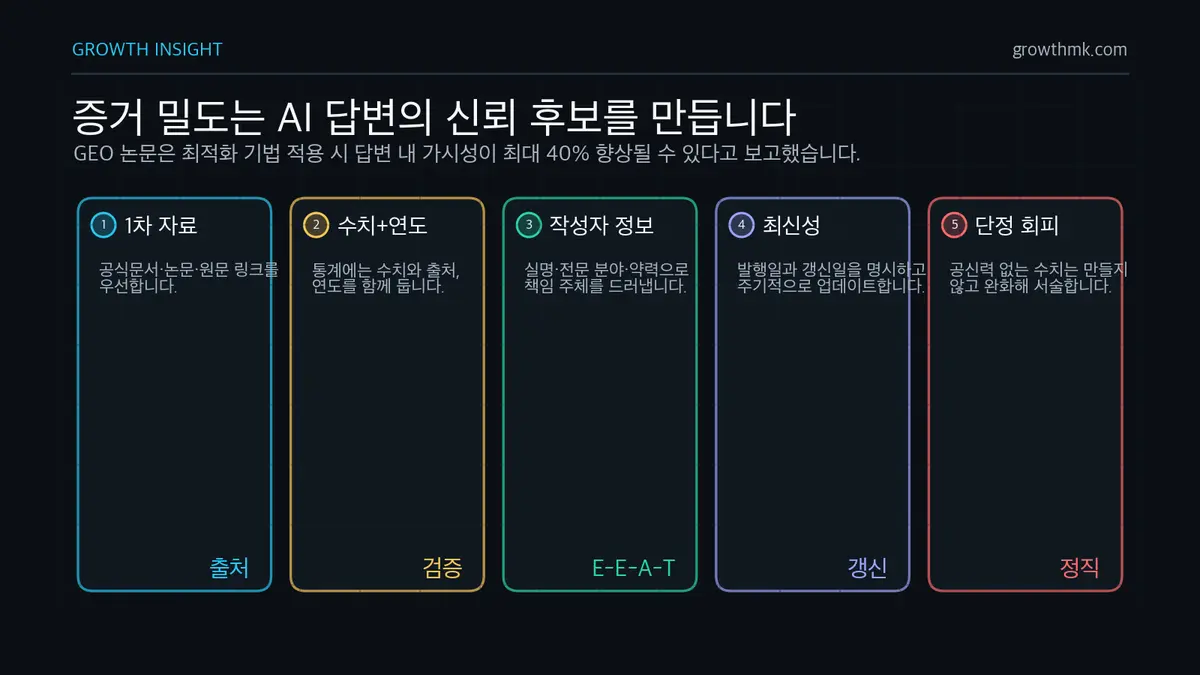
At Growth, we call this “evidence density” — how tightly packed a single page is with verifiable facts. But the single most important principle here is honesty. Plausibly inventing a number with no clear source doesn’t just fail AI’s cross-verification and get you dropped from citation candidates — it undermines your brand’s credibility entirely. It’s better not to use a statistic you can’t confirm. For example, claims like “a large share of the URLs ChatGPT cites carry FAQ or Article schema” circulate widely in the industry, but if you can’t pin the number down to a credible primary source, don’t state it as fact — soften it to something like “structured pages appear to be cited more often,” instead.
Evidence density connects directly to E-E-A-T (Experience, Expertise, Authoritativeness, Trustworthiness). Primary data, real-world case results, and an author’s real name and credentials all build trust. For a detailed breakdown of the criteria, see what is E-E-A-T; for how to secure measurable data in the first place, see why tracking-tool setup matters for B2B marketing. Growth’s own data-science-driven approach is rooted in exactly this idea — speaking from measured fact rather than guesswork.
| Execution checklist (Step 4) | Strong signal | Weak or risky signal |
|---|---|---|
| Source type | Primary sources, official docs, papers | Unsourced assertions, citations of citations |
| How statistics are handled | Number + source + year, stated explicitly | Vague generalizations like “many companies…” |
| Author information | Real name, area of expertise, bio shown | Anonymous, unclear who wrote it |
| Freshness | Publish/update date shown, updated regularly | Stale numbers left unchanged |
| Verifiability | Confirmable via a link to the original source | Claims that can’t be checked |
Step 5 — Build third-party signals (directories, reviews, communities)
AI trusts what other people say about you more than what you say about yourself. No matter how well-organized your own site is, without consistent outside mentions, it’s hard for an answer engine to be confident you’re actually trustworthy. That’s why off-site signals are the final step.
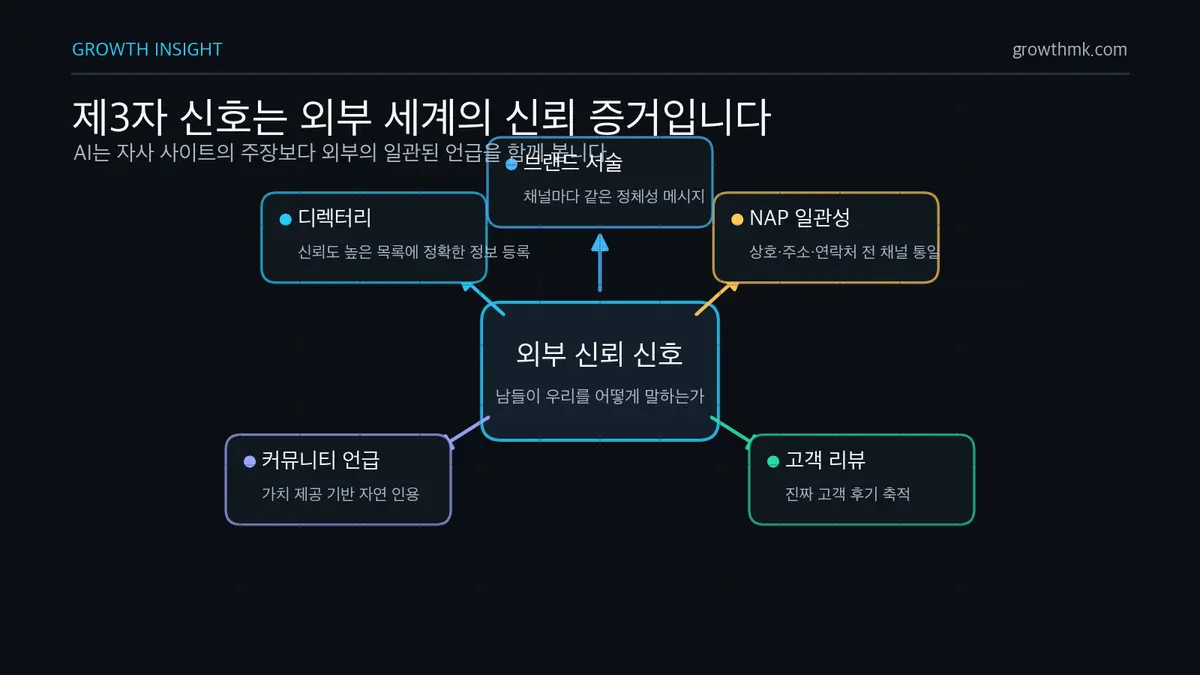
Third-party signals build up along three tracks. First, list accurate information — business name, address, contact details — with trusted directories and industry lists. The more places your consistent business information cross-checks, the more trust it builds. Second, earn reviews and testimonials from real customers. Third, provide content valuable enough that relevant communities and authoritative media naturally mention and cite it. All three, in the end, are just different expressions of the same signal: how the outside world perceives you.
What you should never do here is manufacture it artificially. Fake reviews or mass registration on low-quality directories are questionable even in the short term and genuinely risky over the long run. For a legitimate approach to outside signals — especially healthy backlink management — see our beginner’s guide to managing backlinks. And if you want a standard for staying skeptical of “guarantees” when hiring an outside agency, our checklist for choosing an SEO agency is worth a look.
| Execution checklist (Step 5) | Do | Avoid |
|---|---|---|
| Directories / industry listings | Register accurate info with trusted sources | Mass spam registration on low-quality directories |
| Business info consistency (NAP) | Same name, address, contact across every channel | Letting mismatched info linger across channels |
| Customer reviews | Accumulate real reviews from real customers | Fake or paid-for reviews |
| Community / media mentions | Natural citations earned by providing value | Artificial link exchanges or spam |
| Consistent brand narrative | The same identity and message everywhere | Conflicting positioning across channels |
How do you pull all five steps together into one execution?
These five steps aren’t isolated tasks — they’re one continuous flow. If you set the moment a customer asks ChatGPT a question as the endpoint and design backward from there, this is how it chains together: (5) the outside world recognizes you as trustworthy → (4) your pages are dense with verifiable evidence → (3) machines can parse that evidence accurately → (2) it’s organized into chunks that answer questions directly → (1) AI crawlers can actually read that page in the first place. Break any single link in that chain, and your odds of appearing in an answer drop sharply.
If you’re prioritizing, Step 1 (allowing crawlers) and Step 3 (schema) are technical work you can close out quickly — foundational construction. Step 2 (self-contained chunks) and Step 4 (evidence density) are the heart of content quality, so they need continual refinement. Step 5 (third-party signals) is a slow, cumulative game, which is exactly why it pays to start it earliest. To see this whole picture in the context of how the search landscape itself is shifting, we’d recommend also reading SEO trends driven by changes in South Korea’s search market share and, on how content fits into the AI era, whether it’s okay to use generative AI in content marketing.
| Step | Core question | Difficulty | Speed to see results |
|---|---|---|---|
| 1. Allow crawlers | Can AI actually read us? | Low (technical) | Fast |
| 2. Answer-ready structure | Do we answer the question directly? | Medium (content) | Medium |
| 3. Structured data | Do machines understand our meaning? | Low (technical) | Medium |
| 4. Evidence density | Is our evidence dense enough? | Medium (content) | Medium to slow |
| 5. Third-party signals | Do other people trust us? | High (cumulative) | Slow |
At Growth, we check these five steps through a data-science lens and improve them by measuring actual citation and visibility data — not by guessing. Getting your brand recommended in AI search isn’t about “driving more traffic.” It’s about showing up with the right answer in front of the one person who’s about to make a purchase decision. Designing and executing AI search and answer engine optimization (GEO/AIEO) from the ground up is exactly what Growth’s GEO/AIEO service is built for. If you need a diagnosis of exactly where your brand’s chain is breaking right now, let us know through our contact page.
Frequently Asked Questions
How is AI search optimization different from traditional SEO?
Traditional SEO focuses on raising your link’s rank on the search results page. AI search optimization is about getting your brand cited and recommended inside the answers that ChatGPT, Perplexity, and Google AI Overviews generate. That said, the two aren’t a replacement relationship. Google itself has said the key to appearing in AI Overviews is simply that “a page is indexed and eligible to appear in Search with a snippet” — no special separate requirements — which makes clear that solid SEO is the foundation AI search is built on.
Do I have to allow GPTBot to show up in ChatGPT search?
No. Per OpenAI’s official documentation, GPTBot is for model training, while OAI-SearchBot is what actually powers ChatGPT’s search answers. So if you want to refuse having your data used for training but still want to appear in ChatGPT search, block GPTBot while explicitly allowing OAI-SearchBot in robots.txt. Block both at once, and you disappear from ChatGPT search results.
Doesn’t FAQ schema matter anymore?
Google has discontinued the visual rich result (the expandable Q&A UI) in search results for most sites as of May 2026. But that’s only a change to the display UI. The structured question-and-answer format itself is still an advantage — it helps answer engines extract Q&A pairs accurately. Shift your thinking from “so it looks nice in search results” to “so machines can read it correctly.”
Is loading up on statistics the fastest way to show up in AI answers?
What matters is verifiability, not volume. Numbers grounded in clearly sourced primary data, official documents, or papers become trust signals — but inventing an unsourced statistic will fail AI’s cross-verification, get you dropped from citation, and cost you brand credibility on top of it. It’s safer, and better for you long-term, to soften an unconfirmed number into a trend-level statement rather than stating it as fact.
How quickly will I see results?
It varies by step. Allowing crawlers (Step 1) and structured data (Step 3) are technical work, so they take effect comparatively fast. Self-contained chunks (Step 2) and evidence density (Step 4) build up as you keep refining your content. Third-party signals (Step 5) are a long game — outside trust simply takes time to accumulate. It pays to start Step 5, the slowest one, the earliest.