
Website Domain Rating (DR): Definition, Importance, and an Implementation Guide
 임재복
임재복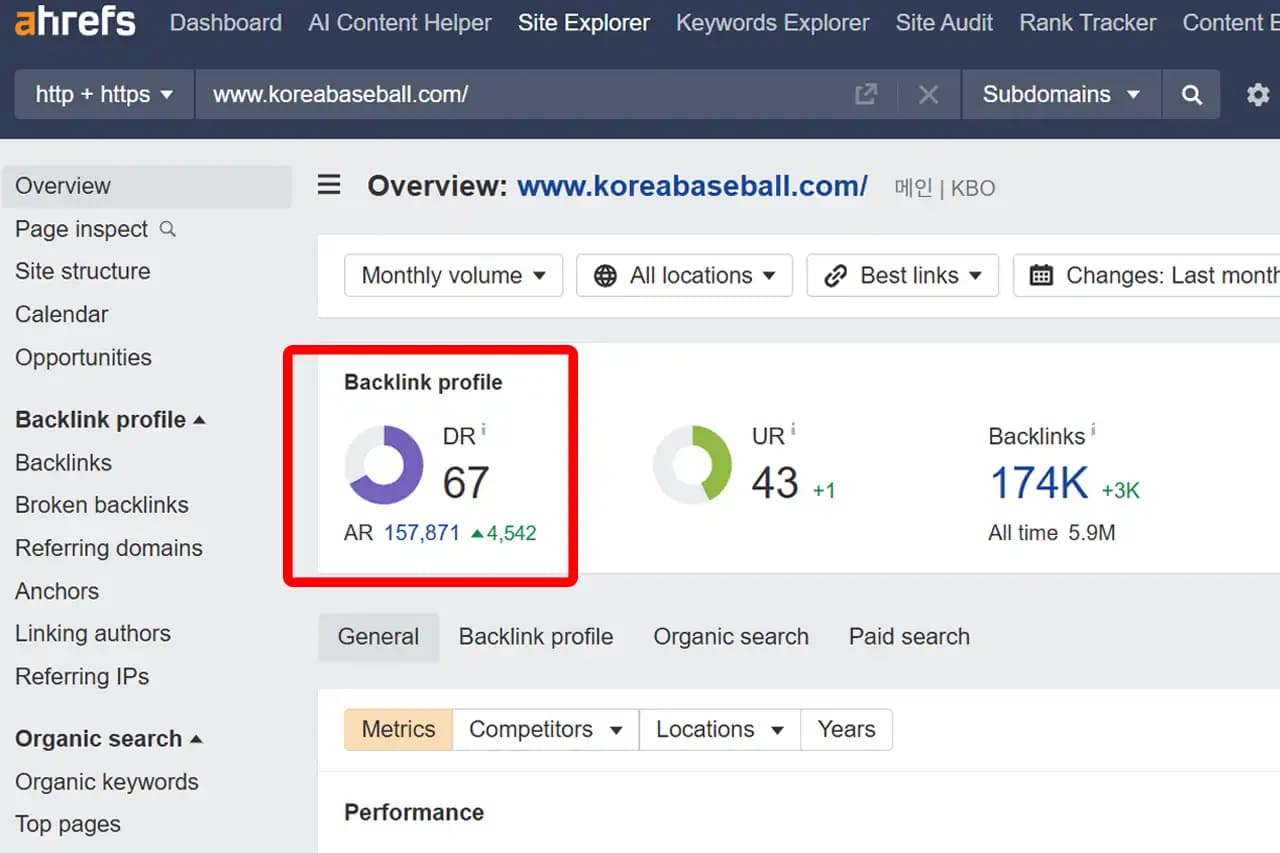
A website is the face of your business in the digital world. So how “trustworthy” of an impression does your website leave with visitors? There’s an important metric for measuring exactly that: Domain Rating (DR).
Domain Rating is a metric that reflects a website’s authority and trustworthiness, and it’s one of the core factors behind SEO success.
A high Domain Rating is essentially a signal to both search engines and users that “this website can be trusted.” But how is DR measured, and why does it matter? And how can you raise it? Let’s dig into everything about DR.
What Is Domain Rating (DR)?
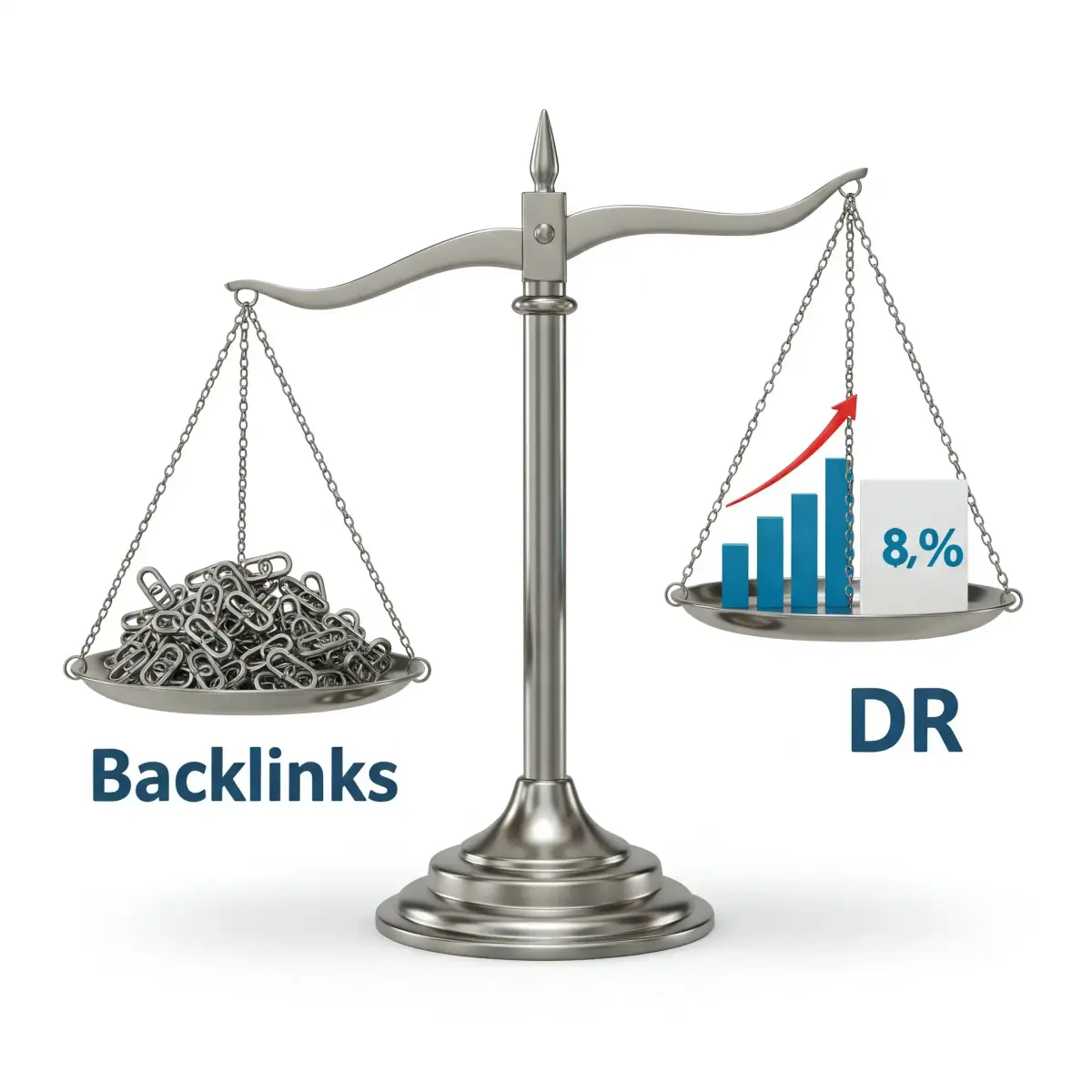
Domain Rating (DR) is a metric developed by the SEO tool Ahrefs that reflects a website’s relative authority. It’s measured on a logarithmic scale from 1 to 100, where a higher number means a higher score. DR is calculated primarily based on the number and quality of backlinks pointing to a website.
- Why backlinks matter: a link from another website to your own website is called a “backlink.” A backlink is essentially another website “vouching for” yours. So the more high-quality backlinks you have, the more a search engine trusts your website.
- How DR is calculated: Ahrefs uses its own proprietary algorithm to calculate DR. This algorithm considers not just the number of backlinks, but a range of factors, including the authority of the websites providing those backlinks and the relevance of the links.
While Domain Rating reflects a website’s overall authority, it’s different from “Page Authority (PA),” which reflects the authority of a specific page. PA is a metric developed by the SEO tool Moz that predicts how likely a specific page is to rank highly on a search engine results page (SERP).
Understanding the Logarithmic Scale
DR is measured on a logarithmic scale from 0 to 100. That means DR doesn’t increase linearly — the higher your score climbs, the much harder it becomes to move up another notch.
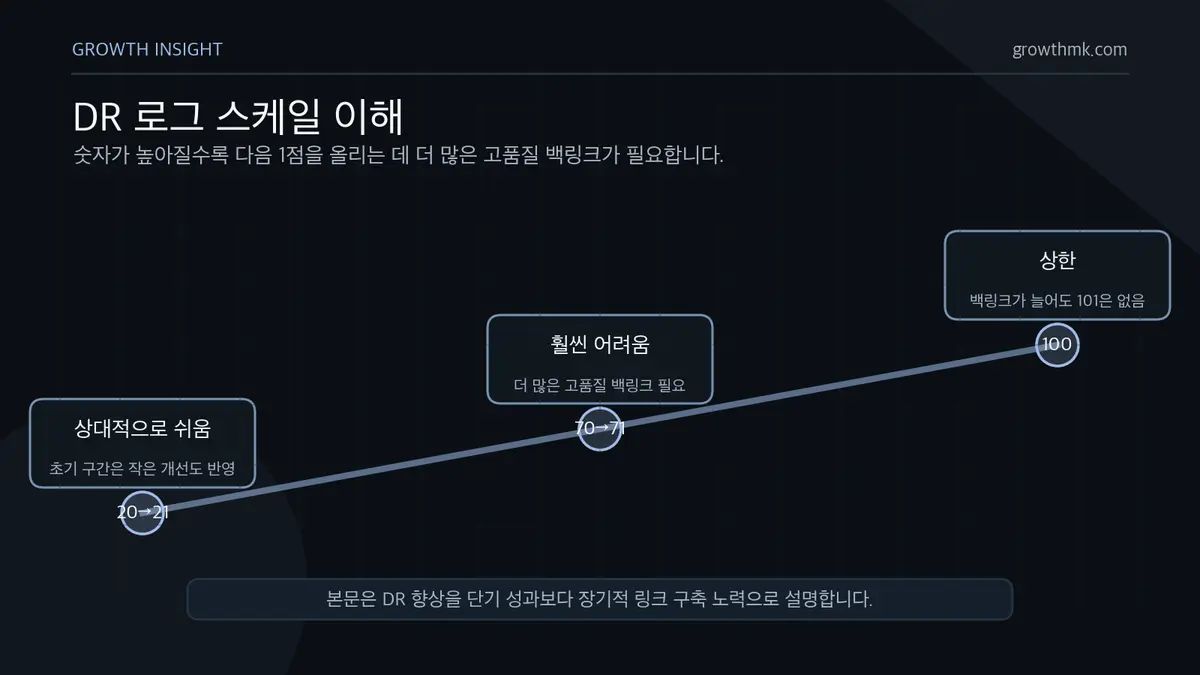
For example, going from DR 20 to 21 is relatively easy, but going from DR 70 to 71 requires far more effort and far more high-quality backlinks.
Also, a website with a DR of 100 can never reach DR 101, no matter how many additional backlinks it earns. Instead, Ahrefs reflects that kind of change by relatively lowering the ranking of every other website in its database.
This suggests that shifts in the overall backlink landscape can affect an individual website’s DR score.
So improving DR is less about short-term results and more about a long-term perspective built on steady, ongoing link-building effort. It’s worth understanding that while relatively easy score gains are possible early on, reaching a high DR level demands considerable time and effort.
Why Domain Rating (DR) Matters
DR has a meaningful impact on a website’s success. A high DR delivers benefits like:

- Better search rankings: websites with a high DR are more likely to rank higher on the search engine results page (SERP). According to research from Backlinko, pages ranked near the top of search results tend to have a higher DR on average. That translates into more traffic and more prospective customers.
Say two websites publish content targeting the same keyword. All else being equal, the website with the higher DR is more likely to rank higher in search results — because search engines place more trust in it.
- Greater brand trust: a high DR raises a website’s credibility. Users place more trust in information coming from an authoritative website.
- Stronger marketing results: a high DR amplifies the effectiveness of various marketing efforts, including content marketing and social media marketing.
Say you produce high-quality content through content marketing and share it on social media. Content from a website with a high DR is more likely to get shared with more people and earn more backlinks — which in turn amplifies the impact of your content marketing.
How to Raise Your Domain Rating (DR)
Raising DR doesn’t happen overnight. It requires steady effort and a strategic approach. Here are a few things that help raise DR.

- Produce high-quality content: it’s important to create high-quality content that meets user needs and provides genuinely useful, valuable information. High-quality content naturally earns backlinks and helps build a website’s authority. Google’s own SEO starter guide also emphasizes that creating content that’s useful to users is the most important starting point in search.
- Earn high-quality backlinks: it’s important to earn backlinks from relevant, authoritative websites. Backlinks play a key role in building a website’s credibility.
- Optimize internal linking: optimize the internal links that connect pages within your website, so users and search engines can navigate your site easily.
- Improve technical SEO: improve technical aspects like your website’s load speed, mobile-friendliness, and security, helping search engines crawl and index your site.
- Use social media: use social media platforms to promote content and raise your website’s visibility.
An Implementation Guide for Raising DR
Raising DR takes more than theoretical knowledge — it needs to be backed by real, practical execution. Here’s a concrete implementation guide for improving DR.

- Build a backlink strategy:
- Competitor analysis: analyze competitors’ backlink profiles to identify backlink opportunities.
- Guest posting: earn backlinks by contributing guest posts to highly relevant websites.
- Link exchanges: exchange links with websites that benefit each other mutually. That said, Google’s spam policies define “excessive link exchanges” aimed purely at manipulating rankings as spam, so this should only be done within the bounds of relevance and a natural fit.
- Fix broken links: find and fix broken links from other websites that were meant to point to your website.
- PR activity: earn natural backlinks through press coverage, interviews, and similar efforts.
- Improve technical SEO:
- Optimize website speed: improve your website’s load speed.
- Ensure mobile-friendliness: make sure your website works smoothly on mobile devices.
- Install an SSL certificate: strengthen your website’s security.
- Submit a sitemap: submit a sitemap to search engines to help them crawl your website.
- Optimize your robots.txt file: control access for search engine bots.
- Measure and analyze results:
- Use SEO tools: use SEO tools like Ahrefs and Google Analytics to measure and analyze metrics like DR, backlinks, and traffic.
- Make data-driven decisions: use your measurement and analysis results to refine your content strategy, backlink strategy, and more.
Conclusion
Domain Rating is a useful metric for gauging the strength of a website’s backlink profile, and it can be put to effective use in building an SEO strategy and analyzing the competitive landscape.
Of course, the fact that Domain Rating correlates with search rankings doesn’t make it a direct ranking factor, and it’s not the only metric that determines a website’s overall SEO performance. To effectively raise your Domain Rating, you need ongoing effort — steadily earning high-quality, relevant backlinks and continuously improving your website’s overall SEO health.
It’s also important to stay current on the latest SEO trends and adjust your backlink strategy appropriately as Google’s algorithm evolves. Ultimately, keep in mind that a website’s success doesn’t hinge on a single metric like DR — it hinges on delivering valuable content and a positive experience to users.
Related Reading
- A Beginner’s Guide to Managing Backlinks
- What Is Anchor Text?
- How Does Link Cloaking Affect Search Engines?
- 10 Frequently Asked Questions About Internal Links
- Dofollow Links vs. Nofollow Links: What’s the Difference?
If you’d like to apply this to your own business — you can see Growth’s approach on our SEO service page, and if you need a specific situational diagnosis, reach out through Contact Us. We’ll answer based on the one customer who becomes revenue — not the volume of traffic.
Frequently Asked Questions (FAQ)
Does a high DR automatically mean higher search rankings?
No. DR is a third-party metric created by Ahrefs — it’s not a value Google uses directly in its ranking calculation. As covered above, DR simply reflects the relative strength of a backlink profile, while search rankings are determined by many factors, including content quality and how well it matches search intent. That said, sites with more authoritative backlinks do tend to rank higher, so there is a correlation between DR and ranking.
What’s the difference between DR and DA (Domain Authority)?
DR was developed by Ahrefs, and DA was developed by Moz. Both metrics estimate a website’s relative authority on a 0–100 scale based on backlinks, but because they use different data and algorithms in their calculations, the same site can score differently across tools. It’s better to treat either metric as a directional trend to watch rather than an absolute number to trust blindly.
Can I quickly raise DR for a new website?
In the early stages, you can raise your score with relatively little effort, but because of the logarithmic scale, each additional point gets much harder to earn as your score climbs. As covered above, improving DR is less about short-term wins and more about the long-term perspective of steadily building high-quality backlinks. Buying links to boost your score quickly isn’t recommended, since it risks violating Google’s spam policies.
Can a site with a low DR still rank near the top?
Yes. DR is just one of many signals, and a site with a low DR can still rank highly for a low-competition keyword or with high-quality content that precisely matches search intent. What matters most is delivering valuable content and a positive experience to users — it’s best to think of DR as a supporting metric that reinforces that.
Marketing Insights
Marketing insights, delivered weekly
Practical growth and GEO/B2B marketing insights, summarized in your inbox every week.
Subscribe for insights